Allow me to introduce…

For a while now I’ve been wanting to introduce you to a few bloggers, some fairly new, whom I actually knew “in real life” before they started blogs.

Lou Ann at In the Way is a missionary with her husband in Spain. I haven’t met her in person, but we’ve had multitudes of e-mails as I worked with the Ladies Missionary Fellowship at our former church, and we’ve kept communicating since! I have met her daughter, though, when she spoke to our ladies’ group once. Lou Ann is in the process of getting her book, His Ways, Your Walk, published, and I’ll be sure to let you know when that happens.

Mary Beth at Annapolis Online is a sweet young mom of a lovely family. I first knew her when her family came to the church where we used to live in SC, and she was in the last year or two of high school then. She married a young man from our youth group, and a year or two later I was privileged to give the devotional at her baby shower. I think that might be the only time I’ve been asked to do that, and I enjoyed it, though it made me very nervous. The subtitle of her blog is Creativity in the Everyday, and that’s mainly what she writes about: neat, creative homey things. She inspires me in many ways.

Susannah at Learning to See is another sweet young wife and mom. She was in the youth group with my older boys and now is the wife of a medical student and the mom of one baby girl. She writes about what she’s learning in her walk with the Lord as well as an occasional recipe or observation, etc.

Debbie at Purple Grandma is a missionary wife in Canada, and I’ve known her family for years, since early married days. She blogs mainly about missionary biographies and other Christian books with an occasional devotional thought or two.

Michael at Sovereign Ostomy attends the church where we currently go, and his wife is a lovely, sweet example of a Christian wife and mom. The blog’s kind of odd title came from Michael’s experience of having Crohn’s disease for years, since his teens, and the recent removal of his colon. In his research before and since his ostomy, he had not found anything on the topic from a Biblical perspective, and he wanted to write from that viewpoint. His is profitable reading not only for those who have had the types of trials he has dealt with, but also for anyone who has had any kind of trial or knows someone who has.

Paul at Piano Animato also attends the church where we do now and is a wonderful pianist. He blogs mainly about music.

All of the above are fairly newish bloggers, I think. But while I am writing about people I knew before I started reading their blogs, I’ll go ahead and mention a few others who have been blogging for a while and whom I may have mentioned before.

Ann at From Sinking Sand and I have known each other since college days, got reacquainted on an online Christian forum, and then started reading each other’s blogs. We found out we were only about 45 minutes away from each other, and we saw each other once a year when my boys were playing basketball and we played her school. Ann has been an English teacher in a Christian high school for years and writes about teaching, education, family, and general observations about life.

Rita at The Jungle Hut was a missionary in the jungles of Venezuela for years until her family had to leave, and now they minister in Paraguay. Our church in SC supported them as well, but I didn’t know she had a blog until another friend, Susan at By Grace, mentioned her friend Rita, and I realized it was the same Rita I knew. Rita can be quite funny and a little saucy, and she writes mainly about missions and sometimes about life in general and politics.

And though she hasn’t blogged in a while, I wanted to mention Bet at Dappled Things, too. I think we knew each other in college — I knew who she was, anyway — and she had my oldest son in a class she taught. We got acquainted, or reacquainted, in the same online Christian forum I mentioned before. She teaches journalism and related courses at a Christian university and oversees the student newspaper there. I’m hoping maybe her summer schedule will let her blog again. 😀

I think that’s it, though I hope I am not leaving anyone out. If you’re looking for good online reading on any of these topics, I can vouch for the fact that these are good folks.

Of grace, law, commandments, rules, and effort

This is one of those posts where I am trying to work things out in my own mind. Some of these thoughts have been swirling around for years, and even now I’ve sat staring at the computer for a while wondering how to start. I guess I’ll do so by pulling out one strand at a time.

Much of the discussion on grace these days emphasizes that we’re not only saved by grace through faith plus nothing, but we’re kept “safe,” kept in Christ the same way. His love for us and our position with Him is not based on what we “do,” it’s based on His grace.

I agree with that.

But some go on to say that there is no room for any kind of law (spiritually speaking, not referring to the civil laws of the land like traffic lights and speed limits), commandments, or even effort in the Christian life, and anything related to such is labeled legalism.

What, then, do they do with passages such as these:

If ye love me, keep my commandments. John 14:15

He that hath my commandments, and keepeth them, he it is that loveth me: and he that loveth me shall be loved of my Father, and I will love him, and will manifest myself to him. John 14:21

If ye keep my commandments, ye shall abide in my love; even as I have kept my Father’s commandments, and abide in his love. John 15:10

Furthermore then we beseech you, brethren, and exhort you by the Lord Jesus, that as ye have received of us how ye ought to walk and to please God, so ye would abound more and more.  For ye know what commandments we gave you by the Lord Jesus. I Thessalonians 4:1-2

 And hereby we do know that we know him, if we keep his commandments.  He that saith, I know him, and keepeth not his commandments, is a liar, and the truth is not in him. I John 2:3-4

By this we know that we love the children of God, when we love God, and keep his commandments.  For this is the love of God, that we keep his commandments: and his commandments are not grievous. I John 5:2-3

And this is love, that we walk after his commandments. This is the commandment, That, as ye have heard from the beginning, ye should walk in it. II John 6

And these are from the grace-drenched New Testament.

Where some get it wrong is in thinking that we have to keep His commandments in order to be saved or in order to “earn” His love and favor, and that’s not correct. But where others get it wrong is in thinking that, since we’re saved and kept by God’s grace, there is nothing that should smack of commandments or rules in the Christian life, and that’s wrong as well.

As I understand them, these New Testament verses about God’s commands are saying that obeying God’s commands is an outflow of our relationship with God and love for Him, not a way to earn His love. The early part of John 15, for instance, talks about abiding in Christ, being a vine in His branch, not being able to do anything without Him, and then it goes on to say, “If ye keep my commandments, ye shall abide in my love; even as I have kept my Father’s commandments, and abide in his love” (v. 10). And far from chafing under His commands, “his commandments are not grievous” (I John 5:2-3), and we obey them out of love.

I think it’s something like my relationship with my own children. They were born my children. They didn’t do anything to earn that spot in the family. They’ll never have to do anything to earn that spot: it will always be theirs. I will always love them, no matter what they do. Even if they rebelled to an extreme extent and I had to ask them to leave my home, it would not nullify my love. But their actions do have an effect on whether that relationship is a happy one or a grieved one, and it reflects on their love and maturity. Sure, a child’s motivation for obedience in their early years is so that they don’t get into trouble, but as they mature, their motivated by wanting to respect and honor their parents.

Going on from commandments to rules, I’ve seen many totally eschew the idea of rules in the Christian life since we’re saved and kept by grace and not by rule-keeping. But not being saved by rules doesn’t mean there are no rules. For instance, I have a rule for myself that I attend church unless I am sick or something comes up (company suddenly coming in, bad weather, extreme tiredness, etc.). It’s not that I think God won’t love me if I miss church. It’s more an effort to apply Romans 13:13-14: “But put ye on the Lord Jesus Christ, and make not provision for the flesh, to fulfil the lusts thereof.” I should go to church out of love for God, a desire to learn more about Him, a desire to fellowship with others in the body of Christ, and ultimately I do. But we all know that even in our closest and most loving relationships, we don’t always “feel” like doing what we should. So sometimes we have to deliberately make an effort in spite of our feelings of the moment. And as one professor used to say, good feelings follow right actions: usually my feelings catch up after I do the right thing. This all doesn’t mean that I live a life of rules out of duty devoid of feeling: it means my actions are based on underlying love that’s deeper than my momentary fleeting feelings.

And that brings me to effort. I’ve read some who point to passages like John 15 and say that we’re vines abiding in the branch, and the branch doesn’t do anything to help itself grow, neither do we have to expend any effort. Similarly, the fruit of the Spirit is something wrought by the Spirit, not something we work to produce.

And I agree with that. On the other hand, the New Testament is filled with action verbs. Love. Obey. Yield. Put on. Put off. Abstain. Work. Walk in certain ways (circumspectly, or carefully, for one). Do not do certain things. Do certain things. Strive. “But be ye doers of the word, and not hearers only, deceiving your own selves” (James 1:22).

I liken it in some ways to the Old Testament battles. Sometimes God did something supernatural to deliver His people, like parting the Red Sea or having the sun stand still in response to Joshua or sending a noise to scare the Syrians into running away. But most of the time the people had to actually pick up their swords and fight. Yet even then they couldn’t win battles in their own efforts alone: if something was between them and the Lord, He did not help them and they lost.

In the same way, we can’t live the Christian life in our own strength. Yet God doesn’t always come in and just do away with whatever battles we face. But as we rely on Him, He enables us to do what He wants us to do.

Being saved and kept by grace doesn’t mean I’m just a happy little blob taking up space on earth until I go on to heaven. It doesn’t mean that since God loves me no matter what, then it doesn’t matter what I do. But it does mean that He will enable me to do whatever He wants me to.

Ephesians2:8-10 sums it up nicely:

For by grace are ye saved through faith; and that not of yourselves: it is the gift of God:  Not of works, lest any man should boast.  For we are his workmanship, created in Christ Jesus unto good works, which God hath before ordained that we should walk in them.

We’re not saved by good works, but we’re created unto good works.

And Romans 8:13 shows how our efforts work together with God’s enabling:

For if ye live after the flesh, ye shall die: but if ye through the Spirit do mortify the deeds of the body, ye shall live.

He doesn’t mortify it for us: there is a response expected from us. But we can’t do it on our own: we can only do it through the Spirit.

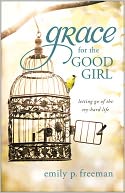
Book Review: Grace For the Good Girl

The premise of Grace for the Good Girl: Letting Go of the Try-Hard Life by Emily P. Freeman is that “Somewhere along the way I got the message that salvation is by faith alone but anything after that is faith plus my hard work and sweet disposition” (p. 14). Even though those of us who have embraced the gospel know better (or should), deep down somewhere we feel like we need to put up a good front of having it all together spiritually, and so we hide behind masks that Emily discusses in depth: good performance, good reputation, a “fake ‘fine,'” acts of service, spiritual disciplines, strength and responsibility, our comfort zones. Some of these are fine in themselves, but they are not meant to be masks. Spiritual disciplines, for instance, should be a part of our communication with Christ, not something we do for appearance’s sake.

I’ve marked multitudes of quotes that really hit home. Here are a few:

I constantly worried that my imperfect status would be discovered. I often experienced guilt but didn’t know why. I felt the heavy weight of impossible expectations and had the insatiable desire to explain every mistake (p. 13)

Instead of recognizing my own inadequacy as an opportunity to trust God, I hid those parts and adopted a bootstrap religion. I focused on the things I could handle, the things I excelled in, my disciplined life, and my unshakeable good mood (p. 13).

I taught the people around me I had no needs and was secretly angry with them for believing me (p. 13).

I have the expectation of myself to be a good girl, a good Christian, a good wife, and a good mom. Not such bad things, until you understand my own personal, twisted definition of “good.” Good means I never mess up. Good means I weigh the perfect amount. Good means I can handle everything. I don’t look like a fool, and I never lose my patience. Good means my husband will never be disappointed in me, my kids will always obey, and everyone basically likes me…If I fail to live up to my own standard of good, I label myself a failure (p. 25).

Feeling scared meant I needed more faith. Feeling anger meant I needed more control. Feeling confused meant I needed to get it together and figure things out. In theory, I knew I was supposed to cast my fear, anger, and confusion on the Lord. But after “trusting” him with my circumstances, I thought it was my responsibility to change the emotions and keep myself from experiencing them again (p. 55).

Since when does the awesomeness of my testimony depend on the extremity of my rebellion? (p. 100).

Where are you? God asks, not because he doesn’t know, but because he knows I have to come out of hiding in order to be found (p. 114).

Having a quiet time sometimes left me feeling as if I had accomplished something rather than related with a person. I equate it to working out: I don’t do it very often, but when I do I feel better about myself and slightly superior to those who may not have done the same that day (p. 151).

The mask-wearing good girl is all about herself. In her most secret place, she wants the glory. But it is only in him that we have been made complete (p. 157).

Part of the solution is:

It isn’t me doing work for God, but it is me trusting God to do the work in me (p. 63).

The story of redemption and healing is that Jesus came to exchange my not-good-enough with his better-than-I-could-ever-imagine (p. 137).

He still asks for our obedience, but it is no longer obedience to the law. Now we are called as believers to be obedient to the truth…This obedience to the truth doesn’t come naturally or automatically. There is laboring. There is striving. But this striving has the potential to be new and light and joyful (p. 135).

The work is not according to the mask we wear; it is according to his power that works within us. It isn’t an external attempt, to live up to the law; it occurs on the spirit level where we are united to Christ (p. 135).

These last two quotes, to me, set apart this book from a lot of what I hear and read about grace these days. Some take it so far as to deny that there is any kind of obedience or striving, and that makes me wary of any grace-based or grace-emphasized talk (not wary of the basis of grace, but how some apply it). But I think Emily struck the perfect balance.

I was also a little wary because I can’t endorse some of the people she quotes, but I think I pretty much agree with just about everything she said herself.

It’s so easy to fall into doing (or not doing) things because good Christian girls do (or don’t) rather then letting what we do or don’t do flow from love for Christ and His power that works in us. We need frequent reminders. In all honesty, I still struggle at times with what’s God’s part and what’s my part in dealing with certain besetting sins: I know I can’t defeat them on my own, yet He doesn’t just come in and remove them all at once: there is a process of growth and there has to be a measure of obedience, yet even that comes from His strength and not my own. I “know” these things in my head, yet I’m still working them out in daily life.

And if I can step away from the book for a moment, we need to have grace for other good girls as well (maybe that’s an idea for another book, Emily. 🙂 )  Often I’ve seen and experienced ways that Christians react when we show that we don’t have it all together that reinforces that performance-based lifestyle rather than coming alongside them in empathy and helping them regain Biblical perspective.

This is another difficult area because the Bible does tell us to provoke one another to love and to good works, to restore one another when we’ve sinned, to even rebuke each other when we’ve done wrong. But I don’t think that means that when one speaks of worrying over an issue, another says, “Well it’s a sin to worry, you know” or just pats them on the back and quotes Romans 8:28. Our pastor shared a perfect example of this recently. He said he was with someone when he received bad news, and at first there was a lot of what he called “spewing,” wondering what was going on, why had God let this happen, etc. As my pastor said, “It wasn’t a time for platitudes.” Later, when things calmed down, then he could help him gain perspective by reminding him of God’s presence and promises and power. And I think that should be our response as well.

Some years ago in a prayer meeting, someone said that so-and-so just found out he had cancer and his wife wasn’t handling the news very well. He didn’t elaborate, but I wondered what he meant by “not handling it well.” Fast forward several years to when I contracted transverse myelitis and was involved in an e-mail support group which contained many nonchristian people. I thought that to be a good Christian testimony I needed to always approach things in faith and victory with a smile. At some point a new lady came into the group who was also a Christian, but she had a different view: she felt it was more honest, more human, more empathetic to let people in on the struggles, to acknowledge when life hurt. And I think she’s right. How often I’ve been comforted by the Psalms  because they show a range of emotion and even anguish, yet they almost always end with resting in God.

Perhaps I should have saved some of the above for another blog post. This book has provoked thoughts in a number of areas, but I’d probably better stop before I quote half the book or make this any longer. I’m still processing some of it, but overall I’d recommend it.

(This review will also be linked to Semicolon‘s Saturday Review of Books.)

“Am I doing any good?”

Old Woman Dozing by Nicolaes Maes (1656). Royal Museums of Fine Arts, Brussels

My mother-in-law sleeps a lot these days. Usually when I go to see her, she’s dozing in her wheelchair and I have to wake her up to visit. She used to encourage me to wake her up because she could sleep any time, but she didn’t get many visitors and didn’t want to miss a visit because she was sleeping. Nowadays she is more inclined to sleep. Once when I woke her up to visit, she actually told me, “Next time, don’t wake me up.” Usually, though, she does her best to be pleasant, but even then, after just a few minutes, she starts yawning and rubbing her eyes, her head starts drooping, and if she has a pillow propping her up in her wheelchair, she’s nuzzling against it to get comfy again.

Sometimes I am tempted to wonder if it is worth a 40 minute drive round trip to wake her up for 5-10 minutes of groggy conversation that she likely won’t even remember.

Sometimes I can do something that makes me feel more useful: get her a pillow, change her hearing aid battery, wipe her hands and face after lunch if the staff hasn’t had a chance yet, advocate with the staff for her concerning some need or oversight, bring her mail.

But really, visiting her shouldn’t be about making me “feel useful.” It’s about letting her know she’s loved and not forgotten and ministering to her in whatever way she needs.

I think of moms going over the same issue for what seems like the hundredth time with their kids, missionaries toiling away in a foreign country with few visible results, men working faithfully the same jobs to pay the same bills, teachers trying to impart knowledge and wisdom to those who don’t seem to want it. Sure, there are times to evaluate methods, ministries, job situations, etc. to see if there is a better way to accomplish the goal and to evaluate whether some change is needed. But sometimes the only answer is to keep going even though we don’t seem to be accomplishing anything. If we’re where God wants us to be doing what He wants us to do, we can rest in the fact that we’re being faithful no matter what the results seem to be. If we do everything we do as unto Him and for His glory, we are indeed accomplishing something good.

The Last ‘Week in Words’

”"

Welcome to The Week In Words, where we share quotes from the last week’s reading. If something you read this past week  inspired you, caused you to laugh, cry, think, dream, or just resonated with you in some way, please share it with us, attributing it to its source, which can be a book, newspaper, blog, Facebook — anything that you read. More information is here.

I’ve been thinking about discontinuing the Week in Words for some time now, for several reasons. Only a very few people participate in it, and maybe a few more than that read it. I thought I’d be posting more quotes from books, but I tend to want to save those for when I review the book. I have a file where I put the quotes I collect through the week, and the last couple of weeks I haven’t put any in there and have had to go looking for something for the WiW. And sometimes I’ll have something else on my heart I want to post on Mondays, but I don’t like to have more than one post a day.It’s starting to feel more like a chore or a weight than a joy.

I have enjoyed it so much. Those of you who have joined in have provided some good food for thought to start off the week. If someone else wants to take it over, that’s fine with me. If you want to rename it, post it on a different day, or whatever, once it’s yours you can shape it as you want to. If you do, let me know and I’ll post a note to that effect so that others who might want to continue with it will know where to go.

I’ll probably still post quotes from time to time, just because I like them and want to share them. Before the WiW I would occasionally post a handful of quotes on one topic, and I might do that some times.

As for today’s quotes:

This was from Everyday Battles: Knowing God Through Our Daily Conflicts by Bob Schultz which I mentioned before in my review here, but in case anyone didn’t see it:

If you find yourself frustrated because you’re losing, don’t lash out in anger. Discover why you’re getting beat. Let it motivate you to learn new skills or develop more strength.

He goes on to mention wrestling with one guy repeatedly through the years and never beating that guy, but learning things he could use in other matches. I had a similar experience with Scrabble on Facebook: one friend used to beat me every time when we first started, but now I’ve learned some of her tricks and win about as often as she does now. In the larger issues of life, whether a besetting sin or not achieving victory in some area, instead of just getting discouraged, we can ask the Lord for wisdom about what we should do differently. Sometimes we might new new skills or strength or methods: sometimes we might need more dependence on Him.

And this was from Don’t Mistake Doing What You Love With Doing What’s Important, HT to A Holy Experience:

The difference between doing what’s important and doing what you want is that the important stuff is usually harder. It’s not so much fun. It generally won’t fulfill all of your deepest personal longings. Working a boring job to provide your family with financial security often gets a bad rap from motivational wonks who would have us drop everything to pursue our dreams, but I believe there’s something valiant, even noble about it.

That’s kind of the lesson in “It’s a Wonderful Life” and “Mr. Holland’s Opus” (which I saw on TV and was relatively clean but may have been edited for TV). Each had a dream that was never fulfilled as they had envisioned it, and had a job they didn’t really like, but each touched various lives in ways they hadn’t realized. There is a time and a place for stepping out on faith and dropping everything to pursue your dreams, but that’s only under God’s leading. Moses in the desert, David as a shepherd, Joseph in prison, even Christ as a carpenter, each had to be faithful for years in one place before it was God’s time to step into a larger area of responsibility and the ministry they would become known for.

And finally, my last quote for the Week in Words:

And now, brethren, I commend you to God, and to the word of his grace, which is able to build you up, and to give you an inheritance among all them which are sanctified. Acts 20:32.

Though I love gleaning wisdom from others, the most important source is the Word of God itself.

You can share your family-friendly quotes in the comments below or write a post on your blog and then put the link to that post (not your general blog link) in Mr. Linky below.

I hope you’ll visit the other participants as well and glean some great thoughts to ponder. And I hope you’ll leave a comment here, even if you don’t have any quotes to share.

Thank you all, once again, for your interest in The Week in Words.

Book Review: Everyday Battles: Knowing God Through Our Daily Conflicts

Everyday Battles: Knowing God Through Our Daily Conflicts is the fourth and last of Bob Schultz’s books for boys and young men. I read it with my youngest son. The author passed away before this book was completed and his daughter got what he had ready for print and added an epilogue.

Bob covered a lot of ground in the book, from confrontations, chastisement, fightings within, refuge, and more. One chapter discussed why some OT battles came about when the temple of God was neglected or filled with abominations and what lessons that has for us. You would expect some discussion about the armor described in Ephesians 6, but only a couple of pieces are mentioned. I don’t know if he meant to get to the rest of it before he passed away. He discusses how a good, loving, wise and kind God allows battles.

His overall theme is that God has something to teach you during battles: something about yourself, but mainly something about Himself.

One quote I especially liked was in the context of boys wrestling. He discusses why he thinks it is okay to allow it, right and wrong times and places for it, and then he says:

If you find yourself frustrated because you’re losing, don’t lash out in anger. Discover why you’re getting beat. Let it motivate you to learn new skills or develop more strength. I wrestled a guy called Herfy for years and never won a match, yet I gained many tricks I’ve successfully used since (p. 15-16).

There is a lot of wisdom there that can be applied to many areas.

This quote bothered me a little at first:

The one thing I want to learn in life is to understand and practically experience abiding in Christ. I’m not looking for some Bible lesson to discuss or some theory to question. I want to live in harmony with the One who created the universe while I’m building houses, driving my truck, walking hand in hand with my wife or my daughters. I want to hear His voice, watch Him work, and follow Him in every adventure He wants to lead me through (p. 31).

At first reading it sounded to me like he was downplaying Bible reading and study in favor of seeking God through experience. But as I thumbed through several pages while preparing for this review, I was reminded that he referred to the Bible often, much more than I had remembered, and drew much of what he taught from the Bible. So I think perhaps what he is getting at here is that he doesn’t want his spiritual experience to be all academic, but rather he wanted it to carry through to the rest of his life.

I also expected to see some discussion on what we commonly hear of as the enemies of Christians and how to combat them: the world (I John 5:4-5), the flesh (Galatians 5:16-17), and the devil (James 4:7-8, Matthew 4:1-11, Ephesians 6:17). There was some mention of fighting the flesh, but not much. Again, I don’t know if that’s something he would have included if he had lived long enough to complete the book, but my son and I are discussing some of these passages in the aftermath of reading the book.

My feelings immediately after the book were disappointment at what he didn’t include what I would have, but then if you get any five people, even any five Christians to write a book on one topic, you’re probably going to end up with five very different books though they might cover some of the same ground. And as I went back over parts of the book for review, I was reminded of many good aspects of it and good things he did bring out. The book isn’t necessarily a manual for how to fight battles, though he discusses some of that: it’s mainly an encouragement to seek the heart of God and draw close to Him through the battles He allows.

(This review will also be linked to Semicolon‘s Saturday Review of Books.)

The Week in Words

”"

Welcome to The Week In Words, where we share quotes from the last week’s reading. If something you read this past week  inspired you, caused you to laugh, cry, think, dream, or just resonated with you in some way, please share it with us, attributing it to its source, which can be a book, newspaper, blog, Facebook — anything that you read. More information is here.

Sorry to be a little late with this. I try to have it up before bedtime the night before, but we played a new game with the family last night, got done around 11, and my brain was fried. 🙂 It was fun, though.

Here are some poignant quotes from the last week:

I mentioned this one in Saturday’s post, but wanted to highlight it again here. From Praying Past Our Preferred Outcomes.

To go deeper than praying only for deliverance means that we approach prayer not as a tool to manipulate God to get what we want, but as a way to submit to what he wants. ~ Nancy Guthrie

The gist of the article is that we usually pray for deliverance from trials and problems, but sometimes God has something He wants to teach us or accomplish first. Another quote:

What would happen if we allowed Scripture to provide the outcomes we prayed toward? What if we expanded our prayers from praying solely for healing and deliverance and success to praying that God would use the suffering and disappointment and dead ends in our lives to accomplish the purposes he has set forth in Scripture? Scripture provides us with a vocabulary for expanding our prayers for hurting people far beyond our predetermined positive outcomes. Instead of praying only for relief, we begin to pray that the glory of God’s character would be on display in our lives and the lives of those for whom we are praying. We pray for the joy of discovering that the faith we have given lip service to over a lifetime is the real deal. We ask God to use the difficulty to make us less self-reliant and more God-reliant. Rather than only begging him to remove the suffering in our loved ones’ lives, we ask him to make them spiritually fruitful in the midst of suffering he chooses not to remove.

And from the song “See, What a Morning” about Resurrection Day:

Death is dead, love has won, Christ has conquered!

That’s been ringing through my mind through yesterday and this morning.

You can share your family-friendly quotes in the comments below or write a post on your blog and then put the link to that post (not your general blog link) in Mr. Linky below.

I hope you’ll visit the other participants as well and glean some great thoughts to ponder. And I hope you’ll leave a comment here, even if you don’t have any quotes to share.

Happy Easter!

See, what a morning, gloriously bright,
With the dawning of hope in Jerusalem;
Folded the grave-clothes, tomb filled with light,
As the angels announce, “Christ is risen!”
See God’s salvation plan,
Wrought in love, borne in pain, paid in sacrifice,
Fulfilled in Christ, the Man,
For He lives: Christ is risen from the dead!

See Mary weeping, “Where is He laid?”
As in sorrow she turns from the empty tomb;
Hears a voice speaking, calling her name;
It’s the Master, the Lord raised to life again!
The voice that spans the years,
Speaking life, stirring hope, bringing peace to us,
Will sound till He appears,
For He lives: Christ is risen from the dead!

One with the Father, Ancient of Days,
Through the Spirit who clothes faith with certainty.
Honor and blessing, glory and praise
To the King crowned with pow’r and authority!
And we are raised with Him,
Death is dead, love has won, Christ has conquered;
And we shall reign with Him,
For He lives: Christ is risen from the dead!

~Keith and Kristyn Getty

(Graphic courtesy of Made 2 B Creative.)

Just popping in…

…to say hello. I’ve been pretty scarce the last few days, both here and at your places. I’ve been keeping up with my Google Reader but not commenting as much. Nothing wrong or going on — the first part of the week was super busy, then maybe because of that I just felt like I had brain burn-out yesterday. Usually I have more blog ideas than time to write them out, but I’ve felt pretty blank blog-wise the last few days.

I was thinking that I had a good bit of time for everyday stuff before the next spate of busyness, but then remembered I need to get graduation announcements for Jesse addressed and mailed in a couple of weeks, and I had wanted to make a scrapbook for him for his graduation reception. So I’d probably better get started!

I’ve also been pondering how to best commemorate the time leading up to Easter. I’ve read Jesus, Keep Me Near the Cross: Experiencing the Passion and Power of Easter (linked to my review) compiled by Nancy Guthrie a few years in a row, but just didn’t feel like getting that out again this year. My regular through-the-Bible reading has me in the gospels just now — finished Matthew and Mark and started Luke — so that has helped keep my focus on the life and death of Christ.

I have a meeting in the morning and was thinking of heading out to the mall afterward and thought how incongruous it was to go shopping on Good Friday (though I think Christ was actually probably crucified on Thursday, but be that as it may…). On the other hand, we know the outcome, and we celebrate that with joy on Easter, so I don’t think we need to spend all day Friday (or Thursday) in hiding and sadness. But the cost of our sin was so great, and Christ did so much to redeem us from it, it seems like we should somehow acknowledge that day especially though we acknowledge it throughout the year. I just haven’t worked out quite how to do so.

I’ve often felt the struggle between grief over Christ’s death versus gladness that He gave Himself to that death to redeem me. Chris Anderson‘s chorus in the song “My Jesus Fair” sums it up quite nicely:

O love divine, O matchless grace-
That God should die for men!
With joyful grief I lift my praise,
Abhorring all my sin,
Adoring only Him.

I hope you have a good week blessed with some time to meditate on and thank Him for His sacrifice for us.

The Week in Words

”"

Welcome to The Week In Words, where we share quotes from the last week’s reading. If something you read this past week  inspired you, caused you to laugh, cry, think, dream, or just resonated with you in some way, please share it with us, attributing it to its source, which can be a book, newspaper, blog, Facebook — anything that you read. More information is here.

Here are a few that spoke to me:

From ivman:

“If all we show people is our high standards, we offer them no hope.” – Drew Conley

Our standards may be a part of our testimony, but if that is all people see, if they don’t see Christ in our lives, as Dr. Conley said, we don’t offer them hope.

This was actually from a few weeks ago, from With the Word by Warren Wiersbe, p. 609, commenting on Haggai 2:1-9:

Beware that golden memories do not rob you of present opportunities.

In that passage in Haggai, the Israelites were rebuilding the temple after their Babylonian captivity, but it seemed “as nothing” compared to Solomon’s temple that some of them remembered. Yet Haggai prophesied that “The glory of this latter house shall be greater than of the former, saith the LORD of hosts: and in this place will I give peace, saith the LORD of hosts.” The Lord of glory Himself would minister in that temple during His ministry on earth. Memories are wonderful, but we can’t let them obscure the present.

Also quoted in With the Word by Warren Wiersbe, p. 591:

“To fear God is to stand in awe of Him; to be afraid of God is to run away from Him.” ~ Carroll E. Simcox

You can share your family-friendly quotes in the comments below or write a post on your blog and then put the link to that post (not your general blog link) in Mr. Linky below.

I hope you’ll visit the other participants as well and glean some great thoughts to ponder. And I hope you’ll leave a comment here, even if you don’t have any quotes to share.