The Week In Words

”"

Welcome to The Week In Words, where we share quotes from the last week’s reading. If something you read this past week  inspired you, caused you to laugh, cry, think, dream, or just resonated with you in some way, please share it with us, attributing it to its source, which can be a book, newspaper, blog, Facebook — anything that you read. More information is here.

Here are a few that spoke to me:

From our youth pastor’s wife’s Twitter:

“Worship that is not based on God’s Word is but an emotional encounter with oneself” ~ Erwin Lutzer

And from a friend’s Facebook:

Any attempt to produce love, joy, peace, endurance, and so forth apart from the Spirit of God is reliance upon strategies that are in competition with God. – Jim Berg

They both are similar in theme: our worship and our spiritual lives must be based on God’s Word and enabled by His Holy Spirit, or else they’re just…emotionalism or worse.

From Nancy Leigh DeMoss’s Twitter, retweeted by John Piper:

“Sin has been pardoned at such a price that we cannot henceforth trifle with it.” ~ Spurgeon

If we could keep that perspective, that would keep us from many a misstep, I think.

You can share your family-friendly quotes in the comments below or write a post on your blog and then put the link to that post (not your general blog link) in Mr. Linky below.

I hope you’ll visit the other participants as well and glean some great thoughts to ponder. And I hope you’ll leave a comment here, even if you don’t have any quotes to share.

I am not skilled to understand

I’ve been enjoying a new arrangement of this on the Soundforth CD God of Mercy.(It’s listed there as “My Savior.”

I am not skilled to understand
What God hath willed, what God hath planned;
I only know that at His right hand
Is One Who is my Savior!

I take Him at His word indeed;
“Christ died for sinners”—this I read;
For in my heart I find a need
Of Him to be my Savior!

That He should leave His place on high
And come for sinful man to die,
You count it strange? So once did I,
Before I knew my Savior!

And oh, that He fulfilled may see
The travail of His soul in me,
And with His work contented be,
As I with my dear Savior!

Yea, living, dying, let me bring
My strength, my solace from this Spring;
That He Who lives to be my King
Once died to be my Savior!

– Dorothy Greenwell, 1873

The Week in Words

”"

Welcome to The Week In Words, where we share quotes from the last week’s reading. If something you read this past week  inspired you, caused you to laugh, cry, think, dream, or just resonated with you in some way, please share it with us, attributing it to its source, which can be a book, newspaper, blog, Facebook — anything that you read. More information is here.

Here are a few that stayed with me recently:

Seen at Challies:

“Pride can look like arrogant self-confidence, or it can look like timid self-pity. Real humility is courageous un-self-consciousness.”~ Jared Wilson

I don’t know who Jared Wilson is, but this rang true and echoes a C. S. Lewis quote about humility.

The Ink-Slinger posted several quotes from G. K. Chesterton. A few of my favorites:

“Feminism is mixed up with a muddled idea that women are free when they serve their employers but slaves when they help their husbands.”

“There are those who hate Christianity and call their hatred an all-embracing love for all religions.”

“It is absurd for the Evolutionist to complain that it is unthinkable for an admittedly unthinkable God to make everything out of nothing, and then pretend that it is more thinkable that nothing should turn itself into everything.”

You can share your family-friendly quotes in the comments below or write a post on your blog and then put the link to that post (not your general blog link) in Mr. Linky below.

I hope you’ll visit the other participants as well and glean some great thoughts to ponder. And I hope you’ll leave a comment here, even if you don’t have any quotes to share.

Thoughts about Amish fiction

The first Amish fiction I ever read was Beverly Lewis‘s The Shunning some years ago. I don’t think I had heard of Beverly before that, and I am not sure what drew me to the book except for maybe curiosity about the Amish shunning. I enjoyed the book and have read everything of Beverly’s ever since (except for her books for younger people).

There is much about the Amish to admire: their gentleness, their work ethic and industriousness, their sense of family, their willingness to forgive evidenced some years ago after a tragic shooting.

I suppose all of those elements plus a curiosity about them and their ways has driven burgeoning market for Amish fiction in recent years.

At first I thought all these people were just copying Beverly, and out of loyalty to her I didn’t read any others. But I don’t think she would want people to feel that way, and I’m sure she’s not the only one who is knowledgeable about the Amish. I do tend to trust her perspective because of her grandmother’s having been Amish.

I especially appreciate that Beverly makes a distinction between Amish who are believers and those who aren’t. In some of her books, the characters are caught in the system, so to speak, even though it doesn’t satisfy them or meet their needs, and they eventually see the light and come to faith in Christ, and sometimes that costs them. Some leave the Amish for the Mennonites. Other characters have quietly become believers and stay, speaking when and however they can about Christ. And others are in an Amish community that is made of of true believers.

And this is what concerns me about the bulk of Amish fiction. The one Amish-based book I read that wasn’t written by Beverly wasn’t clear on this point: an Englisher with a variety of problems escaped the pressures of modern life to live with the Amish for a while, struggled with faith issues, was told, basically, “Live like us and you’ll catch on eventually.” I don’t know how other authors portray it, but I think we have to be careful not to think of the Amish as just another branch of Christianity. Tim Challies reviewed a book called Growing Up Amish a while back. I’ve not read the book, but I can identify with what was excerpted there. We need to remember that by and large their trust is in their system, their church membership, rather than in Christ, and even for those who are believers, their ideas of what is “worldly” is often determined by the bishop and may be far removed from Scriptural principles. Their communities are shot through with extreme legalism and extreme punishment for stepping outside “the rules.”

I am concerned about the over-romanticizing of our thinking in regard to them. I have a Christian friend who jokes about “running off to join the Amish” when life gets too hectic and pressured. I always want to say, “Are you kidding?” The amount of sheer hard work would do many of us in very quickly, but beyond that, I don’t think actually living among them would be what we think it would be. I think we can still read Amish fiction and I think we can still admire the good characteristics of them, but we need to exercise discernment.

Christian concepts that are a little off

IMG_1716

I wrestled with what to title this post. The title I had on the notes to myself was “Christian sayings that bug me.” But not only did that sound curmudgeonly, it doesn’t really matter in the grand scheme of things what bugs me. What matters with any Christian saying is whether it truly matches up with the Word of God.

I don’t mean to be overly nitpicky and critical here. I know what some people mean by some of these sayings, and I think their hearts are in the right place. But when a saying is a little off from what Scripture actually says, it’s not only a little jarring, it can either reveal or cause misunderstanding of Scriptural truth.

So here are a few phrases that to me miss the target a little.

We need to “be Jesus” to people.

We can’t be. We can reflect Him and represent Him. We are “ambassadors for Christ, as though God did beseech you by us: we pray you in Christ’s stead, be ye reconciled to God” (II Corinthians 5:20). We can be instruments through which He works. But we can’t be anyone’s spiritual Savior, deliverer, help. Jesus is the only one.

“Unleashing” God’s power.

This makes Him sound like a genii in a bottle, and if we just rub the lantern in the right way, we’ll see Him work in a mighty way. Even a little study of God’s power and might in the Bible should convince us how ludicrous it sounds to think of ourselves as His gatekeepers. Now, there are passages that indicate our disobedience or lack of faith can block Him from working, and Jesus said some things could only be accomplished by prayer and fasting, and this may be what this saying is getting at, but it shifts the emphasis the wrong direction. His power is His own to direct as He will.

God does not do anything except in answer to prayer.

This may have arisen from James 4:2b: “ye have not, because ye ask not.” It’s true that we don’t have some things because we haven’t asked Him for them, but it is not true that He only acts in response to prayer. There is much to governing the world that we know nothing of, and how many times have we enjoyed our daily bread when we haven’t remembered to ask for it? He does so much more than we know, it’s facetious to think He never does anything except when we ask. I’ve been blessed many times in large and small ways by things He has done I never thought to ask for.

God does not give us more than we can handle.

Of course He does. He doesn’t give us any more than we can handle with His grace, but leaving off that caveat puts the emphasis on us and our ability to handle things rather than on His grace sufficient for everything. It’s “I can do all things through Christ who strengthens me” (Philippians 4:13), not “I can do all things.” I think sometimes He puts us in situations we can’t handle on our own for that very reason, to draw us closer and help us rely on His strength and not our own.

We need God to show up.

….as if He is not already here, and everywhere. I wrote more about this phrase earlier, and I know people mean by this that they really want God to work, to manifest Himself, to display His grace and power by really moving in people’s hearts. But we don’t need to downplay His omniscience or His desire to manifest Himself.

A coincidence is God’s way of remaining anonymous.

God is not in the business of remaining anonymous. All throughout Scripture He does things to make Himself known to people. One exception was when Christ was doing miracles during His earthly ministry: often He would heal someone and then tell them not to make it known. I’m not sure of the reasons for that: maybe it would draw more people who only wanted healing or provisions rather than hearing His word, maybe it would draw undue attention from the Pharisees, maybe it just wasn’t the time to manifest Himself in that way. But as a general rule He does things in people’s lives for the express purpose of turning their hearts to Himself.

Have you heard these phrases? Do you think they are off-base in their emphasis? Are there other similar phrases I have missed?

The Week in Words

”"

Welcome to The Week In Words, where we share quotes from the last week’s reading. If something you read this past week  inspired you, caused you to laugh, cry, think, dream, or just resonated with you in some way, please share it with us, attributing it to its source, which can be a book, newspaper, blog, Facebook — anything that you read. More information is here.

I have just a couple to share this week, both from a post at True Woman:

“In every situation and circumstance of your life, God is always doing a thousand different things that you cannot see and you do not know.” ~ John Piper

Don’t judge the outcome of the battle by the way things look right now. ~ Nancy Leigh DeMoss

I love those behind-the scenes glimpses that God gives us sometimes in the Bible, like the unseen host surrounding Elisha or Michael’s mention of what had been going on in response to Daniel’s prayer. We just have to take it on faith in our own lives that even though a situation seems insurmountable or prayers seem to go unheeded, God is at work. I think it will be really neat in heaven to learn how God was at work in different situations throughout our lives!

You can share your family-friendly quotes in the comments below or write a post on your blog and then put the link to that post (not your general blog link) in Mr. Linky below.

I hope you’ll visit the other participants as well and glean some great thoughts to ponder. And I hope you’ll leave a comment here, even if you don’t have any quotes to share.

Prayer of Consecration

I’ve loved this song since I first heard it sung in church a few years ago:

Lord of life, sing through me.
Give my heart a melody
So sweet and pure, good and true
That I may offer a song to You.

Come to me and still my fear
Until my song is Yours alone.
Sing through me, Lord of Life;
Make my voice Your own!

Lord of life, pray through me.
Fill my mind with quiet peace
So sweet and pure, good and true,
That I may have only thoughts of You.

Come to me and still my doubt
Until my dreams are Yours alone.
Pray through me, Lord of Life;
Make my mind Your own!

Lord of life, live through me.
Keep my soul in harmony
So sweet and pure, good and true,
That through my living I’ll honor You.

Come to me and still my will
Until my deeds are Yours alone.
Live through me, Lord of life;
Make my heart Your own!

~ Words and music by Deborah Dresie.

The line about having “only thoughts of You” didn’t sit quite right with me at first, because we do have to think of what to get at the grocery store, family needs, etc., and I thought maybe it would be better if it said something like having our thoughts those that would be pleasing to Him. But then I reread the song and saw that that stanza is talking about prayer. Then we do have a great need to focus only on Him and put away distractions.

Unfortunately I couldn’t find a performance of it online, but you can hear clips of it from the Soundforth CD Beyond All Praising or Mary Lynn Van Gelderen’s To the Praise of His Glory.

Laudable Link and Neat Videos

I almost didn’t post today because I didn’t have many links accumulated from the week’s reading — but sometimes short and sweet is nice. 🙂

Forgiveness For Moms Who Fail, which would be…all of us.

This is sooo funny — a dog trying to get a statue to play fetch. Poor doggie!

And this is just amazing: a young man with several disabilities but amazing talent on the piano:

Hope you have a great Saturday! I’m looking forward to getting my boy back today.

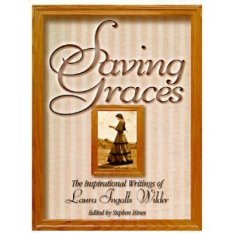
Book Review: Saving Graces: The Inspirational Writings of Laura Ingalls Wilder

I got Saving Graces: the Inspirational Writings of Laura Ingalls Wilder, edited by Stephen Hines, some years back because I was interested in this aspect of her life. I began it for the Laura Ingalls Wilder Reading Challenge, but didn’t get it finished til a few days ago. Well….in one sense I didn’t, but in another sense I had already read it, because these were taken from Laura’s magazine columns collected in a previous book of Mr. Hines’, Little House in the Ozarks: the Rediscovered Writings of Laura Ingalls Wilder. In addition he added Scripture verses pertaining to the topics she wrote about and hymns that she would likely have been familiar with. So that was a bit disappointing, that it was a reprint in effect, and I only skimmed the columns I remembered fairly well but then reread others.

This title originally caught my attention because on a previous reading of the Little House series, I began to wonder if the Ingalls family was what we call God-fearing, but maybe not necessarily what we would understand as born again. Part of that wondering came from their reaction to an evangelist who came through town when Laura was in her teens. I can’t remember much about the scenario, and I didn’t get to that book in my most recent reading, but it seems the family was somewhat wary and not fully supportive of the evangelist. But in the intervening years since I read that, we’ve had encounters with evangelists that I would be wary and unsupportive of, too, so that’s not necessarily an indication of one’s faith. That is one section I am really looking forward to reading again in the future.

I did notice in the first two books in the series I just read for the LIW challenge, Little House in the Big Woods and Little House in the Prairie, there was mention of God, of keeping the Sabbath, of Scriptural principles for daily life. They didn’t go to church in those books, but then, there was not one on the prairie and probably not in the Big Woods, either. Laura’s parents were founders of a Congregational Church in later years. I wasn’t familiar with that denomination, but a brief skimming of the Wikipedia entry for them seems to indicate that they started out very similar to reformed, nonconformist churches but then over the years veered into “Unitarianism, Deism, and transcendentalism.” So I am not sure where the denomination as a whole was in Laura’s time and what she or her parents particularly believed.

In those first two books as well, I don’t remember much mention of prayer, any mention of Jesus in particular or salvation in general. Again, that doesn’t mean they didn’t believe in those things. We have to be careful that we don’t take anyone’s passing mention of God as an evidence of salvation on one hand, but on the other, we have to be careful that we don’t dismiss someone’s testimony because we don’t hear certain “code words.” By that estimation some would discount the salvation of the thief on the cross beside Jesus because his statement of faith didn’t sound like what we read in the “sinner’s prayer” on the back of tracts. 🙂

So, I am not trying to pick apart or dissect their faith but I am trying to look at it objectively. In Wendy McClure’s The Wilder Life, she ran into a number of Christians who loved Laura, and she felt perhaps they were reading their faith into the books. She says:

I know there are a lot of folks who can easily see Christian messages in the books, lessons about trusting and accepting the will of God in times of hardship and relying on the bedrock of one’s faith to get through. There’s plenty of stuff in the books that can help illustrate these things, I guess. But the Ingalls family of the books didn’t appear to be much the praying types, unless the occasional hymn on Pa’s fiddle counts. Mary becomes a little godly by the later books, but as for the rest of the family, their reasons for attending church seems to have more to do with partaking in civilized town life than with religious devotion (The Wilder Life, p. 163).

She goes on to say that she may see it that way because that was how her own family attended church. Since she looks at everything through decidedly secular eyes, and Christians look at the series through the eyes of their own faith, it’s hard to know which of us is reading things into the books.

That brings me back full circle to Saving Graces. Laura’s own words didn’t shed much more light on the issue. She did believe in Scriptural principles and in a “beneficent Providence.” I didn’t get the idea that church was just a social outlet for her. Hines describes her conversion experience as a time when she was deeply burdened for a situation her family was in and knelt to pray and she was “filled with an overwhelming feeling, undoubtedly the presence of the Almighty, and she thought to herself, This is what men call God” (p. 2). Again, I wouldn’t necessarily argue with that, though conversion is more than just a feeling. But Hines says later that public expressions of faith “may have shocked her.” He quotes her as saying, “Of course you loved God, but you also loved your mother, and somehow it didn’t seem right to go around bragging about it” (p. 3). It doesn’t make sense to me that a public expression of faith would be considered bragging, but evidently she considered faith to be intensely personal.

On the other hand, she writes in one of her columns, “Here and there one sees a criticism of Christianity because of the things that have happened [during WWI]….’Christianity has not prevented these things, therefore it is a failure’ some say. But this is a calling of things by the wrong names. It is rather the lack of Christianity that has brought us where we are. Not a lack of churches or religious forms but of the real thing in our hearts” (p. 113).

In these columns she covers success, justice, thankfulness, the benefits of work, the importance and blessing of the home, wise stewardship, remembering the Sabbath, friendship, gossip, “redeeming the time, “the preaching farmer,” and others. One of the quotes I marked had to do with taking the Lord’s name in vain: “I wonder how things came to be so reversed from the right order that it should be thought daring and smart to swear instead of being regarded as utterly foolish and a sign of weakness, betraying a lack of self control. If people could only realize how ridiculous they appear when they call down the wrath of the Creator and Ruler of the universe just because they have jammed their thumbs, I feel sure they would never feel guilty of swearing again” (p. 124). I don’t know if they would, but I agree that it is a sign of weakness and a lack of self-control.

So, even though I was disappointed that this book was taken from the Little House in the Ozarks book, it was nice to have her faith-based columns all in one place for those of us who want to explore her thoughts in this realm in particular.

The Laura Ingalls Wilder Reading Challenge

(This review will also be linked to Semicolon‘s Saturday Review of Books.)

The Week in Words

”"

Welcome to The Week In Words, where we share quotes from the last week’s reading. If something you read this past week  inspired you, caused you to laugh, cry, think, dream, or just resonated with you in some way, please share it with us, attributing it to its source, which can be a book, newspaper, blog, Facebook — anything that you read. More information is here.

I linked to a couple of these on Saturday, but I wanted to pull out a couple of quotes that particularly stood out to me:

From I Got Nuthin, HT to Robin Lee Hatcher:

“If you don’t come to me empty, Jesus says to me, all you’ll have to offer is the self you are so full of.” ~ Heather Kopp.

We can’t be filled with Him and filled with self at the same time.

From On Controversy, HT to Challies:

“If our zeal is embittered by expressions of anger, invective, or scorn, we may think we are doing service of the cause of truth, when in reality we shall only bring it into discredit.” ~ John Newton

Very good article about dealing with controversy publicly (with the caveat that it is written from a Calvinist point of view and I am not a Calvinist.)

And from Diane:

Faith is the bridge between where I am and the place the Lord is taking me.

You can share your family-friendly quotes in the comments below or write a post on your blog and then put the link to that post (not your general blog link) in Mr. Linky below.

I hope you’ll visit the other participants as well and glean some great thoughts to ponder. And I hope you’ll leave a comment here, even if you don’t have any quotes to share.