Is it nice to call someone a false prophet or a false teacher?

Caution

I don’t know whether it’s nice. But sometimes it is necessary, and oftentimes it is the most loving thing one can do.

The Bible has some pretty serious things to say about false prophets and false teachers:

Jesus said, “Beware of false prophets, which come to you in sheep’s clothing, but inwardly they are ravening wolves.” Matthew 7:15

But there were false prophets also among the people, even as there shall be false teachers among you, who privily shall bring in damnable heresies, even denying the Lord that bought them, and bring upon themselves swift destruction. And many shall follow their pernicious ways; by reason of whom the way of truth shall be evil spoken of. II Peter 2:1-3

Beloved, believe not every spirit, but try the spirits whether they are of God: because many false prophets are gone out into the world. I John 4:1

I marvel that ye are so soon removed from him that called you into the grace of Christ unto another gospel: Which is not another; but there be some that trouble you, and would pervert the gospel of Christ. But though we, or an angel from heaven, preach any other gospel unto you than that which we have preached unto you, let him be accursed. As we said before, so say I now again, if any man preach any other gospel unto you than that ye have received, let him be accursed. Galatians 1:6-9

If there arise among you a prophet, or a dreamer of dreams, and giveth thee a sign or a wonder, And the sign or the wonder come to pass, whereof he spake unto thee, saying, Let us go after other gods, which thou hast not known, and let us serve them; Thou shalt not hearken unto the words of that prophet, or that dreamer of dreams: for the Lord your God proveth you, to know whether ye love the Lord your God with all your heart and with all your soul. Ye shall walk after the Lord your God, and fear him, and keep his commandments, and obey his voice, and ye shall serve him, and cleave unto him. Deuteronomy 13:1-4

I don’t recall seeing in Scripture anything along the lines of “He doesn’t speak the truth, but he is very kind…or gives food to the poor…or has such a nice family…” or whatever. For one thing, those “good works” don’t give anyone points with God. For another, the falsehood is such an important issue that it trumps whatever else the person might be doing.

And what I am doing I will continue to do, in order to undermine the claim of those who would like to claim that in their boasted mission they work on the same terms as we do. For such men are false apostles, deceitful workmen, disguising themselves as apostles of Christ. And no wonder, for even Satan disguises himself as an angel of light. So it is no surprise if his servants, also, disguise themselves as servants of righteousness. Their end will correspond to their deeds. II Corinthians 11:12-15, ESV.

I’m not talking about every little thing people can disagree about in the Bible. People can have different views of baptism, church government, election and free will, the best Bible versions, standards of modesty, etc., and still each love God and teach the major truths of the Bible. While all of these are important and we should study the Scripture to be fully persuaded in our own minds, the Bible also teaches that people can have different convictions and should be able to still get along. I think as modern day Christians we have spent way too much time fighting amongst brethren on these things and have gotten sidetracked from the bigger picture of sharing God’s Word and making disciples (for Him, not for our views).

But there are majors issues – the fundamentals, if you will – truths that to deny would be to deny Christ and mislead people into tragedy: who God is, how a person can be rightly related to Him, the Deity of Christ, the inspiration and verity of the Bible, the death, burial, and resurrection of Christ, among others. When a person is wrong on these, I believe it is harmful to dwell only on the “good” he seems to be doing without warning people of his falsehoods. We don’t want to do anything to give credence to his message. That’s why I said earlier that calling a false prophet or teacher what he is can be the most loving thing you can do if it keeps someone from blindly following him into error.

I don’t think that means we have to set up web sites as false teacher watchdogs. I have come across a few like that, and though I am sure the owners meant well, the sites I have seen come across as harsh and unbalanced.

I also don’t think it means that if someone said they read a book or listened to a message from someone we would consider to be a false teacher, that we have to “pounce” on them and rip the teacher to shreds. We should be kind and compassionate with the person we’re speaking to, and part of that may be acknowledging that the person they are listening to might have some good points. We can prayerfully continue and bring biblical truth to bear in the conversation. If a person is really entrenched, we may need to just deal with one aspect at a time.

Jude 1:3 says, “Beloved, when I gave all diligence to write unto you of the common salvation, it was needful for me to write unto you, and exhort you that ye should earnestly contend for the faith which was once delivered unto the saints.” We are called to contend for the faith. Many of the epistles do just that in dealing with falsehoods making the rounds, even to the point of naming names. Interestingly, I had this started this post last week and saved it, and then last Sunday our Sunday School teacher started teaching from Jude. He said the Greek word for “contend” is used only one time in the Bible, and that is in this passage, and it has the idea of an athlete pouring everything into competing and winning with total commitment. Ephesians 5:11 goes on to say, “And have no fellowship with the unfruitful works of darkness, but rather reprove them.”

Besides contending for the faith, we need to clearly separate from false teaching.  Romans 16:17-18 says, “Now I beseech you, brethren, mark them which cause divisions and offences contrary to the doctrine which ye have learned ; and avoid them. For they that are such serve not our Lord Jesus Christ, but their own belly; and by good words and fair speeches deceive the hearts of the simple.” 2 John 1:9-11 says, “Whosoever transgresseth , and abideth not in the doctrine of Christ, hath not God. He that abideth in the doctrine of Christ, he hath both the Father and the Son. If there come any * unto you, and bring not this doctrine, receive him not into your house, neither bid him God speed: For he that biddeth him God speed is partaker of his evil deeds.”

Considering the above, when I quote someone or review a book, if I have some minor issues I might say something like, “I don’t agree with everything he said but I think there are good things to be gleaned from the book.” But if the author is wrong on the major issues, I can’t leave at “I disagree with some things he says”: I feel I must warn my own readers about this person’s falsehoods. Then if they want to go on and read the book, that is up to them, but at least they’ll know to compare what was written with what the Bible teaches (something we should be doing anyway.)

Warning of false teaching is one way we can we can contend for truth; we also need to be sharing truth proactively, as the Biblical writers did as well. Some years ago when David Koresh was in the news, I was astonished to hear an interview with one of his disciples commenting on his knowledge of the Bible. That person had to have had an amazing lack of previous Bible teaching or reading to think a thing like that. That’s one reason, among many others, that I have a passion to get people into the Word of God for themselves: it teaches us to know Him and His truth, helps us grow in Him, and keeps us from being deceived by false teachers who would lead us astray.

While we don’t need to set ourselves up as the False Teaching Police and become consumed with ferreting out falsehoods, we should be in the Word of God enough to recognize when we come across false teaching of it and be able to articulate the truth. It may be one thing that makes a difference in the hearts of those who hear us.
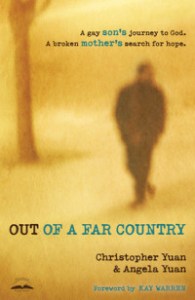

 

Book Review: Out of a Far Country: A Gay Son’s Journey to God. A Broken Mother’s Search for Hope

Far CountryI’ve been wanting to read Out of a Far Country: A Gay Son’s Journey to God. A Broken Mother’s Search for Hope by Christopher and Angela Yuan ever since seeing it recommended by Tim Challies, and I am glad to have finally done so. I’m predicting it will be one of my top ten books of the year.

Christopher and Angela take turns with the chapters, describing events from their different points of view. They open the book with Chris’s coming out to his parents that he was gay. Angela did not object on Biblical grounds: she was an atheist who hated Christians. I don’t think the book ever explains just why she was against his homosexuality, except that they had hoped he would follow in his father’s footsteps and become a dentist, and patients would probably avoid a dentist who had the potential to be HIV positive. Maybe it just didn’t fit in with her idea of a perfect family, but it was devastating to her.

Angela had come from an unhappy home and had put great stock into having a good family. But over the years her husband grew cold and distant, her oldest son rebelled, and now Christopher was going in a direction completely unacceptable to her.  She gave him an ultimatum between his family and his homosexuality, and, believing he had no choice in his orientation, he left home to be with friends who would accept him as he was. Angela crumpled to the ground in despair, feeling she had nothing left to live for. She made plans to end her own life, but wanted to talk to a minister first. Though he was kind, nothing really changed in her heart. He gave her a booklet which she later read, and her eyes were opened to the truth that her lifelong desire for belonging could be fulfilled in belonging to God. It was even a relief to know and admit that she was a sinner, that though she was far from perfect, God still loved her. “I had not been seeking God, but I was found by him” (p. 19).

Chris, for his part, was glad to get away from the “Chinese-mother guilt-trip drama” (p. 8). Coming out to one’s parents and the inevitable negative reaction was a rite of passage among his friends. He finally felt free to live as he wanted to. He “started going to gay clubs and began tending bar” (p. 23) at night while attending dental school during the day. Eventually the party scene took over his life. While feeling low after a broken relationship, he accepted someone’s offer of the drug Ecstasy, and within a very short time started selling drugs to support his own habit, then became a popular and leading seller in his area and even across the country. His schooling suffered to the point that he was eventually expelled, but it no longer mattered since he was making money hand over fist and enjoying life and popularity.

Until he was arrested.

During this time Angela had been growing in her own faith and her husband Leon had come to the Lord as well. At first she tried various things to get through to Chris but finally realized that she could not “fix” him. She could only fast, pray, show him love, and not shield him from the consequences of his actions. She and her husband did not intervene when Chris was threatened with expulsion from school and after he was arrested asked the judge to give him a sentence just long enough to bring him to God. Once after reading Psalm 46:1, “Be still, and know that I am God,” she knew “as hard as it was, I knew I had to quit striving and trying to make things work my way. But rather, I had to let God do things his way and in his timing” (p. 73). “It may have just been easier for us to give up on our son, but God said, Wait! He gave us faith to hope against all the evidence we saw and to trust he had a plan, Leon and I committed to focus not on hopelessness but on the promises of God” (p. 109). She “prayed specifically that God would do whatever it took to bring our son to him — not to us, not out of drugs, not out of homosexuality…but to the Father” (p. 159).

With Christopher’s arrest, his popularity vanished. None of his “friends” wanted any more to do with him. One day in prison, he saw a Gideon’s New Testament on top of some trash, and he took it back to his cell and began to read mainly just as a way to pass the time. Over time, both with reading the Bible on his own and studying it with others, Chris came to believe on Christ.

Being in prison had taken care of getting Chris off drugs and out of the party scene, and he came to admit they were both wrong and he needed to stay away from them once he got out. When he talked with a chaplain about his homosexuality, he was told that the Bible did not condemn homosexuality and gave Chris a book explaining that view. That sounded wonderful to Chris, but as he read the book and then studied the Bible, he felt the book did not line up with what the Bible taught. He did discover that in “Leviticus 18:22 and 20:13 — passages normally used to condemns gays and lesbians…God didn’t call lesbians and gay men abominations. He called it an abomination. What God condemned was the act, not the person. For so long, I had gotten the message from the Christian protestors at gay-pride parades that the God of the Bible hated people like me, because we were abominations. But after reading these passages, I saw that God didn’t hate me; nor was he condemning me to an inescapable destiny of torment. But rather, it was the sex he condemned, and yet he still wanted an intimate relationship with me” (p. 186). Being gay had been a major part of his identity, but as he continued to study the Scriptures, he “began to ask myself a different question: Who am I apart from my sexuality?” (p. 187). He details his thought processes and conclusions in a chapter called “Holy Sexuality.” One conclusion was:

God’s faithfulness is proved not by the elimination of hardships but by carrying us through them. Change is not the absence of struggles; change is the freedom to choose holiness in the midst of our struggles. I realized that the ultimate issue has to be that I yearn after God in total surrender and complete obedience (pp. 168-169).

This book touched me on so many levels. What a joy to see the journey of how God brought both Christopher and his parents to Himself.

Christopher’s testimony from a documentary is here:

You can read more of Christopher’s life and ministry at his web site, www.christopheryuan.com.

(This review will also be linked to Semicolon‘s Saturday Review of Books.)


A revival of what?

Some days ago I turned on the radio to catch the news at noon, and caught the last few minutes of the prayer time my Christian radio station has right before 12:00. As I listened, I heard the announcer pray for “a revival of Biblical values” in our society. I stopped in my tracks and thought, “What?

50sI’m sure he meant well, and I am pretty sure I know what he meant, but that request struck me as a little off-base. I had the same reaction as I do when people speak of “reclaiming our culture for Christ.” I know they don’t mean this, but it brings to mind a 50s-style era where people were at least fairly decent in their lifestyles and even to some extent “God-fearing.” The problem is you can have a pleasant culture exactly like that with most of its members totally lost and on their way to hell.

I don’t think we’re called to reclaim cultures or promote Biblical values without the underlying base of trying to introduce people to the Lord. He has called us to make disciples. That kind of change comes from within and then influences a person’s actions which will then result in a change of values. Trying to promote Biblical values without a heart change is coming at things from the outside. It may make a person easier to live with, but it doesn’t change their destiny or character. But in this postmodern era, especially, Biblical values don’t make sense to someone without a Biblical heart.

I don’t mean that Christians should not be active in government. I’ve been listening to bits of Stephen Davey’s message “Stay on Task” (in other places it appears to be named “I Pledge Allegiance, Part II”) on the radio. I agree with the general thrust of his message that “The mission of the church is not moral reformation, but spiritual transformation” and “Our true battle is against the kingdom of darkness which has blinded the minds of the world to believe that God is not watching.” (It’s a great message – I encourage you to listen to or read it). On the other hand, just because Jesus or the apostles never tried to organize voters or push for campaign issues doesn’t mean it is wrong to do so. Unlike Bible times, we do have a government in these days where we can use our voice. We should first of all pray “For kings, and for all that are in authority; that we may lead a quiet and peaceable life in all godliness and honesty” (I Timothy 2:1-3). And personally I believe we should at least vote, as intelligently as possible. To be given such a gift at this time in history and not use it would be terribly negligent. Some might be called to do more, as described in the article “Is Voting Enough?” I think it is good for Christians to be involved in government as in every other segment of society, to be salt and light there. Since our government can be influenced by our voices, I am grateful for some who keep on top of issues, stand for the right, keep voters informed, and voice our concerns to our representatives. I don’t believe our ultimate hope is in government, but that doesn’t mean it isn’t a tool in God’s hands that can be used for good. Proverbs 21:31 says, “The horse is prepared against the day of battle: but safety is of the LORD.” God didn’t tell people to abandon their horses, but He told them rather to remember that ultimately safety is of Him. Our trust is in Him, not in any tools, even though He may use various tools to accomplish His objectives.

And in past history He has done so without a conservative culture or a representative form of government. I am extremely thankful for both of those and I hope we keep them. But the church can and should thrive with or without them. In Paul’s time, dictators were in power, yet the church grew in numbers and in character.

While we can and should use the tools at our disposal, those pursuits should never take priority over the basics of what God has called us to: being salt and light wherever we are, showing His love and grace to people, and telling them about the only God and Savior who alone can save them and meet their needs.

Booking Through Thursday: YA Censorship

btt  button Booking Through Thursday is a weekly meme which poses a question or a thought for participants to discuss centering on the subject of books or reading.

I have not done one of these in over a year, though I do look at the questions every week. I have been pondering today’s question ever since looking at it earlier this morning, so I thought I’d jot some of those thoughts down here.

The question had to do with censorship of YA (young adult) literature: “Do you think it should vary depending on the impressionable age of the readers? Or is it always wrong? How about the difference between ‘official’ censorship by a government or a school system, as opposed to a parent saying No to a specific book for their child?”

It depends on what you mean by censorship. I would have a problem with the government banning certain books, except maybe pornography. (Has that kind of publication ever done anyone any good except to increase the finances of those involved in producing it?)  But one problem with banning books is that no one would be able to agree on what should be banned. After all, even the Bible has been banned in certain times and places. And I do have a problem with turning government officials into thought police.

I don’t think I would agree with public libraries banning certain books, but I would like them to keep “mature” books away from children’s and teen’s areas. Those who are concerned about what their children read should not be letting them loose unsupervised in a public library anyway.

I do think school libraries have a right and even a responsibility to keep certain books out. Books with filthy language or illicit sexuality do not need to be in a school setting. And of course, ultimate responsibility rests with parents, who do indeed have a right to filter their children’s reading material.

The BTT site linked to an YA author’s blog post wondering why some of her own books were censored (“quietly” rather than officially). I am not linking to the author’s post because of the vulgar language in it, but after perusing it I have to ask, “Seriously?” When she writes like that, how can she wonder why some parents and teachers would object?

I do think filthy language is a reason to restrict some books. There are some books where it is minor and can be overlooked (for instance, the Dickens book I am listening to uses “Damn,” and Unbroken has a smattering of objectionable language in it, but it is understandable that there would be such in a prisoner of war camp). Though I’d rather not read those words, I can understand their being included in some cases. But there are some words that really don’t need to be in YA lit, if anywhere. Yes, some people do use them in real life, but that doesn’t justify a plethora of vulgarity in the name of intellectual freedom.

I don’t think explicit sexuality needs to be a part of YA lit, either (or any fiction, for that matter). Yes, even the Bible talks about adultery and other kinds of sexual sin and how it affects people, but not in a way that would cause arousal on the part of the reader.

Violence is harder to set parameters around. Obviously a book about war is going to have violent scenes, a book that discusses bullying is going to show instances of it, etc. Reality is one thing; gratuitousness is another.

When my kids were younger, I did censor books with New Age and certain other philosophies. I believe in talking about such things, but I didn’t want them presented in a positive and favorable way to an impressionable young mind before we’d had a chance to talk about it.

There are a few reasons for setting some restrictions in reading. Generally I don’t want to read bad language or sexual scenes or put them before my children because of the garbage in/garbage out principle. If we fill our minds with such things, they’re going to become part of our thoughts and may even come back out in our words and actions. There is a phrase going around now that once you see something, you can’t unsee it. Often it is said humorously, but it is true principle both in viewing and reading.

Even though YA stands for young adults, YA books are usually marketed to teens, and these objectionable elements don’t need to be placed in young, impressionable minds.

Despite everything I have said, I do not mean that I wanted my kids only to read things that reinforced our own views and that we agreed with 100%. I am working on a post about reasons for reading, but one major one is to experience other viewpoints and test one’s own thoughts against those of others. However, I did want to be careful with how those thoughts were presented while they were still young.

Sometimes when a controversial book is making the rounds of discussion, some people (even Christians) will say exasperatedly, “It’s just a book.” But books are powerful things. What we read affects how we think. Jesus told stories to illustrate spiritual truth, and I have often said that the best of Christian fiction is like an extended parable or illustration of truth. A principle I have read in a story takes root and stays with me much longer than when I read it in an instructional format. But the same power than can be used for good can also be used for evil. I regret to say that off-color things I read in an unsaved home as a young person have also stayed with me much longer than I would have liked, often popping into mind at the most inopportune times, like while trying to pray or listen to a sermon.

Most of what I have said so far is applicable to anyone, but as a Christian, my guidelines come from verses like these:

Philippians 4:8: Finally, brethren, whatsoever things are true, whatsoever things are honest, whatsoever things are just, whatsoever things are pure, whatsoever things are lovely, whatsoever things are of good report; if there be any virtue, and if there be any praise, think on these things.

I Corinthians 6:12: All things are lawful unto me, but all things are not expedient: all things are lawful for me, but I will not be brought under the power of any.

I Corinthians 10:23: All things are lawful for me, but all things are not expedient: all things are lawful for me, but all things edify not.

The Philippians passage focuses on the positive things we should be filling our minds with. The two verses from I Corinthians indicate that while all things are “lawful,” some things are not expedient (“tending to promote some proposed or desired object; fit or suitable for the purpose; proper under the circumstances” according to Dictionary.com), I shouldn’t allow things to exercise more power over me than they should, and some things are not edifying. Galatians 5:17 says, “For the flesh lusteth against the Spirit, and the Spirit against the flesh: and these are contrary the one to the other: so that ye cannot do the things that ye would” and chapters 6-8 go on to describe the battle between and spiritual and fleshly natures. It is going to be even more of a battle if we’re feeding our fleshly natures. II Corinthians 10:5 says, “Casting down imaginations, and every high thing that exalteth itself against the knowledge of God, and bringing into captivity every thought to the obedience of Christ.”

I don’t think that necessarily means we should read only Christian books. Truth and beauty can be illustrated even in secular works. And I don’t think it means everything we read should have a “Pollyanna” viewpoint. Even the Bible deals with sexuality, but not in a way that inspires lust. It also contains violent encounters, but David says in Psalm 11:5, “The LORD trieth the righteous: but the wicked and him that loveth violence his soul hateth” (emphasis mine) — gratuitous violence is different from a battle scene. It discusses different philosophies, but not in a way that leaves you confused about what’s right.

It is honestly hard to know exactly where to draw the lines sometimes, as I mentioned when I discussed To Kill a Mockingbird. There are books I might read for information that I would not endorse wholeheartedly. Wisdom and discernment are needed when reading Christian books as well as secular ones: not everything that calls itself Christian accurately reflects Biblical truth.

Of course, the world will not have the same standards in most instances, and we can’t fence off every area of temptation and evil influence. Ultimately what people need are hearts changed by the gospel. While we try to take some kind of stand lest explicit books become ever more blatant, we need to remember our main purpose as Christians is to share Christ both in our lifestyles and character as well as with our verbal testimony.

(Some of the above is taken from a previous post titled Book Banning and Censorship.)

Michelle at As4Me has some well-articulated thoughts on Censorship, Schools, and Children, Is Good Censorship an Oxymoron? and some other posts on censorship and banned books here.

Sanctity of Life

I didn’t realize until earlier today that it is Sanctity of Human Life Sunday, but I didn’t want to let the day end without saying something about it.

As a Christian I believe God is the author of life, and He says he knew us even in the womb.

“Before I formed you in the womb I knew you, And before you were born I consecrated you; I have appointed you a prophet to the nations.” Jeremiah 1:5

For you formed my inward parts;
    you knitted me together in my mother’s womb.
 I praise you, for I am fearfully and wonderfully made.
Wonderful are your works;
    my soul knows it very well.
My frame was not hidden from you,
when I was being made in secret,
    intricately woven in the depths of the earth.
Your eyes saw my unformed substance;
in your book were written, every one of them,
    the days that were formed for me,
    when as yet there was none of them.
Psalm 139:13-16

This column, On abortion, it’s best to err on the side of life, makes the point that if there is any chance at all that the unborn fetus is a real human life, then it is best to treat it as such.

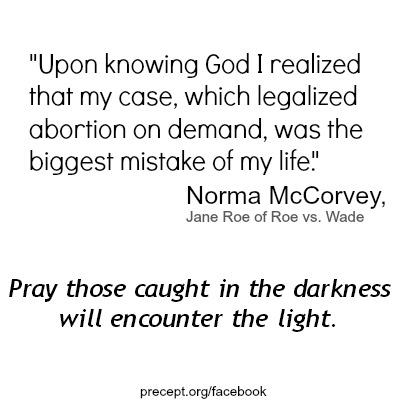
I saw this going around Facebook:

Roe mistake

“Each day, 2,150 women wake up in America believing abortion is the only realistic solution to an unplanned pregnancy” (care-net.org).
God brought Norma out of darkness and into His marvelous light.
Many women are still sitting in the darkness;
will you help them see the light of the world?

We win by showing love, compassion, and mercy to one frightened woman at a time.”

The Hidden Art of Homemaking, Chapter 13: Integration

We’re discussing The Hidden Art of Homemaking by Edith Schaeffer a chapter at a time at  The Hidden Art of Homemaking Book Club hosted by Cindy at Ordo Amoris.

The subject of Chapter 13 is integration, and though it is a vital subject, I wondered at first how Edith thought it fit in with the overall concept of creative homemaking.

She begins by quoting Revelation 7:9-10: “After this I beheld, and, lo, a great multitude, which no man could number, of all nations, and kindreds, and people, and tongues, stood before the throne, and before the Lamb, clothed with white robes, and palms in their hands;And cried with a loud voice, saying, Salvation to our God which sitteth upon the throne, and unto the Lamb.” At that time, the barriers of differing language and class will have been removed, there will be no more war, hostility, anger, or sin. Everyone who has been born again by faith in Jesus Christ as Savior will be perfectly integrated into one family, so it behooves us to start living that way now.

She quotes as well Mark 10:13-14: “And they brought young children to him, that he should touch them: and his disciples rebuked those that brought them. But when Jesus saw it, he was much displeased, and said unto them, Suffer the little children to come unto me, and forbid them not: for of such is the kingdom of God.” “The disciples were displaying an attitude which regards adults as more important, while children needed to be brushed aside. Jesus was quite definite not only that children could come to Him but that the disciples had it all backwards. The adults needed to come as the children come. It is the trust of a child for its father that is needed, the whole-hearted belief” (p. 198). She points out that at that time when we stand before God’s throne, every age will be represented as well.

“What has all this to do with creative living, as a Christian?” (p. 199). She posits that laws do not solve the problem. They may open doorways, a good beginning, but they cannot make a people truly integrated in heart.

“True integration is a matter of people really feeling a oneness with others and attempting to understand them in personal communication of the sort that takes place around the fireplace, washing dishes together, having tea together, eating together, walking together, discovering things in common together. True integration is a matter of people having spiritual communication and fellowship together, discussing and discovering new thoughts and ideas by sharing trends of thought, or thinking out loud and having some kind of creative activities or recreation together – by choice, not law” (p. 200).

Integration of age, too, can best be accomplished at home. I grew up in the “children should be seen and not heard” era, and while children do need to learn not to interrupt and that the conversation should not center around them all the time, they should also be included in the conversations. “Family occasions can be planned to include each member of the family: meals together during which the viewpoints and interests of the children are given a place and during which the world events discussed are not discussed as if the subject matter were high above their heads, with the adults being careful to explain, even to the five year old, what is being talked about. Opinions and reactions should be encouraged” among all the different ages and sexes present (p. 201).

I’m not of the opinion that children should never do things with others their own age, but I think all too often in our communities and churches we are separated by age and life situation too much. At one church we were in, there were programs for children through the sixth grade at each and every service, so that, if a family participated in all of them, their children would never be in “big church” with the adults until they were in junior high. We have no objection to Sunday School and children’s church – it is helpful at times for children to receive instruction on their level in a way that can handle their wiggliness – but we thought having them “out” at every service was overdoing it, and voiced that to the pastor. He said he understood, but he had parents begging him for these programs (it wasn’t the other adults wishing the church would do something with “those kids” – it was the parents.) That was so sad to me. When our boys were small, the nursery only went up to age 2, so at a very young age they started coming into the worship services. The parents with younger kids tended to sit in a section off to the back so as not to be a distraction, and we brought small notepads and pencils and such for the kids to “doodle” while the service was going on (it’s too much to expect a two year old to sit completely still for an hour and a half and listen, but on the other hand, they can learn to be relatively still and quiet with something to occupy their attention). Ours did fine with that. They loved to wave their arms while the songleader led singing, they played “preacher” at home (my husband even build a kid-sized pulpit for them to play church at home). Once when my oldest was drawing on his notepad, the pastor was preaching and asked a rhetorical question, and my son answered it out loud. That caused a few giggles in the area, but I was gratified that he was listening and taking things in even at a young age.

And though we’ve been blessed with good youth pastors and my kids have benefited from youth group, that can be overdone as well. I’d like to see more projects where the teens interact with other members of the congregation.

In the first church we attended when we were married, the adult Sunday Schools were divided by topic, and though people might tend to stay with the same group through different topics and teachers, people were free to go to whichever one they wanted. We had a wonderful mix of single adults, young married couples, middle aged, and older adults, which added a lot of depth to discussions. In most of the churches we have been in since, the adults are divided by age, and the “singles” are sent to their own class. In one church, a young married woman came to the ladies’ group meeting, saw that all the women there were older than she was, and she never came back. That really pierced my heart, especially as ladies’ groups I had been in before had had a great mix of ages and experience.

We tend to seek out people just like ourselves to extend friendship. That’s natural and there is not anything necessarily wrong with that, but we shouldn’t stop there: we should reach out to and interact with people of varying nationalities, skin colors, ages, life situations, etc. If we have a group of friends who are all young married couples, and one couple has a baby, they shouldn’t feel they don’t “belong” any more, the others shouldn’t feel they can no longer relate. Yes, there are changes that will come in, but that’s not a bad thing. That’s life. We shouldn’t regard the “singles” (I wish we could come up with a different name) as incomplete and not able to join in with the rest of the adults until they have a mate. Yes, there is some advantage in breaking off into different groups in like stages of life – the young adults having a camp-out, the teens going on a mission trip or having a fellowship, young moms getting together to encourage each other, etc. But we shouldn’t be totally segregated from anyone different from ourselves. We have much to learn from each other. I’ve often said that the older women teaching the younger as instructed in Titus 2 was probably not originally in classes and seminars (though there is nothing wrong with those occasionally), but rather they probably occurred in everyday life as the women did chores together, had each other over for meals, etc.

Here are a few other quotes from this chapter that stood out to me:

When you really get to know people, their hopes and fears, aspirations and disappointments, viewpoints and misunderstandings, there is a sympathy and a desire to help, a true compassion and love which begins to grow (p. 202).

The tight little segregated life, always spent with people your own age, economic group, educational background, and culture tends to bring an ingrown, static sort of condition. Fresh ideas, reality of communication and shared experiences will be sparks to light up fires of creativity, especially if the people spending time together are a true cross-section of ages, nationalities, kindred, and tongues (p. 202).

You do not have to be a delegate to an international gathering on a large scale to do something. The most real ‘something’ you can do is within the family unit, as you open it up to others, to a cross-section of ages and peoples, or the gathering together of community life on a small scale (p. 203).

There is no real possibility of an integration that is true and meaningful in the total sense unless it is based on the inner integration which God made possible through the Second Person of the Trinity, Jesus Christ. He died so that man might move out of his ‘segregated’ position, segregated from God, from other men, and even from himself in so many aspects, into true integration. This true integration comes only when man is integrated with the Trinity. Jesus becomes one’s Saviour, as one accepts that which He has done for man on the Cross. His death is not for ‘mankind’ as an impersonal whole, but for each individual who accepts Him. God the Father becomes one’s own Father at that time, and the Third Person of the Trinity, the Holy Spirit, indwells one, so that one is truly integrated with the whole Trinity. When this has happened, a man can be helped by the Trinity to find at least the beginning of a true integration with other people. We can have help in understanding others, loving them and communicating with them (p. 204).

I don’t know how the Christian community missed this for so long. All those parables Jesus told involving Samaritans, the times He went out of His way to minister to Samaritans, should have been a wake-up call when we realize the Samaritans and Jews were enemies, due at least partly, if not primarily, because of race. The racism that has run rampant, not just through the American South, but through the world, is a blight and should have no place in those who belong to Christ:

11 Therefore remember that at one time you Gentiles in the flesh, called “the uncircumcision” by what is called the circumcision [the Jews], which is made in the flesh by hands— 12 remember that you were at that time separated from Christ, alienated from the commonwealth of Israel and strangers to the covenants of promise, having no hope and without God in the world. 13 But now in Christ Jesus you who once were far off have been brought near by the blood of Christ. 14 For he himself is our peace, who has made us both one and has broken down in his flesh the dividing wall of hostility 15 by abolishing the law of commandments expressed in ordinances, that he might create in himself one new man in place of the two, so making peace, 16 and might reconcile us both to God in one body through the cross, thereby killing the hostility. 17 And he came and preached peace to you who were far off and peace to those who were near. 18 For through him we both have access in one Spirit to the Father. 19 So then you are no longer strangers and aliens,but you are fellow citizens with the saints and members of the household of God, 20 built on the foundation of the apostles and prophets, Christ Jesus himself being the cornerstone, 21 in whom the whole structure, being joined together, grows into a holy temple in the Lord. 22 In him you also are being built together into a dwelling place for God by the Spirit. (Ephesians 2:11-22, ESV).

Book Review: The Secret Thoughts of an Unlikely Convert

I don’t know when 148 pages of someone’s life story has impacted me more. There are sections where I have sticky tabs and markings on several pages in a row.

Unlikely ConvertThe Secret Thoughts of an Unlikely Convert: An English Professor’s Journey Into Christian Faith is Rosaria Champagne Butterfield’s story of how she, as an atheist, leftist, feminist, lesbian professor specializing Critical Theory, or postmodernism, and whose specialty was Queer Theory, who hated Christians, encountered and embraced the truths of Christianity in what she calls a “train wreck” of a conversion.

After a few pages detailing how she came to her professorship and worldview, she describes a kind and inquiring letter from a pastor in response to an article she had written.

The Bible makes it clear that reason is not the front door of faith. It takes spiritual eyes to discern spiritual matters. But how do we develop spiritual eyes unless Christians engage the culture with those questions and paradigms of mindfulness out of which spiritual logic flows? That’s exactly what Ken’s letter did for me – invited me to think in ways I hadn’t before (pp. 8-9).

The letter had invited her to call him, and after a week, she did. He invited her to have dinner with him and his wife at their home, and she accepted. She was also at this time doing research for a book on the Religious Right and figured he could answer some of her questions. “Even though obviously these Christians and I were very different, they seemed to know that I wasn’t just a blank slate, that I had values and opinions too, and they talked with me in a way that didn’t make me feel erased” (p. 10). Thus began two years of regular meetings and studying Scripture before she ever set foot in a church, which Ken and his wife knew would probably be “too threatening, too weird, too much” (p. 11) for her. “Good teachers make it possible for people to change their positions without shame. Even as Ken prayed for my soul, he did it in a way that welcomed me into the church rather than made me a scapegoat of Christian fear or an example of what not to become,” (p. 14.)

Gradually she came to believe, but she knew it would cost her. “I clung to Matthew 16:24, remembering that every believer had to at some point in life take the step I was taking: giving up the right to myself, taking up his Cross (i.e., the historicity of the resurrection, not masochism endured to please others), and following Jesus.” “I learned that we must obey in faith before we feel better or different. At this time, though, obeying in faith, to me, felt like throwing myself off a cliff” (p. 22). “One doesn’t repent for a sin of identity in one session. Sins of identity have multiple dimensions, and throughout this journey, I have come to my pastor and his wife, friends in the Lord, and always the Lord himself with different facets of my sin” (p. 23).

She tells of a woman she knew and counseled who was in a Bible-believing church but was in a secret lesbian relationship. Her secret denied her the help and prayers of other believers and only resulted in shame and pretense. When Rosaria asked why she didn’t share her struggle with anyone in her church, she replied, “If people in my church really believed that gay people could be transformed by Christ, they wouldn’t talk about us or pray about us in the hateful way they do” (p. 25). Rosaria then asks readers, “Do your prayers rise no higher than your prejudice? I think that churches would be places of greater intimacy and growth in Christ if people stopped lying about what we need, what we fear, where we fail, and how we sin” (p. 25).

Rosaria was a tenured professor in subjects that would now radically change because of her conversion. When she let it be known that she was now a Christian, both she and her gay friends felt she had betrayed them and turned traitor. “I…was alert to the reality that God had ministry waiting for me. I prayed that I would be strong for the task at hand. Yes, I was still a laughing stock in the gay community. Yes, I was still a traitor and an example of what not to be. But so too was Paul the Apostle shamed among Pharisees, and I trusted that God would take my life and make a place for me” (p. 50).

The rest of the book tells how God did just that, both in her career and ministry to others, leading her to marry a pastor, to eventually adopt four biracial children, and to become a homeschooling mom.

Along the way, she shares an eye-opening perspective of what Christianity looks like to others. For instance, when she moved to a community where there were Bible verses on bumper stickers and placards, instead of it looking like people were sharing a bit of light, it looked to her like the community was for “insiders” only. Christians seemed like “bad thinkers” or even anti-intellectual to her before this journey, using Scripture to shut down conversations rather than to shed light. Unfortunately, that is too often true: instead of truly discussing what the Bible has to say and being “ready always to give an answer to every man that asketh you a reason of the hope that is in you with meekness and fear” (I Peter 3:15b), some Christians take offense at being asked and use Scripture to bludgeon. One of my own family members has been turned off, not so much to all Christian truth, but to Christian community because of this experience.

One theme that comes out throughout the book is the willingness to engage people who are different from us in any way. Thank God the pastor and wife who first shared Christ with her looked past her butch haircut and gay and pro-choice bumper stickers to the need of her heart. But even after she became a Christian, she ran into this phenomenon in various churches. When her husband was the guest speaker at a church and she was getting out of the car holding one of her children while the other was asleep in the car seat, a man said to he, “So, is it chic for white women to adopt black kids these days?” After asking him if he was a Christian, she said, “So, did God save you because it was chic?” When her husband started pastoring a small church plant made up mostly of college students, families would come for a month or so and then leave because of a “lack of fellowship” with people just like themselves. I could step on a small soapbox here: I get so discouraged when people within the same church only want to fellowship with people just like themselves — same age bracket, some marital or parental status, same way of educating or disciplining children, etc., etc.

If I shared everything else I marked, I’d be nearly rewriting the book here, so I can’t do that. But here are just a few more things that grabbed me:

“Since all major U. S. universities had Christian roots, too many Christians thought that they could rest in Christian tradition, not Christian relevance” (p. 7).

“When we read in the book of Romans, “And we know that God causes all things to work together for good to those who love God, to those who are the called according to His purpose” (8:28), we are not to be Pollyanna about this. Many of the ‘things’ we will face come with the razor edges of a fallen and broken world. You can’t play poker with God’s mercy – if you want the sweet mercy then you must also swallow the bitter mercy. And what is the difference between sweet and bitter? Only this: your critical perspective, your worldview. One of God’s greatest gifts is the ability to see and appreciate the world from points of view foreign to your own, points of view that exceed your personal experience”  (p. 125).

“Many people in our community protect themselves from inconvenience as though inconvenience is deadly. We have decided that we are not inconvenienced by inconvenience. The needs of children come up unexpectedly. We are sure that the Good Samaritan had other plans that fateful day. Our plans are not sacred” (p. 126).

When a teenage girl in foster care with mental illness heard a pastor speaking about God’s call, afterward she “approached Pastor Steve and said, ‘Steve, I hear voices all the time. How do I know the difference between hearing the voice of God and hearing the voices of my own sick mind?’ Pastor Steve said, ‘Dear one, we all have the check the voices of our own sick mind with the Bible. Daily. You are no different'” (p. 128).

One thought that came to mind while reading the book was, “Why don’t we see this happening more often?” If the gospel is the power of God unto salvation, and it is, then why don’t we see such transformative conversions more often, and why are those raised in Christian culture often so anemic? Sometimes I long with the Psalmist “To see thy power and thy glory, so as I have seen thee in the sanctuary” (Psalm 63:2). Is it because we don’t share the gospel in a kind and loving way enough? Or is it because not many people are truly willing to examine the claims of the Bible and bring themselves under its authority? Maybe both. I’ve seen online encounters where non-Christians have as much of a “smackdown” way of encountering Christians as Christians do encountering them. I know I would have been scared to death to engage someone like Rosaria before she was saved: I’d have been afraid that I wouldn’t be able to answer her questions and she’d be able to run rings around me with her reasoning ability. But I have to remind myself that those whom God brought across her path with just the right thing to say at the right time were operating under the leadership of the Holy Spirit, not their own wisdom and insight. Sometimes we look for a formula: we see articles or pamphlets about “How to witness to atheists” or whomever else, and those can have some helpful points, but we can’t memorize a script and then present it to people. We need to share a Person and show His love to others and trust Him for the right words to say and pray for His working in hearts.

Rosaria writes now from a Reformed Presbyterian perspective, and since I am not from that perspective, I’d disagree with a few minor points here and there, but I am not going to nitpick about them. I do believe Christians can agree on the big issues and agree to disagree about smaller ones.

There is a condensed version of her testimony here, but I do encourage you to read the book as well. I believe it’s going to go down as one of my top ten of the year.

(This will also be linked to Semicolon‘s Saturday Review of Books.)

Sanctity of Life

I didn’t realize until earlier today that today is Sanctity of Life Sunday, but I didn’t want to let the day end without saying something about it.

As a Christian I believe God is the author of life, and He says he knew us even in the womb.

“Before I formed you in the womb I knew you, And before you were born I consecrated you; I have appointed you a prophet to the nations.” Jeremiah 1:5

For you formed my inward parts;
    you knitted me together in my mother’s womb.
 I praise you, for I am fearfully and wonderfully made.
Wonderful are your works;
    my soul knows it very well.
My frame was not hidden from you,
when I was being made in secret,
    intricately woven in the depths of the earth.
Your eyes saw my unformed substance;
in your book were written, every one of them,
    the days that were formed for me,
    when as yet there was none of them.
Psalm 139:13-16

This column, On abortion, it’s best to err on the side of life, makes the point that if there is any chance at all that the unborn fetus is a real human life, then it is best to treat it as such. I would think that even non-Christian people could see that. But apparently they don’t.

I saw this going around Facebook:

Roe mistake

“Each day, 2,150 women wake up in America believing abortion is the only realistic solution to an unplanned pregnancy” (care-net.org).
God brought Norma out of darkness and into His marvelous light.
Many women are still sitting in the darkness; will you help them see the light of the world?
We win by showing love, compassion, and mercy to one frightened woman at a time.

An adoption story

I mentioned yesterday that I wanted to share how adoption has impacted our family. I can’t share all the details. I don’t know all of them, but its not primarily my story to tell, so I will only share what I feel all involved would not mind others reading about.

One of my younger sisters left home just after graduating from high school and moved to another town with her best friend. The friend’s brother and my sister became boyfriend and girlfriend, and within about a year my sister became pregnant. She and her boyfriend were not ready to be married and become parents: I can’t remember if they broke up before or after she found out she was pregnant, but either way, it became awkward for my sister to remain where she was, so she came home.

My mother and sister began meeting with an adoption agency, and though all felt this was the right course of action for several reasons, it still shook us all up to think that we would have a family member that we were about to launch out into the unknown without knowing what would become of them and whether we would ever see or hear from them again. I can remember lying in bed at night just aching over the idea and praying for God’s leading in who should adopt this child.

I wrestled with the whole idea of adoption realistically for the first time. The only Biblical instances I could think of where someone willingly gave their child up to another were Hannah and Samuel, Moses and his mother, and one of the women who came before Solomon, whose desire that her child be given to the other rather than killed proved her motherhood. In a way you could count Jesus who was given by God into Joseph and Mary’s care. All of those were very different situations than what we were dealing with. I wondered if it would be better for pregnant young women to take responsibility for their actions by keeping the child (theoretically…it was not my decision to make and my opinion was not asked for, but I was just thinking through the whole issue.) But all things considered, it seemed like what would be best for the child in this instance was to place her in a loving home where she could receive what my sister could not give at the time.

One day during this time we had a piece of furniture that someone gave us when they moved, and I was thinking of trying to reupholster it. I had never done that kind of thing before, but I went to an upholstery shop nearby just to look around. I ran into a former coworker who now worked at this shop, and we chatted for a bit, catching up with each other. She and her husband had been married for several years and had no children and were now considering adoption. I said something like, “That’s interesting – I have a sister who is placing her baby for adoption.” We talked about it a bit, and one of us said something like, “Wouldn’t it be neat if it could work out for you to adopt her baby!”

Some time later – I don’t remember if it was a few hours, days, or weeks – she called me and asked, “Do you think there is any possibility that it could work out?”

I didn’t know, but the first step was to call my mom and sister and see what they thought. Everyone considered the idea and all agreed that they would much rather know who the child would be going to and know that she was well taken care of than to be in the dark about how she was doing.

I’m fuzzy on the details since this was over 20 years ago, but my friend and her husband and my husband and I met with a Christian lawyer to discuss all the details and what would need to be done. We met with our doctor, also a Christian, to explain the situation and ask if he would deliver my sister’s child. The adoptive family planned to pay my sister’s medical expenses. Then we had to get my very pregnant sister from TX to SC, hopefully without delivering a baby en route (my husband did ask the doctor what to do in that event just in case). We drove out to get her, visited a while with my family, and then drove back.

I think it was only a few days later that my sister went into labor, and I took her to the hospital. Thankfully she was able to labor in the small hospital on the Christian college campus where my husband and I had graduated, so it was warm and cozy rather than big and busy (at least it seemed that way to me, maybe because I knew the place and had had my own son there. It all may still have seemed intimidating to my sister.) I was able to be with her during labor and delivery and “coach” her. I don’t remember if she had had any childbirth classes before she came, but I tried my best to help with both what I had learned in my class and from my own experience.

She delivered a beautiful baby girl. She was able to hold her then and for the day or two she was in the hospital. I can’t remember if the adoptive parents were in the hospital during delivery or if they came shortly after.

The nurses, familiar with the situation, were concerned that my sister did not seem upset: she seemed as happy as any other mother of a newborn. It’s understandable that she would be happy. Maybe the full realization of giving her away just hadn’t hit her yet, maybe she was just savoring the time she had with her daughter, maybe, like me, she preferred to do her crying and soul-searching privately.

I happened to be with her when the lawyer came to her room for her to sign the papers to place her baby for adoption. Unfortunately it was not the same lawyer we had met with but another one from his firm, and this one had all the warmth of doorknob. He basically just handed her the papers: I don’t remember but he must have given some kind of explanation or instruction. He and I and a nurse who was there as a witness just stood around waiting. As my sister read the papers, that’s when realization hit, and that’s when the tears came. The hardest part was the word “abandon,” which appeared several times in the document. I wish like everything I had asked them to wait outside while she read them or obtained a copy of them beforehand so she wasn’t dealing having to read and process them for the first time with strangers in the room.

Finally she did sign the papers, and the lawyer and nurse left. I don’t remember what we said. I think I remember sitting with my arm around her shoulders for a time.

The days afterward are a blur. I know we brought my sister home and she stayed with us some months. She eventually found a job, moved out on her own, married, and had another daughter. I don’t know how she dealt with processing everything: when I tried to talk to her, she’d insist she was fine. Another regret I have from this time is that I wish I had taken her to a crisis pregnancy center for counseling. We have a marvelous Christian one here in TN which provides a variety of services. But I don’t know what would have been available then: as I said, this was new to all of us.

Some of us wrote letters for this new little one and gave them to the adoptive parents to share with her when they felt it was best.

Since we all lived in the same town and knew who each other was, it was inevitable that we would run into each other from time to time. The adoptive parents wanted everything to remain open, partly because the father had been abandoned as a child and knew that pain of a child always wondering what had become of his parents and why they had left him. They would sometimes come into the store where my sister worked and say hello (they wouldn’t come just for that reason, I don’t think — it was a store everyone went to). I don’t know if my sister found it helpful or hard. Personally I found it helpful to see them. My niece went to the same school as my boys, so we’d run into the parents at school functions sometimes. Another thing I’d do differently would have been to sit down and talk with the adoptive parents and say something like, “We feel you are in charge here and we don’t want to intrude, so we want you to take the lead in how much we interact. Do you want us to send birthday greetings and see you from time to time, or would you be more comfortable if we held back?” Because we didn’t know exactly what we should do, it was awkward sometimes, and we tended to hold back so as not to intrude on their family life but hoped it wouldn’t be interpreted as a lack of interest.

The adoptive parents told their daughter from the very first that she was adopted,and I think that is very wise. Revealing it when she became older would have caused much more emotional angst, I think. She knew who we were. She seemed delighted over her boy cousins when we’d see each other.

When she was maybe about 10 or so, my folks were coming to town and wanted to meet the family, so we all met at a restaurant. My niece always seemed happy to see us. When my sister had her second daughter, my first niece was thrilled to have a sister. As my second niece grew up, my first niece and her mom would often be invited to the second niece’s birthday celebrations. After my first niece married and had her own home, she interacted with my sister much more, and now we’re all in touch and interactive on Facebook and such. It is a joy to my sister that her first daughter is a regular part of her life now.

For us an open adoption worked out well. It was nice to be able to see and know that she was well taken care of and thriving, even if things were a bit awkward sometimes. I think if we hadn’t known where she was and who she was with, it would have been like an open wound that couldn’t heal, an ache that would not go away, a cloud always overhead. But I do understand that for some people, seeing a child they had placed for adoption yet not being able to have her would be an open wound.

When a woman becomes pregnant outside of marriage, the decisions she has to make are never easy no matter which way she goes. I say this gently, but I feel it must be said: sexual activity outside of marriage is sin, and though sin can be forgiven, it has painful and difficult consequences. But even though there is pain with placing a baby for adoption, it is a zillion times better than the pain of abortion. I found somewhere online this table from Bethany Christian services:

Similarities
Adoption Abortion
You can pursue earlier goals You can pursue earlier goals
You can live independently You can live independently
You will not have to parent prematurely You will not have to parent prematurely
You will avoid being forced into a hasty marriage or relationship You will avoid being forced into a hasty marriage or relationship
If you are a teenager, you can resume your youthful lifestyle If you are a teenager you can resume your youthful lifestyle
Note: There are no similarities between parenting and abortion. One important similarity between adoption and parenting is that you can give life to your child and watch your child grow up.
Differences
Adoption Abortion
Your pregnancy ends with giving life Your pregnancy ends with death
You can feel good and positive about your choice You may feel guilt and shame about your choice
You will remember giving birth You will remember taking a life
You will have plenty of time to plan you and your baby’s future Abortion is final; you can’t go back on your decision
You can hold, name, and love your baby You will never know or treasure your baby
You can have continued contact with your baby You will miss the opportunity to see your child develop
(Bethany Christian Services)
Abortion does not just solve the problem of an unwanted pregnancy: it snuffs out a life and creates more problems. I would urge anyone with an unwanted pregnancy to seek out a Christian crisis pregnancy service and see what options you have. Placing your baby for adoption may be hard, but it will be a beautiful gift not only to your little one but also to parents who are longing for a child of their own.

Thoughts about the election

After yesterday’s election, of course several thoughts are floating around my mind. I had another post planned for today but decided I’d pin some of these thoughts down.

1. Though I am disappointed in the presidential election results, “the powers that be are ordained of God” ~ Romans 1:13b. “[God] changeth the times and the seasons: he removeth kings, and setteth up kings” ~Daniel 2:21. If that is true for kings, I am sure it is true for other leaders. For reasons only He knows, He has allowed this administration to continue for another term. That doesn’t mean He approves of everything it does.

2. I think conservative Christians are more watchful and prayerful when someone is voted in with whom we have strong disagreements. When someone is voted in whose views are more in line with ours, we tend to sit back and relax.

3. Though I disagree with many of the president’s views and policies, I am instructed to be subject to him (unless his requirements violate Scripture) and to pray for him. These instructions were written while under a leadership much worse than anything we have ever seen in this country.

4. As I mentioned yesterday, government cannot change a human heart. Only God can do that. Many of the underlying issues affecting governmental policy (and the choices people make to vote for such policies) are a matter of heart. We need to be about the Father’s business of trying to lovingly lead people to Him and disciple them by teaching His Word.

5. The talking heads analyzing the election last night made the point that for conservatives to win office, they need to be more “electable,” and that would mean compromise. Compromise can be a good thing in some instances, a  bad thing in others. The type of compromises they are talking about are probably going to be the ones conservative Christians would be most opposed to. The fact that there are more people voting for those policies than against them, and the pressure will be on to compromise in those areas, highlights even more the need for us to be the salt and light we should be.

6. Government cannot meet all my needs or take care of all my responsibilities.

I do have some different posts planned: November is National Adoption Month, and I have at least a couple in relation to that, and I’ve finished some books I want to discuss. I’m looking forward to moving on and sharing some of these things in the days ahead.