31 Days With Elisabeth Elliot: Book List and Memorial Video

Elisabeth Elliot2

Someone commented early on in this series that I should list some of Elisabeth’s books, particularly those that are autobiographical. I think all of her books are autobiographical to a degree, though there is not any one that tells her whole life story. I hope that someone will put all the pieces together in a biography of her someday soon. I’ve also had a few comments from people who had never heard of her or didn’t know much about her, so I thought a book list would be a good idea. I am using the original publication dates where I can find them: many of them have been reprinted multiple times, some with an update from Elisabeth in them, so on Amazon or other places the more recent date they show is that of the reprint.

Books by Elisabeth Elliot

Through Gates of Splendor (1957) was her first, in which she told the story of her husband and the four other missionaries who were killed by the Auca (now known as Waorani) Indians in the 1950s. I reviewed it here. This book started me on the path of reading missionary biographies and reading Elisabeth Elliot.

The Journals of Jim Elliot (1978) are, as the title says, the journals of her first husband, Jim, with some notes by Elisabeth here and there. I wrote about them here.

The Shadow of the Almighty: The Life and Testament of Jim Elliot (1958) is her biography of Jim. This and his journals were prime reading material among many students when I was in college.

The Savage My Kinsman (1961) tells of Elisabeth’s years working with the Aucas/Waorani after Jim’s death.

These Strange Ashes: Is God Still in Charge? is an account of her first year as a missionary, before her marriage to Jim, and if I remember correctly, contains the account of the murder of the man who was helping her translate the Colorado language and her wrestlings with why God allowed it to happen.

Passion and Purity: Learning to Bring Your Love Life Under Christ’s Control (1984) shares her love story with Jim, which was not a smooth one, as they both originally thought God wanted them to be single missionaries. They were willing for that, if that was what God wanted, though they did love each other. This book mainly talks about the need to put God first in one’s love life and to trust Him for the outcome.

Quest For Love: True Stories of Passion and Purity contains Elisabeth’s answers to questions people sent her after reading Passion and Purity.

Furnace of the Lord: Reflections on the Redemption of the Holy City (1969) contains some of her thoughts as she visited Israel (out of print).

Let Me Be a Woman (1977) was written not long before her daughter was married and discusses what the Bible has to say about Biblical womanhood.

Discipline: The Glad Surrender.

The Mark of a Man:Following Christ’s Example of Masculinity, originally written for a nephew.

Path Through Suffering: Discovering the Relationship Between God’s Mercy and Our Pain. Excellent – one of my top three favorite books on suffering.

The Path of Loneliness: Finding Your Way Through the Wilderness to God.

The Music of His Promises: Listening to God with Love, Trust, and Obedience.

The Shaping of a Christian Family. “Drawing from 40 years of observation and her own family experience, Elliot illustrates how we can create a fulfilling Christian home based on Scriptural principles and values.” (Out of print).

God’s Guidance: A Slow and Certain Light (Out of print)

Taking Flight: Wisdom for Your Journey, for graduates (out of print).

 A Chance to Die: The Life and Legacy of Amy Carmichael (1987), her only full biography other than Jim’s (out of print).

No Graven Image, 1966, is her only foray into fiction, but it is based somewhat on her first years as a missionary, also out of print.

All of the following are collections of her thoughts on a wide variety of topics, arising from her study of God’s Word: marriage, motherhood, singleness, abortion, as well as a gamut of aspects on the Christian life:

Twelve Baskets of Crumbs (1977) (out of print).

All That Was Ever Ours (1988)(out of print).

A Lamp Unto My Feet: The Bible’s Light For Your Daily Walk (1985).

Love Has a Price Tag

On Asking God Why: Reflections On Trusting God (1997)

Keep a Quiet Heart 

Be Still My Soul

Secure in the Everlasting Arms

I’ve read the majority of these, though it was some years ago for most of them. Most her books can be ordered on Amazon and other sites as well as her website, along with some CDs and DVDs. There are also a few videos of her speaking on YouTube. Many of her out of print books can still be found used on Amazon and other places.

In addition to her books, her newsletters, which were published every other month from 1982 to 2003, can be found here. Some of the material made its way into her books and vice versa. She also had a radio program called Gateway to Joy for almost 13 years, ending in 2001. Back to the Bible used to have transcripts of it on their site, but, sadly, they don’t any more. However, the Bible Broadcasting Network has started replaying them at 11:15 a.m. on BBN stations, or they can be listened to at that time through live streaming here or on their mobile app, or they can be listened to on demand here.

After Elisabeth Elliot passed away, I was glad to learn that her memorial service would be available online. It was rather long (2+ hours), so it took me a while to have the time to watch it, but I am glad I did. You can find the whole service here.

It looked like they cut out all but one of the grandchildren’s testimonies. I was sorry to see that. I am not sure whether it was because of the time factor or whether theirs would have been a bit too personal. But there were testimonies from a number of personal friends and family members.

It was wonderful both to be reminded of aspects of her life I was familiar with and to learn a few new things. Her daughter, Valerie Shephard, reads some excerpts from her mother’s journal. Elisabeth never tried to portray herself as perfect and was always honest about her shortcomings, but readings from her journal were raw, recounting grief over her impatience with the Indians (which touched me, having battled my own impatience lately – again), times she felt like a failure, her missing her husband in the days after his death, her frustration in dealing with some issues that he usually dealt with. Part of me hopes that some day they might publish her journals, but I would understand if they didn’t: she shared much of her life publicly already, and I would not be surprised if they might want to keep some things private. But that short glimpse helped me see her anew as a woman “of like passions as we are,” who had to deal with grief and frustrations and wrong attitudes and then adjust them in light of Scriptural teaching and what she knew about her Father’s character and workings.

Valerie’s segment as well as that of Joni Eareckson Tada were my favorite parts, though I enjoyed all the testimonies.

A few other observations: I enjoyed the majestic old hymns, something I knew Elisabeth appreciated and used in her devotional times. Evidently she taught them to her children and grandchildren as well. I love many new hymns, but some of these old ones I had not heard in a long time. At first I was going to try to skip through some of the singing to get to the speeches, but I am glad I didn’t.

I loved hearing about her humor. She doesn’t strike you as a funny person at first, but she enjoyed a good laugh.

I also enjoyed seeing photos I had not seen before, including some of places and people and even pets.

But the thing that struck me most was Elisabeth’s interest in and ministry to people. She wasn’t just off at a desk writing all the time. Honestly, that would be my own preference. I often don’t know what to say “in the moment.” That’s one reason I like writing and blogging – I can turn things over in my mind, write a bit, let it sit for a while and come back to it, and finally after days or months give you a fairly thorough answer or opinion on something. But that can’t substitute for an interest in and ministry to people in everyday moments, and one thing those testimonies did was to awaken and encourage that in me.

Though Elisabeth would never want to be out on a pedestal, as she once said of others in the faith whom we admire, so I think we can say this of her:

Pedestals are for statues. Usually statues commemorate people who have done something admirable. Is the deed worth imitating? Does it draw me out of myself, set my sights higher? Let me remember the Source of all strength (“The Lord is the strength of my life,” says Ps 27:1 AV) and, cheered by the image of a human being in whom that strength was shown, follow his example.

I have enjoyed this time over the past month reminding myself of things Elisabeth said. I hope you have as well. Thank you for your kind comments!

To see all the posts in this series, see the bottom of this post.

(Update: Since the time I wrote this, The Elisabeth Elliot Foundation was formed, and many of her articles and broadcasts are available here. In addition, transcripts from her talks from a conference were transcribed and published in Suffering Is Never for Nothing (linked to my review). Her daughter, Valerie Shephard, wrote of her parents’ love story and shared excerpts from some of their letters and journals in Devotedly. Ellen Vaughn published a biography of Elisabeth in Becoming Elisabeth Elliot, drawing largely on EE’s journals and letters. And recently Christianity Today reported that a lost manuscript of Elisabeth’s was found and will be published under the title Heart of God: 31 Days to Discover God’s Love for You.
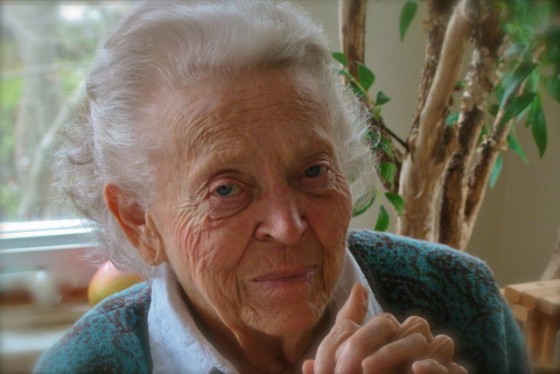
Elisabeth Elliot in heaven

Elisabeth Elliot

Just this morning, Elisabeth Elliot passed through the “gates of splendor” into glory. She has been one of my heroes of the faith for almost 40 years. I first read her first book, Through Gates of Splendor, in college. It tells how her husband and five other men with their families came as missionaries to Ecuador and were burdened to reach a tribe of killers known then as the Aucas, now as the Waorani. The men devised ways to reach out to them, and then to meet them, and although the reception seemed friendly, later all five men were speared to death. Later Elisabeth, her young daughter Valerie, and Rachel Saint, sister to one of the slain men, were invited to go live with the Aucas, and many of them became believers in Christ as Savior and laid down their spears.

That book started me on a lifetime of reading missionary books and reading Elisabeth Elliot. Her commitment to simply reading the Bible, obeying it, and trusting God no matter what the circumstances were an inspiration.You know, it shouldn’t be: that should be normal Christian life for all believers. But sometimes having someone go before us and call back that though sometimes He calls us to go through deep waters and dark valleys, it’s ok, because He is with us, someone who knows those dark valleys by experience…well, there’s just nothing like it.

Besides her commitment to God and His Word, her views of what it means to be a Christian woman shaped my own thinking. Let Me Be a Woman was pivotal for me. The Shaping of a Christian Family influenced my own, Keep a Quiet Heart kept my focus where it needed to be. A Path Through Suffering was one of the books that helped me wrestle through questions on that subject. On Asking God Why was another favorite. The first chapter of The Savage My Kinsman, in which she talks about going on as a widow and quotes William Cullen Bryant’s poem “To a Waterfowl” has endeared that poem to me forever, especially the line: “He, who, from zone to zone, Guides through the boundless sky thy certain flight, In the long way that I must tread alone, Will lead my steps aright.” Back to the Bible used to send out daily e-mail devotionals taken from her books: I think I have kept a copy of most of them.

Just a few of my favorites of her quotes:

Don’t dig up in doubt what you planted in faith.

The fact that I am a woman does not make me a different kind of Christian, but the fact that I am a Christian makes me a different kind of woman.

Faith does not eliminate questions. But faith knows where to take them.

This job has been given to me to do. Therefore, it is a gift. Therefore, it is a privilege. Therefore, it is an offering I may make to God. Therefore, it is to be done gladly, if it is done for Him. Here, not somewhere else, I may learn God’s way. In this job, not in some other, God looks for faithfulness.

Obedience to God is always possible. It is a deadly error to fall into the notion that when feelings are extremely strong we can do nothing but act on them.

The secret is Christ in me, not me in a different set of circumstances.

To me, a lady is not frilly, flouncy, flippant, frivolous and fluff-brained, but she is gentle, she is gracious, she is godly and she is giving. You and I have the gift of femininity… the more womanly we are, the more manly men will be and the more God is glorified. Be women, be only women, be real women in obedience to God.

How can this person who so annoys or offends me be God’s messenger? Is God so unkind as to send that sort across my path? Insofar as his treatment of me requires more kindness than I can find in my own heart, demands love of a quality I do not possess, asks of me patience which only the Spirit of God can produce in me, he is God’s messenger. God sends him in order that he may send me running to God for help.

Leave it all in the Hands that were wounded for you.

This video shows a few clips from the documentary Beyond the Gates of Splendor (which I encourage you to see if you ever have a chance):

World Magazine reported in an article just last year that she “handled dementia just as she did the deaths of her husbands. ‘She accepted those things, [knowing] they were no surprise to God,’ Gren said. ‘It was something she would rather not have experienced, but she received it.'”

I was sorry to hear she passed away this morning. We’ve lost one of the greatest lights of the Christian world here, but I’m happy that now she is beyond the reach of dementia and old age. I pray for comfort for her family and the many who will miss her influence. May we each shine His light faithfully in the sphere of influence He gives us.

I am sure many articles and blog posts will be popping up about her over the next few days, but two I’ve read so far are:

From The Gospel Coalition: Elisabeth Elliot (1926-2015)

From Christianity Today: Missionary Pioneer Elisabeth Elliot Passes Through Gates of Splendor

From John Piper (love how he captures some of her personality): Peaches in Paradise.

From Nancy Leigh DeMoss: She Trusted and She Obeyed.

“Not a long life, but a full one”

Recently I was reading a few paragraphs about the brief life of William Borden. Instead of going into the family business and leading the privileged life of a millionaire, he wanted to be a missionary. Not waiting until he got to the field to begin to minister, he was known for his walk with God and his efforts to reach people all through his college and graduate years. Then he died of spinal meningitis at the age of 25.

That brought to mind others whose walk with God and service for Him in their youth have been exemplary, yet they died relatively young: Jim Elliot, Nate Saint, Henry Martyn, Robert Murray McCheyne, David Brainerd, and others. The question comes unavoidably to mind: since they were so godly, so useful, so effective, why did God take them Home so young when they could have had decades of service in which to accomplish much for Him here?

I don’t know that we’ll ever have the answer to that: it’s wrapped in the mystery of God’s will and sovereignty. Somehow when someone like that dies, especially before their time, humanly speaking, somehow it does inspire others to try to become more like them, so that may be one purpose.

But I saw a new way to look at it this time. What if, instead of taking them home “early,” God had planned before they were even born that they would only live 25-30 years, and they just made the most of it?

Jim Elliot wrote in his journal, before he ever went to the mission field or heard of the people for whom he would give his life:

Seems impossible that I am so near my senior year at this place, and truthfully, it hasn’t the glow about it that I rather expected. There is no such thing as attainment in this life; as soon as one arrives at a long-coveted position he only jacks up his desire another notch or so and looks for higher achievement – a process which is ultimately suspended by the intervention of death. Life is truly likened to a rising vapor, coiling, evanescent, shifting. May the Lord teach us what it means to live in terms of the end.

He makes His ministers a flame of fire. Am I ignitable? God deliver me from the dread asbestos of ‘other things.’ Saturate me with the oil of the Spirit that I may be a flame. But flame is transient, often short-lived. Canst thou bear this, my soul – short life? In me there dwells the Spirit of the Great Short-Lived, whose zeal for God’s house consumed Him. ‘Make me Thy Fuel, Flame of God.’

God, I pray thee, light these idle sticks of my life and may I burn for Thee. Consume my life, my God, for it is Thine. I seek not a long life, but a full one, like you, Lord Jesus.

The ESV version of Psalm 139:16 says, “Your eyes saw my unformed substance; in your book were written, every one of them, the days that were formed for me, when as yet there was none of them.” Some might live only a few hours, a few years, or several decades. God knows our days. We don’t know how many of them we might have. It’s vital to live them all for Him.

That doesn’t necessarily mean becoming a missionary. Not everyone is called to that. It simply means living in close fellowship with Him and being a light for Him in whatever He calls us to: being a student, raising little ones for Him, caring for loved ones, showing forth His love in the home, workplace, and neighborhood.

So teach us to number our days, that we may apply our hearts unto wisdom. Psalm 90:12

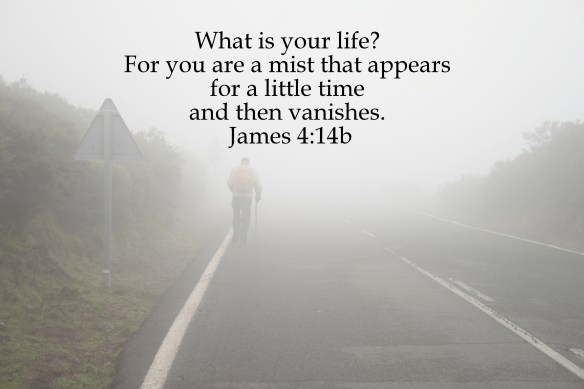
For what is your life? It is even a vapour, that appeareth for a little time, and then vanisheth away. James 4:14b

Photo courtesy of morguefile.com

Photo courtesy of morguefile.com

Sharing at Thought-Provoking Thursday.

Book Review: Gentle Savage Still Seeking the End of the Spear: The Autobiography of a Killer and the Oral History of the Waorani

Gentle SavageMenkaye was one of several Waorani (then known as Auca) men responsible for spearing to death Jim Elliot, Nate Saint, Roger Youderian, Pete Fleming, and Ed McCully, five missionaries who had come to try to reach them with the gospel, in what was known as Operation Auca. Gentle Savage Still Seeking the End of the Spear: The Autobiography of a Killer and the Oral History of the Waorani by Menkaye Aenkaedi with Kemo and Dyowe is Menkaye’s effort to tell his story in his own words – at least, as close to his own words as possible. He cannot write, so he shared his story verbally with someone who spoke his language as well as Spanish, and then it was translated from Spanish to English.

Menkaye begins with what could be called “the Moipa years.” Moipa was a highly skilled Waorani hunter who, out of fear of reprisals for the people he had killed, began killing almost everyone who crossed him or who might someday: men, women, children (who might grow up to take revenge), grandparents, anyone. The people lived in constant fear of him, and many attempts on his life did not succeed. When he finally did die, killing at the slightest provocation, for any real, perceived, or potential threat or wrong had become a way of life. That included any outsiders. Their encounters with non-Waorani had not gone well, and what could they want anyway except to encroach on their territory or to steal from them or hurt them? Better to kill them off before they struck first, they reasoned.

The missionaries had known that the Waorani, or Aucas, as they knew them, were violent, but they had learned some Waorani words from Dayuma, a woman who had escaped the tribe some years before, had flown Nate Saint’s plane over them a number of times, shouting out Auca/Waorani phrases, had dropped gifts to them and received some in return, so they thought the people were receptive to meeting them. They set up camp in their territory, and a man and two women  from the tribe came to visit them, the man even going up for a ride. Everything seemed to be going well. But then a group of Waorani came at them and speared them and tore the fabric off the plane.

Years later, when Elisabeth Elliot had come to know them and asked them why they had speared the men, they replied, “For no purpose.” In Olive Fleming Liefeld’s book, Unfolding Destinies, when she went back to visit and asked the same question, they told her they had not understood the photos the men had shown them. They thought the photos of Dayuma meant that she had died, supposedly at the men’s hands. Later still, Steve Saint related in End of the Spear that when he went back to live and work with the Waorani for a time, he was told there was a disagreement between them about one’s man’s wanting to marry one of the women. Some who were involved got angry, and to divert their turning on each other, someone turned their attention to the missionaries, starting a raid. Menkaye relates that all of these are true. One of the men involved in the argument they were having about marriage began to say that the photos meant that the men were cannibals, and they should spear them before the men killed and ate them.

This event that shook the world is given relatively few pages in Menkaye’s book. With all the people they had killed, these men were just a blip on their radar, another threat averted. But some time later, Dayuma came back to the tribe and told them they had made God angry and they needed to stop killing. Amazingly, they were willing to lay down their spears and hear more. Rachel Saint (Nate’s sister) and Elisabeth and Valerie Elliot (Jim’s wife and young daughter) were invited to come and teach them. Though I had read in Through Gates of Splendor and other books that over time several of the Waorani had come to believe on the Lord Jesus Christ as their Savior, it was touching and beautiful to hear this experience described in more detail by Menkaye and to hear him, Kemo, and Dyowe tell of the joy and freedom in their hearts. Dyowe told Rachel:

I want you to know…that I was one of the men…who killed your brother Nathanael when he was on the beach with the others. I know that God wants to forgive me. But I want to tell you too to forgive me for the things that I have done. I didn’t understand anything back then, and I didn’t know who they were. But I will say that I truly know God has forgiven me today. I want to give myself to Him. It was not only your brother who died. Many, many people died besides him at the point of my spear. But today is the last of my own spear for me. I have found a new spear to pierce the hearts of many people (p. 231).

Almost immediately they became concerned for other branches of the tribe that had broken off to live in new areas, and they tried to reach them with the gospel. Some were martyred in the attempt, and most of these other branches are still not believers, thus the second part of Menkaye’s rather bulky title about still seeking the end of the spear. In fact, one of the end notes relates that while the book was in progress, another raid had taken place against oil company employees.

The next part of Menkaye’s book tells of changes that have taken place in the Waoranis, and the last few chapters, some of the most valuable for anyone seeking to work with tribal people, are his vision for his people. He and other Waorani are not opposed to progress and to changes. They see them as inevitable. Menkaye’s own son attended aviation school in Michigan in the US. They don’t want their young people to lose their Waorani skills and heritage completely, though, and they want any future work within the tribe to be handled differently than it has been. In the past, people were sent in who pretty much took over instead of coming under the tribal leadership – even Rachel and Dayuma. Rachel wanted to set Dayuma in charge, but either Dayuma wasn’t quite cut out for it or the authority went to her head or she backslid or something – Menkaye details a number of problems with her leadership. To be generous, this was something Rachel and Dayuma had not been trained for, and mistakes were made. Menkaye and the others are not bitter and they appreciated everything done for them, especially helping them to understand the gospel, but they did want to point out some of the issues and correct them.

The ones who should be choosing the leaders are the Waorani themselves, based upon what we ourselves see in those candidates, young or old, who have demonstrated maturity from a Biblical perspective, and have carefully studied the Bible in order to know the principles in depth that will be taught and lived out. Never should it be a random choice based on a superficial view of any person., especially someone from the Outside (p. 323).

Reading this makes me appreciate even more the emphasis among missionaries our churches have supported in leading rather than driving the people and in training up leaders from within the people group they are ministering to rather than continuing to bring in leadership from the outside.

I’m sure another difficulty in working with tribal people is how to navigate changes. One doesn’t want to unduly influence their culture, but one doesn’t want to hold them back, either. That is all I can figure was going on when the people began to ask Rachel for clothes and boots, and she said they had done fine without them before and didn’t need them now, according to Menkaye. But they had always lived and worked in the jungle before, where it was shady, and Rachel had them out in the open under the hot sun clearing space for an airstrip and didn’t seem to understand they wanted protection from the sun beating on their backs. I think either she was trying not to change them in that way, or she was trying to squelch their looking for handouts, but evidently this is one area where she and Elisabeth disagreed: Elisabeth thought they should have clothes and arranged for them. (They kept wearing clothes but had mixed emotions about shoes. They found that boots protected them from “thorns, ants, and vipers,” but the weight of them felt odd to them, and “when we were climbing the steep mountain ridges, they made us slip in the mud and slide downward” [p. 227].)

I’ve mentioned before in other missionary book reviews (particularly here) that some people think of these primitive tribal communities as simple people frolicking in the sun who shouldn’t be disturbed by missionaries and businesses. Dr. Jim Yost says in the forward, “The tendency to idealize or romanticize ‘primitive’ culture falls to crushing blows here as the reality of life in the upper Amazon rainforest plays out in gruesome details often too explicit or vivid for the cushioned Western mind.” (p. v). How many of us would have wanted our culture to remain as it was hundreds of years ago just to preserve it? Progress has its problems but also its opportunities.

Menkaye and other Waorani are willing to embrace these opportunities while still maintaining the Waorani culture and autonomy. He has great ideas for them to integrate with the “World of the City,” to help his people explore endeavors in which they can make their own money, and to help their young people have the best opportunities for a changing future.

I do not intend to offend the churches of The Outside World who perceive their role as one of coming in to show us how to do things, but in reality, we can learn equally from each other. Is that not true? Do we not have many things to teach each other and to learn from each other? (p. 329).

If you bring us a new idea, we will welcome that, too. But we will always weigh and balance the influences and outcomes of every new component, and determine together what projects are useful and valuable, and which ones may be harmful in some way (p. 338).

The Waorani are storytellers, but their way of sharing stories is different from ours. There is much more detail than I would personally care to know about some issues, much less than I wanted to know about others, and the stories are laid out differently than we would be used to. There is an appendix of Waorani myths and legends at the end: some seem odd, some are gruesome. But then, they would probably think the same way about our fairly tales and Mother Goose rhymes.

I think this book is incredibly valuable to anyone interested in the heritage of the ministries of the Saints, Elliots, and others who initiated “Operation Auca,” and to anyone with an interest in missions, particularly in ministry to tribal peoples. I hope Menkaye lives a long time to carry out his vision and that others take it up as well.

(This review will also be linked to Semicolon‘s Saturday Review of Books.)

Why Read Biographies?

You would think a post like this would come at the beginning of a series titled 31 Days of Inspirational Biography rather than the end. That would have been more logical – but I didn’t think of it then beyond the few remarks in my introductory post. However, having been steeped in biographies all this month, I have been reminded of several good reasons to pursue them.

I’ve always been interested in people’s stories, in what makes them tick. The very first book I remember checking out at my school library in first or second grade was a biography of Martin Luther (that may not have been the first book I ever actually checked out, but it is the first I remember). I’m sure I read more through my school years, but it was at college that an older woman spoke to a group of us involved in praying for missionaries about her years of reading missionary biographies and the benefit they were to her. That got me started reading Christian and missionary biographies, and that practice was reinforced at the first church we attended after we were married, where a part of the monthly ladies’ meetings included a book report by one of the officers from one of the books in the group’s lending library. So I have been purposefully reading biographies for some 35+ years.

The first benefits that come to mind from reading biographies are the same first benefits gained from reading anything: learning about other places, times, cultures, people, gaining empathy for the people in the story, and understanding how other people think and react.

While you can derive these benefits even from fiction (I have another post in the works about the benefit of reading fiction), biographies and “true life” stories have the advantage of being real. Though spiritual truth can be conveyed even in fiction, in a biography there is no arguing with how the story should have ended or what directions the plot should have taken. If you believe in God, as I do, part of reading a biography is tracing His hand in people’s lives, even, perhaps especially, when the circumstances are different from what we would have thought they would or should be. Though I primarily read Christian biographies, I enjoy some secular ones, and it is interesting to see not only what has influenced them, but they also often have some brush with spiritual truth (Robert Burns‘ story, for example).

We learn history for a number of reasons, among them: to better understand our current times, to appreciate our heritage, to avoid repeating mistakes. There are heroes in our national history who inspire us to a love of country and duty and courage. There are heroes of our spiritual heritage who inspire us in love and dedication to God and to greater faith in remembering that the God they served and loved and Who provided for and used them is the very same God we love and serve today and Who will provide for and use us. Though times and culture change, human nature at its core doesn’t change much, and God never changes.

For me the primary  reason for reading Christian biographies is to follow others as they follow Christ, as Paul said. No, they won’t be perfect, but we can learn from their mistakes just as we learn from David’s or Peter’s in the Bible. Missionaries would never want to be thought of as super-Christians or a step above anyone spiritually, but by and large there usually is a seriousness and maturity in their walk with the Lord, some wrestlings and overcomings, if they have gone through everything they need to in order to get to a mission field. Even though I am not called to “the” mission field (it’s my belief that every Christian is called to “a” mission field, whether on foreign soil or in their own homes and neighborhoods), I can still learn much from what Christians who have gone before me have learned and experienced.

Some people, including a former pastor of mine, don’t like to read older biographies because they made the subjects seem almost too good to be true. Even Isobel Kuhn, whose writing I love, put Amy Carmichael’s books, which I also love, back on the shelf because she thought she was too high and unattainable (I think Amy would either be highly dismayed or would laugh that anyone thought such about her). Admittedly some older Christian biographies can seem unrealistically perfect. I think there are several reasons for this: I think a “warts and all” type of biography was not the fashion in older times like it is today, even in secular biographies, and since Christians are generally instructed to give each other the benefit of the doubt, love each other, overlook each other’s faults, and not gossip or “backbite,” I think that would come into play in writing a biography as well. Yet the Bible shares people’s faults and sins in a realistic and not malicious way. I think we relate to people better when we can see that they are as human as we are, but they acknowledge their faults and are growing in sanctification. I think many of them would probably blush to read the glowing reports people wrote after their deaths.

Let me share, as well, some points to keep in mind when reading Christian biographies.

When reading any book, of course we filter everything through our own frame of reference. But an author can’t possibly know what every reader’s frame of reference will be even in her own time, much less hundreds of years later. So it is the reader’s responsibility to try to figure out the author’s frame of reference or at least to give the benefit of the doubt.

Different times and cultures will yield different practices. It’s fairly common in older missionary biographies for them to speak of servants. That doesn’t mean they were living upper class Western lifestyles while ministering to more primitive people. In more primitive cultures especially, sometimes they would hire help in the kitchen or for certain household tasks so the couple, particularly the wife, could teach or minister in other ways. (Even in modern times I had a missionary friend who mourned over having to spend so much time in the kitchen instead of  in ministerial pursuits: if that is so today, imagine what it would have been like 100+ years ago). Too, in some cultures where becoming a Christian could cost someone their job or family standing, sometimes missionaries would hire them in order to help them out.  Today they might say they hired help or employed someone; likely no one would use the word “servant” today. Another example would be schooling situations. In a lot of older biographies, missionaries sent their kids off to a mission school at a fairly young age because there was no appropriate school available and home schooling as it is known today was unheard of.  Often it was agonizing for both parents and children, and some stories share how God gave grace for the parents to cope. We can’t really hold it against parents then for sending their kids off if that’s all they knew to do at the time. I think the hardships involved as well as the realization that educating and raising their kids was a part of their ministry and testimony led to the changes we see today, where most missionaries home school and some send their kids to public schools in town. But we can understand that God could give grace to people who sent their kids away to school even while that is not a choice most of us would make today.

Even in the more glowing missionary books, you won’t agree with everything. You likely wouldn’t agree with everything even in a biography of your best friend or closest loved one. No two of us is going to agree on every little point of faith and practice. One of the things that stood out to me in 50 People Every Christian Should Know by Warren Wiersbe is that a lot of those people would be on opposite sides of certain fences from each other, yet God used them all. That doesn’t mean the fences and sides don’t matter: each of us is responsible to search out issues and take the stands we feel most faithfully represent Scripture. There are fundamental or foundational issues on which we cannot budge, but there are some beliefs and practices where we can give each other room to differ.

On the other hand, there are those foundational issues to consider. If someone is preaching a false gospel which is going to lead his followers to hell, we need to be aware of that and even warn people about it even though some of what they might say sounds compatible with Scripture, which tells us to “rebuke them sharply,” “mark them and avoid them,” “receive him not. ” Even the devil uses Scripture and appears as an “angel of light.”

I think to sum up what I have been verbosely trying to say in the last few paragraphs, we need to be discerning but not critical.

On the other hand, you might find practices you want to emulate, but don’t feel you necessarily need to change everything with every biography you read. In my early years of reading them, I might be inspired by how one had their time in the Bible, and in the next book I’d see a different way and wonder if I should try that. Feel free to try some of those things and glean what works best for you, but don’t feel tossed about or feel you have to do something just like they did.

Instruction. Encouragement. Inspiration. Illustration of the Christian life in action – overcoming difficulties, growing, seeking God’s wisdom, help and grace. Comfort from that which has comforted others. Warning from their mistakes. These are among the many reasons I enjoy reading Christian biographies.

I’ve often said that reading Christian biographies has been the most influential impact in my Christian life, next to the Word of God itself. I’ve posted this poem before, discovered by an unknown author in the first pages of Rosalind Goforth’s Climbing, but I post it here again as it embodies what Christian biographies have been to me:

Call Back!

If you have gone a little way ahead of me, call back-
It will cheer my heart and help my feet along the stony track;
And if, perchance, Faith’s light is dim, because the oil is low,
Your call will guide my lagging course as wearily I go.

Call back, and tell me that He went with you into the storm;
Call back, and say He kept you when forest’s roots were torn;
That when the heavens thunder and the earthquake shook the hill.
He bore you up and held where the very air was still.

O friend, call back, and tell me for I cannot see your face;
They say it glows with triumph, and your feet bound in the race;
But there are mists between us and my spirit eyes are dim,
And I cannot see the glory, though I long for word of Him.

But if you’ll say He heard you when your prayer was but a cry,
And if you’ll say He saw you through the night’s sin-darkened sky-
If you have gone a little way ahead, O friend, call back-
It will cheer my heart and help my feet along the stony track.

Robert Murray McCheyne said of Jonathan Edwards, “How feeble does my spark of Christianity appear beside such a sun! But even his was a borrowed light, and the same source is still open to enlighten me.” May we learn from these “borrowed lights” to seek the same Light they did.

photo 3(2)

For the 31 Days writing challenge, I have been sharing 31 Days of Inspirational Biography. You can find others in this series here.

(Sharing with Literary Musing Monday)

31 Days of Inspirational Biography: The Last CIM Missionaries in Communist China

In 1950, Arthur and Wilda Mathews and their 13 month old baby, Lilah, traveled to Hwangyuan, China. China had fallen to Communism, and other missionaries were leaving, yet the Chinese church had invited them to come, with the approval of the Communist government. They felt this was a miraculously opened door God would have them go through. Yet, when they arrived, they could sense that all was not well. The Christians pastors who met them were strained, and they discerned that between the time of their invitation and arrival, the Chinese learned that association with the white people would be a liability under Communism, not a asset. The Mathews then thought perhaps, if they could not be a help to the church, they could endeavor to evangelize the unreached Mongols in the area and nearby. They had a few weeks in which to minister, but soon found that they were restricted in ways they could help. They endeavored to set up an inn with which to reach the Mongols, but Chinese troops took it over the day before it was to open. Arthur protested, but soon found it would have been wiser to have said nothing. In two days a policeman came to the mission compound to announce that no one there could do village work without permission, and the white people were forbidden everything: they could not have meetings outside the compound, they could not give out tracts or dispense medicine. They were restricted to the mission compound.

They finally decided that since they were more of a hindrance than a help, they would apply for exit visas. They thought, since the government did not want them, they would be allowed to leave quickly, and so gave away or sold dishes, curtains, etc., keeping just the bare minimum to function until they could leave. Arthur was summoned to the police station and asked to sign a statement that he was for world peace. He had heard of another missionary having to sign some document before leaving, so he signed without thinking much of it. The government official then asked what contribution Arthur was then willing to make toward world peace, outlining a plan in which Arthur would go to India and essentially be a Communist spy. Arthur realized that the Communist definition of world peace was a world dominated by communism, and of course could not consent.

A government official called Arthur in and promised his exit visas if he would do something for them, like write a report of five other missionaries. At first Arthur did write glowing reports of the missionaries in question, but someone told him he dare not turn that in: the Communists would change what he had written but keep his signature. So Arthur threw his report in the fire and told the official he could not be a Judas. The official then told him that he could have given him a pass, if he had cooperated, but now a charge had been laid against him which must be investigated, and “investigations take a long time.”

Thus began a two and a half year ordeal. Their provisions from their mission were frozen by the government, which made Arthur submit a report of what he would need, and then they doled out to him much less than what the report said he needed. Every victory they mentioned in a letter seemed to be immediately challenged by the enemy of their souls: once when they wrote what a blessing Lilah was, she then came down with scarlet fever, and they almost lost her. All of them had turns being ill. Eventually they were told that no one could speak to them, and they could only leave home to draw water from the creek and get food.

They wrestled with the “what-ifs” and the frustration of what they called “second causes,” finally coming to the conclusion that they had to trust that the Lord was in control and had them there for a reason, though it was hard to discern that reason when they were so restricted. Yet the Lord did use them even when they could not speak to the people. The few weeks they had had to minister before restrictions set in, people knew their hearts and saw their love. When the Mathews could no longer speak openly, the people saw them in tattered clothes, persecuted, attacked by illness without much medical aid, laughed at, jeered, humiliated, doing menial, degrading work just to survive, tantalized by the government offering release and then not giving it or doling out money that was theirs in the first place. They saw the Lord provide miraculously for them in many ways. Yet more than that, they saw them endure graciously and joyfully until, finally, the Mathews became the last CIM missionaries to leave China.

Green-Leaf-in-DroughtHow the Lord provided for them and ministered through them in unexpected ways are some of the most exciting parts of the book Isobel Kuhn wrote of their story titled Green Leaf in Drought. She says,

But most amazing of all was their spiritual vigour. Whence came it? Not from themselves: no human being could go through such sufferings and come out so sweet and cheerful. As I was in a small prayer meeting… one prayed thus: ‘O Lord, keep their leaf green in times of drought!’ I knew in a moment that this was the answer. Jeremiah 17:8: “He shall be as a tree planted by the waters, and that spreadeth out her roots by the river, and shall not see when heat cometh, but her leaf shall be green; and shall not be careful in the year of drought, neither shall cease from yielding fruit.” That was it! There was an unseen Source of secret nourishment, which the Communists could not find and from which they could not cut them off…That is needed by all of us. Your drought may not be caused by Communism, but the cause of the drying up of life’s joys is incidental. When they dry up — is there, can we find, a secret Source of nourishment that the deadly drought cannot reach?…Is it possible for a Christian to put forth green leaves when all he enjoys in this life is drying up around him?

The answer, by God’s grace, is yes!

(Reposted from the archives.)

photo 3(2)

For the 31 Days writing challenge, I am sharing 31 Days of Inspirational Biography. You can find others in the series here.

31 Days of Inspirational Biography: Young Mother Trying to Find Time For Bible Reading

The following is another excerpt from Climbing by Rosalind Goforth, which I have mentioned the last couple of days and  many times before. This book shares a very human view of a woman after God’s own heart who also was “of like passions” as we are.

A devoted Christian missionary, Mrs. S, was holding a series of special meetings for our Christian women at Changte. On one occasion, this dear woman, who had no children, told me that I could never have the peace and joy I longed for unless I rose early and spent from one to two hours with the Lord in prayer and Bible study.

I longed intensely for God’s best — for all He could give me, not only to help me live the true Christian life but also for peace and rest of soul. So I determined to do what Mrs. S. had advised.

The following morning, about half-past five o’clock, I slipped as noiselessly as possible out of bed. (My husband had already gone to his study.) I had taken only a step or two when first one and then another little head bobbed up; then came calls of, “Mother is it time to get up?”

“Hush, hush, no, no,” I whispered as I went back, but too late; the baby had wakened! So, of course, the morning circus began an hour too soon.

But I did not give up easily. Morning after morning I tried rising early for the morning watch, but always with the same result. So I went back to the old way of just praying quietly — too often just sleeping! Oh, how I envied my husband, who could have an hour or more of uninterrupted Bible study while I could not. This led me to form the habit of memorizing Scripture, which became an untold blessing to me. I took advantage of odd opportunities on cart, train, or when dressing, always to have a Bible or Testament at hand so that in the early mornings I could recall precious promises and passages of Scripture.

In another place she writes of finding at the last minute that the woman who was supposed to speak at a certain function couldn’t, and she was asked to. She nursed the baby with one arm while looking through her Bible and jotting notes as she could with the other. When Jonathan came through and saw her, he wondered how she could possible get ready for a meeting under such conditions in so short a time. She replied that if she’d had hours to work on it, she would have taken it, but she trusted God would give her just what she needed in the time available.

A few pages later she writes that sometimes she got out a concordance and her Bible to study out something which she needed help on at the time. She ended up with forty outlines resulting from her studies which the Lord used first in her own life, and then in talks to other ladies.

I expanded on this theme of trying to have devotions with young children in the house in an earlier post titled Encouragement For Mothers of Young Children. I went through quite a spiritual slump at one point due to a lack of spending time with God, and He showed me some ways to do so at that super-busy time of having little ones that wasn’t my usual routine, wasn’t even a setting where I would normally “get anything” from his Word, but He enabled me in those times. I hope perhaps it will be an encouragement to some of you in that stage of life – or any stage.

photo 3(2)

For the 31 Days writing challenge, I am sharing 31 Days of Inspirational Biography. You can find others in the series here.

Book Review: How I Know God Answers Prayer

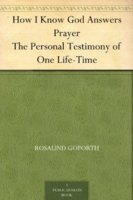
How I Know God Answers PrayerI think I first read Rosalind Goforth’s first book, How I Know God Answers Prayer, maybe in my twenties, so about 30 years ago. I don’t remember how many times I have read it since. It is a testimony of how God has answered prayers both small and great in her life through the years, spurred by people’s occasional response that perhaps what seemed an answer to prayer was just a coincidence that would have happened anyway. She wanted to demonstrate through a lifetime of her walk with God that prayer is just a child of God asking her Father for what she needs, and seeing Him answer – not always just the way she originally wanted, but with love and wisdom nonetheless. Of her three books, including Goforth of China (a biography of her husband) and Climbing (a book she was asked to write concerning some of her own experiences and perspectives), Climbing is my favorite, but this book is very good as well.

Since I was reading it this time for Carrie’s  Reading to Know Classics Book Club, I tried to view it as others might who have not read it before.  For the first time I thought perhaps a little of the effect of what she relates might have been lost by the description of events taken out of context. For instance, when she writes near the end about finding “that the Lord could guide me even in trimming my hat to his glory,” some people might think, “What?” In Climbing, one of the difficulties she underwent was criticism of her dress when she would come home on furlough. There was no Internet, Facebook, or even Wal-Mart in those days to keep up with what was going on in the fashion world back home, and she had no idea what would be stylish or out of style or different from the last time she had been there. It is really ridiculous that people would criticize under such circumstances, but they do. Once when a lady offered to get new outfits for her when she was home, she was relieved, until the lady brought her garments entirely in black, which she evidently thought was appropriate for missionary ladies. Jonathan told her she looked like she was in mourning, but she felt she couldn’t refuse the gifts without causing offense. She didn’t necessarily want to be up-to-the minute in the latest styles (in fact, when Merry Widow hats were in style at one point, she thought they were ridiculous and tried to find a way not to wear them), but she didn’t want to be a distraction, either, as they visited churches and conferences. In that book she relates some of God’s leading and answers to prayer regarding that whole issue, represented here just by the sentences, “I found the Lord could guide me even in trimming my hat to his glory! That is, so that I could stand before an audience and not bring discredit to my Master.”

She mentions the anti-foreigner sentiments and some of the dangers involved, but I don’t know if readers will understand just how pervasive and dangerous it was. China was a very closed-off country then, and anything “foreign” was suspicious (one reason why Hudson Taylor advocated dressing like Chinese rather than British). She does mention here that one of the ways she and her husband tried to combat this was to hold “Open House” where they’d let their neighbors come in and tour the house so they could see there wasn’t anything dangerous about them. In one of her other books she writes that one of these times, someone saw her daughter’s dolls in her bed and spread the word that the Goforths kidnapped children and shrunk them. It seems ridiculous now that anyone would think that, but it was a very superstitious and suspicious time. Rumors like that could at the very least cause people to avoid them, and at the worst set off a powder keg of anger. Sudden mob violence was not uncommon, especially leading up to the time of the Boxer rebellion. I remember reading in another book (I forget whose) about a missionary having in her school a skeleton for educational purposes, and then trying to decide how best to dispose of it so people wouldn’t think they had killed someone. Trying to preach a gospel that the people were probably going to react negatively against at first in such a setting indeed required a lot of prayer and faith.

But even with some events taken somewhat out of context, she presents a testimony full of grace in how the Lord dealt with her. Some of the answers she relates were major –  a sudden breakthrough in her husband’s grasp of the language when he was discouraged and near giving up, found later to have happened right at the time that a group in his old college had met to pray for him, response in meetings found to have happened when others were praying (incidents that should remind and encourage us to pray for others), healing when all other help had been exhausted, protection from danger, especially in their escape during the Boxer rebellion. Of the last, she was asked why God spared them so miraculously but not others. She responded:

Truly a vital question, which could not lightly be set aside! Humbly and prayerfully we pondered this “Why” in the light of Scripture. In the twelfth chapter of Acts, we read of Herod’s succeeding in putting James to death by the sword, and directly after comes the story of how Herod was hindered in carrying out his intention to kill Peter who was delivered by a miracle. Then who could read that marvelous eleventh chapter of Hebrews with its record of glorious martyrdom and miraculous deliverances without being thrilled? In face of these and many other passages, while still unable to answer the “why,” we saw our Almighty God used His own prerogative to glorify His name whether in the glorious martyrdom of some or in the miraculous deliverance of other.

I referenced this a few months ago in a post on our pastor’s cancer, how God heals some but not others, for reasons only He knows.

Such big and dramatic answers to prayer can be thrilling, but what touched my heart even more were the smaller, “everyday” answers: a lost key found, provision for clothes, a gift of fresh fruit, the need for a telephone and a coat and help during a speaking engagement when she felt ill.

Some of the incidents were deeply personal, such as the time her husband wanted to go touring out among the people, and she said no at first, for the safety of the children (smallpox was rampant and the Chinese then had no thought of keeping sick people home). She had to learn that “‘the safest place’ for myself and the children ‘was the path of duty.'” Though several of her children died from other causes, none died during this time in their ministry once she yielded to the Lord about it. Another personal situation was finally understanding what it was to rest in the Lord and trust Him for salvation from the power of sin and not just the penalty of it, after feeling like she had been on something of a roller coaster spiritually for 40 years.

Something else I thought some people might have a problem with in reading her book were the times she mentioned prayer being hindered by a wrong attitude or bitterness on her part, or, in one instance, the fact that she felt God allowed something to bless her for responding in a right way. These days what we often hear is that God deals with us on the basis of His grace, not our “performance.” That is true. Yet there are instances in Scripture, even in the New Testament, of disobedience hindering. We’re told that some people are sick and some have died because of partaking of the Lord’s Supper in a wrong manner, that we should reconcile with our brother before offering a gift to God, that confession of sin is a part of praying for healing, that we can’t expect forgiveness if we don’t forgive. We’ll never be perfect, but we can’t expect the Lord’s blessing if we are hanging on to known sin. As to the other, does God ever do a special little something for us when we obey in some area or do the right thing? I don’t know – I can’t think of a Scripture reference that deals with that exactly in the New Testament. We tend to think, especially when reading the Old Testament, “Be good and God will bless me, mess up and He will come after me hard.” But even there Job experienced great calamity even though he was doing everything right, and the wicked seem to prosper even when they are not obedient. Ultimately everything that God allows comes from His wisdom, love, and grace. But I have felt at times, especially in my very early days as a Christian, that some blessing or answer to prayer came just after taking an important step in the right direction, not as a reward or as God patting me on the head for doing right, but just as a little encouragement from a Father to His child. Don’t we do the same for our children? When we see them struggle in an area and do the right thing, don’t we give them some kind of encouragement, even if it is just a smile or a nod or a thumbs up or a “Well done”? Of course, we need to do right even if no one seems to notice or care or no “blessing” comes in response. I don’t think this nullifies the fact that it all comes from God’s grace because we can only obey and make right decisions with His grace. (I’ve written earlier that grace does not nullify the need for obedience but rather enables it. See Of grace, law, commandments, rules, and effort and What grace does not mean). God blesses us far beyond our ability to obey as it is, and obedience should be an outgrowth of love and reverence for Him rather than a “work” to “earn” blessing. This is too involved a topic for this post, but I feel sure she isn’t advocating that prayer and obedience are like vending machines where we put in out part and then expect God to do His – not at all.

Since this is a testimony of answered prayer, naturally most of the anecdotes involve those answers. Yet she also shares some times when God didn’t answer, at least not in the way she prayed for. In one instance, years later she could see and was thankful for the fact that He hadn’t granted a particular request, one that would have changed the path of her life away from China. In other instances, like healing that did not come and the deaths of several of her children, she continued to trust even though she couldn’t understand.

I don’t think Rosalind shared any of these answers to prayer with the attitude, “Look at me and my wonderful answers to prayer. Aren’t I special?”  I think she would have been horrified that anyone would think that. I think rather, she just wanted to show forth His provision and willingness to take care of His dear children’s needs, like the psalmists, whose testimony was, “Hear what great things the Lord has done and how He delivered me.” Every Christian walking and talking with God would have a record like this whether written or not, though admittedly probably not with situations like being delivered from an angry mob on the list. But like the Ebenezers I mentioned a few weeks ago, we should all be able to look back on those times where God met with us, provided for us, and answered prayer for us in a way that only He could. It’s good to share things like this with our families, so they know God didn’t just meet people’s needs back in Bible times, but He still does today. Such things redound to His praise and encourage us in the Lord when “when I remember you upon my bed, and meditate on you in the watches of the night;  for you have been my help, and in the shadow of your wings I will sing for joy.  My soul clings to you; your right hand upholds me” (Psalm 63:5-8).

photo 3(2)

For the 31 Days writing challenge, I am sharing 31 Days of Inspirational Biography. You can find others in the series here.

Reading to Know - Book Club

(This will also be linked to Semicolon‘s Saturday Review of Books.)

31 Days of Inspirational Biography: Ann Judson, Brave and Faithful

Every missionary has to have dedication and has to be willing to make sacrifices, even in our day. But the amount of dedication and sacrifice and willingness to step into the unknown displayed by Adoniram and his wife and the small group who stepped out with them just amazes me. His wife, Ann Hassletine (also called Nancy) is one of the bravest women I have ever read of, going into the great unknown as she did and facing all that she did in later years. The letter Adoniram wrote to ask her father for her hand in marriage in July of 1810 is an atypical proposal, but frank:

I have not to ask, whether you can consent to part with your daughter early next Spring, to see her no more in this world; whether you can consent to her departure, and her subjection to the hardships and sufferings of missionary life; whether you can consent to her exposure to the dangers of the ocean; to the fatal influence of the climate of India; to every kind of want and distress; to degradation, insult, persecution, and perhaps a violent death. Can you consent to all this, for the sake of Him who left His heavenly home and died for her and for you; for the sake of perishing immortal souls, for the sake of Zion, and the glory of God?

He was not being melodramatic: he was being realistic. It says a lot about Nancy that she accepted such a proposal, especially as it was written only a month after they had met. It took her two months to respond.

Adoniram and Ann were among the first missionaries that we know of that America sent out. I wrote about Adoniram’s biography, To the Golden Shore, last year, but this time I want to focus on Ann.

Ann had come to saving faith in Christ as a teenager, and since that time had developed a strong sense of reverence and dedication to God and a desire to be useful in His service. She would not have taken such an offer as Adoniram’s lightly. She consented and married him more than a year later.

Theirs is one of the most fascinating and, in many ways, heartbreaking stories in Christendom. They sailed for India with a few others. They left as Congregationalists, but during their months at sea their study of baptism in Scripture led them to become Baptists. This step of what they felt was obedience was also a step of faith, as it meant they would no longer be supported by the Congregationalists. Whatever your feelings about modes of baptism and denominations, it says a lot about their character that they would follow through with what they believed to be right as a matter of conscience even though it would cost them in many ways.

Through a variety of circumstances too long to tell here, they ended up in Burma (now known as Myanmar) rather than India. During they voyage Ann had delivered a baby which died and was buried at sea. They labored for six years without a convert and worked on translating the Bible into the native language. Within a year after that first convert, they had baptized 18 Christians. Ann opened a school for women and children. Another son was born and died.

Adoniram was imprisoned for a year and a half due to circumstances too long and detailed to go into here, but involved the Burmese misunderstanding of Adoniram’s banking situation, and they thought they money he was receiving for support from the British, with whom they were at war, meant he was a spy. Ann faithfully visited, bribed the guard so she could see Adoniram, brought him food and encouragement, smuggled his Bible translation work to him a hard pillow, repeatedly appealed for his release, and did what she could to relieve the suffering of the other prisoners as well. When Adoniram and other prisoners were forced to walk barefoot 8 miles to another prison, Ann took her baby daughter and followed. She wrote to her brother around this time, “But the consolation of religion, in these trying circumstances, were neither ‘ few nor small!’ It taught me to look beyond this world, to that rest, . . . where Jesus reigns and oppression never enters.” She fell severely ill with smallpox and spotted fever, and Adoniram was able to nurse her back to health when he got out, though she remained weak. Some time later she contracted another fever she could not fight off. She died at the age of 36, and her baby daughter died soon after.

She had wanted to be  “useful,” and God certainly did use her throughout her life and since. After her death God worked through a book she had written about the early mission work in Burma to inspire interest in missions. He works through her biographies today to encourage us to a closer walk with God and closer dedication to Him. To the Golden Shore naturally has much about her as well as Adoniram, and My Heart In His Hands: Ann Judson of Burma by Sharon James tells Ann’s life story primarily through her journals and letters. Unfortunately it is not in print, but used copies can be found for just a few dollars (somebody needs to work on getting some of these books on Kindle!) Some years ago I read The Three Mrs. Judsons by Cecil Hartley, but I don’t remember much about it. It is available online here. In looking for that one I came across Lives of the Three Mrs. Judsons by Arabella Stuart that is free for the Kindle: I haven’t read it but just ordered it. It is also available online here.

The title from Sharon’s book comes from a journal entry of Ann’s after she accepted Mr. Judson’s proposal:

If nothing in providence appears to prevent, I must spend my days in a heathen land. I am a creature of God, and he has an undoubted right to do with me, as seems good in his sight… He has my heart in his hands, and when I am called to face danger, to pass through scenes of terror and distress, he can inspire me with fortitude, and enable me to trust in him. Jesus is faithful; his promises are precious. Were it not for these considerations, I should sink down with despair…But whether I send my days in India or America, I desire to spend them in the service of God, and be prepared to spend an eternity in his presence. O Jesus, make me to live to thee, and I desire no more.

photo 3(2)

For the 31 Days writing challenge, I am sharing 31 Days of Inspirational Biography. You can find others in the series here.


31 Days of Inspirational Biography: Margaret Paton, Missionary to Cannibals in the South Sea Islands

Margaret PatonI wrote last year about John Paton, a missionary to the New Hebrides in the 1800s and a great man of God, who is the source of one of my all time favorite missionary quotes. Before he went to the field, some regarded him as foolish for going to minister where there were cannibals. To one man’s warning about his potential fate, he replied, “Mr. Dixon, you are advanced in years and your own prospect is soon to be laid in the grave, there to be eaten by worms. I confess to you that if I can but live and die serving and honoring the Lord Jesus, it will make no difference to me whether my body is eaten by cannibals or by worms.”

Some time ago I happened upon a book titled Margaret Paton: Letters From the South Seas, which, as its name implies, is a collection of letters that John Paton’s wife sent out over the years. The letters were written primarily to family back home, though there are a few to other individuals. They are quite long, but that is because they did not have the opportunity to send and receive mail very often. Since they were written to family, they contain more personal glimpses and anecdotes than a prayer letter to supporters would, and Margaret (or Maggie, as she signs herself) often had an amusing way of telling them. But there were also times of tragedy and perplexity that they experienced, and Maggie’s letters convey the situations and the wrestlings of heart they had in trying to discern the Lord’s will and His grace through every trial.
Rather than trying to summarize the whole book, I just want to give you a few excerpts here and there.

Maggie was John’s second wife: his first wife and son had died of malaria on the island of Tanna. When Maggie first came to the island with John, he pointed out “that Sacred Spot [the grave of his wife and child], so indelibly photographed on his memory. Oh, how I longed to spend a quiet hour by the grave of her whose footsteps I feel so unfit to follow, and who met her trials so unshrinkingly and alone — alone, so far as regards female companionship and sympathy!”

They were going to another island to labor and dropping off fellow missionaries at their respective islands on the way. On one island, “Great crowds of people came to look at us, as I believe we are the first white women who eve landed on Fotuna. The ladies were, in consequence, very curious to have us examined properly; and they went about it in a business-like way, as I can testify from the pokes and thumps received. They always felt themselves at the same time, to see how far we were alike. Poor things, they had yet to learn that we were sisters, resting under the same penalty and equally in need of and entitled to the same Saviour.” Then she mentioned having to “escape” when “their examinations” became “rather too minute.”

One thing that some missionaries struggle with, especially in primitive areas, is whether their living arrangements should be just like the natives or closer to what they are used to. There is no one right answer: it depends on the place, the people, health issues, and the leading of the Lord in each circumstance. The Paton’s home would have been nothing really like European homes, but Maggie writes, “I am trying my best to make it the prettiest and most inviting home I know — as refined, as civilized, and as nearly what we have been accustomed to, as our limited resources will permit. We must not let ourselves ‘down’ because we are among Savages, but try rather to lift them up to our Christian level in all things. One’s home has so much influence on one’s work, and on life and character; and it is due to our two wee boys to make it a bright one…it is no part of my creed to believe that…everything pleasant in sinful.” She then writes that, before she left for the field, one lady told her, “that missionaries’ wives were expected to live and dress in the most primitive way, and to set an example of great gravity and solemnity, else they would get to be talked about.” After wrestling with the “old Adam” in her, Maggie “controlled myself to retort, that in my Bible there was no separate code of rules for missionaries’ wives, any more than for other Christian gentlewomen.” She then wonders “that any one can be blind to the fact that our kind Creator has given us such wealth of beauty in Nature.” He could have made everything just useful, yet He chose to scatter beauty and charm throughout creation. This could probably be a separate post, but it all comes back to balance: I’ve read other stories of missionaries trying to find the right balance. I’m thinking of Isobel Kuhn in particular, who had some nice things from her wedding in her new home in a primitive area of China only to have them ruined by such practices the people then had of blowing their nose in their hands and then wiping them on the (new!) furniture, or letting babies use the bathroom on the beloved rug. She had to learn that though it isn’t wrong to “nest” or have nice things, it’s wrong to let them have priority over people’s souls or the work they were called to. I don’t think Maggie went too far the other way, but I’m just offering the other side of the balance for perspective.

In struggling to learn the language, she writes, “How the Apostles must have appreciated the gift of tongues on the Day of Pentecost! I wonder if it was accorded to their wives as well!” She writes how “provoking” it s to think you’ve mastered enough to converse a little, only to see them “looking at each other wonderingly.” “I got Mr. Paton’s help in any great difficulty — though he did not at all times enjoy the interruption, especially if the point in question turned out to be only about a needle and a thread, while he had been called away” from his work.

To some children who had given toward the Dayspring, the mission ship that transported people and supplies to the islands, she wrote, ”Now, if I tell you how really grateful all the missionaries are to the children who give their money so willingly to keep the Dayspring in nice order, and how the little vessel actually helps to keep the missionaries alive, as well as those so dear to them, by bringing them food and medicine and all they require, I am sure you will not grudge having denied yourselves many little gratifications to help in so important a work.”

There is a section I wish I had space to include answering some who criticize a missionary having a family. “The life of the Christian home is the best treatise on Christianity — a daily object lesson, which all can…’read, mark, learn, and inwardly digest.’” She also has a good section answering the comments some make that “ seem to grudge a man of burning enthusiasm and magnetic eloquence going to the foreign field, as if it were so much power and genius being wasted.” She argues convincingly for sending our best to the field.

I’ll forewarn you that there is a bit of perspective that’s not what we would think of as politically correct by today’s standards but I think is probably common for the times.

All of this comes just from the first third of the book! There’s so much more I wish I could include. I hope I’ve inspired you to read it for yourself.

photo 3(2)

For the 31 Days writing challenge, I am sharing 31 Days of Inspirational Biography. You can find others in the series here.

(This will also be linked to Semicolon‘s Saturday Review of Books.)