Review: Van Gogh Has a Broken Heart

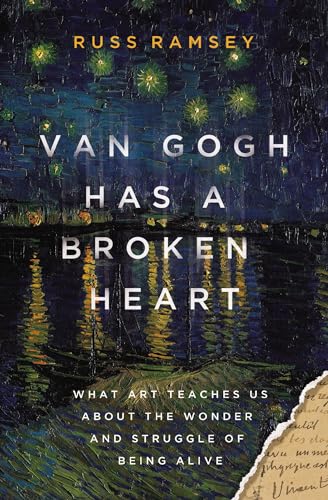
Van Gogh Has a Broken Heart

Van Gogh Has a Broken Heart: What Art Teaches Us About the Wonder and Struggle of Being Alive by Russ Ramsey is similar to his earlier book, Rembrandt Is In the Wind. Each draws observations from art and artists. This second book explores the theme of suffering and the beauty and grace that comes from it.

Art shows us back to ourselves, and the best art doesn’t flinch or look away. Rather, it acknowledges the complexity of struggles like poverty, weariness, and grief while defiantly holding forth beauty—reminding us that beauty is both scarce and everywhere we look (p. 4).

Beauty pulls us upward toward something that calls for some measure of discretion, something to be treated with dignity and care, something sacred. What does it pull us toward? The truth that we were made to exist in the presence of glory (p. 5).

All art comes from somewhere. It comes from someone who is in the process of living the one life they’ve been given. The more we can understand the specifics of their individual experience, the more we will understand why they created what they did and why the world has responded to it in the way we have (p. 12).

Ramsey says sad stories are universal, and they can provide fellowship in whatever we’re going through as well as empathy for others. They help us wrestle with the evil and brokenness in the world. “They remind us not just that this world can wound us, but that wounds can heal. They remind us to hope” (p. 10). They show us that beauty can come from brokenness.

That’s not to say all art comes through suffering. I think it was in my Music Appreciation class in college I heard a comparison of Beethoven and Haydn and how their lives shaped their music. Beethoven had a difficult father, health issues, and started experiencing hearing loss before he was thirty. Haydn had struggles, but by his thirties he had a steady job as the music director for a prince. A lot of his work is light, clever, even playful, while Beethoven’s is rich in emotional depth. 

There are ten chapters in Ramsey’s book. One tells the story of how the Mona Lisa was stolen and recovered, Pablo Picasso was a suspect, and the painting became a lot more famous after the theft. Another contrasts Rembrandt’s Simeon’s Song of Praise, which is very detailed and elaborate, painted early in his career, with Simeon in the Temple, painted late in his career and found after his death. They cover the same incident in the Bible, but the latter is simple and focuses on Simeon’s emotion. 

When I look at the old painter’s reimagining of the scene, to my eye he doesn’t seem to want to show us the spectacle of the temple when Simeon held Jesus, or what he can do with it as a painter. After a life filled with suffering and sorrow, he just seems to want to hold Jesus (p. 51).

Artemisia Gentileschi was a painter I’d never heard of. Ramsey describes the difficulty of a woman in this field as well as an artist working “for hire”–not painting scenes she loved for the pure pleasure of it, but taking commissions of what others wanted to see painted. He points out that “she’s not a girl-power feminism icon. She’s an icon in the sense that she’s an example of a woman who’s navigating a world that’s not built for her” (p. 66).  “We must be careful not to romanticize her work to make it fit our own cultural moment. It is one thing to draw conclusions about the impact of her art over time, and quite another to assign intent to her body of work that may not represent how she thought about it (p. 66). I wish people who try to bring modern-day sensibilities into other people’s history would realize “If we come to an artist like Artemisia with a narrative already in mind and insert her into it, we dishonor her actual experience” (p. 67).

Joseph Turner was another artist I didn’t know, whose style changed about halfway through his career. Ramsey discusses the possible reasons and implications.

The Hudson River School I had heard of but didn’t realize it was: a group of landscape painters who went into unexplored areas of what would become the United States to show immigrants to the area what beauty and grandeur was there. But the beauty was also untamed and could be dangerous. And the influx of new European plans for colonization would clash with the Native Americans already there whose philosophy about the land was vastly different.

Van Gogh’s infamous cutting off of his ear is told in the context of his trying and failing to establish an artist’s residence with Gauguin. They only lived in the same yellow house for sixty-three days, “two of the most productive month’s of each artist’s career, and two of the most turbulent” (p. 125).

Norman Rockwell’s work was “Dismissed by critics, who considered his paintings to be too idyllic and sentimental to be great art (p. 139). Rockwell agreed his work wasn’t “the highest form of art,” but said “I love to tell stories in pictures–the story is the first thing and the last thing” (p. 139). His work was influenced by the new technology of the four-color press. He became a well-loved fixture of the Saturday Evening Post until he started painting scenes from the Civil Rights movement like The Problem We All Live With and Murder in Mississippi, based on real events.

Edgar Degas is known for detailed paintings of ballerinas, like The Dance Foyer at the Opera in 1872. But macular degeneration slowly changed his work to the much less distinct Two Dancers Resting in 1910. I can’t fathom the difficulty and painfulness of trying to portray one’s vision when one’s vision is deteriorating. After discussing other artists with failing vision, Ramsey notes, “The art changes, but not necessarily in a negative way. Often when affliction and compulsion collide, something deeper, truer, and more lasting is born” (p. 166). He quotes modern artist Jimmy Abegg, who also has macular degeneration, as saying “The bad isn’t so bad when you recognize the goodness that will emerge from it, whatever trail that leads me down” (p. 166). Ramsey comments, “Affliction stirs us awake to things we might not have seen otherwise” (p. 166) and seeing “through new eyes” requires courage and humility.

Ramsey includes appendices on the symbolism often used in art and and famous art heists. One appendix is titled “I Don’t Like Donatello, and You Can Too.” Ramsey says we don’t have to like or “get” every artist, but, with “a posture of openness, willing to learn and grow” (p. 192), we can appreciate even what we don’t like.

A few other quotes that stood out to me:

What comes out of this life is his business, but what I do will never be what makes me who I am. Because this is so, when suffering comes, it doesn’t have the power to unravel God’s design. Instead, the suffering becomes part of the fabric (p. 155).

Our sorrows are ultimately hallowed by the One who enters fully into the painful stories of our own lives in order to show us that our suffering matters, while also becoming the place from which the Spirit enables us to become agents of God’s healing grace to those who find themselves lost and alone in their griefs (p. xi).

The goal of suffering well is to move us not only beyond the stick figures, but also from a place of pride to one of intimacy and familiarity with our Lord. It is to move us not from crude to eloquent, but from unfamiliar to intimate. This is why we practice spiritual disciplines (p. 50).

To truly love someone is to move beyond first impressions into the heart of things; it is to take on the sacred work of stewarding another’s joys and sorrow (p. 132).

Think about the physiology of growing old. If the Lord grants us many years, the way to eternal glory will include the dimming of our vision, the slowing of our bodies, the dulling of our minds, and the diminishing of our appetites. It’s a path that requires us to loosen our grip on this world, preparing us to leave it before we leave it. Is this not mercy? (p. 136).

I had missed the fact that there were discussion guides for each chapter in the back until I finished the book. I wish these had been included at the end of the corresponding chapters.

I don’t know if Ramsey has any future books like these planned. I hope so. There are multitudes more paintings and artists that could be discussed. If he does, I’d love to hear his thoughts on a couple of issues. One, how to think about pictures of deity in art and the second commandment about not making images. I wrestled with my own thoughts on this a few years ago. Two, the depiction of nudity in art. I personally would rather not see nudity in art or anywhere else. (There are a couple of paintings involving female nudity in this book).

As with Ramsey’s first book about art, I appreciated not only the information but the thoughtful and beautiful way the author weaves spiritual truth into the narrative. The result is poignant and meditative.

How to Withstand Pressure

How to Withstand Pressure

The USS Thresher was a nuclear-powered submarine that sank in 1963, killing all 129 people on board. A series of events caused it to sink and then to implode due to the extreme pressure deep in the ocean.

Research equipment with cameras that could withstand the oceanic pressure were lowered and found the Thresher in five pieces. In addition, the cameras saw fish and other life forms that were previously unknown.

These sea creatures thrived in pressure strong enough to crush a submarine, How?

This article details features of a few specific deep-sea creatures. But the bottom line, Wikipedia says, is “Deep-sea organisms have the same pressure within their bodies as is exerted on them from the outside, so they are not crushed by the extreme pressure.”

These creatures aren’t crushed by deep sea pressure because their internal pressure is equal to it. In fact, many die (even explode) when they are brought to the surface for study because their pressure is no longer equalized.

We face a lot of pressures these days, don’t we? Making a living, keeping up with responsibilities, making time for those we love. Then we all have struggles against our own besetting sins. The world is getting less friendly to Christianity every day. And we have an enemy of our souls who seeks our destruction like a roaring lion.

We’re not equal to it in ourselves. “My flesh and my heart may fail,” Asaph says. Mine, too. Then he goes on to say, “but God is the strength of my heart and my portion forever” (Psalm 73:26).

The apostle John wrote, “Little children, you are from God and have overcome them, for he who is in you is greater than he who is in the world” (1 John 4:4). The one within us is more than equal to the pressures around us.

“Now we have this treasure in clay jars, so that this extraordinary power may be from God and not from us. We are pressured in every way but not crushed; we are perplexed but not in despair” (2 Corinthians 4:7-8, HCSB).

Sometimes God relieves pressure by removing a burden from us. Other times, He gives us grace to bear it. Missionary pioneer Hudson Taylor said, “It doesn’t really matter how great the pressure is. What matters is where the pressure lies, whether it comes between me and God or whether it presses me nearer His heart.” We need to let pressures of life push us closer to our God. He invites us to cast our care on Him, to depend on His strength in our weakness, to come to Him for rest.

1 John 4:4b

Revised from the archives.

(I often link up with some of these bloggers.)

When Evil Gets Worse

When Evil Gets Worse

The murder of Charlie Kirk yesterday, recent senseless shootings, the remembrance of the 9/11 attack today, all have me echoing Andrew Peterson’s beautiful song, “Is He Worthy?”:

Do you feel the world is broken?

We do.

Do you feel the shadows deepen?

We do.

But do you know that all the dark won’tStop the light from getting through?

We do.

Do you wish that you could see it all made new?

We do.

Last night, I was pondering how to pray about yesterday’s shooting. We pray for justice for the murderer, comfort and grace for the family, for God to turn hearts to Himself through this. But I wanted to pray, “Please make this stop.”

A phrase from a verse about evil men getting worse kept coming to mind, so I looked it up. It’s from 2 Timothy 3:12-13: “Indeed, all who desire to live a godly life in Christ Jesus will be persecuted, while evil people and impostors will go on from bad to worse, deceiving and being deceived.”

Earlier in the chapter, Paul writes this:

But understand this, that in the last days there will come times of difficulty. For people will be lovers of self, lovers of money, proud, arrogant, abusive, disobedient to their parents, ungrateful, unholy, heartless, unappeasable, slanderous, without self-control, brutal, not loving good, treacherous, reckless, swollen with conceit, lovers of pleasure rather than lovers of God, having the appearance of godliness, but denying its power. Avoid such people. For among them are those who creep into households and capture weak women, burdened with sins and led astray by various passions, always learning and never able to arrive at a knowledge of the truth. (2 Timothy 3:1-7).

That sounds like our day, doesn’t it? And the Bible says it’s only going to get worse until Jesus returns. 

So what did God inspire Paul to write to Timothy in light of the increasing evil in the world?

But as for you, continue in what you have learned and have firmly believed, knowing from whom you learned it and how from childhood you have been acquainted with the sacred writings, which are able to make you wise for salvation through faith in Christ Jesus. All Scripture is breathed out by God and profitable for teaching, for reproof, for correction, and for training in righteousness, that the man of God may be complete, equipped for every good work (2 Timothy 3:14-17).

Keep on reading, studying, living out Scripture. The written Word is light (Psalm 119:105) that teaches us of the living Word, Jesus, the light of the world (John 8:12). Evil doesn’t obscure that light; it proves it and points to the need for it. Evil shouldn’t shake our faith in God’s truth, but should make us cling to it and share it even more. 

Someday Jesus will return and set all things right, make the crooked things straight. Until then, we join with the psalmist in saying, “I wait for the LORD, my soul waits, and in his word I hope” (Psalm 130:5). 

Psalm 130;5

(Note: This post is not an endorsement of everything Kirk has ever said: I don’t know all he said. I only recently learned who who he was. But I know he was a professing Christian who tried to stand up for truth the best he knew how and should not have been murdered because of a difference in politics. The main point of this post is to point us to God’s light in an increasingly dark world.)

(I often link up with some of these bloggers.)

What I Learned from a Traumatic Illness

What I learned from a traumatic illness

September 1 will mark thirty years since I contracted transverse myelitis. TM is an auto-immune disorder in which a virus attacks the spine, triggering the body to attack not only the virus, but the myelin sheath around the nerves of the spine. An attack low on the spine might bring just a little numbness and tingling. But an attack high on the spine can result in quadriplegia, ventilator-dependency, and even death.

I was affected in the middle, in the thoracic region. My symptoms began with a vague feeling of numbness in my left hand, like I had slept on it wrong. Within three hours, my left arm was numb up to my shoulder as were both legs up to my lower torso. I couldn’t walk on my own. I was having trouble going to the bathroom.

I thought I was having a stroke. That’s the only thing I knew of that would cause parts of the body to suddenly go numb.

As it turns out, a number of ailments can cause sudden numbness. There was no one test to diagnose TM. Instead, tests were performed to rule out any other possible related illness. That took eight days in the hospital.

I was sent home with a few prescriptions and a plan for physical therapy.

Thankfully, I progressed from a wheelchair to a walker to a cane to walking unsteadily on my own over the course of a few months. My ability to walk has improved, but I still can’t run, jump, hop, or walk very well on uneven ground. Oddly, my balance is often affected the most when I am standing still with no support. This is due to TM’s effect on my proprioception. I’m usually fine if I can hold on to or lean against something stationery.

I am not as numb as I was, but I still don’t have full feeling in my left hand or lower legs. I have odd little nerve sensations–feeling like something is touching me when it isn’t, feeling a sudden hot sensation where there is no heat, etc. I can’t wear my wedding ring because it causes a pinging, funny-bone sensation in my hand.

But overall, I am thankful that I recovered to the point of being able to function as I needed to, to take care of my family, and to lead a relatively normal life.

I’ve been jotting down several things I have learned through this experience, and I thought I’d share them with you. I know many of you are going through physical trials or have in the past. Though our details might vary, I hope you’ll find camaraderie and encouragement here.

The unsteady trajectory of healing. It seems that often healing is a one step forward–two steps back process, feeling better one day and worse another. Often in the first couple of years after TM, I felt my symptoms were increasing to the same point they were in the beginning. Though TM is usually a one-time event, some people do have more than one attack. But repeated attacks are also signs of multiple sclerosis. So that specter was in view whenever I felt worse.

The hidden work of healing. Sometimes assessing healing is like watching paint dry. There doesn’t seem to be any progress day by day. But over time, healing gradually takes place unawares, until finally one day we can see definite progress from the previous week or month.

Riding the waves. When my husband and I were taking childbirth classes, our teacher invited a couple from her previous class to come in and share their childbirth experience. The new mom said something like this: during labor, when she wondered how many hours she was going to have to do this, she felt weary and defeated. But if she only concentrated on one contraction at a time, she was able to get through them better. She likened it to riding each wave of a surf as it came in.

That illustration has stayed with me all these years through many applications. When symptoms flared up or I had a bad day, I thought, I only have to deal with this day, this moment.

The value of rest. The first few months after TM, if I wanted to go anywhere, I would have to rest up the day of the event. Afterward, it wasn’t a matter of making myself rest: my body crashed and I couldn’t have done anything else anyway.

But I noticed I hardly ever had a cold or any other sickness during that time. I realized that maybe rest was nipping any other colds or viruses in the bud. When I began having heart rhythm issues, I couldn’t take decongestants any more. So rest and Tylenol and cough drops at the first sign of a cold became my go-to treatment. Most of the time, I got over them much faster than usual.

The need to strive. This sounds like a contradiction to the need for rest. It’s hard to balance sometimes. Usually we don’t know we’ve overdone it until it’s too late. But we don’t generally make much progress unless we stretch ourselves beyond what’s comfortable.

The value of an ordinary day. When I was in the hospital and recovering at home, one of the things I most wanted and missed was just an ordinary day like I’d had and hadn’t appreciated before.

The value of my work. As a homemaker, I can sometimes feel my work is not as important as other people’s. But when I couldn’t do my work and saw the extra pressure it put on everyone else to do what I always did, it helped me realize that I did have a helpful contribution to making family life go smoothly.

The value of help. People from church brought meals, cleaned bathrooms, babysat, prayed, sent cards, and let us know they cared. A group of men installed a handrail on the stairs and safety bars in the bathroom.

People often wonder what to do to help in a crisis. It varies according to the person and the situation. But I’d encourage praying about it and then doing what the Lord lays on your heart. For instance, one lady brought over a puzzle, and she and my oldest son sat and worked it at the kitchen table while we talked. We’d had to go back and forth to so many doctor’s visits, either taking the kids with us or to babysitters, and that quiet activity was a balm. Yet if someone had asked me what I needed, I never would have thought of a puzzle and quiet conversation.

The mental cost. This is something I didn’t realize until a few years ago. I was reading of a woman who had been in a horrific accident where she was hit by a bus, flying through the air until she landed on the street with multiple broken bones. On the one year anniversary of her accident, she wrote that she had healed physically, but still suffered triggers that affected her mentally and emotionally.

That statement was like a light bulb coming on in my mind.

For maybe a year or two after TM, I suffered from panic attacks. I didn’t tell anyone. This was in an era when many Christians were adamantly against psychiatry. We had seen a documentary about the dangers of Xanax. I was afraid of being shipped off to a psychiatrist and being put on psychotic drugs.

In fact, I was given Xanax while in the hospital, but no one ever explained why. I don’t remember that it had much of an effect. But I didn’t want to continue it.

So even as I healed physically and enjoyed time with my family and getting back to church, I didn’t realize that I was still shaken up mentally and emotionally. I think part of it is that the world no longer felt secure. We know that anything can happen any time–but when it does, life doesn’t seem safe any more.

In truth, this world was never meant to be our safe place. Our shelter and security comes from God. But it takes a while to remember that, or to apply it in new ways, when our lives are severely shaken.

Mental and emotional healing may take just as much of an up-and-down trajectory as physical healing and may leave us with limps, scars, or tender places.

Things evened out over time, but I wish I had talked to my neurologist or primary care doctor.about all this while it was going on. Thankfully, we understand mental issues better now than we did then.

Lessons from limitations. I’ve written about this before, but one of the biggest lessons was that even though I couldn’t do everything I had done before, that didn’t mean I couldn’t do anything. We all face limitations of some kind–physical, financial, relational, season of life, etc. Our limits don’t hinder our ministry: they just define it.

Happy stress is still stress. A nurse shared this with Mittu when Timothy was in the NICU for 10 1/2 weeks. It rang a bell with me, too. Even with events I am dearly looking forward to, I have to pace myself.

Faith during uncertainty. For the first couple of years after TM, I never knew what my symptoms and capabilities would be any given day. I felt bad when plans with the family had to be canceled, though they were understanding. I didn’t know how long symptoms would go on or what level of recovery I would eventually reach. I was used to getting medical problems fixed, either with medication or a procedure. Living with the unknown for so long was wearing, but it caused us to rely on God moment by moment and trust Him for the future.

The joy of finding others. We got our first family personal computer about six weeks after my diagnosis, and transverse myelitis was the first thing I looked up. I found an email subscriber list of TM patients and caregivers. No one else I knew outside of the medical community had ever heard of TM. To find people who knew what I was talking about, who could answer questions and compare notes, was a godsend.

Dealing with “what ifs.” We lived in a split-level house, and I couldn’t use the stairs at first. Would we need to move? I had three sons, the youngest just two years old. Would I be able to take care of them? We had just started our second year of home schooling. Would I be able to continue? About a third of TM patients don’t regain anything they lost at onset. What if I didn’t? Or what if it got worse? What if I developed MS? What if the doctors missed something? Living with uncertainty isn’t comfortable, but God’s Word assured me He was with me and cared for me. I didn’t know what the future held, but I could trust Him to meet my needs and lead us day by day.

It’s okay to have bad days, to cry, to lament. I used to think that in order to be a good testimony, I had to project “victory” and positivity all the time. That’s not only inauthentic, it’s unrelateable. In the psalms, we see people pouring out their confusion, questions, anguish, physical, mental, emotional, and spiritual pains. Eventually they remind themselves of what they know to be true about God’s character and ways, and they rest in Him even though the circumstances may not have changed.

The comfort of Scripture. Finding help and hope in the Bible was not new to me, but God’s Word helped me in special ways during this time. For example, the night before I was scheduled for an MRI, nearly every medical person who came into my hospital room asked me if I was claustrophobic. I didn’t know–I had never been in a position to feel claustrophobic before. I wanted to tell them that their questions were making me feel claustrophobic! I was told that they could give me something to calm my nerves, but it needed to be done a certain amount of time before the MRI. I opted not to take anything.

They stressed to me the importance of being still in the MRI machine. Before the MRI, the verses from my Daily Light on the Daily Path devotional were all about being still: “Sit still, my daughter” (Ruth 3:18); “Be still, and know that I am God” (Psalm 46:10); “Commune with your own heart upon your bed, and be still” (Psalm 4:4), and others. Those words kept running through my mind while I was in the MRI machine, and I remained calm. I even dozed off.

In the following months, other verses stood out to me. “The Lord strengthen him upon the bed of languishing: thou wilt make all his bed in his sickness” (Psalm 41:3); “In all their affliction he was afflicted, and the angel of his presence saved them: in his love and in his pity he redeemed them; and he bare them, and carried them all the days of old” (Isaiah 63:9); “And he said unto me, My grace is sufficient for thee: for my strength is made perfect in weakness. Most gladly therefore will I rather glory in my infirmities, that the power of Christ may rest upon me” (2 Corinthians 12:9), “Though he cause grief, he will have compassion according to the abundance of his steadfast love; for he does not afflict from his heart or grieve the children of men” (Lamentations 3:32-33), and so many others.

How about you? What has God taught you and how has He helped you in illness?

1 Peter 5:10

(I often link up with some of these bloggers.)
Testing

Testing

For most of my husband’s professional career, he worked as a lab technician and then a lab manager, first in the textile industry, then in plastics.

Part of lab work involved troubleshooting problems as they came up. But when the company developed new products, they had to be tested.

In automotive textiles, for instance, fibers and fabrics need to maintain their color despite being hit with bright sunlight for years. So the lab had a weatherometer to simulate so many days of sunshine to see how soon the fibers would fade.

Other tests involved metameric properties: looking the same color in different lights. Automobile manufacturers wanted a car’s color to look the same in sunlight, under the showroom’s fluorescent lights, and in the homeowner’s garage with incandescent lighting. There was a brief exception to this for a time when some cars were deliberately painted to look like they changed colors as they passed. But even then, I believe the interior colors remained the same.

Fibers were also tested for tensile strength: their ability to be stretched or pulled without breaking.

Sometimes were tests were diagnostic. The technicians needed to know the properties of the fibers to discover their weaknesses in order to strengthen them or improve them.

God might test people for the same purposes. He knows our weaknesses and whether we will pass or fail our tests. But often we don’t know until we fail. Like Peter before Jesus was arrested, we feel confident in our devotion to Him. We’re even warned to watch and pray, and, like Peter, fall asleep instead. And then when the temptation comes, we fall on our faces and weep bitterly.

But when we fail a test, God doesn’t reject us or pull us off the assembly line. He uses the failure to make us aware of our need for dependence on Him. If we respond in the right way, we draw even closer to Him because we realize how much we need Him.

However, some tests don’t expose weaknesses: they reveal strengths. Manufacturers like to advertise that their products have passed tests. College entrance exams show that a student is ready to handle the challenges of university learning. Military, police, and firemen all have to pass rigorous tests to prove they can handle their jobs.

When God pointed out to Satan that Job was a righteous, godly man, God knew how Job would respond. Though knocked to the dust in sorrow and coming to some wrong conclusions, Job’s faith never faltered. Even when he questioned God, he was still expressing trust in him. His example of facing intense suffering has encouraged Christian for centuries.

Likewise, Joseph endured the cruelty of his brothers, being sold into slavery, falsely accused, and forgotten, with a grace few of us could manage. His conclusion that God meant for good what his brothers meant for evil has helped many Christians come to the same understanding and to trust God even when life seems unfair and doesn’t make sense.

Sometimes our tests are not just for us. When we see how others weather their tests, we’re encouraged that surviving and thriving are possible. That’s why we listen when someone like Joni Eareckson Tada speaks. She’s been through the fire and found God faithful and good.

Being a good testimony through our tests doesn’t mean putting up a smiling front or keeping a stiff upper lip. The psalmists poured out their confusion, frustration, and fears to God. It helps to read that others have wrestled with the same questions and feelings we do. That’s part of their testimony as well as the resolutions they come to.

If fibers were sentient, they might consider the tensile test was torture. But the technician isn’t being cruel. He doesn’t want to destroy the fiber. He doesn’t want it to fail. He has every hope that it will pass the test so that it can perform the function for which it was created.

God does not test us in a clinical or dispassionate way. He has our best interests at heart. He wants us to grow and develop in the best way we can. Like a parent, coach, or teacher, He stretches our endurance so we may grow stronger and more dependent on Him. He wants to show others, through us, that His grace is sufficient.

The Bible encourages us to endure testing joyfully:

Count it all joy, my brothers, when you meet trials of various kinds, for you know that the testing of your faith produces steadfastness. And let steadfastness have its full effect, that you may be perfect and complete, lacking in nothing (James 1:2-4).

In this you rejoice, though now for a little while, if necessary, you have been grieved by various trials, so that the tested genuineness of your faith—more precious than gold that perishes though it is tested by fire—may be found to result in praise and glory and honor at the revelation of Jesus Christ (1 Peter 1:6-7).

We rejoice in our sufferings, knowing that suffering produces endurance, and endurance produces character, and character produces hope, and hope does not put us to shame, because God’s love has been poured into our hearts through the Holy Spirit who has been given to us (Romans 5:3-5).

And when the tests are over:

And after you have suffered a little while, the God of all grace, who has called you to his eternal glory in Christ, will himself restore, confirm, strengthen, and establish you (1 Peter 5:10).

Blessed is the man who remains steadfast under trial, for when he has stood the test he will receive the crown of life, which God has promised to those who love him (James 1:12). 

Will our faith remain vibrant, or fade under pressures and trials?

Will our colors remain true, or change with circumstances?

Will we endure without breaking?

Not in our own strength. But I can do all things through him who strengthens me” (Philippians 4:13).

May God give us grace to endure testing for His glory.

James 1:3

(I often link up with some of these bloggers.)
Why Doesn’t God Heal Everyone?

Why doesn't God heal everyone?

One of the greatest mysteries we grapple with is why God heals some people, but not others. A friend and I were discussing this recently. As usual, my thoughts continued long after our conversation, so I decided to share them here.

A few years ago, our pastor announced in June that he had liver and pancreatic cancer. He was gone before the end of summer. He was in his prime, pastoring a church with a love for his people that I have rarely seen matched. Two of his daughters got married that summer, and he was able to walk them both down the aisle. But he would have been a terrific grandfather in the coming years. He seemed to have so many years of usefulness left, it was puzzling that God took him home.

Another former pastor’s grandson underwent an excruciating battle with leukemia, which he eventually lost despite hundreds of people’s prayers.

Others experience disabilities for the rest of their lives, either from birth or from an accident or illness.

We can never know all of God’s reasons for what He allows. But here are a few:

We live in a fallen world affected by sin, so there will be illnesses and death until God redeems the earth. Christians aren’t exempt from these effects of the fall.

None of us is guaranteed a long life. We need to be ready for eternity.

God’s perspective. A seemingly early death is not a tragedy to God: it’s a head start on heaven as He welcomes His loved one home.

God enables us to minister to others through what we suffer. Joni Eareckson Tada has been paralyzed since a diving accident fifty-seven years ago. I don’t know of anyone who has done more to help the disabled community, bring awareness of what disabled people suffer, and glorify God in the midst of suffering. Those things probably would not have happened without her accident. When she speaks, we listen, because we know she has proven what she’s speaking about. She’s not mouthing empty platitudes or theories.

God’s strength is displayed through our weakness. Paul famously prayed three times for God to remove an affliction from him. But God answered, “My grace is sufficient for you, for my power is made perfect in weakness” (2 Corinthians 12:7-10).

Healing was not Jesus’ primary purpose. Jesus healed multitudes of people during His time on earth. He demonstrated compassion and power as He did so. But He said His purpose was to preach the gospel (Mark 2:32-39).

God’s glory displayed. When the disciples asked whether a man’s sins or those of his parents caused his blindness, Jesus said, “It was not that this man sinned, or his parents, but that the works of God might be displayed in him” John 9:1-7). Similarly, when Jesus received the news that Lazarus was sick, he said, “It is for the glory of God, so that the Son of God may be glorified through it” (John 11:1-4).

Jesus wasn’t grandstanding. He wanted to show people who He was so they could believe.

Since Jesus is glorified through healing, it’s even more puzzling that He would not heal everyone. But sometimes He is glorified more by displaying His grace through His people’s trials, as He did in Joni and Paul’s lives.

Suffering strengthens and develops us. The apostle Paul wrote, “We rejoice in our sufferings, knowing that suffering produces endurance, and endurance produces character, and character produces hope, and hope does not put us to shame, because God’s love has been poured into our hearts through the Holy Spirit who has been given to us.”

Trials keep us dependent upon the Lord. We always are dependent on God, but sometimes we forget. Sometimes we need His help in areas other people never think about, but that continual dependence is a good reminder that our strength comes from Him. Paul said his “thorn in the flesh” was given so that he might not become conceited over the revelations that had been given to him.

Suffering prepares us for glory. Paul wrote to the Corinthians, “So we do not lose heart. Though our outer self is wasting away, our inner self is being renewed day by day. For this light momentary affliction is preparing for us an eternal weight of glory beyond all comparison, as we look not to the things that are seen but to the things that are unseen. For the things that are seen are transient, but the things that are unseen are eternal.” Paul is not being dismissive when he calls our afflictions “light.” He’s saying that they’ll seem light compared to the glory to come.

Though all of these factors help at times, they don’t satisfy at other times. I’ve been ministered to by what Amy Carmichael wrote in Rose From Brier (emphasis mine):

But, though, indeed, we know that pain nobly born strengthens the soul, knits hearts together, leads to unselfish sacrifice (and we could not spare from our lives the Christ of the Cross), yet, when the raw nerve in our own flesh is touched, we know, with a knowledge that penetrates to a place which these words cannot reach, that our question is not answered. It is only pushed farther back, for why should that be the way of strength, and why need hearts be knit together by such sharp knitting needles, and who would not willingly choose relief rather than the pity of the pitiful?

…What, then, is the answer? I do not know. I believe that it is one of the secret things of the Lord, which will not be opened to us till we see Him who endured the Cross, see the scars in His hands and feet and side, see Him, our Beloved, face to face. I believe that in that revelation of love, which is far past our understanding now, we shall “understand even as all along we have been understood.”

And till then? What does a child do whose mother or father allows something to be done which it cannot understand? There is only one way of peace. It is the child’s way. The loving child trusts.

I believe that we who know our God, and have proved Him good past telling, will find rest there. The faith of the child rests on the character it knows. So may ours, so shall ours. Our Father does not explain, nor does He assure us as we long to be assured… But we know our Father. We know His character. Somehow, somewhere, the wrong must be put right; how we do not know, only we know that, because He is what He is, anything else is inconceivable. For the word sent to the man whose soul was among lions and who was soon to be done to death, unsuccored, though the Lord of Daniel was so near, is fathomless: “And blessed is he whosoever shall not be offended in me.”

There is only one place we can receive, not an answer to our questions, but peace — that place is Calvary. An hour at the foot of the Cross steadies the soul as nothing else can. “O Christ beloved, Thy Calvary stills all our questions.” Love that loves like that can be trusted about this.

Perhaps we wouldn’t be able to understand even if God did explain why He allows such severe pain and loss. But the more we know Him, the better we can trust Him. Like the psalmists, we can pour out our anguish to Him, then remind ourselves of His love and mercy and care for us.

Psalm 46:1

(I often link up with some of these bloggers.)
Freedom to Lament

Freedom to Lament

When we were taking care of my mother-in-law at home, nothing quite helped like talking to others who were doing or had done the same. They knew by experience what was involved. It’s not that we wanted to gripe about our situation, but there were difficulties and pressures these friends would understand. It’s not that other friends weren’t a help, but with these we felt a freedom to talk like we didn’t always feel with others.

That’s one reason Paul says in 2 Corinthians 2:3-4, “Blessed be the God and Father of our Lord Jesus Christ, the Father of mercies and God of all comfort, who comforts us in all our affliction, so that we may be able to comfort those who are in any affliction, with the comfort with which we ourselves are comforted by God.” God comforts us through His Word, His Spirit, and His people.

When this passage came up in our recent ladies’ Bible study, someone pointed out that we need to feel free to be vulnerable with each other, to share when we’re struggling.

I came to that realization some years ago after I contracted transverse myelitis. We got our first computer a few weeks later, and transverse myelitis was the first thing I looked up. In that era before Facebook and message boards, I found a subscriber group of TM patients and caregivers. They were a lifeline to me as I navigated a little-known disease.

I wanted to be a good testimony there. I knew that would mean not hijacking conversations to “preach,” which would not have been well-received. But I wanted to give God the glory for the help and grace He gave and point others to Him. I thought the best way to do that was to always be cheerful and positive.

Some years later, another woman came into the group who was also a Christian. She was very transparent about her frustrations and struggles with TM. She wasn’t complaining, but she was honest. She gave God glory, and it rang true because we saw how He helped her.

I realized we’re not much help to others if we come across as always having everything all together. We’re more authentic when we share our struggles and burdens.

The Sunday after the Bible study session where we discussed these things, our care group met for lunch after the Sunday morning service. Our pastor emeritus had given an excellent message that morning about God’s grace through suffering–in his case, months in the hospital in isolation with Covid, a lung transplant, a blood clot, and more. The host of our care group asked if anyone had anything to share in connection with the message.

One woman shared how hard it was after her son committed suicide. When people asked her how she was doing, and she tried to tell them, she’d have to short-circuit what she wanted to say. She could see by their faces that they weren’t ready for what was on her heart. She pointed out that we need to allow for lament in the church such as the psalmists display. About a third of the psalms are laments, which are different from complaints. The writers conveyed a range of emotions based on their troubles. They eventually reminded themselves of God’s character and love, but they had to spend their grief and confusion first before they could receive it.

Granted, the psalmists did not have as much of the Word of God as we do now, which might have helped with some of their questions. But there are always mysteries as to why God allows certain painful things or doesn’t grant things that seem beneficial.

Paul was honest about his struggles as well:

. . . far greater labors, far more imprisonments, with countless beatings, and often near death. Five times I received at the hands of the Jews the forty lashes less one. Three times I was beaten with rods. Once I was stoned. Three times I was shipwrecked; a night and a day I was adrift at sea; on frequent journeys, in danger from rivers, danger from robbers, danger from my own people, danger from Gentiles, danger in the city, danger in the wilderness, danger at sea, danger from false brothers; in toil and hardship, through many a sleepless night, in hunger and thirst, often without food, in cold and exposure. And, apart from other things, there is the daily pressure on me of my anxiety for all the churches (2 Corinthians 11:23-38).

In Peter’s epistles, he was also quite frank about suffering believers experience.

When people are hurting, we want to fix their problems and make them better. But healing takes time. Sometimes pain drowns everything else out. We can’t help others when we apply Bible verses like band-aids over gaping wounds. There is a time to share Scripture. I’ve been greatly encouraged by a shared verse at just the right time. But first we need to listen and “weep with those who weep” (Romans 12:15). Sometimes the tender care and concern shared in the midst of someone’s pain will open their hearts to receive truth.

Someone has said that Job’s friends ministered to him much more when they sat with him in silence for a week than when they started talking.

Some years ago, in our early married life, someone at church shared a prayer request for a man who had just been diagnosed with cancer. The speaker went on to say that the wife wasn’t taking the news well.

I thought, “How does someone take that kind of news well?” Wrestling through pain, confusion, and grief doesn’t mean one doesn’t have faith. This woman needed someone to come alongside her, not judge for her initial reaction to devastating news.

There is no one formula for aiding people in their worst times. We need to ask God’s guidance for what to share when. But we need to give them space to grieve. We need to listen, empathize, support, and love without judgment and pat answers.

My soul is full of troubles. Psalm 88:3

(I often link up with some of these bloggers.)
When Trying to Avoid Pain Creates More Pain

When trying to a

When we first brought my mother-in-law, Colleen, home from the nursing home several years ago, the muscles in her legs and left arm were contracted due to her being bedridden and not having her arms and legs stretched. We had not thought to ask if that was being done, both because we didn’t know it needed to be, plus we assumed the staff was doing what they were supposed to.

Colleen’s arm was contracted to the point that it was usually folded at the elbow, with her hand up by her chin. One problem, besides discomfort, of having her arm folded against itself all the time was the danger of moisture creating a prime dwelling spot for bacteria to grow, causing skin problems and possible infections. It was hard to clean the area as well. She could open her arm, if we could get across to her that’s what we wanted. But normally, the atrophied muscle kept her arm folded.

On top of that, Collen developed Dupuytren’s contracture in one hand where two fingers are bent in toward the palm and can’t straighten.

An occupational therapist was sent to our home to work with Colleen’s arm and hand. As you can imagine, trying to work contracted muscles was painful, no matter how gentle the therapist was.

Colleen was not a very talkative person except among family or close friends. But when the therapist came, Colleen would start chattering, telling him about her family or anything else she could think of, trying to delay the inevitable. As he worked, Colleen would say he was hurting her, and she’d get more agitated the longer he went on. The therapist, aide, and I tried to encourage her to relax and work with him, but in her mental state at that time, she couldn’t take in the idea that the momentary discomfort would eventually pay off and her arm would feel better.

Her discomfort increased to the point that she’d tense even when the therapist entered her room, making progress even harder. Therapy eventually stopped.*

Sometimes our efforts to avoid getting hurt create more pain. I took a tumbling class for one college P. E. course. The teacher advised that if we ever found ourselves falling, we should roll with it. She said most injuries from falls occur as we try to stop ourselves from falling. That happened to a guy I knew–he was playing soccer, slipped, threw out his arms to catch himself, and broke his wrist.

When God starts working with our tight places, we recoil from the pain. We want to pull away. We want it all to stop.

When we anticipate bad things that could happen, we tense with fear and dread.

When we face difficult situations with tension, we miss the good that our situation is accomplishing and make the experience all the more difficult.

Our pastor recently said something like worry is fear that God won’t get things right. I had to think about that. I was convicted of its truth.

We know from His Word that He has a purpose in all He allows, even suffering. We know He has promised to be with us and give us grace to help in every situation.

But even knowing those truths, knowing He always does what is right, sometimes the problem is we’re afraid we’re not going to like what He allows. As C. S. Lewis said, “We are not necessarily doubting that God will do the best for us, we are wondering how painful the best will turn out to be.”

Look at Job, after all. Who among us would want to go through all he did? Or Joni Eareckson Tada, who has spent more than fifty years in a wheelchair due to a diving accident and then dealt with cancer and chronic pain on top of that. Or Elisabeth Elliot, whose first husband was murdered and whose second husband lost a horrific battle with cancer.

We can scare ourselves to death with “what ifs.” If what we fear comes true, then we’ve doubled our angst by worrying about it ahead of time plus dealing with it when it happens. And if the worst never happens, then we’ve wasted all that time and energy worrying about it.

I’ve known some occupational therapists who are warm and kind. I’ve known others who are not unkind, but their manner is matter-of-fact and down-to-business. But I think any of them would tell us they don’t torture people because they enjoy it. Rather, they know the temporary pain of stretching and working reluctant muscles will lead to greater usefulness and movement and will prevent further deterioration or, in some cases, infections.

God is not just a doctor putting us through the paces for our health. He’s a kind and loving Father. He’s not capricious. He doesn’t act on a whim. Everything He allows is for a purpose. He understands our lamentations. He’s promised to be with us and give us grace every step of the way.

Amy Carmichael wrote a poem about not finding peace in forgetting, endeavor, aloofness, and even submission, but in acceptance. The last stanza goes:

He said, ‘I will accept the breaking sorrow
Which God tomorrow
Will to His son explain.’
Then did the turmoil deep within me cease.
Not vain the word, not vain;
For in acceptance lieth peace.

Instead of tensing at what God might do and allow in my life, I need to trust my good and loving Father and seek His grace all along the way.

Be assured that the testing of your faith [through experience] produces endurance [leading to spiritual maturity, and inner peace]. And let endurance have its perfect result and do a thorough work, so that you may be perfect and completely developed [in your faith], lacking in nothing.
James 1:3-4, Amplified Bible

The testing of your faith produces steadfastness. . .  James 1:3-4

Revised from the archives

(I often link up with some of these bloggers.)

  • For those who might wonder, we dealt with Colleen’s bent arm by cutting the foot portion off an old tube sock and sliding it up to cover the middle part of her arm to help keep from chafing or getting too moist. Thanks be too God, she never got a skin infection there the five years she lived with us.

“All Sunshine Makes a Desert”

"All sunshine makes a desert."

Rain can be awfully inconvenient.

Outdoor activities planned months in advance can be ruined, or at least need to be rearranged, when an unforeseen rainstorm blows in. Grocery shopping becomes a big mess when we have to cart our bags in and out in the rain. Rain makes roads slick, creating driving hazards.

Rain can also be gloomy when we haven’t seen the sun for days.

One of my worst rain experiences came when I was driving home alone. The rain fell so heavily, my windshield wipers couldn’t keep up. I literally could not see anything around me except the faint glow of other headlights. I somehow made it to the parking lot of a convenience store and waited til the showers abated, hoping no one would run into me.

And then there are thunderstorms with the potential to down power lines, send limbs crashing from trees, or strike lightning.

Yet, we need rain.

Rain softens the ground, making it easier to plant seeds. Then those seeds transform into flowers or food with more rain and sunshine.

Rain relieves the scorching heat of summer.

Rain provides water to drink and replenishes water tables for future needs.

Rain washed impurities out of the air.

F. B. Meyer wrote:

We all love the sunshine, but the Arabs have a proverb that ‘all sunshine makes the desert’; and it is a matter for common observation that the graces of Christian living are more often apparent in the case of those who have passed through great tribulation. God desires to get as rich crops as possible from the soil of our natures. There are certain plants of the Christian life, such as meekness, gentleness, kindness, humility, which cannot come to perfection if the sun of prosperity always shines. (1)

That’s true, isn’t it?

Just as I don’t like rain to interrupt my plans or make my tasks harder, I don’t like when trials and problems come up. They’re hard, painful, and sometimes costly. They take time and thought and energy from things I’d rather do.

But they have a good purpose.

When life is going well, we can get complacent. People who get everything they want and have everything just the way they like it sometimes start to feel entitled.

Though we know we need God’s grace and help in every circumstance, we feel our need of Him more during trials.

Trials soften us by humbling us. They show us our lack of strength and our need for His. They help us depend on Him more.

Trials help us grow. “We rejoice in our sufferings, knowing that suffering produces endurance, and endurance produces character, and character produces hope, and hope does not put us to shame, because God’s love has been poured into our hearts through the Holy Spirit who has been given to us” (Romans 5:3-5).

Trials help us to be grateful for what we have.

Trials can help wash impurities out as we search our hearts and confess wrong thoughts, deeds, and attitudes to God. Trials don’t always come because of sin, but when they do, they have a cleansing effect.

Trials point us to those unseen resources I mentioned last week. Hidden water tables of grace sustain us during dry periods.

God’s Word refreshes us with His promises:

And I will make them and the places all around my hill a blessing, and I will send down the showers in their season; they shall be showers of blessing (Ezekiel 34:26).

Sow for yourselves righteousness; reap steadfast love; break up your fallow ground, for it is the time to seek the Lord, that he may come and rain righteousness upon you (Hosea 10:12).

Let us know; let us press on to know the Lord; his going out is sure as the dawn; he will come to us as the showers, as the spring rains that water the earth (Hosea 6:3).

He did good by giving you rains from heaven and fruitful seasons, satisfying your hearts with food and gladness (Acts 14:17b).

One of my favorite childhood memories involves rain. My mom let us put on our bathing suits to go outside and play in a mild rain shower. I don’t know what time of year it was, but it had to have been during warm enough weather to get wet outside. Perhaps the rain was cooling on a hot summer’s day.

There was no thought of mess or inconvenience or disrupted plans. Instead, there was pure joy at the opportunity to do something so different and refreshing.

I can’t honestly say I dance for joy when trials come. But I am trying to learn to “Count it all joy, my brothers, when you meet trials of various kinds, for you know that the testing of your faith produces steadfastness. And let steadfastness have its full effect, that you may be perfect and complete, lacking in nothing (James 3:2-4). God has good purposes in trials and sends them in love and faithfulness.

Rain can be inconvenient, but also refreshing. All sunshine, as the saying goes, makes a desert. God keeps us from desert hardness and barrenness by sending trials our way. As William Cowper says in his hymn, “God Moves in a Mysterious Way“:

Ye fearful saints, fresh courage take;
the clouds ye so much dread
are big with mercy and shall break
in blessings on your head.

Hosea 6:3

(I often link up with some of these bloggers.)

________

(1) This quote comes from Our Daily Homily by F. B. Meyer. I’ve not read this book, but I have seen the quote in Warren Wiersbe’s book Be Satisfied as well as other places.

Unseen Hurts

Though many illnesses and injuries are unseen, we often have a clue when someone is hurt physically. A big bandage or cast. Crutches. A cane. Paleness. Lack of their usual vigor or energy.

But when someone is wounded in spirit, we often can’t tell. Some are quite vocal about what’s going on in their hearts, but others are not.

And even if we are aware that someone is in spiritual, emotional, or mental pain, we forget that it takes time to heal, just like a physical wound does.

These thoughts led me to some other parallels between wounds of the flesh and spirit.

Cleansing. One of the first things we do with a physical wound is clean it out. If someone’s leg was gashed open by an animal or branch, stitching the tear without cleaning is an invitation for infection to set in. Disinfecting can be more painful than the original wound, but it saves pain in the long run.

When we’re wounded in spirit, it’s easy for infection to set in as well in the form of hatred, revenge, bitterness, or unforgiveness. Though everything in us might want to lash out, we need to apply God’s truth to our situation. Holding onto those negative reactions will only cause us more pain. We can look to our Savior, who, “When he was reviled, he did not revile in return; when he suffered, he did not threaten, but continued entrusting himself to him who judges justly” (1 Peter 2:23).

Medicate. The next step in treating an open wound is to apply an antibiotic and pain reliever to kill germs and aid healing.

We can aid our spiritual healing by soaking ourselves in God’s Word. We can pour out our hearts with the psalmists, who experienced multitudes of inner pain: betrayal, friends turned to enemies, loneliness, guilt, and so much more. Through their anguish, they reminded themselves of God’s loving care and restored their peace.

Protect. A wound needs to be protected from dirt and germs, but also from being bumped. I broke and dislocated my little toe several years ago. Not only was it gently taped, but I had a big medical “boot” to support and protect it. Even with that protection, though, I walked slowly and gave doorways and corners a wide berth the first couple of weeks.

When people’s hearts are wounded, we often forget this step. We encourage them to forgive and trust God, but we forget that they need to be protected. Sometimes people in the church concentrate on restoration of the offender, which they should—but they need to help the wounded heal and protect them as well.

Time. It takes time to heal. There’s just no way to get around it or hurry it. God made our bodies marvelous in their ability to recover. But the process is not instant. While a person heals, they usually need extra rest and a cessation of some of their usual activities.

We forget that emotional and spiritual wounds take time to heal, too. Scripture is absolutely essential to healing, but we don’t apply it like a Band-aid and expect instant results.

So far I’ve been thinking in terms of wounds inflicted by others. But even grief from the loss of a loved one will require rest time and often a lightening of activities, depending on the individual. For more than a year after my mother passed away, I couldn’t endure loud, frothy gatherings. It’s not that I was morose and never laughed. My aunt said something that made us all laugh during my mother’s viewing before guests came, and that helped so much. I didn’t closet myself away from others. But I didn’t go to as many gatherings as I might have otherwise. I remember almost wishing we still had formal seasons of mourning, so “normal” activity would not be expected.

Negative responses. A wounded animal will often snarl and nip at the hand trying to help it, not understanding the intention. Illness isn’t an excuse to blow up at others, but when we’re wounded physically, we might find ourselves struggling to respond patiently to others. I tend to get weepy if I am sick or in pain for very long.

Wounded hearts may also struggle in their responses. They may not understand their need for help. They may not be able to sort out the emotional or mental issues and just think they’re having spiritual problems and need to “get right.” Or they may sense they need help, but others, like Job’s friends, treat their needs as spiritual problems to be fixed rather than emotional wounds which need healing.

Help. When we’re physically hurt, we need help from others. Sometimes we need the aid of a crutch or wheelchair for a while. Sometimes we need others to help us get around, bathe, go to the doctor. I’ve been abundantly blessed when ill by people who provided meals, watched my children, took them to the park for an outing, or cleaned my bathroom floors.

We need help from others when we’re wounded inwardly as well. We may just need someone to listen, cry with us, pray with us. Or we may need professional counseling. There’s no shame in needing help to cope. We should be available and willing to support each other.

Scars. Sometimes physical wounds leave a scar. Some say their healed broken bones ache when bad weather is coming. Some illnesses, like a heart attack or stroke, leave changes in our ability to function even when the original illness has been treated and healed. Nerves that have been affected may cause numbing or shooting pain or odd sensations.

Inward wounds can leave lasting results as well. Some areas of our hearts may remain a sensitive.

Post-traumatic stress. I read the account of a woman who had been hit by a bus while crossing a street. She said even a year later, some traffic situations caused anxiety. After I recovered from transverse myelitis, loud, busy places would set my nerves on edge. Since my illness started with my left hand feeling numb, like I had slept on it wrong, that feeling in any part of my body would cause panic. It’s not so much of a problem now, twenty-eight years later: I know those weird sensations come and go and don’t mean another attack is imminent.

Those with wounded spirits experience triggers as well. A woman who has been attacked may shy away from dark lonely places and may panic at feeling pinned down. Someone who has suffered a home invasion may start at any weird noise.

Some post-traumatic responses may fade over time. Some may not.

Results. Suffering a wound or illness can make us more compassionate to other wounded people. Some who have suffered at the hands of others have championed causes to help battle the offense, like Mothers Against Drunk Driving.

Suffering spiritually or emotionally can help us be more compassionate as well, more sensitive to those in need. The “God of all comfort . . . comforts us in all our affliction, so that we may be able to comfort those who are in any affliction, with the comfort with which we ourselves are comforted by God” (2 Corinthians 1:3b-4).

Grace. Whatever God has allowed to happen to us, inwardly or outwardly, He doesn’t leave us alone to flounder. Many people who undergo trials will say that while they would never have chosen them, they’d never want to trade what God taught them during that time or the closeness they felt to Him.

We need His grace not only to heal, to get through the inconveniences and irritations of treatments and recuperation, but also for the aftermath as well. Some illnesses leave us a “new normal” or with new limitations. But He wants us to depend on Him. God’s grace is sufficient for all. “God is able to make all grace abound to you, so that having all sufficiency in all things at all times, you may abound in every good work) (2 Corinthians 9:8). He promises His strength in our weakness (2 Corinthians 12:9-10).

This is a larger topic than one blog post can cover. A few weeks ago I wrote about ways to heal from past hurts. There are many reasons God allows suffering and many aspects of healing and ministering to each other.

But we can seek God’s grace to be tender, patient, kind, and sensitive to each other’s needs. We can ask His wisdom for the best way to help and to point others to the One who “heals the brokenhearted and binds up their wounds” (Psalm 147:3).

(I often link up with some of these bloggers.)