Plug In or Abide?

Plug in or abide?

Most of us have devices we have to recharge: a cell phone, a smart watch, iPads, earbuds, electronic cars, etc. Packing lists for travel include cords and cables for charging. We seek outlets in airport terminals to charge up until our next flight. The threat of storms and power outages causes us to make sure all our devices are charged just in case.

Some of this technological language has filtered into other areas of life. We talk of rest and rejuvenation as needing to recharge our batteries. We say we need to “plug into” some community or power source.

Some might even think of their time in the Bible and prayer as a spiritual recharge. But Joni Eareckson Tada challenges that thought in her devotional book, Spectacle of Glory. In the reading for November 4, she writes that we don’t “sit down for our quiet time and ask ourselves, How long do I have to be plugged into God today to get a good spiritual charge?” She expands that thought by saying:

We don’t get charged up in God in order to unplug and live on our own–until it’s time for the next charge. No. We never disconnect from Him. We are living branches connected to the living Christ. His life is our life.

Instead of plugging in, we abide in Him, as Jesus said in John 15:5: “I am the vine; you are the branches. Whoever abides in me and I in him, he it is that bears much fruit, for apart from me you can do nothing.”

In one of the best definitions for abiding that I have read, Joni says:

Abiding is living in constant awareness of total dependence on Jesus. It involves a constant flow of life-giving sap from the Holy Spirit–not a spiritual charge that takes us up to 80 percent. Abiding in Christ is a 100 percent relationship.

We’re placed in Christ when we believe on Him, and that connection is never severed. But we don’t always consciously think about depending on Jesus.

How do we cultivate that awareness of our dependence on Him? Well, trying to do anything in our own strength will often cause us to fall flat, reminding us we need His strength.

Jesus goes on in John 15 to talk about prayer and His words abiding in us. We don’t confine prayer and Bible reading to our devotional time and then go off on our own. Psalm 1 talks about meditating on God’s instruction day and night. Isaiah 26:3 says “You keep him in perfect peace whose mind is stayed on you, because he trusts in you.” We can talk with Him all through the day. We think about His Word as we make decisions and go about our work, asking Him for help and wisdom in knowing how to apply what He has said.

Then we demonstrate our love to Him by obeying His Word. It’s not that we keep His commandments to try to earn His love. We come to Him for salvation because we can’t keep all His commandments all the time. But when He saves us, we value what He says and we seek His strength to obey Him because we love Him.

Once we believe on Jesus as our Lord and Savior, we’re a branch connected to His vine. His life flows through us. He doesn’t charge us up and then send us off to live independently til we need another charge. We don’t have to worry about becoming disconnected to Him. He’s always with us, constantly empowering us to live for Him. But we abide in Him when we lean into that relationship and depend on Him.

Jesus saying that we can do nothing without Him reminds me of these stanzas from Frances Ridley Havergal’s lovely hymn, “I Could Not Do Without Thee

I could not do without thee,
O Saviour of the lost,
whose precious blood redeemed me
at such tremendous cost;
thy righteousness, thy pardon,
thy precious blood, must be
my only hope and comfort,
my glory and my plea.

I could not do without thee,
I cannot stand alone,
I have no strength or goodness,
no wisdom of my own;
but thou, belovèd Saviour,
art all in all to me,
and weakness will be power
if leaning hard on thee.

May He teach us all to abide more consciously and fully in Him.

John 15:5

(I often link up with some of these bloggers.)

Dealing with Distractions During Prayer

Distractions during prayer

If you’re like me, settling down to pray triggers all kinds of distractions. It’s not so much that other people interrupt me, though that happens occasionally. The problem is usually in my own mind going a dozen different directions.

Here are some practices that have helped me:

Allow for quiet time during the day. I think one reason our thoughts scatter so much is that we don’t often have quiet time to just think any more. If I am cooking or cleaning in the kitchen, I turn the Christian radio station on. If I am driving or getting ready for the day, I listen to music or an audiobook. All of those things can be edifying in themselves. But especially if you are an internal processor like me, your mind needs time to think things through. So allowing for some quiet thinking time during the day helps our thoughts not to go so far afield when we sit down to pray.

Keep a notepad nearby. If I suddenly remember an item I need to add to the grocery list or a blog idea or an appointment I need to make while I am praying, I jot it down to take care of when I am done. That way my mind isn’t struggling to remember those things while also praying. You could also use the notes app on your phone, if the phone itself wouldn’t be a distraction.

Deal with your phone. You may want to silence your phone, depending on whether someone might need to get in touch with you. I have some prayer prompts on my phone, but otherwise I put it in my pocket or turn it face down on my desk. I have most notifications turned off anyway because I don’t like my phone dinging all day. I check my email and social media often enough that I don’t need my phone to tell me every time something comes through for me.

Pray out loud. Depending on whether or not I am alone, praying aloud or in a whisper can keep me focused.

Walk or do something active while praying. Sitting with head bowed and eyes closed makes some of us sleepy. I know many people who like to pray when they take a walk.

Integrate prayer with Bible reading. We often divide prayer and reading into two separate activities. But we can pray as we read. When we come to a passage about praise, we can praise the Lord right then. If something from the Bible convicts us, we can confess that o the Lord immediately and ask for His help.

Use prayer lists. I didn’t always like prayer lists. I felt that if prayer is just talking to my Father, then wouldn’t it seem weird to bring Him a list instead of just talking to Him normally? But then I realized I do use lists when I talk to people. I always jot down things I want to discuss with the doctor before I see him. I might even do the same before calling or FaceTiming my son–even though we can text or email, some things that are better discussed when we’re actually talking. I think God knows our frailties and doesn’t mind if we use aids to prayer.

Pray throughout the day. In my early Christian life, I felt like I hadn’t officially prayed for something unless I prayed about it during my devotional time. But that can result in a ridiculously long prayer list. Plus I might forget a request I heard during the day. Now I try to pray for a request immediately when I hear or see it. With all our other relationships, we have shorter conversations throughout the day and then longer, one-on-one times. It can be that way with the Lord, too: we don’t have to confine all our prayer to our devotional time.

Divide up requests. Some people pray for their country one day, their church another day, their family another day, missionaries one day, and so on. Others pray through their church directory a few people at a time.

Use prayer prompts. I like to use Scriptural prayers to start off my prayer time. Most often I use what we call “the Lord’s prayer.” For instance, I might start, “Our Father . . . Thank you for being My Father. Thanks for making me Your child. Thank you for giving us a picture of a loving Father and child to understand your care of us.” And I go through the rest of that prayer in like manner.

I also like to use prayers like Paul’s in Colossians 1:9-12 or Ephesians 3:14-19 for myself and others. I’ve made a list of them in my notes app as I have found them.

Though I am not quite as fond of prayer acronyms, I did find them helpful in keeping me focused when I first started praying. One is PRAY:

Pray
Repent
Ask
Yield

Another is ACTS:

Adoration
Confession
Thanksgiving
Supplication

Confess and carry on. When I find my thoughts miles away while praying, I just usually say, “I’m sorry, Lord,” and get back to it. Sometimes the thing my mind runs to is something to stop and pray about.

Let distractions remind us of our need. Elisabeth Elliot once wrote in A Lamp For My Feet:

Distractions can be useful. They provide constant reminders of our human weakness. We recognize in them how earthbound we are, and then how completely we must depend on the help of the Holy Spirit to pray in and through us. We are shown, by a thousand trivialities, how trivial are our concerns. The very effort to focus, even for a minute, on higher things, is foiled, and we see that prayer–the prerequisite for doing anything for God–cannot be done without Him. We are not, however, left to fend for ourselves. The Spirit too comes to help us in our weakness.

What about when people distract us? Jesus faced that as well. He took care to pray alone at night or early in the morning, but people still found Him and interrupted Him. A Sunday School teacher from years ago once said that when someone called his home during family devotions, he wanted to answer the phone by saying, “Do you realize you’re being used of the devil right now?” But Jesus never responded in such a way when His time with His Father was interrupted. He always responded graciously. It is taking me a long time to learn that God is over even our interruptions.

I think one of the most important things to remember about prayer is that it is not a performance or a ritual. We’re talking to our loving Father when we pray. We can lay our hearts bare in all our humanness and imperfection, knowing He loves us and wants what is best for us.

Romans 8:26

(I often link up with some of these bloggers.)

Thanksgiving in Unexpected Places

Thanksgiving In Unexpected Places

During and after Thanksgiving several weeks ago, I began to notice thanksgiving in places in the Bible where it’s easy to overlook. I jotted down some notes, thinking I might write about this next autumn. But then I thought–why not now? Though we emphasize Thanksgiving in November, we’re supposed to be thankful year-round. Plus, a thankful post now would go along with the theme of thanksgiving in unexpected places.

One such passage was 1 Timothy 2:1-2: “First of all, then, I urge that supplications, prayers, intercessions, and thanksgivings be made for all people, for kings and all who are in high positions, that we may lead a peaceful and quiet life, godly and dignified in every way.”

We understand the need to pray for our authorities. But thanksgiving? Even for the ones I didn’t vote for, the ones whose ideology is opposite mine?*

I understand that Nero was the ruler when Paul wrote this letter to Timothy. How could anyone be thankful for Nero?

I imagine that even a bad dictator is better than total anarchy. The Bible says God “removes kings and sets up kings” (Daniel 2:21) and “It is God who executes judgment, putting down one and lifting up another” (Psalm 75:7). Scripture gives numerous examples of God working through rulers who didn’t know Him or follow His ways.

We can be thankful that, no matter who is in charge, God ultimately rules. We can respect someone’s authority even if we can’t respect them personally.

Another unexpected mention of giving thanks is in a passage we normally turn to in anxiety: “The Lord is at hand; do not be anxious about anything, but in everything by prayer and supplication with thanksgiving let your requests be made known to God. And the peace of God, which surpasses all understanding, will guard your hearts and your minds in Christ Jesus” (Philippians 4:3b-7).

It’s natural to pray in troubling situations. But when we’re anxious, one of the last things on our minds is thankfulness. Yet we can be thankful that “The Lord is at hand,” He loves us, He knows the best outcome and course of action, and He has the power to answer and keep us. Thanksgiving reminds us how He has answered prayer and delivered us in the past and encourages our faith to trust Him for present and future concerns.

It’s also hard to be thankful when we’re in pain. Pain can become all-absorbing. But David writes, “I am afflicted and in pain; let your salvation, O God, set me on high! I will praise the name of God with a song; I will magnify him with thanksgiving” (Psalm 69:29-30). David goes on to say in verse 32, “When the humble see it they will be glad; you who seek God, let your hearts revive.” Thanksgiving revives and encourages us as well as others. Gratefulness acknowledges that God has a purpose even in suffering (Romans 5:1-5).

Another surprising place to see thanksgiving mentioned is Romans 1. Paul details mankind’s downward spiral, resulting in God’s judgment. A lack of thankfulness (verse 21) is listed in the passage along with idolatry, slander, deceit, faithlessness, hatred toward God, and more. Paul’s letter to Timothy lists characteristics of people in the last days, including lack of gratefulness, as well as selfishness, pride, and disobedience (2 Timothy 3:1-5).

Is a lack of thankfulness as bad as all those other things? Apparently so.

Thanking God for who He is and what He has done and given is a way to acknowledge that all we have comes from Him. It keeps us from pride and from feeling entitled. “The one who offers thanksgiving as his sacrifice glorifies me” (Psalm 50:23).

What a gracious Lord we have. He doesn’t “need” our thanks, though He deserves it. He’s not feeding His ego by desiring our thanks and praise. He wants us to be thankful to encourage us to keep our eyes on Him, to trust Him for all we need, to keep us on track and away from self-dependence or idolatry.

I am reminded and encouraged to “give thanks in all circumstances; for this is the will of God in Christ Jesus for you” (1 Thessalonians 5:18)–not just in November, but every day; not just in good times, but in every situation.

1 Thessalonians 5:18

* I am not thinking of specific examples here and don’t want to get into any political debates. I will not publish comments containing political rants.

(I often link up with some of these bloggers.)
The Light Shines in the Darkness

Light shines in the darkness

Before we take the Christmas decorations down, I love to just sit and look at the lights for a while, to savor the season that passed so quickly. Besides lights on the tree, I have a lighted garland over the windows next to my desk and a small tree on my dresser, as well as the outdoor lights.

Christmas lights are one of the things I miss the most when everything goes back to “normal.” The rest of the winter can be hard with less light and barren, cold, colorless landscapes. Valentine’s Day is a bright spot for us. We have family birthdays in February and March. But that stretch of winter is usually my least favorite part of the year.

It helps to know that, after the winter solstice in December, we’re gradually getting more sunlight. It doesn’t look or feel like it at first. But I take it on faith that it is happening and it will be noticeable in several weeks.

Scripture mentions light over 200 times. God made it the first day of creation in Genesis 1. And the last chapter of the last book of the Bible, Revelation, says that in the “new Jerusalem,” we won’t need lamps or even sunlight any more, because “the Lord God will be their light.”

Some of the Bible references to light are metaphorical. One of my favorite verses is Isaiah 9:2: “The people who walked in darkness have seen a great light; those who dwelt in a land of deep darkness, on them has light shone.” Matthew 4:12-17 says this was fulfilled in Jesus.

When Simeon saw Jesus as a baby, he said, “My eyes have seen your salvation that you have prepared in the presence of all peoples, a light for revelation to the Gentiles, and for glory to your people Israel” (Luke 2:22-32).

In John 8:12, Jesus declared, “I am the light of the world. Whoever follows me will not walk in darkness, but will have the light of life.”

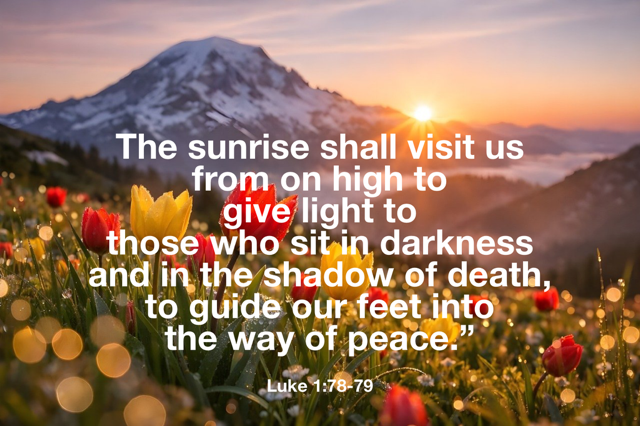
After John the Baptist was born, his father, Zechariah, said, “And you, child, will be called the prophet of the Most High; for you will go before the Lord to prepare his ways, to give knowledge of salvation to his people in the forgiveness of their sins, because of the tender mercy of our God, whereby the sunrise shall visit us from on high to give light to those who sit in darkness and in the shadow of death, to guide our feet into the way of peace” (Luke 1:76-79). Some other translations use “dawn” or “dayspring” in place of “sunrise.”

Josh Taylor shares this beautiful observation in Mercy Mild: A 25-Day Christmas Devotional Tracing Christ’s Love from Eden to Eternity:

When you’re watching a sunrise, you can’t pinpoint the exact moment night becomes day. It spreads, seeps into everything, changes the whole landscape one shade at a time. That’s what God’s mercy does through Jesus. It doesn’t just blast away the darkness—it transforms it, warms it, makes things grow that couldn’t grow before.

Christmas isn’t just about string lights and wrapped presents. It’s about light breaking into darkness in the gentlest way possible. About God looking at our mess and instead of sending judgment, sending His Son—the Dayspring, the Sunrise.

Sometimes the quietest light makes the biggest difference (pp. 140-141).

Sometimes God appears in a blaze of glory: on Sinai, to Paul the apostle, in Revelation. But when Jesus came to save us, He came gently, spreading His light like a sunrise.

Sometimes it’s hard to see His light. As Andrew Peterson wrote in his beautiful song, “Is He Worthy,” the world feels broken. Sometimes it seems like the wrong side is winning

But John 4:9 assures us, “In him was life, and the life was the light of men. The light shines in the darkness, and the darkness has not overcome it.”

Maltbie Babcock captures something of this truth in “This Is My Father’s World”: “Though the wrong seems oft so strong, God is the Ruler yet.”

His light is with us beyond Christmas. We see God’s light in His Word. We see it in His people. We see it when people turn to Jesus for salvation and serve Him and others. 

Those big, glorious bursts of God’s light are usually for a short time, for specific special occasions. Then life goes back to (a hopefully new) normal. After all the excitement Mary experienced with a visit from Gabriel, having baby Jesus, and running from Herod, she spent the next several years as an ordinary wife and mother. But she “treasured up all these things, pondering them in her heart.” (Luke 2:19). After the shepherds saw the angel host and followed the instructions to find the newborn Jesus, they likely went back to shepherding. But “they made known the saying that had been told them concerning this child. . . And the shepherds returned, glorifying and praising God for all they had heard and seen, as it had been told them” (Luke 2:17, 20). 

Like Mary, we can treasure and ponder what we’ve seen, heard, and experienced. Like the shepherds, we can share His light with others, glorifying and praising Him in our everyday lives.

2 Corinthians 4:6

(I often link up with some of these bloggers.)

When God’s Story Crashes Into Ours

God's interruptions

I’m sorry, I have no “Laudable Linkage” today. I have not been online this week enough to collect any links to share. So, instead, I thought I share this impactful quote from an Advent book I am (late in) reading:

Sometimes the biggest moments in God’s plan don’t look big at all. Just one person, being faithful, speaking words that heaven whispered first.

There Joseph is, mapping out his future-maybe sketching plans for his carpentry shop, dreaming about his upcoming marriage… and then everything explodes. An angel shows up. His fiancée is pregnant. God’s asking him to raise heaven’s child.

What do you do when God’s story crashes into yours? Joseph could’ve walked away. Made sense, really. But instead… he stayed. Named the baby Jesus. Became a dad to God’s Son. Changed diapers, taught woodworking, probably worried about providing enough.

God keeps showing up in our carefully planned lives, too. Interrupting our schedules. Rearranging our priorities. Asking us to trust Him with things that don’t make sense. We get this invitation–not just to believe in Jesus, but to let Him reshape everything. Our dreams. Our fears. Our everyday moments. What if we said yes? What if we let God’s story become ours?

Not just a decision we make once. More like breathing–constant, necessary, life-giving.

From Mercy Mild: A 25-Day Christmas Devotional Tracing Christ’s Love from Eden to Eternity by Josh Taylor

(I often link up with some of these bloggers.)
The Wonder of God with Us

The Wonder of God with Us

One of the verses shared most often during the Christmas season is Isaiah 7:14: “Therefore the Lord himself will give you a sign. Behold, the virgin shall conceive and bear a son, and shall call his name Immanuel.”

700 years after this was written, an angel quotes it to Joseph when he reassures him that Mary has not been unfaithful; the baby she is carrying is the Son of God (Matthew 1:18-25). Matthew then goes on to explain that “Immanuel” means “God with us.”

We’re so familiar with that passage and that truth, it’s easy for us to just breeze past them. But if we trace God’s interaction with His people through the Bible, we see what a wonder it is that God went to such great lengths to be with people that neglected and rejected Him.

God was with His people in full fellowship and harmony in the garden of Eden. But then they sinned and were sent out of the garden. Sin separates from God. He is always omnipresent, everywhere at all times. But that personal, harmonious fellowship was broken.

When God freed Israel from Egypt, He gave Moses plans for the tabernacle so that God could dwell among His people. But they had to come God’s way, through the sacrifices He commanded. The veil of the tabernacle, and later the temple, separated everyone from the Holy of Holies. Only the high priest could enter there once a year on the day of atonement.

Then, thousands of years later, “the Word became flesh and dwelt among” His people (John 1:14). The Lord of glory came to a poor family in a humble dwelling. “When the fullness of time had come, God sent forth his Son, born of woman, born under the law, to redeem those who were under the law, so that we might receive adoption as sons” (Galatians 4:4).

When Jesus died for our sin, the veil of the temple was supernaturally ripped in two. The writer of Hebrews tells us, “We have confidence to enter the holy places by the blood of Jesus, by the new and living way that he opened for us through the curtain, that is, through his flesh.”

He made a way for people to be reconciled to Him through Christ. “Therefore, since we have been justified by faith, we have peace with God through our Lord Jesus Christ. Through him we have also obtained access by faith into this grace in which we stand” (Romans 5:1-2). What an amazing gift–that we have access to God directly through Jesus by faith.

He dwells with the humble: “For thus says the One who is high and lifted up, who inhabits eternity, whose name is Holy: ‘I dwell in the high and holy place, and also with him who is of a contrite and lowly spirit, to revive the spirit of the lowly, and to revive the heart of the contrite'” (Isaiah 57:15).

He is with us in life’s challenges: “Be strong and courageous. Do not be frightened, and do not be dismayed, for the Lord your God is with you wherever you go” (Joshua 1:9).

He is with us in anxiety: “The Lord is at hand; do not be anxious about anything, but in everything by prayer and supplication with thanksgiving let your requests be made known to God. And the peace of God, which surpasses all understanding, will guard your hearts and your minds in Christ Jesus” (Philippians 4:5b-7).

He is with us in trouble: “When you pass through the waters, I will be with you; and through the rivers, they shall not overwhelm you; when you walk through fire you shall not be burned, and the flame shall not consume you” (Isaiah 43:2).

He is with us in joy: “I have set the Lord always before me; because he is at my right hand, I shall not be shaken. . . You make known to me the path of life; in your presence there is fullness of joy; at your right hand are pleasures forevermore” (Psalm 16:8,11).

He is with us to provide for us: “Keep your life free from love of money, and be content with what you have, for he has said, ‘I will never leave you nor forsake you’” (Hebrews 13:5).

He is with us at the end, if we know Him: “Even though I walk through the valley of the shadow of death, I will fear no evil, for you are with me; your rod and your staff,  they comfort me”( Psalm 23:4). Then we’ll be “absent from the body, and to be present with the Lord” once again in full fellowship unhindered by a sin nature (2 Corinthians 5:8).

An old song said God is watching us from a distance. No, He is very close. “But now in Christ Jesus you who once were far off have been brought near by the blood of Christ” (Ephesians 2:13). Because Jesus was God’s Son, born of a virgin, lived a sinless life, died on the cross for our sins, and rose again, we can be forgiven, redeemed, close to Him. In overcoming and need, in anxiety and danger, in everyday life and our walk with God, and finally in death, we can rest and rejoice in the fact that God is with us.

C. H. Spurgeon wrote a wonderful poem titled “Immanuel” at the age of 18:

When once I mourned a load of sin;
When conscience felt a wound within;
When all my works were thrown away;
When on my knees I knelt to pray,
Then, blissful hour, remembered well,
I learned Thy love, Immanuel.

When storms of sorrow toss my soul;
When waves of care around me roll;
When comforts sink, when joys shall flee;
When hopeless griefs shall gape for me,
One word the tempest’s rage shall quell–
That word, Thy name, Immanuel.

When for the truth I suffer shame;
When foes pour scandal on my name;
When cruel taunts and jeers abound;
When “Bulls of Bashan” gird me round,
Secure within Thy tower I’ll dwell–
That tower, Thy grace, Immanuel.

When hell enraged lifts up her roar;
When Satan stops my path before;
When fiends rejoice and wait my end;
When legioned hosts their arrows send,
Fear not, my soul, but hurl at hell
Thy battle-cry, Immanuel.

When down the hill of life I go;
When o’er my feet death’s waters flow;
When in the deep’ning flood I sink;
When friends stand weeping on the brink,
I’ll mingle with my last farewell
Thy lovely name, Immanuel.

When tears are banished from mine eye;
When fairer worlds than these are nigh;
When heaven shall fill my ravished sight;
When I shall bathe in sweet delight,
One joy all joys shall far excel,
To see Thy face, Immanuel.

Immanuel–God with us. I pray you know Him today and rejoice that He is not a God far off, but One who dwells right here with us.

Matthew 1:23

(Revised from the archives)

(I often link up with some of these bloggers.)

What Would Mary Say?

What Would Mary Say?

Mary, the mother of Jesus, is called the “favored one” and “blessed among women” in Luke 1. She’s such a wonderful example of someone wholly yielding to the Lord even though His plans for her would drastically affect her life.

As blessed and favored as Mary is, some go beyond what the Bible says to elevate her to a position almost alongside Jesus. What would Mary say about that?

We only have a few of her words recorded in Scripture, but I think they reveal a firm grasp of who she was.

She’s not sinless. A Christmas special we watched posited that because Mary didn’t have original sin, she might not have experienced labor pains. Yet the Bible doesn’t portray her as sinless. Jesus is the only person who was born without a sin nature and who never sinned once. Mary said, “My spirit rejoices in God my Savior” (Luke 2:47), acknowledging her own need for a Savior.

She is not the one we pray to. I suppose some might get the idea of praying to Mary from the incident where Jesus and his family attended a wedding where the wine ran out. Mary went to Jesus and told Him of the problem. He eventually turned water into wine, even though He told her his “hour has not yet come” (John 2:1-12). Some have taken from this scene the idea that we can go to Mary to get her to persuade Jesus to meet our needs.

Yet the Bible doesn’t advocate praying to anyone but God. Even here, Mary was not asked to appeal to Jesus for help.

Even in Mary’s prayer in Luke 1:46-55, her emphasis is on magnifying the Lord.

The Old Testament emphasized that we don’t have access to God except through the sacrificial system He gave to Israel. When Jesus died on the cross, the veil of the temple, which was a barrier only the high priest could enter once a year on the Day of Atonement, was torn from the top to the bottom. Hebrews 10:19-22 says, “Therefore, brothers, since we have confidence to enter the holy places by the blood of Jesus, by the new and living way that he opened for us through the curtain, that is, through his flesh, and since we have a great priest over the house of God, let us draw near with a true heart in full assurance of faith, with our hearts sprinkled clean from an evil conscience and our bodies washed with pure water.” We have direct access to God! As blessed and wonderful as Mary is, why would we try to go through her (which the Bible never tells us to do) when we can go directly to Him?

In the last scene where we see Mary in the Bible, she is with the other disciples of Jesus, male and female, after His ascension back into heaven. Acts 1:12-14 shows them “with one accord . . . devoting themselves to prayer.” She wasn’t being prayed to: she was praying along with them to God.

Mary’s last recorded words. The last thing that the Bible tells us Mary said was to the servants at the wedding in Cana, where Jesus turned water into wine: “Do whatever he tells you” (John 2:5). Her emphasis is always on Him. Do what He says. She claims no authority for herself. Even with Jesus’ followers in Acts, the disciples are in leadership, not Mary.

There’s much we can admire and emulate about Mary. Her humility. Her faith. Her willingness to do God’s will. Her grasp of God’s truth shown in her prayer. Her tendency to treasure and ponder in her heart things that occurred when Jesus was born. Her faithfully standing by Him during His crucifixion.

But she wouldn’t want us to worship her or elevate her to the same, or nearly the same, status as her Son. She would want us to honor, believe in, and glorify Him.

He is the way, the truth, and the life. He is our mediator. He is the one who changes us as we behold Him. He is our peace. In Him is our wisdom, righteousness, sanctification, and redemption.

Let’s proclaim along with Mary, “My soul magnifies the Lord, and my spirit rejoices in God my Savior” (Luke 1:46-47).

Luke 1:46-47

(I often link up with some of these bloggers.)

A Plea to Older Women

A Plea to Older Women

The Bible tells us older folks to mentor, teach, and be an example to younger people.Though I’ve never had a formal mentoring relationship with an older woman, I have been blessed by the testimony, example, and encouragement from women just ahead of my own life situation. Sometimes a passing remark from one of them has stayed with me for days, even years.

Now being in the “older” category myself, I understand concerns about trends in our world today.

It’s good for older people to share from their experience or express their opinions. But how we share our concerns is as important as what we share.

I’ve winced at memes on social media from older people extolling the ways life was superior “back in our day.” But I wonder if we realize how that sentiment comes across. Some might be meant as a joke, but many have a bite to them.

I think those kinds of posts either make people roll their eyes or get defensive. These memes can come across as condescending or finger-wagging, causing unnecessary offense.

Before we post such memes, here are some things that might be good to consider:

We did many things differently from our parents’ generation, didn’t we? So why would we be surprised when the next generation does as well?

Our view of “our day” may not even be correct. We tend to wax nostalgic, reframing the good and forgetting the bad.

We need to remember the struggles we had as younger women–the feeling that we’re failing at motherhood, at life in general, that we’ll never catch up or measure up.

Sometimes the issues some like to gripe about reflect cultural changes that aren’t good or bad in themselves.

For one example, a particular meme said something catchy (though I have forgotten how it was worded) about how we survived without taking water bottles or to-go coffee cups with us everywhere.

My first thought was, “So . . . what’s so bad about that?” So people like to bring their drink of choice with them. Is that a character flaw?

Another meme (or maybe the same one) went on to decry the bringing of our beverages into church. However, some people may think it makes for a more hospitable atmosphere to bring beverages. Many churches have coffee brewing and offer to-go cups from before Sunday school until after the morning service. Some of us who have physical problems like postnasal drip, with its frequent throat-clearing, or dry mouth, call less attention to ourselves and distraction for others by being able to take a sip rather than having to go out to the water fountain during a service.

I’ve known people adamantly opposed to bringing food or beverages into the sanctuary. But this is a cultural rather than a biblical issue. Churches didn’t have sanctuaries in Bible times. They met in homes, where there well might have been something to drink. There’s nothing sinful about carrying beverages with us, even bringing them into church.

It’s true we might not understand some of the practices of younger folks. And our practices might even actually be better. I’ve seen memes about phone usage and discipline that I actually agreed with. But the sarcastic tone didn’t invite dialogue or conversation.

Instead of ridiculing or talking down to younger women, let’s edify them. Instead of sharing what we think of as our better ways, let’s share from our own failures and faults how the Lord gave us grace and helped us overcome. Let’s encourage them that God loves them and wants them to draw close to Him and seek His help. His grace is always available in times of need. Let’s look for the positive and the well-meaning intentions to praise. Let’s tell them they are doing a good job when they are and pray for them when they need help. Let’s make our speech healthful rather than stabbing.

Isaiah foretold of the Servant of the Lord, Jesus, “The Lord GOD has given me the tongue of those who are taught, that I may know how to sustain with a word him who is weary. Morning by morning he awakens; he awakens my ear to hear as those who are taught” (Isaiah 50:4). May we meet each day with Him, learn of His truth and character, and share with others in humility and love. May our words–and memes–be full of grace.

Proverbs 12:18

(I often link up with some of these bloggers.)

Is God Disappointed In Me?

Is God Disappointed in Me?

When we’ve been walking with the Lord for a while, we’re sometimes dismayed that we’re still fighting battles with the same sins. We think, “Shouldn’t we be past that by now?”

Or perhaps we’ve gotten victory over some sins, but new ones crop up. Or regrets over past actions haunt us.

We might think God must be saying the same thing–“Shouldn’t she have made more progress by now? Is she ever going to get it right?”

Of course, God doesn’t ask questions like that. He knows us inside and out and knows our future as well as our past.

When I searched the Internet for articles about disappointing God, the first few discussed how God doesn’t have emotions as we do and is totally self-sufficient and self-satisfied in Himself.

I found that distinctly unhelpful in this context. Yes, God is self-sufficient and doesn’t need anyone or anything. But the Bible speaks of Him being pleased and displeased, angry or delighted.

A case study of what certainly looked like disappointing God came to mind: Peter’s denial of Christ. In Luke 22:31-34, at the last supper, Jesus told Peter that he would deny Jesus three times, even though Peter was sure he would follow Christ to the death.

In verse 40, Jesus told Peter, James, and John, “Pray that you may not enter into temptation.” But they fell asleep.

After Jesus was arrested, Peter followed behind and waited at the high priest’s courtyard while Jesus was inside. Peter was asked or accused three times of being one of Christ’s followers, but he denied it, denied even knowing Jesus. The Bible says, “And immediately, while he was still speaking, the rooster crowed. And the Lord turned and looked at Peter. And Peter remembered the saying of the Lord, how he had said to him, ‘Before the rooster crows today, you will deny me three times.’ And he went out and wept bitterly.”

We don’t know what was in that look of Jesus. I imagine it was something like the song, “The Look,” although that’s not about this situation.

We also don’t know what Peter was feeling, though we can imagine. In his place, I would have felt remorse, regret, probably some degree of self-loathing.

Later, though, the Lord was very tender with Peter.

After Jesus’ crucifixion and resurrection, the angels told the women who came to the tomb, “But go, tell his disciples and Peter that he is going before you to Galilee. There you will see him, just as he told you” (Mark 16:7).

Tell the disciples and Peter. Special mention. Jesus hadn’t dismissed Peter or ejected him from among Jesus’ followers.

Jesus appeared to His followers several times after His resurrection. Then Peter and a few others went fishing. I’ve heard sermons scolding Peter for this, accusing him of going back to his old life instead of fulfilling his mission. That may be. He may have thought, “I failed at being a disciple of Jesus–I should go back to what I know.” But the Bible doesn’t really say. Maybe he was bored. Maybe they were running out of funds and needed to make some money–they’d been hiding out for several days.

But whatever Peter’s motive, the group fished through the night without catching anything. In a scene reminiscent of the time Jesus called Peter to follow Him, He appeared and told the disciples to cast their nets on the other side. When they did, they netted so many fish, they couldn’t haul them into the boat.

Then we have the famous scene where Jesus asked Peter three times whether he loved Him. Three times, Peter said yes. Three times, Jesus told him to feed His sheep.

Three times–the same number of times Peter denied Jesus.

Was Jesus rubbing Peter’s failure in? I think He was reassuring him that he was restored and still had a purpose in God’s kingdom. Was Peter’s failure at catching fish a reminder that Peter couldn’t even do the task that was his strength, his profession, without Jesus? Possibly.

Many years later, when Peter wrote, “He himself bore our sins in his body on the tree, that we might die to sin and live to righteousness. By his wounds you have been healed. For you were straying like sheep, but have now returned to the Shepherd and Overseer of your souls” (1 Peter 2:24-25). Perhaps he was thinking of his own straying and return to his Shepherd.

I don’t profess to have all the answers to whether God is ever disappointed in us, but, as I have pondered the question, a few things came to mind.

We won’t reach sinless perfection in this life. We receive a new nature when we’re saved, but we still have the old one until we get to heaven. We’re sanctified–set apart unto God–from the first moment we’re saved. But until we reach heaven, and sin and Satan are removed completely, we’ll still fight our old nature. Galatians 5:17 says, “For the desires of the flesh are against the Spirit, and the desires of the Spirit are against the flesh, for these are opposed to each other, to keep you from doing the things you want to do.”

The Bible makes provision for forgiveness of sin after salvation. John wrote, “My little children, I am writing these things to you so that you may not sin. But if anyone does sin, we have an advocate with the Father, Jesus Christ the righteous” (1 John 2:1) and “If we say we have no sin, we deceive ourselves, and the truth is not in us. If we confess our sins, he is faithful and just to forgive us our sins and to cleanse us from all unrighteousness. If we say we have not sinned, we make him a liar, and his word is not in us” (1 John 1:8-10). This isn’t a green light or an encouragement that sin doesn’t matter. It does. But when it happens, as God knew it would, there is forgiveness.

God sees us through Jesus. The essence of salvation is that Jesus took our wrong on Himself so that we might receive His righteousness. He lived a righteous life in our place because we couldn’t. “For our sake he made him to be sin who knew no sin, so that in him we might become the righteousness of God” (2 Corinthians 5:21). The Bible says in many places that once we repent of our sin and believe on Jesus as our Lord and Savior, we’re in Christ. “There is therefore now no condemnation for those who are in Christ Jesus” (Romans 8:1). Again, this doesn’t mean that we can live any old way because God sees Jesus’ righteousness rather than ours. That feeling is incompatible with salvation. Our desires change when we’re saved to where we want to please God. Though we fail sometimes, our ultimate desire is to please Him. And when we do go our own way in rebellion, the Bible says God disciplines and chastens His children (Hebrews 12:5-13) to train them in righteousness.

Remember Satan’s influence. Jesus told Peter, “Satan demanded to have you, that he might sift you like wheat” (Luke 22:31). We can’t blame Satan when we sin, because God has promised a way of escape (1 Corinthians 10:13). But it helps to know that some of the weird thoughts that occasionally assail us might be coming from an outside influence.

Don’t trust in yourself. Peter had good, fervent intentions. But they were not enough to keep him from falling. 1 Corinthians 10:12 warns, “Let anyone who thinks that he stands take heed lest he fall.”

Use the means God provided. Jesus told Peter to watch and pray, lest he enter into temptation. Paul told the Galatians, “Walk by the Spirit, and you will not gratify the desires of the flesh” (5:16). God’s Word builds us up and strengthens us (Romans 16:25; Acts 20:32). Jesus defeated Satan’s temptations with Scripture.

A heightened awareness of sin develops as we grow in the Lord. When we first hear about sin, we might respond, “Well, nobody’s perfect.” Or we feel we’re not guilty of the “big stuff”–murder, adultery, stealing, drug dealing, etc.–so we’re not so bad. But as we read the Bible, we find that pride, self-glory, angry thoughts, and hatred are every bit as sinful. And we realize even more that sin is an affront to a holy God. We identify with David when he said, “My iniquities have overtaken me, and I cannot see; they are more than the hairs of my head; my heart fails me” (Psalm 40:12).

God knows our frailties. David writes in Psalm 103, “As a father shows compassion to his children, so the Lord shows compassion to those who fear him. For he knows our frame;
he remembers that we are dust.”

God’s posture towards His own is loving, merciful and faithful. David went on to say in Psalm 40, “But may all who seek you rejoice and be glad in you; may those who love your salvation say continually, ‘Great is the Lord!’ As for me, I am poor and needy, but the Lord takes thought for me. You are my help and my deliverer; do not delay, O my God!” (verses 16-17). Another psalmist writes, “If you, O Lord, should mark iniquities, O Lord, who could stand? But with you there is forgiveness, that you may be feared” (Psalm 130:3-4). Lamentations 3:22-23 says, “The steadfast love of the Lord never ceases; his mercies never come to an end; they are new every morning; great is your faithfulness.” “The Lord is gracious and merciful, slow to anger and abounding in steadfast love” (Psalm 145:8).

Just before Jesus told Peter of his coming denial, He said, “I have prayed for you that your faith may not fail” (Luke 22:32). Even knowing that Peter would fail, Jesus said, “When you have turned again, strengthen your brothers.” He knew Peter would fall, but He also knew Peter would repent.

Have you ever felt like God must be disappointed in you? What truths helped you? Do any of these thoughts resonate with you?

Psalm 130:3-4

(I often link up with some of these bloggers.)
Thanksgiving Is Not a Feeling

Thanksgiving is not a feeling

I often feel a little awkward when a group leader wants participants to share something we’re thankful for right off the bat. I hope she won’t call on me first so I have a little time to think.

In the midst of a heavy trial is another time it is hard to be thankful. The weight of what we’re going through overshadows thankful feelings.

Then other times, nothing bad is going on, but life just seems mundane, unexciting. If someone asks us what we’re thankful for at those times, we’d likely draw a blank.

These are all occasions when we might not feel thankful. But thanksgiving isn’t a feeling. It’s an action. And, ironically, giving thanks even when we don’t feel thankful often leads to feeling thankful.

It doesn’t usually take a lot of thought to find reasons to be thankful. And if you’re like me, once you get started, it’s hard to stop!

When going through a trial, I can be thankful that:

  • God is with me.
  • He promised to give me grace and help me.
  • He knows just how much to allow.
  • He loves me.
  • He is interested in my growth even if I am not.
  • He has a purpose in all He allows and works it for my good.

When life is mundane, I can be thankful that:

  • A respite is provided from busyness.
  • God is with me, even in the small moments.
  • When I do things as unto the Lord, they are important even if they are not big.
  • Quiet days provide time to listen to others.

When life is busy, I am thankful that:

  • God gives strength.
  • God quiets my racing heart.
  • God gives peace.
  • Rest is coming.

Any day, I can be thankful that:

  • God saved me.”Giving thanks unto the Father, which hath made us meet to be partakers of the inheritance of the saints in light: Who hath delivered us from the power of darkness, and hath translated us into the kingdom of his dear Son: In whom we have redemption through his blood, even the forgiveness of sins” (Colossians 1:12-14).
  • God comforts me. “For the LORD shall comfort Zion: he will comfort all her waste places; and he will make her wilderness like Eden, and her desert like the garden of the LORD; joy and gladness shall be found therein, thanksgiving, and the voice of melody” (Isaiah 51: 3).
  • God helps me. “The Lord is my strength and my shield; in him my heart trusts, and I am helped; my heart exults, and with my song I give thanks to him” (Psalm 28:7).
  • God loves me. “Let them thank the Lord for his steadfast love, for his wondrous works to the children of man!” (Psalm 107:8).
  • God forgives me. “I will give thanks to you, O Lord, for though you were angry with me, your anger turned away, that you might comfort me” (Isaiah 12:1).

We often look to our circumstances for reasons to be thankful. But we can be thankful for God Himself and His wonderful attributes:

  • Oh give thanks to the LORD, for he is good; for his steadfast love endures forever!” (I Chronicles 16:34; Ezra 3:11; Psalm 106:1; 107:1; 118:1, 29; 136).
  • Sing unto the LORD, O ye saints of his, and give thanks at the remembrance of his holiness” (Psalm 30:4).
  • Let us come before his presence with thanksgiving, and make a joyful noise unto him with psalms. For the LORD is a great God, and a great King above all gods” (Psalm 95:2-3).
  • I will give thanks to the Lord with my whole heart; I will recount all of your wonderful deeds” (Psalm 9:1).

Among the many admonitions and encouragements to be thankful in the Bible is this, from 1 Thessalonians 5:18: “In everything give thanks; for this is the will of God in Christ Jesus for you” (NKJV). In everything–all circumstances, the ESV says–there is something for which we can be thankful.

Thanksgiving often spontaneously overflows when news is good or something happy occurs. But when we’re going through something hard, thanksgiving isn’t easy. The Bible says sometimes praise is a sacrifice. When we remind ourselves who our God is, what He has promised us, and how He loves us, we can find abundant reasons to thank Him.

1 Thessalonians 5:18

(I often link up with some of these bloggers.)