Psalm Sunday: Psalm 6

I am a couple of days late with this week’s Psalm Sunday entry. I usually do these Sunday evenings after church, but this last Sunday we had a parent-teen fellowship at that time (am I getting old when I cringe at the thought of an activity that’s supposed to last until 9:30? I am usually up until way past that, but I don’t like to be out past that time). Then Monday I was preparing for a ladies’ meeting at church in the evening and got a phone call from school that they thought my son had pink eye and I needed to come and get him. I was afraid of that, but I was hoping that the redness was just due to irritation from a cold and that allergy eye drops would do the trick. After getting him, having lunch, getting to the doctor’s office, dropping off prescriptions, going to the store for more tissues and a few other things, waiting in the drive-through line at the pharmacy, deciding it was too late to make the quick-and-easy dinner I’d just bought, and making a quick swing by Arby’s, I finally got off to the ladies meeting. I was so glad the Lord led me to prepare for it earlier in the day!

But that is not what this post is about. 🙂

Psalm 6

1 O LORD, rebuke me not in thine anger, neither chasten me in thy hot displeasure.

2 Have mercy upon me, O LORD; for I am weak: O LORD, heal me; for my bones are vexed.

3 My soul is also sore vexed: but thou, O LORD, how long?

4 Return, O LORD, deliver my soul: oh save me for thy mercies’ sake.

5 For in death there is no remembrance of thee: in the grave who shall give thee thanks?

6 I am weary with my groaning; all the night make I my bed to swim; I water my couch with my tears.

7 Mine eye is consumed because of grief; it waxeth old because of all mine enemies.

8 Depart from me, all ye workers of iniquity; for the LORD hath heard the voice of my weeping.

9 The LORD hath heard my supplication; the LORD will receive my prayer.

10 Let all mine enemies be ashamed and sore vexed: let them return and be ashamed suddenly.

Usually I like to go verse by verse though what the passage actually says before talking about what I think it means to me. But I don’t think that’s necessary this time — not because this post is late, but because the Psalm is pretty self-explanatory. David is grieving over sin and asking forgiveness, which he feels confident of having received in the last three verses.

It seems to me that throughout Christian history the pendulum has swung back and forth between an emphasis on how awful sin is and on God’s mercy and readiness to forgive. The two need to be kept in balance. Both are true, but an emphasis on one or the other can lead to distortion. The first can lead people almost to despair of being able to be forgiven, the thought that “my sin is too great for me to take it to God.” The latter can lead to a taking of sin lightly and almost thoughtless or perfunctory asking of forgiveness. But taking these two truths together, in balance, we see the magnitude and awfulness of our sin, God’s “hot displeasure” (v. 1), grieve over it as David did — and as New Testament believers we know what sin cost — the lifeblood of the Son of God, and we should never take it lightly; but we also see the great grace of our God in providing a means whereby we can be forgiven, we see the tender gaze of a Father who is slow to anger and ready to forgive and restore fellowship when we come to Him in repentance.

Something else that struck me is that David not only has confidence that God has heard and answered his prayer, but now he can face his enemies in confidence as well. When we’re burdened down with the weight of sin, we’re defeated in other areas as well, but when we have confidence that all is right between ourselves and God, that gives us renewed confidence and vigor in other areas. too.

You can read more meditations on this Psalm or share your own at Butterfly Kisses.

John 3:16 Valentine

jn316hrt.gif

I received this in an e-mail a few years ago. I searched the ‘net for it today and found it here at Caleb’s Country Corner Graphics, but I don’t know if it is original with that artist or not. I sent an e-mail to ask, but haven’t received an answer yet. Her site does give permission to use it, though. I thought it was a very sweet Valentine, not to mention the greatest expression of love ever.

Christian quotes about love

(Friday’s Feast post is below this one.)

709402_good_morning_its_paradise.jpg

The springs of love are in God, not in us. It is absurd to look for the love of God in our hearts naturally; it is only there when it has been shed abroad in our hearts by the Holy Spirit.

— Oswald Chambers, My Utmost for His Highest, April 30

The labor of self-love is a heavy one indeed. Think whether much of your sorrow has not arisen from someone speaking slightingly of you. As long as you set yourself up as a little god to which you must be loyal, how can you hope to find inward peace?
– A.W. Tozer

How many of you will join me in reading this chapter (I Corinthians 13) once a week for the next three months? A man did that once and it changed his whole life. Will you do it? It is for the greatest thing in the world. You might begin by reading it every day, especially the verses which describe the perfect character. “Love suffereth long, and is kind; love envieth not; love vaunteth not itself.” Get these ingredients into your life. Then everything that you do is eternal. It is worth doing. It is worth giving time to. No man can become a saint in his sleep; and to fulfill the condition required demands a certain amount of prayer and meditation and time, just as improvement in any direction, bodily or mental, requites preparation and care. Address yourselves to that one thing; at any cost have this transcendent character exchanged for yours.
—Henry Drummond, The Greatest Thing in the World

To love those whom we do not like means that we treat them as if we did like them — to choose to act kindly toward them even though we do not like them….The Bible does not ask us to like the brethren, it asks us to love them, and that means, therefore, something like this: we may not like certain Christians. I mean by that, there is none of this instinctive, elemental attraction; they are not the people whom we naturally like; yet what we are told is that to love them means that we treat them exactly as if we did like them. Now, the men and women of the world do not do that; if they do not like people, they treat them accordingly and have nothing to do with them. But Christian love means that we look beyond that. We see the Christian in them, the brother or sister, and we even go beyond what we do not like, and we help that person. Love your brethren — that is the exhortation with which we are concerned.
— Martyn Lloyd-Jones on I John 3:16-18 in his book Children of God

True love ennobles and dignifies the material labors of life; and homely services rendered for love’s sake have in them a poetry that is immortal.
~ Harriet Beecher Stowe

Let the wife make the husband glad to come home.
Let the husband make the wide sorry to see him leave.
— Martin Luther

(Photo courtesy of the stock.xchng

Questions vs. accusations

We had one of our missionaries speaking at church last night. In the course of his message he referred to God’s asking Adam in the garden of Eden, after he had partaken of the forbidden fruit, where he was hiding and what he had done. God, of course, knew the answer. But He asked Adam the questions all the same. The speaker said one reason for that is because “Questions stir the conscience, but accusation hardens the will.”

That’s one of those things I wish I had known when my kids were younger.

Satan’s goal

You know how you can read a particular Bible passage for years, be blessed by it, get much from it, and then someone asks a question or brings an insight that you did sort of know on one level, but the way they put it opens up whole new vistas for you?

That happened yesterday in Sunday School. The overall topic was afflictions, and the teacher mentioned a few verses in Scripture that spoke of afflictions, reasons for them, etc. Then we spent most of the class period on Job. After reviewing a little bit about Job’s situation, and the discussion between Satan and God in Job 1 and 2, our teacher asked, “What was Satan’s goal in afflicting Job?” He wanted Job to curse God.

I knew that — but putting it like that made me think — when we are going through any kind of trial, do we think about this aspect of things? So often we just want relief, we want out. That’s normal — Job did, too. We don’t have any record that he had any idea of this conversation behind the scenes. But we have it — and we can seek God’s grace not only to get through any trial, but to uphold God’s honor.

Psalm Sunday: Psalm 5

1 Give ear to my words, O LORD, consider my meditation.

2 Hearken unto the voice of my cry, my King, and my God: for unto thee will I pray.

3 My voice shalt thou hear in the morning, O LORD; in the morning will I direct my prayer unto thee, and will look up.

4 For thou art not a God that hath pleasure in wickedness: neither shall evil dwell with thee.

5 The foolish shall not stand in thy sight: thou hatest all workers of iniquity.

6 Thou shalt destroy them that speak leasing: the LORD will abhor the bloody and deceitful man.

7 But as for me, I will come into thy house in the multitude of thy mercy: and in thy fear will I worship toward thy holy temple.

8 Lead me, O LORD, in thy righteousness because of mine enemies; make thy way straight before my face.

9 For there is no faithfulness in their mouth; their inward part is very wickedness; their throat is an open sepulchre; they flatter with their tongue.

10 Destroy thou them, O God; let them fall by their own counsels; cast them out in the multitude of their transgressions; for they have rebelled against thee.

11 But let all those that put their trust in thee rejoice: let them ever shout for joy, because thou defendest them: let them also that love thy name be joyful in thee.

12 For thou, LORD, wilt bless the righteous; with favour wilt thou compass him as with a shield.

In verses 1-3, David cries out to the Lord to hear his prayer.

Verse 4 is one reason David has confidence that God will hear and answer: God does not take pleasure in wickedness, so David has confidence that the wickedness of his enemies will not prevail. We have that hope and expectation as well: ultimately evil will be taken care of and all will be set right. “The wrong shall fail, the right prevail,” as one song says. God’s timetable is not the same as ours: Israel had 10 wait 400 years for deliverance out of Egypt; some people in Hebrews 11 died without having seen the promises to them fulfilled. But quite often God does give us the victory, or at least a glimmer of it, in a shorter time. Verses 5-6 continue describing the wicked and what God hates about their activities.

In verse 7, David contrasts himself with the wicked he has just been talking about, not with a cocky self-righteousness, but with reverence and trust on God’s mercy. A true understanding of God’s mercy will lead to reverence, godly fear and humility as well as confidence in Him. That mercy is available to the wicked, too, if they would but humble themselves before Him.

In verse 8 David asks the Lord to lead him in His righteousness — again, nothing cocky or self-righteous there, but an utter trust in God’s righteousness. “Make Thy way straight before my face.” How often I need to pray that, that I might clearly know His way and what direction to take.

In verse 9 he goes back to describing the wicked from whom he needs deliverance, and in verse 10 calls for their destruction. In a sense that is a difficult passage because as New Testament believers we have been taught to love our enemies, pray for them that despitefully use us and persecute us, etc. (Matthew 5:43-45.) One way to reconcile those two thoughts is to remember that David had not had that instruction yet. There is a sense in which more and more is revealed of God’s will through history. For instance, there is instruction in later books of the Bible about having more than one wife which Jacob did not have, instructions about not marrying a relative which Abraham did not have. In our own lives, God does not deal with everything all at once (and that is such a good thing — think how overwhelming that would be!) — when we’ve been saved 20 years we might be convicted about things that we weren’t at first. For instance, when I was first saved the Lord dealt with me about lying. Years later that was refined beyond just outright lies to conviction about not being manipulative with facts, not telling about a situation in such a way as to favor my actions. And I think that’s true historically. We have so much more of God’s Word today that the patriarchs did — and to whom much is given, much is required (Luke 12:48).

On the other hand, though, I do remember around the time of Desert Storm praying that Sadam Hussein would either come to the Lord, or, if God knew that he never would, that God would take him out of the way. If I had lived in Hitler’s time I probably would have prayed the same way about him, and I probably should pray the same way about bin Laden.

“Let them fall by their own counsels.” That’s one way enemies can be defeated! That reminds me of David’s prayer in II Samuel 15: 31: “And David said, ‘O LORD, I pray thee, turn the counsel of Ahithophel into foolishness.'” (I don’t know if this Psalm is talking about that same situation or not. I might try to look that up later.) If you read II Samuel 15 and the next couple of chapters, that’s exactly what happened. It’s a great story!

In verses 11 and 12 David again contrasts the righteous with the wicked and rejoices that he can trust in God’s defense.

It struck me in going through this Psalm that David expresses confidence in God’s mercy (v. 7), His righteousness (v. 8), and His defense (v. 11). And we can have confidence in Him as well!

You can read more meditations on this Psalm or share your own at Butterfly Kisses. It’s interesting each week to see what each different lady got out of the Scripture.

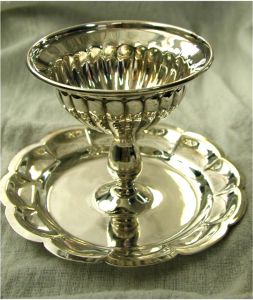
Refined silver

620051_silver_cup.jpg

I will refine them as silver is refined, and will try them as gold is tried. Zechariah 13:9.

AS the purifying process is carried on, “the refiner watches the operation, with the greatest earnestness, until the metal has the appearance of a highly polished mirror, reflecting every object around it: even the refiner, as he looks upon the mass of metal, may see himself as in a looking-glass, and thus he can form a very correct judgment respecting the purity of the metal. When he is satisfied, the fire is withdrawn, and the metal removed from the furnace.” See Jesus, as the Refiner, watching “with the greatest earnestness” the purifying of thy soul in the furnace of earth. His hand has lighted the fire which is now separating the pure metal of holiness from the dross of sin in thee. His loving eye is ever eagerly watching for the moment when the purifying work is done. Then, without a moment’s delay, He withdraws the fire, and the purified soul is removed from the furnace. See, again, when it is that the purification is completed; it is when the Image of Christ is reflected in us, so that He can see Himself in us as in a mirror. Raise your eyes, then, amidst the flames, and see the Face of Jesus watching you with the tender pity and intense interest of His love.
— George Body

From the February 2 reading of Joy and Strength compiled by Mary Wilder Tileston

Photo courtesy of the Stock.xchng

In spirit and in truth

I had a couple of other posts in mind this morning, but as I was reading new posts from my Bloglines, I was about to fall asleep in my chair (not because of the posts! 🙂 ) So I gave up and decided I would have a more productive day if I went ahead and took a nap. Then there were errands to run and such.

But something came to mind that I did want to share just quickly. In light of my last post and some of the discussion over at Everyday Mommy’s lately, this verse came to mind:

God is a Spirit: and they that worship him must worship him in spirit and in truth. John 4:24.

We tend to think sometimes that as long as we’re sincere, it doesn’t really matter how we worship. But it wasn’t quite that way with Uzzah who reached out a hand to steady the ark or Nadab and Abihu who offered “strange fire” before the Lord. We forget, since God doesn’t usually handle things that way in these days, that that is how He feels when His instructions are violated. True, we don’t have the specifications that they did in their day. But God has given us His Word both so that we might know Him and that we might live as He wants us to. He wants us to worship not just in spirit but in truth.

Doctrine

I mentioned in my post about fundamentalism and separatism that I was going to write later some thoughts about “secondary issues” (or the non-fundamentals). But I have been thinking for the last several weeks about doctrine. I write and/or compile a newsletter/booklet for our ladies group, and one regular column for the last few years has been called “Women of the Word,” dealing with reasons to read the Bible, how to’s, devotional tips, Bible studies, etc. I went back and looked up a couple of columns I had written about doctrine and want to include them here before I go on to secondary issues. After all, we need to know doctrine — God’s truths — before we can exercise discernment, and we need discernment to know what is fundamental and what is secondary, what we need to stand firm on and what we have room to differ on.

So, first is one written in October of 04:

Our “favorite” times in the Word are often the “warm fuzzies” — when we feel especially blessed, loved, comforted, encouraged, or secure in what we have read. And those times are, indeed, wonderful. But as we read, we should be looking for more than “warm fuzzies” — we should be looking for truth about our God.

I was thinking recently that it is too bad that churches are too often divided into those preaching “doctrinal” messages or those meeting “felt needs” when really they should go together. We can’t truly meet spiritual needs without the truth, the doctrine, of God’s Word. When a trial comes and people feel forsaken, what most comforts but the precious truth that God will never forsake us? When a lie seems the only way out of a tough situation, what keeps us from it but the knowledge that it will displease a God whose essence is truth?

A.W. Tozer once wrote that “there is scarcely an error in doctrine or a failure in applying Christian ethics that cannot be traced finally to imperfect and ignoble thoughts about God.” He further felt that “wrong thoughts about God are in reality a form of idolatry.” I think that’s true.

When we don’t worship God for Who He truly is, then we are worshipping a god of our own making, and that is idolatry. Now, of course, all of us are imperfect in our knowledge of Him and are, or should be, ever growing in Him, and He’ll correct our understanding along the way. But that is a little different than not knowing Him for Who He is due to neglect or misapplication of the Word.

Our thinking has much bearing on our intimacy with God. We can’t know Him aright apart from what He has revealed of Himself in His Word. As we learn more of Him, we love Him and worship Him more, and what seemed like “dry doctrine” then does become something that warms and thrills our hearts as the Holy Spirit brings that truth to mind.

And, the more we behold Him, the more we are changed into His likeness. II Corinthians 3:18: “But we all, with open face beholding as in a glass the glory of the Lord, are changed into the same image from glory to glory, even as by the Spirit of the Lord.”

So, don’t be afraid of that word “doctrine.” II Timothy 4: 3-4 says, “For the time will come when they will not endure sound doctrine; but after their own lusts shall they heap to themselves teachers, having itching ears; And they shall turn away their ears from the truth, and shall be turned unto fables.” That is a warning to us not to turn away from sound doctrine, but also possibly an admission that sound doctrine needs to be “endured.” Learning doctrine may not always feel warm and fuzzy, but the Holy Spirit will use it in our lives in blessed ways.

This next one was just from January of this year:

Often when we read our Bibles, we’re looking for comfort, encouragement, strength, assurance of God’s love, care, guidance, and protection — and the Bible is a wonderful source for all of those things. But one of the most important reasons for reading and studying God’s Word is to learn correct doctrine. Immediately the word doctrine can bring to mind dryness, dullness, and argumentation. But if we think of doctrine as a manifestation of God’s truth and character, we can in turn worship Him by knowing and sharing the doctrines of His Word.

So often I have heard some of the sweetest people make some of the most off-the-wall comments about truth, and I have been so surprised by the lack of discernment. I remember a news report about cult leader David Koresh quoting one woman saying she was drawn in because of how well he knew his Bible. But just in that short news report Koresh made several unbiblical statements. Sometimes celebrities whose behavior and public statements contradict the Bible are quoted as spiritual sources.

One of my former pastors, Jesse Boyd, used to say that (at least in his day) bankers were trained to recognize counterfeit bills not by studying the various counterfeits, but by studying genuine currency so well that they could tell if any bill differed from it. If we know God’s Word and His truth well, we won’t be led astray and we can help share God’s truth with our children, neighbors, relatives, and others within our sphere of influence.

We have to remember, though, to let our speech be always “with grace” (Col. 4:6) and to speak the truth in love (Eph. 4:15). We don’t need to “pounce” on every comment or reference another person might make, but graciously seek what the Lord might have us say. We also have to distinguish between clear doctrine and those areas where good people can differ or personal preferences.

That we henceforth be no more children, tossed to and fro, and carried about with every wind of doctrine, by the sleight of men, and cunning craftiness, whereby they lie in wait to deceive; But speaking the truth in love, may grow up into him in all things, which is the head, even Christ. (Ephesians 4:14-15).

For I give you good doctrine, forsake ye not my law (Proverbs 4:2).

These were more noble than those in Thessalonica, in that they received the word with all readiness of mind, and searched the scriptures daily, whether those things were so. Therefore many of them believed; also of honourable women which were Greeks, and of men, not a few (Acts 17:11-12).

Teasing

I just learned a few days ago that my youngest son has been being teased for weeks or months, I don’t know how long. It came to light a few days ago. In one of their school chapels, the students had been encouraged to make sure their hearts were right with God, and in an unusual moving of the Spirit, many did so, and did so publicly that day. It was totally unplanned, but chapel lasted for a couple of hours or more that day as they gave time for students to confess to the Lord, and to each other if need be, anything that He convicted them of. Our church had had wonderful revival services the week before, and this, I think, showed the Lord’s continued working.

What my son felt the need to confess to us was that he had pushed or shoved another student a while back. That’s not characteristic of him, but the student had said something about me. What, I don’t know and didn’t ask. I told Jesse that while I appreciated his wanting to defend me, that probably wasn’t the way to handle it, and he agreed. As we talked longer, somehow it came out that he was regularly teased about his ears. He laughed as he told me some of the things that had been said. I mentioned to him that there is a surgery in which they can take ears that stick out too far and make them closer to your head. My husband and I had talked about it before — to me Jesse’s ears were kind of borderline. If they had been much worse we would have already had the surgery to avoid just this kind of thing. But all surgeries have their risks, so we didn’t want to do it unnecessarily. So we were waiting to see how things changed as he went through puberty. As I mentioned this surgery to Jesse, he said, “No, I’m fine with it. A lot of times I laugh along with them.”

So, though he’s handling it well, my mother-bear heart was upset. I don’t think we need to talk to parents of the other kids or anything like that — I think that could only make it worse.

But what bothers me is that, when anything of this nature comes up in a conversation, the general response is something like, “Oh, kids are just that way.”

Well, that’s true. But it is also a kid’s way, when he is little, to hit another toddler over the head who has a toy he wants or to lie the first time his mind can comprehend that he might be in trouble but he might get out of it if he can make Mom think that something else happened. We correct those behaviors — why do we let other behaviors go unchecked with the excuse that kids are just that way? Especially Christian parents of Christian kids? People have often said through the years, “Kids can be so cruel.” Shouldn’t we be trying to teach our children not to be that way?

I know often parents are unaware of the kinds of things their kids are saying. Probably my own children have said things they shouldn’t have to other children along the way as they were growing up that I am totally unaware of. Perhaps one thing we can do as parents is to ask the Lord to bring these things to light if and when they happen so they can be dealt with. Another thing we can do is actively teach that God made everyone the way they are for a reason. Our standard is not, or shouldn’t be, that everyone should look like movie stars or models. We talk about that in other areas, but we need to apply it to this. Sometimes I’ll see someone and my first reaction is that their nose is big or their eyes are too far apart or whatever, and I’ll have to ask myself, “By whose standard? Who decreed that noses are only supposed to be so long or eyes are supposed to be set only a certain way? Who made that nose or those eyes?” We need to check these attitudes in ourselves and in our children. And we need to teach the harmfulness of hurtful words (Prov. 12:18: There is that speaketh like the piercings of a sword: but the tongue of the wise is health) and the need for gracious, edifying words (Eph. 4:29: Let no corrupt communication proceed out of your mouth, but that which is good to the use of edifying, that it may minister grace unto the hearers.)

I hope this doesn’t sound like I am “ranting.” It isn’t meant to. These thoughts weren’t stirred just by this one incident. but have been on my mind for a while. I’ve been a mother for 22 years, worked with children for several years before that, and was a child myself before that. 🙂 So, knowing that children are wont to tease and to sometimes be cruel is nothing new to me.  But over the years I have been amazed at the tendency of adults, especially Christian adults, to just brush it off as normal. Christians aren’t supposed to yield to the sinful impulses that come normally. We’re supposed to seek God’s supernatural grace to yield our bodies, including our mouths, to Him for His use.

The Lord is so good to minister to us and bring something of His truth before our eyes just when we need it. I mentioned a few days ago that I was delighted to find a reproduction of Rosalind Goforth’s biography of her husband, Jonathan.  I’ve been wanting to reread it since I got it, and I picked it up yesterday. One of the early chapters talked about his college experiences. He came from a farming background, and his mother was one of the best seamstresses in the county, and she made his clothes for school. When he went away to college, his home-made clothes stood out like a sore thumb in the city. Even more than that, though, he was naive and unpretentious. He did realize that his clothing did not fit in, and, though very poor, bought some material to have some new clothes made. Some young men in his dormitory found it, cut a hole in the top, put it over Jonathan’s head, and made him run up and down a hallway through a number of other laughing students. He felt afterward that this kind of behavior should be reported, but was told by the college authorities that it was just a harmless prank. It hurt him, not so much that this had been done to him, but that it had happened at a Christian college. Rosalind writes, “That night he knelt with Bible before him and struggled through the greatest humiliation and the first great disappointment of his life. The dreams he had been indulging in but a few days before had vanished, and before him, for a time at least, lay a lone road. Henceforth he was to break an independent trail. It is not hard to see God’s hand in this, forcing him out as it did into an independence of action which so characterized his whole after life.” By the time he graduated, he had the honor and support of the whole school, and many had come to apologize for their actions that year.

So — I know the Lord can use these kinds of things to teach and to build character, and I can trust Him to work all things together for good (Romans 8:28).