Psalm Sunday: Psalm 4

In our journey through the Psalms together hosted by Erica at Butterfly Kisses, we’re looking at Psalm 4 this week. I hope you can join us!

1 Hear me when I call, O God of my righteousness: thou hast enlarged me when I was in distress; have mercy upon me, and hear my prayer.
2 O ye sons of men, how long will ye turn my glory into shame? how long will ye love vanity, and seek after leasing? Selah.
3
But know that the LORD hath set apart him that is godly for himself: the LORD will hear when I call unto him.
4
Stand in awe, and sin not: commune with your own heart upon your bed, and be still. Selah.
5 Offer the sacrifices of righteousness, and put your trust in the LORD.
6 There be many that say, Who will shew us any good? LORD, lift thou up the light of thy countenance upon us.
7 Thou hast put gladness in my heart, more than in the time that their corn and their wine increased.
8 I will both lay me down in peace, and sleep: for thou, LORD, only makest me dwell in safety.

Once again David calls out to the Lord in his distress. From past experience he knows that God can and will hear his prayer and help him.

In verse 2-5 he addresses the “sons of men” — apparently those who were causing his distress. He asks how long they will continue in their ways, turning glory into shame, loving vanity (uselessness, futility, emptiness), seeking leasing (deception and lies, according to the Strong’s definition). He exhorts them to know something: that the Lord has set apart the godly for Himself and will hear their prayer. He admonishes them to stand in awe of Him and to commune (to say, to answer, to say in one’s heart, to think, to command, to promise, to intend, according to Strong’s definition) with their own hearts, to be still, to offer sacrifices of righteousness and trust in the Lord. In other words, “God will hear my prayer because I am His. Be still, be quiet: think about these things. What your living for is useless, vain, and false. Turn to Him; trust in Him.” David here issues an invitation, or an exhortation, really, to the ungodly to come to the Lord as well.

In verse 6 he addresses the Lord again. Perhaps his statement, “There be many that say, ‘Who will shew us any good?'” is based the response he got, or thought he would get, from the sons of men. He asks for God’s countenance on Him and is glad in his heart, gladder than what the others have to celebrate about. He sleeps in perfect peace, knowing that His safety is in the Lord.

This Psalm reminds me a little of the first few verses of Psalm 37:

1 Fret not thyself because of evildoers, neither be thou envious against the workers of iniquity.

2 For they shall soon be cut down like the grass, and wither as the green herb.

3 Trust in the LORD, and do good; so shalt thou dwell in the land, and verily thou shalt be fed.

4 Delight thyself also in the LORD: and he shall give thee the desires of thine heart.

5 Commit thy way unto the LORD; trust also in him; and he shall bring it to pass.

6 And he shall bring forth thy righteousness as the light, and thy judgment as the noonday.

7 Rest in the LORD, and wait patiently for him: fret not thyself because of him who prospereth in his way, because of the man who bringeth wicked devices to pass.

We don’t have to fret, worry, or stew about what the ungodly are doing, even when they set themselves against us. If we belong to the Lord and our hearts are right with Him, we can trust Him to take care of us and of them.
True for spouses as well as others

A section of the e-mail devotional I received today from Back to the Bible, compiled from Elisabeth’s Elliot’s writings, had the following paragraphs, which I thought gave an excellent perspective for relationships of any kind:

It is always possible to be thankful for what is given rather than to complain about what is not given. One or the other becomes a habit of life. There are, of course, complaints which are legitimate–as, for example, when services have been paid for which have not been rendered–but the gifts of God are in an altogether different category. Ingratitude to him amounts (let us resort to no euphemisms) to rebellion.

Many women have told me that my husband’s advice, which I once quoted in a book, has been an eye-opener to them. He said that a wife, if she is very generous, may allow that her husband lives up to perhaps eighty percent of her expectations. There is always the other twenty percent that she would like to change, and she may chip away at it for the whole of their married life without reducing it by very much. She may, on the other hand, simply decide to enjoy the eighty percent, and both of them will be happy. It’s a down-to-earth illustration of a principle: Accept, positively and actively, what is given. Let thanksgiving be the habit of your life.

Such acceptance is not possible without a deep and abiding belief in the sovereign love of God. Either he is in charge, or he is not. Either he loves us, or he does not. If he is in charge and loves us, then whatever is given is subject to his control and is meant ultimately for our joy.

Like Women of the Bible

Someone sent this to me in an e-mail years ago. The original author is unknown. This would make a good jump-start for a Bible study, but just reading over these is convicting and instructive, too:

LIKE WOMEN OF THE BIBLE

Like Deborah, I will serve the Lord in power and speak His word without fear.

Like Esther, I will intercede for God’s people before the throne.

Like Abigail, I will humble myself to wash the feet of the servants of the Lord.

Like Sarah, I will respect my spouse and his ministry to the Lord.

Like Hannah, I will dedicate my children to the Lord.

Like Priscilla, I will explain the way of God more perfectly to those who are seeking.

Like the Shunamite widow, I will trust God in the day of adversity.

Like Lydia, I will be a worshiper of God and open my home to His ministers.

Like Tabitha (Dorcas), I will always do good and help the poor.

Like Joanna, I will use my wealth to support the ministry of Jesus.

Like Mary, the mother of Jesus, I will hear the word of God to me and answer, “Be it unto me as you have said”.

Like Mary, the sister of Martha, I will know the voice of Jesus and hear his words.

Like Mary, the mother of Mark, I will make my home a haven for the followers of Jesus.

Like Mary, the Magdalene, I will keep at the feet of Jesus and love him unto death.

Psalm Sunday: Psalm 3

In our journey through the Psalms together hosted by Erica at Butterfly Kisses, we’re looking at Psalm 3 this week. I hope you can join us!

A Psalm of David when he fled from Absalom his son.

1 Lord, how are they increased that trouble me! many are they that rise up against me.

2 Many there be which say of my soul, There is no help for him in God. Selah.

3 But thou, O LORD, art a shield for me; my glory, and the lifter up of mine head.

4 I cried unto the LORD with my voice, and he heard me out of his holy hill. Selah.

5 I laid me down and slept; I awaked; for the LORD sustained me.

6 I will not be afraid of ten thousands of people, that have set themselves against me round about.

7 Arise, O LORD; save me, O my God: for thou hast smitten all mine enemies upon the cheek bone; thou hast broken the teeth of the ungodly.

8 Salvation belongeth unto the LORD: thy blessing is upon thy people. Selah.

In this day and time in the U.S., many of us would have a hard time trying to imagine what it would be like to have to hide from an active enemy bent on destroying us. The fear and uncertainty would be multiplied in this case when David’s self-proclaimed enemy was his own son who raised up an army to overthrow him. But as was his habit, David encouraged himself in the Lord. He knew by previous experience that those who said, “There is no help for him in God” were mistaken. He knew he could call on the Lord for protection, safety, sustenance, and deliverance. He could rest his heart in the Lord.

What enemies do we have today? Our “adversary the devil, as a roaring lion, walketh about, seeking whom he may devour” (I Peter 5:8). “Friendship of the world is enmity with God” (James 4:4): there is a world system which has set itself against the Lord. There may come a time when we face persecution for our faith or a war on our soil. We may have smaller-scale “enemies” in the form of a rival who is after our job or a neighbor with a grievance. In every circumstance we can do as David did. Remind ourselves of God’s promises. Call out to Him for protection. Keep from falling for lies by relying on God’s truth and character. Trust Him for the outcome. Rest in His care.

The Key to Escape From Doubting Castle and Giant Despair

Excerpts from Chapter 7 of The Pilgrim’s Progress by John Bunyan:

Now there was, not far from the place where they lay, a castle, called Doubting Castle, the owner whereof was Giant Despair, and it was in his grounds they now were sleeping: wherefore he, getting up in the morning early, and walking up and down in his fields, caught Christian and Hopeful asleep in his grounds. Then with a grim and surly voice, he bid them awake, and asked them whence they were, and what they did in his grounds. They told him they were pilgrims, and that they had lost their way. Then said the giant, You have this night trespassed on me by trampling in and lying on my grounds, and therefore you must go along with me. So they were forced to go, because he was stronger than they. They also had but little to say, for they knew themselves in a fault. The giant, therefore, drove them before him, and put them into his castle, into a very dark dungeon, nasty and stinking to the spirits of these two men. Here, then, they lay from Wednesday morning till Saturday night, without one bit of bread, or drop of drink, or light, or any to ask how they did; they were, therefore, here in evil case, and were far from friends and acquaintance. Psa. 88:18. Now in this place Christian had double sorrow, because it was through his unadvised counsel that they were brought into this distress. Now Giant Despair had a wife, and her name was Diffidence: so when he was gone to bed he told his wife what he had done, to wit, that he had taken a couple of prisoners, and cast them into his dungeon for trespassing on his grounds. Then he asked her also what he had best do further to them. So she asked him what they were, whence they came, and whither they were bound, and he told her. Then she counseled him, that when he arose in the morning he should beat them without mercy. So when he arose, he getteth him a grievous crab-tree cudgel, and goes down into the dungeon to them, and there first falls to rating of them as if they were dogs, although they gave him never a word of distaste. Then he falls upon them, and beats them fearfully, in such sort that they were not able to help themselves, or to turn them upon the floor. This done, he withdraws and leaves them there to condole their misery, and to mourn under their distress: so all that day they spent the time in nothing but sighs and bitter lamentations…….

So when the morning was come, the giant goes to them again, and takes them into the castle-yard, and shows them as his wife had bidden him. These, said he, were pilgrims, as you are, once, and they trespassed on my grounds, as you have done; and when I thought fit I tore them in pieces; and so within ten days I will do you: get you down to your den again. And with that he beat them all the way thither. They lay, therefore, all day on Saturday in a lamentable case, as before. Now, when night was come, and when Mrs. Diffidence and her husband the giant was got to bed, they began to renew their discourse of their prisoners; and withal, the old giant wondered that he could neither by his blows nor counsel bring them to an end. And with that his wife replied, I fear, said she, that they live in hopes that some will come to relieve them; or that they have picklocks about them, by the means of which they hope to escape. And sayest thou so, my dear? said the giant; I will therefore search them in the morning.

Well, on Saturday, about midnight they began to pray, and continued in prayer till almost break of day.

Now, a little before it was day, good Christian, as one half amazed, brake out into this passionate speech: What a fool, quoth he, am I, thus to lie in a stinking dungeon, when I may as well walk at liberty! I have a key in my bosom, called Promise, that will, I am persuaded, open any lock in Doubting Castle. Then said Hopeful, That is good news; good brother, pluck it out of thy bosom, and try.

Then Christian pulled it out of his bosom, and began to try at the dungeon-door, whose bolt, as he turned the key, gave back, and the door flew open with ease, and Christian and Hopeful both came out. Then he went to the outward door that leads into the castle-yard, and with his key opened that door also. After he went to the iron gate, for that must be opened too; but that lock went desperately hard, yet the key did open it. They then thrust open the gate to make their escape with speed; but that gate, as it opened, made such a creaking, that it waked Giant Despair, who hastily rising to pursue his prisoners, felt his limbs to fail, for his fits took him again, so that he could by no means go after them. Then they went on, and came to the King’s highway, and so were safe, because they were out of his jurisdiction.

Now, when they were gone over the stile, they began to contrive with themselves what they should do at that stile, to prevent those that shall come after from falling into the hands of Giant Despair. So they consented to erect there a pillar, and to engrave upon the side thereof this sentence: “Over this stile is the way to Doubting Castle, which is kept by Giant Despair, who despiseth the King of’ the Celestial country, and seeks to destroy his holy pilgrims.” Many, therefore, that followed after, read what was written, and escaped the danger. This done, they sang as follows:

“Out of the way we went, and then we found
What ‘twas to tread upon forbidden ground:
And let them that come after have a care,
Lest heedlessness makes them as we to fare;
Lest they, for trespassing, his prisoners are,
Whose castle’s Doubting, and whose name’s Despair.”

Psalm Sunday: Psalm 2 and 110


In the Psalm Sunday series that Erica at Butterfly Kisses started, we are looking at Psalm 2 and 110 together this week.

Psalm 2:

1 Why do the heathen rage, and the people imagine a vain thing?

2 The kings of the earth set themselves, and the rulers take counsel together, against the LORD, and against his anointed, saying,

3 Let us break their bands asunder, and cast away their cords from us.

4 He that sitteth in the heavens shall laugh: the LORD shall have them in derision.

5 Then shall he speak unto them in his wrath, and vex them in his sore displeasure.

6 Yet have I set my king upon my holy hill of Zion.

7 I will declare the decree: the LORD hath said unto me, Thou art my Son; this day have I begotten thee.

8 Ask of me, and I shall give thee the heathen for thine inheritance, and the uttermost parts of the earth for thy possession.

9 Thou shalt break them with a rod of iron; thou shalt dash them in pieces like a potter’s vessel.

10 Be wise now therefore, O ye kings: be instructed, ye judges of the earth.

11 Serve the LORD with fear, and rejoice with trembling.

12 Kiss the Son, lest he be angry, and ye perish from the way, when his wrath is kindled but a little. Blessed are all they that put their trust in him.

Psalm 110

1 The LORD said unto my Lord, Sit thou at my right hand, until I make thine enemies thy footstool.

2 The LORD shall send the rod of thy strength out of Zion: rule thou in the midst of thine enemies.

3 Thy people shall be willing in the day of thy power, in the beauties of holiness from the womb of the morning: thou hast the dew of thy youth.

4 The LORD hath sworn, and will not repent, Thou art a priest for ever after the order of Melchizedek.

5 The Lord at thy right hand shall strike through kings in the day of his wrath.

6 He shall judge among the heathen, he shall fill the places with the dead bodies; he shall wound the heads over many countries.

7 He shall drink of the brook in the way: therefore shall he lift up the head.

I won’t go verse by verse and be as in-depth with these Psalms as I was with Psalm 1, partly because I am not as familiar with them as I am with Psalm 1, and partly because that would make this post much too long. There are a number of good commentaries that would go into much more detail much better than I could do, so I will leave that to them and just give a couple of impressions or thoughts after reading these two Psalms.

Overall these psalms don’t give us the warm fuzzies, do they? Sometimes we come to the Psalms for that, for encouragement and comfort, and there is certainly plenty of that in them. But there is this aspect, too. God is holy and righteous and as such is perfectly just to be angry because of sin, to be angry that people want to throw off His rulership.

I used to think that good Christians did not, or should not, get angry. But, really, the Bible doesn’t teach that. There are a lot of warnings about anger, but Ephesians 4:26 says, “Be ye angry, and sin not: let not the sun go down upon your wrath.” There are many passages about God’s just and righteous anger. Our problem is that we’re angry over selfish reasons and not reasons based on God’s righteousness, or if we are angry over the right things for the right reasons, our anger can too often be mixed with pride or self-righteousness, or be expressed in a carnal way.

It might seem hard to reconcile God’s love with God’s anger. But, really, if we think about it, we get angry when those we love are rebellious and make foolish choices. In fact, if we didn’t love them, we wouldn’t care, would we? Even though God is angry when people rebel against Him and choose to go a way that will cause harm to themselves and to others, He has done everything in His power, sending His own Son to take on their sin and punishment, so they can be redeemed.

Another thing I get out of this passage is that, though the “heathen rage” and though we do see people these days wanting to “break His bands asunder,” they can only go so far. As one hymn says, “though the wrong seems oft so strong, God is the ruler yet.”

And both of these Psalms point to the coming Christ. Blessed are all they that put their trust in him.

Psalm Sundays

I saw over at She Lives that Erica at Butterfly Kisses is hosting Psalms Sunday for whoever would like to participate to study a particular Psalm each week and then post our thoughts on what we studied. That’s a wonderful idea! The Psalms are full of a lot of good instruction and inspiration. Thank you, Erica!

The first one is, appropriately, Psalm 1:

1 Blessed is the man that walketh not in the counsel of the ungodly, nor standeth in the way of sinners, nor sitteth in the seat of the scornful.

2 But his delight is in the law of the LORD; and in his law doth he meditate day and night.

3 And he shall be like a tree planted by the rivers of water, that bringeth forth his fruit in his season; his leaf also shall not wither; and whatsoever he doeth shall prosper.

4 The ungodly are not so: but are like the chaff which the wind driveth away.

5 Therefore the ungodly shall not stand in the judgment, nor sinners in the congregation of the righteous.

6 For the LORD knoweth the way of the righteous: but the way of the ungodly shall perish.

I see this as a study in contrasts between the righteous and the ungodly.

The first contrast is what drives them, what they take their cues from, what they meditate on. I don’t think I would have ever noticed this on my own, but I have heard a couple of preachers point out the progression of the ungodly from walking to standing to sitting in verse 1. In my college days, we walked all over campus to classes, to the library, to the dining area, etc. It was one thing to walk along with friends whom I didn’t know very well, but we might have some point of contact — say, we sat near each other in a class, saw each other on the way to eat lunch, and struck up a conversation on the way. But if we stop at some point and talk, that indicates a little more involved communication, If we then sat down to continue our conversation, that indicates a little more attention, a little more involvement and purpose. We have to be careful about the counsel of the ungodly, less we get more and more entranced and entrenched.

The opposite of the “counsel of the ungodly” is the law of the Lord. It is interesting to me that the word “law” is used. Sometimes that refers to the specific laws in the Bible, sometimes to the Pentateuch (the books of Moses, the first five books of the Bible), sometimes it is a synonym for God’s Word in general. When this was written, the primary written word of God was Moses’ books and the earlier history books — the New Testament, of course, wasn’t written for centuries; the major and minor prophets came along mostly after David’s time. Job is said to be the oldest book in the Bible, so it might have been available. Proverbs and Song of Solomon would have been after David’s time. It’s funny that the word of God that they had available then that the psalmist delighted in is the part that most people get bogged down in these days. And I do have to admit that Leviticus, which is where I am now, is pretty heavy in places (so I am also reading a Psalm a day to supplement it. But “all Scripture is given by inspiration of God” (II Tim. 3:16). God’s law reflects the fact that God is righteous and holy and is interested in fair and just behavior. If “the law” in verse 1 refers to the books of Moses, we have the accounts of creation, early man and the entrance of sin, the promise of a redeemer, the history of God’s dealings with Israel, their exodus from Egypt, the Lord’s miraculous deliverance of them at the Red Sea, the characters of Abraham, Isaac, Jacob, Joseph, Moses, Joshua, God’s leading of them, His patience in their stubbornness and unbelief, His giving of the law, the need of a blood sacrifice when that law is violated — much, much to meditate on and learn about God there! And of course we can extrapolate the blessings of meditation of God’s law to the whole of His Word that we are privileged to have today.

Meditation, by the way, is not the clearing the minds of all thoughts into a kind of nothingness that we hear about these days. It is an active use of our mental faculties, a mulling over of the truth in God’s Word.

The second contrast I see is in their stability. The ungodly have none: they get blown about in the wind (this just brought to mind Eph. 4:14). The righteous, on the other hand, are firmly planted by the river so that their roots are always near the source of the sustenance, and therefore they won’t “dry up” and wither, but rather are fruitful.

By the way, I don’t think whatsoever he doeth shall prosper is fodder for the “prosperity gospel.” This isn’t promising wealth and health. It echoes Joshua 1:8: “This book of the law shall not depart out of thy mouth; but thou shalt meditate therein day and night, that thou mayest observe to do according to all that is written therein: for then thou shalt make thy way prosperous, and then thou shalt have good success.”

The third contrast is their ending. The ungodly shall not stand; the ungodly shall perish. But thankfully the Lord knows the way of the righteous.

Now — does that mean the righteous have reason to think themselves so much better than the ungodly? No. We’re all ungodly (Romans 3:23). We are not to look down on them as if we are better. In fact, we should have that much more compassion on them, their state, their end, and share with them how they can be made righteous and forgiven by accepting God’s perfect sacrifice for their sins. And then they can meditate on God’s Word, have stability in their lives, and a better end. And they can tell the ungodly that they know.

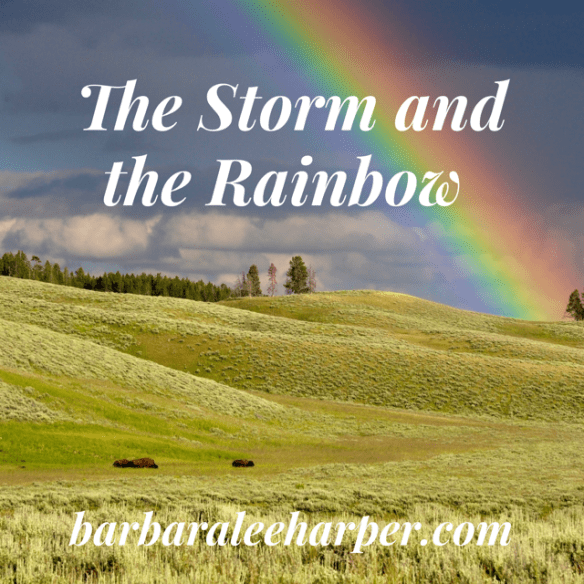
The Storm and the Rainbow

IMG_2388

Yesterday had been grey and drizzly all day. When I was waiting in the car line at my son’s school in the afternoon, a computerized voice on the radio broke into the regular programming to warn of a fast-moving storm which had conditions that could produce a tornado, and a tornado warning was in effect for the next 45 minutes. Right on cue, raindrops began splattering hard and fast against the windshield, and as I drove up to where my son was waiting, he made a mad dash for the car. Just then I saw another mother and friend herding several children into the cafeteria. She saw me, made a swirling motion with her hand, and mouthed, “Tornado.” I nodded to indicate that I had heard the warning, but I felt sure we could make it home all right. We only live a short distance away — 3 minutes if the lights are green, 10 minutes at most.

As I drove towards the main road, though, I saw low, dark, swirling clouds that had not been there when I came to the school. The rain pounded harder and harder, the sudden onslaught almost flooding the roads. My original plans had been to take my son home and then go run an errand for which I knew he would not want to accompany me, but with the conditions, I decided I’d better stay home until this storm blew over. I had almost not taken the tornado warning seriously, but now it looked as though a tornado could materialize out of the sky at any moment, and I was anxious to get home.

Just before we got to the turn into our subdivision, I was aware of a bright light behind us. The sun was shining! As I waited in the turn lane, I thought I saw a bit of color — I had to blink a couple of times, and it seemed like a rainbow appeared almost right before my eyes. It was a perfect arc, seeming to start on one side of a little red brick church and going over our neighborhood, coming down on the other side. It looked like you could reach out and touch it. It made you want to go look for the end of it just to see if it touched the ground.

Then I noticed that, though the rain had slowed, just above the rainbow the sky was still dark grey. The sunlight was coming from behind us. Just below the rainbow, the sky wasn’t daylight blue, but it was definitely lighter and brighter than the stormy sky. It made the whole area under the arc look like a light-filled globe. I wished I had my camera, but probably neither my camera nor I had the skills to capture the beauty of it.

690382_rainbow.jpgI have always loved the ethereal beauty of rainbows, and I’ve always loved associating them with God’s promise in Gen. 9:11-17. When my older boys were toddlers they would say the rainbow was “God’s pwomise.” Yet this morning, thinking about the rainbow yesterday being the dividing line between the grey skies and the brighter sky, I realized that God’s promises are often the dividing line between hope and despair in the storms of life. Whether a sudden squall of disaster assails us or a slow-brewing storm erupts over us, only the solid, unmoving, unchangeable promises of God keep up anchored. He has promised that He loves His children and always will. He has promised to supply our needs. He has promised sufficient grace. He has promised to work all things together for good to those who love Him. He has promised new mercies every morning and unfailing compassion. There are multitudes of His promises that we can cling to through the storms of life that will make our skies brighter in comparison to the storm clouds above.

For thou hast been a strength to the poor, a strength to the needy in his distress, a refuge from the storm, a shadow from the heat, when the blast of the terrible ones is as a storm against the wall. Isaiah 25:4.

The LORD is slow to anger, and great in power, and will not at all acquit the wicked: the LORD hath his way in the whirlwind and in the storm, and the clouds are the dust of his feet. Nahum 1:3.

Then they cry unto the LORD in their trouble, and he bringeth them out of their distresses.
He maketh the storm a calm, so that the waves thereof are still.
Then are they glad because they be quiet; so he bringeth them unto their desired haven.
Oh that men would praise the LORD for his goodness, and for his wonderful works to the children of men!
Psalm 107:28-31

Be merciful unto me, O God, be merciful unto me: for my soul trusteth in thee: yea, in the shadow of thy wings will I make my refuge, until these calamities be overpast. I will cry unto God most high; unto God that performeth all things for me. Psalm 57:1-2.

(Rainbow photo courtesy of the stock.xchng)

Reading the Bible

chbiblegrouping.gif

Often around this time of year people think about the need to read their Bibles more. I highly recommend it! (See Thirteen Reasons to Read the Bible.)

I wrote in an earlier post about devotional tips:

When I first became a Christian as a teen-ager, the church I was in then had a strong emphasis on reading the Bible through in a year. I am so glad, because I think that, more than anything else, got me grounded spiritually. There are many advantages to reading the Bible through in a year: it kept me focused; I knew where to read next instead of wandering around aimlessly; I discovered choice nuggets in places like II Chronicles and Zephaniah that I probably would never have discovered otherwise; it kept me balanced; it helped me understand passages in their context; and each time through I would understand the passage more.

There are a number of plans online for reading the Bible through. One here is based, I believe, on the One Year Bible plan. BibleGateway.com has a few different ones: a comprehensive one for reading the Bible through in a year, a 121-day biographical one covering some of the major people in the Bible, a 61-day survey schedule, and a 61-day chronological reading plan.

I mentioned in that post on devotional tips that I no longer read the Bible through in a year, but I do still read it through, for all the reasons mentioned above. But by going at my own pace I can take more time with particular passages if needed.

One resource I would highly, highly recommend is the book What Do I Know About My God by Mardi Collier. Whether you do her particular plan or not, the testimonies of how God has used His word in her life are inspiring. Another good resource is Alone With God by Jason Janz.

Anything is better than nothing, so I encourage you, if you’ve never made reading the Bible every day a part of your life, or you have but you’ve let it slip, it’s a worthy investment of your time. Whether you’re just starting or you’ve been reading it for years, I pray you’ll have a blessed year of getting to know God better and drawing ever closer to Him.

(Graphic courtesy of Creative Ladies Ministry.)

Happy New Year!

Several years ago, a teacher in my Christian college shared a passage at the beginning of the year that continually comes back to my thoughts with each new year:

But the land, whither ye go to possess it, is a
land of hills and valleys, and drinketh water of the rain
of heaven: A land which the LORD thy God careth for:
the eyes of the LORD thy God are always upon it, from
the beginning of the year even unto the end of the year.

Deuteronomy 11:11-12

How wonderful that the eyes of the Lord our God
will be upon His children
throughout the hills and valleys of this coming year,
and no matter what happens,
He is with us and cares for us.

(Graphic courtesy of Anne’s Place)