Book Review: Safely Home

In Safely Home by Randy Alcorn, Ben Fielding is on the fast track to becoming CEO of Getz International. To increase the company’s business with China, Ben’s boss wants him to spend a few weeks there and suggests Ben stay with his old college roommate, Li Quan, to get a feel for what the “common man” in China might need from their business.

Ben has been in China many times before, is familiar with much of the culture, even speaks fluent Mandarin, but he has never looked up his old roommate. He is uncomfortable doing so now. Quan had come to college in America an atheist and became a Christian while here: Ben was a professing Christian in college, but his business goals have usurped everything else in his life. But, being put on the spot by his boss, he has little choice but to go and see Quan.

Ben is shocked that his brilliant roommate, who as a student had been asked to stay on at Harvard as  history professor, is living in such poverty. When he begins to learn about house churches and persecution of Christians, he is disbelieving, having fallen for the public relations hype fed to American businessmen and officials. But the more time Ben spends in China with Quan, the more his eyes are opened, not only to the true situation there, but also to the needs of his own heart.

Interspersed with Ben and Quan’s story are glimpses into the heavenlies as Alcorn interprets it, the great “cloud of witnesses,” the King’s care, watchfulness, and preparation for His own.

The story was inspired by Ron DiCianni’s beautiful print Safely Home, depicting a martyr being greeted home by his Savior, an angel waiting to the side with the new arrival’s white robe, the nations of earth visible below.

Knowing a couple of people who have worked in China, I do know that true Christians have to meet “underground,” have to be very careful about their words, actions, and even e-mails, and they can lose their jobs or be arrested for their faith.

We have it so relatively easy in America, we forget the hallmark of many Christians through the ages has been suffering and martyrdom. This book is a wake-up call, and it was a rebuke to me over the “little things” that I get grumbly about or the ways I fail to stand. In myself I know I don’t have it in me to face what some Christians do. But they would say they don’t either: their Savior helps them, as He will us as we walk for Him. We just need to remember that, in a world that hates Him, we often need to make a choice whether we’ll play it safe here, or do what we ought to and take the consequences; temporary safety and ease here, or being joyously welcomed Safely Home there.

A couple of my favorite lines from the book:

From the King: “They don’t understand that I am not only at work here, preparing a place for them, but I am at work there, preparing them for that place” (p. 313).

“The hands and feet of the only innocent man became forever scarred so that guilty people would not have to bear the scars they deserved” (p. 375).

My only little teensy criticism was that the story seemed a little more message-driven rather than story-driven. All writers are conveying a message, of course, and craft stories around the truths they wanted to convey or portray. It’s just a little more obvious here. But that may just be my impression — the reviews I looked through didn’t mention that, so it’s obviously not a drawback.

I do not only recommend but encourage the reading of this book.

(This review will also be linked to Semicolon‘s Saturday Review of Books.)

Listening to God

I just saw this today at The Good Life, and it really speaks to something I’ve been pondering recently. It’s from God’s Wisdom in Proverbs by Dan Phillips, which I haven’t read, nor do I know much about Dan Phillips, but I appreciate this quote:

“Listen” does not mean, here or anywhere else in Scripture, to harken to a subjective, mystical, murmury, semi-revelatory inner voice of God. God has no intention of turning our attention within ourselves, of urging us to seek after holy hunches and vaporous mumblings inside our own deluded hearts. He categorically condemns such orientation (Prov. 28:26; Jer. 17:9). God knows all too well that dense foolishness is “original factory equipment” in our fallen minds, thanks to Great-Great-Grandad Adam (Prov. 22:15).

No, God is not speaking of our listening to the inscrutable mumblings of some spirit, as if it were His Spirit. Rather, here and everywhere God is urging us to listen to the Word of God (cf. 1:23, 33; 16:20; contrast 28:9). The content makes this unavoidable. Solomon means the wise man to listen to the words he is writing. Internal, lowgrade, spiritual “sweet nothings” would have been far from the inspired king’s mind.
~Dan Phillips
God’s Wisdom in Proverbs

Thy words were found, and I did eat them; and thy word was unto me the joy and rejoicing of mine heart: for I am called by thy name, O LORD God of hosts.
Jeremiah 15:16

It is the spirit that quickeneth; the flesh profiteth nothing: the words that I speak unto you, they are spirit, and they are life. John 6:63

May you find joy and life as you partake in His Word today.

Reading Classics Together: The Disciplines of Grace

I’m joining in the “Reading Classics Together” at Challies‘ place for the first time. I’ve always liked the idea: a group of people reads a chapter of a book a week and discusses it. But this is the first time the title they are discussing appealed enough to me for me to jump in.

The Disciplines of Grace by Jerry Bridges attracted me for a couple of reasons. I’ve heard Bridges favorably mentioned and recommended for years but just have never gotten to one of his books. And the title of this one seemed to explore what I was pondering in a post a while back, Of grace, law, commandments, rules, and effort (who knew someone had already written a book about it? 🙂 ) As I said there, people often seem to go too far one way or the other, either emphasizing grace to the point of having a laid-back attitude toward sin and obedience and even accusing those who emphasize obedience of legalism (I’ve seen this so many times in online discussions), or emphasizing obedience so much that they get caught up in their own performance and think they have to earn favor with God.

The first chapter, “How Good Is Good Enough?” deals with those two sides and illustrates them by contrasting two days, a good one where we’ve done pretty well by our standards, and a bad one where we failed at the starting block and can’t seem to get back on track all day. Bridges emphasizes that we can never earn God’s grace — by its very nature grace is undeserved, and though God wants us to obey (by His grace), even if we do, it’s only by His grace. He also emphasizes that depending on God’s grace every day doesn’t negate the need for vigorous personal effort in the pursuit of holiness.

Here are just a few quotes from the chapter that stood out to me:

The pursuit of holiness requires sustained and vigorous effort. It allows for no indolence, no lethargy, no halfhearted commitment, and no laissez faire attitude toward even the smallest sins. In short, it demands the highest priority in the life of a Christian, because to be holy is to be like Christ — God’s goal for every Christian (p. 12).

When we pray to God for His blessing, He does not examine our performance to see if we are worthy. Rather, He looks to see if we are trusting in the merit of His Son as our only hope for securing His blessing (p. 19).

It is only the joy of hearing the gospel and being reminded that our sins are forgiven in Christ that will keep the demands of discipleship from becoming drudgery. It is only gratitude and love to God that comes from knowing that He no longer counts our sins against us (Romans 4:8) that provides the proper motive for responding to the claims of discipleship (p. 21).

And my favorite:

Your worst days are never so bad that you are beyond the reach of God’s grace. And your best days are never so good that you are beyond the need of God’s grace (p, 19).

More discussion on this chapter is here.

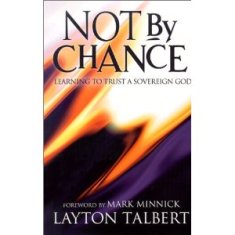
Book Review: Not By Chance: Learning to Trust a Sovereign God

As I mentioned when I reviewed Beyond Suffering: Discovering the Message of Job by Layton Talbert, my husband and I have known Dr. Talbert for years, back before he was a PhD., before he was married….when he still had hair. 🙂 He was one of the adult Sunday School teachers at the church we attended when we were first married, and sitting under his teaching plus reading his columns in Frontline magazine, have caused me to trust his treatment of Scripture. But that trust did not come just from knowing him, but rather because of attitudes such as this:

The Holy Spirit is not capricious or careless in His use of words. It is incumbent upon us, therefore, to handle the text of Scripture attentively and accurately. If we are to form a correct understanding of the facts of the story (and, consequently, to arrive at sound theological conclusions), it is vital that we carefully observe the details — and confine our conclusions to the information explicitly communicated by those details (p. 87).

And:

We are not at liberty to draw inferences that contradict other explicit statements of Scripture. And we must be tentative about defending apparently logical inferences that carry us beyond explicit statements of Scripture (p. 252).

Though he would not claim infallibility, nor would I claim it for him, Dr. Talbert’s detailed study and respect for the Word of God and carefulness and balance in teaching it makes his books trustworthy.

I first picked up Not By Chance: Learning to Trust a Sovereign God years ago mainly because it was his with the thought, “Yes, I should read that some time.” I believed in God’s sovereignty and providence and was often comforted by it, so I wasn’t quick to plunge into a book about it, even as much as I respected its author. But like I suspect is the case for many of us, it’s when something bad or seemingly incongruous happens to shake us up that we begin to wonder about God’s providence, not to question it per se, but to wonder how this or that fits into it.

Dr. Talbert begins by discussing what providence means and thoroughly examining Scripture concerning God’s providence over man, creation, weather, opportunities…and multitudes of other things. By the end there is no escaping the fact that God is in control. And while that’s a comfort on one hand, it’s a conundrum on the other: what about the bad things?

Dr. Talbert covers that well, too. Notice I didn’t say he explains it. There are some things about providence that we can’t understand or fully explain, just like we don’t thoroughly understand the Trinity, or the fact that Jesus is both fully God and fully man at the same time, and other mysteries. But he does shed as much light on it from Scripture as he can, and it does help. For instance, in dealing with a mistaken logical inference, he says:

We often assume that all good things come from God and all “bad” things come from Satan. That is a false and unbiblical assumption that gives Satan far too much credit and attributes to him far more power than he actually possesses. Contrary to popular misconception, Satan is not God’s evil counterpart, but Michael’s. Satan, like Michael, is “only” an angel; so he is an evil angel, not an evil God. Jehovah Himself claims that He is the only God and the ultimate ruler over all our circumstances, both the “good” and the “bad” (p. 12).

And here:

God guides and governs all events, including the free acts of men and their external circumstances, and directs all things to their appointed ends for His glory.

Notice that this definition does not say that God initiates or causes all events. If we are to maintain Biblical precision in our understanding and application of Scriptural truth, the terms we choose to state it are vital (p. 62).

And from a study of the life of Joseph:

God also providentially superintends and often uses the unfairnesses of life to accomplish His purposes in and for us and those around us (p. 66).

This is something many of us wrestle over:

Part of the mystery of providence resides in the fact that God rules and reigns over all things according to His will and pleasure (Ephesians 1:11), yet man is still fully responsible and accountable for his choices and actions. In other words, God exercises His providence and accomplishes His will through the free and voluntary choices and attitudes of men and women. Were this fact limited to God’s persuasive working in believers, that would be amazing enough. But it is equally true of the wicked. God never prompts evil men to sin, yet even their rebellion against Him and their hostility against His people is providentially governed and employed by God. (The clearest example of this…[is] found in the events surrounding the Crucifixion) (p. 86).

Sometimes pondering providence can lead us to think that it doesn’t matter what we do since God is in control anyway. But Dr. Talbert reminds us that God has assigned certain duties to us in Scripture and providentially works through them.

The providence of God is never intended to lull us into a lackadaisical attitude of fatalism, as if our actions don’t really matter because God rules and overrules however He wants anyway. It is revealed to maintain a glow of energizing trust that, despite all appearances to the contrary, God is governing for His glory and for my good — a trust that inspires me to stay faithful, obedient, loyal and devoted to Him, and confident in Him…God’s providence, then, encompasses and incorporates the faithfulness and obedience of His children (p. 70).

There are chapters on God’s preserving providence, governing providence, the mystery of providence, the means of providence, silent providence, the problems of providence, providence and prayer (why pray when God is in control? this is an excellent chapter) and case studies from Biblical characters illustrating the truths being taught. Plus there are chapters on God’s providence displayed in the incarnation and passion of Christ and the church. There is a wonderful section in the study of Joseph about why God sometimes allows delays and what He accomplishes through them. There are several appendices, one being the two sides salvation: God’s determination and man’s responsibility.

I marked over 60 quotes that especially stood out to me, so there’s no way I could share all of them here. But here are just a few more:

When we are willing to submit to and practice only what immediately makes sense to us, and ignore what doesn’t (even when it is clearly commanded), we have substituted ourselves — our finite mind — as the sovereign (p. 215).

[God] is the Maestro of providential orchestration, of split-second timing, of perfect point and counterpoint (p. 249).

We dare not construct a system of theology that helps the Holy Spirit by refining or redefining the words He selected or by interposing words He chose to omit so as to tweak out of it, ever so gently, a slightly modified meaning that better fits the system (p. 259)

One of the absolute best statements I’ve ever heard as to why God’s providence allows for hard or painful things was quoted from Steve Estes, in When God Weeps with Joni Eareckson Tada:

“God permits what He hates to achieve what He loves.”

In short (although I guess it is too late to say that, huh? 🙂 ) I do very highly recommend this book.

(This review will also be linked to Semicolon‘s Saturday Review of Books.)

Book Review: The Horse and His Boy

Chronicles of Narnia Reading Challenge

Reading to Know - Book Club

I read The Horse and His Boy by C. S. Lewis for the Chronicles of Narnia Reading Challenge and the book club choice for July sponsored by Carrie at Reading to Know.

The events in The Horse and His Boy take place during the latter time period in The Lion, the Witch, and the Wardrobe, when the four Pevensie children are kings and queens in Narnia.

But Shasta had never heard of Narnia. Shasta was a boy living in Calormen with a poor fisherman whom he called his father. When a stranger arrived to lodge with them, Shasta listened at the door while the stranger bargained with the fisherman about buying Shasta! Shasta was shocked, but relieved, for he had felt uneasy about not really loving the fisherman as a father.

Shasta strolled out to where the stranger’s horse was grazing to think over his predicament, only to discover that the horse is a talking horse from Narnia named Bree. Bree convinced Shasta that they must both escape to Narnia.

On their way they encountered another escapee, Aravis, on another talking horse, Hwin. Aravis was proud daughter of a lord of Calavar and is escaping an arranged marriage.

They had to go through a great city, but in the process Shasta was absconded by a group of Narnians who mistook him for someone else while Aravis recognized a friend and hid away with her. Through these situations they learned the best way to get across the desert, but they also learned of a planned attack on a neighboring city of Narnia. When they met up again, they hasten on to Narnia now not just for their own reasons, but to warn them of attack.

I had read the whole Chronicles of Narnia some time ago, but I didn’t remember much of anything about this story. And while I wouldn’t say it’s a favorite story of the series, I love the richness of the themes.

One obvious theme is identity. Shasta discovers he is not who he always thought he was and exclaims, “Why, I could be anybody!” He’s even more surprised when he does learn who he actually is. Bree and Hwin could not express their true and full identity while in captivity. Aravis has to hide her identity to escape, and when she meets up with her friend she sees her former lifestyle in a new light. Rabadash, the proud, jilted prince who leads the attack against Narnia’s neighbor as a foothold toward Narnia itself, becomes in form like the identity he’s portraying. And when Aslan identifies himself to Shasta, Shasta is “no longer afraid” that he would harm him, “but a new and different sort of trembling came over him. Yet he felt glad too.”

Another theme is finding one’s true homeland (Bekah develops this theme beautifully here in Groping for another land.)

A third theme echoes many Biblical admonitions that those who humble themselves will be exalted and those who exalt themselves will be humbled.  Shasta comes from a humble background yet Aravis later has to admit, “I’ve been snubbing him and looking down on him…and now he turns out to be the best of us all.” Aravis has to take responsibility for her actions and determines “I think it would be better to stay and say we’re sorry than to go back.” Bree realizes his proud folly as well, but at first holds back, being almost too proud in his abasement to go forward. The Hermit tells him. “But as long as you know you’re nobody special, you’ll be a very decent sort of Horse, on the whole.” Rabadash refuses to humble himself and faces the consequences.

Still another theme is Providence (which I didn’t know when I started the book, but it dovetails nicely with my concurrent reading of  Not By Chance: Learning to Trust a Sovereign God by Layton Talbert. I’ve just finished that except for one appendix and hope to review it later this week.) When Aravis remarks to the hermit she has taken refuge with that she’s had luck, he remarks, “I have now lived a hundred and nine winters in this world and have never yet met with any such thing as Luck.” When all the characters meet up with Aslan, they learn he had been with them, watching over them, guiding circumstances. Shasta’s situation, in fact, is reminiscent of Joseph’s in the Bible, being sent ahead to later save others. Related to Aslan’s providence towards individuals is his repeated admonition that he tells each one no story but their own when they ask about what’s going on in other people’s lives. And when Shasta is telling the story of how he came to be in Calormen, he remarks that Aslan “seems to be at the back of all the stories.”

This is one of those books that has me still thinking, making connections, realizing themes and truths long after the book is closed. And that’s one mark of a good book.

__________________

Instead of writing a separate wrap-up post for the end of the Narnia challenge tomorrow, I’ll just wrap it up here by saying I also read The Silver Chair (linked to my thoughts) for this year’s challenge. I always enjoy breathing Narnian air and look forward to finishing up the last two books of the series next year.

Previous Narnia-related posts are:

The Lion, the Witch, and the Wardrobe.

Prince Caspian.

Voyage of the Dawn-Treader.

The Lion, the Witch, and the Wardrobe Graphic Novel.

Narnian Magic (not a book, but a hammering out of my thoughts on the use of magic in the series.)

(This review will also be linked to Semicolon‘s Saturday Review of Books.)

The surprise at Mary’s prayer meeting

Those dear folks praying for Peter at Mary’s house in Acts 12 get such a bum rap. You remember the story: Peter was in prison, many were gathered together at Mary’s house praying for him, he was miraculously delivered, he came to Mary’s house, Rhoda answered the door, in her excitement she left him at the door while she told the others he was there, and they thought she was crazy. They’re accused of not really praying in faith if they were so astonished when the prayer was answered.

But Dr. Layton Talbert, in his book (Not By Chance: Learning to Trust a Sovereign God, brings up a different viewpoint. We don’t know that they were praying for Peter’s deliverance from prison. He points out that the text doesn’t say. James was killed by Herod earlier in the chapter: since he was not delivered they may not have expected Peter to be, either. “The only precedent we have for the church’s prayer under similar circumstances is in Acts 4:23-30. There, in the face of recent imprisonment, persecution, and renewed threats, the church made only one request. And it wasn’t for deliverance from prison or persecution; it was for boldness in the face of both (4:29)” (p. 203).

That’s a rebuke to me. When I’m experiencing any kind of trouble, the main focus of my prayer is likely to be deliverance. “Lord, please get me out of this. Please remove this problem. Soon. As soon as possible. Today, even? Now? Please?”

It’s not wrong to pray for or seek for deliverance. There are examples of both all through the Bible. Jacob. The Psalmist’s prayers. Persecution scattered the early disciples far beyond Jerusalem, taking the gospel with them. Paul escaped for his life several times. Even Jesus evaded the murderous intents of mobs when His time was not yet come.

But as we saw yesterday, it is not always God’s will to deliver, at least not in the way or the time we wanted. James was killed. Joseph spent long years as a slave and then as a prisoner. Paul was eventually imprisoned. Jesus, when His time was come, faced betrayal, arrest, torture, and death.

When we don’t know when or whether God will deliver us or a loved one from a serious trial, besides praying for deliverance, we can pray for these as well:

  • that with all boldness they may speak His word (Acts 4:29)
  • that they or we would “count it all joy when ye fall into divers temptations” (James 1:2)
  • that  we’d know “that the trying of your faith worketh patience” and “let patience have her perfect work, that ye may be perfect and entire, wanting nothing” (James 1:3-4).
  • that we’d “fear none of those things which thou shalt suffer: behold, the devil shall cast some of you into prison, that ye may be tried; and ye shall have tribulation ten days: be thou faithful unto death, and I will give thee a crown of life.” (Revelation 2:10).
  • that we’d let “none of these things move me, neither count I my life dear unto myself, so that I might finish my course with joy, and the ministry, which I have received of the Lord Jesus, to testify the gospel of the grace of God” (Acts 20:24).
  • “That their hearts might be comforted, being knit together in love, and unto all riches of the full assurance of understanding, to the acknowledgement of the mystery of God, and of the Father, and of Christ; In whom are hid all the treasures of wisdom and knowledge.” (Colossians 2:2-3) (It’s interesting to look through verses about comfort in Paul’s epistles.)

In fact, the more I look through these, the more I seem to find: not surprising since many of Paul’s epistles were written while people were after him or while he was in prison.

May we and our loved ones seek His will and grace and help in our afflictions as well as out of them.

When God doesn’t deliver

In the wake of the horrible tragedy that occurred recently when a gunman entered a movie theater and opened fire, some remarkable testimonies of God’s providential deliverance have emerged. So you STILL think God is a merciful God? tells how the author and her children escaped the theater unharmed. A Miracle Inside the Aurora Shooting: One Victim’s Story relates how a bullet entered one victim’s brain through a previously undiscovered birth defect, causing the bullet to miss the brain itself.

Of course, some will attribute the circumstances to happenstance or luck. But others wonder, why does God deliver some but not others?

In Rosalind Goforth’s book How I Know God Answers Prayer, one chapter details the miraculous bur harrowing account of her family’s deliverance during the horrors of the Boxer rebellion in China in the 1900s. She says:

Many times we were asked in the homeland to tell the story of our escape during the Boxer uprising, and often the question was put, “If it was really God’s power that saved you and others on that journey, then why did He not save those of His children who were so cruelly put to death?” For a time this question troubled me. Why indeed? One day when seeking for light on the matter I was directed to Acts 12. There I found the only answer that can be given. We are told in verse 2 that James was put to death by the sword; then the rest of the chapter is given to the detailed record of Peter’s wonderful deliverance in answer to prayer (vv. 5, 12).

She goes on to say that a great many people were praying for them and that undoubtedly had a lot to do with their deliverance.

But some pray and are prayed for, yet still die or suffer. What then?

Hebrews 11, that great “Hall of Faith” passage tells of many marvelous things God wrought through the faith of His people. But then verses 36-38 take a turn from all that deliverance and provision and answered prayer:

And others had trial of cruel mockings and scourgings, yea, moreover of bonds and imprisonment: They were stoned, they were sawn asunder, were tempted, were slain with the sword: they wandered about in sheepskins and goatskins; being destitute, afflicted, tormented; (Of whom the world was not worthy:) they wandered in deserts, and in mountains, and in dens and caves of the earth.

Why were these not delivered? The text doesn’t say, but they are commended just the same as the others: “And these all, having obtained a good report through faith, received not the promise: God having provided some better thing for us, that they without us should not be made perfect” (vv.39-40).

In the New Testament, John the Baptist was beheaded. Stephen was stoned. James was killed. Layton Talbert asserts:

But martyrdom is no less providential than deliverance, and the martyrdom of these men was as providentially superintended by God as was the martyrdom of His own Son. Such deaths are neither a failure on God’s part nor a victory on Satan’s. They are a part of the outworking of God’s all-wise and always good purposes. (Not By Chance: Learning to Trust a Sovereign God, page 198).

He goes on to relate:

You have probably heard that “the safest place to be is in the center of God’s will.” A veteran missionary to Colombia, South America, once explained how experience and personal Bible study led him to modify that saying. “The most fulfilling, joyful, and peaceful place to be is in the center of God’s will,” he concluded. “But it is not necessarily the safest.” This is not heresy — unless we measure orthodoxy by conformity to cliche rather than to Biblical realism. (p. 198).

The quote is taken from the article “Peace, if not safety,” and the missionary, Timothy A. McKeown, goes on to make these statements, also quoted in Not By Chance:

It seems to me that the Bible is full of examples of God’s people often-not occasionally-being placed in unsafe, uncomfortable, and dangerous situations.

Most prayers in Scripture focus not on the personal safety and benefit of believers but on the power, majesty, testimony, and victory of God over his-and, of course, our-enemies.

The Lord calls us to obedience in spite of the “costs”-not to personal comfort and safety!

Dr. Talbert continues:

Our death is as much a matter of providence as our life. It may seem tragic or ignominious or accidental. But God’s providence rules over the tragedy, the ignominy, and yes, even accidents. Moreover, we must labor to think God’s thoughts, to maintain God’s perspective (p. 199).

He goes on to point out that the deaths of John the Baptist, Stephen, and James were not the end of them, in two senses. 1) They go on to life in heaven with God, our true and ultimate home, and 2) their influence and testimony continue on.  This is true in our times as well, as illustrated by Jim Elliot and the other four missionaries who were killed by the tribe they were trying to reach, Gracia Burnham’s husband, and any saint of God.

In On Asking God Why by Elisabeth Elliot, she included a chapter called “On Brazen Heavens” written by her brother, Thomas Howard. After describing times when God has not answered prayer, at least not as the person praying wanted, he says:

Turning again to the disclosure of God in Scripture, we seem to see that, in his economy, there is no slippage. Nothing simply disappears. No sparrow falls without his knowing (and, one might think, caring) about it. No hair on anybody’s head is without its number. Oh, you say, that’s only a metaphor; it’s not literal. A metaphor of what, then, we might ask. Is the implication there that God doesn’t keep tabs on things?

And so we begin to think about all our prayers and vigils and fastings and abstinences, and the offices and sacraments of the Church, that have gone up to the throne in behalf of the sufferer. They have vanished, as no sparrow, no hair, has ever done. Hey, what about that?

And we know that this is false. It is nonsense. All right then–we prayed, with much faith or with little; we searched ourselves; we fasted; we anointed and laid on hands; we kept vigil. And nothing happened.

Did it not? What angle of vision are we speaking from? Is it not true that again and again in the biblical picture of things, the story has to be allowed to finish?

Was it not the case with Lazarus’ household at Bethany, and with the two en route to Emmaus? And is it not the case with the Whole Story, actually–that it must be allowed to finish, and that this is precisely what the faithful have been watching for since the beginning of time? In the face of suffering and endurance and loss and waiting and death, what is it that has kept the spirits of the faithful from flagging utterly down through the millennia? Is it not the hope of Redemption? Is it not the great Finish to the Story–and to all their little stories of wandering about in sheepskins and goatskins as well as to the One Big Story of the whole creation, which is itself groaning and waiting? And is not that Finish called glorious? Does it not entail what amounts to a redoing of all that has gone wrong, and a remaking of all that is ruined, and a finding of all that has been lost in the shuffle, and an unfolding of it all in a blaze of joy and splendor?

A finding of all that is lost? All sparrows, and all petitions and tears and vigils and fastings? Yes, all petitions and tears and vigils and fastings.

“But where are they? The thing is over and done with. He is dead. They had no effect.”

Hadn’t they? How do you know what is piling up in the great treasury kept by the Divine Love to be opened in that Day? How do you know that this death and your prayers and tears and fasts will not together be suddenly and breathtakingly displayed, before all the faithful, and before angels and archangels, and before kings and widows and prophets, as gems in that display? Oh no, don’t speak of things being lost. Say rather that they are hidden–received and accepted and taken up into the secrets of the divine mysteries, to be transformed and multiplied, like everything else we offer to him–loaves and fishes, or mites, or bread and wine–and given back to you and to the one for whom you kept vigil, in the presence of the whole host of men and angels in a hilarity of glory as unimaginable to you in your vigil as golden wings are to the worm in the chrysalis.

There may be any number of reasons why someone faces death without actually dying. Many who have done so have testified it gave them a new sense of purpose. But as to the question, why does God deliver some people from death and not others, we can’t really know the answers. Even those who were delivered will have to face death another time. All we can do is trust that God has His purposes in what He allows.

But God never promises that all His people will comfortably live the American Dream for 80+years. One of the lessons in such tragedies as the one in Aurora is that truly we never know what a day may bring forth and we’re not promised another breath. We need to be ready to face our Maker. “And this is the record, that God hath given to us eternal life, and this life is in his Son.  He that hath the Son hath life; and he that hath not the Son of God hath not life” (I John 5:11-12).


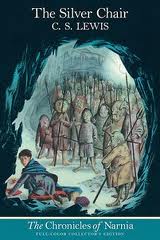
Book Review: The Silver Chair

Chronicles of Narnia Reading Challenge

Reading to Know - Book Club

I read The Silver Chair by C. S. Lewis for the Chronicles of Narnia Reading Challenge and the book club choice for July sponsored by Carrie at Reading to Know.

I’m reading the Narnia books in the order in which they were first published, and The Silver Chair comes fourth, just after The Voyage of the Dawn Treader (linked to my thoughts.)

The book opens with Eustace from that book (though by now Eustace is “not a bad sort,” having changed from the negative, complaining boy he used to be) and schoolmate Jill Pole dealing with some bullies in the school. As Eustace tries to tell Jill about Narnia, they wonder if maybe they could ask to be taken there. Then they hear the bullies pursuing, make a run for a gate in a wall, and find themselves suddenly somewhere else. Eustace ends up falling over a cliff while trying to help Jill keep from doing so, but Aslan rescues him by sending him to land.

Jill is frightened by Aslan at first. She’s dreadfully thirsty, but Aslan is beside the stream, and Jill is hesitant to go forward. He invites her to come and drink. She wants to look for another stream, but he tells her there is no other. Parts of this conversation recall the invitation from Christ to come and drink and the fact that there is no other stream of living water that can be had other than His.

Jill does finally trust Aslan enough to come and drink. After dealing with her about her part in Eustace’s fall, Aslan gives her a task for the both of them but says it will be harder because of her actions. She and Eustace must find and bring home the young prince Rillian, Caspian’s son, who has been missing for ten years. Aslan gives Jill four signs and makes her memorize them, then sends her off to join Eustace.

She quickly “muffs” the first sign, which makes their task even harder than it would have been. With the help of some owls and Puddleglum, a Marsh-wiggle, they set off to find the prince. They are sent the wrong way by what seems to be a beautiful woman and a silent knight, run into some trouble with the next two signs, brush against great danger at a giant’s castle, and end up searching through an underground world to find a seemingly silly young man who has to be tied to a silver chair every evening during a fit of insanity. Or is that when he is truly sane?

Though I missed the Pevensie children, I did enjoy this foray back to Narnia. A repeated theme throughout the book seems to center around obedience and trust. When they don’t follow the first signs, their task gets that much harder. Then when things come to a crisis and the final sign seems to be before them, yet the circumstances are not what they thought they would be, Puddleglum says, “There are no accidents. Our guide is Aslan…and he knew already all things that would” happen, and “Aslan didn’t tell Pole what would happen. He only told her what to do.”

Besides those already mentioned, there are other Biblical allusions, among them, the reminder from Aslan about how important it was to keep reminding oneself of his word, and his remark, when Jill wonders how he could have been calling them when they were the ones looking for a way to Narnia, “You would not have called to me unless I had been calling to you.” Though at first they fall into trouble by being more concerned with creature comforts, getting to a place where they could get in out of the elements, rest, and eat, though that place was a place of danger to them, later on they’re delivered from great temptation and disaster by reminding themselves of Aslan’s words and the bedrock truth they know.

I enjoyed some of the veiled humor sprinkled throughout the book as well, often aimed at the children’s school, known as the “Experiment House.” The best of those lines was when “the Head’s friends saw that the Head was no use as a Head, so they got her made into an Inspector to interfere with other Heads. And when they found out she wasn’t much good even at that, they got her into Parliament where she lived happily ever after.”

I also read the chapter pertaining to The Silver Chair from The Way Into Narnia (linked to my thoughts. I had read it last year except for the chapters specific to the books I hadn’t read yet. It’s a great Narnian resource). He pointed out something that hadn’t dawned on me in the structure of the story, that it takes descending steps and then ascending steps. He felt the theme was freedom and obedience, or freedom through obedience, and I think I’d agree.

(This review will also be linked to Semicolon‘s Saturday Review of Books.)

Discernment

I was dismayed recently, when reading through the comments on a somewhat controversial blog post, to see that when one commenter tried to bring the Scriptures to bear on the topic, he was called legalistic and judgmental (and this by other professing Christians.)

Conversely, the Bible says the Bereans “were more noble than those in Thessalonica, in that they received the word with all readiness of mind, and searched the scriptures daily, whether those things were so” (Acts 17:10). Searching through the Scripture to see if what was being said lined up with what was there was considered a noble thing.

A couple of nights ago, the evening reading from Daily Light on the Daily Path contained several verses on this topic:

The ear trieth words, as the mouth tasteth meat. Job 34:3

Beloved, believe not every spirit, but try the spirits whether they are of God: because many false prophets are gone out into the world. I John 4:1

Judge not according to the appearance, but judge righteous judgment. John 7:24

I speak as to wise men; judge ye what I say. I Corinthians 10:15.

Let the word of Christ dwell in you richly in all wisdom. Colossians 3:16a

He that hath an ear, let him hear what the Spirit saith. Revelation 2:29

He that is spiritual judgeth all things. I Corinthians 2:15a

Take heed what ye hear. Mark 4:24a

I know thy works, … and how thou hast tried them which say they are apostles, and are not, and hast found them liars. Revelation 2:2

Prove all things; hold fast that which is good. I Thessalonians 5:21

Several of those verses that speak of judging. Someone might say, “Whoa, wait a minute…I thought we weren’t supposed to judge.” That’s one of the most misunderstood concepts from the Bible. We’re not supposed to judge in the sense of condemning someone on the assumption that we know what what their motives are, condemning someone’s actions that might be different from ours when there is not a Scriptural principle involved, acting as if we’re superior in some way, etc. But to exercise discernment, to judge whether this or that statement or action is in line with Scripture (especially when the one saying or doing says it is but seems to be a little off-base) is another thing entirely.

According to a Greek lexicon the word used for “judgeth” in Acts 17:11 and I Cor. 2:14-15 quoted above means:

examine or judge

  1. to investigate, examine, enquire into, scrutinise, sift, question
    1. specifically in a forensic sense of a judge to hold an investigation
    2. to interrogate, examine the accused or witnesses
  2. to judge of, estimate, determine (the excellence or defects of any person or thing

I’ve linked back to some of the other definitions in the verses themselves so as not to be too lengthy here.

Sometimes what another person advocates won’t seem major, but as one pastor put it, if you’re taking a trip and start off on the right path, and then turn just ten degrees the wrong direction, it won’t look like a big difference at first, but if you keep going you’ll find yourself way off course.

Of course, there are some areas where Christians can have differences of opinion and practice, where the Bible doesn’t speak directly or in clear principle, and we should allow each other the grace to do so (Romans 14). But many today are taking Christian liberty to mean “I can do whatever I want and other Christians shouldn’t judge me for it,” when Romans 14 teaches the exact opposite, the reigning in of one’s freedom so as not to cause others to stumble. And even the premise there is wrong: we’re not free to do “whatever we want” as Christians.

I was stunned recently when a blogger I read and love linked to another’s post advocating a certain position that is controversial in the church today, and the author of this post effectively swept away all the New Testament arguments against her position by saying the N. T. is about attitudes rather than rules. That should raise a number of red flags to any discerning reader.

The Bible has many warnings against false prophets. Paul warns that it is not just those from the outside, but even some from within the church will lead some astray: “ For I know this, that after my departing shall grievous wolves enter in among you, not sparing the flock. Also of your own selves shall men arise, speaking perverse things, to draw away disciples after them” (Acts 20: 29-30). But he goes on to say in v. 30, “And now, brethren, I commend you to God, and to the word of his grace, which is able to build you up, and to give you an inheritance among all them which are sanctified.”

Soak in the Word of God. Hold it to a higher esteem than anyone else’s words. “Let the word of Christ dwell in you richly in all wisdom” Colossians 3:16a.

For more on this topic, see also:

Tension.
Controversies.
Analyzing vs. criticizing.
Just what does “judge not” mean, anyway?
Does niceness really matter?
Doctrine.