The Perfect Wisdom

Our church uses the same hymn for an opening for several weeks/months in a row, and just recently we started using the song “The Perfect Wisdom.” Around the same time the Galkin Evangelistic Team‘s CD, By Faith, came out with that song as its third track. I’ve about worn my CD out replaying that song. It is all wonderful, but the part that stood out to me the most at first was the last six lines.

The perfect wisdom of our God,
Revealed in all the universe:
All things created by His hand,
And held together at His command.
He knows the mysteries of the seas,
The secrets of the stars are His;
He guides the planets on their way,
And turns the earth through another day.

The matchless wisdom of His ways,
That mark the path of righteousness;
His word a lamp unto my feet,
His Spirit teaching and guiding me.
And oh, the mystery of the cross,
That God should suffer for the lost
So that the fool might shame the wise,
And all the glory might go to Christ!

Oh grant me wisdom from above,
To pray for peace and cling to love,
And teach me humbly to receive
The sun and rain of Your sovereignty.
Each strand of sorrow has a place
Within this tapestry of grace;
So through the trials I choose to say:
“Your perfect will in your perfect way.”

~ Words & Music by Keith Getty and Stuart Townend

I Run to Christ

I’ve posted this text before, but its inclusion on the new Wilds CD, A Living Sacrifice, has it in my mind again.

I run to Christ when chased by fear
And find a refuge sure.
“Believe in me,” His voice I hear;
His words and wounds secure.

I run to Christ when torn by grief
And find abundant peace.
“I too had tears,” He gently speaks;
Thus joy and sorrow meet.

_____

I run to Christ when worn by life
And find my soul refreshed.
“Come unto Me,” He calls through strife;
Fatigue gives way to rest.

I run to Christ when vexed by hell
And find a mighty arm.
“The Devil flees,” the Scriptures tell;
He roars, but cannot harm.

_____

I run to Christ when stalked by sin
And find a sure escape.
“Deliver me,” I cry to Him;
Temptation yields to grace.

I run to Christ when plagued by shame
And find my one defense.
“I bore God’s wrath,” He pleads my case—
My Advocate and Friend.

Words by Chris Anderson
Music by Greg Habeggar
Reprinted with permission

You can peruse more of Chris and Greg’s hymns at their web site, Church Works Media. Notes on the text to this hymn are here and you can listen to a choral version of it here.

May you run to Christ for any and every need, large or small.

Shadow and Coolness

It’s supposed to get up into the 100s today. I am so glad for air conditioning! But the forecasted high temperatures reminded me of this poem. Amy Carmichael was a missionary in India for most of her adult life. The inspiration for this poem came as a result of the heat in India and the refreshing coolness to be found in the shadow, plus the story of the Israelites being led by the pillow of fire by night and the pillar of cloud by day in the book of Exodus.

I Follow Thee

Shadow and coolness, Lord,
Art Thou to me;
Cloud of my soul, lead on,
I follow Thee.
What though the hot winds blow,
Fierce heat beats up below?
Fountains of water flow –
Praise, praise to Thee.

Clearness and glory, Lord,
Art Thou to me;
Light of my soul, lead on,
I follow Thee.
All through the moonless night,
Making its darkness bright,
Thou art my heavenly Light –
Praise, praise to Thee.

Shadow and shine art Thou,
Dear Lord, to me;
Pillar of cloud and fire,
I follow Thee.
What though the way be long,
In Thee my heart is strong,
Thou art my joy, my song –
Praise, praise to Thee.

Come Holy Spirit

I was listening the the music shuffling through my iPhone this morning and this song came on via Brian Pinner’s CD, Cantate Domino (he has it there as “Breathing After the Holy Spirit.”) I love this melody. I hadn’t heard it in years, but it spoke to my heart this morning. I believe it is taken from or inspired by Romans 5:5 (NKJV): “Now hope does not disappoint, because the love of God has been poured out in our hearts by the Holy Spirit who was given to us.”

Come, Holy Spirit, heavenly Dove,
With all Thy quick’ning powers;
Kindle a flame of sacred love
In these cold hearts of ours.

Look how we grovel here below,
Fond of these trifling toys;
Our souls can neither fly nor go
To reach eternal joys.

In vain we tune our formal songs,
In vain we strive to rise;
Hosannas languish on our tongues,
And our devotion dies.

Dear Lord! and shall we ever live
At this poor dying rate?
Our love so faint, so cold to Thee,
And Thine to us so great!

Come, Holy Spirit, heavenly Dove,
With all Thy quick’ning powers;
Come, shed abroad the Savior’s love
And that shall kindle ours.

~ Isaac Watts, 1707

Book Review: Raising Real Men

I first became aware of this book through the M.O.B (Mothers of Boys) Society web site.* I enjoy Hal and Melanie’s occasional columns there, usually full of wisdom and practical insight, as they are raising six boys themselves.

The premise of Raising Real Men: Surviving, Teaching, and Appreciating Boys by Hal and Melanie Young is that what society and moms find negative about boys is part of what defines them as men and should be trained rather than squelched. For instance, a natural bent toward leadership in a pint-sized immature young boy with a sin nature will look bossy and controlling. Risk-taking in a young guy will look like recklessness. The goal is to develop those qualities in a right way rather than just squashing them. And moms in particular, who prefer peaceful, docile children, need to understand that boys act, think, and respond differently. That doesn’t mean we let them run rampant: too often destructive behavior is excused  with a “That’s just the way boys are” attitude. But we pray for them, teach them, train them, lead them to the Lord, and help them, with God’s help, to become mature young men.

The Youngs discuss various aspects of this training, from acceptable risk-taking, competition, heroes, dealing with violence, purity, money matters, work ethics and experience, differences in learning, chivalry, gender roles, household duties, preparing for marriage and careers, and transitions as boys mature.

Here are a few quotes from the book that stood out to me:

God has placed in our boys a desire to be in charge, because one day they will be in charge. Today’s boys will be the fathers, and bosses, and elders, and statesmen of tomorrow. We’ve got to teach them how to submit to authority without destroying their leadership (p. 24).

Adults sometimes equate a desire for adventure with immaturity and recklessness. The Bible makes a distinction and so should we. The desire to conquer, to win against the odds, to do great things — these can be admirable ambitions. The willingness to pit one’s nerve against an unsettling foe is frequently called for in Scripture…On the other hand, overconfidence and rashness is soundly criticized (p. 48).

Our boys should be active and adventurous, but careful of themselves at the ultimate extreme, understanding that life is a gift and their bodies are the temple of the Holy Spirit. To risk life meaninglessly is foolishness; note that God’s gifts of boldness and courage are not for self-fulfillment or entertainment but for greater service to Him (p. 53).

Every family has some way they can teach their sons to be faithfully independent in a step-by-step way….It doesn’t seem fair to keep sons under constant instruction and supervision, with no chance to stand on their own, then give them complete responsibility and freedom when they come of age…Think of it like teaching a baby to walk — first you hold their hands, then you stand just a bit away, then farther away. If they stumble, you can catch them — to a point (p. 63).

When God asked Adam and Eve [questions], He wasn’t looking for information; He was forcing them to confront their fall from innocence (pp. 89-90).

This is the difficultly with “time-out” punishments that focus on exclusion from the fellowship of the family. Exclusionary punishments send the child away from the love and wisdom of his parents to brood in a corner, feeling angry and sorry for themselves in the lack of discipline and teaching. The fear of abandonment and rejection is deep in a small child. How much better to correct the sin and heal the broken fellowship quickly! (p. 91).

It was especially gratifying to read someone else saying that about “time-outs.” I had always felt that they weren’t the best way to discipline. There were some times we sent a child to his room to wait while we got our emotions under control (and gave them time to do the same) or prayed or thought about what to do. If they were sometimes in a bad mood that wouldn’t be rectified (boys have their “moods” as well as girls), we’d say something like, “If you want to be in a bad mood, that’s up to you, but you’re not going to inflict it on the rest of the family. You can go to your room til you’re feeling more sociable.” Usually it didn’t take long for a change in attitude to come. But where definite disciple is needed, it’s so much better to deal with it effectively and get it over with.

To me the heart and summation of the book came at the end:

Our boys need to be comfortable in their own skins. Not all men are athletes just like not all are intellectuals. Manliness is much more than brute force, it’s a heart attitude of confidence and boldness to accomplish the mission given by God (p. 243).

There were maybe a couple of minor things I disagreed with: one equated shyness with selfishness. I believe shyness is a personalty characteristic and not intrinsically selfish, but it can manifest itself in selfishness. Being an intensely shy person myself, the realization that my responses could hurt or offend people or curb ministry to them helped me a great deal in opening up and reaching out when I’d naturally feel more comfortable pulling back and remaining quiet.

The book almost assumes its readers are home-schoolers, but that is probably because the Youngs home school and are writing from their experience, and much of the book came from talks given to home school associations and such. But one does not have to home school to benefit from the book.

When I was growing up, fathers were quite authoritarian: nowadays the pendulum has swung to the other extreme and fathers are portrayed on TV as bumbling fools and “manhood” is looked down upon. As a mom of three grown boys, I am glad to recommend this balanced treatment on the topic with its encouragement to raise real, godly men to authentic Biblical manhood.

___________
*Disclaimer: While I recommend the M.O.B. Society web site, I do not agree with every little thing every writer there says nor with every ad there.

(This review will also be linked to Semicolon‘s Saturday Review of Books.)

Book Review: Feminine Appeal

Feminine Appeal by Carolyn Mahaney came about when several people heard her teach through Titus 2 and urged her to put her talks into book form.

In the first chapter she shares her early wife and mothering years of wishing she had someone to come alongside and teach, guide, ask questions of, etc., and then explains that’s exactly what Titus 2 calls us to do.

I appreciate that instead of pulling these verses out to stand on their own, she brings out them out in the context of the rest of the chapter. The purposes for godly women mentoring younger women goes beyond our individual homes and families: the larger purpose is that such teaching “becomes” (KJV) or “accords with” (ESV) “sound doctrine” (verse 1), “that the word of God be not blasphemed” (verse 5), “that he that is of the contrary part may be ashamed, having no evil thing to say of you”, (verse 8), and “that they may adorn the doctrine of God our Saviour in all things” (verse 10). She explains that “To ‘adorn’ means to put something beautiful or attractive on display — like placing a flawless gemstone in a setting that uniquely shows off its brilliance” (p. 27). By our actions and conduct, even how we minster to our homes and families, we can display the gospel of Christ.

She then delineates the teaching of Titus 2:3-5 into seven virtues, giving each of them their own chapter:

  • The Delight of Loving My Husband
  • The Blessings of Loving My Children
  • The Safety of Self-Control
  • The Pleasure of Purity
  • The Honor of Working at Home
  • The Rewards of Kindness
  • The Beauty of Submission

Though much of the book is directed to married women, Carolyn encourages single women to read along, too, both because much of this instruction is to all women, and because it will help prepare them if God does lead them to marriage, and it will help them as they mentor and encourage other women as well.

There was much that spoke to me in this book, but a few highlights particularly stood out. One was a reminder that “While the salvation of our children is our highest aim, our tender love is not sufficient for this task. Only the Holy Spirit is able to reveal the truth of the gospel. However, our tender love can be an instrument in God’s hands” (p. 61).

Another came from the chapter on self-control.

“Self-control doesn’t just happen. We can’t adopt the indifferent attitude ‘let go and let God’ and expect magically to become self-controlled. Self-control requires effort. However, development of this quality is not solely dependent on us. We cannot acquire this virtue by our own strength. It is only as we cooperate with the power of the Holy Spirit that we will achieve self-control, Our growth will take place as it did with Paul who said, ‘For this I toil, struggling with all his energy that he powerfully works within me’ (Col. 1:29). Notice that Paul did toil and struggle, but his effort was initiated and sustained by the Holy Spirit.”

I wrote recently about the struggle between grace and obedience, and this caps those thoughts off perfectly.

I hadn’t heard the word the KJV uses here, “sober,” interpreted as self-control before, but other versions use that word, and the original Greek word does convey that idea.

Another highlight was a quote from Dorothy Patterson’s book Where’s Mom?:

“Much of the world would agree that being a housekeeper is acceptable as long as you are not caring for your own home; treating men with attentive devotion would also be right as long as the man is the boss in the office and not your husband; caring for children would even be deemed heroic service for which presidential awards could be given as long as the children are someone else’s and not your own” (p. 102).

Absurd, isn’t it? I was thinking recently that most everyone appreciates good marriages, well-behaved polite and kind children, and walking into a well-ordered home, yet how ironic that society devalues the efforts of those dedicated to them.

Another quote from the same book says:

Homemaking — being a full-time wife and mother — is not a destructive drought of uselessness but an overflowing oasis of opportunity; it is not a dreary cell to contain one’s talents and skills but a brilliant catalyst to channel creativity and energies into meaningful work” (p. 109).

After receiving many of the truths in this book multiple times over the years through godly teaching and preaching, good books, and my own studies, there wasn’t much that was new to me here, and perhaps anticipation of that is what kept this book on my nightstand for ages before I finally determined to include it in my spring reading plans. But it’s good to remind ourselves from time to time of truths we already know. We can get discouraged in our duties or sway one way or another, pulled off-balance by differing opinions and philosophies. Reading such a book as this provides both encouragement and course correction.

Whether you need encouragement or reminding, or you’ve never received such instruction as this, or you need help knowing how to mentor others, I recommend this book to you.

(This review will also be linked to Semicolon‘s Saturday Review of Books.)

Book Review: It Is Not Death to Die: A New Biography of Hudson Taylor

(I hope you’ll forgive me for talking mostly about books the last two weeks. 🙂 I happened to finish several recently and I’m trying to finish off my spring reading plans.)

I’ve mentioned before the importance of reading missionary biographies, for our own growth and inspiration and to keep before us those names in church history that need to be remembered just like Washington, Lincoln, and others need to be remembered in our secular history.

Hudson Taylor is one of those names for several reasons. He was a pioneer missionary to China in the 1800s during a time when China was especially hostile and suspicious of foreigners. He wanted to convert people to Christ in their own culture rather than converting them to Western culture. He dressed as a Chinaman, much to the dismay and criticism of the overseas European community and even other missionaries, simply because he found that the most effective way to work with the Chinese. A missionary coming into a town dressed as a European was likely to be attacked and cause a riot. He suffered much hardship uncomplainingly and purposefully lived as simple a life as possible. He did not set out to start a mission agency, but the agency which sent him out failed miserably: they failed to advise or prepare him, failed to forward funds and communicate with him when he was on the field, causing other mission agencies to step in and help him and others, and then they had the gall to criticize other mission agencies in the periodicals of the day. The necessity of a mission agency attuned to the needs in China and resp0nsible in its habits led to Hudson beginning the China Inland Mission. There were a few missionaries in the bigger cities, but China wanted to go inland where the gospel had not been preached. Probably the most notable aspects of Hudson, however, were his simple childlike (but not childish) faith and his unswerving obedience to what he perceived God wanted him to do.
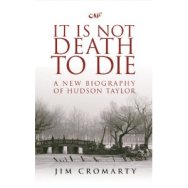
For these reasons I was very glad to see It Is Not Death to Die: A New Biography of Hudson Taylor by Jim Cromarty. There are two older well-known biographies of Hudson Taylor. One is a two-volume set, Hudson Taylor in Early Years: The Growth of a Soul and Hudson Taylor and the China Inland Mission: The Growth of a Work of God by his daughter and son-in-law, Dr. and Mrs. Howard Taylor, first published in 1911. But the first volume is over 500 pages and the second well over 600, which can be quite daunting and they can sometimes be hard to find (Amazon only had used copies but I found them on sale just now here.) These are excellent and easily readable though they were written over a hundred years ago. The other well-known biography of Taylor is Hudson Taylor’s Spiritual Secret, also written by his daughter and son-in-law, but much more compact at 272 pages and still printed regularly today.

I had high hopes that this new biography by Cromarty would bridge the gap between these two and bring Hudson’s life before a modern audience that might not seek out the older books. And while it is a faithful representation with much research evidently behind it and I can recommend it, I wish it were more dynamically written. It’s a good reference book for people who want to know more about Taylor, but I don’t know if it would draw in those who are unfamiliar with him or those who do not like to read biographies.

Biographers do have it a little rough: they can write in a story form, which is more interesting but tends to be less accurate as the biographer has to invent conversations and situations to bring out the points he needs to; or they can right a factual version which can tend to be more encyclopedic and accurate, but which doesn’t appeal to the average modern reader. This one is in the style of the latter. I think it could have been much more condensed: there are many descriptions of various CIM missionaries’ travels which could have been left out or at least summarized. The book is 481 pages, not including indexes and end notes, and I have to admit I got bogged down in places.

But I do recommend the book. If you persevere, you will find great nuggets about Taylor’s character. He was not unflawed: he was very human and he would never have wanted people to think he was some super-Christian. But he loved and followed the Lord in an exemplary and humble way.

I marked way too many places to share, especially in a review that is long already:

But here are a few places that stood out to me:

His health, as he described it, could “not be called robust” (p. 49), but I hadn’t realized he struggled so much with his health through the years, including regular bouts of dysentery.

Before he went to China, the girl he had planned to marry refused his proposal because she did not want to go to China. He wrote to his mother, “Trusting God does not deprive one of feelings or deaden our natural sensibilities, but it enables us to compare our trials with our mercies and to say, ‘Yet notwithstanding, I will rejoice in the Lord, I will joy in the God of my salvation'” (p. 55).

Once during a storm on the way to China in a ship, he took off a life jacket because he felt he was trusting in it rather than the Lord. Later he realized that was wrong thinking and wrote, “The use of means ought not to lessen our faith in God; and our faith in God ought not to hinder whatever means He has given us for the accomplishment of His own purposes…When in medical or surgical charge of any case, I have never thought of neglecting to ask God’s guidance and blessing in the use of appropriate means…to me it would appear presumptuous  and wrong to neglect the use of those measures which He Himself has put within our reach, as to neglect to take daily food, and suppose that life and health might be maintained by prayer alone” (p. 99). He was later said to be “a man of prayer, but it was prayer associated with action…’He prayed about things as if everything depended upon the praying…but he worked also, as if everything depended upon the working'” (p. 329).

To live in inland China at that time meant giving up what would be considered as Western luxuries, and Hudson tried hard to give a real picture of the mission field before new missionaries came over. “The only persons wanted here are those who will rejoice to work — really to labour — not to dream their lives away; to deny themselves; to suffer in order to save.” (p. 294). He wrote to applicants, “If you want hard work, and little appreciation of it; value God’s approbation more than you fear man’s disapprobation; are prepared, if need be, to seal your testimony with your blood and perhaps oftentimes to take joyfully the spoiling of your goods…you may count on a harvest of souls here, and a crown of glory that does not fade away, and the Master’s ‘Well done’…it is no question of ‘making the best of both worlds’ — the men who will be happy with us are those who have this world under their feet” (p. 303).

At one time he said. “My soul yearns, oh how intently for the evangelization of these 180 millions of the nine unoccupied provinces. Oh that I had a hundred lives to give or spend for their good…Better to have pecuniary and other outward trials and perplexities, and blessing in the work itself, souls being saved, and the name of the Lord Jesus being magnified, than any measure of external prosperity without it” (p. 297).

He was known to be a humble and unassuming man. Many meeting him for the first time were surprised that he didn’t “stand out,” but looked at first like a regular Chinaman. Spurgeon wrote of him, “Mr. Taylor…is not in outward appearance an individual who would be selected among others as the leader of a gigantic enterprise; in fact, he is lame in gait, and little in stature; but…his spirit is quiet and meek, yet strong and intense; there is not an atom of self-assertion about him, but a firm confidence in God” (p. 329). Many times he quietly and unassumingly helped and ministered to others, especially new arrivals. Once when a group he was with had to spend a night on a boat with a leper, and someone complained about the stench of his bedding, Hudson spent the night in his cabin uncomplainingly and bought him new bedding the next day. Another time when an exhausted group of travelers fell into bed without eating, Hudson prepared omelets for them all. Once when he knew of a paper that was critical of him, almost derogatory, he said, “That is a very just criticism, for it is all true. I have often thought that God made me little in order that He might show what a great God He is” (p. 400).

In one meeting, Hudson said, “What we give up for Christ we gain, and what we keep back is our real loss…Let us make earth a little less homelike, and souls more precious. Jesus is coming again, and so soon! Will He really find us obeying His last command?” (p. 383).

I had thought that the title of this book came from the hymn, “It is Not Death to Die,” originally written in 1832 and recently updated. But in writing of Hudson’s death, Cromarty cites the Banner of Truth 1977 publication of Pilgrim’s Progress, at the section where Mr. Valiant-For-Truth dies, and the line “It Is Not Death to Die” is in the passage he quotes but I have not found it in the online versions of Pilgrim’s Progress. Nevertheless, the sentiment is true. Dying to self and living for Christ, which Hudson Taylor exemplified, is true life, just as dying to this body makes way for heaven for those who have trusted Christ as Savior.

(For a more positive review that brings out some different things about Cromarty’s book and Taylor’s life, see my friend Debbie’s review here.)

(This review will also be linked to Semicolon‘s Saturday Review of Books.)

No, Not Despairingly

I had not heard this song in years, but a friend posted the lyrics on Facebook recently, reminding me of them. In fact, the only time I have heard this song was when the music pastor of the church we attended when we were first married sang them. But it is a rich old hymn. The tune I am familiar with is not the same one listed here.

No, not despairingly come I to Thee;
No, not distrustingly bend I the knee:
Sin hath gone over me, yet is this still my plea,
Jesus hath died.

Ah! mine iniquity crimson hath been,
Infinite, infinite—sin upon sin:
Sin of not loving Thee, sin of not trusting Thee—
Infinite sin.

Lord, I confess to Thee sadly my sin;
All I am tell I Thee, all I have been:
Purge Thou my sin away, wash Thou my soul this day;
Lord, make me clean.

Faithful and just art Thou, forgiving all;
Loving and kind art Thou when poor ones call:
Lord, let the cleansing blood, blood of the Lamb of God,
Pass o’er my soul.

Then all is peace and light this soul within;
Thus shall I walk with Thee, the loved Unseen;
Leaning on Thee, my God, guided along the road,
Nothing between.

~ Horatious Bonar, 1866

Book Review: When Christ Was Here

I’ve been privileged and blessed to hear Claudia Barba speak a few times, so when I saw she had written a book called When Christ Was Here: a Woman’s Bible Study, I was happy to order it. I was just finishing the gospels in my reading through the Bible, so the book was timely for me.

Claudia opens with the importance of studying the doctrine of Christ’s incarnation, because “every false religion is an open denial or some sort of distortion of this doctrine” (p. 1). The first chapters study the claims and testimony in Scripture about Jesus’s deity, then one chapter is devoted to His humanity. The remaining chapters focus on Jesus and different types of people (His earthly family, the self-righteous, social and moral outcasts, people in pain, people who fail, the discouraged) and different situations (trials and temptation), because, she points out, “You need to know how He lived on earth because you are commanded to live as He lived. “He that saith he abideth in him ought himself also so to walk, even as he walked.” (I John 2:6).

Much of the book was familiar territory (I had forgotten until halfway through the book that Claudia’s father, Dr. Otis Holmes, had been the professor for my Life of Christ class in college! Though I can’t remember specifics from the class, I am sure its truths became a part of my thinking.)  But it was good to go over it again: we’re instructed often in Scripture to remember what we’ve been taught, and if we don’t, all too often we can veer off the straight path of Scripture.

Some thoughts were new to me, though, or opened my understanding a bit more.

For instance, in John 5:19, Jesus said, “Then answered Jesus and said unto them, Verily, verily, I say unto you, The Son can do nothing of himself, but what he seeth the Father do: for what things soever he doeth, these also doeth the Son likewise.” Claudia comments, “He was not saying that He did not have adequate power alone but that because of their essential union, He could not act independently of His Father” (p. 15).

A particularly interesting chapter was the one on Jesus’s earthly family. “Doesn’t it seem strange that those who lived so closely with Jesus did not believe on Him? Even His example of perfect holiness in daily living was not enough to bring belief to their hearts. Their rejection says nothing at all about Him but everything about them” (p. 40). This should be enlightening in considering “lifestyle evangelism,” the thought of just being a witness by our godly lifestyles without verbally witnessing: even a perfect lifestyle does not convert people (though our lives must back up what we believe). I am sure Jesus spoke truth to His family as well as living it, and thankfully some of them did come to believe on Him after the resurrection, and I am sure His godly life as well as the words He had spoken had new meaning to them then.

Another eye-opening section to me in the chapter on moral outcasts had to do with Simon and the woman known as a sinner who washed His feet with her tears, dried them with her hair, and anointed them with ointment from an alabaster box (from Luke 7).

Simon had thought that Jesus didn’t recognize the real sinner in the room. But He did, of course. It just wasn’t the one Simon thought it was! (p. 74).

There’s irony here, for the sinner is praised as a saint, and the “saint” is exposed as the real sinner (p. 74).

Simon loved little, not because he had fewer sins, but because he thought he didn’t need forgiveness (p. 75).

This was the first time it dawned on me that when Jesus said, “Her sins, which are many, are forgiven; for she loved much: but to whom little is forgiven, the same loveth little” (Luke 7:47), the point was not just her great sin which had been forgiven: it was also that Simon had great sin as well, but he just didn’t realize it. It’s not that her sins were big and his were little: it was that she loved much because hers were forgiven, but he didn’t love much (he didn’t even extend the common courtesies of the day to Jesus) because his sins weren’t forgiven because he had not acknowledged them.

In “Jesus and People in Pain,” part of the chapter deals with Mary and Martha when their brother Lazarus died, and Jesus had not come to them when they sent word that Lazarus was sick. “[Jesus] doesn’t delay because He doesn’t know, doesn’t love, or doesn’t care. His delays are for our good. They are designed to accomplish much greater purposes’ (p. 82).

In “Jesus and People Who Fail”:

Jesus allowed Peter to be sifted as wheat (Luke 22:31). This is not the sort of sifting of flour you are familiar with. It’s a winnowing process, the tossing of grain in a bowl that allows the breeze to blow away the chaff (hulls, dust), and leave behind only the good grain. The Lord let Satan “shake up” Peter through this failure, and as a result, much fleshly self-reliance was filtered from his character. (p. 99)

If you have failed, don’t despair. Repent and begin again! But never forget what you are capable of, and use your experience to help others (p. 101).

That phrase “never forget what you are capable of” is most sobering to me. That is one good thing that comes out of failure, though: the reminder of what we’re capable of when we lean on our own strength instead of His, the reminder of how we need to stay every close to Him and in His Word and to rely on Him to keep us.

From “Jesus and Temptation”:

Temptation is not designed to make you fail or give you an excuse to sin. Instead, it is an opportunity for you to find the way of escape, to glorify God by defeating Satan. (p. 130).

If you are looking for a rich, meaty Bible study, if you feel the need to “turn your eyes upon Jesus,” this book is for you.

(This review will also be linked to Semicolon‘s Saturday Review of Books.)