Laudable Linkage and Cool Videos

I didn’t have quite as much time for web surfing this week, but here are a few noteworthy things I did see:

The Unsaved Christian. Someone on Facebook linked to this. At first I balked at the title because someone is not a Christian if unsaved, so this seemed like a misnomer, but the article explains what she means and gently but clearly sounds a needed warning.

Winning Your Friends to Christ, HT to Susan.

Grace Spots.

Responding to the Scandal. If you saw the recent 20/20 report on abuse within IFB churches, this is the best response I have seen, HT to my son, Jeremy. I’ve been thinking about writing a post about this issue, but this hasn’t been a week I could have extended thoughtful time at the computer. But Dr. Bauder says just about everything I would say and more, and much better.

Homemade Note Pads are presented as a Teacher Appreciation Gift, but they’d be good for anyone.

Styrofoam Wall Art. I forget where I saw the link to this. I’ve seen similar ideas using canvas, but this would be cheaper.

Timelapse Video of San Francisco-to-Paris flight Captures Aurora Borealis. Neat article and video.

This is pretty funny. I can see how they do some of it, but they do the change-out pretty fast!

Have a great Saturday! We had storms through the night and lost power this morning, but I am so glad it is back on now!

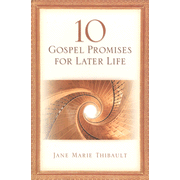
Book Review: 10 Gospel Promises For Later Life

I don’t usually begin book reviews this way, but I feel I must say at the outset that I cannot recommend 10 Gospel Promises For Later Life by Jane Marie Thibault.

The premise is a good one. Mrs. Thibault has been a clinical gerontologist and has worked with the elderly for nearly thirty years. After a consultation with a pastor whose housebound church members said they had trouble relating to the gospel any more for various reasons, Mrs. Thibault began discussing this with her patients and heard similar comments. So she compiled a list of ten major concerns elderly people face — among them, depending on others for help, fear of illness, pain, fragility, disability, loneliness, losing everything and ending up in a nursing home, life after death — and sought to apply gospel truth to them.

While there are some helpful parts to the book, unfortunately there are several major difficulties.

In a section speaking of Jesus’ suffering on the cross, the author says:

Jesus realized that his suffering was necessary. The only way he could convince humanity of God’s love for us was to die for his cause and his teaching. He put his money where his mouth was, dying for his message out of total and complete God-love for the entire world’s well-being until the end of time (p. 85).

Jesus’ death was much more than dying for his cause to convince us of his teaching! He died so that those who believe could be”justified freely by his grace through the redemption that is in Christ Jesus:Whom God hath set forth to be a propitiation through faith in his blood, to declare his righteousness for the remission of sins that are past, through the forbearance of God; To declare, I say, at this time his righteousness: that he might be just, and the justifier of him which believeth in Jesus (Romans 3:24-26.) If a judge told a convicted murderer that he could go free, everyone would cry that that was unjust. In the same way, God cannot just forgive sins without satisfying His justice. When Jesus took our sin on Himself and suffered our punishment, that act satisfied God’s holiness and justice, so He could justify us and still be just Himself, and those who receive Christ as Savior receive as well “the righteousness of God which is by faith of Jesus Christ unto all and upon all them that believe” (Romans 3:22).

Another major problem I have with the book is Mrs. Thibault’s belief that living people can ask the dead for help. Speaking of “institutionally acknowledged saints,” she writes:

“If they continue to live in God’s love and to participate in God’s love of us, the saints might also help us in our daily lives, especially if we ask them to enable us to grow in our love of God and one another” p. 121-122).

“I also believe that every single Christian in the church visible (that’s us) can ask for help from anyone in the church triumphant (those who have been promoted into heaven before us”) (p. 123).

She relates that in struggling with forgiving her mother because of feeling that her mother had been apathetic to her and emotionally abandoned her before her death when the author was a teenager, the author wrote a prayer to her mother asking that the two of them work on healing their relationship.

There is nothing in the Bible that encourages interaction with the dead: in fact, there are warnings against it. Deuteronomy 18:11 says, “There shall not be found among you any one that maketh his son or his daughter to pass through the fire, or that useth divination, or an observer of times, or an enchanter, or a witch.Or a charmer, or a consulter with familiar spirits, or a wizard, or a necromancer.  For all that do these things are an abomination unto the LORD: and because of these abominations the LORD thy God doth drive them out from before thee.” The only time I can remember in the Bible that anyone tried to communicate with the dead was in I Samuel 28 when King Saul was desperate because the Philistines were about to attack him and God wasn’t answering his prayers any more because of his disobedience. He tried to contact the prophet Samuel through a medium, and Samuel did not say, “Hi there, what can I do for you?” He said, “Why hast thou disquieted me, to bring me up?” He not only did not help him, but he prophesied that Saul and his sons would be die. There is nothing I am aware of in the New Testament that would negate these warnings. Mrs. Thibault is not advocating using mediums or having seances, but still, there is nothing in the Bible instructing us to seek help from the dead or to pray to anyone other than God. Why would we want to, anyway, when He has promised to meet every need exceeding abundantly above all that we ask or think?

A third major problem is the idea that “By interpreting our suffering as energy that can be useful to the human community and by offering this energy to God, we unite our sufferings with those of Christ…In effect, we turn the energy of our suffering into a gift for others to use for their well-being” (p. 86). She posits “According to the string theory of quantum physics, we are all inter-connected by subatomic ‘strings’ along which energy flows from one created thing to another. We can use our will, our intention, to direct this energy wherever we want it to go” (p. 88-89).  According to my husband, who is a physicist, this is a faulty application, and the string theory is just a theory: according to Wikipedia, “The theory has yet to make testable experimental predictions, which a theory must do in order to be considered a part of science.” Mrs. Thibault says “This sounds like the scientific equivalent of Jesus’ image of the vine and the branches” (p. 89), but Jesus is speaking of the spiritual life and energy He gives to those who abide in Him (John 15), not of our directing energy wherever we want it. She writes, “Jesus has promised us that we can use our suffering energy for the welfare of all” (p.91). Not in any version of the Bible I have ever read. There are many Scriptural reasons for suffering, but nothing like this is mentioned: even the section of suffering for others’ sake does not indicate this kind of thing. The author tells of “dedicated suffering” as a group for agreed upon persons and  says that those who participated in this kind of thing decreased their doctor visits and personal complaints. I don’t doubt that they felt better, but I think it was more likely due to the thought that their pain could help others and the practice of each participant expressing his or her pain. It is helpful to discuss your pain with others who also experience pain who would uniquely understand you. The author says this practice of offering the energy created by our pain to others or to God for Him to use for others “has its theological foundation” in Colossians 1:24: “Who now rejoice in my sufferings for you, and fill up that which is behind of the afflictions of Christ in my flesh for his body’s sake, which is the church.” But I do not believe this type of practice is what Paul is talking about (my views on what this verse is teaching align more with what is taught here.)

Even though there were parts of the book I found helpful and useful, I cannot endorse it overall for these reasons.

(This review will also be linked to Semicolon‘s Saturday Review of Books.)

The Week In Words

”"

Welcome to The Week In Words, where we share quotes from the last week’s reading. If something you read this past week  inspired you, caused you to laugh, cry, think, dream, or just resonated with you in some way, please share it with us, attributing it to its source, which can be a book, newspaper, blog, Facebook — anything that you read. More information is here.

This is one of those weeks when I have many I want to share, but I am afraid if I share all of them at once, some will lose their impact and get lost in the shuffle. But if I try to leave some for another week when I don’t have any….well, so far there has been only one week like that! So I think I will just get started and then decide what to do.

This is a quote from a former pastor on a friend’s Facebook:

“Obedience is not legalism. It is the beautiful response of spirit-enabled people to say yes to God.” — Mark Minnick

That’s a rich one that really needs some time to meditate on. I don’t know if you’ve ever experienced being accused of legalism when you were simply trying to obey something you felt Scripture taught (and another differed on), but I have. Or, on the other hand, some people so emphasize grace that they don’t seem to see a need for obedience because they have grace for their disobedience. God provides grace in abundance when we fail, but He provides grace to obey and avoid failing, too if we ask Him (speaking here of the everday walk of a Christian — we all need God’s grace for salvation because we all have failed in the first place.)

This was seen at Challies in a review of the book Written in Tears by Luke Veldt which he wrote after reading Psalm 103 every day for a year after his teen-age daughter suddenly died. I haven’t read the book yet, but I want to.

Sometimes people of faith have a hard time remembering that suffering was an excruciatingly painful process for Job. ‘The Lord gives and the Lord takes away; blessed be the name of the Lord,’ we quote Job brightly—forgetting that when he said it he had shaved his head and torn his clothes and that a few days later he was sitting on an ash heap, covering in painful boils and cursing the day he was born.

Don’t try to make the pain go away. The pain doesn’t go away. Hurt with me.

Rich advice for anyone wanting to help anyone suffering.

From a devotional titled The Invitation by Derick Bingham. commenting on John 7:37, 44:

You are not big enough to be the goal of your own existence. Make Him your goal.

The next few are from Jesus, Keep Me Near the Cross: Experiencing the Passion and Power of Easter, compiled by Nancy Guthrie.

From Adrian Rogers on Isaiah 53:7 concerning Jesus’s silence before His accusers (p. 53):

If Jesus had risen up in His own defense during His trials, I believe He would have been so powerful and irrefutable in making His defense that no governor, high priest, or other legal authority could have stood against Him! In other words, if Jesus had taken up His own defense with the intention of refuting His accusers and proving His innocence, He would have won! But we would have lost, and we would be lost for all eternity.

I had never thought about it that way before, but I am sure that that is at least one of the reasons for His silence.

And from Martyn Lloyd-Jones on Hebrews 2:14-15 (p. 77-78):

The world was very pleased with itself, was it not, as it looked upon him there dying upon the cross? That is why they laugh. That is why they are joking. At last they had got him, they had nailed him, they had killed him. He was finished….. The devil thought he was defeating Christ, but Christ was reconciling us to God, defeating the devil and delivering us out of His clutches.

If it was not so deadly serious, the irony would be amusing that when the devil did his worst against Christ, Christ was using that very act to redeem men and deliver them from the devil.

I think I will stop there today — I have another lengthy one but I think I will save it for its own post.

If you’ve read anything that particularly spoke to you that you’d like to share, please either list it in the comments below or write a post on your blog and then put the link to that post (not your general blog link) in Mr. Linky below. I do ask that only family-friendly quotes be included. I hope you’ll visit some of the other participants as well and glean some great thoughts to ponder.

And please do comment even if you don’t have quotes to share!

Book Review: Faithful

Faithful by Kim Cash Tate is another book I won in a contest at Mocha With Linda.

Kim unfolds the lives of three friends:

Cydney is approaching her 40th birthday, single, wondering why God has not fulfilled her desires for a husband and children, stung by the fact that her thoughtless sister planned for her wedding to take place on Cyd’s birthday. But as the handsome and likable best man shows interest in Cyd, she’s flattered and even attracted, yet sure he is not the one for her.

Dana seems to have a perfect marriage — until her husband is caught having an affair.

Phyllis has been praying for her husband to come to Christ ever since she did six years previously, but he remains adamantly opposed to anything smacking of Christianity. Then at a college reunion she runs into an old friend who is widowed and seems a sensitive, thoughtful, godly Christian man, and she finds herself torn between the marriage she has and the ideal one that could be.

Each of these women learns in various ways what it means to trust in God’s faithfulness and to be faithful personally in their situations.

This was a hard book to put down — I kept wanting to let everything else go so I could keep reading and see what happened! Kim Cash Tate made it very easy to like her characters and to empathize with them and to be drawn into their struggles.

I know some women might avoid a book like this because of its subject matter, but real women in this world do face these kinds of situations, and Kim shares both the struggles and temptations they face as well as both spiritual and practical ways to deal with them in a gracious and non-preachy manner. Nevertheless I would urge caution before allowing a teen to read it: I definitely recommend a mom previewing it first.

(This review will also be linked to Semicolon‘s Saturday Review of Books.)

The Week In Words

”"

Welcome to The Week In Words, where we share quotes from the last week’s reading. If something you read this past week  inspired you, caused you to laugh, cry, think, dream, or just resonated with you in some way, please share it with us, attributing it to its source, which can be a book, newspaper, blog, Facebook — anything that you read. More information is here.

I have just a couple this week:

I am only about 24 pages into Women’s Ministry in the Local Church by J. Ligon Duncan and Susan Hunt, but this quote stood out to me:

If we lack interest in the church we lack what for Jesus was a consuming passion. Jesus loved the church and gave himself for it (Eph. 5:25). ~ Dr. Edmund Clowney

There seems to be a disregard or even a disdain for church these days, and this is a needed reminder of just how important it is in God’s eyes.

Then in Jesus, Keep Me Near the Cross: Experiencing the Passion and Power of Easter, compiled by Nancy Guthrie, J. Ligon Duncan III shares in the chapter “Betrayed, Denied, Deserted.” speaking of the moment when Judas betrays Jesus with a kiss:

We cannot help but admire the dignity of the Lord Jesus Christ as he goes through this indignity. He does it with magnanimity and with the sense that he is nor forsaken. He is not out of control. God’s providence is ruling over all.  So the character and the calmness of Jesus remind us and provide an example for us in the midst of our own trials (p. 38-39).

And later in the same chapter:

In this statement, Jesus is stressing that is not not going to the cross because God lacks the power to stop it. Nor does Jesus lack the ability to ask of God to spare him. Instead, Jesus is going to the cross because he has chosen to go to the cross. He is not a passive victim. He is the prime actor. (p. 40).

This is so important to remember, especially as people’s thoughts turn toward the cross this season and they perhaps watch films dealing with the death of Christ. There are little clues throughout the gospels that Jesus was not a “passive victim,” but was very much in control of what happened when, and he went through it all willingly.

If you’ve read anything that particularly spoke to you that you’d like to share, please either list it in the comments below or write a post on your blog and then put the link to that post (not your general blog link) in Mr. Linky below. I do ask that only family-friendly quotes be included. I hope you’ll visit some of the other participants as well and glean some great thoughts to ponder.

And please do comment even if you don’t have quotes to share!

The Week In Words

”"

Welcome to The Week In Words, where we share quotes from the last week’s reading. If something you read this past week  inspired you, caused you to laugh, cry, think, dream, or just resonated with you in some way, please share it with us, attributing it to its source, which can be a book, newspaper, blog, Facebook — anything that you read. More information is here.

Here are a few that ministered to me this week:

From a friend’s Facebook:

“Order and beauty are contagious. So are disorder and ugliness. I want my house to reflect the peace and order of heaven.” ~ T. Sparrow

I quoted this post of Challies’ on Saturday, but I wanted to share this quote from it here as well:

Humility is not found in doubting what is true, but in believing that what God says is true is true indeed.

I saw this at Diane’s Facebook:

We profess to be strangers and pilgrims, seeking after a country of our own, yet we settle down in the most un-stranger-like fashion, exactly as if we were quite at home and meant to stay as long as we could.”— Amy Carmichael

That’s convicting to me because I have a pretty strong “nesting” instinct, which I don’t think is wrong in itself, but I have to remember this world, this home, is not permanent.

From an e-mail devotional of Elisabeth Elliot, taken from her book On Asking God Why:

I seek the lessons God wants to teach me, and that means that I ask why. There are those who insist that it is a very bad thing to question God. To them, “why?” is a rude question. That depends, I believe, on whether it is an honest search, in faith, for his meaning, or whether it is a challenge of unbelief and rebellion. The psalmist often questioned God and so did Job. God did not answer the questions, but he answered the man–with the mystery of himself.

From another friend’s Facebook:

“Great thoughts of your sin alone will drive you despair; but great thoughts of Christ will pilot you into the haven of peace.” -C. H. Spurgeon (March 27, Evening)

If you’ve read anything that particularly spoke to you that you’d like to share, please either list it in the comments below or write a post on your blog and then put the link to that post (not your general blog link) in Mr. Linky below. I do ask that only family-friendly quotes be included. I hope you’ll visit some of the other participants as well and glean some great thoughts to ponder.

And please do comment even if you don’t have quotes to share!

Majestic Sweetness

This hymn was one of the favorites of a dear former pastor, Jesse Boyd (for whom our Jesse was named). Pastor Boyd has been with the Lord for several years now. I hadn’t thought about this hymn in a long time, but I heard it on the radio this morning. Loved ones of several different friends have passed away in the last week and a half, and this song was a sweet reminder of what they’re experiencing now. I was only going to post a few of the verses I was familiar with, but as I read these over, I don’t see how I can leave any out. But I think among my favorites are stanzas 4 and 5. You can find a MIDI version of the tune here. You can here about a 90 second clip of it here.

Majestic Sweetness Sits Enthroned

Majestic sweetness sits enthroned
Upon the Savior’s brow;
His head with radiant glories crowned,
His lips with grace o’erflow,
His lips with grace o’erflow.

To Christ, the Lord, let every tongue
Its noblest tribute bring
When He’s the subject of the song,
Who can refuse to sing?

Survey the beauties of His face,
And on His glories dwell;
Think of the wonders of His grace,
And all His triumphs tell,
And all His triumphs tell.

No mortal can with Him compare
Among the sons of men;
Fairer is He than all the fair
Who fill the heav’nly train,
Who fill the heav’nly train.

He saw me plunged in deep distress
And flew to my relief;
For me He bore the shameful cross
And carried all my grief,
And carried all my grief.

His hand a thousand blessings pours
Upon my guilty head:
His presence gilds my darkest hours,
And guards my sleeping bed,
And guards my sleeping bed.

To Him I owe my life and breath
And all the joys I have;
He makes me triumph over death
And saves me from the grave,
And saves me from the grave.

To Heav’n, the place of His abode,
He brings my weary feet;
Shows me the glories of my God,
And makes my joys complete,
And makes my joys complete.

Since from His bounty I receive
Such proofs of love divine,
Had I a thousand hearts to give,
Lord, they should all be Thine,
Lord, they should all be Thine.

Words by Samuel Stennett, 1787
Music by Thomas Hastings

Laudable Linkage and Fun Videos

Here are a few things that stood out to me online this week:

Filling my home with the unseen, HT to Lizzie. Both the photos and the sentiments are lovely.

Pray to BLESS. I’ve heard and read a number of acronyms as a help to prayer, but I had never come across this one before. Very helpful.

The New Evangelical Virtues. Tim Challies masterfully discusses “characteristics that seem to pass as virtues today…doubt, opaqueness, and an emphasis on asking rather than answering questions.” “Humility is not found in doubting what is true, but in believing that what God says is true is true indeed.”

Spring Cleaning Your Facebook Account. No, not a discussion of purging your “Friends” list, but rather helpful questions to check our hearts. It’s not that the technology is bad, but what’s in our hearts is going to reveal itself even there.

Why Books Still Matter.

I almost labeled this “Luggage Inspectors,” but I didn’t want to be snarky. 🙂 Let’s just say don’t leave a parked car where there are monkeys:

This is amazing. I could never do this — not only because I can’t play music, but I’m sure I would knock over more than one glass.

Happy Saturday!

Friday’s Fave Five

Welcome to Friday’s Fave Five, hosted by Susanne at Living to Tell the Story, in which we can share five of our favorite things from the last week. This has been a wonderful exercise in looking for and appreciating the good things God blesses us with. Click on the button to learn more, then go to Susanne’s to read others’ faves and link up your own.

Here are a few of mine:

1. A low-key week. That’s been especially helpful since our church starts a week of special meetings next week. It’s hard to start out that kind of week tired.

2. Going back to bed. Jesse had to be at school at 6 a.m. for a trip to a Fine Arts Festival his choir from school is in today in another town. Getting to school at that time means getting up that much earlier….so pretty soon after he left I went back to bed (thus my lateness in posting today!)

3. My husband taking Jesse to school so early so I didn’t have to.

4. A haircut. No pictures: nothing special or different, I was just overdue for one and finally got to it yesterday. Feels so much better!

5. The hope of heaven. I’m not trivializing that by putting it on a “favorites” list. It’s just especially poignant today as a the step-father of a friend from our church here passed away after a long health struggle. As believers we sorrow when a loved one dies, but not as those who have no hope (I Thessalonians 3:13-14). A verse that often comes to mind when a believer dies is John 17:24: “Father, I will that they also, whom thou hast given me, be with me where I am; that they may behold my glory, which thou hast given me: for thou lovedst me before the foundation of the world.”

Controversies

There have been a couple of controversies brewing within Christendom over the last few weeks, one quite well known, and one not known by quite as many (and if you don’t know what I am talking about, don’t worry about it. I’m not addressing these particular conflicts themselves).

What almost always seems to happen with this type of thing is that people quickly take sides.

On one side is the “If you don’t have something nice to say, don’t say anything at all” crowd. I think many women fall into this category: we want everyone to play nicely. Do you know that that sentence is not in the Bible? Of course there are warnings about gossip, idle words, schisms, doubtful disputations, etc. But in one message I heard, the speaker said he used to feel that way until he bought a red letter edition of the Bible and noticed some of the things that Jesus said. Paul in his epistles deals with many controversies of his day and ours and even names names publicly. He publicly rebuked Peter at one point. There are admonitions in Scripture to take a stand against error — not just the error of those who do not know God, but the errors of those who profess to:

Preach the word; be instant in season, out of season; reprove, rebuke, exhort with all long suffering and doctrine. I Timothy 2:4.

And have no fellowship with the unfruitful works of darkness, but rather reprove them. Ephesians 5:11.

Beware of false prophets, which come to you in sheep’s clothing, but inwardly they are ravening wolves. Matthew 7:15.

Take heed therefore unto yourselves, and to all the flock, over the which the Holy Ghost hath made you overseers, to feed the church of God, which he hath purchased with his own blood. For I know this, that after my departing shall grievous wolves enter in among you, not sparing the flock. Also of your own selves shall men arise, speaking perverse things, to draw away disciples after them. Therefore watch, and remember, that by the space of three years I ceased not to warn every one night and day with tears. Acts 20:28-31.

The Bible does teach that there should be unity among the brethren, but not a unity at all costs:

Now we command you, brethren, in the name of our Lord Jesus Christ, that ye withdraw yourselves from every brother that walketh disorderly, and not after the tradition which he received of us. II Thessalonians. 3: 6

And if any man obey not our word by this epistle, note that man, and have no company with him, that he may be ashamed. Yet count him not as an enemy, but admonish him as a brother. II Thessalonians 3: 14-15.

I wrote unto you in an epistle not to company with fornicators: Yet not altogether with the fornicators of this world, or with the covetous, or extortioners, or with idolaters; for then must ye needs go out of the world. But now I have written unto you not to keep company, if any man that is called a brother be a fornicator, or covetous, or an idolator, or a railer, or a drunkard, or an extortioner; with such an one no not to eat. I Corinthians 5:9-11.

On the other side of controversies are the “contenders for the faith.” Jude does exhort us to “earnestly contend for the faith which was once delivered unto the saints” (verse 3). Yet there are some who become needlessly contentious in their contending. There are sometimes sharp words used in Scripture, and some define their whole personality and outlook on those words, forgetting the ones about “speaking the truth in love” (Ephesians 4:14-16) and the admonition that “the servant of the Lord must not strive; but be gentle unto all men, apt to teach, patient, In meekness instructing those that oppose themselves; if God peradventure will give them repentance to the acknowledging of the truth; And that they may recover themselves out of the snare of the devil, who are taken captive by him at his will” (II Timothy 2:24-26).

Doctrine is important. I am so grateful for the balanced voices of discernment who wisely and carefully lay out the issues and their importance with as much grace as possible after careful study of the issues. May we learn from them to take a strong, bold stand when necessary but in a way that brings Scriptural light to the situation rather than just stirring up the heat of controversy.

That we henceforth be no more children, tossed to and fro, and carried about with every wind of doctrine, by the sleight of men, and cunning craftiness, whereby they lie in wait to deceive; But speaking the truth in love, may grow up into him in all things, which is the head, even Christ. (Ephesians 4:14-15).