100 Ways to Improve Your Writing

101 Ways to Improve Your Writing

If you’ve read much writing instruction, you may have seen this well-known paragraph:

This sentence has five words. Here are five more words. Five-word sentences are fine. But several together become monotonous. Listen to what is happening. The writing is getting boring. The sound of it drones. It’s like a stuck record. The ear demands some variety. Now listen. I vary the sentence length, and I create music. Music. The writing sings. It has a pleasant rhythm, a lilt, a harmony. I use short sentences. And I use sentences of medium length. And sometimes when I am certain the reader is rested, I will engage him with a sentence of considerable length, a sentence that burns with energy and builds with all the impetus of a crescendo, the roll of the drums, the crash of the cymbals—sounds that say, “Listen to this; it is important” (p. 58).

The author of that masterpiece is Gary Provost, who wrote “more than a thousand published article and stories” (p. 160) as well as two dozen books. He was also a writing teacher and the founder of a semiannual Writer’s Retreat Workshop.

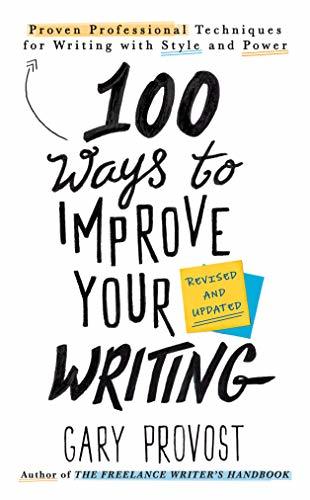
101 Ways to Improve Your Writing: Proven Professional Techniques for Writing with Style and Power was his second instructional book about writing, The Freelance Writer’s Handbook being the first. Some of the material here originally appeared in the Writer’s Digest magazine. The first edition of the book came out in 1985. This 2019 edition has been updated, mostly concerning changes in technology, by his wife, Gail Provost Stockwell, and one of his students who became a teacher and then the director of his writer’s conference, Carol Dougherty.

This book is laid out in eleven sections which are divided into several fairly short topics within the section. Some sections cover broad topics like overcoming writer’s block, developing style, giving words power, and making your writing likeable. But others get into the minutia of grammar, punctuation, and editing. The short pieces on each topic make this book very readable. Since they were so short, I read a handful at a time. But when I read this again, I think I might take one or maybe two at a time and digest them before moving on.

Gary sprinkles succinct but helpful side-by-side good and bad examples to illustrate what he advises.

One aspect of his writing I really appreciated was his saying that his tips are just that: “Tips, not laws” (p. 159). For example:

Never violate a rule of grammar unless you have a good reason, one that improves the writing. But never choose good grammar over good writing. There is nothing virtuous about good grammar that does not work. Your goal is good writing. Good grammar is only one of the tools you use to achieve it (pp. 118-119).

Try to use the active voice. But realize that there are times when you will need to use the passive. If the object of the action is the important thing, then you will want to emphasize it by mentioning it first. When that’s the case, you will use the passive voice (pp. 78-79).

For the past several years, I’ve tried to read at least one book about writing each year, as well as blogs about writing. Much of the information in this book wasn’t new to me, but I benefited from the reminders and the different way of expressing them. Plus, even though I have heard and read many of these things, I certainly haven’t mastered them yet. However, some of the advice touched on subjects we discussed in my last session with my critique group and helped me think through those issues. 

I think this book would be an excellent introduction for new writers and a great “refresher course” for more experienced writers.
Review: Write a Must-Read

Write a Must-Read by A. J. Harper

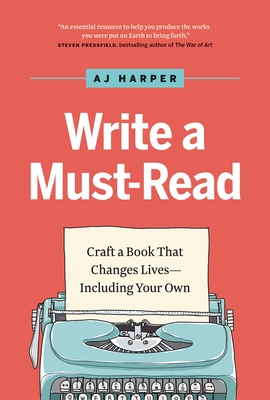
A. J. Harper (no relation) has had a varied career as a ghostwriter on multiple books, publisher, editor, coach, co-writer, teacher, and more. Clients urged her to teach other writers how to write transformational nonfiction books. A nudge from a co-writer and an author retreat helping writers caused her to realize maybe she could write such a book. The result is Write a Must-Read: Craft a Book That Changes Lives—Including Your Own.

Harper’s main theme is “Reader first.” Often writers get started because they feel they have something to say. But writing to impact others isn’t just focused on imparting the writer’s story or information. Even a memoir or biography needs to have a take-away for the reader; otherwise, unless the author is famous, a reader won’t be interested in reading it.

First Harper helps writers identify their ideal reader and what their need is. I appreciated the distinction that the ideal reader is not an avatar, with multiple specific characteristics down to the cereal the reader eats (I’ve seen some writing advice that seems to lead this way). Rather, “Ideal Readers may come from different backgrounds and circumstances (demographics), but their problems, desires, and challenges in pursuit of their desire (psychographics) are the common denominator” (p. 46).

Then she helps writers craft their Core Message: what’s the “foundational truth that your entire book is built on” (p. 65). From there, writers craft the promise they make their readers.

Harper talks about teaching points,stories, anecdotes, case studies, outlines, sequencing, and much more, all under the umbrella of what would best serve the reader.

She includes a multitude of helpful questions to ask while editing and ends with a crash course in the process of publishing and need for marketing.

All her points are illustrated with stories and anecdotes from the authors she has worked with.

Many of the chapters end with exercises to work through and links to her web site for more information or to download worksheets or lists.

Some of the quotes that most stood out to me:

Writing a book is not about organizing content. It’s about creating an experience for the reader (p. 119).

The best outline for your book is the one that meets your reader where they are and takes them on a journey that leads to your Promise, delivered (p. 119).

You are not the hero of this book. They are. You are not the focus of this book. They are. And they need you to help them get where they want to go (p. 121).

Your book is not a collection of stories and knowledge. It is a journey—a quest (p. 130).

With nonfiction, specifically personal and professional development books, the aim is transformation. My singular goal is to help the reader change their life (p. 138).

A book is not about something. A book is for someone (p. 200).

I first read this in the evenings, a chapter or less at a time, before closing out the night with fiction before bedtime. That wasn’t the time I wanted to work through exercises and such. So I am going back through the book now at my desk, making notes, printing out worksheets and filling them out.

Some of my readers would want to know that there’s a smattering of profanity through the book, and the author comes from a completely different worldview than mine.

But the writing advice is excellent all throughout.

Writing Pet Peeves

Pet peeves in writing

I mentioned a writing pet peeve in a recent book review, and some were curious about it. I have more than one. 🙂 So I thought I’d share them and see if others thought the same as I do.

Let me say first that I am an avid reader and love books and authors. I have great respect for authors, especially while trying to become one myself and seeing what’s involved.

I know writing is hard work. Plus we’re only human, and typos and grammar errors and other mistakes will filter through no matter how many people edit a manuscript.

But I share these in the hopes that any author who sees them will take them as constructive and not nit-picky criticism. I’m avoiding grammar and punctuation issues because there are tons of articles about those.

Conversations left hanging. Character A asks a question, and before Character B answers, the author fills in a lot of description, explanation, or backstory. A sentence or two is fine, but sometimes it feels the characters are just standing there in awkward silence waiting for the narrator to finish. In the book review I mentioned, the character wasn’t conversing but was asked to step up and give her presentation. Then there were seven paragraphs, partly backstory, partly description of the room and people, before the character spoke. The point of view was from this character, so it felt like her audience was just waiting and watching while all these thoughts ran through her mind before she spoke.

Characters with similar names. One book I read had a Kari and a Kali–a difference of only one letter. In another (from one of my favorite authors), two characters had two-syllable names that started with “Sh” or “Sch” and ended with “field.” One was a good guy and one was a bad guy. I had to keep going back to the first few chapters to remind myself which was which.

Describing multiple reactions at once. Sometimes I’ll see a character’s reaction or expressions with multiple adjectives: for example, “Her pale blue eyes reflected sorrow, grace, and fear.” First, this seems like telling, not showing. Second, how does anyone show that all at once? I could understand surprise turning to fear or something like that, but not several different emotions simultaneously.

Foreign phrases without translation, even common Latin ones. Sometimes you can get the gist of what is meant by the context, but it still takes the reader out of the story if they have to puzzle over an unfamiliar phrase. It does help that you can highlight a word or phrase in the Kindle app and get the translation. But that still takes the reader out of the narrative for a bit.

Overly technical terms. I was very disappointed in a recent article about counseling which used words like “vivify.” We’re often told in writing instruction not to use words the average person wouldn’t know. I got dinged on a manuscript critique for writing “in the midst” and “portend.” I was told, “You wouldn’t say, ‘I was in the midst of. . . ‘” But I say that all the time. This can be a little difficult because a word we think is common might be unfamiliar to others. But generally we need to consider the audience and avoid academic or technical terms (except, perhaps, in science fiction where the term is going to be explained).

Overused plot devices. It’s okay if a character learns vital information by eavesdropping on a conversation, but that shouldn’t happen repeatedly in the same story.

Overused plots. I’ve read that there are only a handful of storylines, and all the books written reuse them in different ways. That may be true. But it seems that a lot of books will have the same basic plot at one time. Lately I’ve seen a lot of books where the main female character has to go back to her hometown or estranged family for some reason (usually the illness or death of a parent) and encounters the boyfriend she left behind.

Giving modern sensibilities to historical characters. It took hundreds of years for society to come to certain understandings.

Modern phrases or slang in historical fiction. I know many historical fiction writers who diligently research language usage in their time period, so there are sources to check for that kind of thing.

Inaccuracy in spiritual truths. One author fussed with me when I said in a review that her book was inaccurate in its partial sharing of the gospel. She dismissed sharing the whole gospel in a book because, she said, one would have to write at a fifth grade level to do so. I’ve read a lot of Christian fiction over the last 40+ years, and I’ve seen the gospel explained in a tasteful and natural way. That’s supposed to be part of the Christian life, so it’s not being “preachy” to explain the gospel.

I agree that not every Christian book calls for a full gospel presentation. It depends on the type of story and characters and the author’s purpose. A Christian story doesn’t require that someone become a Christian during the plot. Often it’s the Christian characters who need to learn or grow in the story. But what is there concerning the gospel or any other spiritual truth should be accurate and not misleading. I go into this more in The Gospel and Christian Fiction.

Probably the inaccuracy I see most is when Christian characters urge a non-Christian to just start praying or doing Christian things, as if they’ll eventually become a Christian that way.

Older books re-released under new titles. It’s maddening when you buy a new book from a favorite author only to realize you read it a long time ago under a different title.

How about you? Do you share any of these pet peeves or do you have others? I’d love to hear them, but please frame them constructively and kindly. Also, I’d like to avoid grammar and punctuation issues in this discussion.

(I often link up with some of these bloggers.)

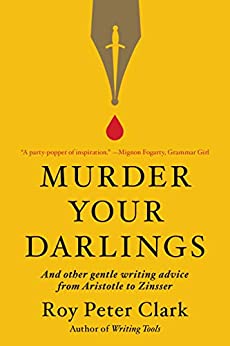
Murder Your Darlings

Murder Your Darlings is not a detective mystery or true crime drama.

Murder Your Darlings is writing advice. You see it a lot in writing circles these days, but it originally came from Sir Arthur Quiller-Couch, a British author and professor (known as Q, not to be confused with the WWII spy-gadget-maker). This phrase was first delivered in a lecture to his students in 1914 which was later published. In context, he said, “Whenever you feel an impulse to perpetrate a piece of exceptionally fine writing, obey it—whole-heartedly—and delete it before sending your manuscript to press. Murder your darlings” (p. 17).

Roy Peter Clark interprets Q’s advice thus: “Ask yourself, ‘Am I including this because it provides the reader with a memorable and delightful piece of evidence to prove the point of my text? Or is it beside the point even though it reveals what a good wordsmith I am?'” (p. 21).

In other words, the phrase, sentence, or paragraph that’s the most precious to you, but doesn’t really add anything to your thesis, must go. Clark opines that you don’t have to “commit verbicide on the words you love the most” (p. 17). You can save them in a file for another day.

Clark, known as “America’s writing coach,” shares advice from over 50 other writing sources in Murder Your Darlings: And Other Gentle Writing Advice from Aristotle to Zinsser. Clarks says, “I am not trying to steal their thunder. I am trying, instead, to amplify it, to pay back my debt to the authors who shaped my craft” (p. 8).

Some of these books are filled with writing advice, and Clark pulls out a lesson or two to discuss. “Most of what you will read here is why I appreciate them, what I or others have learned from them, and what I think you, the reader, can take away and apply to your own work” (p. 23).

Clark begins each chapter with a “toolbox,” a brief summary of the particular principle or writing instruction he’s going to discuss. Then he’ll give a little background about the work he is drawing from, the author, illustrations of the writing advice under consideration, whether he agrees or disagrees and to what extent. He ends each chapter with a short list of “Lessons” summarizing the main points of the chapter.

Clark’s book is quite readable. The Lessons at the end are particularly helpful to remind oneself of the salient tips from a chapter. Some of the writers he quotes from are well-known, others are not.

As you can imagine, I have multitudes of passages highlighted from the book. Here are a few:

It turns out that the internet is not an information superhighway. It is, instead, a polluted ocean with buried treasure sitting here and there on the bottom. Neutralize the poison of the propagandists, hackers, conspiracy theorists, trolls, and bullies by devoting your online efforts to the public good (p. 83).

Early writing is not sculpture, but clay, the stuff in which you will find the better work (p. 105).

An implied social contract exists between the reader and an author of nonfiction and that the contract reads, “Please believe me, my memory of events may be flawed, but none of this was intentionally made up.” If the author decides to veer from this standard, say, by using composite characters, the author must be transparent, revealing the strategies before the story begins, not in a footnote at the end (p. 222).

Donald Murray . . . advised writers to use “Shorter words, shorter sentences, shorter paragraphs at the points of greatest complexity” (p. 231).

Another Roman author, Horace, steps into the light with a sense of mission that is both public and aesthetic, arguing that the purpose of great literature is to delight and instruct or, on the good days, to do both! (p. 237).

This is a secular book, and there are words I wouldn’t use and situations and philosophies I wouldn’t agree with. But I found it fairly easy to sidestep those things just to glean the writing advice.

Clark’s book will help you hone your craft by sharing wisdom with you from sources that you might not have found yet. And the sources he quotes might inspire you to look up the authors’ original works.

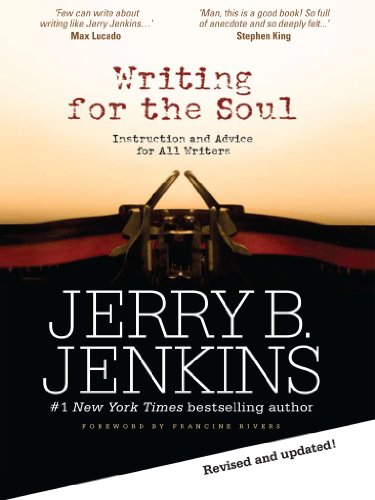
Writing for the Soul

Writing for the Soul: Instruction and Advice from an Extraordinary Writing Life by Jerry B. Jenkins is part memoir as well as instruction, advice, and tips about writing. But even the biographical parts are written to share what he learned.

Jenkins started out working for a newspaper writing for the sports section while he was still in high school. His goal was to write for the Chicago Tribune until a message at camp about surrendering his all to the Lord led him to do just that. A job editing a Sunday School paper for Scripture Press under a tough editor caused him to hone his skills. An interview led to his first book, a biography. Many of his next books were biographies or “as told to” stories. Then he branched into fiction. Left Behind, the book for which he is probably most well known, was his 125th book.

In Writing for the Soul, Jenkins covers everything from his family policy, motives and tools for writing, discovering what to write and your audience, characters, plot, perspective, and much more. Some of the chapters end with a question and answer section. Interspersed through the chapters are smaller sections covering topics ranging from working with celebrities to the need for humility to internal dialogue of characters. In a paper book, these might have been sidebars: in the Kindle version I read, they were paragraphs withing the chapter but set off by dividing lines.

In-between chapters, Jenkins shares experiences with some of the people whose biographies he has written, from Meadowlark Lemon and other sports figures to musician B. J. Thomas to Billy Graham.

I especially appreciated the sections on making inspirational writing not sound “preachy.”

As you can imagine, I have myriads of quotations marked in this book. Just a few:

Know where your audience is coming from, imagine someone you know or know of who fits in that audience, and pretend you’re writing to that person alone (p. 5, Kindle version).

What’s your passion? Your strength? What field do you really know? Write about it. Fashion a short story, write a poem, interview a leader in the field, or work on a novel. Put yourself and your interests into it (p. 11).

Big doors turn on small hinges (p. 13).

The most attractive quality in a person is humility. Sometimes money and fame will come whether or not you expect or seek them. But if you become enamored with the trappings of success, they become your passion. You need to return to your first love . . . Don’t let success or pressure change you. If you become a success, stick with what got you there (p. 38).

Choice words in precise order bear power unmatched by amplified images and sound and technical magic (p. 54).

Don’t confuse inspiration with initiative. Initiative solves your procrastination problem and pulls you through writer’s block. Inspiration gives you something worth writing about (p. 57).

Variety still keeps the batteries fresh (p. 71).

The stuff that comes easy takes the most rewriting. And the stuff that comes hard reads the easiest (p. 194).

This book was first published in 2006, and my copy was updated in 2012. Just a couple of places seem a little out of date, like working with cassette tapes for interviews (unless people still do that. I’d assume most recording is done digitally now).

He also doesn’t have much esteem for self-published books, thinking the goal of self-publishing is to be picked up by a major publisher. But self-publishing has increased exponentially in the last few years and garners much more respect now than when the first self-published books came across as “homemade” and unprofessional. I wonder if his views have changed on that.

But the majority of his advice is timeless, and I gained much from it.

You can also find Jerry Jenkins’ advice at his web site and blog.

(This book would work for either the memoir or arts category of the Nonfiction Reader Challenge.)

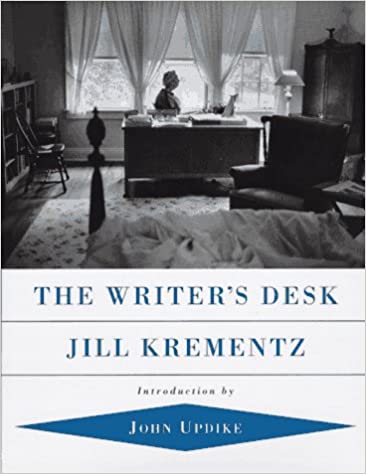
The Writer’s Desk

I saw The Writer’s Desk by Jill Krementz mentioned by literary agent Wendy Lawton at the Books and Such blog. I was able to find a used copy at Amazon for around $6. I’ve enjoyed leafing through it the past few days.

The book is made up of large black and white photos of over 50 writers at their desks. Alongside each photo is a paragraph or two from the writer about his or her workspace, style, routine, etc.

It’s interesting to see the wide variety of styles, routines, and even dress. Some of the men came to their desks with sports jackets and ties. James Michener preferred very loose tee shirts and shorts so he was unimpeded as he worked.

The work space for some was clean and sparse. Many had very cluttered desks and offices.

Some had a routine; others were more free form in style.

Some needed absolute quiet and solitude; some were able to concentrate in the midst of everyday family life.

Some wrote longhand, some used a typewriter, others a computer. The book was published in 1996, and some of the pictures are much older. I don’t know how many chose pencils or typewriters instead of computers or just because that’s what was available in their day.

I loved many of the insights:

John Updike writes “by hand, when the fragility of the project—a poem, the start of a novel—demands that I sneak up on it with that humblest and quietest of weapons, a pencil” (p. xi).

Archibald MacLeish: “I am sure—I mean I am not sure at all but I believe—the master poets must come at their poems as a hawk on a pigeon in one dive. I can’t. I chip away like a stonemason who has got it into his head that there is a pigeon in that block of marble. But there’s a delight in the chipping” (p. 77).

Joseph Heller said many of his ideas come when he’s doing things like walking the dog or brushing his teeth. “I don’t get my best ideas while actually writing” (p. 85).

Isaac Bashevis Singer: “Some writers say that they can only write if they go to a far island. They would go to the moon to write not to be disturbed. I think that being disturbed is a part of human life and sometimes it’s useful to be disturbed because you interrupt your writing and while you rest, while you are busy with something else, your perspective changes or the horizon widens. All I can say about myself is that I have never really written in peace” (p. 91). That’s encouragement for people like me who are easily disturbed.

Saul Bellow: “I think that art has something to do with an arrest of attention in the midst of distraction” (p. 99).

Jill Krementz is the wife of Kurt Vonnegut and the author of several other books. She says in her acknowledgements that many of these excerpts came from George Plimpton’s “Writers at Work” series in his magazine.

Of the 56 authors mentioned here, I had only heard of nineteen and read about six of them. So I took a little bit of time to look up the desks of other favorite authors. I had looked up Louisa May Alcott’s desk after reading the novel The Orchard House, taken from the name of the house Louisa lived in while writing Little Women. It’s hard for me to imagine writing much on such a small area, but it was unusual for a woman to have a desk in those days. Her father made the semicircle desk especially for her. I also enjoyed this view of C. S. Lewis at his desk with his cup of tea nearby and Lucy Maude Montgomery at hers. I stopped there, as this rabbit trail could take hours. But maybe someday I’ll explore some more.

I enjoyed this glimpse of writers’ spaces and styles.

Book Review: Write Better

In every writer’s conference, writer’s blog, or book about writing I have encountered, writers are told to continually improve their craft. Wherever we are on our writing journey, we need reminders, encouragement, and instruction. We can too easily grow complacent. Plus, changes in what’s acceptable can occur so quickly, we need to keep on top of current trends.

At the last writer’s conference I attended virtually, one industry professional said she read a book about writing or speaking every month. I thought I was doing good to read one a year!

Last year, several people recommended Write Better: A Lifelong Editor on Craft, Art, and Spirituality by Andrew T. Le Peau. Blogger and author Tim Challies said, “It is every bit the book many Christians need as they consider writing, and every bit the book many Christian writers need as they attempt to grow in their skill.” Literary agent Steve Laube called it the “book of the summer” of 2020.

Mr. Le Peau worked for InterVarsity Press for over forty years, spending much of that time as the associate publisher for editorial. He’s also written several books and Bible studies. So he knows what he’s talking about.

He also writes from and for a distinctly Christian point of view.

Le Peau divides his book into three parts: Craft, Art, and Spirituality.

Craft deals with the “nuts and bolts” of writing: creating good openings, endings, and titles, the craft and character of persuasion, narrative nonfiction, etc.

Art goes into creativity, tone, metaphor, restraint, and more.

Spirituality discusses calling, voice, authority, courage, and stewardship.

Several appendices cover platform, editors, coauthoring, self-publishing, and copyright.

I agree with the high praise that others have given this book. Le Peau not only writes well and has heaps of experience: he reads extensively and gives multitudes of examples of what he’s teaching. He writes professionally but without lapsing into academese.

I have many more places marked than I can share, but I wanted to note a few points that especially stood out to me.

After observing that “persuasion is part of almost every piece of nonfiction” (p. 37), Le Peau encourages writers to be honest persuaders.

If we want to be honest persuaders, we will be on the lookout for and stay away from hasty generalizations, false analogies, demonizing opponents, avoiding or sidelining the central issue (that is, using red herrings), and more. Honesty means respecting the truth as best we can know it, respecting contrary viewpoints, giving due credit, and using logic (p. 44).

He points out that “presenting the arguments for these other viewpoints in as strong a form as possible” (p. 55) is not only honest, but doing so actually strengthens our own arguments and the solutions we offer.

Even though this book primarily covers nonfiction, Le Peau encourages using stories. Stories pull us in and touch the heart. Stories “are bound to stick with us long after the information has been forgotten” (p. 60).

His chapter on creativity helped diffuse some of its mystery: “Essentially, creativity isn’t concocting something entirely unprecedented. Rather it is bringing together two things that have been around for a while but previously hadn’t been combined. Innovation almost always involves building on the past” (p. 117).

A few other quotes:

Grammar has one—and only one—purpose: to facilitate clear, effective, powerful, artful communication (p. 129).

Metaphors, similes, and analogies sharpen the sword of our writing. They allow us to cut quickly through the fat to the meat of our purpose (p. 146).

When we are too focused on readers getting our point, we can become didactic and perhaps preachy, engaging only one dimension—perhaps just the mind or just the will. Art engages the whole person—will, heart, soul, mind, and strength (p. 158).

Regardless of what we are writing, however, we must treat our readers with dignity. Don’t announce that you are going to tell a funny joke or story. Give readers the dignity of deciding for themselves if it is humorous. Besides, doing so makes it less funny because you have given away the element of surprise. Don’t say a story will be sad or happy or startling. That inoculates the reader against sadness or happiness or shock. Just tell the story (p. 159).

The goal of writers is not complete originality but to take the past and give it a shake, a fresh look that helps us see  reality differently and better (p. 185).

Criticism is not just something to be endured. It is something to help us grow and improve (p. 214),

Though all the book is valuable, perhaps the most valuable part of it is the last section on spirituality, having the right perspective whether in success or failure, remembering we’re stewards of God’s truth and the talents He gave us. “Remember, my identity is in Christ. I am not defined by what I write. I am not defined by the praise or criticism or sales of my book or the number of hits on my blog. My identity is in Christ, who loves me with an everlasting love, who made me, who put the urge to write in me, and who helped me get it out” (p. 225).

I wish I could read a book like this and keep all of its information readily accessible in my mind. Since I haven’t figured out how to do that, I should plan to reread this one every year. Highly recommended.

You can read more from Mr. Le Peau at his blog, Andy Unedited.

(Sharing with Carol’s Books You Loved, Booknificent)

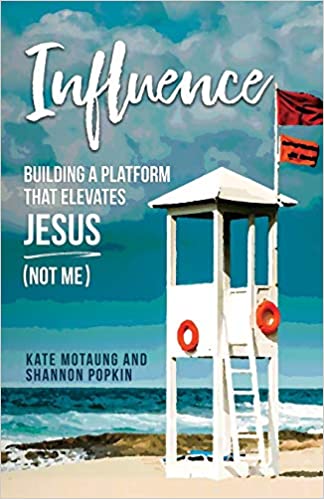
Book Review: Influence: Building a Platform that Elevates Jesus (Not Me)

In the very first workshop of the very first writer’s conference I attended, the speaker commented that publishing had changed significantly over the past ten years.

He didn’t say how publishing worked before. I assume writers wrote books and sent them in to the publisher, who did the rest. The author would have to fix some things after editors combed over their manuscript. But the publisher would market the book to the waiting world. And that makes sense: the publisher has a much bigger reach than individual authors in their homes.

Now, however, publishers expect authors to do most of the marketing on their own.

One reason is the rise of online book purchasing. Publishers have lost the opportunity to create attractive signs and displays to catch shoppers’ eyes as they browse a bookstore. Many brick and mortar bookstores have closed.

Additional reasons are the success of bloggers with big followings who then publish books and the availability of “influencers” on social media. And though I have not read this, I can’t help but wonder if it’s a cost-cutting measure to significantly reduce a marketing department by having writer’s do their own marketing.

So in these times, one can’t publish a book with a traditional publisher without a significant “platform.” In the blogs and Facebook writer’s groups and Twitter accounts I follow, would-be authors have lamented multiple times that they were told their concept, writing, and style were all good, but they were rejected because their platform wasn’t big enough (as determined by their social media followers and newsletter subscribers). One recent tweet I saw said the writer was told he needed upwards of 20,000 followers. I don’t know if that’s the norm. But all of this is discouraging.

Sure, anyone can self-publish these days. But a self-published book won’t get much beyond family and friends without taking some measure to get it out in front of the public.

All of this puts unknown Christian writers in a quandary. We’re supposed to humble ourselves, not exalt ourselves. We’re not supposed to be self-promotional. Drawing attention to ourselves in that way is distasteful to most of us. And we don’t want to annoy friends by constantly sharing “Buy my book!” posts on social media. So how in the world can we build a platform that publishers require and still maintain a clear conscience and a Christian testimony?

Kate Motaung and Shannon Popkin have wrestled through these issues and shared their conclusions and experiences in Influence: Building a Platform that Elevates Jesus (Not Me). They begin with this helpful analogy: instead of viewing platform like a stage where celebrities seek attention and applause, think instead of a lifeguard’s platform. He’s not there to elevate himself, but to see who needs help and get a life jacket to them. He “puts himself out there” not to be admired, but so those who need help can find him.

As Christian writers, we have a message the world needs. Focusing on serving others will help us maintain the right perspective.

Then there’s the other side of the problem: What if my book is a success? What if my blog post goes viral? How can I guard against getting big-headed and puffed up?

Kate and Shannon acknowledge that praise, attention, “likes,” and such can be addicting. They discuss pride and humility and the biblical foundations necessary for a right perspective.

They also go into envy, comparison, heart motivations, disappointments, dealing with unexpected wrenches thrown into the works. They look at how people in the Bible got their message out.

And they discuss “imposter syndrome”—the feeling that we’re fakes, that we really don’t have anything worthy to say.

The right perspective is to realize and admit that we can’t do it on our own. That we are nothing without Him. That we don’t have anything to say without His enabling. Humility is essential for the people of God. It’s a good thing to think less of ourselves. But it’s not biblical or honoring to the Lord if we doubt His ability to use us for His purposes and His glory (p. 19).

If He has called us to something, He will enable us. He doesn’t want to hide our talents in the ground. He wants us to let our lights shine where they can be seen and point the way to Himself.

There’s no need to shrink yourself down or deflate your gifts. That’s not humility any more than inflating your importance is (p. 77).

Finally, the authors discuss conquering anxiety over our platforms, times to turn down opportunities, and trusting that God is in control over all.

They’re not only grounded in Scripture, but they are transparent about their own struggles.

There are discussion questions at the end of the book for personal use to to facilitate group discussions.

The one thing I wish they had included was a chapter or appendix on practical ways to build a platform. They mention some in passing. But it would have been helpful to have a list and a brief description. No one can do all the things. Each person can only do what resonates with them and works within their time constraints and personality. But such a list might have given some new ideas to try.

Overall I thought this was an excellent book. It’s one I can highly recommend and one I should probably reread once a year or so.

(Sharing with Booknificent, Grace and Truth, InstaEncouragements,
Carol’s Books You Loved)

Guest Post at Almost an Author

I have a guest post at Almost an Author today titled Publishing Dreams Can Come True. I share a bit about the immense obstacles one author overcame to write what’s now considered a beloved classic. I want to encourage authors (and others!) to pursue their dreams and overcome their own obstacles with God’s help. I hope you’ll check it out.

Book Review: On Writing Well

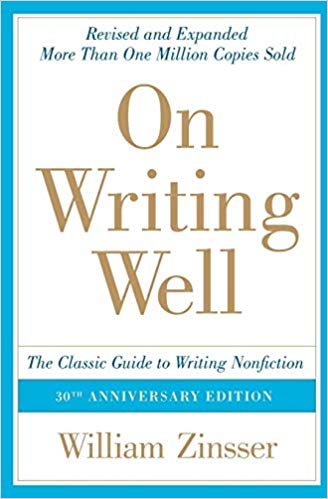
 On Writing Well by William Zinsser is on just about every list of books recommended for writers. The subtitle, which I assume is not originally Zinsser’s and was added later, is “The Classic Guide to Writing Nonfiction.”

Zinsser lived from 1922-2015. He began as a journalist, later wrote for magazines, wrote books on a wide variety of topics, and then began to teach writing. That vast experience informs this book.

On Writing Well was published in 1976 and has been updated numerous times. My copy was published in 2016 with a 2006 introduction by Zinsser explaining the most recent update to include the computer era.

The first of the book’s four parts covers “Principles”: grammar, style, word usage, eliminating clutter, etc.

Part 2 deals with methods: the unity of the piece, the lead and ending, and various other aspects.

Part 3 discusses a variety of forms: the travel article, memoir, science and technology, sports, business, arts, humor. I might have been tempted to skip or at least skim through this section, as most of my writing doesn’t fit those categories. But I have a compulsion to read all of a book. And I am glad I did. A couple of the principles in this section are:

De-jargonize. Almost any field has its own vocabulary. One business hired Zinsser specifically to help them with communication, because even their engineers couldn’t understand each other any more. In one exercise, he had educators rewrite “Evaluative procedures for the objectives were also established based on acceptable criteria,” keeping in mind “clarity, simplicity, brevity, and humanity.” The best result: “At the end of the year we will evaluate our progress” (pp. 171-172).

Focus on the human element no matter what you’re writing about. He gave an example about race car driving, something I have zero interest in. But the piece grabbed me because it shared one person’s story rather than a detailed technical report.

Part 4 explores attitudes: developing confidence and your own style, etc. In one chapter in this section, he gives readers a window into his thought processes by taking them through a longer piece he wrote and discussing why he made the choices he did.

The “clarity, simplicity, brevity, and humanity” mentioned earlier are what the author calls his “four articles of faith” (p. 171). Those are his main themes, demonstrated by example time and again.

This book is chock-full of good instruction and tips. I have markings and sticky tabs on almost every other page. Here are a few of the standout quotes:

Writing is hard work. A clear sentence is no accident. Very few sentences come out right the first time, or even the third time. Remember this in moments of despair. If you find that writing is hard, it’s because it is hard (p. 9).

The race in writing is not to the swift but to the original (p. 34).

Every successful piece of nonfiction should leave the reader with one provocative thought he or she didn’t have before. Not two thoughts, or five—just one. So decide what single point you want to leave in the reader’s mind (p. 52).

Don’t annoy your readers by over-explaining—by telling them something they already know or can figure out. Try not to use words like “surprisingly,” “predictably,” and “of course,” which put a value on a fact before the reader encounters the fact (p. 91).

True wit, however, is rare, and a thousand barbed arrows fall at the feet of the archer for every one that flies (p. 194).

Don’t alter your voice to fit your subject. Develop one voice that readers will recognize when they hear it on the page (p. 231).

Now, if I could only keep all these wonderful helps in mind all the times I’m writing! I generally only read 3-4 pages at a time so I could process as I went. But I think this is a book I’ll need to reread often in the coming years.

Have you read On Writing Well? What was a major takeaway for you?

(Sharing with Booknificent, Carole’s Books You Loved)