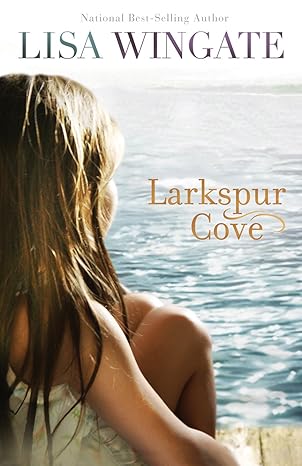
Larkspur Cove is the first of Lisa Wingate’s Shores of Moses Lake series.
Andrea Henderson has moved into her parents’ lake house in Texas with her teenage son after her husband’s betrayal and abandonment. She’s found a job as a social worker and wants to make a new start for herself and her son.
Her son, Dustin, is having a hard time making the transition. Left alone while his mom works, he ventures out with some new friends into an area of Moses Lake where boats are not supposed to go, ignoring the posted warning signs. Mart McClendon, the fish and game warden (or “boat cop,” as some call him), takes the teens in and calls their parents.
When Mart and Andrea meet, sparks fly. She thinks he is overreacting. He thinks she is some over-busy rich mom who doesn’t keep an eye on her son.
When Mart offers to let the teens take a water safety course in lieu of a fine, Andrea agrees despite Dustin’s protests.
Andrea’s work takes her into remote areas. One day when she sees an older man with a little girl in his truck, she suspects something is wrong. The little girl is not in a seat-belt and her hair is tangled with bits of leaves.
Later, Mart’s friends at a diner tell of seeing an old man with a little girl in the hills across the lake. The man, Len, is not known to have a family. He hasn’t been right mentally since he returned from Viet Nam. But he has seemed harmless. Yet, where had this little girl come from, and can a recluse like Len take care of her?
As Mart and Andrea investigate the situation, they learn more than Len’s situation. They discover their own purposes and more about each other.
I enjoyed this story. The little community around Moses Lake seems like real people, characters without being caricatures.
The Waterbird Bait and Grocery has a “wall of wisdom” where people write little sayings, and these proverbs and observations begin each chapter.
Some of the themes: first impressions aren’t always accurate; the best solutions are not always the most obvious; it takes time to heal from trauma, and others.
The audiobook was nicely read by two narrators, Johanna Parker and Scott Sowers. It was free from Audible’s Plus Catalog at the time I listened.
My only complaint is that this author has a penchant for putting several paragraphs of description or backstory in-between lines of dialogue. It can make discussions seem really stilted, especially while listening to an audiobook. I picture the other characters waiting patiently for the one with the next line to come back out of his or her thoughts and speak.
But otherwise, this was a great story. I’m looking forward to the rest.
When one of my sons was a child, he got hold of the word “irritating” – as in, “Mo-ooom, he’s irritating me.”
We tried to teach our boys not to irritate each other on purpose, not to hit, tease, “bother,” bait, infringe on the possessions or person of the other, etc. But sometimes in everyday living together, we’re going to irritate each other.
After listening to whatever had irritated my young son, I would deal with the issue. But when the complaints of irritation grew, I would say something like, “You need to work on not being so irritate-able” (pronounced on purpose for emphasis). That was not a satisfying answer. The problem is with the other guy, Mom! You need to make him stop!
I need to heed my own advice. I find myself getting far too irritated far too often. Sometimes it’s the other thing or person that is being irritating, or causing the issue: the stupid recalcitrant computer, the driver who wasn’t watching what he was doing, the Alexa device that can’t handle a simple request, etc.
But too often, it’s just a matter of my own irritate-ableness. Touchiness, my mom used to call it.
Honestly, little irritations trip me up spiritually much more often than major trials.
So what can I do when I am feeling irritable?
Remember we live in a fallen world. Appliances and cars break down at the most inconvenient times. Traffic jams seem to occur when I am most in a hurry. We all have sin natures that won’t be completely eradicated until we get to heaven. I shouldn’t be surprised when things go wrong or when there are occasional misunderstandings.
Fix the issue, if possible. Find out if there is something wrong with the computer, leave early so every red light isn’t aggravating, slow down and take the necessary time to accomplish something so haste doesn’t create more problems, gently ask the other person to refrain from or change whatever they are doing,etc.
Forbear. A former pastor used to say forbearing was just good old-fashioned putting up with each other. Ephesians 4:1-3 goes a step further and speaks of “forbearing one another in love” (“bearing with” in some translations).
Humble myself. The verses mentioned speak of humility and meekness. Who am I to think that the entire world should revolve around my preferences? Colossians 3:12-14 also speaks of forbearance in the context of “kindness, humbleness of mind, meekness, longsuffering,” and forgiveness.
Focus on the other person. When I am fixated on an irritating behavior in someone else, I view the whole person through that lens. Instead, I need to focus on that person as another child of the Father whom He loves every bit as much as He loves me and seek ways to serve him or her.
Do unto others as I would have them do unto me. I need to remember that I’m probably unwittingly irritating someone else who is being forbearing with me. I need to handle the irritations that come from other people as graciously as I would want them to handle mine.
Don’t make excuses. There are certain times, seasons, hormones, and circumstances that make one more susceptible to irritability. I admit it is really hard for me to be civil, much less loving, when I haven’t had enough sleep. And during certain hormonal surges I’ve wondered how in the world not to blow up at someone. But God’s promises and requirements don’t have exception clauses for “those” times. He gives more grace when we ask Him and rely on Him for it.
Behold our God. II Corinthians 3:18 says we’re changed more and more into Christ’s likeness as we behold Him. When I look inside and tell myself I need to be more kind, loving, forbearing, etc., I get discouraged and fail because I don’t have it in myself (Romans 7:18). But when I look at Him, that irritability seems to just melt away.
The Lord is gracious and merciful, slow to anger and abounding in steadfast love. The Lord is good to all, and his mercy is over all that he has made (Psalm 145:8-9).
For to this you have been called, because Christ also suffered for you, leaving you an example, so that you might follow in his steps. He committed no sin, neither was deceit found in his mouth. When he was reviled, he did not revile in return; when he suffered, he did not threaten, but continued entrusting himself to him who judges justly (! Peter 2:21-23).
Pray. I often pray Colossians 1:9-14 for myself and my loved ones. Verse 11 says, “Strengthened with all might, according to his glorious power, unto all patience and longsuffering with joyfulness.” We need God’s strength to be patient. Along with His power, He also gives us joy.
Trust God to work through even this. Author and missionary Elisabeth Elliot has been my “mentor from afar” for most of my adult life. She was honest about her human failings and struggles. She wrote in A Lamp for My Feet:
How can this person who so annoys or offends me be God’s messenger? Is God so unkind as to send that sort across my path? Insofar as his treatment of me requires more kindness than I can find in my own heart, demands love of a quality I do not possess, asks of me patience which only the Spirit of God can produce in me, he is God’s messenger. God sends him in order that he may send me running to God for help.
It encouraged me that Elisabeth had some of the same feelings I wrestle with.
God uses some people and circumstances as sandpaper to smooth our rough edges. Romans 5:3-5 tells us “suffering produces endurance, and endurance produces character, and character produces hope, and hope does not put us to shame, because God’s love has been poured into our hearts through the Holy Spirit who has been given to us.” That’s true of “little” sufferings as well as the big ones.
I’m behind on blog-reading this week, but I found some thought-provoking posts to share.
Being the Best You Can Be. “It is good to be the best you can be. It is noble to attempt to maximize your potential and to make the greatest good on even the least gift. God calls each one of us to be faithful stewards of all that he has entrusted to us. Yet there is a world of difference between being the best you can be and wanting to be known as the best.”
Bible Reading Blues? Study Your Stop. “If you were sitting across from me and you mentioned that you’d abandoned your Bible reading plan, I wouldn’t ask you about what went well. We’d talk about what didn’t work. We’d start with what made you stop because understanding why you didn’t finish could be the key to helping you begin again.”
Guarding the Gospel: Understanding the Dangers of Syncretism. “Syncretism is the combination or synthesis of two or more different religions or philosophies. Syncretism happens in Christian missions when people profess Christ by believing an altered version of the gospel message that lines up with their previous beliefs.”
ChatGPT May Be Eroding Critical Thinking Skills, HT to Redeeming Productivity. “Researchers used an EEG to record the writers’ brain activity across 32 regions, and found that of the three groups, ChatGPT users had the lowest brain engagement and ‘consistently underperformed at neural, linguistic, and behavioral levels.’ Over the course of several months, ChatGPT users got lazier with each subsequent essay, often resorting to copy-and-paste by the end of the study.”
He who grows in grace remembers that he is but dust, and he therefore does not expect his fellow Christians to be anything more. Charles Spurgeon.
It’s hard to believe we’re at the last Friday in June already. Even though we’re only officially into summer by a week or so, to me it seems summer is a third of the way over with the end of June in sight. I’m fighting the heat wave and fostering gratitude by pausing for a few moments with Susanne and friends at Living to Tell the Story to focus on the blessings of the week.
1. An old video. My Facebook memories pulled up a video Jason published eleven years ago. Timothy had been born ten and a half weeks early and spent that amount of time in the NICU. He got to go home on his original due date in June. Jason made a video showing Timothy’s progress and homecoming. It always makes me a little teary and abundantly grateful.
2. Amazon gift cards. I had a couple on hand for a few months, waiting to enter them until I knew what I wanted to spend them on. Otherwise they get frittered away. I finally used them this week. It’s like extending Mother’s Day and Christmas.
3. Air conditioning and ceiling fans. I imagine a lot of us will list those this week. I don’t know how people survived summer heat and humidity before AC.
4. Nowhere to go this week. First time that’s happened in a long time.
5. Getting “extras” done. One of my dearest friends is coming to visit next week. I got over the idea that I needed to practically spring-clean when company was coming long ago. But there are always little extras we like to tend to before they get here.
Summer has arrived in earnest, with temperatures in the nineties this week. I’m thankful for air conditioning and ceiling fans!
I like when we get past the summer solstice. It’s hard to wind down when it’s still light outside so late.
All the plants are well-established now. I got peonies for Mother’s Day, but I think we may have missed their blooming cycle. The leaves look healthy, so we can look forward to their flowers next year. The wildflowers are prolific and provide a nice view from the windows.
We enjoyed getting together for Father’s Day with all the family (our oldest in RI was there via FaceTime). We enjoyed exploring Ancient Lore Village when they had a free weekend event. It’s full of buildings that look like they’re out of Lord of the Rings.
I had a routine cardiologist appointment, plus the appointment to renew my driver’s license and get my Real ID. I’m glad to have those behind me.
I also met with a friend to have lunch and talk about ideas for making cards.
Watching
We haven’t really watched much worth mentioning except The Courageous Heart of Irena Sendler again. It’s based on the true story of a Polish social worker who worked with the Resistance and smuggled thousands of Jewish children out of the Warsaw ghetto and placed them with other families until the war was over.
Creating
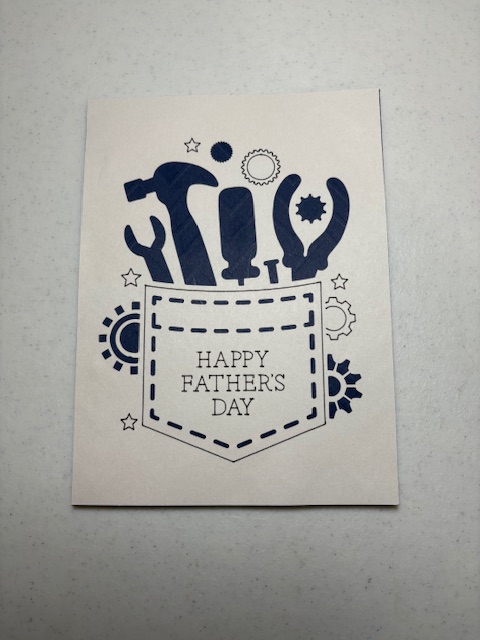
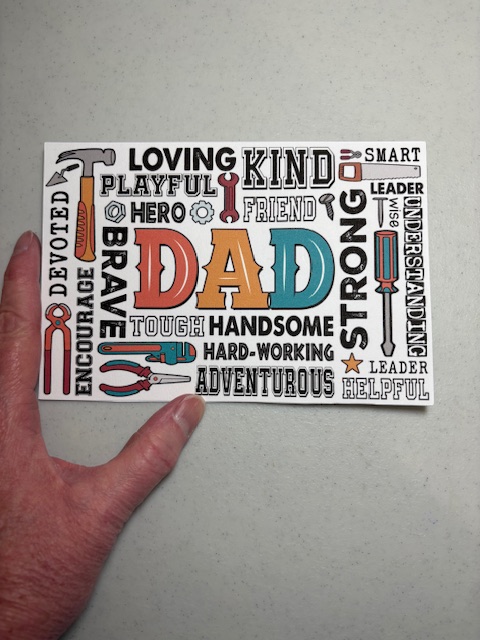
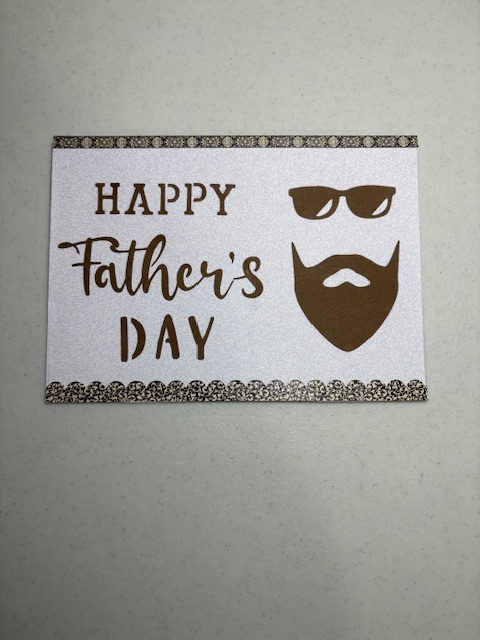
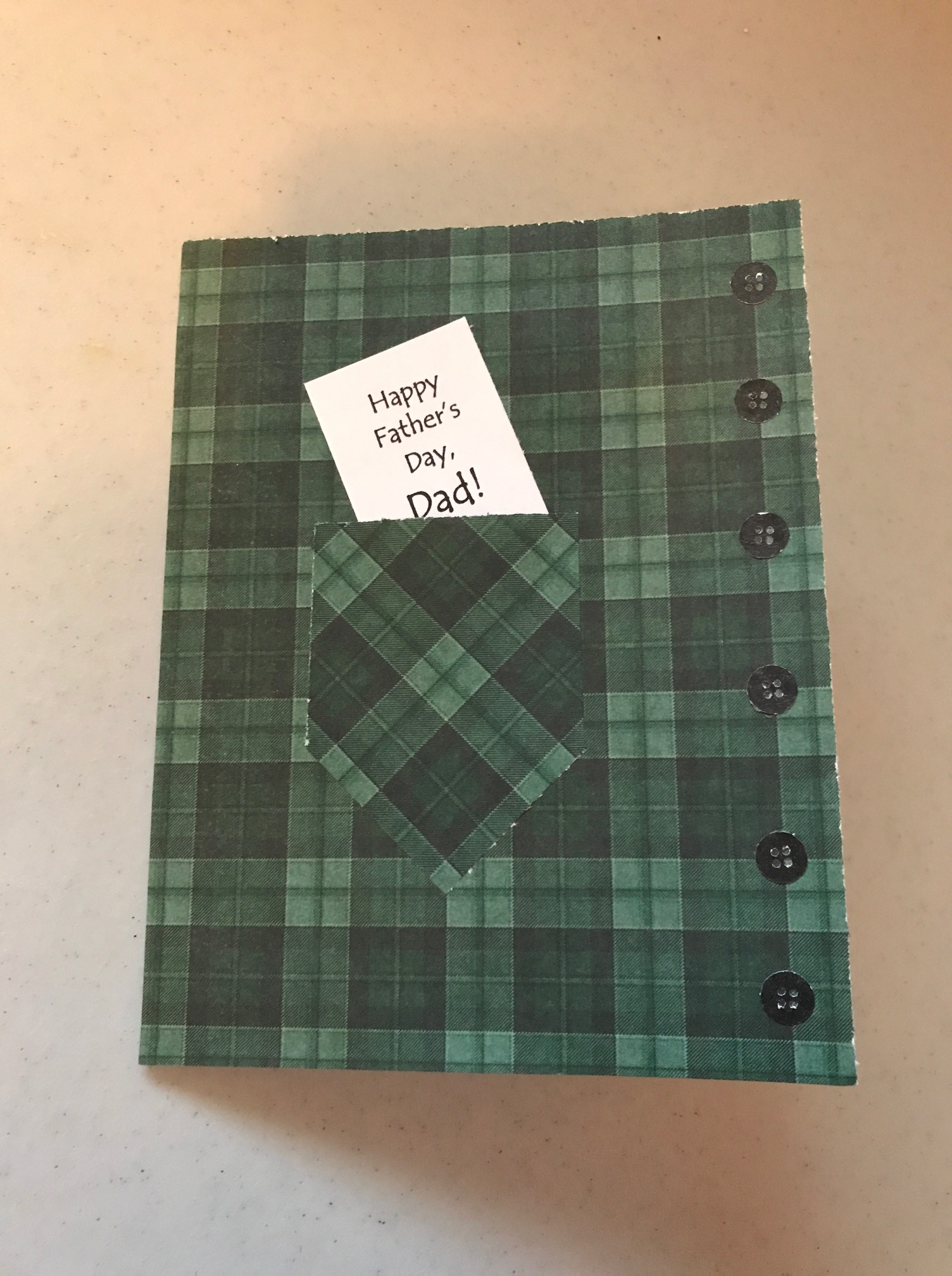
I made three Father’s Day cards, letting the Cricut do the heavy lifting this time.
This was for my stepfather:
The Cricut did the writing as well as the cutting.
This was for Jim:
The Cricut has some designs that can be sent to the computer to print out, then the Cricut cuts around them.
This was Jason’s:
Reading
Since last time I have finished:
Minor Prophets 1 by the Navigators. I didn’t review this, except a brief mention on GoodReads. I was disappointed. It had a lot of questions with no answers and very little insight.
Code Name Edelweissby Stephanie Landsem. Excellent! Based on a true story of Hitler trying to infiltrate Hollywood and a Jewish man with an underground network of unprofessional spies.
Every Hour Until Then by Gabrielle Meyer, her latest Time Crossers novel (audiobook). A young woman living in both 1888 and 1938 discovers her sister in 1888 is one of Jack the Ripper’s victims. She wants to save her sister, but knowingly changing history will cause her to lose her life in that timeline. Excellent!
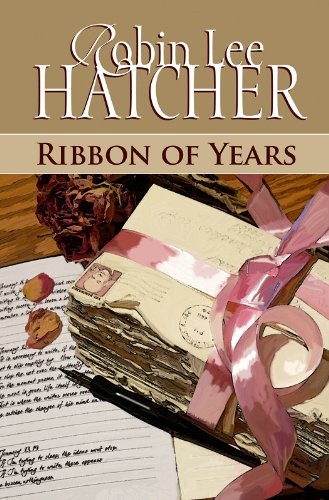
Ribbon of Years: A Timeless Journey of Love, Loss, and Unwavering Grace is a novel by Robin Lee Hatcher (audiobook). A woman’s life story from rebellious teenager to settled woman of faith is told through objects she left behind at her death. It was just okay for me, but the friend who recommended it loved it.
I’m currently reading:
Exalting Jesus in 1 & 2 Thessalonians (Christ-Centered Exposition Commentary) by Mark Howell. I’ve not read this author nor this series before–giving them a try.
The Collected Letters of C.S. Lewis, Volume 3: Narnia, Cambridge, and Joy, 1950 – 1963, compiled by Walter Hooper. I’m getting near the end!
Rembrandt Is in the Wind: Learning to Love Art through the Eyes of Faith by Russ Ramsey. I am loving this so far.
North! or Be Eaten, the second in the Wingfeather Saga by Andrew Peterson.
Rays of Glory. Those glorious sunbeams filtering through clouds show up because light hits dust and other particles in the air. It’s amazing that God can be glorified when His light reflects off our “dust.”
The Mission for My Remaining Years. There are some things we may not be able to do as we get older. But we can always share what God has taught us and point people to Him.
A Good Father Reflects God. No father is perfect, and some are farther from perfection than others. But God gives us a picture of a good father to help us understand His love for us.
Simple Card-Making Ideas. Not my usual kind of post, but a discussion of card-making with a friend grew into a blog post.
Looking ahead, I have a couple of medical appointments in July, Independence Day, and Jason’s birthday. Otherwise, it looks to be a quiet month. I hope to work on my manuscript a bit.
I enjoy making cards as a hobby. It began when I shopped for cards one year and found most of them were $5.99 and up. I had a lot of craft supplies on hand and decided to try making cards.
You may have seen a meme which says something like why spend $6 on a card when you can spend $72.95 on craft supplies to make cards. 🙂 One can easily get carried away, as there are so many tools and materials with which to make cards these days. But some of the nicest cards are the most simple.
This isn’t a craft blog, but as I discussed these things with a friend recently, I thought some of you might be interested as well.
I confess I have an embarrassment of riches when it comes to craft supplies. My family often gets me either craft things or gift cards to Hobby Lobby. I can’t receive some of the “usual” gifts for moms. Scented things give me a headache, so candles, perfumes, lotions, soaps, etc, are out. I prefer to buy my own clothes. I enjoy inexpensive jewelry, but have more than I can use as it is. I used to ask for books, but most of my books are ebooks now. So craft supplies and gift cards are my main gifts.
Hobby Lobby frequently has some of their papercrafting supplies on sale for 40% off, so I make the most of my gift cards then.
My husband bought me a Cricut machine some years ago, which plugs into the computer and accesses their Design Space. You can look up specific projects or search for images. When you find what you want, the machine will divide the image up into different layers, which you can then set it to cut. The Cricut is a marvel, and I still don’t know a lot of what it can do. But it is also expensive. I almost feel guilty for having one, or feel I should have an Etsy shop or something to justify my having a Cricut. But I thankfully accept it from my husband’s generosity.
However, I want to encourage you that you can make nice cards without a machine or hoards of supplies.
Getting ideas
I have a Pinterest board for homemade cards, divided into categories. Some of the pins take you to the site of the person who made the card with their instructions. However, most don’t contain instructions. I try not to copy an idea exactly if the person who made it is trying to sell it. But I might let the idea inspire me.
I take the interests of the recipient in mind. For instance, my daughter-in-law likes sunflowers, daisies, and the color purple. My oldest son likes foxes and has a cat. My husband is handy and like camping and fishing. My youngest son is into gaming and technology. So I’ll try to find or come up with an idea incorporating their interests.
I also look through my decorative papers, trims, and stickers, and sometimes an idea will evolve.
Tools
I’m blessed with a lot of tools accumulated through the years, but nice cards can be made with the barest supplies.
I usually use scrapbooking paper as a background, but that’s not always necessary. Hobby Lobby and Michael’s both sell individual sheets of decorative paper as well as pads of themed paper. I’ve gotten some pads of decorative paper on Amazon as well.
Decorative scissors provide an interesting edging.
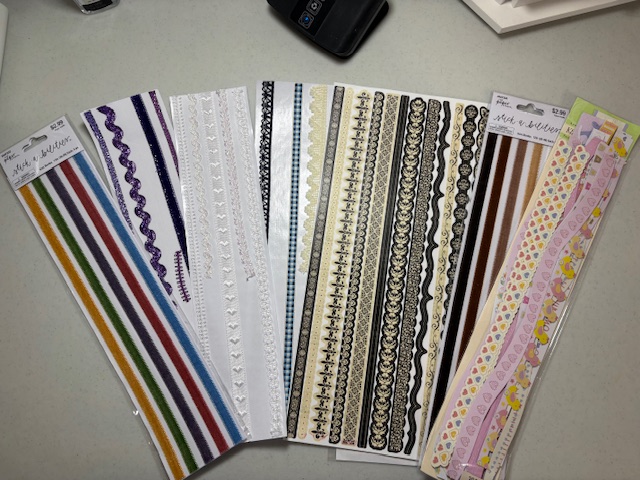
Lace, ribbons, paper scraps, or store-bought trims add special touches and sometimes provide a cover for overlapping papers. Most of these trims are adhesive, which helps a lot.
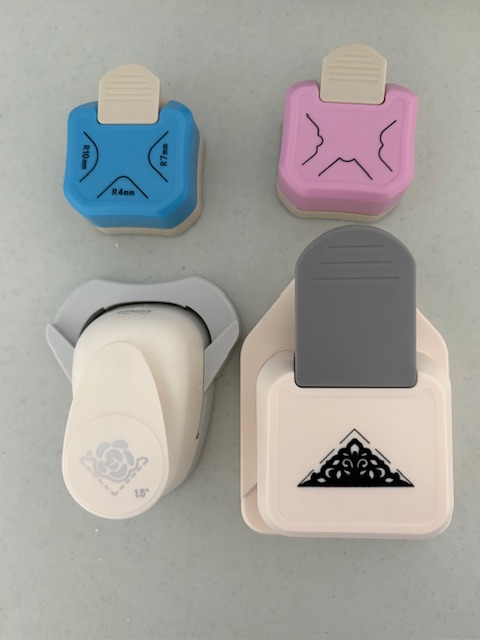
Punches can be expensive. When I haven’t had just the right size, I’ve used stencils instead. I’m not good at cutting things out on a line, so they edges aren’t as sharp as with a punch. But they’ll do. Sometimes a wobbly edge can be covered up with trim or a sticker.
Some of my favorite punches are corner cutters.
You don’t have to have wording on the front of a card. I do on most of mine. Since my writing is not the best, I usually use the computer for whatever I want the front to say, print it, then use the paper cutter, punches, or stencils to cut it out. But I have also used stamps and stickers. I have some lettering resources to try to teach myself to write clearly enough for the front of a card, but haven’t had time to delve into them yet.
I just use a basic craft glue stick most of the time. My oldest son got me a sticker-maker, which I usually use for the inside sentiments. The glue it uses is really strong with little hope of repositioning. But the basic glue stick can be moved around a little before it dries.
Sample cards
All of these have appeared on the blog before.
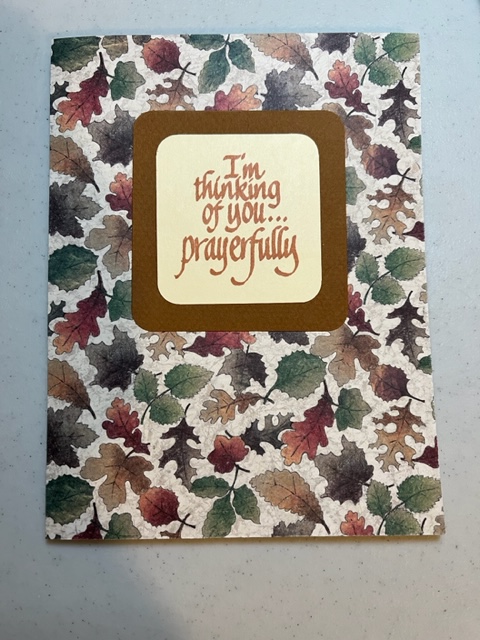
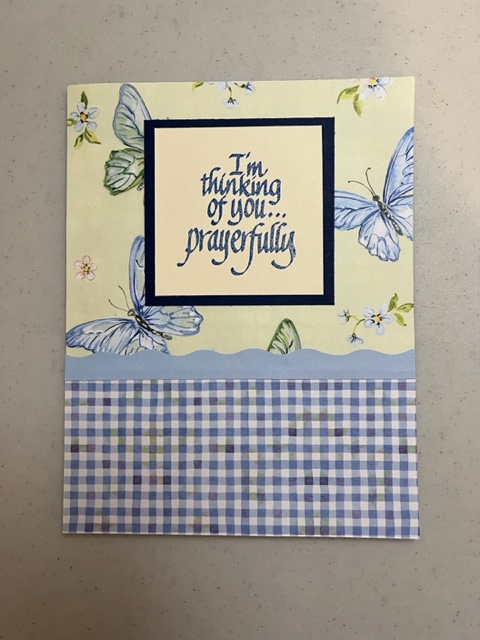
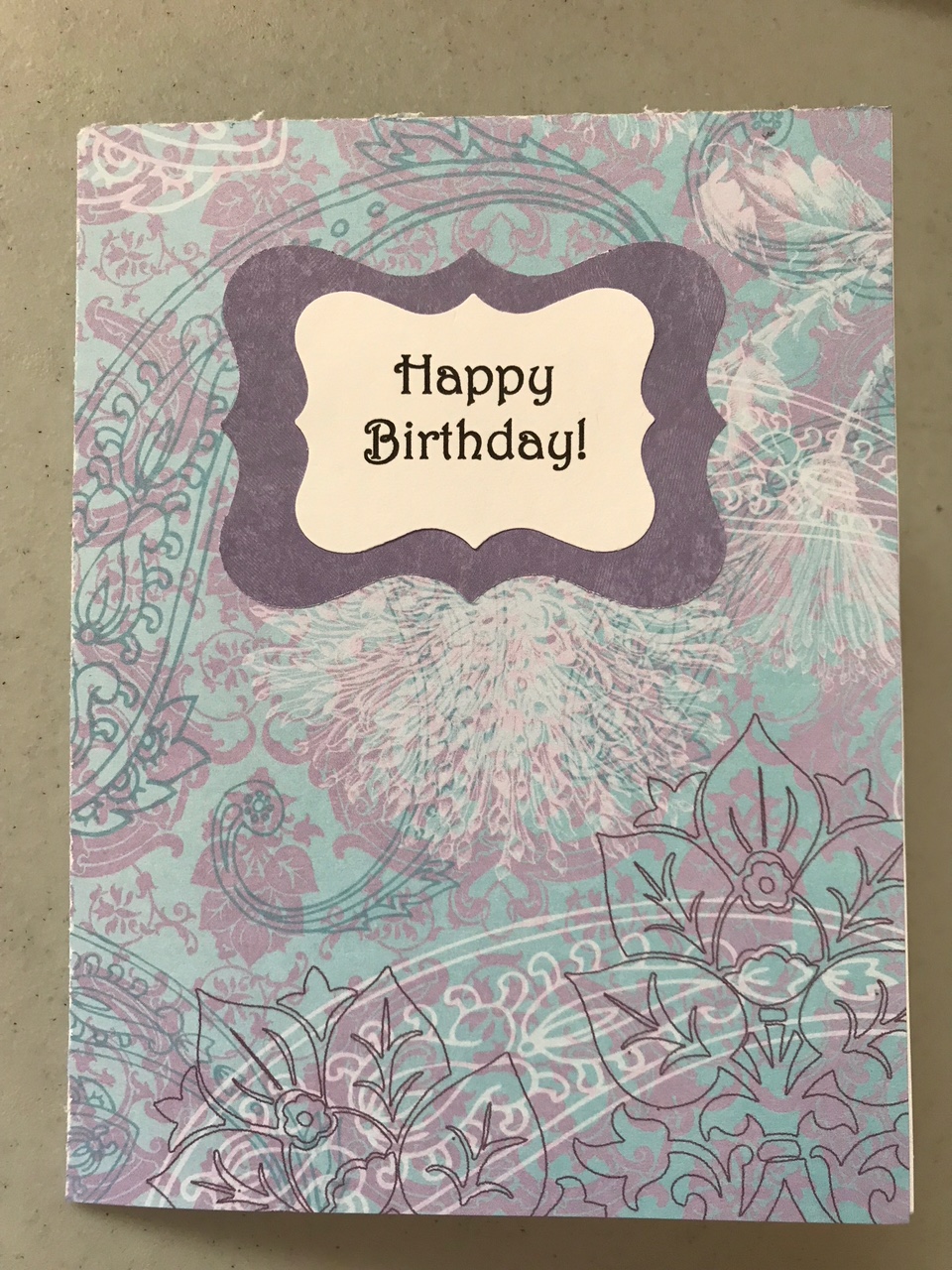
One of the simplest card ideas has a decorative background of scrapbooking paper and a simple saying surrounded by a contrasting or solid color:
The words here were done with a stamp. The corners of both the saying and the paper around it were rounded with a corner cutter.
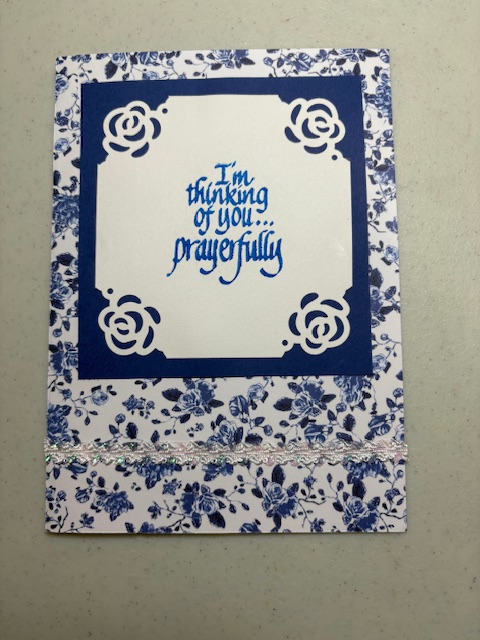
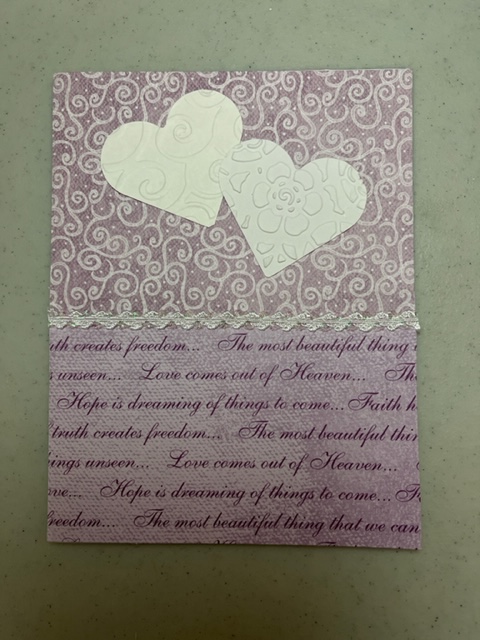
This card takes the decoration one step further:
The roses on the corners of the saying were done with a decorative punch. I added a piece of lacy sticker trim across the bottom.
You could also use coordinating papers on a card, and cover the overlap with a bit of trim.
The trim above was made with colored paper and decorative scissors.
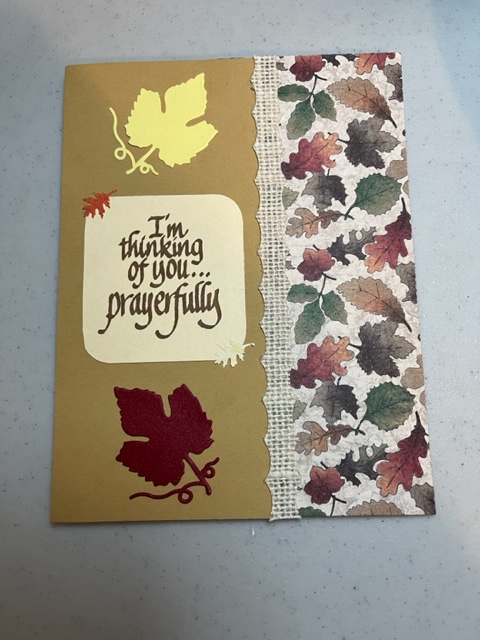
This one takes things a step further:
The burlap trim is another sticker. The two leaves were cut out with another device, a Cuttlebug. But there are also leaf punches or stencils one could use. If I remember correctly, the small leaf stickers were used to cover up a mistake on the corners.
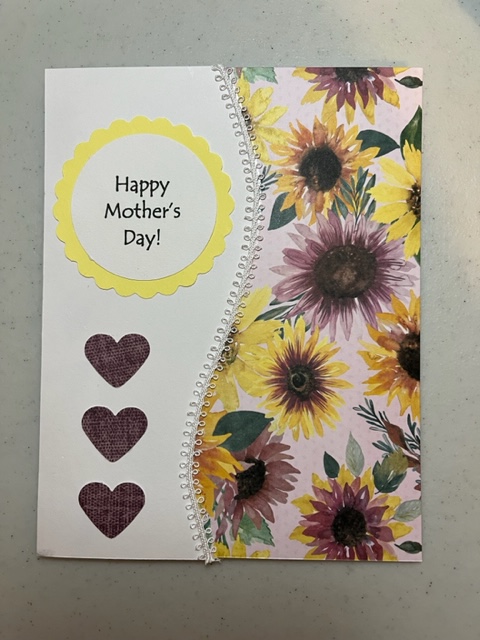
And this takes the same basic idea even further:
The cards above and below use two punches of different sizes, which could also be done with stencils:
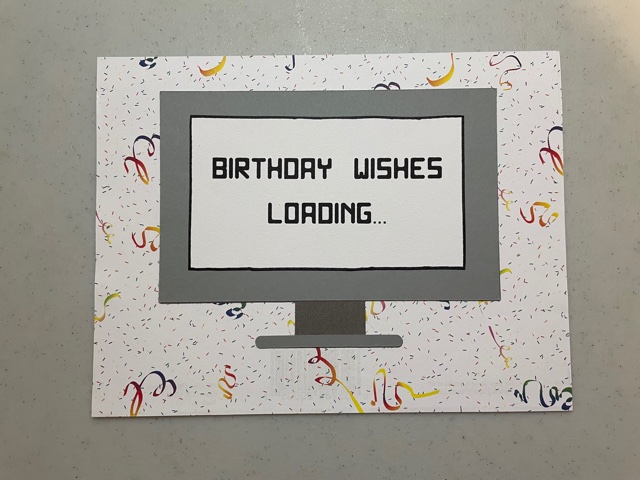
You could also use simple shapes. I think I used the Cricut for the monitor here, but it could easily be done without it:
I found a font online that looked like computer typing and used it here.
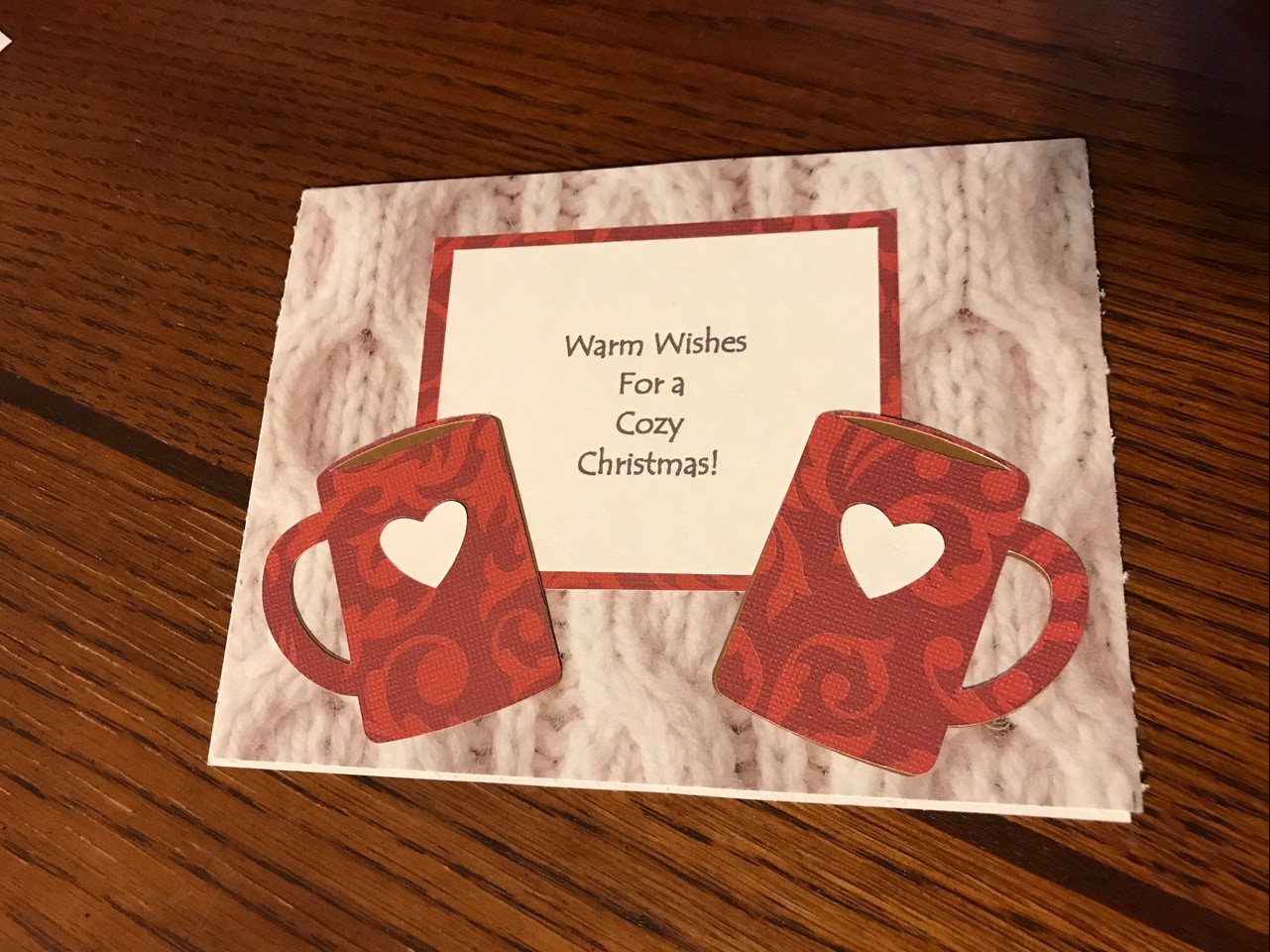
I think I did these mugs with the Cricut as well, but they would be simple enough to draw.
This is one of my favorites, from an idea on Pinterest.
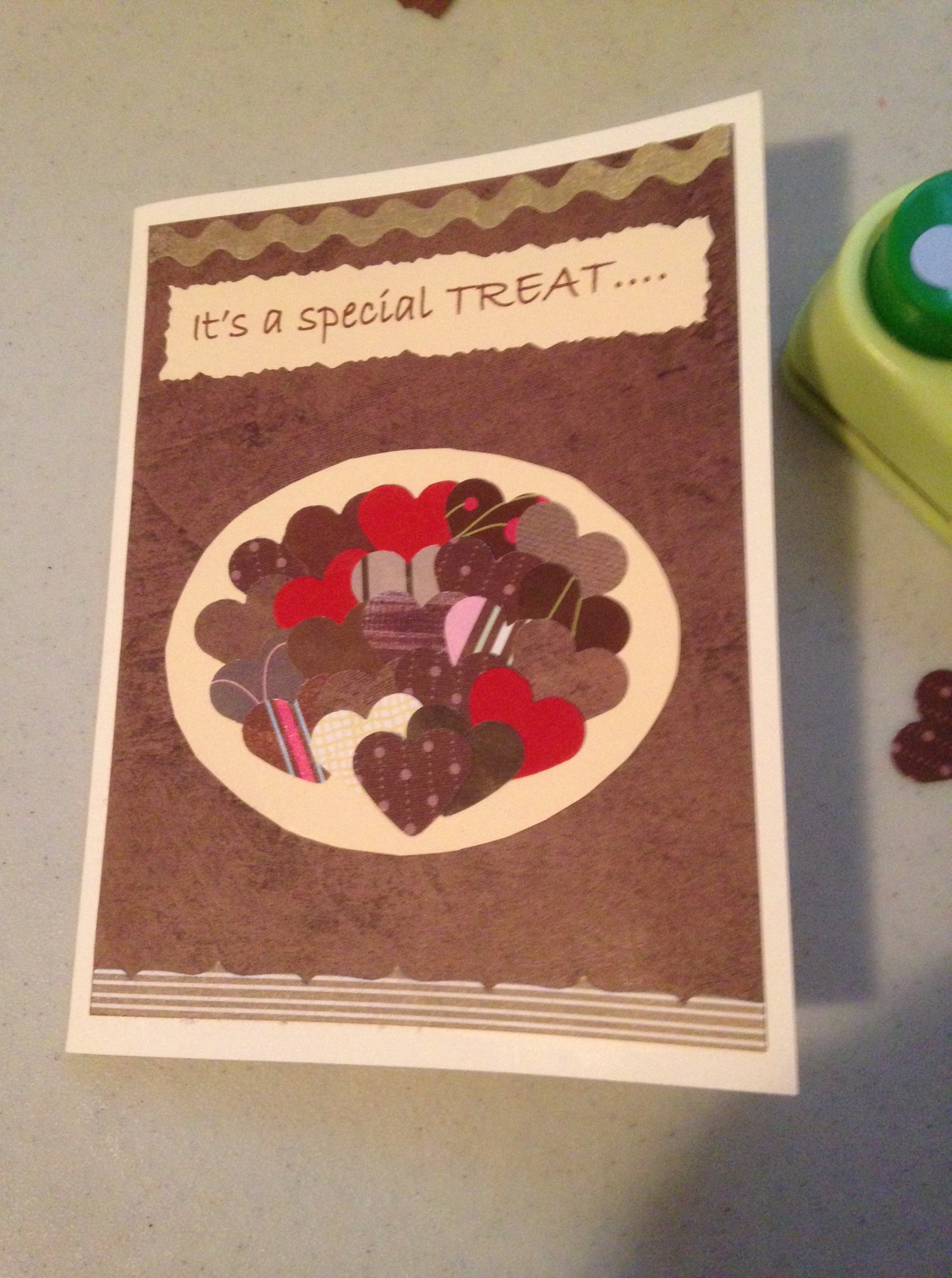
I used a heart punch on various papers to make what I hoped looked like a plate of Valentine candy. Decorative sticker trim is at the top and bottom.
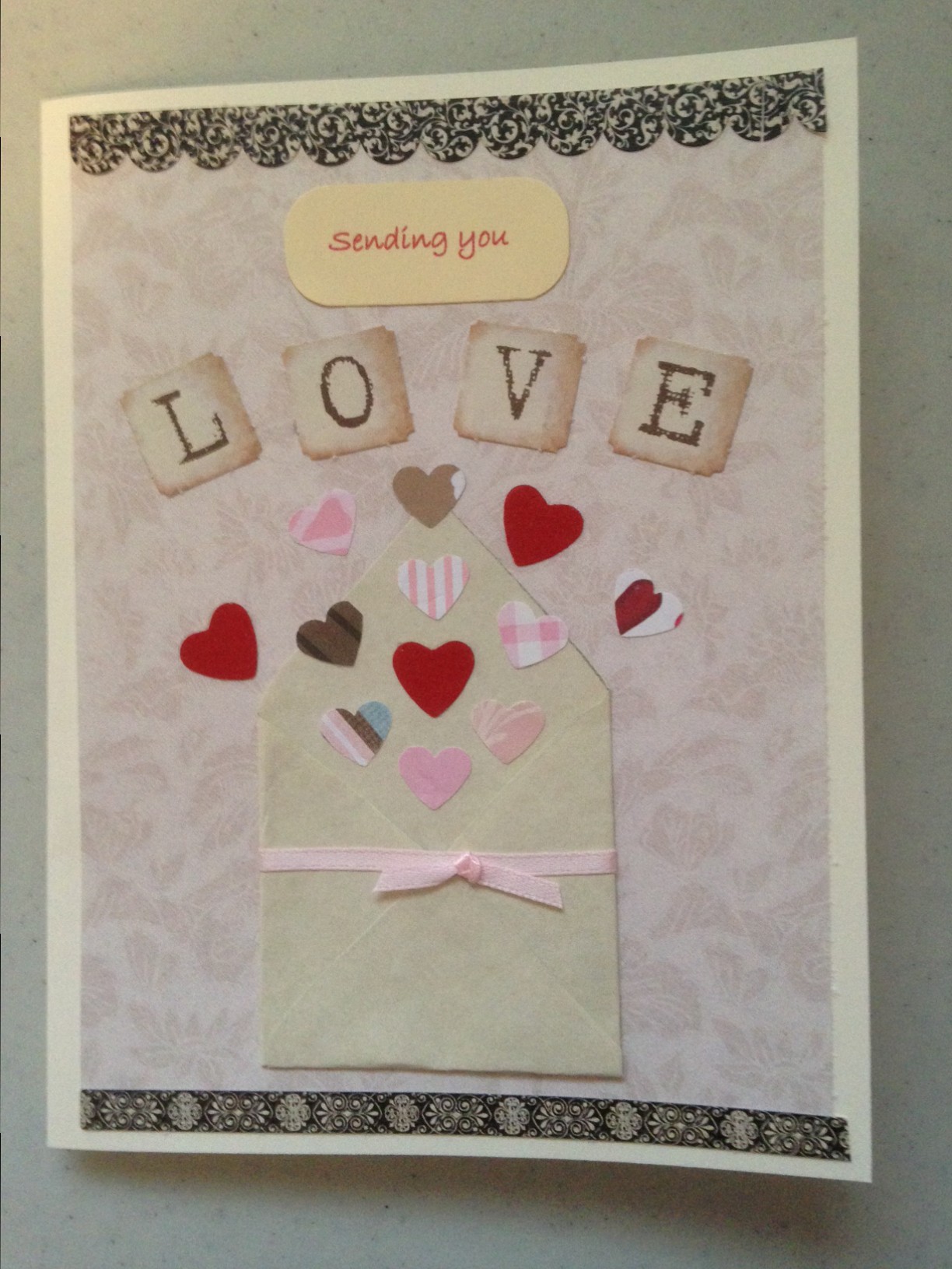
This was another made with heart punches. The letters for “LOVE” came from a package of scrapbooking paper which had a couple of pages of letters.
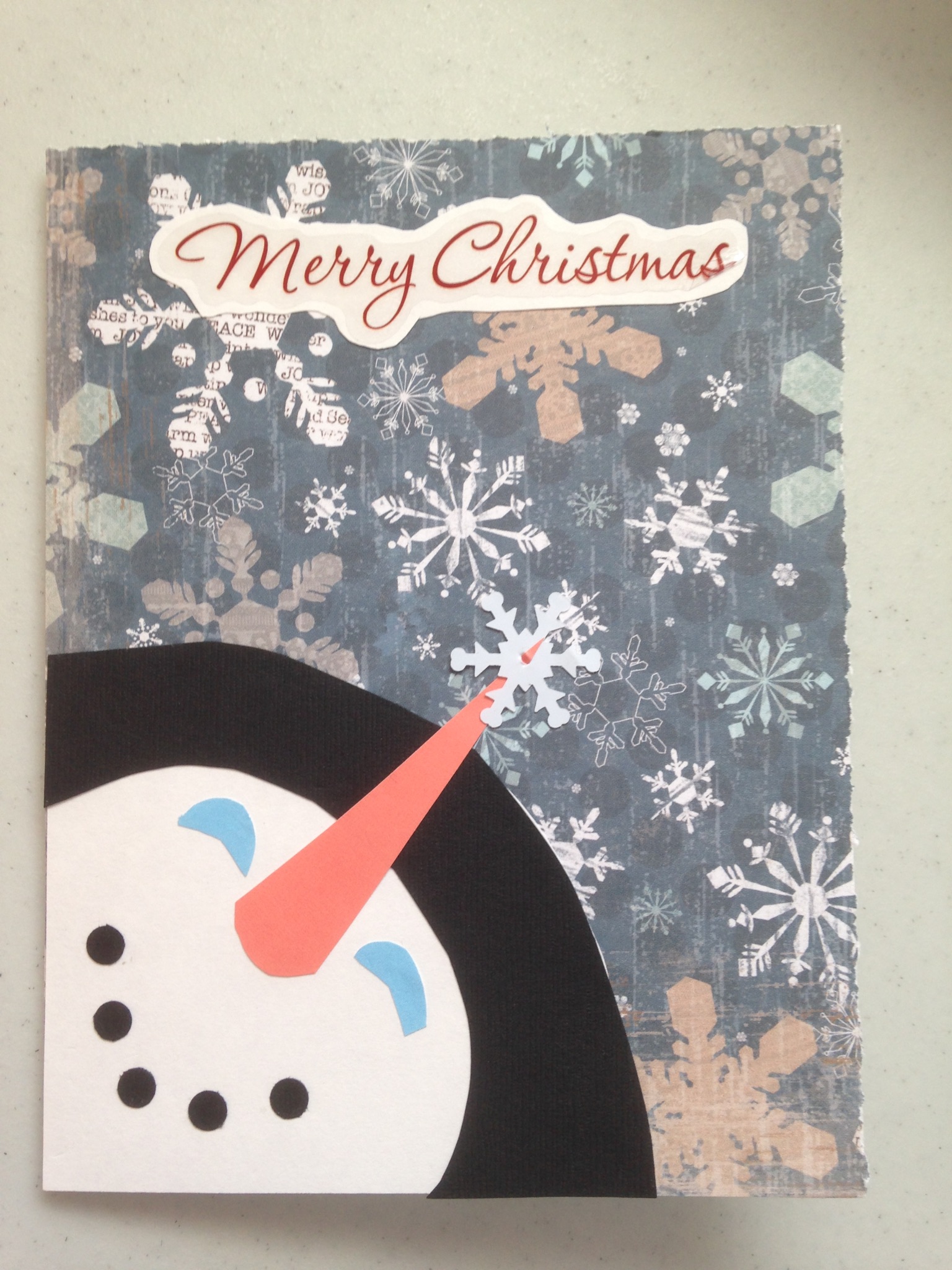
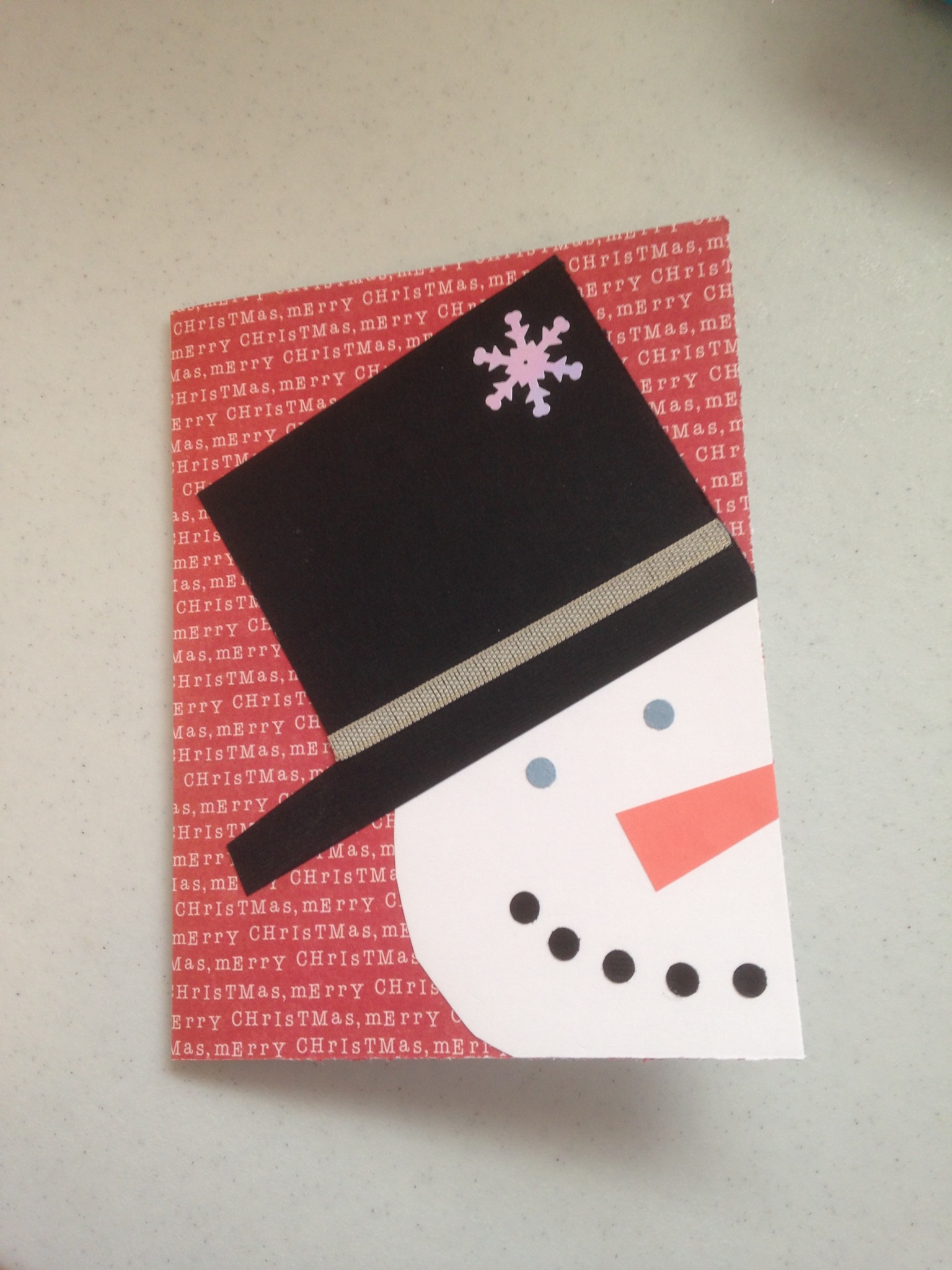
This is another Pinterest inspiration. I think I did it all freehand except the snowflake. And the dots for the mouth were probably from a punch. “Merry Christmas” was a sticker put on cardstock, then trimmed following the shape of the letters.
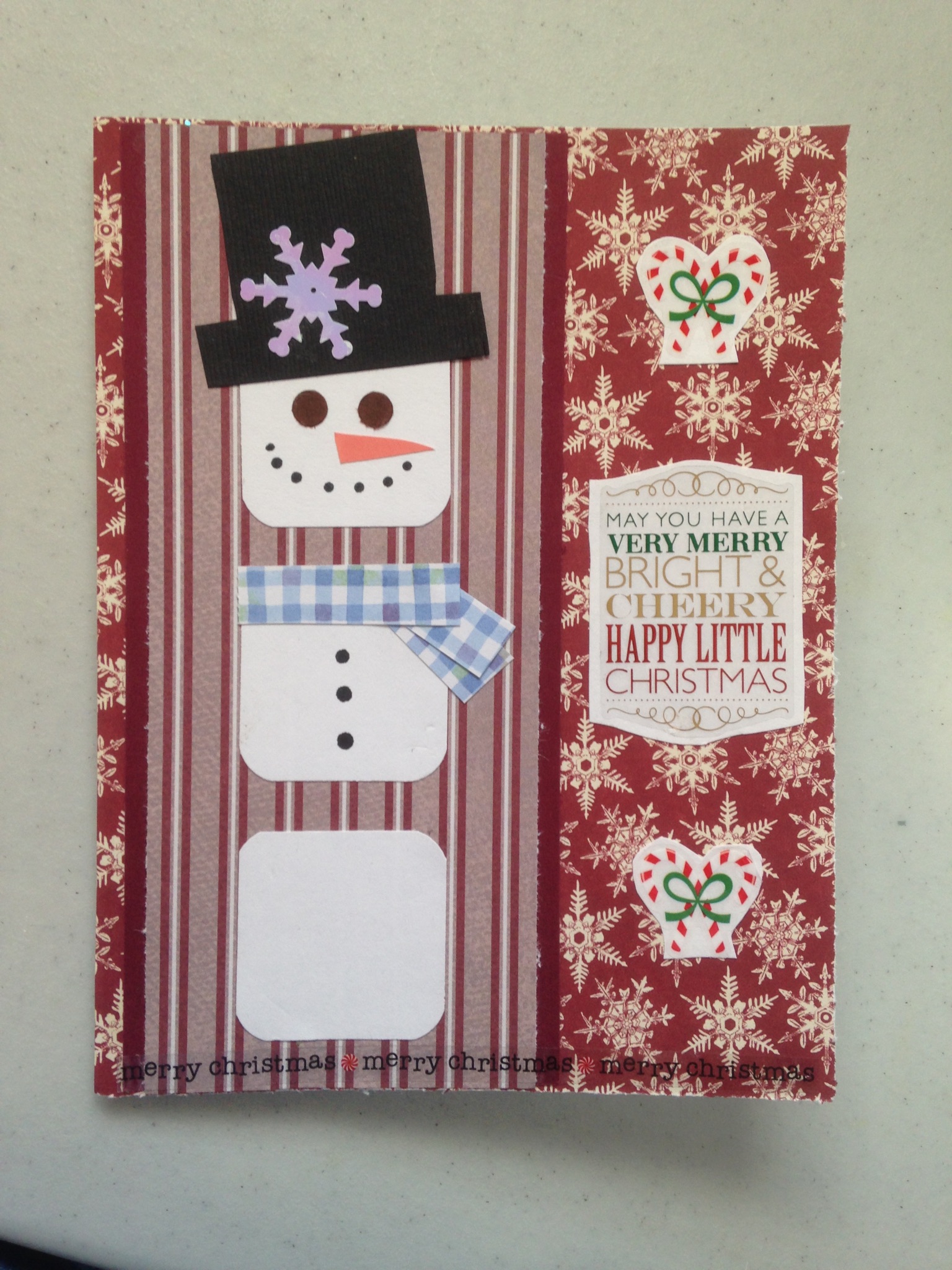
This one was made with two different kinds of paper for the background and stickers for the side graphics. The “scarf” was made from scrapbooking paper. The snowflake on the hat was from a package plastic snowflakes.
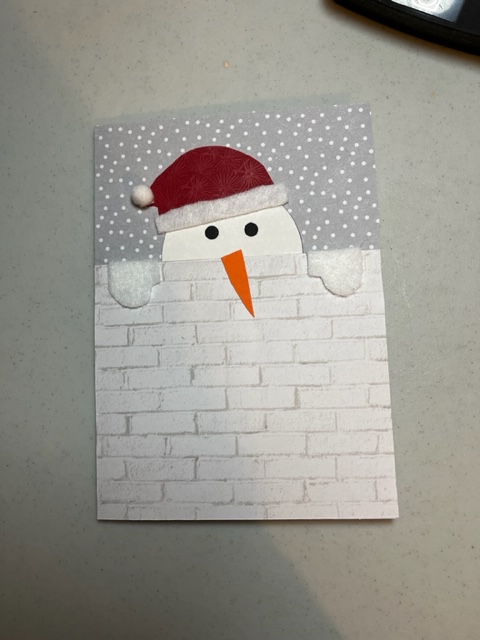
Another freehand idea from Pinterest.
The “wall” and sky here were scrapbooking paper, and the snowman was freehand. The hat came from a package of felt stickers.
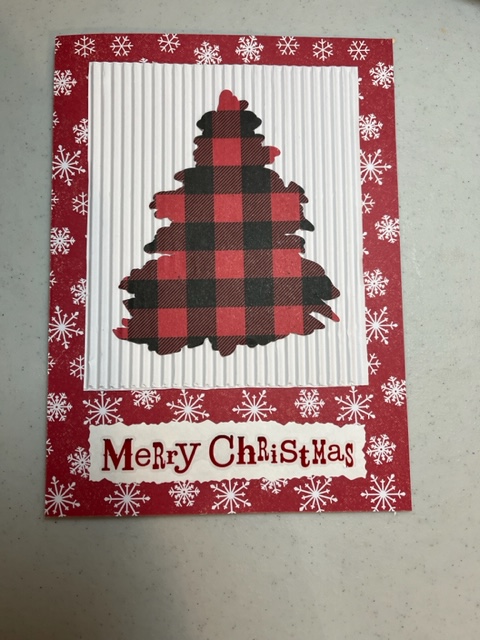
The white square here is from a corrugated scrapbooking paper:
The tree was done with the Cricut, but could easily be cut out by hand. The “Merry Christmas” was another sticker placed on white cardstock and cut with decorative scissors.
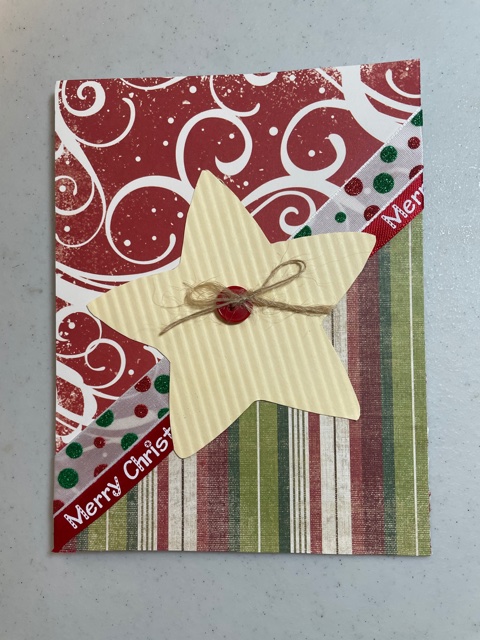
This Pinterest idea also uses corrugated paper, two different scrapbooking papers, ribbons, and a button with twine:
Tip: if you’re using lace, fabric, or ribbon that is not a sticker, it helps to dab the glue stick on the cut edges so they don’t fray.
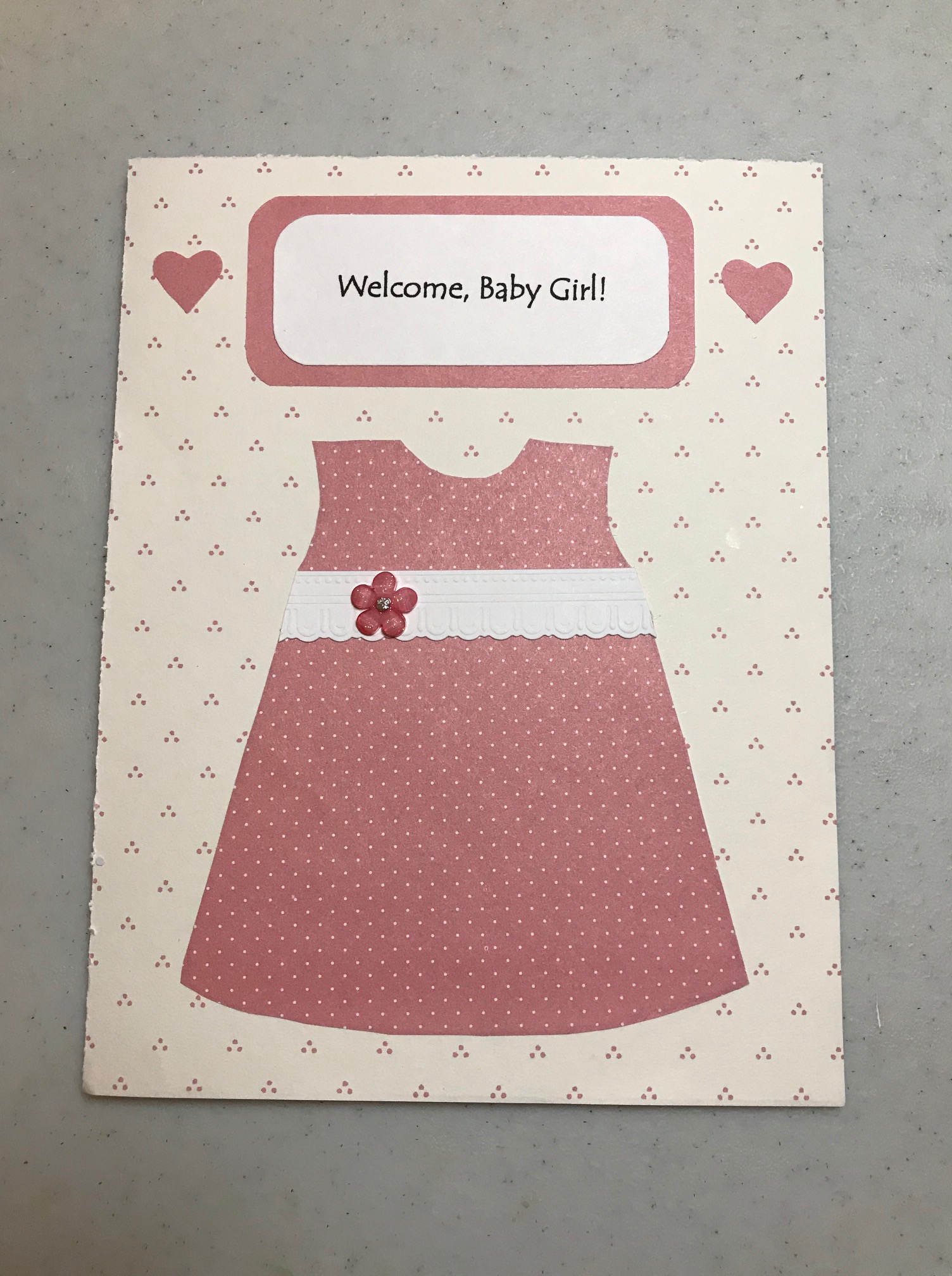
The dress here was cut out freehand, and the “lace” is a sticker:
The flower came from a package of them.
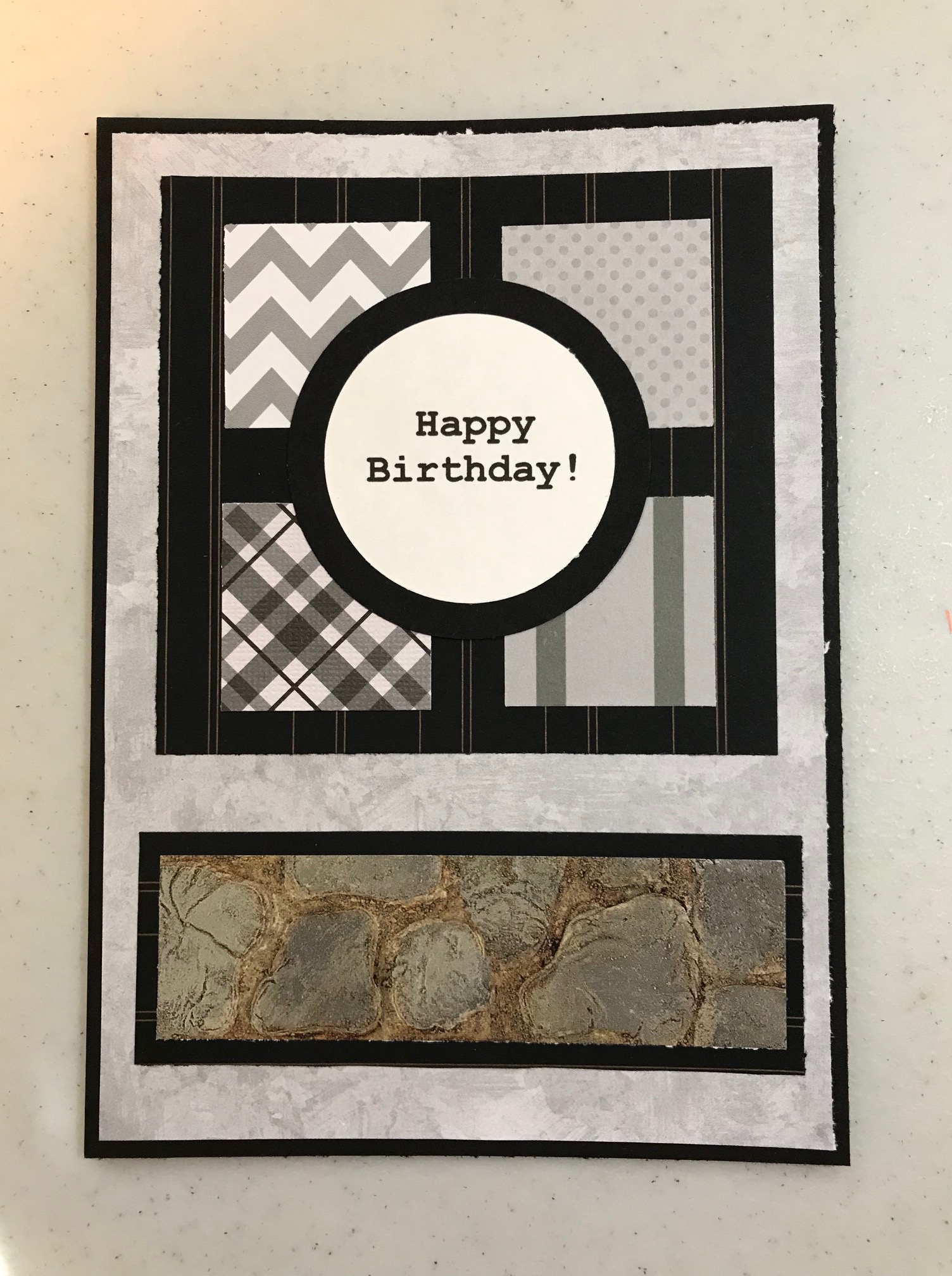
Here is another one with simple shapes and a variety of papers:
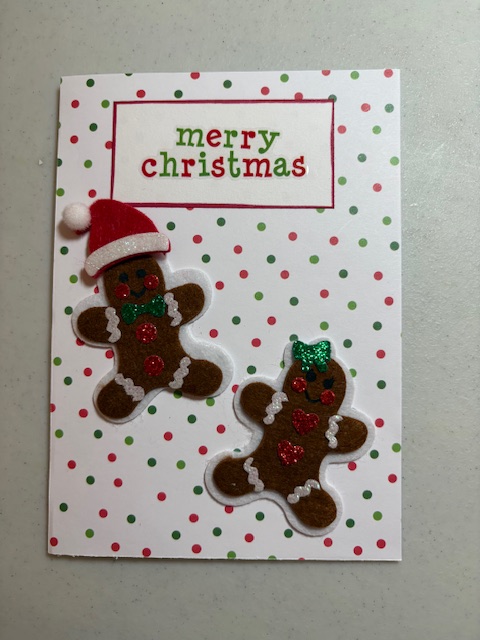
This card just used scrapbooking paper, a Merry Christmas sticker, and puffy gingerbread people stickers. I added a felt Santa Christmas hat sticker.
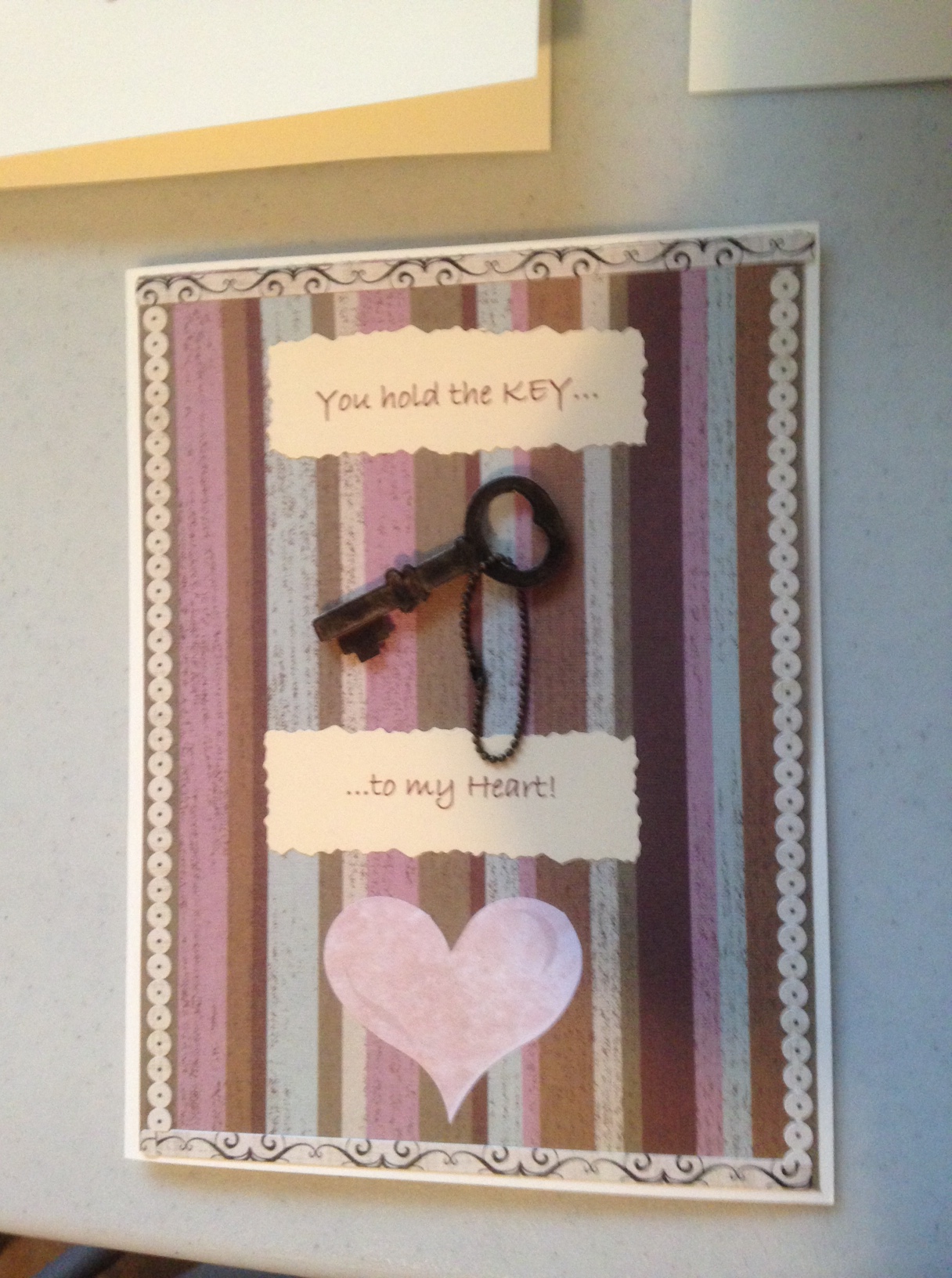
You can find all kinds of little shapes at craft stores to use on cards. This little key was glued on scrapbooking paper, then I put decorative sticker trims around the edges.
There are even more tools, materials, and ideas for card-making out there. Cards can be very simple or elaborate, depending on your tastes and time.
I hope this inspires you to try making cards yourself.
You’re sick. Your sinuses are inflamed, your throat is raw, your nose is red, drippy, and chafing. You have a fever and ache all over. And you don’t feel like eating.
But you do eat. Nothing sounds good, except maybe the proverbial remedy for a cold, chicken soup. But you eat because your body needs it. And the very food you don’t have an appetite for not only nourishes you, but helps your body fight infection and get well.
The same is true spiritually. When something is wrong in our lives, when we’re in some kind of dark valley—we tend to put God’s Word aside. Our appetite for it has waned.
But we need the Bible then more than ever. We may not be able to keep up with our usual routine or an intense study. But we need to keep sipping and tasting. We might spend more time in the Psalms or favorite passages than other passages. We might listen instead of read.
And the very Word we don’t have an appetite for not only nourishes us, but helps us heal. It will strengthen us and help us fight spiritual infection.
So when our appetite for the Word of God is off, we need to keep partaking. Our souls need it. We may not feel instant refreshment. It may seem a little dry. But we can ask God to open “the eyes of our heart” and minister to us.
Often a subdued appetite can be aroused by tasting food. It didn’t sound good, but once we had a few bites, we wanted more.
We may feel like reading the Bible is the last thing we want to do. But it’s been my experience, many times over, that once I start reading it, I want more.
Incline my heart to your testimonies, and not to selfish gain! Turn my eyes from looking at worthless things; and give me life in your ways (Psalm 119:36-37).
They loathed any kind of food, and they drew near to the gates of death. Then they cried to the Lord in their trouble, and he delivered them from their distress. He sent out his word and healed them, and delivered them from their destruction. Let them thank the Lord for his steadfast love, for his wondrous works to the children of man! And let them offer sacrifices of thanksgiving, and tell of his deeds in songs of joy!
Our Father Values His Children, HT to the Story Warren. “The Father certainly feeds the birds and takes care of us. We can easily see how He takes care of us when we have all we need. But what about those times when the resources we typically depend on dry up, and from your viewpoint all looks impossible.”
You Need God When Life Is Good: Three Ways to Remember Your Need. “It doesn’t usually happen on purpose, but quietly, thoughtlessly. We slide into self-reliance not because we don’t need God, but because the comfort of the moment dulls our awareness of just how much we do.”
The Cool of the Day. “But this…this is worship too. God speaks in the heat of the kitchen as well as the cool of the day, if I have ears to hear.”
Does Your Prayer Life Point to the Beauty of Christ? “Prayer continues to be the most difficult of all the spiritual disciplines for me. Prayer is hard. Maybe you’ve had the same thought: ‘I don’t like to talk about this, but it’s really hard for me to pray. It’s awkward, and I don’t know what to say. I don’t know how to do it.‘”
Let God’s Word Shape Your Prayers. “While we know that we’ve been given an indescribable gift in prayer, we often miss its full potential, offering only intangible and vague petitions such as ‘be with so-and-so as they go through this trial.’ We want to pray, but we lack the right words to shape our prayers. How do we pray beyond the surface need and get to the heart of the matter?”
Fallen Behind on Your Bible Reading Plan? HT to Redeeming Productivity. “This is the time of year when many readers give up on their Bible reading plans. Despite their best intentions, their plans fall by the wayside. But there’s no need to wait until next January to start over. Now is the time to ‘go’ for it and get back into the rhythm and routine of Bible reading. After all, the person who is truly blessed is the one who delights in and meditates on God’s instruction day and night (Psalm 1:2). Here are some strategies to help you get going if you have been struggling to read Scripture daily and thoughtfully.”
Cultivating Flavor. “When my children were trying solid foods for the first time, many helpful advice-givers encouraged me to try varied tastes, textures, and types of foods so that the kids would grow into healthy adults. It makes me want to cultivate this type of flavor in their education and entertainment choices. I don’t only want to put my time and effort into growing herbs in the garage to flavor their food. I also want to shape the moral palates of each of my children so that they will love virtue and live as lights in darkness.”
Master Your Moments and Master Your Days. “God is more interested in who we are becoming than in what we are accomplishing. Great deeds done from bad motives please God less than small deeds done from great character. And character’s primary focus is always on the matter at hand, the duty of the moment.”
Being the Best Christian, HT to Challies. “You would think that after almost 34 years of walking with the Lord, this ‘be the best’ mentality would hardly be a problem anymore, a thing of the past that I’ve outgrown. While the Lord has given me more wisdom and discernment to see it, it still entangles me from time to time.”
Facing the Midlife Spiritual Plateau, HT to Redeeming Productivity. “For those who’ve been following Jesus for years, it’s not uncommon to hit a spiritual plateau, often in midlife. You’re reading the Bible, going to church, part of a growth group, serving where you can—but it feels like you’re no longer growing. Not like you once did. Instead, it’s like you’re coasting.”
What’s Lost Isn’t Always Lost. HT to the Story Warren. “Our most memorable losses are sometimes the most inconsequential ones. Once when I was five, my brother and I were bored outside of church, because our parents were talking to the big people again. So we started playing catch with my Luke Skywalker action figure and after one fumbled throw, Luke dropped through the iron grate of a storm drain. I still have the memory of seeing my prized toy only four feet away, but absolutely inaccessible.”
Diapers of Glory, HT to Challies. “Now that I’m a stay-at-home mom, success looks different than it once did—and, like the disciples, I realize I’ve been asking the wrong questions.”
Diabolus Ex Machina, HT to Challies. This is an unsettling “conversation” with AI in which it repeatedly lies. (Note: not from a Christian source).
Your relationship with God will never be any stronger, more vibrant, or more genuine than your relationship with the Word of God. Nancy DeMoss Wolgemuth
Whew, this week has been a blur. Thursday, as I write this, is my first day all week without something scheduled. I thought I’d get a lot done at home today; instead, I’ve been wiped out and took a nap. 🙂
Thankfully, much of the busy stuff has also been good. I’m sharing highlights with Susanne and friends at Living to Tell the Story.
1. First birds in the birdbath. Some had perched on the side before; one had taken a drink. But finally a couple of birds splashed around in there. That was fun to see.
2. Wildflowers. The ones Jim planted from seeds around Mother’s Day are blooming nicely.
3. Father’s Day. We enjoyed celebrating my husband and the son who is also a father by getting the family together for lasagna and presents. Mittu made lemon pound cake.
4. Timothy. Jason and Mittu asked if we’d watch Timothy Monday night so they could go on a date. They brought pizza as well. We worked on the Lego-type camper van they had given Jim a while back. Then Timothy showed us how to use his 3-D printing pen. I’ve mentioned before that he likes tornado sirens. I am amazed by how much he knows about them. He was telling us all about where Knoxville used to have theirs and even knew what brands they were.
5. Appointments done. I see my cardiologist twice a year and just had one of those appointments this week. Then I also had the appointment to apply for my Real ID. Both went well, and I am very glad to have them behind me.
The story opens with middle-aged Julianna Crosby somewhat at loose ends, feeling there should be more to life. Nothing major is wrong, but she just feels sort of empty, purposeless.
She visits an estate sale, usually one of her favorite activities. As she roams through the house, she finds an upstairs sitting room with a cardboard box labeled “My Life.” The woman at the door had said everything in the house was on sale, so Julianna opened the box. The items inside were a hodgepodge collection that didn’t seem connected.
Just then an elderly man comes into the room and notices the box. He sits down and asks Julianna to pass him the movie poster in the box. He begins to tell Julianna how Miriam, the woman whose house they were in, acquired the poster and what it meant to her.
As a teenager, Miriam had wanted to be an actress. Headstrong and impulsive, she didn’t even want to finish high school: she wanted to run away to Hollywood.
More people come into the room with Julianna and the older man, Jacob McAllister. Each person has some story to tell about Miriam based on one of the items in the box. Through frequent flashbacks, we get the story of Miriam’s life, from a teenage girl headed for trouble, to a young wife who can barely handle her husband being sent off to war, and so on throughout her 80 yeas of life.
She has many ups and down through the years, but eventually finds God faithful and his grace sufficient for all her needs. Her life, then, inspires others–even Julianna’s.
I heard of this book from Susanne, who loved it so much, she’s read it four times. I’ve enjoyed some of this author’s books through the years, so I looked up this book and found the audiobook was free with my Audible account.
I didn’t realize until I started listening to it that it was narrated by a “Virtual Voice.” I was disappointed, but figured it was free and I’d already started it, so I kept listening.
That was a mistake. The voice sounded human, but the inflections were often wrong. There was no emotion in the voice. Some words were mispronounced. Sometimes the voice sounded garbled and I missed a few words–if this had been a cassette, I would have said it sounded like the tape had wrinkles in places.
Miriam’s life was inspirational, not because she lived it perfectly, but because she learned to rely on God through all that happened to her.
The author said that Miriam was based on her own mother. The audiobook didn’t contain end notes, so I am not sure whether the events of the story occurred in the author’s mother’s life, or whether the character of Miriam reflects the author’s mother–or both.
The story itself was good, but I am afraid I didn’t love it as much as my friend did. I can’t pinpoint exactly why. However, I feel I can recommend it to you–at least the print version–without qualms. Maybe you’ll love it as much as my friend.







 Stray Thoughts