Another Friday marks another opportunity to pause for a moment and cultivate gratitude for the blessings of the week. We share those blessings with Susanne and friends at Living to Tell the Story.
1. Dinner guests. A couple from our church loves India and has been there several times. Mittu invited them over for Indian food but asked if we could meet at our house. The wife of the couple has back and hip problems, and our house is on one level while Jason and Mittu’s front door opens to steps going up to their living room. It worked out well that Mittu did the cooking and I did the cleaning. 🙂 We had a wonderful time of fellowship.
2. An Amazon gift card. I received it for my birthday but was saving it until I knew what I wanted to do with it. It was nice to extend a birthday gift for several months.
3. A denim jacket. It may sound silly, but I have been wanting one for a while. The ones I had seen were a little more than I wanted to pay. I found one at a pretty reasonable price on Amazon, and that’s one of the things I used my gift card for.
4. Central Heat. We had a cold spell this week—nights in the 30s, days in the 60s. It’s so nice to just push a button to switch from AC to heat.
5. Fall color is starting to show on the leaves in earnest now.
Perhaps you know someone who can’t seem to come to assurance that they are Christians.They’ve asked Him to save them several times, and feel content each time, but sooner or later, they question whether they really believed or repented, or did so the right way or “enough.”
Satan can trip people up over assurance because if we’re insecure about our salvation, we come to a standstill in our Christian growth. We don’t have the confidence to serve the Lord in any way. Instead of going forward in our Christian lives, we’re spinning our wheels over the same issues.
On the other hand, there is such a thing as false assurance. Jesus said there would be people who stand before Him some day, fully assured that they are all right spiritually. They’ll be shocked to hear Him say, “I never knew you; depart from me, you workers of lawlessness.”
Then he explains that God truly wants us to have assurance. He shares what it means that Jesus died in our place and why we can trust Him, along with separate chapters on the nature of true faith and repentance. Another chapter discusses the seeming contradiction between Bible verses that say we will never lose our salvation with other verses that appear to indicate we can. The last two chapters cover evidences of salvation in 1 John and what to do with continued doubts. One appendix deals with whether one needs to be baptized again if they’ve made subsequent professions of faith after baptism. The second deals with the “indispensable link between assurance and the doctrine of justification by faith alone.”
At first glance, I thought this book was about reasons not to use the terminology of “asking Jesus into your heart” as a way of telling people how to be saved. Greear discusses this briefly, saying he thinks it can be used as long as the gospel has been fully understood.
Some of the quotes that stood out to me:
Salvation comes not because you prayed a prayer correctly, but because you have leaned the hopes of your soul on the finished work of Christ (Location 269, Kindle).
I can say with certainty that God wants you to have certainty about your salvation. He changes, encourages, and motivates us not by the uncertainty of fear, but by the security of love. That is one of the things that makes the gospel absolutely distinct from all other religious messages in the world (Location 295).
We don’t hope we are forgiven, we know it, because our standing before God has nothing to do with our worthiness, but the worthiness of the Advocate who now stands in our place (Location 551).
If you base your assurance on what you do or how well you do it, you’ll never find assurance. You’ll always be wondering if you are doing enough. If your assurance is based on what Christ has done, however, you can rest in His performance. Your salvation is as secure as His finished work (Location 654).
When we come to Jesus nothing can be off-limits. We cannot come with preconditions or limitations. To possess eternal life, we must be willing to let everything else go. We don’t approach Jesus to negotiate eternal life; we approach Him in total surrender. As C. S. Lewis famously said, “We don’t come to Him as bad people trying to become good people; we come as rebels to lay down our arms” (Location 887).
You don’t follow Jesus like you follow someone on Twitter, where you are free to take or leave their thoughts at your leisure. Following Jesus is not letting Him come into your life to be an influence, even if it’s a significant influence. Following Jesus means submitting to Him in all areas at all times regardless of whether you agree with what He says or not (Location 979).
If repentance were perfection, none of these people repented. Repentance, however, means recognizing Jesus’ authority and submitting to it, even though you know your heart is weak, divided, and pulled in conflicting directions. Repentance includes a plea for God to change your inconsistent, divided heart (Ps. 86: 11; Mark 9: 24) (Location 1019).
Greear writes pastorally, basing his answers firmly in Scripture but with everyday rather than academic language. I’ve not read him before, and I might disagree with a couple of his minor points. But overall I think this book was tremendously helpful both for those who have made a false profession and those who fear they might have.
Some believe that Jesus is a good example, but they don’t believe He is God in the flesh.
C. S. Lewis famously said that if Jesus is not God, He is not good. Since He claimed to the God, if He isn’t, then He is either delusional or deceptive.
We know by faith, by the Word of God, by His claims, by the testimony of others that Jesus is God.
So we know that Jesus is more than just a good example. Yet the Scriptures tell His children specifically to look to Him as an example in various aspects of life.
We don’t follow His example to try to be enough like Him to earn salvation. That would never work. We could never be “good enough.” Plus, He’s told us that salvation is by grace through faith, not ourselves (Ephesians 2:8-9).
So first, we look to Him for salvation (John 3:16-18). Then we look to Him as our perfect example for leading a godly life.
Love. “Therefore be imitators of God, as beloved children. And walk in love, as Christ loved us and gave himself up for us, a fragrant offering and sacrifice to God” (Ephesians 5:1-2).
Endurance. “Therefore, since we are surrounded by so great a cloud of witnesses, let us also lay aside every weight, and sin which clings so closely, and let us run with endurance the race that is set before us, looking to Jesus, the founder and perfecter of our faith, who for the joy that was set before him endured the cross, despising the shame, and is seated at the right hand of the throne of God. Consider him who endured from sinners such hostility against himself, so that you may not grow weary or fainthearted.” (Hebrews 12:1-3).
Service. “When he had washed their feet and put on his outer garments and resumed his place, he said to them, “Do you understand what I have done to you? You call me Teacher and Lord, and you are right, for so I am. If I then, your Lord and Teacher, have washed your feet, you also ought to wash one another’s feet. For I have given you an example, that you also should do just as I have done to you. Truly, truly, I say to you, a servant is not greater than his master, nor is a messenger greater than the one who sent him. If you know these things, blessed are you if you do them” (John 13:12-27).
Putting othersfirst. “We who are strong have an obligation to bear with the failings of the weak, and not to please ourselves. Let each of us please his neighbor for his good, to build him up. For Christ did not please himself, but as it is written, ‘The reproaches of those who reproached you fell on me'” (Romans 15:1-3).
Humility and sacrifice. “Have this mind among yourselves, which is yours in Christ Jesus, who, though he was in the form of God, did not count equality with God a thing to be grasped, but emptied himself, by taking the form of a servant, being born in the likeness of men. And being found in human form, he humbled himself by becoming obedient to the point of death, even death on a cross. Therefore God has highly exalted him and bestowed on him the name that is above every name,so that at the name of Jesus every knee should bow, in heaven and on earth and under the earth, and every tongue confess that Jesus Christ is Lord, to the glory of God the Father” (Philippians 2:5-11).
Suffering. “For this is a gracious thing, when, mindful of God, one endures sorrows while suffering unjustly. For what credit is it if, when you sin and are beaten for it, you endure? But if when you do good and suffer for it you endure, this is a gracious thing in the sight of God. For to this you have been called, because Christ also suffered for you, leaving you an example, so that you might follow in his steps. He committed no sin, neither was deceit found in his mouth. When he was reviled, he did not revile in return; when he suffered, he did not threaten, but continued entrusting himself to him who judges justly. He himself bore our sins in his body on the tree, that we might die to sin and live to righteousness. By his wounds you have been healed” (1 Peter 2:19-24).
“Since therefore Christ suffered in the flesh, arm yourselves with the same way of thinking, for whoever has suffered in the flesh has ceased from sin, so as to live for the rest of the time in the flesh no longer for human passions but for the will of God” (1 Peter 4:1-2).
Taking up our cross. “Then Jesus told his disciples, ‘If anyone would come after me, let him deny himself and take up his cross and follow me. For whoever would save his life will lose it, but whoever loses his life for my sake will find it'” (Matthew 16:24).
There are also many ways He was an example to us where the Bible doesn’t use that word. For instance, as He resisted Satan with the Word of God, He showed us how to do the same. (Matthew 4). 1 John 2:6 says, “Whoever says he abides in him ought to walk in the same way in which he walked.”
However, looking to Jesus as an example naturally leads to this thought: He is God. Of course He could do all these things perfectly. I am not and cannot.
Of course, we’ll never do any of these things perfectly. But looking to Jesus does more than inspire us and give us an ideal.
When I look at how Jesus suffered unjustly without “reviling” or “threatening,” my tendency to chafe under my minor trials melts away.
When I see how He didn’t stand on His “rights” as the Son of God, my grasp on my own rights loosens.
When I see the love He expressed to me and to others, His love fills me and overflows.
Colossians 2:3 tells us that in Christ “are hidden all the treasures of wisdom and knowledge.” Similarly, 1 Corinthians 1:30 says, “And because of him you are in Christ Jesus, who became to us wisdom from God, righteousness and sanctification and redemption.”
So we not only learn wisdom as we observe in the Bible what He did when He was on earth, but our very righteousness and sanctification are in Him.
Furthermore, 2 Corinthians 3:18 tells us “And we all, with unveiled face, beholding the glory of the Lord, are being transformed into the same image from one degree of glory to another. For this comes from the Lord who is the Spirit.”
As we behold Him, we don’t just see an inspirational example to follow. In some way, we’re actually transformed to be more like Him.
May this be our prayer:
Oh! to be like Thee, oh! to be like Thee, Blessed Redeemer, pure as Thou art; Come in Thy sweetness, come in Thy fullness; Stamp Thine own image deep on my heart.
I haven’t been online as much as usual this week, but I have a short list of good reads discovered.
Count It All Joy: How to Grow and Mature in Trials. “I have a confession to make: Sometimes I revert to thinking like I’m in a fairytale. This one meets that one, and they live happily ever after. This happens and that happens and . . . they live happily ever after.”
Let’s Stop the Kid Jokes, HT to Challies. “While joking about kids may seem inconsequential in the moment, this sort of talk points to a larger cultural trend toward devaluing children by depicting them as burdensome and annoying. As Christians, we need to pause and reflect on how we speak about our children. Do our comments about parenting and our children’s struggles reflect Christ’s heart or the hot takes of our culture?”
The Measure of a Mom: How Women Combat Comparison. “Even in the local church, conflict flares unseen in the minds of mothers who allow their choices to become their identity. And with so many choices available, there are infinite ways for us to be divided.”
I Don’t Want to Be Taught! “While the rest of us are trying to white-knuckle a disciplined outward appearance, my youngest daughter’s disdain for being taught was in full display. It caused me to consider the state of my own heart, how often I might resent being shown my lack of wisdom and knowledge in matters more weighty than chess. Despite following Christ for most of my life, I find I am often still trying to go it alone, trying to prove I know the rules (or can make my own) and can safely play by them.”
You Can’t Afford to Sit Out the 2024 Election. “There is no perfect party or candidate. But some support policies that do a better job of honoring biblical values. I pray for protection for those who do.” I don’t say much about politics here, but I believe we need to be good stewards of this right we’ve been given to have a voice in our elected officials.
Unbelief puts our circumstances between us and God, but faith puts God between us and our circumstances. —F. B. Meyer
October is chugging right along. I’m pausing a few moments with Susanne and friends at Living to Tell the Story to remember the good parts of the week.
1. Getting “extra” things done. You know how, when someone is coming over, all of a sudden you have a number of projects and “extra” housekeeping tasks you want to get done? A friend was due to stay with us overnight on her trip from OH to SC, but had to change plans due to Hurricane Helene. She did go later, but had to vary her route so much that she wasn’t passing close to us any more. I decided to go ahead with some of those extra activities anyway, which was helpful since we’re having some folks over for dinner this week.
2. Answered prayer. My son’s friend’s cancer surgery went well, and a friend’s family in FL was safe during Hurricane Milton.
3. Dinner and games. Timothy texted and asked if he and his mom and dad could bring dinner over one night. Of course! We often play Jackbox games through the Apple TV, but this time played Telestrations at the table since Tim is old enough to handle it now. That one always provides laughs and creativity.
4. Rearranging and sorting books. I have a small bookcase in our bedroom (in addition to two large ones in the family room and one in the guest bedroom). The small one has my massive pile of “to-be-read” books. I also put books there that I have finished but either haven’t found a place for yet or haven’t decided what to do with. It felt good to get those organized and dusted, find places for a few, and set aside a stack to give away.
5. Recorded Zoom training sessions. A couple of sites I follow had Zoom meetings about writing with special guests and a Q&A session afterward. I couldn’t attend either at the time, but, thankfully, the sponsors made the recordings available to watch later. I’ve worked my way through those a little at a time throughout the week.
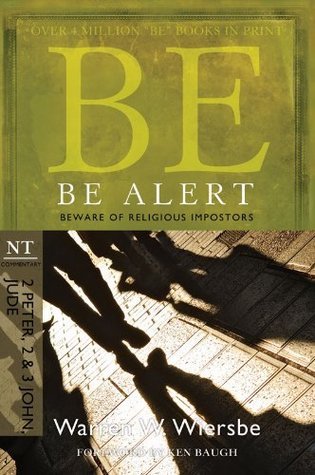
At first glance, it might seem like Warren Wiersbe collected leftover short epistles to review in Be Alert: (2 Peter, 2 & 3 John, Jude); Beware of Religious Imposters. However, as his subtitle indicates, these four books near of the end of the New Testament have a common theme.
Often we go to the Bible for comfort, affirmation, assurance that God loves us and will take care of us. Those motives aren’t wrong: we find all those things in the Bible.
But the Bible’s purpose isn’t just to make us feel warm and cozy. God is truth, and anything that isn’t in line with His Word is falsehood. Satan, as God’s enemy, works seemingly tirelessly to question and pervert what God said. Indeed, his first recorded temptation was to question Eve in the garden of Eden about what God said and then to twist it. Often Satan includes enough truth to hook unsuspecting individuals.
That’s one reason to know God’s truth well (the first being that we learn to know God by learning His truth). Paul warned that “Men will rise up even from your own number and distort the truth to lure the disciples into following them” (Acts 20:30). Peter shared that false teachers will “twist” the Scriptures (“wrest” in the KJV). “The Greek word translated ‘wrest’ means ‘to torture on the rack, to distort and pervert’” (p. 113).
2 Peter, 2 and 3 John, and Jude all share what false teachers do, what motivates them, and what judgement is coming to them.
We’re not to support false teachers in any way, not even allowing them into our homes (2 John 10-11), but we’re to help those who have been influenced by them. “And on some have compassion, making a distinction; but others save with fear, pulling them out of the fire, hating even the garment defiled by the flesh” (Jude 22-23).
While the call to beware of false teachers is meant to help us to be alert and careful, we don’t need to panic or live in fear. 2 Peter opens with the reminder that “His divine power has granted to us all things that pertain to life and godliness, through the knowledge of him who called us to his own glory and excellence, by which he has granted to us his precious and very great promises, so that through them you may become partakers of the divine nature, having escaped from the corruption that is in the world because of sinful desire” (2 Peter 1:3-4) and closes with “You therefore, beloved, knowing this beforehand, take care that you are not carried away with the error of lawless people and lose your own stability. But grow in the grace and knowledge of our Lord and Savior Jesus Christ. To him be the glory both now and to the day of eternity. Amen” (2 Peter 3:17-18).
Likewise, Jude ends his warnings with “But you, beloved, building yourselves up on your most holy faith, praying in the Holy Spirit, keep yourselves in the love of God, looking for the mercy of our Lord Jesus Christ unto eternal life” (verses 20-21). Wiersbe comments, “He did not write, ‘Keep yourselves saved!’ because he had already assured them that they were ‘preserved in Jesus Christ’ (Jude 1). He wrote, ‘Keep yourselves in the love of God.’ Our Lord made a similar statement recounted in John 15: 9: ‘Continue ye in my love’” (p. 191). After several paragraphs on Christian love, he concludes, “We grow in our love for God as we listen to His Word, obey it, and delight in doing what pleases Him. That is how we keep ourselves in God’s love” (p. 192).
Finally, Jude concludes with this wonderful benediction: “Now to Him who is able to keep you from stumbling, And to present you faultless Before the presence of His glory with exceeding joy, To ]God our Savior, Who alone is wise, Be glory and majesty, Dominion and power, Both now and forever. Amen” (verses 24-25).
Here are a few more thoughts Wiersbe shared:
In his first epistle, Peter emphasized the grace of God (1 Peter 5: 12), but in this second letter, his emphasis is on the knowledge of God. The word know or knowledge is used at least thirteen times in this short epistle. The word does not mean a mere intellectual understanding of some truth, though that is included. It means a living participation in the truth in the sense that our Lord used it in John 17: 3: “This is life eternal, that they might know thee the only true God, and Jesus Christ, whom thou hast sent” (italics Wiersbe’s) (p. 19, Kindle version).
God has not only given us all that we need for life and godliness, but He has also given us His Word to enable us to develop this life and godliness. These promises are great because they come from a great God and they lead to a great life. They are precious because their value is beyond calculation. If we lost the Word of God, there would be no way to replace it. Peter must have liked the word precious, for he wrote about the “precious faith” (2 Peter 1: 1; cf. 1 Peter 1: 7), the “precious promises” (2 Peter 1: 4), the “precious blood” (1 Peter 1: 19), the precious stone (1 Peter 2: 4, 6), and the precious Savior (1 Peter 2: 7) (p. 22).
God gives His children all that they need to live godly lives, but His children must apply themselves and be diligent to use the “means of grace” He has provided. Spiritual growth is not automatic. It requires cooperation with God and the application of spiritual diligence and discipline. “Work out your own salvation.… For it is God which worketh in you” (Phil. 2: 12–13) (pp. 22-23).
It is a frightening fact that many people who are now zealous members of cults were at one time attending churches that at least professed to believe the Christian gospel (p. 79).
And with that, I have finished all 50 of Warren Wiersbe’s “Be” commentaries!
In Tending Roses by Lisa Wingate, Kate Bowman drives with her husband and baby son to her grandmother’s Missouri farm a few weeks before Christmas. But this will be no idyllic holiday season.
Kate’s grandmother “had a talent for stirring up unpleasantness, she was an expert on every subject, and she felt the need to control everyone” (p. 16). She acted like a martyr when she didn’t get her way. She was so fussy about her house, Kate often felt she loved it more than her.
Kate’s grandmother has become forgetful and nearly burned the farmhouse down. Kate’s father and aunt are coming for Christmas and planning to move Grandma Rose into a nursing home.
All the family has not been together and has rarely spoken to each other since Kate’s mother died.
So this holiday family reunion has all the makings of a potential war.
Kate and her husband have been elected to go to the farm early, under the guise of an extended visit, to help keep an eye on Grandma and prevent any other fires or disasters til the rest of the family comes. Kare is still on maternity leave due to her son’s heart condition, and her husband works remotely, so they are the perfect candidates.
But worries over the baby’s health, the piles of medical bills, and her assistant taking over her job have Kare distracted.
At first the visit goes about as well as Kate expected. But one day she finds her grandmother’s journal and discovers the hopes, dreams, and trials she experienced as a younger woman. That and getting to know her on an everyday level have Kate questioning her own future as well as the family’s decision about Grandma’s.
There’s naturally a lot of tension at first in the book with all the personality clashes and problems. But I loved the story arc and the slow understanding that developed between Kate and her grandmother.
A secondary story line involves Dell, an impoverished child living nearby in a shack with her ailing grandmother. “Poverty and ignorance were characters we saw on TV, or sometimes passed on the highway while traveling to some vacation hideaway. They were not our neighbors. They did not have faces with soft brown eyes and down-turned mouths that never smiled” (p. 83).
A few sentences that stood out to me:
I felt a little like a wishbone in a tug-of-war (p. 146).
Grandma sensed World War III coming on and stepped in like Switzerland (p. 175).
That’s the problem with people. We’ll starve to death looking over the fence when we’re knee-deep in grass where we are (p. 206).
Years have mellowed my joy in Christmas, as in all things. The packages, the tree, the fire, all carry memories to me—reminders that I am the last. Looking at them, I relive, remember, and regret. And an ache blossoms in my breast that I am no longer young (p. 232).
This had been the hardest year of my life, when all the colors ran outside the lines I had drawn, but also the year when I finally discovered myself (pp. 272-273).
This story is more than a reminder to “stop and smell the roses.” It weaves together themes of family, forgiveness, faith, materialism versus contentment, aging, caring for each other, especially the elderly.
This book is the first in a series of five. I’m looking forward to the rest of the series.
There are times the Bible tells us to overlook offenses.
Hatred stirs up strife, but love covers all offenses (Proverbs 10:12).
Whoever covers an offense seeks love, but he who repeats a matter separates close friends (Proverbs 17:9).
Good sense makes one slow to anger, and it is his glory to overlook an offense (Proverbs 19:11).
Above all, keep loving one another earnestly, since love covers a multitude of sins (1 Peter 4:8).
But other times, we’re told to confront sin.
Whoever rebukes a man will afterward find more favor than he who flatters with his tongue (Proverbs 28:23).
If your brother sins against you, go and tell him his fault, between you and him alone. If he listens to you, you have gained your brother.But if he does not listen, take one or two others along with you, that every charge may be established by the evidence of two or three witnesses.If he refuses to listen to them, tell it to the church. And if he refuses to listen even to the church, let him be to you as a Gentile and a tax collector (Matthew 18:15-17).
My brothers, if anyone among you wanders from the truth and someone brings him back, let him know that whoever brings back a sinner from his wandering will save his soul from death and will cover a multitude of sins (James 5:19-20).
How do you know when to confront someone and when to overlook what they did?
That’s something I have wrestled with most of my adult life. By nature, I tend to avoid confrontation unless I am in a position of authority, such as with my children or a class.
As I have pondered these questions, it seemed confrontation is clearly called for when someone
commits a crime
violates a clear, specific biblical command, like lying or committing adultery
hurts someone else, like an abuser
premeditates any of these things.
On the other end of the scale, we should obviously overlook minor irritations like squeezing the toothpaste tube or putting toilet paper roll on the “wrong” way.
But a vast gray area exists between those extremes.
Once I was talking with a friend who was upset with our pastor. He had preached a strong Mother’s Day message about the value of a mother in the home. He never said a mother shouldn’t work outside the home, but my friend felt that’s what he meant. She felt that she had no choice but to work while mothering. She was so troubled that she was already planning to avoid church the next Mother’s Day.
We moved shortly thereafter, but I was concerned about a larger breach forming between my friend and the pastor. I didn’t think she had sinned, but Hebrews 12:15 warns of a “root of bitterness” which would have caused much grief and more hurt. I don’t remember what I said in the moment, but this concern grew to the point that I wrote my friend a letter, trying to bring understanding and smooth things over. Still feeling uncertain over whether I should say anything, I asked God to let the letter get lost in the mail if it wasn’t His will for it to reach her.
Soon I got a note from my friend saying, “I hope you didn’t send me a bunch of money, because I received an envelope from you with nothing in it.”
Furthermore, the next time we talked, she spoke of the pastor in glowing terms. So no breach had formed at all.
Well—God definitely answered my prayer! But I was also a bit shaken. This was obviously not a time God wanted me to intervene. So how could I know when He did, especially when my bent was to avoid doing so?
How do we navigate the gray areas? I still don’t have all the answers, but these principles come to mind.
Pray much. We can cause further problems if we jump in where we shouldn’t. We need God’s wisdom and guidance.
Be swift to hear, slow to speak (James 1:19). Unless someone is in imminent danger, it’s better to act slowly and cautiously. “The one who gives an answer before he listens — this is foolishness and disgrace for him” (Proverbs 18:3).
Speak from a relationship. An expression of concern will go over much better if there is a previous relationship. Someone who knows me and cares about me has more of a right to point out something wrong than an acquaintance.
Speak the truth in love (Ephesians 4:15). Someone whose blog I have lost track of wrote about a woman in her church who spoke to her rather harshly about dressing immodestly at church. To this younger lady’s credit, she took the woman’s rebuke to heart and agreed with her. But the way it was handled caused unnecessary pain.
Aim for restoration. Most rebuke in Scripture is meant to help turn the person around. We live in such a smack-down culture, we need to remember not to just lob attacks at people. We don’t point out wrong in order to elevate ourselves as “right,” but to help the person see what’s wrong and be motivated to correct it.
Give the benefit of the doubt. For example, if a person seemingly snubbed you at church, consider that maybe they didn’t see you or were preoccupied.
Consider extenuating circumstances. When people are under stress, they say and do things they wouldn’t otherwise. After everything calms down, we might need to discuss how what they said hurt our feelings. But then again, we might write the offense off as uncharacteristic.
If this kind of reaction is a habit, though, I think a discussion is probably necessary. Abusers often follow this pattern of blowing up, then blaming their reaction on the other person.
When you overlook, truly overlook. If we’re not going to speak to someone about their offense, we shouldn’t stew over it.
Don’t be a busybody. A young woman in a former church shared with some of us that an older woman told her that she and her husband shouldn’t wait until he finished school, as they planned, to have children. This same older woman told another young mother that she was having too many children too close together. Though I know this older woman felt she was “helping,” she seems to me to have stepped over the line.
When the young wife told us of this incident and how it hurt her and seemed an unnecessary intrusion, I said, “That sounds like Mrs. X.” It was Mrs. X. Another lady in the group spoke of needing to know how to take Mrs. X. so as not to get feelings hurt. But I have often wondered if someone should have said something to Mrs. X.
Ephesians 4:1-3 says, “I therefore, a prisoner for the Lord, urge you to walk in a manner worthy of the calling to which you have been called, with all humility and gentleness, with patience, bearing with one another in love, eager to maintain the unity of the Spirit in the bond of peace.”
Sometimes love bears with each other in our faults and foibles; sometimes love points out wrong that it may be confessed and forgiven.
Here is some of the thought-provoking writing I found online this week:
The Corner of Sanity. “The Corner of Sanity has ended up being the most graciously extended metaphor for my life as a Mom; I’ve willingly handed over my sleep schedule, my to-do list, and certainly my standards of cleanliness each time a new baby comes along. But from the beginning, I’ve learned the vital importance of holding fast to morning time with God to get me through. Many other priorities can be downgraded or abandoned entirely, but going without time in the Word and in prayer has been akin to spiritual starvation. Trying to love and tend young life while starving is impossible to sustain—at some point, I will just run dry.”
When You Fear Your Best Days Are Behind You. “We notice how our struggles have changed us and fear we may never be able to do anything significant again. We look at how we are now, compare ourselves to how we used to be, and think our most fruitful years are behind us.”
Complaining to God. “In the book of Numbers the people of Israel are judged for moaning and groaning about not having enough food. Then why are there so many Psalms of lament, suggesting that complaining to God is okay?”
How Hannah Found Peace in the Middle of Pain. “Sometimes I’ve told myself, ‘When I get past this, then I’ll quit fretting.’ However, if my peace depends on my circumstances or other people, then peace is fragile and illusive. The story of Hannah in 1 Samuel 1-2 shows sorrow and challenges can either rob our peace or push us toward the Source of peace.”
Proverbs Purpose #4: To Transform People. “He desires nothing less than the transformation of the simple person (‘the youth’) into a wise person (who has ‘prudence’), and of a wise person (‘one who understands’) into a wiser person (one who will ‘increase in learning’).”
Guard Your Heart When Suffering, HT to Challies. “In an effort to pull us away from fellowship with the Lord and our effectiveness in the kingdom of God, Satan is always looking for weak spots to target his assaults on God’s children. His long experience with humans has taught him that we are especially vulnerable in times of physical weakness. This is why he delights in or taking advantage of times of physical suffering.”
What If He’s Faithful? HT to Challies.”I’d like to pose another question when life is hard and you’re fearful of the future. What if He’s faithful? Instead of immediately defaulting to all the potential disasters, what if we take our thoughts captive and force them to settle down in front of the 100% likelihood of who God will be to us no matter how hard life gets?”
He’s Still Working on Me. “As he and I don’t go away by ourselves very often, I had a verrrry hard time with this turn of events. Since I’m a Christian and believe in the sovereignty of God, I knew God could have changed the timing of this sickness or just not allowed it to happen in the first place. But he didn’t. And though it wasn’t a life-threatening illness, I was still less than pleased.”
Clearing Up Confusion About Humility, HT to Challies.”Here’s the simple guideline: To develop humility, don’t put yourself up relative to others, and don’t put others down relative to you. Instead, do the opposite.”
“The only thing that keeps me stable and settled in these days of uncertainty is the absolute dependability of God’s Word.” — Elisabeth Elliot
This first Friday of the month, I echo what Anne of Green Gables said: I am so glad I live in a world where there are Octobers! I’m joining with Susanne and friends at Living to Tell the Story to share some blessings of the week.
1. Safety. I mentioned last week that we were predicted to lose power for a few days during Hurricane Helene. Some people in the area did, but most were fine. Our lights dimmed a couple of times, but, thankfully, didn’t go out. My two sisters in SC were without power for several days but have it back now.
As I mentioned Wednesday, though the storm is over, the ramifications are not. It’s not often that hurricane-level winds and rain make it this far from the coast, but parts of TN, SC, WV, and particularly NC and FL were hit badly and will take years to recover.
2. Helpers. Though some of the photos and footage I’ve seen are horrifying, I’ve also been heartened to see groups and individuals jumping in to help.
3. Fall coolnessand color. We’re still pretty warm in the afternoons, but the evenings have been so nice. And, though this sounds trite in light of what some people have lost, I was really hoping the trees wouldn’t be stripped bare of leaves during the storm. Soaking up the beauty of fall color helps me get through the bleakness of winter. I’m happy to say we have plenty of leaves left that are turning lovely fall shades.
4. Fall decorations. I finally got these put up last weekend. I didn’t take any pictures since the decorations are the same as in years past.
5. Dinner. Last Sunday night, Jason and Mittu came over and made grilled cheese sandwiches and tomato soup from Jim’s tomato bounty. He only planted one package of seeds, and the tomatoes have been small, but they’ve been prolific.












 Stray Thoughts