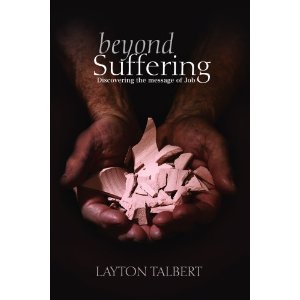
Book Review: Beyond Suffering: Discovering the Message of Job

Layton Talbert was one of our Sunday School teachers at the church we attended the first fourteen years we were married, back before he earned his PhD. In the years since our class with him, I’ve very much enjoyed his articles in Frontline magazine, where he currently serves as a contributing editor. I particularly like his regular “At a Glance” column where he usually gives an overview of a book of the Bible (his column on Ecclesiastes particularly opened that book up for me). Next to one of our former pastors, Dr. Mark Minnick, there is no one whose exegesis and teaching I trust more (though no one is infallible, of course). So when our current pastor began preaching through the book of Job and recommended Dr. Talbert’s book, Beyond Suffering: Discovering the Message of Job, I didn’t need much convincing to get it. In addition, I know personally many of the people he mentions in the book. I trust, however, that even though this prior knowledge inclined me positively toward the book even before I got it, it didn’t cloud my perspective.

Dr. Talbert has attempted (successfully, I think) to write the book on two levels: the main text is easily readable for most any layperson, but the end notes are helpful for more experienced theologians (and for others who want to delve into them.) Though probably no one loves end notes, I can understand that having those notes scattered throughout the book as footnotes would make the text look cluttered and daunting to some.

Dr. Talbert begins by acknowledging that the book of Job is both long and difficult, especially the discourses between Job and his friends, but he reminds us “the Holy Spirit does not waste space” (p. 9) and even these discourses are valuable to us. He offers several helpful suggestions for reading Job, explores the theme of the book (suggesting that suffering is the catalyst rather than the main theme), and plunges right into commentary, not verse by verse, but section by section.

I spent a few hours this week compiling a list of the quotes I marked as well as pages numbers of sections that were particularly instructive to me but were too long to quote, both as a way of review and a way to have some of them handy. I ended up with five pages. I can’t share all of that here, but I’ll try to share some of the most poignant.

Satan’s accusation that Job is “pious only for pay” undermines God as well as Job because if it is so, that means God is content with that arrangement (p. 40).

Suffering can cause us to question either God’s omnipotence or His love: either He wasn’t able to stop the suffering or He was able but allowed it because He’s not completely good. “Since both options are expressly unbiblical, we are faced with a choice: (1) Ignore what the Bible says about God and reevaluate Him on the basis of our limited experience, knowledge, and understanding or (2) accept God’s self-description and reevaluate our circumstances in the light of the Bible’s depiction of realty.” P. 57).

“It is not merely the affliction itself that Job finds so hard to bear; it is the sudden and inexplicable change in God’s posture toward him that the circumstances seem to signal (p. 85).

“Expressions of grief may not fit some people’s sanitized ideas of what a Christian ‘ought’ to think and feel. But when catastrophe strikes like lightning, ripping ragged holes in the lives of previously serene saints, God has preserved a record of the grief of godly saints for our consolation. Anger is not unbelief and questions are not sinful; they are human and shared by some of the best of God’s people” (p. 90).

You may have wondered, as I have, if Job “sinned not” in his initial reaction to his suffering at the end of chapter one, yet repents in chapter 42:1-6, what happened in between that he had to repent of? Part of the answer is this: “If Job justifies himself at the expense of God’s righteousness (as God says he did – Job 40:8), then he has virtually, if unintentionally, made himself more righteous than God….Whenever we think that God is being unfair, or that we would never do some of the things God does, we make ourselves more righteous than God” (p. 98).

On the difficulty of 19:25-27: “We must be content to enter the passage with no prejudgment as to what we will bring out of it. That’s the only way to insure that we derive our theology out of the text (exegesis) rather than read our theology into a text (eisegesis)” (p. 121). (Yes! If only all Bible teachers and preachers would get this. bh)

“[God] censures Job for defending his own righteousness over against and at the expense of God’s righteousness (40:8)” (p. 159).

“For Job to be browbeaten into ‘confessing’ uncommitted sin with the assurance that his fortunes will be restored is to trifle with his soul, to confuse his conscience, and to redirect everyone’s attention to materialism as the motivation and demonstration of one’s spiritual condition” (p. 130).

“The three friends argue that Job’s suffering is consistent with God’s justice because [Job] has (obviously) sinned. Job argues that his suffering is contrary to God’s justice because he has not sinned. Elihu offers a revolutionary third perspective: suffering is not necessarily linked to God’s justice at all. God’s justice remains intact, therefore, and may not be impugned (34:12). The issue is man’s justice in responding to inexplicable suffering sent or allowed by a just God. That suffering may not be explicitly ‘deserved’ does not render the suffering itself unjust, nor does it imply that God is unjust for permitting it” (p. 170).

“Job is not rebuked for asking why. He is rebuked for an honest question that has soured into a complaint laced with insinuation. God reprimands Job for sins of speech and attitude subsequent to his sufferings – speech and attitudes that reflect wrongly on the character of God” (p. 202).

If you’ve ever wondered, as I have, what God’s discussion of animals has to do with Job’s suffering, a part of the answer is: “By belaboring this point with Job, God unveils one of His divine qualities. The Lord is powerful and majestic and wise beyond man’s comprehension, but He is also compassionate…even towards beasts. He talks as if He has intimate knowledge of their nature and needs because He does. That’s the point” (p. 206).

“We may not always see the signs of God’s goodness in our immediate circumstances, but what we see is not all there is. That is a significant part of God’s answer to Job” (p. 206).

“The furnace of affliction may be transformed into a holy of holies, a sanctuary filled with the presence of the God Whose path is in the storm” (p. 235).

“Believe Him implicitly, with or without proof, because He has spoken. Trust Him submissively, with or without understanding, because He is sovereign and good. Worship Him reverently, with or without reward, because He is worthy… Wait for Him patiently, with or without reprieve, because He will come.” (p. 241).

“God’s revelation furnishes ample evidence to justify faith but also ample opportunity to exercise faith” (p. 256).

I was also happy to see Job vindicated from something I heard a preacher say years ago, that Job’s confession in 3:25 that “the thing which I greatly feared is come upon me, and that which I was afraid of is come unto me” indicated that he had a “life-dominating sin” of fearfulness. But God repeatedly says that Job is “a perfect and an upright man, one that feareth God, and escheweth evil” (1:8; 2:3) and that his trials came upon him “without cause” (2:3).

There are also insightful discussions on the purposes for suffering, possible reasons why God didn’t tell Job what was behind his suffering, a section on helping the hurting (an excerpt from that is here), and even an appendix on leviathan, for those who might want more information about what that creature mentioned by God might have been.

This is an immensely helpful book, both for those who have wrestled with suffering and those who have wrestled with their study of the book of Job. Those of you who read here regularly know that it is rare that I can recommend a book completely without reservation: this is one I can.

(This review will also be linked to Semicolon‘s Saturday Review of Books.)

Book Reviews: Two Mysteries

I read two mysteries this past summer but have not discussed them before now because they were gifts for my “secret sister” at church, and naturally I needed to keep them secret til after I let her know who I was. 🙂 She likes mysteries, so I checked out a couple to pass on to her.

A Penny For Your Thoughts by Mindy Starns Clark is the first in her Million Dollar Mystery series. Callie Webber had previously been an investigator but opted later to use her skills to check out charities her elusive but wealthy and well-connected boss wanted to contribute to. When her newest client, a friend of her boss, is murdered, her boss asks her to investigate the death as a personal favor. As Callie uncovers family and business secrets, soon her own life is in danger. I stewed a bit over not liking the murderer’s reasoning until I realized that, duh, any murderer is going to be a little warped in his or her thinking. I liked this book a lot, and though I don’t gravitate to mysteries generally, I am tempted to read others in this series mainly because I think I know who Callie’s boss might be (she knows his name but has never met him) and I want to see if I am right. 🙂


A Penny For Your Thoughts
is Christian fiction; The Map In the Attic by Jolyn Sharp is not, but it is a very clean story. Annie Dawson is cleaning out her grandmother’s attic (I don’t know if the similarity in name is purposeful between Annie of Grey Gables and Anne of Green Gables, but the similarity is only in name) when she finds an old piece of needlework stuffed in a cookie jar in a box marked for a yard sale. She shows the piece to her fellow Hook and Needle Club members, and someone realizes it is not abstract art but a detailed map. The ladies then want to know, of course, a map of what. Evidently someone else knows or wants to know, too, because someone tries to steal the map — more than once.

Overall it was a pretty interesting book. It ended rather abruptly, suggesting it is leading to another book in the series. After a bit of research I discovered this book (which I had received in a book swap) is evidently part of a series in a book club, which I have no desire to join, but some of the books are available used in places like Amazon.

(This review will also be linked to Semicolon‘s Saturday Review of Books.)

Communication in Marriage

E-Mom at Chrysalis hosts an occasional Marriage Monday, inviting bloggers to write on a certain topic related to marriage. When she announced the topic this month was communication, I didn’t think I’d have anything to say besides, “Yes, do it.” 🙂 But throughout the morning thoughts have been coming to mind about communication, so I thought I’d share a few gleaned from 30+ years of marriage. Forgive me for not having this as carefully crafted and polished as it would have been if I’d started when the topic was first announced. 🙂

1. Do communicate. Sometimes life gets so busy it seems you just pass each other on the way to getting other things done, but make time to talk. I wouldn’t necessarily schedule a set weekly time to talk: that might work for some, but for us that would be awkward and stifling. But lingering to chat a bit after dinner instead of dashing off to clean up the kitchen, etc., allows some time to touch base.

2. It’s okay to be comfortable with silence sometimes. Women in general tend to talk more than men. One statistic I saw said women use approximately three times more words a day than men. And I heard one speaker say that many men have used up all their words by the time they get home from work. A wise husband will reserve some for his wife, but a wise wife will understand that when a husband sits quietly it may not mean anything is wrong. He may just be resting his brain. Over time as you get to know each other’s personalities more, you’ll probably be able to sense when silence might indicate something is wrong.

3. Try not to communicate in anger. That’s usually when harsher and more hurtful words are used. If possible, wait until emotions are under control. On the other hand, if it is really important, don’t let it fester: try to find a time to talk about it calmly (pray beforehand for wisdom and self-control. “The heart of the righteous studieth to answer” Proverbs 15:28).

4. Avoid “never” and “always.” “You never pick up your socks!” “You always interrupt me!” Statements like that are probably not completely true, and they engender defensiveness. Just calmly state whatever the problem is and request the change you want.

5. Don’t try to talk to him when he is distracted. Whether he is paying the bills or watching a football game, those are probably not the times to ask him a question or tell him something important. My husband doesn’t watch football, but when he is involved in a project he is very focused until it’s done or at least until he gets to a stopping place. I’ve spoken to him during those times and even gotten an answer, but later he doesn’t remember any of it. Instead of getting frustrated over it, just try to make sure you have his attention and he’s not distracted before saying something important. (After all, aren’t we the same way? We can multitask talking with some things, but other times we’d really like to finish what we’re doing first.)

6. Don’t assume. We can cause so many problems when we do that. Once during our early marriage, I was taking items to donate somewhere, and my husband asked me to get a statement from the place so we could deduct the donation on our income taxes. It’s not a problem now, but at the time I felt extremely awkward asking for it, and I felt like we were supposed to give “not letting our left hand know what the right is doing,” and this would be a violation of that. I stewed over it until we finally did talk about it, and my husband explained that he didn’t want to the statement as a means to take credit for what we had given: he just didn’t want to pay a penny more in taxes than necessary. Similarly, once my son and daughter-in-law joked about digging coins out of the couch for a date (Don’t we all remember early married days like that?), and so my husband saved his pocket change for several weeks and then gave it to them for a date night. At first my daughter-in-law thought the change was a subtle hint that they should be using the laundromat instead of washing laundry at our house. We laughed about it, but some misunderstandings based on assumptions can cause serious problems, especially if we stew over it rather than saying anything.

7. Speak to him with respect. This should probably be #1.  Especially if you’re dealing with a perceived problem, don’t lash out. Don’t talk to him like he is one of the children. Think of how you carefully you would word things if you were talking to your boss, your pastor, or someone you highly respected. You know what? You’re supposed to respect your husband like that. Even more than that. (Ephesians 5:33).

8. You don’t have to say everything in your head. I’m not talking about keeping secrets, but there are two aspects of this. First, I tend to want to tell every little detail of a story or situation (maybe it’s part of having three times more words that need an outlet, I don’t know), but it can be incredibly boring to listen to (or read. I am striving for conciseness, but it is not my natural bent.)  I know because I feel that way when people are telling  a very long story with a lot of detail that isn’t really needed. When I see eyes starting to glaze over, it’s a reminder to get to the point and leave out extraneous detail.

Secondly, you don’t have to point out every little fault or flaw. How would you feel if he did that to you? Love covers a “multitude of sins” (I Peter 4:8). We all have our “besetting sins” that make us not the easiest person to live with.

9. Be careful about teasing. This is subjective and varies from person to person, but I’ve heard some couples say things to each other “in fun” that would have devasted me. You should never make fun of him, to him or to anyone else (that goes back to the respect issue), but be careful about little teasing barbs and sarcasm as well.

10. Attack the problem, not the person.

11. Remember every Scriptural instruction about the use of our words applies to marriage, too. It’s easiest to drop our guard with those closest to us when those are the ones with whom are words should be most carefully guarded. There are too many verses to list here, but a good topical study would be to look up “words,” “speak,” “tongue,” and related words in a concordance or Bible search program. If it seems too much to look through the whole Bible, just look through Proverbs: there is enough there for us to work on for a long time. But here are just a few:

There is that speaketh like the piercings of a sword: but the tongue of the wise is health. Proverbs 12:18.

Let your speech be always with grace, seasoned with salt. Colossians 4:5b

Let no corrupt communication proceed out of your mouth, but that which is good to the use of edifying, that it may minister grace unto the hearers.  And grieve not the holy Spirit of God, whereby ye are sealed unto the day of redemption. Ephesians 4:29-30.

Pleasant words are as an honeycomb, sweet to the soul, and health to the bones. Proverbs 16:24.

The tongue of the wise useth knowledge aright: but the mouth of fools poureth out foolishness. Proverbs 15:2.

I’m sure I am forgetting some great principles in communication in marriage. Can you think of any others?

This post will be also linked to “Works For Me Wednesday,” where you can find a plethora of helpful hints each week at We Are THAT family on Wednesdays, as well as  Women Living Well.

The Week In Words

”"

Welcome to The Week In Words, where we share quotes from the last week’s reading. If something you read this past week  inspired you, caused you to laugh, cry, think, dream, or just resonated with you in some way, please share it with us, attributing it to its source, which can be a book, newspaper, blog, Facebook — anything that you read. More information is here.

Here are a couple that caught my eye this week:

From a friend’s Facebook:

“God delights to increase the faith of his children. We ought, instead of wanting no trials before victory, no exercise for patience, to be willing to take them from God’s hand as a means. Trials, obstacles, difficulties, and sometimes defeats, are the very food of faith.” ~ George Muller

I’m guilty of wanting more faith without wanting the situations that help to develop it. But that’s kind of like wanting to be fit without exercising.

This was at the beginning of a chapter in Goforth of China:

But Thou art making me, I thank Thee, sire.
What Thou hast done and doest Thou know’st well.
And I will help Thee; gently in Thy fire
I will lie burning; on Thy potter’s wheel
I will whirl patient, though my brain should reel.
Thy grace shall be enough the grief to quell,
And growing strength perfect through weakness dire.
~ George MacDonald

That’s not how I naturally feel, but may He give me grace to “whirl patient” in the Potter’s fire. Sometimes after a few trials in life we can tend to think, “OK, I’ve had my share, that should be it.” But as long as we live we’ll need continued shaping.

If you’ve read anything that particularly spoke to you that you’d like to share, please either list it in the comments below or write a post on your blog and then put the link to that post (not your general blog link) in Mr. Linky below. I do ask that only family-friendly quotes be included.

I hope you’ll visit some of the other participants as well and glean some great thoughts to ponder. And don’t forget to leave a comment here, even if you don’t have any quotes to share! 🙂

Assorted thoughts on the anniversary of 9/11

  • “Now, we have inscribed a new memory alongside those others. It’s a memory of tragedy and shock, of loss and mourning. But not only of loss and mourning. It’s also a memory of bravery and self-sacrifice, and the love that lays down its life for a friend–even a friend whose name it never knew. “ –  President George W. Bush, December 11, 2001
  • “For thou hast been a strength to the poor, a strength to the needy in his distress, a refuge from the storm, a shadow from the heat, when the blast of the terrible ones is as a storm against the wall.” Isaiah 25:4
  • I don’t know how one defends against a plane flying at you. I believe in a strong military, but “The horse is prepared against the day of battle: but safety is of the LORD.” Proverbs 21:31.
  • Those who saw 9/11 only as an act of judgment and thought they knew whose sin “caused” it need to remember Luke 13:1-5: “There were present at that season some that told him of the Galilaeans, whose blood Pilate had mingled with their sacrifices. And Jesus answering said unto them, Suppose ye that these Galilaeans were sinners above all the Galilaeans, because they suffered such things? I tell you, Nay: but, except ye repent, ye shall all likewise perish. Or those eighteen, upon whom the tower in Siloam fell, and slew them, think ye that they were sinners above all men that dwelt in Jerusalem?I tell you, Nay: but, except ye repent, ye shall all likewise perish.”
  • I’m grateful people turn to God in an hour of need: I just wish they realized they need Him every hour.

Laudable Linkage and Videos

I found a lot of great reading this week. Here’s some of it:

How to Get the Most Out of Your Pastor’s Preaching. One quote: “If your heart is humble, your focus won’t be on evaluating the message or how it’s delivered; you will let the message evaluate you.” Ouch.

Discernment and Sexual Predators. Sad that this is even needed, but this is highly valuable advice for young girls and women to watch our for sexual predators, even in the church. Quote: “[We] puff up the minds of girls with princess mythologies but we don’t (often) equip them to recognize that Prince Charming needs to have some character, not just sweet talk.”

Help for Fighting Lust: Recognizing Flattery.

There Never Was Such Another. “Touching description of Charles Hodge with his fifty-one year-old dying wife Sarah.”

Janet shared a video of a chrysalis forming. Fascinating! Her family has quite the monarch butterfly nursery going, especially nice since the area where she got the caterpillars has been flooded recently.

Is Living With Illness Choosing to Give In? Excellent article about living with chronic illness.

Projecting Poverty Where It Doesn’t Exist by Steve Saint. Wise and balanced presentation.

The Most Relaxing Classical Music in the World is on sale in mp3 format for 99 cents, but I don’t know for how long, HT to Lisa.

The Mystery of Motivation.

Actor Peter Jacobson lends his aid in raising money for Transverse Myelitis, specifically for the James T. Lubin Fellowship Fund.

On the crafty side of things:

Button Art on the Cheap.

Button Heart Canvas. Love it!

Penn Gillette of Penn and Teller tells how, as an atheist, he once received a Bible portion from an apparently very gracious man. Thought this was a great example of how to engage someone, especially someone whom you think will disagree with you. But I also though some of Gillette’s observations were interesting, especially as an atheist: “If you believe that there’s a heaven and hell and that people could be going to hell or not getting eternal life or whatever, and you think it’s not really worth telling them this because it would make it socially awkward…how much do you have to hate somebody to believe that everlasting life is possible and not tell them about it?” HT to Stuff Christians Like.

Testimony of a pilot who was scheduled to fly Flight 11 on 9/11 but was bumped:

Friday’s Fave Five

Welcome to Friday’s Fave Five, hosted by Susanne at Living to Tell the Story, in which we can share five of our favorite things from the last week. This has been a wonderful exercise in looking for and appreciating the good things God blesses us with. Click on the button to learn more, then go to Susanne’s to read others’ faves and link up your own.

I missed last week due to a quick out of town trip. Here are a few of my faves from the past couple of weeks:

1. More presents. I had mentioned my dear hubby snagged a good deal on an HP TouchPad for my birthday: he went on to buy me this case for it…trimmed in pink!

I used it when we went away last weekend to keep the TouchPad from getting banged up in the suitcase.

He also got me a dock thingy (dontcha love my technological expertise? 🙂 ) in which the TouchPad rests nearly upright while still charging the battery. I’ve got it on the kitchen counter and I’m loving the “Shuffle” mode to play the CDs I loaded onto it. That feature is way-old news for those of you with iPods and such, but this is the first time I’ve used it. It’s like listening to a radio without commercials! And it’s bringing up songs I hadn’t listened to in a while. Love it!

2. Coolness. The temperatures have been really pleasant this week, such a relief from the heat but not too chilly yet. Some leaves are even starting to change — I don’t know if we’re in for an early fall. Traditionally we’ll usually have some more hot days before fall fully arrives. But this has been a lovely week temperature-wise.

3. Wraps. I had one for lunch last week and one at a restaurant a while back while traveling. They make for a refreshing, not too heavy meal. At home I usually have one with instant ramen noodle cup-of-soups — maybe not the healthiest thing on the planet, but every now and then it really hits the spot.

4. Nice people at counters. The lady at the hotel counter where we stayed last weekend was just the perfect blend of niceness — friendly but not overly so, pleasant but not syrupy sweet. It really is refreshing to have someone like that help you rather than someone who acts like they’d rather be somewhere else or could care less if you’re there.

5. A day off. We don’t “celebrate” Labor Day per se, but we do like the day off. No major plans, just puttered around the house, took a really nice nap to the sound of gently falling rain, and got barbecue from a local restaurant. A nice day after a super-busy weekend.

There — I worked in all of the faves I had jotted down without going over five. 🙂

But here is a little bonus I saw in a Victorian Trading Company catalog: I don’t wear boots and these are too expensive, but they are so cute:

Happy Friday!

Rambles…

I don’t know if anyone reads this type of post, but I’m just rambling about what’s going on in our lives lately…

Last weekend we spent a few days at our old house in SC to get it ready to put on the market. We hadn’t put it on the market yet because the market was so sluggish we felt we’d lose money on it and because about half a dozen houses were up for sale on our street (which might make a potential buyer wonder what’s wrong with the area). Jim’s company has been helping with the old house payments as part of his relocation package, but that’s coming to an end before long, so we need to get the ball rolling. If we can’t sell it in a reasonable time frame, we’ll look into renting it. Jim already looked into a leasing company, which would help since we’re in another state, but I’d really rather be out from under the responsibility completely.

Jim took off a few days and went down on Thursday; Jesse and I went after school got out on Friday. I don’t think I had been back to the house since Jeremy moved a year ago. Jason and Mittu did some work on it while they lived there, and Jim and Jesse took a few excursions over the summer to paint and do minor repairs. So it was good to see those.I certainly don’t miss those stairs, though.

My main order of business was cleaning: mopping all the rooms that didn’t have carpet, wiping out cabinets, dusting windowsills, vacuuming, cleaning up the stove and counters, making runs to W-Mart, etc. It looks a lot better, but it’s discouraging, because the more you do the more you see needs to be done, but at some point you just run out of time and energy. But we got it to the place where the realtor could take decent pictures.

We also took everything we had left in the attic (Jim and Jesse, actually, did that) and a heap of things Jason and Mittu had left and sorted through what to keep, trash, or donate. I finally let go of a number of toys I had held on to for grandkids some day. Funny how I had more of a hard time letting go of some of the toys than the kids did. But I tried to look at it realistically. When mine were little, my mother-in-law kept a box of toys for the kids to play with at her house, and they were all old, faded, labels torn off, etc., and the kids just weren’t motivated to play with them even though they “worked.” So I tried to look at things through that lens, and it wasn’t necessarily easier to let them go emotionally, but it did help me to be more practical.

I also had one box of the kids’ work from our four years of home schooling and a couple from elementary school years. It was fun to sort through those. Though there is a part of me that wants to hang on to all of that, I decided not to keep rote stuff like spelling tests and math exercises and workbook sheets, but rather just the things that showed some of their personality and creativity. I’m looking forward to going through the papers I kept more carefully.

Jesse got to go for a few hours to a youth activity our old church was having. He tries to touch base with friends whenever we’re there, and he missed a couple he really wanted to see, but I’m glad he got to do that, at least.

While Jim was there alone he just slept at the house — we have one couch and love seat still there. But when Jesse and I came down we all stayed at a hotel. Jim went back to the house early Sat. morning to get started, while Jesse and I finished getting ready and packed up. I had two dresses on hangers in the closet and laid them on the end of the bed so I’d be sure to see them — and somehow I missed them, even though I took another pass through the room to make sure we had everything. 🙄 I drive myself crazy with double and triple checking things, and still miss or forget things. Sigh. Thankfully the hotel found them and sent them to us, though it cost about the price of one of the dresses to do so!

We ended up getting back here about 11 p.m. Saturday night, exhausted. I had thought we might stay for the Sunday morning service at our old church, but Jim wanted to get back. I was dragging through Sunday, and though I don’t usually like to get meals out for Sunday dinner, I asked if we could this time. We brought home Papa Murphy’s pizza. I did get a good nap in the afternoon.

Our Labor Day was just a low key day. Jim and Jesse unloaded some of the stuff we brought back, cleaned out the cars, I did laundry and such, Jim and I took a nap in the afternoon. We had some much needed rain — no thunderstorms or heavy pouring, just gentle steady rain that was very pleasant to fall asleep to.

I’m still working on the best way to schedule my time since school started back, mainly struggling with where to fit the exercise in. I like to do it before showering, but during the school year I usually shower first thing. So I’ve been trying different things — still haven’t found an ideal situation, but I’m still keeping up with it. I don’t want to lose what ability I’ve worked up to, even though some days I exercise through gritted teeth because I don’t want to do it. But usually by the time I’m done I’m glad I did.

That’s probably way more than enough rambling for one day!

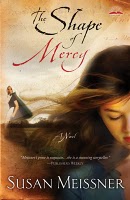
Book Review: The Shape of Mercy

I read Susan Meissner’s Lady in Waiting last year and subsequently wanted to read more of her books. So I recently picked up The Shape of Mercy which was published in 2008, and I remembered several bloggers mentioning it and liking it, so I decided to give it a try.

In The Shape of Mercy, Lauren Durough comes from a family of wealth and privilege, but wants to forge her own path, her own destiny. She defies tradition by going to a different college than expected and living in the dorms, and she takes a further step by looking for a job to take care of living expenses rather than depend on her father’s stipend. That leads her to an eighty-three year old well-to-do retired librarian, Abigail, who is looking for someone to transcribe a diary that was written by one of her ancestors, named Mercy, who had been arrested and convicted during the Salem witch trials.

Lauren learns that misjudgment and jumping to conclusions did not die in 1692, but she is especially startled to learn the extent those elements rule her own heart.

Overall I thought this was a marvelous, multi-layered book. Susan brilliantly wove together the diary entries with the contemporary story, and I was drawn in to Lauren’s growth and realizations about herself as well as her curiosity about Abigail’s life. There were times when I didn’t want to put the book down, times I was almost in tears for different characters.

This would be one of those five-star, two thumbs up reviews except for just a couple of things.

Major Spoiler Alert:

It doesn’t bother me so much that one character commits suicide — I think such a thing is always a tragedy, but I can accept it as part of the plot because such does happen in the real world. What does bother me, though, is that is is regarded by the other characters as something heroic, sacrificial, and done out of love when biblically it is never regarded that way. “Thou shalt not kill” certainly applies to one’s own life as well as others. There is a difference between taking a bullet for someone and aiming that bullet at yourself. Suicide is the ultimate taking of your own life into your own hands and the ultimate lack of faith in God to handle one’s life circumstances as He sees fit. There were Bible people who wanted to die, but they left the actual process to the Lord. I don’t want to turn this into a treatise on suicide, but felt I must explain why the response in this book disturbed me.

Secondly, at one point the author refers to “that bit of the divine still smoldering in us.” If she means that we’re made in God’s image and some of that can still be seen even though we’re marred by the fall of man and our own personal sin, I can agree with that. If she means some spark of divinity resides in every human being, I can’t agree with that.

But other than those two elements, I really enjoyed the book and I do plan on reading more of Meissner.

Something neat I just found earlier today is a blog where Meissner continued the stories of some of the characters as blog posts here. I poked around just a bit today and I am looking forward to reading a bit more.

(This review will also be linked to Semicolon‘s Saturday Review of Books.)

Book Review: Peace Like a River

I had seen many bloggers refer to Peace Like a River by Leif Enger years ago, and I put the title on my TBR list, but only got to it the last couple of weeks: my family wanted ideas for my birthday, and I scanned my list of TBR titles and suggested this one and a couple of others.

The story is told by eleven-year-old Reuben Land, who almost didn’t survive his birth as a severely asthmatic child but was brought back after twelve minutes without breathing by his father calmly saying, “Reuben Land, in the name of the living God I am telling you to breathe.”

Thus begins a series of miracles at the hands of Reuben’s father. After many of them Reuben says, “Make of that what you will.” Honestly, I don’t know what to make of that, and that may be why I hadn’t sought out this title earlier, but figuring out the author’s theology of such isn’t really necessary to enjoying the story. Reuben narrates the book as a witness: “Someone to declare, Here’s what I saw. Here’s how it went. Make of it what you will.”

In Reuben’s eleventh year, his brother Davy kills two bullies, somewhat but not entirely in self-defense, and escapes jail when he seems sure to be convicted (not much of a serious spoiler there as the back of the book refers to Reuben’s “outlaw older brother who has been controversially charged with murder.”) There follows a strange dichotomy of heart for some of the characters and for me as a reader as well: you find yourself hoping Davy is okay, yet knowing that he has to face justice, and grieving that he seems to have no regrets or repentance. After a time Reuben, his nine-year-old sister Swede, and their father go after Davy to try to find him, only to discover after a time that the FBI is following them. Throughout it all the character of each unfolds through the events, especially that of Reuben’s father.

Leif Enger is a wonderful storyteller. The book feels as if you’re sitting across from him in rockers on the front porch, listening to him tell a story. One reviewer’s blurb on the back of the book says “his novel moves in a current that can be poetic and slow or as tumultuous as whitewater rapids,” an apt description. He’s no mean poet as well, as through Swede he shares segments of an epic Western poem (though it didn’t seem like this could come from the hand of a nine-year-old girl, precocious as she was). I also liked that the chapter titles were significant: this was the first book in a long time in which I paid attention to the titles and at the end of each chapter looked back and thought about the title designations. And at the end of the book, when I turned it over and looked again at the front cover, I realized with a start who the shadowy horseback rider was, and nearly came to tears.

Some of Enger’s phrases stood out to me as well: a description of a particular women who “resembled an opportunity missed by Rembrandt”: “Fair is whatever God wants to do”; a reference to something people say “as if they’ve been educated from greeting cards.”

There were humorous parts as well: in one incident when Reuben and another girl end up in the church kitchen during a long service and start to make pancakes, the smell floats up to the sanctuary, influencing one man to “prophesy” about heavenly smells at the Lord’s banquet table.

I probably should say for some readers that though there is a description of a charismatic service, I am not charismatic and not promoting that kind of thing, but I am not going to dissect all of that. One doesn’t have to agree with every little point in a book to benefit from it.

I did enjoy the book and it had me pondering for a while afterward. In a search earlier today I came across this interview which shed more light both on the author and the book. I am definitely planning to put his next one, So Brave, Young, and Handsome on my TBR list.

(This review will also be linked to Semicolon‘s Saturday Review of Books.)