Flashback Friday: Extracurriculars

Mocha With Linda hosts a weekly meme called Flashback Friday. She’ll post a question every Thursday, and then Friday we can link our answers up on her site. You can visit her site for more Flashbacks.

The question for this week is:

What type of extra-curricular school activities did you participate in during your school days? Clubs? Spelling bees or other contests? Cheerleader or drill team? Sports? Journalism? Choir or theater? Were there any memorable events related to those? Did you receive any awards? Were football games a big deal at your school? Did you usually attend – and was it with a group or as a date? What was Homecoming like?

My first thought was that I didn’t participate in many extra-curricular activities, but after thinking about it, I realized I did have a few.

In my childhood, it was unheard of for kids to have so many things going on with music lessons and sports all the time, etc. It’s hard as a parent to know where the balance should be between giving them opportunities to grow, develop, and learn and not running everybody ragged. I think there needs to be some carefree downtime for just playing in a child’s life, for lying in the grass looking up at the clouds and imagining what the shapes are.

But back to the question:

Money was scarce when I was growing up, and that may have had a lot to do with the lack of extra-curricular activities. I do remember someone coming to our school in an assembly to talk about violin lessons, and I so wanted to take them, but I just assumed we wouldn’t have the money for such, so I didn’t even bring it up to my parents. That’s been one of the regrets of my life. I took one semester of piano in college and enjoyed it, but concluded I just didn’t have time for it — it took me five years to complete a four-year course as it was. I thought about taking some kind of music lessons as an adult, because there are times I’d just love to express myself in that way, but the amount of time it would take to get to that level, to be able to play well without getting frustrated, is more than I want to spend right now — I have other, higher interests. So I just listen to great music. πŸ™‚

I was not athletically inclined at all, and P. E. was always my valley of humiliation, so I never took part in any outside sports, though that may have actually helped me if I had. But, except for Little League baseball and swimming lessons, I don’t remember ever even hearing about extracurricular sports for kids at all.

I was in a couple of spelling bees in elementary school and won for my class and got up to the level where the winners from each grade participated in a spelling bee in front of the whole school, but I bombed out both times. One year I lost on the word “chocolate,” of all things. Maybe that is why I am so obsessed with it now. πŸ™‚

The biggest thing in my elementary years was Girl Scouts. My mother’s father was very big into the Boy Scouts organization — I don’t remember at what level of leadership, but I do remember attending some kind of big jubilee or something like that that they had several years. So his participation may have influenced my parents towards Scouts. I don’t remember much about it except my first camping experiences and making a poncho with pom-pom fringe for the sewing badge — one of our leaders invited a bunch of us over to use her sewing machine, and we all watched Gilligan’s Island, I think, while taking turns with the sewing machine. I remember really enjoying Scouts as a whole.

The elementary school I attended let kids do book reports outside of class requirements and gave out awards at the end of the year assembly for them — I can’t remember if the awards were for those who did the most, or if increments of ten won certain ribbons or certificates (i.e., you read 10, you got one award, a different one of you read 20, etc.). But I do remember getting some kind of award for that several years in a row.

I mentioned in an earlier Flashback that my family did not attend church regularly, but I do remember being in one church play. I was in a group of girls who were supposed to represent women mourning — I don’t remember which Bible story we were reenacting. But I do remember a group of us with what you think of as the Biblical….scarves, or whatever you call them, over our heads, and then we were holding up more fabric over our faces, like veils, but not covering our eyes, so we could see. We were supposed to walk in like that and making sounds like moaning or loud crying. But I couldn’t stop laughing. It was a good thing we had something to cover up our faces! Other people might have seen me with a red face and thought I was doing a good job, but my mom knew I was laughing just by looking at me as I passed by.

The Baptist Church of a friend of mine had some kind of program for girls — I don’t remember much about it except that the different levels you reached were marked by different members of royalty, with the highest being princess. I remember feeling sad that our attendance was so sporadic that I’d never make those top levels, but otherwise I enjoyed it.

I attended a pretty big high school for 9th and 10th grades, and I don’t remember participating in much there. But I went to a small Christian school in 11th and 12th grades, and there got involved with yearbook, student council, and I don’t remember what all else. I was in choir, but everyone was — it was a class and not really an “extra.” But I liked it. I tried out for cheerleader once (insert hysterically laughing smiley). I attended the occasional football game at the big school, but my best friend was in the band, so I didn’t really have anyone to go with. I don’t remember what sports the small high school had. I don’t think we had a Homecoming there.

In college I was in some kind of “Future Teacher’s” club, a club for the Home Ec Association, and a fledgling writing club that was just starting up my last year. My university always did a couple of Shakespearean plays during the year, and I sometimes wished I had tried out as an extra in one of those, but there just never seemed to be time. As I mentioned, it took me five years to get through just with classes and work — I don’t know how some people were able to do everything they did!
Sexuality in Christian Fiction

One of the issues that keeps many Christian people from reading a lot of modern fiction is the proliferation of explicit sexual scenes. Yet now I seem to be finding more sexuality in Christian fiction — not full-fledged descriptions, but more of a window into that activity than I really want to read and imagine.

It’s not that I and Christians in general don’t like sex. It was God’s idea, after all: He invented it not only for procreation but also for enjoyment, within the parameters for which He created it (within marriage, to one spouse, between a man and woman.) Enjoyed as He meant it, it is a wonderful expression of love and intimacy.

But as Quilly once so aptly put it, I don’t enjoy sex as a spectator sport. I think it is meant to be private.

I do understand that some Christian authors write sexual scenes to show show how a person could easily get into trouble sexually without meaning to. And I understand that some want to portray sexuality in a normal, healthy, marital way, reasoning that, 1) it is okay to do so since God created it, and 2) if all sexuality in literature is the “wrong” variety (illicit, adulterous, etc.), then that gives readers a warped view of what it is meant to be.

And Song of Solomon is in the Bible after all, as well as graphic verses like Proverbs 5:19. And I am glad they are: they helped immensely when, as a young wife, I had to change my mind set from thinking of sex as something I needed to avoid and resist as an unmarried woman to something I was now free to enjoy. I knew that intellectually, but there were times of going over these passages to assure myself that it really was ok now.

I don’t think I have seen anything as graphic as those passages in Christian fiction, but I have read some passages that made me feel uncomfortable in the sense of feeling aroused or feeling voyeuristic — and that’s not how I want to feel when reading! Especially Christian fiction!

My appeal to any author, Christian or secular, would be to remember the “less is more” principle. A hint in this area is usually better than a full-fledged description. Some of you may remember on the TV sitcom “Happy Days” that occasionally Mrs. Cunningham would head upstairs saying something about “feeling frisky,” and Mr. Cunningham would get a goofy grin on his face and rush upstairs after her. It was cute, it revealed they were happy in that area of their lives, and that was all we needed to know.

By contrast, in one Christian book I just finished, a couple’s wedding night was portrayed step-by-step until they actually got into bed, and though I would say it was tastefully done and not explicit, and it fit naturally into the story, I still didn’t want to be left with the mental image of a man undressing his wife even though in reality it is a normal and wholesome thing.

What do you think? Are you comfortable with the portrayal of Christian married couples as sexual beings in Christian fiction? Is it helpful to portray married Christian sexuality as normal, healthy, and fun? How much is too much? At what point do you close a book or avoid an author (or avoid recommending an author) because of sexual content?

Meme of Reading Questions

Booking Through Thursday has a very long reading meme posted today (55 questions!!!) That’s way too much for me, but I picked out a few to answer, as reading is one of my favorite activities.Feel free to join me — either these questions or the whole slew of them, or just whichever ones you’re most interested in.

Favorite childhood book?

A Child’s Garden of Verses by Robert Louis Stevenson plus a children’s picture Bible.

What are you reading right now?

The Unfinished Gift by Dan Walsh (won from Mocha With Linda — thanks, Linda!) and Faithful Women and Their Extraordinary God by Noel Piper

Bad book habit?

I honestly can’t think of one. I’ve cured myself of dog-earing pages and laying books open flat. Maybe hanging on to ones I am probably never going to read again. It’s hard to let them go. I’ve gotten better about that, but I still need to purge the shelves — and unpacking and handling each one individually will give me opportunity to do that.

Do you have an e-reader?

No. I don’t anticipate getting one. I can see the convenience of just carrying it rather than several books, and if I traveled a lot I might want to do that. But I like the real book experience.

Do you prefer to read one book at a time, or several at once?

I usually have two going at a time — one in each bathroom. πŸ™‚ Sometimes I’ll have a Bible study or self-help book at the same time.

Have your reading habits changed since starting a blog?

My TBR list has grown immensely after seeing what others read and recommend! And I read a bit less as relaxation times are often spent at the computer.

How often do you read out of your comfort zone?

Not often. I am not unwilling to, I just have so many stacked up that I am looking forward to that there’s not much time to explore others.

What is your reading comfort zone?

Christian fiction, biographies.

Can you read on the bus?

I haven’t been on a bus in years, but if the question has to do with reading on a moving vehicle, yes, I have no problem with that as long as I am positioned where I don’t see the road going by in my peripheral vision. That bothers my eyes. But otherwise reading makes road trips bearable (if I am not the one driving. πŸ™‚ )

Favorite place to read?

Stretched out on the living room couch with pillows behind my back and a throw blanket over me.

What is your policy on book lending?

I don’t have a policy. I don’t mind lending to anyone who asks. I’ve only had a few unreturned.

Do you ever write in the margins of your books?

Bible studies, self-help type books, yes. Otherwise I might only underline a significant passage or make a mark by a paragraph and then put a mini sticky-note on the page to help me find it again.

What makes you love a book?

Identification with the characters or plot. Excellent writing that makes me think or speaks to my soul. Well developed characters. Truth.

What will inspire you to recommend a book?

See answers to above question.

Genre you rarely read (but wish you did?)

History.

Favorite biography?

Amy Carmichael of Dohnavur by Frank Houghton.

Favorite cookbook?

Good old basic Betty Crocker cookbook.

Most inspirational book you’ve read this year (fiction or non-fiction)?

Jesus, Keep Me Near the Cross: Experiencing the Power and Passion of Easter.

Favorite reading snack?

I don’t usually snack while reading.

Name a case in which hype ruined your reading experience.

Usually a lot of hype turns me off from a book, i.e., Harry Potter, The Shack, Twilight, The Purpose Driven Life. Haven’t read any of those.

How do you feel about giving bad/negative reviews?

I try not to be unkind, but I am going to be honest. I don’t criticize just to be critical, and I do try to note if something is just a difference of opinion or preference. But if something in a book hits one reader the wrong way, it will likely have that same effect on others, and I would hope a writer reading a negative review would take it in that light and use it as a means to improve their communication. Of course, no one can please everyone all the time.

Most intimidating book you’ve ever read?

The unabridged Les Miserables, both because of the sheer length of it plus some tedious passages. But it was worth it!

Most intimidating book you’re too nervous to begin?

I wouldn’t say nervous, but I haven’t read War and Peace for the same reasons. Maybe some day! I did know Les Mis was a beautiful story, and that led me to want to explore the full book. I don’t really know anything about W&P, so I am not really driven to it at this point.

Favorite Poet?

Hard to narrow down, but I think Robert Frost. He’s kind of the Everyman of poets, easily understandable and accessible, yet no less deep.

Favorite fictional character?

Oh, this is hard. David Copperfield. Sydney Carton. Anne of Green Gables. Elinor Dashwood. Pa and Ma Ingalls and Laura. Jean Val Jean.

Favorite fictional villain?

One of the best crafted villains that comes to my mind is Javert of Les Miserables because he doesn’t seem like a villain. He thinks he’s on the side of right. He stands for the good causes of righteousness and justice but forgets forgiveness and mercy and compassion. He reminds me somewhat of the apostle Paul who persecutes Christians because he thinks they are sinning against the God he thinks he is serving, yet unlike Paul, who is brought prostrate and converted when he is brought face to face with the truth, Javert can’t face it, can’t comprehend it, and sadly destroys himself.

The longest I’ve gone without reading.

I don’t think I have gone a whole day without reading something, even a few sentences, in my adult life.

What distracts you easily when you’re reading?

Other people.

Favorite film adaptation of a novel?

Lord of the Rings.

Most disappointing film adaptation?

The third in Kevin Sullivan’s Anne of Green Gables series, Anne of Green Gables: The Continuing Story. Why, oh, why did he have to stray SO far from the book?!

The most money I’ve ever spent in the bookstore at one time?

Over $900 — but it wasn’t for me, it was for our church missions’ closet — and that was after a 25% discount. We don’t usually have that much money in the missions’ closet account, but we had a surplus right before I left, and I wanted to leave it well-stocked. Those weren’t all books — there were some CDs in there as well. Personally — I know I’ve spent $50 before, maybe $75 or so.

What would cause you to stop reading a book half-way through?

Smut, bad language, dull writing.

Do you like to keep your books organized?

Yes, by basic types.

Even with leaving out many questions this ended up rather long! Let me know if you do this — I’d love to come check out your answers!

Book Review: The Cambridge Seven

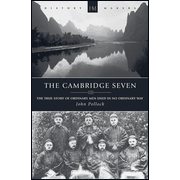
In 1883 Harold Schofield, a missionary doctor in China, surveyed the needs of his field and prayed in faith “that God would waken the church to China’s claims, that He would raise up men to preach His word. Above all that He would touch the universities and call men of talent and ability and consecrate them to His work in China. It seemed a prayer absurd enough except to faith” (p. 42). He did know know that God had begun answering his prayer “even while he was yet speaking,” and he didn’t live to see the answer: like those saints in Hebrews 11, he died not having yet received the promises, but God used him in faith and prayer.

This book details the answer to that prayer. The subtitle of The Cambridge Seven by John Pollock is “The True Story of Ordinary Men Used in No Ordinary Way,” an apt title.

A fairly short book at only 111 pages, it details the Lord’s leading in the lives of seven young men from their conversions to their departure for China with a brief synopsis at the end about what happened to each of them. C.T. Studd, M. Beauchamp, S.P. Smith, A.T. Polhill-Turner, D.E. Hoste, C.H. Polhill-Turner, W.W. Cassels were all Cambridge students who felt called to offer their lives as missionaries to China. They were from different backgrounds: some were wealthy, some were in the military, some were collegiate athletes — one of them a household name in his day; some were more “ordinary.” They were of varying abilities and gifts. Yet as God called them one by one, and it became known, and they shared their testimonies of salvation and surrender over England and Scotland, God used them in a remarkable way before they ever even got to China.

For many of them, the first stirrings toward faith in Christ came when D. L. Moody and Ira Sankey held meetings in England. Some of “their friends thought it a great joke that two uneducated Americans should be coming to preach to the University” (p. 29). But the Holy Spirit worked through His servant and His Word to convict their hearts and bring them to Himself. Others came from Christian families yet were only nominal believers until the Lord began to draw them to a closer fellowship and surrender to Himself.

Some of their families supported them: others strongly resisted the idea of their sons going to a foreign mission field, at least at first.

I appreciated the caution and care with which they approached their call. As D. E. Hoste “began to feel the urge to devote himself to the gospel. Nothing else seemed worthy,” his father “refused. He pointed out how recent was Dick’s faith, and reminded him that, though nothing could break its reality, the intensity of his emotions might be transient. To rush, on impulse, to such a binding decision would be foolishly wrong and might afterwards be regretted” (p. 43). C. T. Studd was listening to an address about the needs of China and “thought for a moment of rising in his place and offering for China on the spot. But he felt ‘people would say I was led by impulse.’ When the meeting ended he slipped away by himself and prayed for guidance” (pp. 69-70). I wince sometimes in our modern-day meetings when a speaker seems to feel he has to compel people down the aisle or else they’ll miss the will of God for their lives forever afterward. That may be true in some cases — there are moments of crisis when we need to make a decision for the Lord without hesitation. But as a general rule I’d rather people take time to pray and make sure their call is really of God than to respond to man-made pressure mistaken for the Holy Spirit’s.

China was not an easy field to go to then, if indeed it ever was. Some of these men were laying aside personal wealth and the possibility of brilliant careers and social prominence. But as they shared their call, they did not do so with woebegone countenances. They did not make it seem like a sacrifice: they made it seem like a joyous privilege. Perhaps that contagious joy was one of the things that drew a number of people to give their all to the Lord in their wake. Hudson Taylor, founder of the China Inland Mission through which they would be working, even allowed them to wait past their appointed time of departure because they were being called to more meetings in the British Isles to speak: he recognized that God was doing something unusual through them.

C. T. Studd is perhaps the most well-known of the seven in our day. One of his most well-known quotes is at the end of this section:

I had known about Jesus Christ’s dying for me, but had never understood that if he died for me, then I didn’t belong to myself. Redemption means ‘buying back,’ so that if I belonged to Him, either I had to be a thief and keep what wasn’t mine or else I had to give up everything to God. When I came to see that Jesus Christ had died for me, it didn’t seem hard to give up all for HIM. It just seemed common, ordinary honesty.

(This review will be linked to Semicolon‘s Saturday Review of Books.)

The Week In Words

Welcome to The Week In Words, where we share quotes from the last week’s reading. If something you read this past weekΒ  inspired you, caused you to laugh, cry, think, dream, or just resonated with you in some way, please share it with us, attributing it to its source, which can be a book, newspaper, blog, Facebook β€” anything that you read. More information is here.

Just a further note β€” if you’ve posted a quote on your blog this past week, feel free to link it here as well. You don’t have to save it for Mondays. :) And please do read and comment even if you’re not posting quotes.

Here are a few that stood out to me this week:

On several friends’ Facebook statuses:

The happiest people don’t have the best of everything, they just make the best of everything they have.

That speaks much to being content with such things as we have, as we’re instructed to be (Hebrews 13:5-6). It seems no matter how much we have, there is always a craving for more.

I saw this at Semicolon’s:

β€œIt is not enough to simply teach children to read; we have to give them something worth reading. Something that will stretch their imaginations–something that will help them make sense of their own lives and encourage them to reach out toward people whose lives are quite different from their own.”~Katharine Paterson, U.S. National Ambassador for Young People’s Literature

I so agree with this! I am astounded when I hear parents or teachers say, “I don’t care what my kids are reading as long as they’re reading.” We don’t say the same about physical food: “I don’t care what my kids are eating, as long as they’re eating.” Why would we care less about what kids are putting into their brains? I am not talking about the extremes of censorship but rather teaching discernment and providing good books to read (for them and ourselves). There are so many good choices, we don’t need to read shoddy stuff just to have something to read.

Then in an article titled 10 Writing Tips at ChristianWritingToday.com (I got there via Semicolon’s link to 8 Writing Tips From C. S. Lewis on the same site) these first two were the ones that most stood out to me:

1.Β  Write only when you have something to say. (Playwright David Hare).

2.Β  The reader is a friend, not an adversary, not a spectator. (Jonathan Franzen)

That second one especially spoke to me: if writing is to be a means of communication rather than just self-expression, writers need to engage the reader, and then not be offended if a reader doesn’t “get” or like something, but rather look for ways to better communicate with the reader (though of course we all understand that we can’t please everybody. But pleasing and effectively communicating aren’t always the same thing.)

Then from an Elisabeth Elliot e-mail devotinal from her book A Lamp For My Feet concerning Romans 12:1-2:

The primary condition for learning what God wants of us is putting ourselves wholly at his disposal. It is just here that we are often blocked. We hold certain reservations about how far we are willing to go, what we will or will not do, how much God can have of us or of what we treasure. Then we pray for guidance. It will not work. We must begin by laying it all down–ourselves, our treasures, our destiny. Then we are in a position to think with renewed minds and act with a transformed nature. The withholding of any part of ourselves is the same as saying, “Thy will be done up to a point, mine from there on.”

That is the sticking point, isn’t it? I want God’s perfect will in my life…unless it means that.

From the same source comes this quote:

If God is almighty, there can be no evil so great as to be beyond his power to transform. That transforming power brings light out of darkness, joy out of sorrow, gain out of loss, life out of death.

Sometimes we boggle at the evil in the world and especially in ourselves, feeling that this sin, this tragedy, this offense cannot possibly fit into a pattern for good. Let us remember Joseph’s imprisonment, David’s sin, Paul’s violent persecution of Christians, Peter’s denial of his Master. None of it was beyond the power of grace to redeem and turn into something productive. The God who establishes the shoreline for the sea also decides the limits of the great mystery which is evil. He is “the Blessed Controller of all things.” God will finally be God, Satan’s best efforts notwithstanding.

We tend to want bad things prevented rather than transformed. That day will come, but it is not now. A friend once said she realized that if God were to wipe out all the evil in the world, He would have to wipe out all of us, for we all sin. I am thankful He transforms us rather than just doing away with us, and and we can trust Him to limit what He allows of evil and trust Him to somehow work it together for good (Romans 8:28) until the day when it is taken out of the way completely.

If you have some family-friendly quotes you’d like to share, please leave the link to your β€œWeek In Words” post (not just to your general blog) with Mr. Linky below. Of course, it is fine to just leave a quote in the comments section if you’d rather. I hope you’ll visit some of the other participants, too: this is a small enough meme so far that it is not hard to visit around with others who love to glean quotes from their reading as well.

The Week In Words Participants

1. bekahcubed 2. Susan 3. Jerrie

Powered by… Mister Linky’s Magical Widgets.

(Mr. Linky is closed for this post: Please see the current Week In Words post to put your new quotes in.)

Happy Birthday to Jeremy!

A Very Happy 26th Birthday to Jeremy!

I am so glad we could all be together for it!

Laudable Linkage

I saw some great things around the Internet the last couple of weeks. Let me know if you find any of them useful!

Supernatural Love at Femina. We all need it. This is a great delineation of what it looks like, how to apply I Cor. 13 in everyday life. It’s geared toward moms, but of course the chapter and many of the principles listed could be applied in multitudes of ways.

Strength For a Weary Mom at girltalk.

Defining Success as a Parent at The M.O.B. Society. I love this site! I wish there had been something like it when my guys were small.

Confession Is Not Propitiatory at My Two Cents. It’s not how hard we confess that appropriates our forgiveness. Amen.

Thinking About Immigration Missiologically at MissioMishmash.

Davis Bunn and Writer’s Conferences. Maybe some day…

And on the crafty front:

Gifts Bags From Newspapers.

And a neat idea for storing fabric (HT to Lizzie).

And a couple of funnies from icanhascheezburger.

funny pictures of cats with captions
see more Lolcats and funny pictures

funny pictures of cats with captions
see more Lolcats and funny pictures

Have a great Saturday!

Friday’s Fave Five

Susanne at Living to Tell the Story hosts Friday’s Fave Five so we can share our favorite things from the last week. This has been a wonderful exercise in looking for and appreciating the good things God gives. Click on the button to learn more, then go to Susanne’s to read others’ faves and link up your own.

I have multitudes of favorite things this week — or two weeks, actually, since we were moving last week and I wasn’t able to participate then. I don’t know if I can condense it to five — we will see!

1. The move went relatively smoothly. My husband’s company paid for movers, but we hadn’t contracted with any yet because we wanted to wait until we officially closed on the new house. Then when we did start calling them, it looked at first like none would be available the week we wanted to move, but one came through. Then we had several phases of moving: Wed. the movers came and packed; Thursday they loaded the truck and then we drove to TN that evening; Friday they unloaded in TN; Saturday Jim rented a U-Haul and drove back to SC to move Jason and Mittu into our old house while Jesse and I stayed here and started unpacking; Sunday he loaded up his mom’s things from her assisted living place and brought her here to TN, and then we moved her into her new place. Moving three households in one week seems absolutely crazy, but it had to be done, and everything worked out pretty much as planned and went fairly well. A few mishaps, but nothing major. Even though there is still a lot to do, it feels a little more relaxing because we can do it at our own pace now.

2. My new house! I could make a FFF just about it. I already wrote about it here, but to make a subset fave five, some of my favorite things about it are that it is one level — no steps except for a couple at the front and side doors; the kitchen/dining area has a more open feel than our old house; the kitchen has many more cabinets, much more counter space, a walk-in closet pantry, and lighting over all the counters; a garage (we’ve never had one before! And garage-door openers! So far I still get a little thrill pushing that button!); our master bathroom (only the second time in 31 years we’ve had one); pink floral towel racks left in the master bathroom by the previous owner as well as a pink and green striped rug; walk-in closets; quiet neighborhood….let’s see, I think that’s more than five already.

3. Two neighbors have come over to introduce themselves. One brought produce from her garden, the other brought home-made jelly. Both invited us to their churches. It’s nice to be welcomed!

4. Jim’s mom has adjusted really well to her new place. We had wanted to set up her room as much as possible like her old one, but we couldn’t because it is arranged so differently. But she doesn’t seem to mind. Jim and I had a meeting with one of the ladies in charge this week (we had met before, but this time we got down to the nitty-gritty details) and we’re really pleased with how they handle things and the attention they give her. She came out for lunch while we were there and saw us and came over, then one of the residents came over and welcomed her and invited her to eat at her table. When I visited her yesterday, she exclaimed how nice everything was and how good the food is. πŸ™‚ So far there doesn’t seem to be much confusion, except the first day she went down the wrong hall. This facility is a very small, homey place, and so far we’re really pleased.

5. Jim’s relocation package included a bit of money for “incidentals,” and since we went from one and a half bathrooms in the old house to three full bathrooms in the new, we needed some new towels. I got some to match the pretty towel racks in our bathroom:

So that’s five already, and I haven’t even mentioned yet that Jesse had his first experience with the youth group here and enjoyed it, that a dear friend agreed to take the ladies’ group in SC, at least on an interim basis, and they had their first meeting Monday night and did fine. It’s a blessing to know I am leaving it in good hands. And I have mentioned my GPS before, but it has been invaluable in finding our way around a new town.

So it has been a very good if very busy couple of weeks. School starts for Jesse next week, and though he is a little “weirded out” by the thought of starting a new school — he had been in the same Christian school from K-5 through 10th grade, so this is his first time to be “the new guy” — I have every reason to believe he’ll do fine, and I am looking forward to settling in to a new routine.

Flashback Friday: Back to School

Mocha With Linda hosts a weekly meme called Flashback Friday. She’ll post a question every Thursday, and then Friday we can link our answers up on her site.

The question for this week is:

Did your family have any back-to-school traditions when you were growing up? Were you generally eager or reluctant to start school? Was buying school supplies a big deal or did you order them through the school? Were there any school supplies you particularly loved? Did you take your lunch or buy it at school? Brown bag or lunch box/thermos? Does the first day of school from any grade stand out? Did you ride the bus, walk, or go by car to school? Do you remember how early or late school began/dismissed each day? Did you go to kindergarten? Half-day or whole day?

I LOVED school, and I loved getting new school supplies and getting them all set up and ready — in a cigar box in elementary school, then graduating to those clear zippered pouches that fit into one’s 3-ring binder. There is just something about a new box of crayons, packages of new pens and pencils, etc. In fact, seeing all the neat new school supplies out in stores has made me wish I needed them! They have some really fun, cute stuff these days. I remember carrying books and such back and forth in a book satchel — something like modern day “messenger bags.”

We didn’t really have any rituals or traditions associated with starting school. We just bought supplies at the store.

We varied between taking and buying lunches. I do remember that the little cartons of milk only cost 5 cents, and I seem to remember even 3 cents in early elementary school. I loved the hard plastic or metal lunch boxes with matching thermoses. I don’t remember what any of mine looked like.

We varied walking, riding the bus, or having someone take us to school depending on where we lived at the time. My most memorable rides involved my grandfather, the one I have mentioned with the distinctive laugh. My mom must have had a job requiring her to be there early at the time, because I remember my grandfather taking me to someone’s house where I had breakfast and then rode to school with them. Almost every single morning in my grandfather’s car we heard “Mairzy Doats” and “Mr. Lonely” on the radio. I don’t remember the people whose house I went to or what they looked like: I only remember that the mom required us to drink the milk left in our cereal bowls, which I thought was really gross.

The only first days of school that stand out are from high school: one was on my August birthday, which I thought was atrocious since school used to start after Labor Day in September. And the other was either when I started high school or when we moved to a new school when I was in jr. high — I don’t remember anything about the day, but I remember my mom picking me up, asking about my day, me shrugging my shoulders and saying something noncommittal like “It was all right,” and her saying she thought of all the kids I’d have the most to say, and I had the least. We talked about nearly everything, so it was unusual for me not to bubble over with all the details about the day. I don’t remember why I seemed to have not much to say that day!

Kindergarten was not required when I was of age, so I started right in with first grade and did fine.

I eagerly anticipated school most years — new books and the glories within, new teachers, seeing old friends. I loved learning (most of the time.)

I wasn’t able to do last week’s flashback because we were in the throes of moving, but it had to do with what we wanted to be when we grew up. I went through various stages, wanting to be a movie star :roll:, teacher, psychologist, writer, but underlying them all was the desire to be a wife and mom, and I am so glad the Lord gave me that privilege. That encompassed a little bit of teaching and psychoanalyzing. πŸ™‚ And I’ve had various opportunities to write a little bit — maybe He will give opportunity to expand on that. After boxes are unpacked!

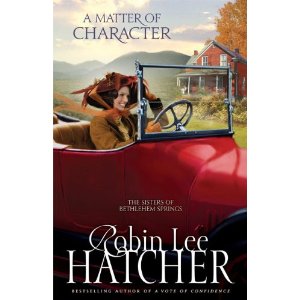
Book Review: A Matter of Character

Daphne McKinley is a single heiress in 1918 with a secret: she writes melodramatic “dime novels” about adventures in the Old West based on true-life stories as told to her by a family friend. She doesn’t need the income, but she writes for the joy of storytelling.Β  She writes under the pseudonym “D. B. Morgan” for two reasons: she doesn’t want to embarrass her family, who might feel such novels were beneath her, and she feels her books might not find a publisher if it were known she was a woman.

Unbeknown to her, Joshua Crawford, the real life grandson of the main character in Daphne’s stories, is on his way to Bethlehem Springs to search out the reclusive D. B. Morgan and make him apologize and correct the defamation of character of his grandfather.

Daphne and Joshua are both in for the surprise of their lives!

I found A Matter of Character by Robin Lee Hatcher a delightful read. It was fun to get a peek at the kinds of decisions an author wrestles with in regard to plot and characters, and I appreciated Daphne’s personal struggle with the responsibility and weight her words carry even in fiction.

A Matter of Character is the third and last and my favorite of Robin’s “Sisters of Bethlehem” series, though it could easily be read alone.

(This review will be linked to Semicolon‘s Saturday Review of Books.)