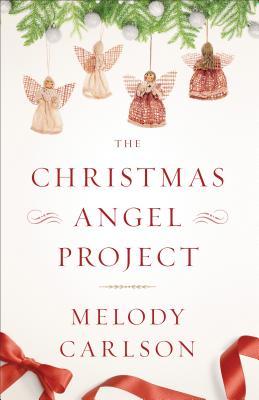
In The Christmas Angel Project by Melody Carson, five friends who are different ages and from different walks of life have been meeting together regularly for a book club. Just after Thanksgiving, one of the women, Abby, dies unexpectedly. She seems to have been the glue that kept them together and inspired them.
Some days after Abby’s memorial service, the other women meet together to decide what to do about the group–whether to keep meeting, invite more people, or disband. Abby’s husband gave the group a bag of Christmas gifts that Abby had prepared for them before she passed. They opened them together at their meeting. Abby had made an angel ornament for each of them with their individual characteristics.
Inspired by Abby’s example, the women decide to change their book club to a “Christmas angel” club. Each will choose a project involving their own unique gifts, talents, and resources and report back to each other once a week in lieu of reading books.
Belinda is Abby’s long-time personal friend, divorced with a college-age child. She started a thrift shop years ago that has become something of a boutique.
Cassidy is the youngest, a single veterinarian who struggles with self-confidence.
Grace is newest to the group. She and Belinda had an undercurrent of rivalry for Abby’s friendship. Grace and her husband argue over their twin’s lack of effort in college, among other things. Grace has her own home design business.
Louisa is the oldest of the group. Her husband passed away the year before. Now Abby’s passing has really affected her. She had been an artist, but hasn’t been inspired to create anything since her husband died. She wonders what she’s still doing here, why God didn’t take her instead of Abby.
As each woman struggles to decide what to do for her project, they each experience ups and downs, successes and failures, and learn more about themselves and others in the process.
It’s understandable that the book would start off sad. But it did seem a little depressing at first, especially for a Christmas story. The years when we were most grieving a loss, I don’t know if it would have been helpful to read a book like this or not.
But once they got going on their projects, the story picked up. I did enjoy the book overall. I was happy I discovered the audiobook free in Audible’s members’ Plus Catalog.
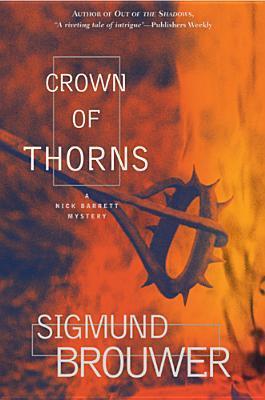
Crown of Thorns is the second in Sigmund Brouwer’s Nick Barrett Mystery Series, the first being Out of the Shadows (linked to my review).
Nick Barrett had grown up in Charleston high society as an outsider. His father was from an old, established family, but his mother was a waitress. In the first book, he had come back to Charleston after several years’ absence when he received an unsigned note promising information about his mother’s disappearance.
At the beginning of this book, Nick is still in Charleston, on a break from his teaching duties in New Mexico, embroiled with his half-brother in a court battle over the family inheritance.
While he waits, he visits frequently with a couple of old friends from his former years in Charleston, elderly twin sisters who own an antique shop. They ask him to help with a dilemma. A young girl from a crime-ridden side of town had come to them trying to sell a four-hundred-year old valuable painting that had been stolen from one of Charleston’s elite families fifty years earlier. They wanted to know, among other things, how this girl had come by the painting.
When Nick meets the eleven-year-old girl named Angel, he has no idea what he’s about to get into.
The plot weaves threads from a fifty-year-old murder, a young mother trying to escape from an abusive cult run by her father-in-law, and Angel’s voodoo-practicing grandmother.
If I had just started with this one and hadn’t read the first book or others of Brouwer’s, I probably would not have gotten past the prologue with its talk of voodoo spells. I just like to stay as far away as possible from that kind of thing. But I had read enough of the author’s work to trust he wouldn’t steer me wrong. He’s not promoting those practices and doesn’t go into gratuitous detail. And, as Nick’s journey has been spiritual as well as familial, the author clearly includes the offsetting truth of the gospel.
I look forward to reading the concluding book in the series.
I’m not sure where or when or how the phrase originated, but the last few years I’ve seen many women fretting over not being “enough.”
My first thought on hearing this was “Enough for what?” Enough for their responsibilities? For the demands on their time? Enough spiritually? Enough in their relationships?
My second thought was “Of course we’re not ‘enough.'”
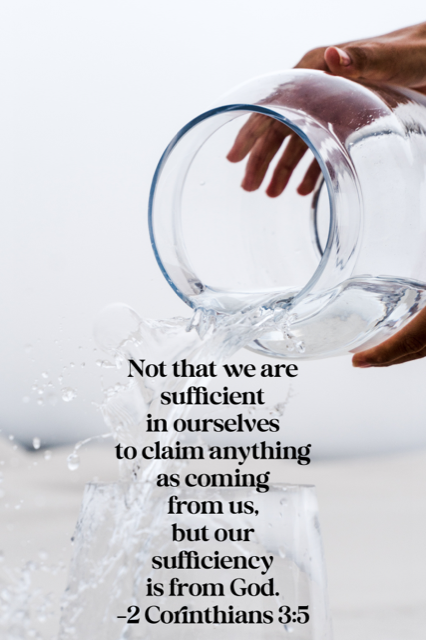
In speaking of his ministry to the Corinthians, Paul states, “Not that we are sufficient in ourselves to claim anything as coming from us” (2 Corinthians 3:5). In place of “sufficient,” some other translations use “competent,” “qualified,” “adequate”—all synonyms for “enough.” The dictionary definition for “sufficient” uses the word “enough.”
One commentary said this verse hearkened back to a question Paul asked in chapter 2, verse 16. After speaking about spreading the “fragrance of the knowledge of him everywhere,” Paul asks, “Who is sufficient for these things?”
The answer is given in the second part of verse 5 in chapter 3: “But our sufficiency is from God.”
Other passages bring out these same truths.
In John 15:5, Jesus said, “I am the vine; you are the branches. Whoever abides in me and I in him, he it is that bears much fruit, for apart from me you can do nothing.”
Jesus told His disciples in Matthew 26:41, “Watch and pray that you may not enter into temptation. The spirit indeed is willing, but the flesh is weak.”
Paul agrees in Romans 7:18: “For I know that nothing good dwells in me, that is, in my flesh. For I have the desire to do what is right, but not the ability to carry it out.”
But, he says in Philippians 4:13: “I can do all things through Christ who gives me strength.”
And he said God told him, in 2 Corinthians 12:9, “My grace is sufficient for you, for my power is made perfect in weakness.”
And you know what’s even more amazing? God doesn’t do just what’s enough.
In 2 Corinthians 9:8, Paul says, “And God is able to make all grace abound to you, so that having all sufficiency in all things at all times, you may abound in every good work.”
In Jeremiah 31:25, God says, “For I have satiated the weary soul, and I have replenished every sorrowful soul” (KJV and NKJV). Other versions say God satisfied the weary soul. The idea is being saturated, drinking one’s fill.
When Jesus fed 5,000 people in Matthew 14, there were twelve baskets of leftovers above and beyond what the crowd ate.
In Luke 6:38, Jesus said, “Give, and it will be given to you. Good measure, pressed down, shaken together, running over, will be put into your lap.”
In Ephesians 3:20, Paul says, “Now unto him that is able to do exceeding abundantly above all that we ask or think, according to the power that worketh in us” (KJV and NKJV).
So, dear friend, don’t worry about your not-enoughness. Let it turn you to His all-sufficiency. Abide in Him like the branch abides in the vine, letting His Spirit work in and through you. Rest in His grace, His strength, His provision for every need, physical, spiritual, mental, emotional. He is enough. He is more than enough.
I don’t want to “laud” my own links here, but I did want to call attention to an older post titled “Christmas Hope, Christmas Grief, Christmas Joy.” Both of my parents, my grandmother, a college friend, and even our only family dog all died in December, though in different years. Every year, someone I know is facing a first Christmas without a loved one who passed away that year. Grief may cast a shadow over Christmas, but Christmas gives us hope and joy to carry on.
All We Have to Do Is Turn. “It’s comforting that it’s all we’re asked to do, no matter how far we may have wandered from God. We’re not called to find our own way back. We’re not called to fix it all ourselves, which is reassuring as there is no way we could ever fix it by ourselves.”
Is There a Place for Ambition in the Life of a Christian Woman? “I began to think carefully about ambition—my own aspirations as well as the place ambition might play in the life of a Christian woman, a servant of God. Was it wrong for me to long for more opportunities for service—wrong for me to long for a broader reach?”
I Need Sundays, HT to Challies. “Jesus loves his Church. It was His idea. The abuses and failures of the church do not negate the commands of Scripture to gather as a body of believers. We will not always get it right, that’s for sure. But that doesn’t mean that we can toss the proverbial baby out with the bath water. The commands of Scripture are still ultimately for our good, our growth, our sanctification. If one of God’s very means of grace for our endurance in the Christian life is the church, then Christians will struggle to flourish in faith apart from it.”
When Going Through the Motions Is the Best Way Forward. “I feel like I’m just going through the motions. Perhaps you’ve heard people say this about a relationship, their work or their spiritual lives. Perhaps you’ve even said it yourself. Chances are, it was presented as a negative. If you’re going through the motions, something is wrong, right? Not necessarily.”
Pain Needs Interpreting, HT to Challies. “Rather than just react to pain, the Bible calls us to act towards it. We’re not to just be subject to our pain, blown about in every direction by it. Rather we’re to respond to it, and subject it to the light of God’s word.”
It’s So Easy, HT to Challies. “The world can be a hard place. We are all the walking wounded at times. The voices around us are not always kind, and many of us can find ourselves on the margins, overlooked. It is these times when even the smallest word of encouragement can turn our hearts from sadness to hope.”
Stop Calling Them Names, HT to Challies. “[T]he Bible teaches us to directly confront theological error. It even has a category for using harsh speech with wolves who pervert a church’s fidelity or lead people into eternal destruction (cf. Acts 13:8–11). But neither should Christians engage in the worldly practice of name-calling or employing theological slurs, especially when speaking of brothers and sisters in Christ.”
This is really cool: a graphic showing where things in the Bible are mentioned in more than one place. The bottom line lists the chapters from Genesis to Revelation, with Psalm 119 in the middle. Though the Bible was written over hundreds of year by several authors, it’s a coherent whole
Occasionally someone will ask me what the “HT” in some of my listings means. I used to see that abbreviation frequently, but not so much any more. It means “hat tip,” meaning I saw that link at someone else’s site that I want to acknowledge.
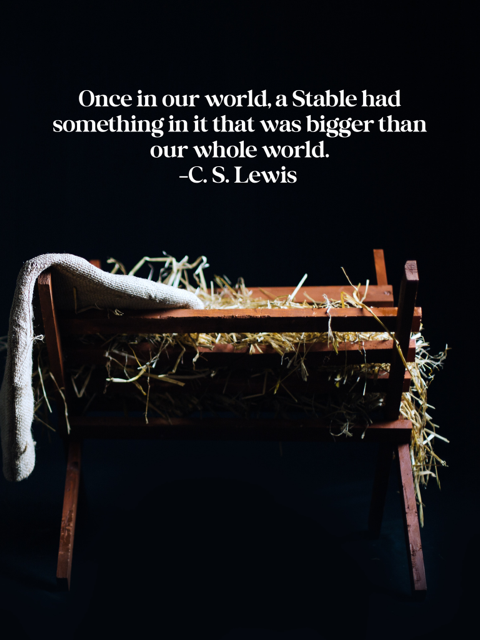
Once in our world, a Stable had something in it that was bigger than our whole world. C. S. Lewis
These Fridays seem to come around faster and faster. I haven’t gotten everything done I wanted to this week–but I’ve still got today and tomorrow! And it’s been a good week overall. It’s nice to pause for a moment with Susanne and friends at Living to Tell the Story to reflect on and share the blessings of the week.
1. Another Chick-Fil-A biscuit. One morning I woke up to find Jim had gone to the gym. There’s a Chick-Fil-A right across from the gym (hardly seems like a fair temptation, does it?) I texted him to see if he might pick up breakfast at CFA on his way home. Funny thing was, he didn’t see my text until after we had eaten–he had gotten CFA for us to celebrate his first day back at the gym after his surgery.
2. Dishwasher chores done. I usually unload the dishwasher sometime during the day and load it back up right after dinner. Somehow one evening last week I hadn’t done either when I dozed off on the couch. I woke up to hear Jim unloading and loading it. Much appreciated!
3. Leftover meals. Another one I forgot from last week: a couple of nights we didn’t want anything busy or heavy, and we had enough leftovers on hand to just heat up plates. Nice to have an easy dinner plus declutter the refrigerator.
4. Vitamin E capsules. I’ll spare you the details, but I have a couple of bothersome skin patches. The doctor basically dismissed it as nothing one year. This year I persisted. He prescribed a steroid cream, which worked wonders—but also raised my blood sugar. At church one morning, one woman was telling another whose husband had just had surgery about puncturing Vitamin E capsules and using their oil on the scars to reduce scar visibility as they heal. I wondered if they might work on my skin issue–and they did! (Note: a little research showed it’s not recommended to use it on scars while they’re forming: best to ask your doctor’s advice.)
5. Warmth and coziness. It’s the time of year when I am especially glad for winter clothes, sweaters, and throw blankets. And I am immeasurably thankful to be able to heat our home at the touch of a button.
Bonus: Canceled plans. With age and some physical issues, it’s hard for me to be out several days in a row. We had something scheduled for six out of the next seven days beginning with Wednesday. One thing I just decided not to go to. Sadly, Mittu was sick and we missed something we were going to attend together. But having a lightened schedule is a great stress reducer.
In Secrets She Kept by Cathy Gohlke, Hannah Stirling’s mother has just passed away. More than mourning her mother, she mourns the loss of what could have been. Hannah’s mother had been distant from Hannah and her father for as long as she could remember.
Going through her parents’ home for some clue about her mother’s past turns out to be fruitless. When she sees the lawyer to finalize her mother’s affairs, Hannah is surprised to be given a key to a safe deposit box that Hannah had never known about. But all she finds there is her parents’ wedding certificate, her father’s military discharge papers, and a few empty envelopes with German addresses and stamps on them.
The paperwork, however, lets her know a shocking surprise: the man she called Daddy all her life could not have been her real father.
The point of view switches to thirty years earlier in Germany, when Hannah’s mother, Lieselotte Sommer, was a teenager just before Kristallnacht. Her mother lay dying, her brother was a whole-hearted member of the Hitler Youth, and her father was a rising member of the Nazi party. Lieselotte had loved her brother’s friend, Lukas Kirchmann, for as long as she could remember. She helps him and his family help Jews with food, false papers, and anything else they can. She longs for the day they can marry.
But Lieselotte’s father puts pressure on her to marry a Nazi officer and raise Aryan children for the Fuhrer. Her father has been distracted, but she never guessed the depths he would go to to further his own ends.
Switching back to Hannah again, her lawyer researches the German addresses on the envelopes in her mother’s safe deposit box. He discovers that she has a grandfather she never knew about. Her mother, Lieselotte, had said she was from Austria and her family all died in the war.
Hannah travels to Germany to meet her grandfather, to try to find out more about her mother, and to discover who her father was. At first she enjoys the connection with her grandfather. But her research uncovers horrifying family secrets.
This book was riveting. I listened to the audiobook, free at the time from Audible’s Plus Catalog, and eventually began looking for extra time to listen more. All the characters, including side characters, are well-developed and the plot. There’s so much more I’d love to say, but I don’t want to spoil anything for potential readers. So I’ll just say it’s a really good book and highly recommended.
I’ve mentioned many times that I considered Elisabeth Elliot my “mentor from afar” for most of my adult life. I discovered her books in college, four decades ago, beginning with Through Gates of Splendor, Shadow of the Almighty, and The Journals of Jim Elliot. I’ve read almost all her books ever since, some of them several times, as well as her newsletters.
Most of you know that Elisabeth was the wife of Jim Elliot, one of five missionaries killed when trying to reach a tribe in Ecuador then known as “Aucas” (now known by their name for themselves, Waorani). A few years later, Elisabeth, her young daughter Valerie, and Rachel Saint, sister of one of the other missionaries, were invited to live with the Waorani. After writing Through Gates of Splendor about “Operation Auca” and the five missionaries, then her husband’s biography, and several articles, Elisabeth began to feel God called her into a ministry of writing. She and Valerie came back to the USA, where Elisabeth spent decades writing, speaking, and teaching.
Elisabeth’s public ministry ended in 2004 when her dementia began to make travel and speaking impossible. She passed away in 2015 at the age of 88. She’s regarded as one of the most influential Christian women of the last 100 years.
It was only a matter of time before biographers started telling her story. In Elisabeth Elliot: A Life, Lucy S. R. Austen harmonizes Elisabeth’s public writing with the journals and letters Austen had access to, which I feel is the strength of this book.
Elisabeth never put herself on a pedestal. She was quite honest about her faults and foibles. Austen takes care to present Elisabeth realistically, not idealistically.
However, I felt that Austen often sat in judgment on Elisabeth’s writing, criticizing such things as her approach to discerning God’s will in her early years, Jim’s behavior as they dated, the difference between what Elisabeth wrote in her journals and what she wrote publicly thirty years later, and so on. I have questions marks and notes of “author judgment” in several margins.
I knew much about Elisabeth’s earlier life from her books and writing. I was looking forward to learning more about what happened after she came back to the USA. But Elisabeth’s earlier life takes up two-thirds of the book, with her last fifty-two years filling only a third. That may be due to several factors: people’s interest in her missionary career; a number of questions and issues about that time; the decreasing number of family letters sent. And then, a lot of the narrative about her time in the States reads like lists of where she traveled and spoke, along with whom she visited and who visited her.
I was heartened to see some of her questions and struggles that emphasized that she was in many ways an ordinary Christian woman dealing with some of the same issues we all do. I was sad to hear of serious issues in her second and particularly third marriages.
Elisabeth seemed, by all accounts, to be a classic introvert. I was sad to see that introversion was thought to be unspiritual in her early life and that she fought against it rather than seeing it as the way God made her.
I was surprised to read that she thought speaking was not her main ministry and, in fact, took away from her writing ministry. I’m thankful to have heard her speak in person twice.
Her views on many things changed and solidified over the years, as happens with most of us. Her journals and sometimes her letters were ways of processing her thoughts. I wouldn’t be too alarmed by some of the views she seemed to hold or wrestled with along the way.
As it happened, I was midway through the book when I turned on the replay of Elisabeth’s radio program, Gateway to Joy, on BBN Radio one morning. She was doing a series called “Jungle Diaries,” reading from her journals of her time in Ecuador. She said she had not looked at them in forty years. She commented that people think she “has it all together,” but her diaries assured that she did not then, and she still did not claim to.
She also commented that her “theology has been developed” since those writings, but what she wrote was raw and real and honest. Then she mentioned that she was shocked to read of her desire to go to the Aucas. She “had no recollection of wanting to go to the Aucas, certainly not that soon after Jim died” (“Jungles Diaries #1:Journal Beginnings,” aired October 16, 2023).
I was quite surprised to hear her say that, as her books indicated that she strongly wanted to go. But then I thought about my own life forty years ago. I was four years married and would soon be expecting my first child. I remember where I worked, where we went to church, who our friends were. But there’s more I don’t remember than I do.
So I feel that Austen often made too much of the differences between what Elliot wrote over a span of forty or more years. But I think Austen tried to be faithful with the material she had.
In writing circles, we’re often told that we might have a perfectly fine manuscript that may be rejected because a similar book has just been published. For that reason, I was surprised to see Austen’s biography come out in-between the two parts of Ellen Vaughn’s “authorized” biography. Perhaps the publishers felt there was sufficient interest in Elisabeth to warrant two biographies of her published so close together. If so, I think they were right.
But I hope sometime someone writes a simple biography of Elisabeth, not analyzing or explaining or annotating, but just telling her story.
One of the main take-aways from listening to or reading about Elisabeth is that her supreme desires were to know and obey God. She was no-nonsense, yet she had a sense of humor. She was sentimental, but she wasn’t unfeeling. She wasn’t perfect, and she wouldn’t say this, but I think she went further than many of us in her spiritual journey.
(Updated to add: I thought I’d share a couple of other, more positive reviews from friends I know and trust: Ann’s is here, and Michele’s is here.)
In my early Christian life, whenever something went wrong, I would doubt God’s love for me. When preachers said God did things for His glory and our good, I would think, “His glory maybe, but my good? How is this good for me?”
There may be many reasons for that reaction, too many to explore here. But surely one was being spiritually immature and not knowing my Bible well enough. Another was the mistaken (and also immature) notion that if God loved me, I wouldn’t have problems. A popular book at the time was If God Loves Me, Why Can’t I Get My Locker Open? I never read the book, but I identified with the feeling.
Satan has capitalized on those feelings since the beginning. When he came to tempt Adam and Eve, he questioned what God said, contradicted it, and insinuated that God didn’t really have their best in mind.
Perhaps that’s one reason Paul prays in Ephesians 3 that God would “grant you to be strengthened with power through his Spirit in your inner being, so that Christ may dwell in your hearts through faith—that you, being rooted and grounded in love, may have strength to comprehend with all the saints what is the breadth and length and height and depth, and to know the love of Christ that surpasses knowledge, that you may be filled with all the fullness of God.” It’s interesting that the next well-known verse in that passage comes in this context: “Now to him who is able to do far more abundantly than all that we ask or think, according to the power at work within us, to him be glory in the church and in Christ Jesus throughout all generations, forever and ever. Amen.”
God wants us to know and rest in His love.
Why?
Well, anyone who loves wants the other person to know it.
But also, when we’re secure in God’s love, we’ll be less inclined to believe Satan’s lies. We can go forward through whatever trial is ahead knowing God is with us and has allowed it for some good purpose. We can obey Him because we know He is good, righteous, kind, and loving. We can love others out of the overflow of God’s love to us.
So how can we remind ourselves of God’s love when we might not feel it?
Remember what He did to save you. God would not have put up with all He did throughout humanity’s history, and Jesus would not have come to earth to live and die for us, if they did not love us. John 3:16, probably the most famous Bible passage in the world, tells us, “For God so loved the world, that he gave his only Son, that whoever believes in him should not perish but have eternal life.”
God’s law convicted me of my sin and showed me my need for a Savior. But it was His love that drew me, that convinced me He would receive me. He loved me when I was still in sin, His enemy, and uninterested. “God shows his love for us in that while we were still sinners, Christ died for us” (Romans 5:8).
Chas. H. Gabriel expressed this beautifully in his hymn “He Lifted Me”:
He called me long before I heard, Before my sinful heart was stirred, But when I took Him at His word, Forgiven, He lifted me.
From sinking sand He lifted me, With tender hand He lifted me, From shades of night to plains of light, O praise His name, He lifted me!
In Hosea, God says He drew Ephraim with “gentle cords, bands of love.” James Grindlay Small captures this in “I’ve Found a Friend”:
I’ve found a Friend, oh, such a Friend! He loved me ere I knew Him; He drew me with the cords of love, And thus He bound me to Him. And round my heart still closely twine Those ties which naught can sever, For I am His, and He is mine, Forever and forever.
Get to know God better. Jesus said, “And this is eternal life, that they know you, the only true God, and Jesus Christ whom you have sent” (John 17:3). Eternal life begins with knowing God. But we come to know Him increasingly more through our lives. We learn about Him from nature and other people, but the primary way of knowing Him better is through His Word. The more we know Him, the more we rest in His character and love.
Remember how He has blessed you. I’ve mentioned before “Ebenezers,” those times in your life when you especially saw God move and work in your behalf.
Meditate on His Word. I’ve referred to a few verses about God’s love. Here are a few more:
The LORD delights in you (Isaiah 62:4).
Can a woman forget her nursing child,that she should have no compassion on the son of her womb?Even these may forget,yet I will not forget you.Behold, I have engraved you on the palms of my hands;your walls are continually before me.(Isaiah 49:15-16).
The Lord takes pleasure in those who fear him, in those who hope in his steadfast love (Psalm 147:11).
The Lord your God is in your midst, a mighty one who will save; he will rejoice over you with gladness;he will quiet you by his love; he will exult over you with loud singing (Zephaniah 3:17).
But you, O Lord, are a God merciful and gracious, slow to anger and abounding in steadfast love and faithfulness (Psalm 86:15).
As the Father has loved me, so have I loved you. Abide in my love (John 15:9).
See what kind of love the Father has given to us, that we should be called children of God; and so we are (1 John 3:1).
In all these things we are more than conquerors through him who loved us.For I am sure that neither death nor life, nor angels nor rulers, nor things present nor things to come, nor powers,nor height nor depth, nor anything else in all creation, will be able to separate us from the love of God in Christ Jesus our Lord (Romans 8:37-39).
May the Lord direct your hearts to the love of God and to the steadfastness of Christ. (2 Thessalonians 3:5).
Listen to Scripture-based songs about God’s love, or read the lyrics. I’ve mentioned a few already. Here are some more:
Could we with ink the ocean fill, And were the skies of parchment made; Were every stalk on earth a quill, And every man a scribe by trade; To write the love of God above Would drain the ocean dry; Nor could the scroll contain the whole, Though stretched from sky to sky.
Here is love, vast as the ocean, Loving-kindness as the flood, When the Prince of Life, our Ransom, Shed for us His precious blood. Who His love will not remember? Who can cease to sing His praise? He can never be forgotten, Throughout heav’n’s eternal days.
“How Deep the Father’s Love For Us” by Stuart Townend (This is still under copyright, so I won’t post its lyrics, but you can find them here).
“O Wondrous Love” by Steve and Vikki Cook is also still under copyright: the lyrics are here.
Loved with everlasting love, Led by grace that love to know; Spirit, breathing from above, Thou hast taught me it is so. Oh, this full and perfect peace! Oh, this transport all divine! In a love which cannot cease, I am His, and He is mine.
In heavenly love abiding, No change my heart shall fear; And safe is such confiding, For nothing changes here: The storm may roar without me, My heart may low be laid; But God is round about me, And can I be dismayed?
Remember God’s love and truth work hand in hand. Some people emphasize God’s love to the exclusion of His righteousness and holiness. They see God as a doddering old grandfather who overlooks any wrongdoing and slips them sweets when their mother isn’t looking. They don’t understand that God is a God of truth as well as love, that it wouldn’t be loving of Him to let us go on in our sin without chastening.
A loving parent has to say no sometimes, or require hard things. A child might feel the parent would show more love by giving everything the child wants or making life easy. But that kind of behavior is selfish rather than loving, wanting the child’s approval (or wanting to avoid a tantrum) instead of doing what would build the child’s character.
Remember God’s love is based on His character, not ours. When we’re doing what we’re supposed to, we “feel” loved by God. But when we fall and fail, we feel maybe His love has dimmed a little, if not evaporated.
But the Bible tells us that “As a father shows compassion to his children, so the Lord shows compassion to those who fear him. For he knows our frame; he remembers that we are dust (Psalm 103:13-14). Verse 17 goes on to say, “But the steadfast love of the Lord is from everlasting to everlasting on those who fear him.”
He chastens us like a father because He loves us (Hebrew 12:5-11).
Though John 3:16 says God loves the world, that doesn’t mean the whole world has automatically become His. Some reject or ignore God’s love and gifts.
“God gave us eternal life, and this life is in his Son. Whoever has the Son has life; whoever does not have the Son of God does not have life” (1 John 5:11-12).
If you do know God, rest in His love, remind yourself of it often.
May you “come to know and to believe the love that God has for us. God is love, and whoever abides in love abides in God, and God abides in him” (1 John 4:16).
I didn’t think I’d have a Laudable Linkage this morning. It’s been a busy week, and I am way behind on blog reading. But I had a little free time yesterday afternoon and found these good reads.
Picture Perfect Christmas. “Every time I look awful, I run into my most together friend. HER. That altogether all together friend. I try not to let it, but it surely can make me cranky. And angsty. Crangsty.”
Victim Blaming and the Rich Young Ruler, HT to Challies. “The way that Jesus responded to the rich young ruler is so different from what comes naturally to me. When I see someone suffering, my mind often seeks to figure out how they are at fault for their own suffering. And that response is wrong for two main reasons.”
Grace in Afflictions. “I have been meditating for several weeks on 2 Cor. 4:15-18. The expression “light affliction” has been returning to my mind as I deal with daily, nagging physical conditions that are burdensome and uncomfortable. I’m seeking relief, improvement, and help from any source available. Even though I’m plagued by real challenges and wearing out, I’m still striving for healing and personal progress in my body and my soul. To respond I’m fleeing regularly to my study of God’s grace as revealed in scripture.” I especially love the last paragraph here.
Repeat Forever. “Can we linger just a little longer on thanksgiving before we move onto Christmas? ‘I will bless the Lord at all times; His praise shall continually be in my mouth.‘ (Psalm 34:1, NASB). One of the definitions of ‘continually’ is ‘without an intermission’ (dictionary.com). In other words, ongoing.”
Though we are keenly aware of the abuses that have grown up around the holiday season, we are still not willing to surrender this ancient and loved Christmas Day to the enemy. – A. W. Tozer
Happy first Friday of December! It was nice to have a buffer week between Thanksgiving and the first of December. Though life is always busy, December is especially so. It’s even more important to schedule pauses for remembering what’s important and counting our blessings. Susanne at Living to Tell the Story hosts an opportunity to do that with Friday’s Fave Five.
Here are a few of mine:
1. Decorating for Christmas with the family. I thought about waiting til next week, just from tiredness. But I am glad we went ahead. I am so thankful that the family helps with this, even though Jason and Mittu have their own house to decorate. Not only do many hands make light work, but it’s fun to reminisce as we do. Mittu made a great lunch. for us all.
2. Lunch with Melanie. We try to get together once a month or so, but it had been a long while. We had gift cards to Red Lobster and enjoyed catching up. By the way, she had a birthday this week! Some of you know her through FFF or other blogging means—feel free to pop over and wish her a belated happy birthday.
3. A good eye exam with no new issues or problems.
4. Hot oil hair treatment. I have very dry skin and have to put lotion all over year-round. But cold, dry weather really does a number on me. I couldn’t put lotion on my scalp, however. Then I remembered I used to use VO5 hot oil treatment—a little tube you put in a cup of hot water and then massage its contents into your scalp before shampooing. I even had some in the bathroom cabinet. It felt so good.
5. Online shopping. We got a good chunk of our Christmas shopping done this week, and now enjoy receiving the deliveries!











 Stray Thoughts