

How Can We Love Like God Loves Us?

How can we love like God loves us?

This time of year, our hearts are drawn toward love. Whether one celebrates Valentine’s Day or not, we can’t help but hear about it and see displays in stores.

Valentine’s Day is one of my favorite holidays. I love to make cards for my family, prepare a special meal, and bake heart-shaped cupcakes served on festive, heart-covered paper plates. I love receiving cards, flowers, and my favorite candy. I don’t often listen to mushy love songs, but I’m more inclined to in February.

As fun as those things are, we know real love goes deeper. It shows up “for better or worse, for richer or poorer, in sickness and in health.” Love can feel giddy or warm and fuzzy. But love can also feel like hard work..

Jesus told us to “love one another just as I have loved you” (John 13:34; 15:12). What’s more, He told us to go beyond loving those who please us or love us back, but also to love those who persecute us and hate us.

How can we do that? After all, He is God, and we are not. Oswald Chambers said in the April 30 reading from My Utmost for His Highest, “The springs of love are in God, not in us. It is absurd to look for the love of God in our hearts naturally; it is only there when it has been shed abroad in our hearts by the Holy Spirit.”

I’m far from perfect in this, but I’ve found these things to help:

Pray for more love

I was encouraged when I realized there were passages in the Bible about praying to be more loving. That indicates God knows we’re not perfectly loving yet and we need to grow in love. I sometimes pray these for myself and need to do so more often.

Now may our God and Father himself, and our Lord Jesus, direct our way to you, and may the Lord make you increase and abound in love for one another and for all (1 Thessalonians 3:11-12).

And it is my prayer that your love may abound more and more, with knowledge and all discernment (Philippians 1:9).

That Christ may dwell in your hearts through faith—that you, being rooted and grounded in love, may have strength to comprehend with all the saints what is the breadth and length and height and depth, and to know the love of Christ that surpasses knowledge (Ephesians 3:17-19).

May the Lord direct your hearts to the love of God and to the steadfastness of Christ (2 Thessalonians 3:5).

Abide in Him

Trying to love as Jesus did will show us soon enough that we can’t do it in our own power. “Abide in me, and I in you. As the branch cannot bear fruit by itself, unless it abides in the vine, neither can you, unless you abide in me. I am the vine; you are the branches. Whoever abides in me and I in him, he it is that bears much fruit, for apart from me you can do nothing” (John 15:4-5).

We have come to know and to believe the love that God has for us. God is love, and whoever abides in love abides in God, and God abides in him” (1 John 4:16).

Be Filled with the Spirit

Ephesians 5:5 tells us, “God’s love has been poured into our hearts through the Holy Spirit who has been given to us.” Part of the fruit of the Spirit is love, so when we’re filled with Him, we’ll be filled with His love.

Behold Him

It makes sense that to love as Jesus loved, we need to consider how He loved.

He took initiative. God loved us even before we knew Him, before we turned to Him, even before the foundation of the world (Ephesians 1:3-6). “We love because he first loved us” (1 John 4:19).

He showed grace. “God shows his love for us in that while we were still sinners, Christ died for us” (Romans 5:8). He loved us when we were most unlovable and undeserving. He didn’t wait for us to “clean up” or get “good enough.”

His love was sacrificial. “For God so loved the world, that he gave his only Son, that whoever believes in him should not perish but have eternal life” (John 3:16). God gave not just a pittance, not just a fraction, but rather what was most dear to Him. 

His love is active. The Father and Son love not just in word, but in deed. “By this we know love, that he laid down his life for us, and we ought to lay down our lives for the brothers” (1 John 3:16). “Greater love has no one than this, that someone lay down his life for his friends” (John 15:13).

He gave of Himself. “Therefore be imitators of God, as beloved children. And walk in love, as Christ loved us and gave himself up for us, a fragrant offering and sacrifice to God” (Ephesians 5:1-2). That giving involved inconvenience, weariness, misunderstandings, false rumors, humiliation, pain, and death. He ministered to others when He was the only One who deserved to be ministered to.

His love is kind. “For we ourselves were once foolish, disobedient, led astray, slaves to various passions and pleasures, passing our days in malice and envy, hated by others and hating one another. But when the goodness and loving kindness of God our Savior appeared, he saved us, not because of works done by us in righteousness, but according to his own mercy, by the washing of regeneration and renewal of the Holy Spirit, whom he poured out on us richly through Jesus Christ our Savior” (Titus 3:3-6).

He is longsuffering. “The Lord is slow to anger and abounding in steadfast love” (Numbers 14:18a).

His love corrects us. “My son, do not despise the Lord‘s discipline or be weary of his reproof, for the Lord reproves him whom he loves, as a father the son in whom he delights” (Proverbs 3:11-12). God’s love is not indulgent. Sometimes love involves doing the hard thing of bringing sin to the surface so it can be dealt with.

More than just observing how He loved, we need to observe His glory. 2 Corinthians 3:18 tells us, “And we all, with unveiled face, beholding the glory of the Lord, are being transformed into the same image from one degree of glory to another. For this comes from the Lord who is the Spirit.” We’re changed to be more like Him as we behold Him.

Once a missionary was troubled because she didn’t love others the way she knew she should. For years she berated herself with the need to be more loving, but she continually failed, leaving her continually discouraged. Finally she started to meditate on God’s love for her. Without realizing it, her life was transformed so much that people asked her husband what had happened to her.

If we just tell ourselves over and over, “I need to be more loving,” we’re going to get discouraged because we’re focusing on ourselves and setting ourselves up for failure. But when we concentrate on His love for us, our hearts will overflow with that same love to others. No wonder Paul prays that we might know the love of Christ (Ephesians 3:19).

He took the first step in loving me, so I should not wait on others to make the first move. His love came at a great sacrifice, so I should not be surprised when love costs me. He loved me at my most unworthy and forgave a multitude of my offenses, so how can I withhold love from others? When I meditate on His love for me, His love flows through me to others.

Love one another as I have loved you. John 15:12

(Revised from the archives)

(I often link up with some of these bloggers.)
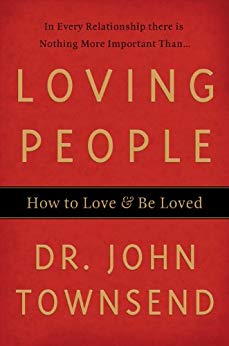
Book Review: Loving People

I’ve mentioned several times here that I struggle with my own selfishness and with not being more loving (not thinking of romantic love necessarily, but generally loving others) . Recently I was discussing with a friend that overcoming selfishness is not a once-and-done effort. It requires an every day yielding to God instead of ourselves.

So when Loving People: How to Love and Be Loved by John Townsend came through on a Kindle sale, I got it. I had heard of Townsend but never read him before.

Early in the book, Townsend says:

You may have noticed that the title of this book has a double meaning. Loving can be both a verb (the action of demonstrating love) and an adjective (the description of someone who demonstrates love). The intent here is to bring attention to the reality that both meanings are necessary for each other to exist. If you want to be a loving person, you must actively show love to people. And if you want to love people, you are to be a person characterized by loving.

A few more of his introductory comments about love:

Care and love aren’t the same thing. Almost any of us could say that we truly care about some people. We can freely admit that, and we are glad these people are in our lives. We want what’s best for them. But the reality is often that we don’t know how to treat those we care about in the most loving way. We want to be the best for those people, but we don’t know how to love them in the way that is best. That is, we would like to be close to them, to be a positive influence for them, and to bring them to intimacy and a better life. But there is a disconnect between our care for those we love and how we address or approach them.

Love is much more than good feelings or intentions. It has direction, movement, and purpose. But while we may feel love, we may not be doing love. Most of us don’t know how to experience and become competent in the art form of love.

We cannot force ourselves to feel anything. Feelings are the result of changes inside us. They aren’t a cause; they are an effect. Trying to will ourselves to feel love doesn’t work. Yet when we say that love is only a feeling, we reduce it to something less than what it truly is. As I said earlier, love encompasses and experiences feelings, but love is not limited to feelings. It is much more—genuine love involves the heart, soul, and mind.

In this book, I define love simply as “seeking and doing the best for another.” When we love someone, we bend our heart, mind, and energies toward the betterment of someone else. That is what loving people do. It involves the whole person. It is ongoing and intentional.

As the architect of love, God lives out this definition. He is constantly seeking and doing what is for our best, things that help us connect, grow, and heal. He is actively doing whatever it takes for us to be the people he designed us to be. The ultimate example of his love is, and always will be, in the sacrifice of Jesus for an alienated and broken creation: “For God loved the world so much that he gave his one and only Son, so that everyone who believes in him will not perish but have eternal life.”

He proposes that love is made up of the following components:

  • Connecting—making an emotional bond
  • Truth-Telling—honesty that serves the other person
  • Healing—repairing brokenness
  • Letting Go—giving up what should be surrendered
  • Romancing—the unique love of being a couple

He spends more than a fourth of the book on connecting, which he defines as “a heart-to-heart attachment that goes beyond knowing about someone to actually knowing that person.” He gives multiple examples: one involved a wife who shared problems and frustrations about her day, and her husband, thinking he was being helpful, suggested possible solutions. But she didn’t want solutions, at least, not yet. She wanted the connection: she wanted to know she was truly heard and understood. By contrast, disconnection isn’t just missing someone who is away for a few days, but rather “the inability to feel and experience the warmth of connection over time. It is the absence of the security of being attached. It is the lack of bonding inside.”

I thought truth-telling was an odd inclusion, because of course you don’t lie to people you love. But Townsend means truth-telling as more than just not lying: it means confronting the other person in a kind and loving way when they need to be confronted. “If your loved one’s life is going down the drain, someone needs to say something. Be that person.” “People who are truly loving will confront, limit, and quarantine people who consistently make wrong choices. So keep that distinction in mind: love seeks the best, but it does not enable bad behavior.”

Under healing, he says: “Loving people are the primary agents of restoration.”

About letting go: “Sometimes love means knowing when it is time to let someone go or to let him do something he is going to do. When you accept reality and give up efforts to control someone’s life or change who he is, you are being loving . . . Letting go is the ability to surrender and to allow what is real to exist. By letting go, I mean giving up efforts to control, manipulate, or force someone to do something different.”

About romance: “Romance is a wonderful aspect of love, but it is not as broad or as deep as love itself. Romance must fit into and serve love. Love can never serve romance.”

He discusses the components of each of these aspects and gives numerous examples, illustrations, and balancing considerations.

This book is not a Bible study, so it reads differently from one. Surprisingly absent from a book by a Christian about love was any discussion about the classic biblical passage on love, 1 Corinthians 13 (except for verses 1 and 13). But Townsend provides a biblical basis for most of his points. In the chapter on connection, for instance, I thought, “This is all well and good, but where do you get this from the Bible?” Well, from the One who made the greatest effort to connect with people who were not only uninterested in Him, but opposed to Him. “Therefore he had to be made like his brothers in every respect, so that he might become a merciful and faithful high priest in the service of God, to make propitiation for the sins of the people. For because he himself has suffered when tempted, he is able to help those who are being tempted” (Hebrews 2:17-18).

The last chapter, “Putting It All Together,” didn’t really put it all together for me. I had hoped it would recap the main points. Instead, it contained instructions to “assemble your team” and “measure and evaluate your process of growth.”

I got a lot of helpful points and thoughts from the book, but I can’t say, “Aha! Now I’ve got it!” Townsend brought up aspects of love that I had not heard or read in other pieces on this subject, but he also did not address other aspects that are usually considered.

While Townsend had a lot of good things to say, his style just didn’t gel with me. Not to say there is anything wrong with his style: he is a best-selling author, after all. But many of the conversations he described in the book are just not the kind I can imagine anyone I know having. Real people did have them, but I guess they were very different personalities from mine and my family and friends.

The best advice I’ve heard about love came from a book I have not been able to recall or find again. But the writer said that for years she berated herself for not being more loving. She was a missionary in a difficult area, and she found herself too often irritated with unloving thoughts towards others. The more she tried to become more loving, the more frustrated she became. But then she started to think about God’s love for her, gracious and undeserved. And without even being aware of it at first, resting in His love overflowed into her own heart and actions.

That’s not to say we can’t learn from books like this. I was particularly convicted about connecting, truly listening and empathizing instead of just offering my two cents to fix the other person’s problems.

I’ve heard similar definitions of love before, that’s it’s a self-sacrificing desire to meet the needs of the loved person. And I’ve heard that it’s not just a feeling. Yet I struggle with doing the right thing, but with resentment. That’s part of having a sin nature, I guess, and we’ll never have it down perfectly while here on earth. Maybe in some ways love is doing your best for another despite resentment. But that’s not how God loves. And I want to love more like Him.

What helps you to be a more loving person?

(Sharing with Carole’s Books You Loved, Booknificent)