100 Ways to Improve Your Writing

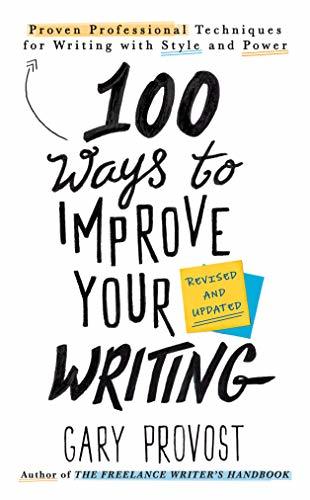
101 Ways to Improve Your Writing

If you’ve read much writing instruction, you may have seen this well-known paragraph:

This sentence has five words. Here are five more words. Five-word sentences are fine. But several together become monotonous. Listen to what is happening. The writing is getting boring. The sound of it drones. It’s like a stuck record. The ear demands some variety. Now listen. I vary the sentence length, and I create music. Music. The writing sings. It has a pleasant rhythm, a lilt, a harmony. I use short sentences. And I use sentences of medium length. And sometimes when I am certain the reader is rested, I will engage him with a sentence of considerable length, a sentence that burns with energy and builds with all the impetus of a crescendo, the roll of the drums, the crash of the cymbals—sounds that say, “Listen to this; it is important” (p. 58).

The author of that masterpiece is Gary Provost, who wrote “more than a thousand published article and stories” (p. 160) as well as two dozen books. He was also a writing teacher and the founder of a semiannual Writer’s Retreat Workshop.

101 Ways to Improve Your Writing: Proven Professional Techniques for Writing with Style and Power was his second instructional book about writing, The Freelance Writer’s Handbook being the first. Some of the material here originally appeared in the Writer’s Digest magazine. The first edition of the book came out in 1985. This 2019 edition has been updated, mostly concerning changes in technology, by his wife, Gail Provost Stockwell, and one of his students who became a teacher and then the director of his writer’s conference, Carol Dougherty.

This book is laid out in eleven sections which are divided into several fairly short topics within the section. Some sections cover broad topics like overcoming writer’s block, developing style, giving words power, and making your writing likeable. But others get into the minutia of grammar, punctuation, and editing. The short pieces on each topic make this book very readable. Since they were so short, I read a handful at a time. But when I read this again, I think I might take one or maybe two at a time and digest them before moving on.

Gary sprinkles succinct but helpful side-by-side good and bad examples to illustrate what he advises.

One aspect of his writing I really appreciated was his saying that his tips are just that: “Tips, not laws” (p. 159). For example:

Never violate a rule of grammar unless you have a good reason, one that improves the writing. But never choose good grammar over good writing. There is nothing virtuous about good grammar that does not work. Your goal is good writing. Good grammar is only one of the tools you use to achieve it (pp. 118-119).

Try to use the active voice. But realize that there are times when you will need to use the passive. If the object of the action is the important thing, then you will want to emphasize it by mentioning it first. When that’s the case, you will use the passive voice (pp. 78-79).

For the past several years, I’ve tried to read at least one book about writing each year, as well as blogs about writing. Much of the information in this book wasn’t new to me, but I benefited from the reminders and the different way of expressing them. Plus, even though I have heard and read many of these things, I certainly haven’t mastered them yet. However, some of the advice touched on subjects we discussed in my last session with my critique group and helped me think through those issues. 

I think this book would be an excellent introduction for new writers and a great “refresher course” for more experienced writers.

Review: Write a Must-Read

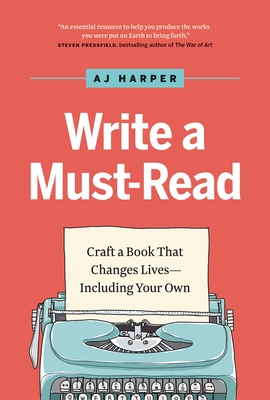
Write a Must-Read by A. J. Harper

A. J. Harper (no relation) has had a varied career as a ghostwriter on multiple books, publisher, editor, coach, co-writer, teacher, and more. Clients urged her to teach other writers how to write transformational nonfiction books. A nudge from a co-writer and an author retreat helping writers caused her to realize maybe she could write such a book. The result is Write a Must-Read: Craft a Book That Changes Lives—Including Your Own.

Harper’s main theme is “Reader first.” Often writers get started because they feel they have something to say. But writing to impact others isn’t just focused on imparting the writer’s story or information. Even a memoir or biography needs to have a take-away for the reader; otherwise, unless the author is famous, a reader won’t be interested in reading it.

First Harper helps writers identify their ideal reader and what their need is. I appreciated the distinction that the ideal reader is not an avatar, with multiple specific characteristics down to the cereal the reader eats (I’ve seen some writing advice that seems to lead this way). Rather, “Ideal Readers may come from different backgrounds and circumstances (demographics), but their problems, desires, and challenges in pursuit of their desire (psychographics) are the common denominator” (p. 46).

Then she helps writers craft their Core Message: what’s the “foundational truth that your entire book is built on” (p. 65). From there, writers craft the promise they make their readers.

Harper talks about teaching points,stories, anecdotes, case studies, outlines, sequencing, and much more, all under the umbrella of what would best serve the reader.

She includes a multitude of helpful questions to ask while editing and ends with a crash course in the process of publishing and need for marketing.

All her points are illustrated with stories and anecdotes from the authors she has worked with.

Many of the chapters end with exercises to work through and links to her web site for more information or to download worksheets or lists.

Some of the quotes that most stood out to me:

Writing a book is not about organizing content. It’s about creating an experience for the reader (p. 119).

The best outline for your book is the one that meets your reader where they are and takes them on a journey that leads to your Promise, delivered (p. 119).

You are not the hero of this book. They are. You are not the focus of this book. They are. And they need you to help them get where they want to go (p. 121).

Your book is not a collection of stories and knowledge. It is a journey—a quest (p. 130).

With nonfiction, specifically personal and professional development books, the aim is transformation. My singular goal is to help the reader change their life (p. 138).

A book is not about something. A book is for someone (p. 200).

I first read this in the evenings, a chapter or less at a time, before closing out the night with fiction before bedtime. That wasn’t the time I wanted to work through exercises and such. So I am going back through the book now at my desk, making notes, printing out worksheets and filling them out.

Some of my readers would want to know that there’s a smattering of profanity through the book, and the author comes from a completely different worldview than mine.

But the writing advice is excellent all throughout.

Review: Adorning the Dark

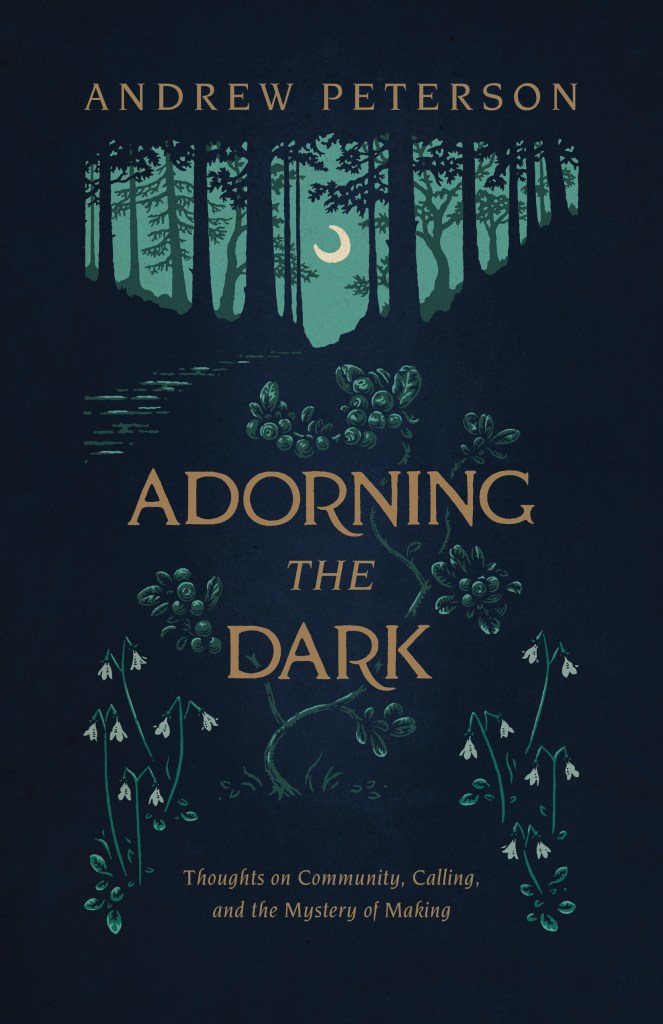
Adorning the Dark by Andrew Peterson

My first encounter with Andrew Peterson’s music was when a friend put the music video for “Dancing in the Mine Fields” on Facebook. The song is sweet one about marriage, and the video features several older couple holding their wedding portraits.

Then when I read The Yearling by Marjorie Kinnan Rawlings, I loved it so much I looked up some background information about it. I discovered another music video of Andrew’s called “The Ballad of Jody Baxter,” Jody being the main character in The Yearling.

Those songs are folksy, but many of you might be familiar with a contemporary song of Andrew’s titled “Is He Worthy?” We sing this at church sometimes.

I knew that Andrew had written a series of fantasy novels for children called The Wingfeaher Saga. I have not read them yet, but I want to. I’ve heard good things about them.

And somewhere along the way, I learned that Andrew was instrumental in forming The Rabbit Room, a site dedicated to “Cultivating and curating story, music, and art to nourish Christ-centered communities for the life of the world.” I have read a few articles there.

Even with that limited knowledge, I was interested when I saw Andrew’s Adorning the Dark: Thoughts on Community, Calling, and the Mystery of Making come up for a Kindle sale.

Andrew says he writes and speaks on this topic as “a practitioner, not an academic,” which means he “learned by doing, which is a nice way of saying that that I learned by doing it wrong half the time” (p. 4, Kindle version).

But not writing as an academic made the book extremely relatable. Andrew shares his journey, his testimony, and what he learned along he way.

Though he writes frequently of song-writing, many of of illustrations work for other kinds of writing and artistic expression as well.

In the first chapter, Andrew shares that many people know Bach wrote S. D. G., standing for Soli Deo Gloria (“glory to God alone”) on his manuscripts. But Andrew shares what few people know: that Bach also wrote “Jesu Juva,” Latin for “Jesus, help!” on his manuscripts as well. That’s an emphasis throughout the book. Andrew says is calling is “to use whatever gifts I’ve been given to tell the truth as beautifully as I can” (p. 4), and “to make known the heart of God” (p. 5).

He writes about battling self-doubt, creating as an act of worship, the fact that creating is work, not magic, that writing what we know doesn’t mean the polished end, but the struggle. He writes about humility, self-consciousness, and the fact that we don’t create to draw attention to ourselves even though “art is necessarily created by a Self” (p. 28). He references Lewis and Tolkien and others and talks about imagination, serving the work, and serving the audience.

One of the references to Lewis described his use of the word sehnsucht, an inconsolable longing which is evidence we were made for something more than we see and experience in this world.

One favorite section was about the tension between art and agenda and what makes Christian art Christian.

One great problem with much art that’s called “Christian” is agenda, which is to say that it’s either didactic, or manipulative, or merely pragmatic—in other words, the artistic purity of the work tends to take a back seat to the artist’s agenda (p. 47).

Art and agenda can and do coexist . . . Agenda is bad when it usurps the beauty. Christian art should strive for a marriage of the two, just as Christ is described as being “full of grace and truth” (John 1: 14). Truth without beauty can be a weapon; beauty without truth can be spineless. The two together are like lyric and melody (p. 47).

He describes revision, or selectivity, as “[pulling] the weeds before they choke the flowers” (p. 61) and being “able to discern what’s necessary to the aesthetic of the song and what isn’t. Then lose what isn’t” (p. 59). He points out that it takes forty gallon of maple sap to make one gallon of maple syrup. You wouldn’t put the sap on your pancakes. But once it’s boiled down, it’s perfect. On the other hand, “Revision is crucial . . . but it’s possible to monkey with something so much that the magic dies” (p. 99).

He writes that creating is not just inspiration, but also discernment and discipline—or dying to self.

He tells how art nourishes community and community nourishes art.

One of my favorite sections talks about how creativity isn’t just being “artsy.” We’re creative because we’re made in the Creator’s image. Andrew says the Rabbit Room’s conference, Hutchmoot, was meant to “encourage people to look for the glimmer of the gospel in all corners of life, that they would see their God-given creativity in both their artistic works and their front gardens, in their home repair and the making of their morning coffee, and that they would call out that glorious creativity in everyone they meet” (p. 89). His wife would “never claim to be an artist, but she’s one of the most creative people I know. Her song is our family” (p. 104).

I have multitudes of quotes marked besides what I’ve already shared. Here are a few:

Who do I think I am, anyway? We need not look anywhere but to the eyes of our Savior for our true identity, an identity which is profoundly complex, unfathomable, deep as the sea, and yet can be boiled down to one little word: beloved. That’s it. And that’s why it’s so silly (and perilous) to use your gifting to clothe yourself with meaning. Those clothes will never quite fit (p. 15).

Living as we do in dying bodies in a dying world, our best work always falls short of the initiating vision (p. 16).

If you wait until the conditions are perfect, you’ll never write a thing (p. 26).

Jesus, you’re the source of beauty: help us make something beautiful; Jesus, you’re the Word that was with God in the beginning, the Word that made all creation: give us words and be with us in this beginning of this creation; Jesus, you’re the light of the world: light our way into this mystery; Jesus, you love perfectly and with perfect humility: let this imperfect music bear your perfect love to every ear that hears it (p. 10).

The reintroduction of fairy tales to my redeemed imagination helped me to see the Maker, his Word, and the abounding human (but sometimes Spirit-commandeered) tales as interconnected. It was like holding the intricate crystal of Scripture up to the light, seeing it lovely and complete, then discovering on the sidewalk a spray of refracted colors. The colors aren’t Scripture, nor are they the light behind it. Rather, they’re an expression of the truth, born of the light beyond, framed by the prism of revelation, and given expression on solid ground (p. 41).

Somewhere out there, men and women with redeemed, integrated imaginations are sitting down to spin a tale that awakens, a tale that leaves the reader with a painful longing that points them home, a tale whose fictional beauty begets beauty in the present world and heralds the world to come. Someone out there is building a bridge so we can slip across to elf-land and smuggle back some of its light into this present darkness (p. 42).

The real flash of inspiration came not before they started working, but during the process (p. 47).

Keep working, keep straining toward a level of excellence that will most likely elude you forever, but it’s the only way your songs are ever going to move from bad to decent to good (p. 74)

Become a student of the craft. Have conversations with people whose insight dwarfs your own; they’ll teach you what to look for (p. 74).

Constraints are wonderful things, and lead you down paths you might not otherwise take (p. 99).

One holy way of mending the world is to sing, to write, to paint, to weave new worlds. Because the seed of your feeble-yet-faithful work fell to the ground, died, and rose again, what Christ has done through you will call forth praise from lonesome travelers long after your name is forgotten. They will know someone lived and loved here.

Whoever they were, they will think, they belonged to God. It’s clear that they believed the stories of Jesus were true, and it gave them a hope that made their lives beautiful in ways that will unfold for ages . . .

This is why the Enemy wants you to think you have no song to write, no story to tell, no painting to paint. He wants to quiet you. So sing. Let the Word by which the Creator made you fill your imagination, guide your pen, lead you from note to note until a melody is strung together like a glimmering constellation in the clear sky. Love the Lord your God, and love your neighbor, too, by making worlds and works of beauty that blanket the earth like flowers. Let your homesickness keep you always from spiritual slumber. Remember that it is in the fellowship of saints, of friends and family, that your gift will grow best, and will find its best expression (p. 98).

My only tiny quibble with the book is the title. Andrew speaks throughout the book of pushing back the darkness by shining light. To me, that sounds more accurate than adorning or decorating or enhancing the darkness.

Even though our tastes in music are different and I didn’t know many of the artists or songs Andrew referenced, I got so much from this book. I did add several of the books he mentioned to my want-to-read list. Parts of this book brought me to tears. But it also stirred my soul, fired my imagination, and left me with a burning desire to keep writing.

(I often link up with some of these bloggers.)

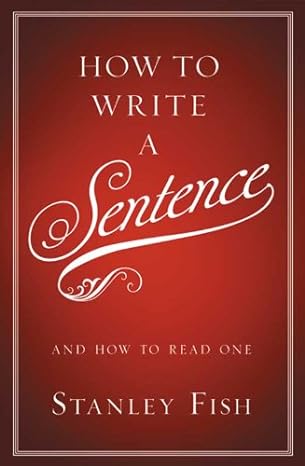
Review: How to Write a Sentence and How to Read One

When I was in school, the types of sentences we learned about were declarative, interrogative, imperative, and exclamatory. There were also simple, complex, and compound sentences.

Recently I learned about right-branching sentences.

But Stanley Fish doesn’t write about any of these in How to Write a Sentence and How to Read One.

First he spends time explaining what a sentence is: organization of words in logical relationships.

If one understands that a sentence is a structure of logical relationships and that the number of relationships involved is finite, one understands too that there is only one error to worry about, the error of being illogical, and only one rule to follow: make sure that every component of your sentences is related to the other components in a way that is clear and unambiguous (unless ambiguity is what you are aiming at) (p. 20).

He suggests practicing various forms of sentences without regard to content at first to get used to logical progressions and connections. He compares this to learning scales in music.

He expounds on the subordinating, additive, and satiric styles of sentences.

The subordinating style, he says, is technically called hypotaxis. This involves “the art of arranging objects and actions in relationships of causality, temporality, and precedence” (p. 50).

The additive style, also known as parataxis, involves a “coordinate, rather than a subordinate construction” (p. 62).

The first displays “planning, order, and control”; the latter has the effect of “spontaneity, haphazardness, and chance” (p. 61), even though it might be just as carefully planned.

“Satire, the art in which ‘human vice or folly is attacked through irony, derision, or wit'” (p. 89), is a “content category . . . but there’s a lot of formal skill in writing satire” (p. 90).

Fish has a chapter on each of these styles with numerous examples from literature. He also has a chapter on effective first and last sentences, with abundant examples as well. Many of the examples are well-known; some are obscure.

My one quibble with his examples, though, is that many of them are from older writings and are so long, no editor would allow them today. One random example on page 145 (Kindle version) has 76 words and nine clauses. One can say a lot with that much material! 

Nevertheless, the point is taken that effective sentences are thoughtfully arranged, not randomly scattered. 

Some of my favorite quotes from the book:

Language is not a handmaiden to perception; it is perception; it gives shape to what would otherwise be inert and dead (p. 42).

Content must take center stage, for the expression of content is what writing is for (p. 134).

What you can compose depends on what you’re composed of (p. 138).

Evanescence can be produced by language that in its mundane use sits inert on the page (p. 146).

I think I’ll need to read this book again to benefit from it more. It had the misfortune of being dipped into in bits and pieces among other reads. But I think my brain needs a rest first. I was glad I read this via the Kindle app, where I could tap some of the words I’d never seen before and use the built-in dictionary to find out what they meant.

But I can recommend this book for thoughtful examination of what sentences are and how they can be effectively composed.

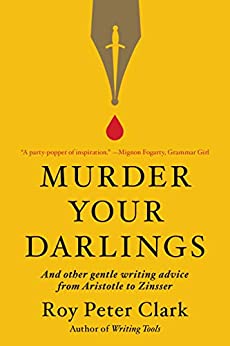
Murder Your Darlings

Murder Your Darlings is not a detective mystery or true crime drama.

Murder Your Darlings is writing advice. You see it a lot in writing circles these days, but it originally came from Sir Arthur Quiller-Couch, a British author and professor (known as Q, not to be confused with the WWII spy-gadget-maker). This phrase was first delivered in a lecture to his students in 1914 which was later published. In context, he said, “Whenever you feel an impulse to perpetrate a piece of exceptionally fine writing, obey it—whole-heartedly—and delete it before sending your manuscript to press. Murder your darlings” (p. 17).

Roy Peter Clark interprets Q’s advice thus: “Ask yourself, ‘Am I including this because it provides the reader with a memorable and delightful piece of evidence to prove the point of my text? Or is it beside the point even though it reveals what a good wordsmith I am?'” (p. 21).

In other words, the phrase, sentence, or paragraph that’s the most precious to you, but doesn’t really add anything to your thesis, must go. Clark opines that you don’t have to “commit verbicide on the words you love the most” (p. 17). You can save them in a file for another day.

Clark, known as “America’s writing coach,” shares advice from over 50 other writing sources in Murder Your Darlings: And Other Gentle Writing Advice from Aristotle to Zinsser. Clarks says, “I am not trying to steal their thunder. I am trying, instead, to amplify it, to pay back my debt to the authors who shaped my craft” (p. 8).

Some of these books are filled with writing advice, and Clark pulls out a lesson or two to discuss. “Most of what you will read here is why I appreciate them, what I or others have learned from them, and what I think you, the reader, can take away and apply to your own work” (p. 23).

Clark begins each chapter with a “toolbox,” a brief summary of the particular principle or writing instruction he’s going to discuss. Then he’ll give a little background about the work he is drawing from, the author, illustrations of the writing advice under consideration, whether he agrees or disagrees and to what extent. He ends each chapter with a short list of “Lessons” summarizing the main points of the chapter.

Clark’s book is quite readable. The Lessons at the end are particularly helpful to remind oneself of the salient tips from a chapter. Some of the writers he quotes from are well-known, others are not.

As you can imagine, I have multitudes of passages highlighted from the book. Here are a few:

It turns out that the internet is not an information superhighway. It is, instead, a polluted ocean with buried treasure sitting here and there on the bottom. Neutralize the poison of the propagandists, hackers, conspiracy theorists, trolls, and bullies by devoting your online efforts to the public good (p. 83).

Early writing is not sculpture, but clay, the stuff in which you will find the better work (p. 105).

An implied social contract exists between the reader and an author of nonfiction and that the contract reads, “Please believe me, my memory of events may be flawed, but none of this was intentionally made up.” If the author decides to veer from this standard, say, by using composite characters, the author must be transparent, revealing the strategies before the story begins, not in a footnote at the end (p. 222).

Donald Murray . . . advised writers to use “Shorter words, shorter sentences, shorter paragraphs at the points of greatest complexity” (p. 231).

Another Roman author, Horace, steps into the light with a sense of mission that is both public and aesthetic, arguing that the purpose of great literature is to delight and instruct or, on the good days, to do both! (p. 237).

This is a secular book, and there are words I wouldn’t use and situations and philosophies I wouldn’t agree with. But I found it fairly easy to sidestep those things just to glean the writing advice.

Clark’s book will help you hone your craft by sharing wisdom with you from sources that you might not have found yet. And the sources he quotes might inspire you to look up the authors’ original works.

Book Review: Write Better

In every writer’s conference, writer’s blog, or book about writing I have encountered, writers are told to continually improve their craft. Wherever we are on our writing journey, we need reminders, encouragement, and instruction. We can too easily grow complacent. Plus, changes in what’s acceptable can occur so quickly, we need to keep on top of current trends.

At the last writer’s conference I attended virtually, one industry professional said she read a book about writing or speaking every month. I thought I was doing good to read one a year!

Last year, several people recommended Write Better: A Lifelong Editor on Craft, Art, and Spirituality by Andrew T. Le Peau. Blogger and author Tim Challies said, “It is every bit the book many Christians need as they consider writing, and every bit the book many Christian writers need as they attempt to grow in their skill.” Literary agent Steve Laube called it the “book of the summer” of 2020.

Mr. Le Peau worked for InterVarsity Press for over forty years, spending much of that time as the associate publisher for editorial. He’s also written several books and Bible studies. So he knows what he’s talking about.

He also writes from and for a distinctly Christian point of view.

Le Peau divides his book into three parts: Craft, Art, and Spirituality.

Craft deals with the “nuts and bolts” of writing: creating good openings, endings, and titles, the craft and character of persuasion, narrative nonfiction, etc.

Art goes into creativity, tone, metaphor, restraint, and more.

Spirituality discusses calling, voice, authority, courage, and stewardship.

Several appendices cover platform, editors, coauthoring, self-publishing, and copyright.

I agree with the high praise that others have given this book. Le Peau not only writes well and has heaps of experience: he reads extensively and gives multitudes of examples of what he’s teaching. He writes professionally but without lapsing into academese.

I have many more places marked than I can share, but I wanted to note a few points that especially stood out to me.

After observing that “persuasion is part of almost every piece of nonfiction” (p. 37), Le Peau encourages writers to be honest persuaders.

If we want to be honest persuaders, we will be on the lookout for and stay away from hasty generalizations, false analogies, demonizing opponents, avoiding or sidelining the central issue (that is, using red herrings), and more. Honesty means respecting the truth as best we can know it, respecting contrary viewpoints, giving due credit, and using logic (p. 44).

He points out that “presenting the arguments for these other viewpoints in as strong a form as possible” (p. 55) is not only honest, but doing so actually strengthens our own arguments and the solutions we offer.

Even though this book primarily covers nonfiction, Le Peau encourages using stories. Stories pull us in and touch the heart. Stories “are bound to stick with us long after the information has been forgotten” (p. 60).

His chapter on creativity helped diffuse some of its mystery: “Essentially, creativity isn’t concocting something entirely unprecedented. Rather it is bringing together two things that have been around for a while but previously hadn’t been combined. Innovation almost always involves building on the past” (p. 117).

A few other quotes:

Grammar has one—and only one—purpose: to facilitate clear, effective, powerful, artful communication (p. 129).

Metaphors, similes, and analogies sharpen the sword of our writing. They allow us to cut quickly through the fat to the meat of our purpose (p. 146).

When we are too focused on readers getting our point, we can become didactic and perhaps preachy, engaging only one dimension—perhaps just the mind or just the will. Art engages the whole person—will, heart, soul, mind, and strength (p. 158).

Regardless of what we are writing, however, we must treat our readers with dignity. Don’t announce that you are going to tell a funny joke or story. Give readers the dignity of deciding for themselves if it is humorous. Besides, doing so makes it less funny because you have given away the element of surprise. Don’t say a story will be sad or happy or startling. That inoculates the reader against sadness or happiness or shock. Just tell the story (p. 159).

The goal of writers is not complete originality but to take the past and give it a shake, a fresh look that helps us see  reality differently and better (p. 185).

Criticism is not just something to be endured. It is something to help us grow and improve (p. 214),

Though all the book is valuable, perhaps the most valuable part of it is the last section on spirituality, having the right perspective whether in success or failure, remembering we’re stewards of God’s truth and the talents He gave us. “Remember, my identity is in Christ. I am not defined by what I write. I am not defined by the praise or criticism or sales of my book or the number of hits on my blog. My identity is in Christ, who loves me with an everlasting love, who made me, who put the urge to write in me, and who helped me get it out” (p. 225).

I wish I could read a book like this and keep all of its information readily accessible in my mind. Since I haven’t figured out how to do that, I should plan to reread this one every year. Highly recommended.

You can read more from Mr. Le Peau at his blog, Andy Unedited.

(Sharing with Carol’s Books You Loved, Booknificent)