Reading Challenge Update

2014tbrbuttonRoof Beam Reader, who hosts the 2014 TBR Pile Challenge, has check-in points around the 15th of each month so we can summarize how we’re doing.

Of the 12 books I’ve listed here, I’ve completed Ida Scudder, am about halfway through Made to Crave and Walking From East to West, and am a few chapters into Crowded to Christ. So I think I’m pretty much on track there.

classics2014I might as well update the other challenges, too: for the Back to the Classics Challenge, I’ve completed two from the required categories of my list (The Blue Castle by L. M. Montgomery and The Scarlet Pimpernel by Baroness Orczy), and am about 3/4 of the way through The Woman in White by Wilkie Collins (which I am finding riveting!) From the optional categories I’ve completed A Study in Scarlet by Sir Arthur Conan Doyle and am about 1/4 of the way through Farmer Boy by Laura Ingalls Wilder. That leaves me three from the required and two from the optional lists, so I think I am in good shape there, too.

The Blue Castle by L. M. Montgomery was also read in connection with Carrie’s  L. M. Montgomery Reading Challenge and Reading to Know Classics Book Club and Farmer Boy is part of my Laura Ingalls Wilder Reading Challenge. Crowded to Christ is also part of the The Cloud of Witnesses Challenge. And Crowded to Christ, Made to Crave, Ida Scudder and Walking From East to West are all eligible for the Nonfiction Reading Challenge in which I am aiming to read 11-15  nonfiction books.

It’s funny how just having made these lists is spurring me on to more purposeful reading. And now I am going to have to read more Sherlock Holmes and Wilkie Collins when I get done with these challenges!

The Third Laura Ingalls Wilder Reading Challenge

Welcome to the third annual Laura Ingalls Wilder Reading Challenge! We hold it in February because her birthday  (February 7, 1867) and the day of her death (February 10, 1957) both occurred in February, so this seemed a fitting time to commemorate her.

Many of us grew up reading the Little House books. I don’t know if there has ever been a time when there wasn’t interest in the Little House series since it first came out. They are enjoyable as children’s books, but they are enjoyable for adults as well. It’s fascinating to explore real pioneer roots and heartening to read of the family relationships and values.

Some of Laura’s other writing has been bundled into books, as well: her newspaper columns have been compiled in Little House in the Ozarks: the Rediscovered Writings of Laura Ingalls Wilder by Stephen Hines, and some of her letters have been compiled in West From Home and other books (links are to my reviews).

Then, of course, there are any number of biographies and books about Laura or the Ingalls family. Let the Hurricane Roar by Laura’s daughter, Rose Wilder Lane, and isa fictionalized account of some of her grandparent’s experiences. The Wilder Life: My Adventures in the Lost World of Little House on the Prairie by Wendy McClure, Laura fan extraordinaire, is unique in that it is one woman’s attempt to capture as many “Laura moments” as she can by doing some of the activities Laura did (like churning butter) and going to some of the sites where Laura lived. I Remember Laura by Stephen W. Hines is a collection or articles and interviews of people who actually knew Laura. Those are just a few that I’ve read: there are many more out there I’d like to get to some day. I listed a few others under Books Related to Laura Ingalls Wilder, but that list is by no means exhaustive.

For the reading challenge in February, you can read anything by, about, or relating to Laura. You can read alone or with your children or a friend. You can read just one book or several throughout the month — whatever works with your schedule. If you’d like to prepare some food or crafts somehow relating to Laura or her books, that would be really neat too.

Let us know in the comments whether you’ll be participating and what you think you’d like to read this month. That way we can peek in on each other through the month and see how it’s going (that’s half the fun of a reading challenge). On Feb. 28, I’ll have another post where you can share with us links to your wrap-up post. Of course if you want to post through the month as you read, that would be great. You don’t have to have a blog to participate: you can just leave your impressions in the comments if you like. And I just may have a prize at the end of the month for one participant. 🙂

My own plans are to read The Farmer Boy about Almanzo’s childhood. I may go on to By the Shores of Silver Lake, but I haven’t decided yet – I’m participating in so many other reading challenges this year, I want to be careful to pace myself.

Feel free to grab the button for the challenge to use in your post:

Laura Ingalls Wilder Reading Challenge
<div align="center"><a href="http://wp.me/p1mPv-32b" title="Laura Ingalls Wilder Reading Challenge"><img src="https://barbaraleeharper.com/wp-content/uploads/2011/11/liw.jpg"   alt="" width="144" height="184""" alt="Laura Ingalls Wilder Reading Challenge" style="border:none;" /></a></div>


Reading to Know - Book ClubBy the way, Carrie  chose Little House on the Prairie as her Classics Book Club selection for February to dovetail with this challenge, so if you’d like to read that book you can complete something for two challenges with one book. 🙂

What’s On Your Nightstand: January 2014

What's On Your NightstandThe folks at 5 Minutes For Books host What’s On Your Nightstand? the fourth Tuesday of each month in which we can share about the books we have been reading and/or plan to read.

Usually I anticipate the Nightstand posts and have them ready, but for some reason this month I completely forgot about it until I saw Nightstand posts listed on several of my friends’ blogs in my Feedly! So I’m going to whip this one together.

It has been a good month for reading!

Since last time I have completed:

Unglued: Making Wise Choices in the Midst of Raw Emotions by Lysa TerKeurst, reviewed here.

Jennifer: An O’Malley Love Story by Dee Henderson, short review here.

Unspoken by Dee Henderson, reviewed here.

The Blue Castle by L. M. Montgomery, reviewed here. for Carrie’s January selection for her Reading to Know Classics Book Club her L. M. Montgomery Reading Challenge.

Lost and Found by Ginny Yttrup, reviewed here.

The Incorrigible Children of Ashton Place: Book IV: The Interrupted Tale by Maryrose Wood, short review here.

A Study in Scarlet, the first Sherlock Holmes book by Sir Arthur Conan Doyle, audiobook, reviewed here.

The Scarlet Pimpernel by Baroness Orczy, audiobook, reviewed here.

A Tale of Two Cities, audiobook, by Charles Dickens for Carrie’s Reading to Know Book Club for December.

Bonhoeffer: Pastor, Martyr, Prophet, Spy by Eric Metaxas was finished months ago but I just reviewed it here.

Two devotional books I read through last year were A Quiet Place: Daily Devotional Readings by Nancy Leigh DeMoss and One Year Christian History by E. Michael and Sharon Rusten, both reviewed just briefly here.

I also listed my top ten books read in 2013 here.

I’m currently reading:

Made to Crave: Satisfying Your Deepest Desire With God, Not Food by Lisa TerKeurst along with a online Bible study using Made to Crave hosted by Proverbs 31 Ministries. I will probably post a general review of the book here when I finish it, but I’m blogging about the individual chapters on my I Corinthians 10:31 blog under the label Made to Crave study.

Walking From East to West: God in the Shadows by Ravi Zacharias

Crowded to Christ by L. E. Maxwell

Ida Scudder: Healing Bodies, Touching Hearts by Janet and Geoff Benge

Next up:

The Woman in White by Wilkie Collins. I’ve never read him before but he was a contemporary of Dickens and all reviews of this  book are high.

Farmer Boy by Laura Ingalls Wilder for my Laura Ingalls Wilder Reading Challenge (more on that below).

Other than that I am not sure, but it will be something from the book challenges I am participating in here and here. Those challenges are really spurring me on!

I invite you to participate in the Laura Ingalls Wilder Reading Challenge which runs through February, where we read books by or about or somehow related to LIW. I’ll have a post up Feb 1. where you can share what you plan to read and check out what others are reading.

Laura Ingalls Wilder Reading Challenge
Happy reading!

Book Review: The Scarlet Pimpernel

PimpernelThe Scarlet Pimpernel by Baroness Orczy is the forerunner of the heroes with a secret identity genre, at least according to Wikipedia. It was originally published as a play in 1903, then as a novel in 1905.

A scarlet pimpernel is a small red flower in England, and it’s also adopted as the name and sign of an English man who dons different disguises to help rescue those slated for the guillotine in France during the Reign of Terror of the French Revolution in 1792. He is rumored to have 19 men under his command, and his exploits have made him the talk of England, with everyone wondering about his true identity.

Citizen Chauvelin is an agent who has come from France specifically to find out the identity of the Scarlet Pimpernel and to stop him. He calls on an old friend, Lady Marguerite Blakeney, a Frenchwoman married to the very rich but very foppish English Sir Percy Blakeney. Chauvelin is convinced that in the circles in which Marguerite moves, she is sure to hear something that might be helpful to him. To ensure her cooperation, he threatens the safety of her brother with papers that show that he is in league with the Scarlet Pimpernel and therefore in danger of his life.

Marguerite wrestles with her conscience: she is as enamored of the Scarlet Pimpernel as everyone else and does not want to be the downfall of a brave man. Though she is French, she feels her countrymen have gone way too far in the Revolution. On the other hand, her she loves her brother dearly, and he is her only remaining family member.

She considers turning to her husband for help, but they have been estranged since the first days of their marriage, although they put up a good front for everyone else. Marguerite had once spoken out against the Marquis de St. Cyr, unwittingly causing him to be arrested and sent to the guillotine. Her husband can’t forgive her for that and doesn’t trust her. Besides, he’s slow, lazy, and dimwitted, so she doesn’t feel she can confide in him.

I’ll leave the plot there so as not to spoil it. I wouldn’t say Baroness Orczy is the best writer – there are places in the book that are tedious, other places a bit overwrought – but this is certainly an exciting book, with intrigue, suspense, danger, and everything we love about heroes in disguise.

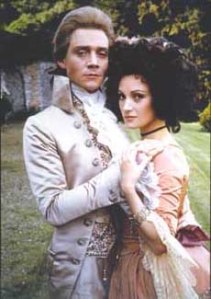
Scarlet PimpernelI first came across this story years ago as a film starring Jane Seymour and Anthony Andrews (and a young Ian McKellen [Gandalf] as Chauvelin), which I loved. There is a good bit more swashbuckling and derring-do in the film than in the book, and the film shows the audience who the Scarlet Pimpernel is right off the bat, whereas the book slowly unfolds it. The film is based not only on the book The Scarlet Pimpernel but also Eldorado (which I haven’t read), which includes more about Marguerite’s brother and the rescue of the captive Dauphin. Many of the details are changed or in a different order, but they did keep the overall story arc the same, and they especially captured the angst of Marguerite and Percy’s love for each other that they each keep hidden at first because of their misunderstandings.

For those who would want to know, there is smattering of “damns” and “dems” and “demmed.” There are also what I did not recognize as minced oaths, but when I looked them up I saw that they were. I wish those weren’t there. :-/ But otherwise this is a fun story.

I listened to the audiobook read by a Mary Sarah, who was not the best narrator, but the book was still enjoyable.

(This will also be linked to Semicolon‘s Saturday Review of Books.)

This also completes one of my requirements for the  Back to the Classics Challenge hosted by Karen at Books and Chocolate.

classics2014

Book Review: The Blue Castle

Carrie chose as the January selection for her Reading to Know Classics Book Club The Blue Castle by Lucy Maud Montgomery of (Anne of Green Gables fame), which dovetails nicely with her L. M. Montgomery Reading Challenge also held in January. This book is one of the few LMM wrote for adults and the only one set totally outside Prince Edward Island. It was originally published in 1926.

Blue CastleThe Blue Castle opens with a very depressed Valancy Stirling. It’s her 29th birthday, and she has no friends, has never had a boyfriend or anyone even remotely interested in being one, and she is surrounded by a large and eccentric family, including a domineering mother who goes into “fits” of silent treatment over the slightest perceived violation of her wishes. Her actions are hemmed in by what her gossipy clan would say and whether her uncle might cut her out of his will if she displeases him. With no hope of anything ever changing for the rest of her life, no wonder she’s depressed.

She gets just a bit of a respite by reading books primarily about nature by author John Foster (when her mother will let her), but usually she escapes to her blue castle, the place in her daydreams where she’s beautiful and pursued by handsome princes.

This 29th birthday isn’t helped by the fact that it is raining relentlessly, but that at least saves her from the anniversary picnic of her aunt and uncle. She has been having occasional pains in her chest, and she chooses this day to sneak out to a local doctor (not the family-approved one) to see about it. The doctor is called away on a family emergency just after her exam, but he writes her to tell her that she has angina, probably only has a year to live, and should avoid stress and strain. Thus changes everything for Valancy. No longer does she have to worry about being cut out of anyone’s will or following the same dreary, monotonous routine for the rest of her life. She begins saying exactly what she thinks and doing exactly what she wants, to the point that her family thinks she is losing her mind. Then when poor disgraced Cissy Gay, daughter of the town drunk, is dying, Valancy scandalizes her family by going to live with them to be a housekeeper, cook, nurse, and companion to Cissy. Worse, she takes up with that Barney Snaith, whom everyone is convinced has a sordid past.

When Cissy dies, Valancy does not want to return home, so she proposes to Barney Snaith, telling him she only has a year to live. She loves him but does not expect him to love her. He takes her up on her offer, and they move to his island, which reminds Valancy very much of her blue castle.

They spend the next year exploring the island, getting to know one another, and being very happy. The writing here sounds more like the LMM I know and love, with her descriptions of nature and their wanderings and their happiness at home.

Then, when a year is about up….well, I won’t spoil the story for you. 🙂 Let’s just say it takes an unexpected twist.

I had a hard time liking the book at first. The first part was so depressing, and then when Valancy started to assert herself, she went overboard (though that’s not entirely surprising considering how long and severely she was repressed). But somewhere during the time she went to take care of Cissy and then her marriage I started enjoying it more, and I really liked how it ended. I did guess who Barney really was earlier in the book, but his family connections totally surprised me.

There almost seems to be an anti-religious tone in the book, as all the Stirlings are upstanding church members despite their gossip and harshness (even their minister is harsh and judgmental), but Valancy does tell Roaring Able (Cissy’s father) that there are good people in both their churches, and she does find a little church back in the woods whose pastor is simple and sincere and interested in ministering to people. I’d disagree with Barney that their happy life on the island was “what it must be like to be born again,” at least not in the Biblical sense, but he probably meant it along the lines of springtime renewal.

Thanks, Carrie is for choosing this book for the Classics Book Club! I don’t know when I would have come across it otherwise.

Reading to Know - Book Club    L. M. Montgomery Reading Challenge

(This will also be linked to Semicolon‘s Saturday Review of Books.)

This also completes one of my requirements for the  Back to the Classics Challenge hosted by Karen at Books and Chocolate.

classics2014

Book Review: A Study in Scarlet

Some years ago in another town, the local radio station would play classic radio programs on Friday nights, and occasionally some of these would be Sherlock Holmes stories. I enjoyed them, but I was never inclined to read any of the books about him. However, over the past few years we’ve seen several film and TV adaptions or shows loosely based on the Holmes’ character, and I was curious to find out what the “real” (or maybe I should say original) Sherlock Holmes was all about.

Study in ScarletA Study in Scarlet is the first Sherlock Holmes book written by Sir Arthur Conan Doyle. It was first published in a magazine, and it’s one of the few Sherlock Holmes stories to be made into a full length book: the rest are short stories.

The book is told from Dr. John Watson’s point of view and opens with his coming back to England to recover after being wounded as an army doctor in Afghanistan. He runs into an old friend and, after sharing that he is looking for someone to share living quarters and expenses, the friend introduces him to Sherlock Holmes, who is looking for a roommate. The friend forewarns Watson that Holmes is a bit eccentric, but Watson feels he can get along with him well enough.

Upon their first meeting Holmes tells Watson he perceives he has been in Afghanistan, but doesn’t explain how he came to that conclusion yet. The two move into 221B Baker Street, and as they get to one another, Watson discovers that Holmes knows very little about literature, astronomy, politics, and other subjects, but knows a great deal about chemistry and sensational literature and a bit about geology and botany. Holmes feels he only has so much room in his brain and only wants to put into it what will help him in his craft. Watson can’t quite figure out what Holmes does for a living until Holmes reveals he is a consulting detective. Watson doubts Holmes abilities until Holmes tells him all about a telegram deliverer by observation, and Watson has the opportunity to question the messenger about Holmes’s speculations which are, of course, correct. Watson then becomes Holmes’ biggest fan.

The telegraph Holmes receives concerns a case in which his opinion is wanted. Holmes invites Watson to come along to meet Inspectors Gregson and Lestrade at an abandoned house where a male corpse has been found. There is a bit of competition between Holmes, Gregson, and Lestrade, but of course Holmes notices clues and makes deductions that the others miss.

Just when Holmes has identified the killer (but hasn’t yet explained how he did so), the story abruptly shifts to a desert scene in America where the only two people left in a caravan, an older man and a young girl, are about to die from hunger and thirst. At first I thought maybe this was a book of short stories after all and this was the next story, but after a while characters pop up with the same names of some of the characters in the first part. The man and girl are rescued by a caravan of Latter-Day Saints (Mormons) who are traveling to Salt Lake City, and they invite them to come along on the condition that they adopt the Mormon religion. Not having much choice, they do so, and the man, John Ferrier, adopts the girl, Lucy. Lucy grows and Ferrier prospers until Lucy falls in love with a man who works in nearby mines. The man in not a Mormon, though, and Brigham Young tells Ferrier that this is against Mormon rules and he has thirty days for Lucy to chose one of two other men, or something dire will happen. Each day a number is painted somewhere on Ferrier’s property, counting down to the 30 days.

Though at first I resented this time away from Holmes and Watson, the story about Lucy did get interesting and suspenseful. I won’t ruin it by telling what happened except to say that it does connect with the corpse in London that Holmes is investigating.

Then the story shifts back to Watson’s retelling of the arrest of the killer, his confession and his side of the story, and Holmes’ explanation for how he found him out.

I very much enjoyed this adventure with Sherlock Holmes and will probably delve into some of his other stories in the future. I listened to this story via an audiobook read very nicely by actor Derek Jacobi.

(This will also be linked to Semicolon‘s Saturday Review of Books.)

This also completes one of my requirements for the  Back to the Classics Challenge hosted by Karen at Books and Chocolate.

classics2014

Book Review: Bonhoeffer: Pastor, Martyr, Prophet, Spy

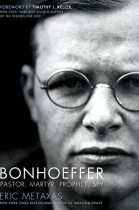
bonhoefferDietrich Bonhoeffer is one of those names I’ve heard for years but never really knew anything about, so when Bonhoeffer: Pastor, Martyr, Prophet, Spy by Eric Metaxas came up for sale at a good price on both Audible.com and Amazon’s Kindle store, it looked like a good time to learn more about him. (The Kindle price has gone back up but at this writing the audiobook at Audible is just $3.99.  The narrative parts were easy to listen to, but the philosophical parts were harder for me to grasp just by listening, so I was glad to have the Kindle version with which to read and ponder more slowly.)

I finished this book back in the fall, but noted so many places in it that even beginning a review by looking back at those notes was daunting. The book itself is some 600+ pages. So I finally decided that I wouldn’t summarize the book or his life except to say that he was a German Lutheran minister who helped to found what was called the Confessing Church, who opposed Hitler to the point of participating in the conspiracy to assassinate him, who was executed because of his part in that plot, and whose theology has been argued about ever since. You can find many further summations online (Wikipedia’s article on Bonhoeffer is a nice one). I’m just going to share some of my own impressions and things I liked and didn’t like.

I was intrigued by the family discussions he grew up with. His mother was a Christian, but his father, Karl, was not, yet his father “respected his wife’s tutelage of the children in this and lent his tacit approval of it” and attended the family religious activities, though the family did not attend church. Karl Bonhoeffer was a psychiatrist and “taught his children to speak only when they had something to say. He did not tolerate sloppiness of expression any more than he tolerated self-pity or selfishness or boastful pride.” He also wanted his children to keep their emotions under control, feeling that “Emotionalism, like sloppy communication, was thought to be self-indulgent.” He had a strong dislike of cliches and didn’t allow his children to use them, which puzzled me at first until I understood that he wanted his children to think for themselves rather than just parroting catch-phrases. These all worked together to cause his children to be razor-sharp thinkers.

Some followed their mother, some their father. When Dietrich announced at age 14 that he was going to be a theologian, his lawyer brother questioned his choice and called the church a “‘poor, feeble, boring, petty bourgeois institution.’ ‘In that case,’ said Dietrich, ‘I shall have to reform it.'”

I liked that spirit about him, which led him to start the Confessing Church when the German Christians began to let themselves be Hitler’s puppets. He wasn’t one to sit back and grouse about issues when he could take action. On the other hand, that spirit is probably part of what led him into the conspiracy against Hitler.

I can understand the problems with Hitler’s regime and atrocities and the feeling that this could not be allowed to continue. I can condone a staging a coup to take him down. I can appreciate the difficulties in doing so because Hitler’s popularity with the public was at a high by the time his generals knew what was going on behind the scenes and knew that something must be done. They tried to limit him before WWII began and failed, and by that time any movement against him would have been at the peril of their own lives. I wrestle with whether an assassination attempt was the right response. With some of the conflicts in the world in my lifetime, I’ve often wondered whether taking out the one guy at the head of the trouble would be a better recourse that having multitudes die in a war, and I have always been glad that I wasn’t the one who had to make such decisions. So I can appreciate the moral wrestlings people of conscience would have had in that day, yet I still have trouble with a professing Christian pastor conspiring to have a leader killed, especially in light of the kind of political leadership Paul was under when he wrote in his epistles about what a Christian’s stance should be under it: he didn’t say anything about attacking those in charge or taking them out. Even though Bonhoeffer wasn’t the one pulling the trigger or planting bombs personally, he said that to aid as he did he’d have to be willing for such. “If necessary, he would be willing to kill Hitler…Bonhoeffer had to be clear that he was not assisting in the fulfillment of a deed he was unwilling to do” (p. 388, Kindle version).

I can’t really regard him as a martyr: he was persecuted for his faith, in being cut off from preaching, teaching, and writing, but he was executed for his part in the conspiracy against Hitler, not for his faith (unless you believe, as Metaxas evidently does, that his faith was what drove him to be a part of that plot).

I do appreciate his integrity in realizing that any action of this kind he took had to be his action alone and not something he could lead the church into. I also appreciated his testimony of unfailing kindness while imprisoned.

I am confused about his theology: some statements he made in the book I liked and agreed with, like the difference between cheap grace and costly grace, but some had me scratching my head. Evidently I am not the only one, because in a few articles I have read since finishing the book, there are some who argue over whether he was conservative or liberal and what his views were on various important doctrines. I was confused, too, at how he could discern problems with wrong theology yet still align himself churches that taught wrong theology.

I really disagreed with him here:

Bonhoeffer knew that to live in fear of “guilt” was itself sinful. God wanted His beloved children to operate out of freedom and joy and to do what was right and good, not out of fear of making a mistake. To live in fear and guilt was to be “religious” in the pejorative sense that [he] often talked and preached about. He knew that to act freely could mean inadvertently doing wrong and incurring guilt. In fact, he felt that living this way meant that it was impossible to avoid incurring guilt, but if one was wished to live responsibly and fully, one would be willing to do so (p. 424-425K).

Only the man whose final standard is not his reason, his principles, his conscience, his freedom, or his virtue, but who is ready to sacrifice all this when he is called to obedient and responsible action in faith and in exclusive allegiance to God – the responsible man, who tries to make his whole life and answer to the question and call of God (pp. 445-446K).

God…demands responsible action in a bold venture of faith and…promises forgiveness and consolation to the man who becomes a sinner in that venture…one must sacrifice oneself utterly to God’s purposes, even to the point of possibly making moral mistakes (p. 446).

I do agree Christians should operate out of love for God rather than a neurotic fear of misstepping, but I don’t thing “freedom in Christ” precludes walking circumspectly or working out our salvation with fear and trembling. I don’t honestly think Bonhoeffer would say that, either, but there is a balance there and statements like these seem to lean too far one way. I can understand being willing to sacrifice reputation (as Mary, Jesus’s mother did), but I don’t see that God calls us to sacrifice virtue, when He is the one who has called us to virtue, and to sacrifice oneself to Him to the point of making moral mistakes seems incongruous.

I enjoyed the historical aspects of the book, particularly  about how Hitler came to power. I had always wondered how such a man could have been elected to leadership or not deposed at some point. I don’t know where I was during some of my history lessons, but I didn’t know (or had forgotten) that Germany was quite unhappy with their lot after WWI, and part of what brought Hitler to glory was his reclaiming some of the territory Germany had lost. Then he staged certain events or recast them to the public to make it look like he had no choice but to take certain actions. It was also fascinating how he somehow escaped so many assassination attempts on his life.

I was perturbed by some aspects of Metaxas’s writing. He seemed to assume the reader knew certain aspects of Bonhoeffer’s life already and would refer to them way beforehand, plus he would mention someone and say something like “In 20 years he will be the person who does such and such.” I know a biography is a different genre than a novel or story, but some story-telling techniques can make it more interesting (and not ruin the suspense by spilling the beans too soon). He seemed to feel as if Bonhoeffer could do not wrong except that he sometimes “spoke hyperbolically, for effect, and sometimes it backfired” (p. 364K). He also got a little carried away sometimes with sentences like, “Behold, that unpredictable magus, Adolph Hitler, would now with a flourish produce from his hindquarters a withered olive branch and wave it before the goggling world” (p. 356K) and, commenting on Hitler’s atrocious table manners, “the famously vegetarian Reichsfuhrer indecorously bolted his meatless mush.”

Some of the articles I found online that discussed Bonhoeffer or disagreed with much of what Metaxas wrote are:

Hijacking Bonhoeffer.
Metaxas’s Counterfeit Bonhoeffer: An Evangelical Critique.
Bonhoeffer: Approaching His Life and Work (a second article titled Bonhoeffer and the Scriptures is underneath the end notes of the first article).
So Many Different Dietrich Bonhoeffers.

I don’t feel so bad about my confusion of where Bonhoeffer stands if even the experts don’t agree on it. 🙂 But there are enough quotes of his dismissing certain core doctrines that I wouldn’t call him an evangelical (in Hijacking Bonhoeffer, the author makes the argument that Mataxas painted Bonhoeffer as much more conservative than he was to make him more appealing to conservatives, therefore “highjacking” him from the liberals who claim him as their own.)

So…I’m glad to have read the book, particularly for the historical aspect but also to get something of a window into who Bonhoeffer was, though the window itself may not have been the clearest, according to these other sources.

(This will also be linked to Semicolon‘s Saturday Review of Books.)

Book Reviewed: Unglued

UngluedUnglued by Lysa TerKeurst was one of those books I heard good things about, got when it was either free or on sale for the Kindle app, and then let sit there for months. I’m not sure what prompted me to read it now, but I am glad I did.

The subtitle is Making Wise Choices in the Midst of Raw Emotions. Most of us have had experiences with out-of-control emotions, both externally from others or internally within ourselves. Some of us are “exploders” who lash out at others in some way, and some of us are “stuffers” who seethe inside, or some combination of the two.

Emotions in themselves aren’t wrong: God gave them to us for various reasons. But just like with the rest of His gifts, we can use them in wrong ways.

Lysa starts with the idea of making “imperfect progress.” Sometimes we beat ourselves up over missteps and failures, but we need to remember it’s okay to take baby steps and to get up and start over as many times as needed, as long as we’re moving forward.

A big part of diffusing our emotions is taking control of the thoughts that feed them. “We won’t develop new responses until we develop new thoughts. That’s why renewing our minds with new thoughts is crucial. New thoughts come from new perspectives” (p. 22K – the K means Kindle version. I’m not sure if the page numbers are the same in the book itself). “Scripture also teaches that we can accept or refuse thoughts. Instead of being held hostage by old thought patterns, we can actually capture our thoughts and allow the power of Christ’s truth to change them: We demolish arguments and every pretension that sets itself up against the knowledge of God” (p. 23K).

The other biggest factor in getting our emotions under control is spending time in God’s Word, and Lysa shares many applicable Scriptures.

Here are some other helpful quotes:

“I can face things that are out of my control and not act out of control” (p. 23).

“Could I trust God and believe He is working out something good even from things that seem no good? You see, if I know there is a potential good hidden within each chaotic situation, I can loosen my grip on control” (p. 24K).

“We can’t always fix our circumstances, but we can fix our minds on God” (p. 28K).

“Instead of condemning myself with statements like, I’m such a mess, I could say, Let God chisel. Let Him work on my hard places so I can leave the dark places of being stuck and come into the light of who He designed me to be” (p. 37K).

“I choose to view this circumstance as a call to action, not a call to beat myself up mentally” (p. 40K).

“In processing unglued reactions, soul integrity if the heart of what we’re after. Soul integrity is honesty that’s godly. It brings the passion of the exploder and the peacemaking of the stuffer under the authority of Jesus where honesty and godliness embrace and balance each other” (p. 52K).

“I stuff to protect myself by keeping conflict at bay. But if I’m stuffing and not being honest about my true feelings, that self-protection quickly turns into selfishness, and the unresolved conflict gives birth to bitterness” (p. 56K).

“Choosing a gentle reply doesn’t mean you’re weak; it actually means you possess a rare and godly strength” (p. 69K).

“Feelings are indicators, not dictators. They can indicate there is a situation I need to deal with, but they shouldn’t dictate how I react. I have a choice” (p. 72K).

“We must spend time with God, letting His truths become part of who we are and how we live. That’s what it means to have an internal experience with Him. Only then will we develop holy restraint” (p. 75).

“I acknowledge that I can only control myself. I can’t control how another person acts or reacts. Therefore, I shift my focus from trying to fix the other person and the situation to allowing God to reveal some tender truths to me…My job isn’t to fix the difficult people in my life or enable them to continue disrespectful or abusive behaviors. My job is to be obedient to God in the way I act and respond to those people” (p. 88K).

“I stuff as a false way to keep the peace. True peacekeeping isn’t about stopping the emotion. Remember, emotions move inward or outward – whether we want them to or not. True peacekeeping is about properly processing the emotions before they get stuffed and rot into something horribly toxic” (p. 91).

“Is my desire in this conflict to prove that I am right, or is my desire to improve the relationship?” (p. 92K).

“Instead of reacting out of anger, I pause and let the Holy Spirit redirect my first impulses. Then I tackle the issues – not the person” (p. 93).

“It is through God’s ‘great and precious promises’ (2 Peter 1:3-8) that I can participate in the divine nature. A nature very different from my own. I may not be gentle by nature, but I can be gentle by obedience. If – and only if – I equip myself with predetermined Biblical procedures that I can rely on when I start to feel the great unglued coming on” (pp. 104-105K).

“I started thinking that maybe I needed my own set of default procedures for when selfishness, pride, impatience, anger, or bitterness rear their ugly heads. Because in the moment I feel them, I feel justified in feeling them and find them hard to battle. But God’s promises – His truths and examples from Scripture – are powerful enough to redirect me to the divine nature I’m meant to have. Having a predetermined plan from Him will help me stay calmer when I start to feel unglued. More godly. More in line with Scripture” (p. 107K).

That’s probably way too many quotes – and that’s not even all I marked. But I hope some of them spoke to you as they spoke to me.

This is the first book by Lysa Terkeurst I’ve read, though I have two more on hand. I enjoyed her style, and I gleaned much from this one (I even went skimmed back through it after I finished to remind myself of some of the main points).

There were places where I didn’t agree with something she said, but I instead of going into them here, I’ll refer you to this review for more detail. Reading it has made me rethink this book.

(This will also be linked to Semicolon‘s Saturday Review of Books.)

Book Review: Unspoken by Dee Henderson

UnspokenI’ve mentioned before my history of reading Dee Henderson novels. Her latest is Unspoken, which involves a survivor of one of the most famous kidnappings in Chicago. Charlotte Graham was kidnapped at sixteen and found four years later but has never said a word about it to the police or much of anyone else in the eighteen years since. She has a new life and profession and tries to keep a low profile.

But her grandfather, who is evidently wealthier than most of the population, has died and wanted her to manage his estate, part of which is a massive amount of valuable old coins. That brings her to Bryce Bishop, a dealer in coins who has his own respectable family business in Chicago. Bryce had been bored and prayed for God to shake up his life a bit, and Charlotte’s coins, the way she offered them for sale, and the woman herself have certainly answered that prayer.

Charlotte has decided she is single for life, so at first she is uninterested in anything but a business relationship with Bryce. The time they spend together leads to a friendship and interest on Bryce’s part. It’s a while before she feels free enough to disclose anything about her past, and she does so in stages. She describes herself as “at best a messed-up Christian” because she can’t reconcile how God could love her and yet let this happen to her, and how He would have forgiven her kidnappers if they had repented.

As Bryce and Charlotte work through their issues, a well-known investigative reporter decides it is time to write a book about the case. Not only will the book open old wounds for Charlotte, but it opens the door for danger as well. There is a reason she hasn’t said anything to the police about her abduction, and this reporter’s book could not only jeopardize her privacy but also the safety of her loved ones.

Paul and Ann Falcon from Full Disclosure are characters in this book as well, as friends of Bryce. You don’t have to have read that book to understand this one, but it was fun to “see” them again.

As always, Dee had done a wonderful job with the story, the suspense, the characters, and the spiritual issues in a natural way. I can always count on her books to pull me right in and keep me interested all the way through. This one did get a little boggy in places with all the detail about coins: I understand some detail was needed to be authentic, but I could have used less in places. But overall I loved it!

(This will also be linked to Semicolon‘s Saturday Review of Books.)

TBR Challenge

I appreciated my friend Lisa‘s comment on my post about book challenges last week about the struggle with balance between wanting to be intentional in reading yet not wanting to feel hemmed in. I struggle with that, too. There are some books I’d never get around to reading without some of these challenges and lists, but I don’t want to have so many lists that I’m feeling overly pressured. I know sometimes God has directed me to a book I needed right at the moment that wasn’t on my radar, and I want to leave room for that and for the just-for-fun books (because I read both to learn and to relax.)

2014tbrbuttonI’ve been pondering for a few days what to list for the 2014 TBR Pile Challenge hosted by Roof Beam Reader. The challenge is to read 12 books in a year that have been on your shelves unread with a publication date before 2013. I chafe a little bit at that because I have books on my shelves published last year that I want to get to, and books I just got for Christmas that have pre-2013 publication dates but are new to me. But I do understand the need for guidelines of some kind, or else this would be just a general reading list. So I am trying to keep within the spirit of the post and choose books that I’ve had on my shelves or in my Kindle app for a while now. I came up with a list of 25, and that’s not including a box of books in my closet that I had forgotten about. 😳 So from those I’m narrowing it down to this list of 12, with two allowable alternate titles in case I decide against any of the others during the year (as per instructions, as I finish each book and review it, I’m adding the link to that review to the titles below):

1. Made to CraveSatisfying Your Deepest Desire with God, Not Food by Lisa TerKeurst (pub. 2010). Proverbs 31 Ministries is hosting a study of this book beginning Jan. 19, so I’ll be joining in that. (Finished March 1, 2014)

2. Crowded to Christ by L. E. Maxwell (pub. 1952), recommended by a former pastor. (Finished April 7)

3. Ida Scudder: Healing Bodies, Touching Hearts by Janet and Geoff Benge (pub. 2012). I had read a biography of hers (though not this one) some 25-30 years ago and wanted to refresh myself on her story. (Finished Feb. 3)

4. The House Is Quiet, Now What? by Janice Hanna and Kathleen Y’Barbo (pub. 2009). The subtitle is Rediscovering Life and Adventure As a Empty Nester. My nest isn’t totally empty yet, and I don’t see a shortage of things to do for a long time to come, but figured this would be helpful with perspective. One sentence I saw while flipping through it really spoke to me (about the “sandwich generation”), so I am looking forward to this. I had thought Lisa recommended this one, but maybe that was a different book. (Finished March 10)

5. How to Read Slowly by James W. Sire (pub. 1978). Even with making notes and marking with sticky tabs. I have a hard time feeling like I’ve really grasped everything I need to from nonfiction, so I am hoping this will help in that regard. (Finished July 20)

6. How to Be a Writer by Barbara Baig (pub. 2010). I like to read a book about writing every now and then to keep those embers stirred.

7. Walking From East to West: God in the Shadows by Ravi Zacharias (pub. 2009), because Sherry recommended it to me and because I like hearing how people came to the Lord, among other reasons. (Finished March 16)

8. The Great Divorce by C. S. Lewis (pub. 1946). I’ve read Narnia, the Space Trilogy, and Mere Christianity and now want to read some other Lewis books. (Finished May 6)

9. Loving the Church by John Crotts (pub. 2010), sent to me by Carrie a long time ago. 😳 (Finished June 17)

10. The Book of Three by Alexander Lloyd (pub. 2006), first book in the Prydain Chronicles, recommended by Janet. (Finished June 30)

11. Wednesdays Were Pretty Normal: A Boy, Cancer, and God by Michael Kelley (pub 2012). (Finished May 21)

12. Why We Are Not Emergent: By Two Guys Who Should Be by Kevin DeYoung and Ted Kluck (pub. 2008), partly because I have never heard anybody adequately explain what the emergent movement is, and I’ve heard this is a good critique. (Finished October 15)

Alternates: Girl in the Gatehouse by Julie Klassen (Finished Aug. 31) and Just Jane: A Novel of Jane Austen’s Life by Nancy Moser (Finished Aug. 4). (My wrap-up post for this challenge is here: https://barbarah.wordpress.com/2014/12/15/reading-challenge-wrap-up/)

You notice how many of these are nonfiction. That’s probably why they have been languishing on my shelves. 😳 I gravitate to fiction and biographies: I like nonfiction when I read it, but I usually have to “make” myself read it. So this list will be a challenge in more ways than one!

As per Roof Beam Reader’s instructions, when I finish and review each book, I’ll make its title above into a link to the review.

Nonfiction Challenge hosted at The Introverted ReaderLisa mentioned on her reading challenges post this morning a Nonfiction Reading Challenge which I hadn’t seen but given all the nonfiction  have listed here, I figured I may as well join up. 🙂

The Challenge:  Read any non-fiction book(s), adult or young adult. That’s it. You can choose anything. Memoirs? Yes. History? Yes. Travel? Yes. You get the idea? Absolutely anything that is classified as non-fiction counts for this challenge.

I always like levels in my challenges, so here are mine:

Dilettante–Read 1-5 non-fiction books

Explorer–Read 6-10

Seeker–Read 11-15

Master–Read 16-20

This challenge will last from January 1 to December 31, 2014. You can sign up anytime throughout the year.

With the books listed about plus a couple of others I want to read this year, I am aiming for the Seeker level.

Do you have books that have been on your “To Be Read” shelves for a while? Maybe you’ll consider joining in with challenge with us, and we can encourage each other along the way.