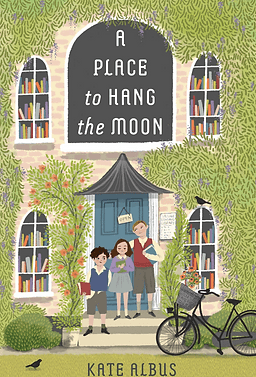
In A Place to Hang the Moon by Kate Albus, William, 12, Edmund, 11, and Anna, 9, live in 1940 England. Their parents died when William was 5. “The grandmother” had charge of them since, but she sent them off to boarding school and was cold and aloof when they were home.
Now the grandmother has died as well. The family solicitor, Mr. Engersoll, explains that the children have been left a lot of money, but no one has been named as their guardian. Apparently there is no one to ask. The children plead to stay with the family’s housekeeper, Mrs. Collins, but she’s too old to take them in.
Mr. Engersoll suggests that the children join evacuees being sent to the country. Perhaps the foster parents they find might take them in permanently. The children are advised not to tell anyone that they are alone in the world or that their family has money, so they don’t get taken advantage of.
The children agree with what Mrs. Collins calls “the preposterous plan,” as there seems to be no other option.
The children are billeted together first with one family, then another. I don’t want to spoil the story by telling what went on in those places, but neither is suitable.
The children spend many afternoons in the town library. Books have always been their friends, and the warmth and quietness of the library provide a refuge. The kind interest of the librarian, Mrs. Muller, makes the place even more welcome.
It’s not long, however, before they discern Mrs. Muller is something of an outcast. She’s married to a German man who has disappeared.
The children wish they could stay with Mrs. Muller, despite her husband’s possible Nazi leanings.
This story starts out like a classic fairy tale, with children alone in the world having to overcome various difficulties. I had thought it was a young adult book, but Amazon recommends it for grades 4-7.
I don’t often read secular books for this age group, but the Story Warren and Hope both spoke well of this story, piquing my interest. I agree with C. S. Lewis that a good children’s book can be enjoyed by adults as well. When the title came up temporarily free from Audible. I gave it a try.
I’m so glad I did. I loved this book. The story is well-told and the characters are beautifully drawn. Descriptions of both warm and cozy and difficult scenes make you feel you are experiencing them along with the children. References to beloved classic children’s books are scattered throughout. Polly Lee’s British accent enhanced the audiobook. I didn’t want the book to end.
Some of my favorite quotes:
The first words of a new book are so delicious—like the first taste of a cookie fresh from the oven and not yet properly cooled.
The librarian took this all in, standing by the fire and observing the children for a while, letting the silence be. Somehow, it didn’t feel awkward, the way silences often do. Perhaps librarians are more used to quiet than most.
William, Edmund, and Anna knew, somewhere deep in the place where we know things that we cannot say aloud, that they had never lived in the sort of home one reads about in stories – one of warmth and affection and certainty in the knowledge that someone believes you hung the moon.
Edmund took in the boy’s mended jacket, the eyes underlined in shadows, the skin above his upper lip chapped raw from a dripping nose gone unattended, and saw the sort of hunger whose endlessness digs a pit in a person. Being eleven, Edmund wouldn’t have put it quite in those words, but he recognized it nonetheless.
While she wasn’t sure of the precise definition of the word “bibliophile,” Anna was certain it meant something that she wanted to be.
The stealing of sweets, after all, is an act committed only by those with unspeakably black souls.
The smell of the cookies filled the children with a warmth that can only come from the magnificent alchemy of butter and sugar.
Truth be told, Anna was rather giving away the ending, but sometimes one cannot help oneself.
Anna thought of offering up a hearty platter of I told you so, but she didn’t. Why foul perfection with such a sharp thing as bitterness?
This is a lovely book. Not fluffy bunny and serene landscape lovely, but a wonderful tale beautifully told.
The Four Graces are daughters of the vicar of Chevis Green, England, during WWII. This book is sometimes listed as the fourth Barbara Buncle book, but Barbara only appears in one scene at the beginning at a wedding. The setting and some of the characters from the previous book carry on, however.
The vicar has been a widower for some time, and his grown daughters all help around the house and village–or at least they did, until one went into the service during WWII.
Liz works on the neighboring farm of Archie Chevis-Cobb, the local squire. She’s always up for adventure and is unconventional and outspoken.
Sal takes care of most of the home chores. She was sickly as a child and therefore did not attend school. She has a quiet, steady disposition and helps her father smooth the ruffled feathers of his congregants.
Addie enlisted in the WAAF and lives in London but pops in and out.
Tilly is quiet and shy and plays the organ.
Amid the war shortages and rationing, the Graces live a quiet, pleasant life. But then William Single, a scholar interested in Rome, comes to stay with them and study what he thinks is an old buried Roman settlement nearby. William is a large but gentle, bumbling man and fits into the household nicely.
A young officer, a friend of Addie’s comes to visit–too often for Tilly’s tastes. She’s afraid he has designs on one of her sisters.
But the household is totally disrupted by the arrival of Aunt Rona, the girls’ late mother’s sister. Bombing shattered all her windows of her London house, so she came to stay with the Graces. But she takes over and tries to manage everything and everyone. And then the girls fear Aunt Rona might be trying to worm her way into their father’s affections.
This book reminded me a bit of Little Women, if it had been set during WWII. The girls here are older, though, all in their twenties.
Some of the quotes I loved:
Life was like that, thought Liz. You drifted on for years and years—then, suddenly, everything happened at once and all the things that had seemed so stable dissolved and disintegrated before your eyes…and life was new.
I have noticed that nowadays when people speak of being broad-minded they really mean muddleheaded, or lacking in principles—or possibly lacking the strength to stand up for any principles they may have.
“Books are people,″ smiled Miss Marks. ″In every book worth reading, the author is there to meet you, to establish contact with you. He takes you into his confidence and reveals his thoughts to you.
She talked less than some of the others and perhaps thought more.
I listened to the audiobook nicely read by Karen Cass.
This was a secular book, so I would not agree with every little thing–like brief mentions of astrology and a universal religion. But otherwise, this is a sweet English village story that I enjoyed very much.
In fact, I am a little disappointed to leave this setting and these characters behind. I’d love for there to have been a sequel or at least a mention of the sisters in other books like Stevenson does with some of her characters. But we’ll just have to imagine the Graces continuing in in the ups and downs and pleasures and sorrows of life.
Usually when I talk about books or films here, I only share a part of the plot, some quotes, and my thoughts about them. I don’t want to give away the end or any surprises.
But “Babette’s Feast” is a short story. This post would only be a paragraph or two if I just shared a bit about it. Plus, I’d love to explore what it means and hear your thoughts as well.
“Babette’s Feast” is part of a collection published as Anecdotes of Destiny in 1958 by Isak Dinesen (pen name of Danish Author Karen Blixen). In 1987, it was made into an award-winning Danish film.
The story opens with two elderly sisters in Norway in the 1800s. Their late father was a pastor who created his own strict sect. “Its members renounced the pleasures of this world, for the earth and all that it held to them was but a kind of illusion, and the true reality was the New Jerusalem toward which they were longing.”
The women were beauitful and admired in their youth. Many young men noticed them, but those who approached their father for permission to court them were rebuffed. The girls were his right and left hand—would these young men tear them from him?
However, both young women had a chance at love. Lorens Löwenhielm, a rakish Calvary officer, was sent by his father to visit his aunt in the country and meditate on his ways. Lorens sees Martine in the marketplace. He visits her home and admires her all the more. But her purity seems to show up his own smallness. He eventually leaves to go back to his garrison and pour himself into his career. He marries a lady-in-waiting to the Queen.
An acclaimed singer, Achille Papin of Paris, visits the area on vacation. Bored one morning, he wanders into church and is captivated by the voice of Philippa. He offers to give her singing lessons, telling her father she will “sing . . . to the glory of God.” But inwardly, he thinks she could be a famous prima donna and sing with him.
He shares his dreams with Philippa. In one lesson, they sing a love song together and he kisses her.
Philppa tells her father she does not want to take singing lessons any more.
The young women ministered beside their father for years until he passed away. They continued charitable works in the community, helping the poor and needy, holding meetings in their home.
But the little congregation had thinned out and gotten old and contrary. Members focused on old wrongs with each other.
Now elderly, the women are startled when a pale woman shows up on their doorstep and faints. When she awakes, she gives them a letter. She was a French refugee fleeing from civil war in Paris. Achille Papin sent the sisters the letter asking them to take the women, Babette, in. It was proposed that she work as a cook and maid, but the sisters cannot afford to hire her. Babette does not want pay.
Babette recovers from her troubles and becomes a real asset to the sisters and the community. The sisters eat very plainly and show Babette how everything must be cooked. She’s savvy with merchants and saves the sisters money. Her efforts at home free them to minister even more to the community.
As the hundredth birthday of the sisters’ father approaches, they want to prepare a special dinner for the congregation. They not only want to honor their father’s memory, but they hope to inspire the congregation back to the ideals he taught.
Meanwhile, a friend of Babette’s in France had purchased a lottery ticket for her and renewed it every year. Suddenly, Babette receives news that she has won 10,000 francs.
The sisters rejoice in Babette’s good fortune but grieve that they will lose her. They are sure that with independent means, she will no longer need their hospitality.
But Babette wants to use her money to provide the feast for their father’s hundredth birthday dinner. The sisters reluctantly agree.
Babette wants to make an authentic French meal and orders supplies. The sisters are alarmed at the strange items that arrive, including a massive live turtle and several bottles of wine. The sisters face a conundrum. How can they allow these rich and foreign foods to be given to the congregation? But what can they do? They don’t feel they can offend Babette by rejecting her offer.
They go to the congregation and confess what has happened. The members understand and promise not to comment on the food, good or bad.
Meanwhile, officer Löwenhielm’s aunt wants to be included in the feast to honor the late pastor. And her nephew, Lorens, is in town: could he accompany her?
By now, Lorens has achieved all the honors he could want. But he sees it all as vanity. He remembers enough of what he heard back in the little congregation to convict him that there is more to life, and he has been foolish.
Finally the big feast arrives. Lorens is well-traveled and is the only one to recognize the superb quality of the wine and food. In fact, they remind him of the time he ate at a restaurant of one of the most famous and acclaimed chefs in Paris.
The sisters and congregants eat silently and tentatively at first. But soon the meal and the wine and the fellowship warms their hearts. They renew their love for each other and put away old wrongs.
When everyone leaves, the sisters thank Babette for the meal. They ask when she will be leaving them.
She won’t be leaving, she says. She has spent all her 10,000 francs on the meal. She had been the famous chef Lorens spoke of and gave the sisters and congregation the best meal she could produce.
_______
On the surface, this story could seem like a slam at the Puritanical practices of the sisters and an encouragement to enjoy life’s good things.
But I think the story goes deeper than that.
I don’t think it’s meant to be a slam, per se, but perhaps a different way of looking at things. The sisters’ religion looked on love and marriage as illusions. They were to concentrate on the life to come, not this one. But God gave us richly all things to enjoy, after all (1 Timothy 6:17). God’s Word and gifts do not just affect us on a spiritual plane. Some of His good gifts are physical and tactile. He wants us even to eat and drink as unto Him (1 Corinthians 10:31).
When the officer first visits the meeting at the sisters home, their father speaks of Psalm 85:10: “Mercy and truth are met together; righteousness and peace have kissed each other.” The translation in the book says “bliss” rather than “peace.” When the officer comes back to the feast so many years later, not a general, he stands up to speak and shares this same verse and talks about grace. So perhaps the author is bringing together the idea that righteous and bliss are not antithetical.
One facet of the tale is the ministry of food. Psalm 104:14-15 says God causes “the grass to grow for the livestock and plants for man to cultivate, that he may bring forth food from the earth and wine to gladden the heart of man, oil to make his face shine and bread to strengthen man’s heart.” Craig Claiborne said, ” Cooking is at once child’s play and adult joy. And cooking done with care is an act of love.”
One article talked about the women caring for each other in their own way. The sisters provided a home, even though their means were meager. Babette made meals to their preferences, even though it must have galled her to do so, until the feast. They all grew to care for and appreciate each other.
Another aspect is to not judge a book by its cover. Though austere, the sisters were genuine and kind. They were wary of Babette’s foreignness at first, but came to see her heart.
Dione Lucas said, “The preparation of good food is merely another expression of art, one of the joys of civilized living.” And this idea of giving through one’s art is mentioned in the story of Babette. She tells the sisters that the people she cooked for in France “had been brought up and trained, with greater expense than you, my little ladies, could ever imagine or believe, to understand what a great artist I am. I could make them happy. When I did my very best I could make them perfectly happy.” Later she quotes Monsieur Papin, “Through all the world there goes one long cry from the heart of the artist: Give me leave to do my utmost!”
When the sisters lament that Babette will be poor all her life, now that she has spent her fortune, she replies, “Poor? No, I shall never be poor. I told you that I am a great artist. A great artist, Mesdames, is never poor. We have something, Mesdames, of which other people know nothing.”
Here’s the trailer of the film. It’s in Danish with English subtitles.
This article discusses the film and story and the differences between the two.
Have you read or watched “Babette’s Feast”? What did you think of it?
The Two Mrs. Abbottsis the third Barbara Buncle book by D. E. Stevenson. By this time, Barbara Buncle is the first Mrs. Abbott, having married her publisher, Arthur.
In the previous book, Miss Buncle Married, Arthur’s nephew, Sam, worked with Arthur and came to stay with the Abbotts frequently. A neighbor of the Abbotts, a young woman called Jerry, had her own business boarding horses and teaching riding lessons. Over the course of the last book, Sam and Jerry fell in love despite some comical obstacles, and finally married. So Jerry is the second Mrs. Abbott.
In The Two Mrs. Abbotts, WWII has arrived. Sam is away fighting throughout the book, but we have one scene with him. Arthur is only seen at the beginning of the book, unfortunately.
Soldiers camp in huts near Jerry’s house, so Jerry and her longtime cook, maid, and friend, Markie, pull their living quarters to a smaller section of the house and give the soldiers access to their kitchen. All through the day they find soldiers making food, writing home, washing clothes, etc. Markie, a much older woman, becomes a mother figure to the men, helping them compose letters and listening to them talk.
Early in the book, Barbara agrees to host a woman from the Red Cross who has traveled to speak to local women about how they can help. The Red Cross woman turns out to be Susan, Barbara’s closest friend from the first book, and one of the few who was not offended by Barbara’s books about their village.
Barbara does not do much writing in this volume, her time being taken up with her two precocious children and helping in the community.
However, one of her husband’s firms best-selling authors comes to town to speak at a festival. Janetta Walters. Arthur doesn’t like her books much, but they’re popular. There’s nothing wrong with them–they’re just fluffy and unrealistic. But Jannetta is thrown for a loop when a young man assigned to take her around and provide for her needs while in town tells her her books are “rot” and she could “do better.” Jannetta knows not everyone will like her books. This young man has a right to his opinions. He doesn’t mean anything to her, so his views shouldn’t affect her. But they do. Suddenly she is no longer interested in writing, much to the chagrin of her sister, who is dependent on her income.
Jannetta disappears for a while, and just about the time I began to wonder about her, she shows up again in the most clever way.
Another prominent character in this book is Archie Chevis-Cobb, Jerry’s brother. In the last book, he was immature and reckless, assuming he was going to be his aunt’s heir. But she keeps changing her will. In the end, he does inherit. But instead of this making him more spoiled, it sobers him. He wants to fight for his country, but Arthur and others convince him that his farm, which he has brought up to great standards, is needed to support the community.
A number of other smaller plots occur: sullen, sloppy evacuees are a trial to Jerry; Barbara tries to help her young lovesick neighbor through a relationship that is obviously not good for him; a spy is reportedly lurking in the area; Jerry takes in a paying guest, Jane; a runaway girl wants to stay with Jerry and Markie. Markie has a marvelous adventure.
Though Barbara is not as prominent in this book, the stories are delightful. In fact, this might be my favorite of the three books, but that’s with having the background of the first two in mind.
A few of my favorite quotes:
Jane felt glad to have known Markie, for Markie’s example had shown her that you could do humble things splendidly, and be happy doing them—and make others happy.
Janetta sighed. She reminded herself that hundreds of thousands of people enjoyed her stories and showed their appreciation by borrowing her books from libraries—or, better still, buying them and keeping them in their bookcases. She reminded herself of the large “fan mail” that poured into Angleside from all over the world (not only letters, but parcels of food from admirers in America and Canada and South Africa who were anxious to sustain her so that she might continue to delight them with her books).
In time she would realize romance was a good thing in the right place. It was not the whole of life—as Janetta had made it—nor was it entirely foolish, as Jane seemed to think. It was like chocolate cream, thought Archie, a certain amount of it was good for you and extremely palatable; too much of it made you sick.
Mrs. Marvel looked slightly annoyed, for she hated having to use her brain.
I listened to the audiobook, nicely read, as the others were, by Patricia Gallimore. My only complaint is that the narrator changed the voice she used for Jerry from the last book and made her sound snooty, which she wasn’t.
There is one more book that is sometimes included as a Miss Buncle book, The Four Graces. Barbara only appears at the very beginning at a wedding. But some of the other characters from The Two Mrs. Abbotts continue on. I’m enjoying listening to the audiobook of it now.
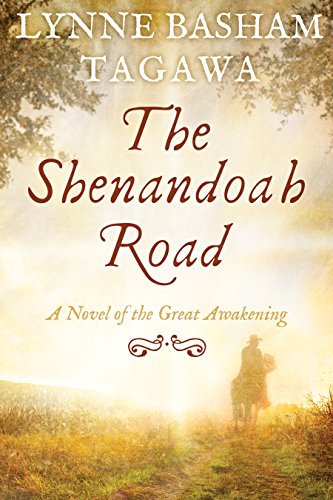
In The Shenandoah Road: A Novel of the Great Awakeningby Lynne Basham Tagawa, John Russell is a widower in need of a wife to mother his four-year-old daughter. Leaving his daughter in his sister’s care, John travels back to Boston, where his father lives, to do some trading and hopefully find a wife as well.
Abigail Williams is the daughter of a Boston merchant. Her father approaches her with a proposition. His bookkeeper’s son is looking for a woman to marry and accompany back to a settlement in Shenandoah. The two men are coming to dinner tonight. Would she think about the possibility?
The settlement in Shenandoah is smaller and much rougher than what Abigail is used to. But John Russell seems to be a kind man. She decides to marry him and go.
Abigail has dutifully kept the commandments all her life. But when John shares with her part of a sermon by George Whitfield, her heart is troubled. Is keeping the commandments not enough? How can she be sure she’s right with God?
As the Russells travel the long road back to the settlement by the Shenandoah River, they face dangers in roving buffalo, Indians, and a dangerous ruffian. Abigail wonders how she will adjust to life when she gets to John’s home. She feels her lack of knowledge about everyday housewifery. She wonders if John’s daughter will accept her. But most of all, she struggles to understand the words from Whitfield and the Bible that her husband shares with her.
I don’t know that I have ever read a novel from this time period, though I was familiar with Whitfield and Jonathan Edwards and such. It seems like every believer would have been thankful for the “Great Awakening.” But just like in our times, people had different opinions about the various proponents and points of doctrine. It was interesting to see some of that discussed.
I enjoyed the historical aspects of daily life, as well. Abigail loved botany, especially the medicine use of plants. It’s unfortunate that we’ve gotten away from such knowledge today.
I enjoyed getting to know John and Abigail as hey got to know and appreciate each other.
Still, I wasn’t swept into the story and characters as often happens with fiction. I can’t quite put my finger on why. But even though I wasn’t spellbound, the book is still a good one.
For readers, nothing sounds more cozy than curling up with a good book, a throw blanket, and a cup of coffee and a cookie or two within reach. Add in a warm fire, a rainy day, and just the right lamp, and we’re in reading heaven.
Or perhaps your ideal reading environment is on the beach under an umbrella, or on your back deck during a cool evening.
In any of those scenarios, we probably picture a physical book. In fact, friends have told me that they don’t like the idea of e-books because they like the feel of an actual ink-and-paper book in their hands.
I understand that. I can’t imagine reading Little Women, for instance, without my favorite old-fashioned illustrated version.
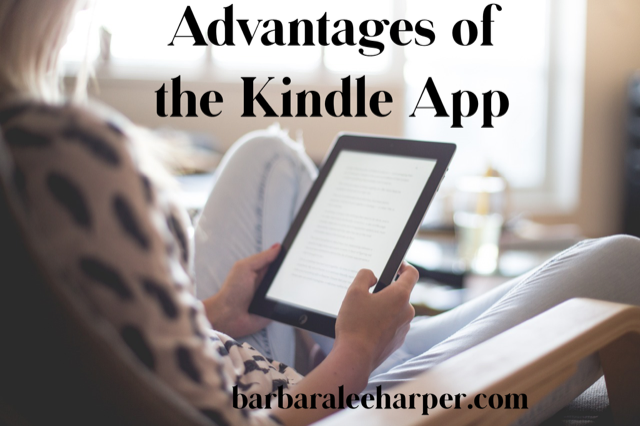
I first started using the Kindle app on my iPad mini for traveling purposes. Otherwise, I’d bring at least two, and possibly three, books with me anywhere I went. I also wanted to take advantage of the occasional Kindle sale or free book. But I never thought the Kindle app would become my main source of reading.
However, once I got used to the Kindle app and discovered many of its features, I grew to love it. When I talked with a paper-book-only friend about some of these Kindle features, she had been totally unaware of them. So I thought I’d share some of these features with you in case you had not heard of them, either. This is not a paid or affiliate post.
All of these features are on the Kindle app. I assume they are all on the Kindle device as well, but I don’t know.
By the way, I’m avoiding the term “real book.” Paper, digital and audio books are all real books.
The Kindle app:
Saves space. It’s nice to “pack” a whole library rather than trying to fit three books into my baggage when traveling. But even at home, I don’t have any space for more books. We have three full-size bookcases, one half-size, and at least three boxes of books in closets. I’ve culled books to give away several times, but my bookcases are still full. There’s no room in the house to add any more.
Adjustment of text size. The print in some books is tiny. I can set the text in the Kindle app to the size that’s best for me.
Easier to hold, especially while lying down. If you’ve ever read in bed, I’m sure you’ve experienced your book falling in your face or your hand cramping after a while.
Can be used on Apple devices as well as many Android. The iPad mini is the perfect size for me, but if you prefer reading on a regular iPad or other device, you can.
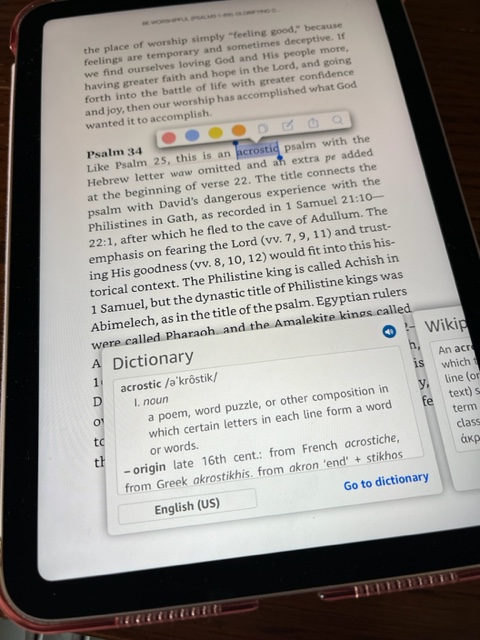
Built-in dictionary. If I come across an unfamiliar word while reading, I don’t usually take the time to stop and look it up. I get the gist of it from the context and keep going. But in the Kindle app, you can highlight the word, then a dictionary definition will pop up. I’ve gotten so used to that feature, I’ve wished it was available on everything I read online as well as in ink-and-paper books!
Translations.You can also highlight phrases in another language and get the translation instantly.
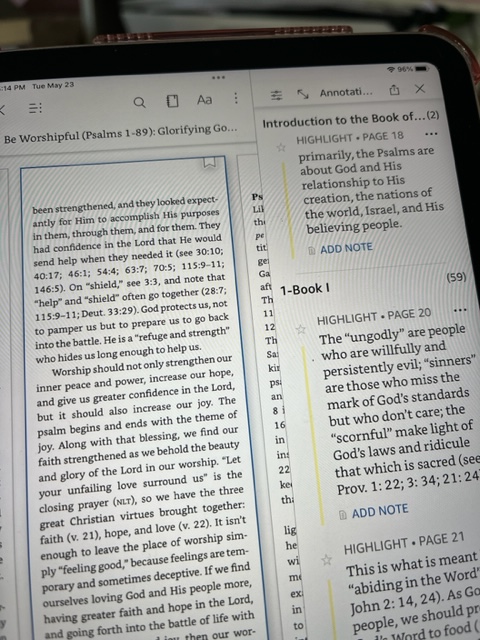
Highlighting. You can highlight passages in the book in five different colors. I usually just use the standard yellow for quotes I want to remember. But sometimes I’ve used blue for main points so I can see them at a glance.
Add notes. When you highlight a section, an icon will show up at the top that looks like a paper and pencil. You can tap that and add your own notes–like writing in the margin of a paper book.
Search function. When you tap on a page in the Kindle app, a magnifying glass icon appears at the top. You can search for a particular word or name or phase. Sometimes I forget who a particular character is, so this feature is like looking back several pages to refresh your memory. Or if I remember a snatch of a sentence but didn’t highlight it, I can look it up.
List of notes. That same list of icons that appears at the top of the page when you tap it also shows an icon that looks like page or notebook. Tap that, and you’ll see a list of all the quotes you’ve highlighted from the book as well as notes you’ve added. This is a great help to me when I just want to review the book for my own memory or when writing a review for the blog. I can tap on a highlighted quote, email it to myself, then copy and paste it into a blog post.
Kindle sales. I’ve mentioned before that I check Kindle sales from Inspired Reads and Gospel eBooks lists. Though these are Christian sites, I would not endorse everything they list. But I’ve gotten scores of books trough them. A $1.99 e-book is a great way to try an new author or stock up on books from a favorite author. Plus I get a weekly email from Iron Stream Media offering some of their books free or for 99 cents.
Advance readers or launch teams. Most authors use e-versions rather than an ink-and-paper book to send to readers who agree to review an upcoming book or serve on an author’s launch team. So having Kindle access affords you that opportunity.
Syncs to any device that supports a Kindle app. I mentioned that I usually read e-books on my iPad mini. But I have the Kindle app on my iPhone as well. So if I find myself with an unexpected wait time while I’m out, I can read a bit. It’s not as easy to read a book on a phone, but it can be done, and it’s a good way to pass the time waiting.
Whispersync. If you get the same book via Amazon for the Kindle and Audible for an audiobook, if they are set up to “Whispersync,” you can pick up with one from where you left off on the other. I don’t usually do this–I usually have one or the other. But occasionally, usually due to sales, I’ll have both. It’s nice to be able to go back and forth.
As with anything else, there are a few disadvantages to using the Kindle app. Here are a few:
It’s harder to share books. I believe Amazon lets you share Kindle books with another person for two weeks. But it’s easier to hand them a book for however long they need it. Of course, if your friend doesn’t live near you, sharing electronically is an advantage.
You can’t see what others are reading. I liked the idea that I was “advertising” a book by reading it in public. Or I’d see what someone else was reading and ask about it. You can’t really do that with an e-book without feeling intrusive.
Your device needs charging. But we’re so used to charging devices, that’s not much of a hardship. Unless the power is out.
You don’t really own Kindle books. This is the biggest disadvantage to me. If an author or publisher decides to take their books down, and they are not downloaded on your device, they’ll just disappear from your library. Thankfully, that doesn’t happen often.
You can’t give or sell your read e-books like you can ink-and-paper books.
If you’re trying to reduce screen time due to eye strain or other reasons, you might prefer a physical book.
By and large, I’ve found the advantages to using the Kindle app outweigh the advantages.
Do you use the Kindle or Kindle app? What do you like or dislike about it?
In D. E. Stevenson’s novel, Miss Buncle’s Book (linked to my review), Barbara Buncle is a quiet single lady in 1930s England who needs to make some money. So she writes a book about what she knows–her neighbors. She changes their names and some of their activities. Her book becomes a best-seller. But some of her neighbors recognize themselves and their town. And some of them are determined to find out who is behind the pseudonym “John Smith.”
At the end of that book (spoiler alert), Miss Buncle marries her publisher, Arthur Abbott. They move to Hampstead Heath, away from the heat caused by Barbara’s book.
Miss Buncle Married opens with the newlywed couple enjoying married life, but not the city. They’re expected to be out almost every night, playing bridge with friends and attending events. They long for a quieter home life. So Barbara starts looking at houses in the country.
Barbara finds the house of her dreams in Wandlebury. Arthur isn’t sure about the fixer-upper. But Barbara has everything redone nicely, and they love their new home.
It’s not long before they meet their new neighbors. The pastor’s wife who loves to gossip, thinking it gives her and “in” with her neighbors, when really they hold her at arm’s length because they don’t want to become her subjects. A large, temperamental artist, his languid wife, and their three children, two of whom have claimed Barbara’s back yard as their playground. Mrs. Chevis-Cobb, the society matron who changes her will when her relatives displease her. Jerry, a young woman who supports herself by caring for horses.
Arthur’s nephew, Sam, comes to visit the Abbotts regularly and begins to mature nicely.
Of course, the reader wonders, “Will Barbara write another book? And will it get her into as much trouble as last time?” I’ll leave that for you to discover.
Barbara is presented in both books as somewhat naive and innocent, yet with amazing insight in some ways. She doesn’t mean to meddle, but her attempts to help people present some quite funny episodes in the book.
Some of my favorite quotes from the book:
He . . . looked at his wife, and, as he looked at her, he smiled because she was nice to look at, and because he loved her, and because she amused and interested him enormously. They had been married for nine months now, and sometimes he thought he knew her through and through, and sometimes he thought he didn’t know the first thing about her—theirs was a most satisfactory marriage.
Jerry found Barbara very soothing and comforting during this difficult time. It was not necessary to confide in Barbara to gain her sympathy—you just talked to Barbara about odds and ends of things, and you came away feeling a different creature.
“It’s turned out all right after all,” she said contentedly. “Things usually do, somehow. You worry and fuss and try to make things go the way you think they should, and then you find that the other way was best. I’m going to try not to worry about things anymore.”
As with the first book, this is a secular work, and thus I wouldn’t agree with everything here, like many classics. It’s a clean story, but there are some oddities, especially with the strange family next door.
But all in all, this was a sweet, funny story. I listened to the audiobook superbly read by Patricia Gallimore. The picture above is from the audiobook cover as well, which I like much better than the book cover.
. . . you’d like authors to be able to keep writing books, right?
You may not be aware of some ways publishing has changed over the last few years. These changes put different pressures and requirements on new and published authors. I’ll discuss some of those changes as I go.
But here are ways you can help authors keep books coming:
Buy their books. Sometimes I hear people say they never buy books. Some can’t; that’s understandable. I’ll get to some other ways we can help that don’t cost money.
But buying a book isn’t just an investment for the author. If you were going to a concert, a professional ball game, or even a movie, you’d pay a high price for just 2-3 hours of entertainment. The price of a book can give you 10+ hours of entertainment.
For many of us, though, our book appetite is bigger than our wallet.
If you can’t pay full price, books are frequently on sale. I often get Kindle books for less than $2. Inspired Reads lists half a dozen or so and Gospel eBooks lists several, but you need discernment with these two: I wouldn’t recommend everything they list. Tim Challies lists a Kindle sales most days, usually Christian nonfiction and classics.
If you pre-order books, you often get a lower price. Audible.com frequently has “two books for one credit” and other audiobooks sales. Then there are library sales, thrift store sales, garage sales. Even though the author does not get much money from these purchases, they still help his sale numbers (which publishers look at when considering whether to publish his future books).
I have not tried these, but I’ve heard recommendations for Chirp (audiobooks), BookBub, and CelebrateLit.
Ask for books for gifts. I usually let my family know of a few books I’d like for birthday and Christmas ideas.
Write a review. Amazon reviews carry great weight with publishers, plus they are helpful to other buyers considering the book. The reviews don’t have to all be 5-stars to help. In fact, it looks a little suspicious if all the reviews are 5-star. Reviews don’t have to be long and shouldn’t “spoil” the plot.
One of the ways publishing has changed over recent years is that authors have to do as much as 80% of their own marketing, even if they’re traditionally published. With the closure of so many brick-and-mortar bookstores, publishers don’t have the opportunity to advertise there via posters, end-caps displays, author events, etc. They have always depended on word of mouth, but much more so now.
Besides Amazon, reviews on Goodreads or one’s blog help get the word out as well.
Mention a book on Instagram with the hash tag #bookstagram. You can add additional hashtags like #amreading, #historicalfiction or whatever the genre is, and the author’s name (#roseannamwhite, for example). You can add a picture of the book cover, a picture of you holding the book, a picture of the book cover on your Kindle app, etc.
Get the book for free. Even though an author doesn’t get the revenue from free books, if you review them, they get the word of mouth publicity. Some authors and publishers will give free copies of their book in exchange for an honest review. NetGalley offers digital Advanced Reader Copies of books to reviewers. Revell is a Christian book publisher with a program to offer free books for review. Audible.com includes some titles for free for its members.
Check books out of the library. Libraries don’t keep books that don’t get checked out. So keeping an author’s book active helps, and reviewing helps even more. Plus libraries are likely to buy more books by authors whose books are frequently checked out.
Request a book be added to the library. Most libraries have ways to do this online.
Suggest your favorite book or author for a book club suggestion.
Follow your favorite author. Publishers and agents want writers to have a “platform” before they risk putting time and money into them. Many a debut author has been turned down, sadly, because of a low platform. I’ve read that the primary following publishers look at is a writer’s email list numbers. That’s why you so see many authors asking you to subscribe to their newsletter. I have to confess I don’t subscribe to many myself just because I don’t have time to read them all and I don’t want lots of extraneous email. Plus I disagree with the thought that an author’s biggest fans and promoters are going to come from their email lists. But that’s how the system stands today. So if you really want to support a particular writer, following them primarily through an email list, but also on Facebook, Twitter, and/or Instagram will help their platform numbers. As a bonus, most writers will offer freebies via extra chapters or resources to email subscribers.
Be on an author’s launch team. The first few days after a book comes out are critical to the book’s success in the eyes of publishers. Authors will ask for volunteers for launch teams to help when the book comes out. Being on a launch team usually involves receiving an advanced copy of the book, reading it before publication, and having a review ready for Amazon within the first day or two after the book is released. Some authors will also ask for posts on Facebook about the book. Some will offer material for blog posts, like interview questions and answers.
You may not be able to do all of these, but helping an author in any of these ways will be much appreciated and will help keep good books coming.
Which of these most resonates with you? Do you have any other ideas for ways to support authors and help promote good books?
D. E. Stevenson was a Scottish writer who lived from 1892-1973. Her books were best-sellers in their time and continue to be read widely today.
In Miss Buncle’s Book, Barbara Buncle is a single lady in her thirties. Due to a dwindling income, she decides to write a book to try to earn some extra money. She doesn’t have any imagination, she insists, so she writes what she knows–her neighbors in the town of Silverstream. She changes their names and has them interact in different ways. She sends the manuscript in under the pseudonym John Smith.
The publisher loves her novel, though he can’t quite decide whether it’s written satirically or straightforwardly. Either way, he feels the book will do well.
And he’s right: the book becomes a bestseller.
The only problem is, most of the inhabitants of Silverstream recognize themselves in the fictional town of Copperfield. Some think the book is great fun. Others are offended at the way they are portrayed or at their secrets coming out. Everyone agrees that “John Smith” must live among them—how else would he know them so well? So the hunt is on.
Meanwhile, the book has an effect on its readers. Some recognize their flaws and change. Colonel Weatherhead enjoys the novel but doesn’t see the parallels with his neighbors. He particularly enjoys the colonel in the book who dramatically proposes to his neighbor in the garden. But after finishing the book, Colonel Weatherhead finds himself restless. He’s never been discontent with his life before. But now he seems lonely. And somehow he never noticed before that his neighbor is both nice and attractive. Maybe he should call on her. . . Thus life for some begins to imitate art.
Barbara herself gets lost in her thoughts sometimes as to whether she’s in Silverstream or Copperfield. Her counterpart in the book, Elisabeth Wade, is much more confident. So Barbara begins to act as Elisabeth Wade.
But the discontented readers are worked up to a fever pitch in their search for John Smith and their desire to make him pay for what he has written about them.
Overall this was a fun book with a very satisfactory ending.
Having read much about writing and publishing the last few years, some of the comments on those subjects had me smiling.
Barbara’s publisher: “What fools the public were! They were exactly like sheep…thought Mr. Abbott sleepily…following each other’s lead, neglecting one book and buying another just because other people were buying it, although, for the life of you, you couldn’t see what the one lacked and the other possessed.”
Miss Buncle did impress him because she wasn’t trying to.
Mr. Abbott could have cheated Miss Buncle quite easily if he had wanted to. Fortunately for her, he didn’t want to. It was not his way. You make friends with the goose and treat it decently, and it continues to lay golden eggs.
Miss Buncle after signing her contract: “I’m an author. How very odd.”
Miss Buncle on receiving her first print copy of her book: “She had spent the whole morning reading her book, and marveling at the astounding fact that she had written every word of it, and here it was, actually in print.
“And why to me?” inquired Mr. Abbott with much interest. “I mean why did you send the book to me? Perhaps you had heard from somebody that our firm—”
“Oh, no,” she exclaimed. “I knew nothing at all about publishers. You were the first on the list—alphabetically—that was all.” Mr. Abbott was somewhat taken aback—on such trifles hang the fates of bestsellers!
Dorcas [the maid] was beginning to get used to living in the house with an author. It was not comfortable, she found, and it was distinctly trying to the temper.
Authors! said Dorcas to herself with scornful emphasis—Authors indeed!—Well, I’ll never read a book again but what I’ll think of the people as has had to put up with the author, I know that.—Preparing meals, and beating the gong, and going back ’alf an hour later to find nobody’s ever been near them, and the mutton fat frozen solid in the dish, and the soup stone cold—and them ringing bells at all hours for coffee, “and make it strong Dorcas—make it strong!” and them writing half the night, and lying in bed half the day with people toiling up to their bedrooms with trays.—Authors—poof! said Dorcas to herself.
“Dorcas, I could never give up writing now,” she said, incredulously (nor could she, the vice had got her firmly in its grip, as well ask a morphinomaniac to give up drugs). “You don’t know how exciting it is, Dorcas. It just sweeps you along and you’ve no idea of the time—”
I listened to the audiobook wonderfully read by Patricia Gallimore. She portrayed all the characters so well, from the sly Mrs. Greensleeves to the morose Mr. Bulmer and the haughty Mrs. Featherstone Hogg and so many more.
This is not a Christian book, so of course I wouldn’t agree with everything the characters do.
This book is the first of three about Miss Buncle. I’m pretty sure I’ll read the next one some time in the future.
All That It Takes is a sequel to All That Really Matters by Nicole Deese. Val Locklier had been Molly McKenzie’s virtual assistant in the first book. As Molly’s business expanded, she invited Val to move from Alaska to Spokane for a full-time job.
Moving was a big leap for Val. Not only was she extremely cautious by nature, but she had her ten-year-old son, Tucker, to think about. Leaving the support system of her parents was hard. But she felt it was time to spread her wings.
Molly settled Val in the upstairs apartment her brother rents out. He’s out of the country and left Molly in charge. He usually rents to single guys, but Molly doesn’t think he’ll mind renting to Val. They had met a few months before.
As Val settles in, an opportunity for an elite film mentorship unexpectedly opens up. Val wants to expand in that area, but all her insecurities arise to talk her out of taking a chance.
Molly’s brother, Miles, is unhappily on his way home from Mexico. He is the outreach pastor, but the new senior pastor has cut down on outreach and travel–while setting up things like a gourmet coffee bar. Miles grew up with Pastor Curtis, but never felt Curtis adequately filled his pastor-father’s shoes. People seemed so much more earnest in Mexico, focused on the right things. Disillusioned, he thinks maybe he’ll resign his position and seek an opportunity there. He calls his missionary father to keep an eye out for a position.
When Miles arrives home, he finds two surprises. Val and Tucker now live above him. And Pastor Curtis reassigned Miles to the family resource center, a side ministry that is on its last legs.
Miles feels like he is set up to fail, just marking time until Pastor Curtis closes this ministry as well. But he begins to clean things up, gets to know the one or two people still on staff, and learns about what the facility does. Val agrees to take pictures and help him spiff up the web site, but is unexpectedly pulled into the needs of a young woman who visits the center.
As Val and Miles become more attracted, Val is not sure whether her reservations are her old insecurities or a warning sign not to get involved. “Pastor Miles McKenzie was an adventurer by nature, a traveler of exotic places and an extroverted humanitarian who never seemed to sit still for longer than a minute. And while he’d been nothing but kind to Tucker and me during our brief encounters at the fundraising event we attended last fall and again during Molly and Silas’s wedding this March, I was certain that other than his sister, the two of us had little in common” (p. 12). Val is a single mom certainly not looking for adventure.
As Miles seeks his own will for his future, he finds that God might be leading a different way, and he just might have been wrong about a couple of things.
Some of the quotes that stood out to me:
Give me an essay to write anytime. Or a ten-page paper, for that matter, on any number of subjects that I could research and put into my own words. But don’t ask me to think on the spot. Don’t ask me to provide meaningful answers that determine my future without adequate time to prepare (p. 67, Kindle version).
Every story is original not because of the plot . . . but because each storyteller behind the pen or camera or canvas has an original perspective (p. 107).
You might not be able to make sense of God’s plan or timing, but I can promise you that He isn’t confused (p. 126).
In the midst of trials, it’s tempting to confuse release with relief. But make no mistake, they are not interchangeable. One is long-lasting, the other fleeting (p. 126).
Sometimes all that it takes is one person being willing to step out in love for the betterment of another to change the trajectory of an entire life (p. 270).
I’d much rather my life be defined by a thousand little moments of faithfulness than by one big moment of fame (p. 389).
When I started this book, at first I missed the “sparkle” of Molly’s personality from the previous book. She’s in this story, but as a side character. Val and Miles are quieter people. But as I got to know them, I really enjoyed their story.






 Stray Thoughts