Three Children’s Books About Race

Recently, my daughter-in-law and I were discussing the lack of diversity in children’s books. Bible story books, in particular, seemed to draw Biblical people lily white, when in reality they would have been Middle Eastern in appearance.

Not long afterward, I came across What God’s Family Looks Like, a post from The Story Warren about children’s books that deal with race. I looked up the main book mentioned, then followed a rabbit trail of recommended reading. I ended up getting these three books.

Why be colorblind when we can be colorFULL insteadThe first is Colorfull: Celebrating the Colors God Gave Us by Dorena Williamson, illustrated by Cornelius Van Wright and Ying-Hwa Hu. I love the tagline: “Why be colorblind when we can be colorFULL instead?”

The back of the book says this:

Imani and Kayla are the best of friends who are learning to celebrate their different skin colors. As they look around them at the amazing colors in nature, they can see that their skin is another example of God’s creativity! This joyful story takes a new approach to discussing race: instead of being colorblind, we can choose to celebrate each color God gave us and be colorFULL instead.

Imani’s Granny Mac helps gives the kids some perspective. My daughter-in-law said she wished adults would read this book, too.
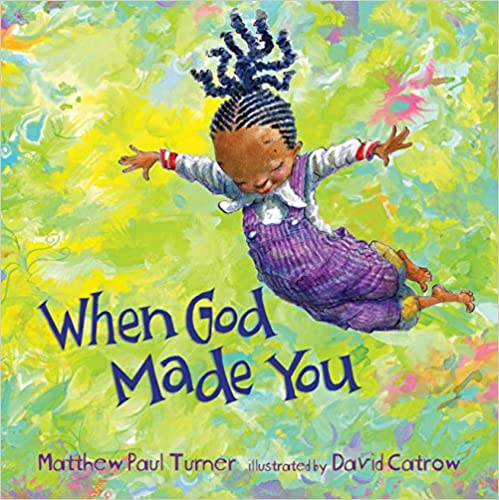
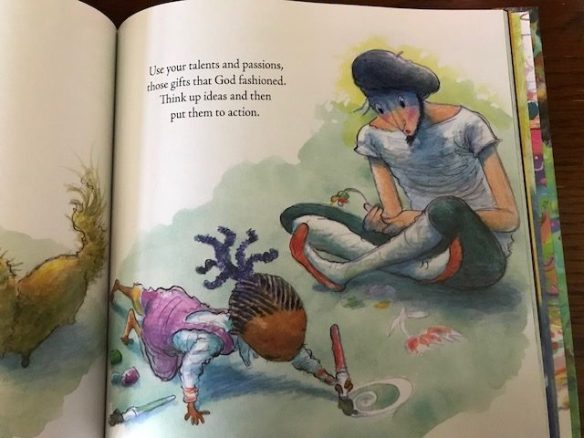
When God Made You by Matthew Paul Turner, illustrated by David Catrow, doesn’t explain or emphasize race: the story just incorporates it naturally as part of who God made you to be. God planned each person with their particular gifts, appearances, personalities, etc. to reflect His image.

One line in this gave me pause: “Have faith but love more.” At first it seemed to downplay faith. But you could also read it as saying, “Have faith, but don’t stop there: love others.”

An inside page:
Trillia Newbell’s God’s Very Good Idea (illustrated by Catalina Echeverri) took several weeks to get here. I hope that means lots of people are buying it!

Trillia begins at the beginning: with creation. Making people, and making them in all different colors and varieties, was God’s idea. They would “all enjoy loving him and all enjoy loving each other . . . reflecting what God is like.”

But the first people chose to disobey God. That plunged all of us into sin. We don’t love God or each other as we ought. “Sometimes we treat others badly because they are different than us.”

But part of God’s very good plan was sending Jesus to come and live on earth, to show us how to love, to die on the cross so we could be forgiven, and to rise from the dead, and to give us the Holy Spirit to help us live for Him.

He also gave us the church as a foretaste of what it will be like in heaven some day, “lots of different people enjoying loving him and loving each other.”

I love that Trillia’s story is couched firmly in the Bible and the gospel. She gives an overview of creation, sin, and redemption in words a child could understand.

I didn’t get a chance to read these with my grandson. I sent him home with them. But I hope he enjoys them!

I believe children need to be taught early that God created all people in His image.

Now that I look again at the post I first mentioned, I see a whole list that I must have forgotten to look up when I got distracted earlier. So I will probably explore some of those. Now that we have some books with a good, Biblical worldview about race, I’d love to find some that just show kids of all different colors naturally as characters in a story.

Do you know of any good books for kids along these lines?

(Sharing with InstaEncouragement, Worth Beyond Rubies, Grace and Truth,
Hearth and Soul, Senior Salon, Booknificent Thursday, Carole’s Books You Loved)

Book Review: Chasing Jupiter

I enjoyed Rachel Coker’s debut novel, Interrupted: A Life Beyond Words, so much, that after finishing it I immediately looked up her second book, Chasing Jupiter.

In this book, Scarlett Blaine is a teenager in Georgia in the 1960s. Her parents are busy fighting and going to political meetings, so Scarlett becomes the main cook and caregiver for her elderly grandfather and younger brother. Her brother, Cliff, has some kind of unnamed mental or processing disorder. Not as much was known about such things then, so he’s just generally regarded as “different.” Partly out of standing up for him, Scarlett takes on the mantle of being “different,” too—not in a mental way, but just in her personality.

Cliff has decided he wants to build a rocket to go to Jupiter. Scarlett knows they can’t build a real one, but she helps Cliff raise money for materials. They decide to make and sell peach pies, with the help of the local farmer’s son, Frank.

Scarlett grows to like Frank, but Frank has eyes for Scarlett’s wild sister, Juli.

Scarlett’s pastor’s wife hears about her culinary skills and invites her over to help make food for the church’s shut-ins. Scarlett is reluctant at first, but then enjoys getting to know the pastor’s wife.

A series of family tragedies shakes Scarlett’s faith. Her pastor’s wife tells her, “The beauty of salvation and God’s grace isn’t in him solving all of our problems instantly, like a magic genie. Its beauty comes in the assurance that he has a greater plan for you.” Can Scarlett trust Him with all the problems and find peace in the midst of them?

Rachel has written another beautiful story. It took me just a bit longer to connect with Scarlett than Allie in the previous book. But I could empathize with much in her situation.

This book was written in 2012, and I’ve seen nothing from Rachel since these two books. There’s nothing on her Facebook page since 2017, when she was newly married. Looks like she went into photography for a while, but that sight has not been updated since 2016. Perhaps everyday life precluded her writing. But I hope she finds her way back to it some day.

(Sharing with Booknificent, Carole’s Books You Loved)

Book Review: A Gentleman in Moscow

Amor Towles novel, A Gentleman in Moscow, takes place almost entirely within the walls of the grand Metropol Hotel in Moscow. Count Alexander Ilyich Rostov lived there in 1922, when he was convicted as an unrepentant aristocrat, declared a Former Person, and sentenced to house arrest. He was moved from his suite to an attic storage room and told that if he stepped out of the hotel, he would be shot.

Believing that “if a man does not master his circumstances then he is bound to be mastered by them,” the Count determines to make the best of his.

There are worse places to be confined than a Grand Hotel. But confinement is confinement, and it strains the count at times. In one of the best pieces of “showing, not telling” I’ve seen, the Count has been inside for about a year when he feels a blast of cold air in a hallway. Searching for its origin, the Count finds himself in the coat room, where someone has just come in in from outside. He also notices the smell of wood smoke on the coat someone has just left behind. The coat room girl finds him a few minutes later, holding the sleeve of the coat. It was such a poignant moment, made all the more so by the fact that Towles didn’t explain, “He missed the outdoors and the smell of winter and wood smoke.” He left the scene as is for the reader to infer why the Count lingered, holding the coat sleeve.

The Count hits a low point, and I love the scene that switches his thinking. But mostly the book involves the Count’s activities, friendships with members of the staff, interactions with a nine-year-old girl, a famous actress, an American journalist, Russian officials, and various others who come through the hotel.

We learn what kind of man the Count is. He’s in his thirties at the beginning of the novel and his sixties by the end. At first he is quite charming but almost flippant. He’s almost unfailingly polite. As he tells a little girl who asks about the rules for being a princess, “Manners are not like bonbons, Nina. You may not choose the ones that suit you best; and you certainly cannot put the half-bitten ones back in the box.” He’s not without thought for others, as we see in remembrances of getting his grandmother out of the country before his arrest, his care of his sister, his sacrifice for a friend. But we also see how he grows as a person over the course of the novel.

The narrator also lets us in on what’s going on in the country and how it affects the Count even inside a hotel. This was a time of great change in Russia, after the revolution, spanning two world wars, famines, the Stalinist era, and more.

A few of my favorite quotes:

“A king fortifies himself with a castle,” observed the Count, “a gentleman with a desk.”

But imagining what might happen if one’s circumstances were different was the only sure route to madness.

It was, without question, the smallest room that he had occupied in his life; yet somehow, within those four walls the world had come and gone.

I also enjoyed a section where he talked about names in Russian novels—how difficult they are, and how several names can be used for the same person with nicknames, honorifics, etc. I smiled because I had thought that very thing when reading Russian novels.

This is not an action-packed, plot-driven novel (though the action picks up and becomes quite suspenseful in the last few chapters). It’s more of a quiet, thoughtful book. This doesn’t often happen, but I didn’t start another book for more than a day after finishing this one, just to sit with my thoughts about it a little longer.

Towles said he got the idea for the novel when, traveling for business overseas. He noticed some of the same people every time he visited certain hotels. He wondered if some of them lived in the hotel, and that started his thoughts around a character who did live at a hotel, but not by his own choice.

I loved Towles’ writing. One thing I especially liked was the way he took details of a previous scene that I thought was finished and brought them up again later. For instance, in an early scene, the Count has some fennel sent to his friend, the chef at the hotel restaurant. I got the idea that fennel was hard to come by, and the Count was a nice guy to get some, and he still had the connections to do so. But then the purpose for the fennel comes out in a much later chapter, a delightful surprise.

I normally avoid most current secular fiction because there’s almost always some language issues and/or sex scenes. I don’t recall many language problems–a couple of “damns,” one instance of taking the Lord’s name in vain (though the author sometimes told us someone did without subjecting us to the sound of it). There are a couple of sexual encounters, but no steamy, explicit scenes.

I enjoyed going down the rabbit hole of Towles’ web. He shares some information on the Metropol (a real hotel) and its history and some questions he receives and their answers. The structure of the novel hadn’t dawned on me until I read the guide Towels’ mention of it n the guide: the first few chapters cover a day, then a couple of days, gradually increasing. Tthe middle covers years, and the last chapters hone in on days again. I was also surprised that one of the most-often asked questions concerned who the person was in the last scene with the Count. That person was always described throughout the novel with a particular adjective that’s also used at the end, so that was no mystery to me. I enjoyed learning what some of the scenes were based on.

I listened to the audiobook superbly read by Nicholas Guy Smith. He did a wonderful job giving each character distinctive  and apt voices.

Have you read A Gentleman in Moscow? What did you think?

(Sharing with Carole’s Books You Loved)

Book Review: Interrupted: A Life Beyond Words

In Rachel Coker’s debut novel, Interrupted: A Life Beyond Words, teenager Allie Everly takes care of her mother in the late 1930s. Suffering from a brain tumor, Allie’s mother’s behavior and memory become increasingly erratic.

After her mother passes away, Allie is uprooted and sent miles away from home to be adopted by a single woman named Beatrice. Resentful and bitter, Allie can’t allow herself to accept Beatrice’s love. She closes people out and barely accepts a friendship with bright bubbly classmate Charlie (a girl). When her childhood friend, Sam, shows up, Allie keeps him at arms length.

Allie’s mother had not believed in God, had even told Allie not to trust Christians. Beatrice assures her that:

Faith isn’t about superstition or leaning on others because you haven’t got any … guts. It takes guts to believe sometimes. To know that even when things don’t look like they’re going well, God is still there and he’s still guiding you. Faith like that—the faith to trust Christ enough to take the place for your sins and take control of your life. Faith like that takes all the guts in the world. And it’s worth it.

This was such a good story. I loved Sam and Beatrice’s patience and Allie’s slow dawning that life might be different, good, even. I enjoyed the lines from Emily Dickinson at the beginning of each chapter.

Most astonishing of all is that Rachel wrote this and one other book when she was a home school student. She did a marvelous job. But it doesn’t look like she has written anything since these books in 2012, unless perhaps she has started using a pen name. I hope she is still writing, or comes back to it, because she has great talent.

(Sharing with Carole’s Books You Loved, Booknificent)


Book Review: None Like Him

The subtitle of None Like Him by Jen Wilkin is 10 Ways God is Different From Us (and Why That’s a Good Thing).

God has some attributes that we’re supposed to emulate: kindness, love, compassion, etc. He possesses those characteristics in perfection. We never will this side of heaven, but we should be growing in them as we read God’s Word.

Some of God’s attributes, however, are unique to Him: omnipotence (all-powerful), omniscience (all-knowing), omnipresence (everywhere at the same time), immutability (unchangeableness), eternality, etc. Jen devotes one chapter each to these and five more characteristics of God. A subject like this could easily be filled with ivory-tower theologicalese, but Jen doesn’t let it. Her treatment of God’s attributes is both understandable and practical while still invoking awe.

At first it might seem more practical to study the attributes of God that we’re supposed to grow in (and Jen’s next book, In His Image, does just that). But there’s good reason to ponder these unattainable attributes. Studying these characteristics helps us get to know our God better, contributes to our worship of Him, and reminds us of our limitations.

Wait—do we want to be reminded of our limitations? Well, we need to be. Sometimes our overreaching is due to pride. And it’s immensely restful to leave to God the things only He can do.

Our limits teach us the fear of the Lord. They are reminders that keep us from falsely believing that we can be like God. When I reach the limit of my strength, I worship the One whose strength never flags. When I reach the limit of my reason, I worship the One whose reason is beyond searching out (p. 25).

For instance, it never occurred to me before reading this book that our constant efforts to be in more than one place (with one person, on the phone with another, with one eye on the news) might be grasping for omnipresence. Subject ourselves to information overload might be reaching towards omniscience. We don’t want to stagnate: we want to keep learning and growing. But we do have limits.

No, we cannot be in more than one place at one time. When we reach for omnipresence ourselves, we guarantee that we will be fully present nowhere, spread thin, people of divided attentions, affections, efforts, and loyalties. Better to trust that these bodies which tether us to one location are good limits given by a good God. Better to marvel that, wherever we are tethered, his spirit surrounds us and fills us. Aware that he is witness to all we think, speak, and do, we learn to live circumspectly. Aware that he views his children through the lens of grace, we learn to choose frank confession over futile concealment. Aware that we cannot outrun his presence, we cease running, and abide. We learn to savor his nearness. No more virtual Twister. When we trust him as fully present everywhere, we are finally free to be fully present wherever he has placed us (pp. 104-105).

Here are just a few of the quotes I marked:

The thought that there might be a way to cast off at least some of these perpetual needs for perpetual needlessness is an enticing one, indeed. Take, for example, our current cultural obsession with caffeinated drinks as evidence of our desire to be sleep-optional creatures (p. 58).

Sanctification is the process of learning increasing dependency, not autonomy (p. 63).

Like Samson, when we view a particular strength as the product of our obedience to God, we will use that strength to serve ourselves rather than to serve God and others. All strength, whether physical, emotional, or intellectual, can be used either to serve or to self-elevate (p. 127).

The truth of God’s limitless power would be absolutely terrifying were it not paired with the truth of his limitless goodness (p. 135).

Our primary problem as Christian women is not that we lack self-worth, not that we lack a sense of significance. It’s that we lack awe (p. 154).

We too often approach the Bible in a self-serving way: we want to be comforted, affirmed, or assured in some way. The Bible does minister to us, but we need to approach it to learn about God.

God is incomprehensible. This does not mean he is unknowable, but that he is unable to be fully known. It is the joyful duty, the delightful task of his children to spend their lives, both this one and the next, discovering who he is. According to Jesus, knowing God is the fundamental aim of life: “And this is eternal life, that they know you the only true God, and Jesus Christ whom you have sent” (John 17:3). We take pleasure in working to grow in our knowledge of him (p. 33).

Meditating on His attributes leads us to worship and increases our faith. The more we know Him, the more we love Him, the more we trust Him.

My meditation of him shall be sweet: I will be glad in the LORD (Psalm 104:34).

(Sharing with Senior Salon, InstaEncouragament,
Carole’s Books You Loved, Booknificent)

Book Review: Candleford Green

Candelford Green is the third installment of the Lark Rise to Candleford series, Flora Thompson’s semi-autobiographical account of growing up in a small English village.The books take place in the 1880s and 1890s, and Flora writes as an adult looking back at simpler times and the changes that happened since.

In the first book, Lark Rise, Flora’s alter-ego, Laura, is the oldest daughter in her family, living in the small village of Lark Rise. In the next book, Over to Candleford, Laura spends a lot of time with her relatives in Candleford Green, a slightly bigger village some eight miles away.

In this third book, Candleford Green, Laura works as an assistant in the post office. Young girls often went into service as maids or mother’s helpers at this time. Laura’s mother didn’t feel she was suited for either of those jobs. But when a friend of the Candleford relatives invites Laura to help her out in the Post Office, her family agrees to let her go.

Like the first two books, there’s no real plot. The book is mostly Laura’s observations of how the people lived, worked, celebrated, decorated their homes, etc. Along the way are little vignettes of some of the individuals who make up the village.

Some of the quotes that caught my eye:

Few would care to take that trouble for the sake of a few spoonfuls of jelly in these days. . . it was thought a waste of time in many households. On the face of it, it does seem absurd to spend the inside of a week making a small jelly, and women were soon to have other uses for their time and energy, but those who did such cookery in those days looked upon it as an art, and no time or trouble was thought wasted if the result were perfection. We may call the Victorian woman ignorant, weak, clinging and vapourish—she is not here to answer such charges—but at least we must admit that she knew how to cook.

At fourteen it is intolerable to resign every claim to distinction. Her hair was soft and thick and brown and she had rather nice brown eyes and the fresh complexion of country youth, but those were her only assets in the way of good looks. ‘You’ll never be annoyed by people turning round in the street to have another look at you,’ her mother had often told her, and sometimes, if Laura looked dashed, she would add: ‘But that cuts both ways: if you’re no beauty, be thankful you’re not a freak.’

And she had her own personal experiences: her moments of ecstasy in the contemplation of beauty; her periods of religious doubt and hours of religious faith; her bitter disillusionments on finding some people were not what she had thought them, and her stings of conscience over her own shortcomings. She grieved often for the sorrows of others and sometimes for her own.

‘You’ve got to summer and winter a man before you can pretend to know him’ was an old country maxim much quoted at that time.

This about two single women taking care of elderly parents while trying to run a shop:

No wonder the Pratt girls looked, as some people said, as if they had the weight of the world on their shoulders. They must in reality have carried a biggish burden of trouble, and if they tried to hide it with a show of high spirits and simpering smiles, plus a little harmless pretension, that should have been put down to their credit. Human nature being what it is, their shifts and pretences only served to provoke a little mild amusement.

The new vicar, according to Laura, didn’t mention heaven or hell or sin or repentance, but his sermons made “you feel two inches taller.” The people were what I’d call God-fearing in a general sense, but it doesn’t sound like the gospel was proclaimed except for one or two of the townspeople.

I found the first book sometimes hard to wade through. I didn’t have any problems with the last two: maybe I grew more used to Thompson’s style.

Nowadays, the books are usually packaged together under one title, Lark Rise to Candleford. My copy looks like the one here.

I hope to be able to watch the series, Lark Rise to Candleford. I know some things will be different. Laura is just a teenager in this last book and younger than that in the first two books. Dorcas, the postmistress, doesn’t appear until halfway through the second book, but I understand she’s there at the beginning of the series.

Overall, these were pleasant reads. I’m glad to finally be acquainted with Laura and the villagers.

(Sharing with Booknificent Thursday Carole’s Books You Loved)

Book Review: The Phantom of the Opera

Born in 1868, Gaston Leroux was a French court reporter and newspaper drama critic who liked Edgar Allan Poe and Arthur Conan Doyle. He started writing detective stories which were serialized in the newspaper. He became intrigued with the Palais Garnier opera house in Paris, which had an underground lake and suffered a famous chandelier crash. Leroux wove these details into Le Fantôme de l’Opéra, or The Phantom of the Opera.

Leroux lays the plot out as a detective sharing the details of his investigation into rumors of an “opera ghost.”

Two new managers have taken over the opera house, and the old managers showed them a memorandum book with the ghost’s requirements of a certain sum of money each month and Box 5 to be always available for his use. The new managers think the old ones are pulling their leg, so they ignore the instructions despite increasing threats.

During one performance, the lead singer, Carlotta, is too ill too sing. Her understudy, Christine Daaé, performs the role beautifully. The Vicomte Raoul de Chagny was in the audience and recognizes Christine as his old playmate from childhood. Raoul tries to see Christine after the performance, but goes into a jealous rage when he hears another man talking in her dressing room.

However, Christine and Raoul do meet later. She tries to keep aloof from Raoul, but falls in love with him. She tells him that the man he heard is her teacher, the Angel of Music that her father promised to send her when he died. But the Angel of Music—also known as the Opera Ghost or O. G. or Erik—is very jealous and dangerous.

The O. G. continues leaving instructions for the new managers. He wants Christine to sing the lead in Faust. When Carlotta sings instead, she starts croaking during her aria. Then the great chandelier falls, killing one person.

Now the new managers are angry, believing that someone is trying to extort them.

Christine begins to seek a way to be with Raoul. She plans to sing one last time for Erik and then escape with Raoul. But at the height of her aria, everything goes dark for an instant. When the light comes back on, Christine is gone.

Raoul, of course, goes to search for her and learns more about O. G. in the process.

So, though the format is a crime story, the novel also has several elements of a gothic romance. Parts of it reminded me of Beauty and the Beast and Frankenstein.

As you’re probably aware, there was a famous 1925 movie based on the book with Lon Chaney as the Phantom. Andrew Lloyd Weber wrote a successful musical based on the story in the 1980s which is still being performed today and which was turned into a movie in 2004.

I had read this book several years ago, but forgotten much of it. Though gothic romances aren’t my favorite genre, and parts of this one are a little overwrought, overall I enjoyed getting reacquainted with the story.

I read, or rather listened to this for the Classics in Translation category of the Back to the Classics Reading Challenge.

Have you read Phantom? What did you think?

(Sharing with Books You Loved, Booknificent Thursday)

Book Review: Hurricane Season

In Hurricane Season by Laura K. Denton, Betsy and Jenna grew up as very different sisters. Their parents were both professionals and distant. Betsy was the responsible one who did all the right things. Jenna was free-spirited, willful, and apt to make a mess of things. But they loved each other fiercely, and Betsy was Jenna’s greatest advocate and protector.

As adults, Betsy married dairy farmer Ty, and they work together to make a go of the business and home that had been passed down through generations in Alabama. Their biggest sorrow is their inability to have children.

Jenna is a single mom to two young girls and a coffee shop manager. An old friend urges Jenna to go to an artist’s retreat in Florida to revive her dormant love of photography. At first it seems impossible. But a scholarship and her sister’s agreement to watch the girls for two weeks enable Jenna to go.

Betsy’s fragile peace with her childlessness is threatened by having two children full time, but she thinks she can hold on for two weeks. But then Jenna calls. She has an opportunity to stay past the initial two weeks, possibly even for the rest of the summer.

Besides the potential storms brewing  internally, a hurricane threatens the Gulf of Mexico.

The point of view shifts back and forth between Betsy, Ty, and Jenna. Their current circumstances and their past histories are shaped by their perspectives and personalities. Probably no one person has the entire perspective of a family. We need each other’s viewpoints and narratives to understand the whole.

I enjoyed each sister’s bumpy journey. My mind raced ahead to different ways the plot might go, but it ended up working our differently than I had thought it would—a good thing!

When I bought this book, I thought it was Christian fiction. Though there are a few mentions of God, prayer, church, etc., I can’t say a faith message was overt. For that reason, I’d label it inspirational fiction.

This is the second of four novels by USA Today best-selling author Denton. Have you read any of her work? What did you think?

(Sharing with Books You Loved, Booknificent Thursday)

Book Review: If We Make It Home

If We Make It HomeChristina Suzann Nelson’s debut novel, If We Make It Home: A Novel of Faith and Survival in the Oregon Wilderness, was named “debut of the month and one of the Best Books of 2017 by Library Journal” according to Amazon. I can see why.

A university building used for student housing is about to be torn down, and those who lived there are invited for a reunion. Four former roommates find their way back to Carrington, Oregon. They used to be close but they haven’t spoken in 25 years.

Hope James stayed in the area, running a coffee shop. She was considered the quiet glue that kept them connected while they were students.

Ireland Jayne used to be the one that called them to prayer. But she has walked away from her faith and turned her concerns towards environmentalism and activism. She is a professor, but her job is presently hanging by a thread. She has not seen her son in years.

Jenna Savage has been a stay-at-home mom, but her triplets just fled the nest. She had cried and prayed and tried so long to become pregnant, and then loved her three so much, that she doesn’t know what to do with herself now that they’re gone. She has a penchant for food and not for exercise.

Vickie Cambridge has a worldwide ministry and TV show for women, but she has neglected her own family.

Somehow the latter three end up on a survival trip in the Cascades with an older woman named Glenda, described by one as a “mountain woman.” Jenna wants the challenge. Ireland and Vicky want the escape.

None of them has any experience, and the trip is rougher than expected. (When Glenda vetoes Vicky’s butane curling iron, Vicky quips, “This must be what persecuted missionary wives feel like.”)

But then a series of disasters tests them beyond their limits and brings out the best and worst in each one.

The chapters alternate between the different women’s points of view, giving us a window into their inner struggles and their differing views of their situations and each other.

One thing this book taught me: I do not ever want to go on a survivalist trip into any wilderness or forest of any kind. Even without the disasters.

But besides that, I thought the women’s stories and journeys were so well told. I ached with each of them in their troubles and rooted for them in their triumphs.

I loved Christina’s phrasing:

The sun beats down on us and makes me feel like a loaf of over-kneaded bread in the oven.

Vicky snivels on the other side of me. I’m in an emotional sandwich. And it’s making me swirl with unease. The lightning looks like a safer companion.

Saving nature and surviving it are two very different things. We are not saviors in the wilderness. We are intruders.

The next thing she says is a muffle of grunts. Great, we’ve lost the perky one. We’re doomed.

“How do you think the pioneers got their soap?” “They bought it before they left.”

Maybe this is God’s provision. It never looks like I imagine.

I also like that the story doesn’t end with their getting out of the woods, but continues on with the aftermath of everything that happened.

All in all, a great book. I look forward to reading more by Christina.

(Sharing with InstaEncouragement, Grace and Truth, Global Blogging, Senior Salon,
Books You Loved, Booknificent Thursday)

Book Review: Waves of Mercy

In Lynn Austin’s novel, Waves of Mercy, 67-year-old Geesje de Jonge is asked to write some of her experiences immigrating from the Netherlands for Holland, Michigan’s 50th anniversary celebration. She’s reluctant to delve back into the hardships and struggles of faith that accompanied her journey, but her son and neighbor finally persuade her to.

Meanwhile, young socialite Anna Nicholson had accidentally stumbled into a Chicago church that was unlike any she had known before, which stirred up questions about faith and God. But her fiance had not approved of this new church and forbid her to go back to it. Their disagreement was so severe that they broke up. Anna gets away to a hotel on Lake Michigan with her mother to think and recover. A storm on the way causes a recurring nightmare to resurface in which she and her mother fall into the sea during a storm.

On her long walks on the beach, Anna meets a young seminary student who tries to answer her questions. Her mother is no help at all, since she doesn’t think polite people talk about such things as religion. Her fiance wants to get back together, and her parents encourage their reunion. But Anna feels she needs to get some things settled in her heart first.

As the Amazon description says, “Neither Geesje nor Anna, who are different in every possible way, can foresee the life-altering surprises awaiting them before the summer ends.”

I enjoyed this book a lot. The Netherlanders had left their home to escape religious persecution arising from their wanting to pull away from the state church. America was a land of freedom and opportunity. They knew it would be hard to build a community from scratch, but they were willing to work for their and each other’s freedom.

However, they had no idea the difficulties and heartbreak that would be involved. Anna often struggled with despair, even rage. While I agree that we can be honest with God about our feelings, doubts, and questions, I disagree with Geesje telling someone who had suffered a loss, ““You have every right to be angry with God right now.” However, she does go on to tell this person, “No matter what, don’t ever stop trusting Him. I believe that God is as grieved . . . as we are.”

I enjoyed Anna’s story as well. She’s often tempted to give up her questions and go along with the pressure of her parents’ and fiance’s expectations. But something keeps propelling her forward.

The sequel to this book, Legacy of Mercy, continues Anna and Geesje’s stories. I’m putting it on my birthday wish list!

(Sharing with Global Blogging, Senior Salon, Books You Loved, Booknificent Thursday.
Links do not imply 100% agreement)