Book Review: A Season to Dance

When I saw Susan’s review of A Season to Dance by Patrica Beal, I wasn’t sure if I’d be interested in the story. But I was touched by the author’s testimony of how she became a Christian during the course of writing the book. So when I saw the ebook on sale for the Kindle app, I decided to give it a try.

In this novel, Ana Brassfield is a ballerina with dreams of dancing at the Met one day. She’s happy in her relationship with landscape architect Peter. But her old boyfriend, Claus,  is in town to dance Romeo to her Juliet. Ana is conflicted because she never knew why Claus left ten years ago. And though she doesn’t want to be, she finds herself still attracted to Claus.

But a betrayal ends her relationship with Peter and sends her traveling to Germany. New challenges and relationships rise and fall. A chance meeting with another American and a tract lead to Ana reading the Bible, but she doesn’t understand most of it.

Many people live like Ana, pursuing dreams and relationships only to find that nothing satisfies. One of the things Ana pursues are men. In this book she is torn between two, but a side comment reveals “for years and years, I’d kept looking for that first-love magic. Forever looking—from bed to bed—but never finding it.” Since a lot of people do live this way, I didn’t have a problem with that part of Ana’s journey being mentioned. If someone’s main problem was theft, we’d see them stealing. Like the woman at the well in John 4, Ana’s main temptation was men. Still, I could have used less mention of it. Thankfully there were no explicit scenes. I don’t read many romances, so statements about how someone’s kisses taste and phrases like “nibbling my wet lips with a sigh” kind of make me cringe.

Aside from that aspect, though, I was touched by Ana’s journey. Patrica writes how she came to know the Lord while writing this book here. I appreciated that Ana’s spiritual experience was a gradual one, with understanding coming in bits, and willingness coming a little later. I think it’s that way for most people rather than one sudden flash. And I really liked that the author was clear about salvation. I know every Christian book doesn’t have to contain the plan of salvation, and there are times a more subtle message is appropriate. But sometimes when authors try hard not to spell out what salvation and conversion involve, they make it unclear and confusing.

Like Ana, the author danced ballet and lived in both Georgia and Germany, so her writing is enhanced by those experiences. I don’t know much about ballet, and I enjoyed a peek into that world. One aspect I particularly liked was that Ana’s fiance worked at Calloway Gardens in GA, one of my favorite places from the few short years we lived near Atlanta.

One of the characters contracts Huntington’s disease, and the author described the heartbreak of that illness and its effects in a realistic way.

If it weren’t for the heavy sexual aspect of this book, I’d have no problem recommending it. As I said, it’s not explicit, but it’s mentioned quite a bit. I think that part of Ana’s life could have been conveyed with a lot less information. But I loved Ana’s gradual transformation and growth.

(Sharing with Carole’s Books You Loved, Booknificent)

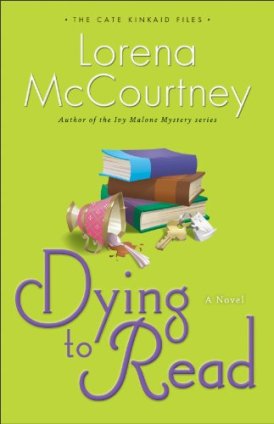
Book Review: Dying to Read

In Lorena McCourtney’s novel, Dying to Read, Cate Kinkaid is nearly 30 and at a crossroad. She’s helping out her private investigator uncle until another job opens up. Her first assignment is simply to verify that a particular woman lived at a certain address. But things get complicated when Cate finds a disgruntled book club and a dead body rather than the woman she’s looking for.

Then Cate’s uncle falls off a ladder and needs hip surgery, so she’s on her own. She decides the least she can do is try to get more information about the woman she was originally looking for. But, though she has no PI training, something about the dead woman’s case and the book club nags at her. Before long she finds herself deep in suspects and danger.

I don’t read many mysteries. I got this on a Kindle sale because of the title and the book club aspect. It took me a little while to get into the book, but I was engaged before too long. Cait is a little quirky. I wouldn’t call the writing funny, exactly, but there are some witty moments. But it’s not exactly a comedy: there are several twists and turns and some dangerous moments. The author did a good job presenting several plausible suspects while keeping the real murderer a surprise until nearly the end.

This book is the first in a trilogy. If you like clean, cozy mysteries with a Christian main character, I think you’d like this book.

(Sharing with Carole’s Books You Loved, Booknificent Thursday)

Book Review: Be Resolute

Warren Wiersbe’s “Be Series” commentary on Daniel is Be Resolute: Determining to Go God’s Direction.

It’s easy to see why the author chose that title. If you’re not familiar with the book of Daniel except for the lion’s den, Daniel and his three friends (Shadrach, Meshach, and Abednego) were teenagers when Babylon conquered Israel. Most of the population was exiled to Babylon in three waves. Daniel and other young men were selected for a training period to be assimilated in the Babylonian government. But Daniel and his friends stood firm in their faith while still being gracious and kind to their captors.

God had multiple reasons for Israel’s captivity, the main one being their longstanding stubborn rebellion and disobedience to God. But one of the good things He brought out of it was the testimony of these four young men (and hopefully others as well) of the one true God.

The first few chapters contain some of the most familiar stories in the Bible: Daniel and his friends kindly asking for a diet in keeping with their convictions, and ending up in better health; Daniel’s interpreting Nebuchadnezzar’s dreams when no one else could; the three others in the fiery furnace, Nebuchadnezzar’s humbling transformation, the “handwriting on the wall” at Belshazzar’s feast, and Daniel in the lion’s den. In every case, the men gave glory to God and trusted Him for the outcome. The three who faced the furnace for not bowing to the king’s idol said something that rings down through the ages: “Our God whom we serve is able to deliver us from the burning fiery furnace, and he will deliver us out of your hand, O king. But if not, be it known to you, O king, that we will not serve your gods or worship the golden image that you have set up.” (3:17-18). God doesn’t always answer prayer as we’d like. Loved ones aren’t always cured. Crises aren’t always averted. But God is faithful and has His reasons for what He allows. And God used he testimony of these four young men not only in their own timeline, but in all the years since.

I say young men—though the book opens with them as teens, Daniel is in his 80s by the time he was thrown in the lion’s den. He spent his whole adult life in captivity. But he never complained.

Prayer is another big theme in the book, as Daniel seeks God throughout. His prayer of confession for the nation in chapter 9 is a model for us. In Daniel 10, He is told about spiritual warfare going on behind the scenes. Wiersbe says:

The prophet Daniel realized the great significance of God’s plans for Israel, and once again he fainted and was unable to speak. Here he had been involved in a cosmic spiritual conflict and didn’t even know it, and the Lord was using some of His highest angels to answer his prayers! This certainly lifts prayer out of the level of a humdrum religious exercise and shows it to be one of our strongest and most important spiritual weapons. The neglect of prayer is the reason why many churches and individual believers are so weak and defeated. The late Peter Deyneka, missionary to the Slavic peoples, often reminded us, “Much prayer, much power; no prayer, no power!” Jesus taught His disciples that the demonic forces could not be defeated except by prayer and fasting, the very activities that Daniel had been involved in for three weeks (Matt. 17: 14–21).

The last few chapters of Daniel are markedly different. Instead of interpreting dreams and vision for other people, Daniel receives a few himself that throw him for a loop. The angel Gabriel is sent to help him understand.

Honestly, without the ESV Study Bible notes and this book of Wiersbe’s I would have been pretty lost in these sections. I have read Daniel several times over the years, but I don’t remember what I did when I came to this part. Complicating matters is the fact that there are several schools on interpretation about some of it.

The part that covers the history of the next four dynasties is so accurate that people have attacked Daniel, saying it had to have been written after the fact. As Wiersbe says, “Prophecy is history written beforehand.”

The ESV Study Bible’s notes go into great detail about the various prophecies and schools of interpretation. Most of it refers to the history immediately after Daniel’s time, but there are differences of opinion as to what might be figurative and what might refer to end times. I appreciated this reminder:

There are many difficulties in deciding between these interpretations, which all involve questions of the proper approach to interpreting biblical prophecy. In all of this it is crucial not to miss Daniel’s message for his audience, namely, that God has allotted the amount of time for these events, and therefore his people should trust and endure (p. 1607).

I don’t think these different views are anything to fight or disfellowship over. But they can make for some interesting conversations.

The book ends with Daniel himself not understanding everything he’s been told: “I heard, but I did not understand. Then I said, ‘O my lord, what shall be the outcome of these things?’ He said, ‘Go your way, Daniel, for the words are shut up and sealed until the time of the end.'” Why tell him these things, then? Many reasons. For future readers and students of the Word of God through the ages. But for all of us, what the Bible tells us about future events reminds us He is in control (a major theme in Daniel). Also, as Wiersbe says, “Knowing God’s future plan and obeying God’s present will should go together. ‘And everyone who has this hope in Him purifies himself, just as He is pure.’ (1 John 3: 3 NKJV).”

A few other quotes from Wiersbe:

A heart that loves the Lord, trusts the Lord, and therefore obeys the Lord has no difficulty making the right choices and trusting God to take care of the consequences. It has well been said that faith is not believing in spite of evidence—that’s superstition—but obeying in spite of consequences.

Faith means obeying God regardless of the feelings within us, the circumstances around us, or the consequences before us.

Daniel was respectful to the king but he was not afraid to tell him the truth. Even if we don’t respect the officer and the way he or she lives, we must respect the office, for “the powers that be are ordained of God” (Rom. 13: 1).

All of these people and events may not be interesting to you, but the prophecies Daniel recorded tally with the record of history, thus proving that God’s Word can be trusted.

May the Lord help us to leave something behind in the journey of life so that those who come after us will be encouraged and helped!

Wiersbe ends his commentary with an extra chapter of summary of the themes in the book and Daniel’s character. He hasn’t done this in any of the other “Be” series that I’ve read. But it was helpful here, after our brains were stretched and heads were spinning over the last few chapters of prophecy, to go back over the book as a whole.

Once again I appreciated Wiersbe’s thoughts and insights.

(Sharing with Welcome Heart, Carole’s Books You Loved, Booknificent Thursday)

Book Review: My Antonia

My Antonia by Willa CatherThough I had heard of Willa Cather, I had never read her books and had no plans to. Then Hope’s great review of Cather’s My Antonia piqued my interest.

When ten-year-old Jim Burden’s parents died, he was sent to live with his grandparents in Nebraska. Arriving on the same train was a Czech (called Bohemian then) family, the Shimerdas, who became Jim’s grandparents’ neighbors.

The Shimerdas had one crooked relative in the area who sold them his cave of a home and some equipment for much more than they were worth.  Since they could not speak English, couldn’t ask for advice, and didn’t know any better, they paid his prices. But that meant almost all the money they brought with them was gone. The family had a hard time getting started, not only because of language barriers, poverty, and getting acclimated to new ways, but also for lack of what Jim’s grandmother called horse-sense.

The oldest daughter of the family was a bright, eager girl a few years older than Jim named Antonia (pronounced with accents on the first and third syllables—An’-ton-EE-ah). She learned English more quickly than the rest, and she and Jim became childhood friends traipsing over the countryside together. Jim taught two of the Shimerda girls English, and Antonia spent time helping Jim’s grandmother in the kitchen.

After a few years, Jim’s grandparents got too old to maintain the farm and moved into town. Antonia and many of the other immigrant girls worked in town and sent money home.

The story is told from Jim’s point of view, and he describes their adventures and relates many stories of townsfolk. We also see Antonia’s growth and development through his eyes. Though he had something of a crush on her for a while, he becomes more of a longtime family friend. Later he goes to college and law school and returns home less frequently, but he does see Antonia at intervals. She’s had a very hard life on many fronts, but maintained a strong spirit. He says of her near the end, “I know so many women who have kept all the things that she had lost, but whose inner glow has faded. Whatever else was gone, Antonia had not lost the fire of life.”

The book is partly about growing up on the prairie in the late 19th century. Cather herself moved to Nebraska from Virginia as a child, as Jim Burden did. Partly the book is about the immigrant experience of that time. But ultimately I think the story is about the resilience of people like Antonia.

Unfortunately, some people’s ideas of immigrants hasn’t changed much over time:

I thought the attitude of the town people toward these girls very stupid. If I told my schoolmates that Lena Lingard’s grandfather was a clergyman, and much respected in Norway, they looked at me blankly. What did it matter? All foreigners were ignorant people who couldn’t speak English. There was not a man in Black Hawk who had the intelligence or cultivation, much less the personal distinction, of Antonia’s father. Yet people saw no difference between her and the three Marys; they were all Bohemians, all ‘hired girls.’

I liked Jim’s (Cather’s?) summation:

Those girls had grown up in the first bitter-hard times, and had got little schooling themselves. But the younger brothers and sisters, for whom they made such sacrifices and who have had ‘advantages,’ never seem to me, when I meet them now, half as interesting or as well educated. The older girls, who helped to break up the wild sod, learned so much from life, from poverty, from their mothers and grandmothers; they had all, like Antonia, been early awakened and made observant by coming at a tender age from an old country to a new.

I can remember a score of these country girls who were in service in Black Hawk during the few years I lived there, and I can remember something unusual and engaging about each of them. Physically they were almost a race apart, and out-of-door work had given them a vigour which, when they got over their first shyness on coming to town, developed into a positive carriage and freedom of movement, and made them conspicuous among Black Hawk women.

The girls who once worked in Black Hawk kitchens are to-day managing big farms and fine families of their own; their children are better off than the children of the town women they used to serve.

I always knew I should live long enough to see my country girls come into their own, and I have. To-day the best that a harassed Black Hawk merchant can hope for is to sell provisions and farm machinery and automobiles to the rich farms where that first crop of stalwart Bohemian and Scandinavian girls are now the mistresses.

I love how Cather phrases some things:

Misfortune seemed to settle like an evil bird on the roof of the log house, and to flap its wings there, warning human beings away.

We burrowed down in the straw and curled up close together, watching the angry red die out of the west and the stars begin to shine in the clear, windy sky.

Grandfather’s prayers were often very interesting. He had the gift of simple and moving expression. Because he talked so little, his words had a peculiar force; they were not worn dull from constant use. His prayers reflected what he was thinking about at the time, and it was chiefly through them that we got to know his feelings and his views about things.

The week following Christmas brought in a thaw, and by New Year’s Day all the world about us was a broth of grey slush, and the guttered slope between the windmill and the barn was running black water.

In the winter bleakness a hunger for colour came over people, like the Laplander’s craving for fats and sugar.

The sun was going down in a limpid, gold-washed sky.

This book is the third in Cather’s Prairie trilogy, O Pioneers! and The Song of the Lark being the first two.

I enjoyed listening to the audiobook nicely narrated by Grover Gardner. I looked up some quotes in the online Gutenberg version and noticed some differences in the introduction there from my version. Wikipedia explains differences between the first and later editions. There are a number of Kindle editions at various prices.

I thoroughly enjoyed My Antonia. Some sources say this is Cather’s best, so her other work may fall short of this one. But I’d still like to explore some of her other books.

I’m counting this book as my 20th Century Classic for the Back to the Classics Reading Challenge.

Have you read My Antonia or Cather’s other books? What did you think?

(Sharing with Carole’s Books You Loved, Booknificent Thursday)

Book Review: A Portrait of Marguerite

In A Portrait of Marguerite by Kate Lloyd, Marguerite Carr’s only son is about to leave for college, and she feels lost. Her best friend drags her to an art class, just to get out of the house and do something fun. Marguerite had been an art major in college but had set art aside when she married and then had her son. She’s reluctant to let art back into her life, but she lets her friend talk her into the art class.

There she meets two people who will have an impact on her future: the instructor, Henry, and an older fellow student, Emily. Unfortunately, Henry is a friend of Marguerite’s ex-husband, Phil, which doesn’t raise him in her estimation.

We learn later in the book that Marguerite is weighed down by a secret from her past. As the story progresses, everyone that she holds in high regard is found to have faults and failures, even her beloved father. And her ex-husband, wonder of wonders, seems to have changed for the better.

I’m usually not one to infer symbolism where it’s not intended, but I do think Marguerite’s painting journey, from reluctance to dabbling to freedom, parallels her inner journey as she learns to forgive and accept herself and others.

The spiritual undercurrent, mainly from Emily, is subtle but realistic.

While this wasn’t the most riveting read, I enjoyed it. I’d give it a 4 out of 5.

(Sharing with Carole’s Books You Loved, Booknificent Thursday)

Book Review: Be Rich (Ephesians) Gaining the Things That Money Can’t Buy

Warren Wiersbe’s Be Rich commentary on the book of Ephesians does not a promote the “prosperity gospel”—insert prayers and gifts to televangelists and receive health and wealth. No, as the subtitle goes on to say. “Gaining the Things That Money Can’t Buy.”

Ephesians 1:3 says God “has blessed us in Christ with every spiritual blessing in the heavenly places.” Just some of those blessings:

  • Chosen in Him (verse 4)
  • Adopted as sons (verse 5)
  • Redemption through his blood, the forgiveness of our trespasses (verse 7)
  • An inheritance (verse 11)
  • Believers are “sealed with the promised Holy Spirit, who is the guarantee of our inheritance until we acquire possession of it, to the praise of his glory” (verses 13-14).

Wiersbe says, “‘In Christ’ is the most frequently used phrase in the book of Ephesians, and the point is clear: If you’re in Christ, you have everything.”

Another theme in the book is unity. Not a unity that ignores truth, but unity based on truth. Paul, the author of the letter to the Ephesians, says God’s plan was “to unite all things in [Christ], things in heaven and things on earth” (1:10). The first half of chapter 2 tells how we can be reconciled with God; the second half says that God, through Christ, broke down the barriers between Jew and Gentile. “For through him we both have access in one Spirit to the Father. So then you are no longer strangers and aliens, but you are fellow citizens with the saints and members of the household of God … ” (2:18-19). Chapters 4-6 share practical ways that unity in Christ is worked out in the church community, in the home, and in the workplace.

I’ve got dozens of quotes marked, but here are a few:

The Bible is our guidebook; the Holy Spirit is our Teacher. As we search the Word of God, we discover more and more of the riches we have in Christ.

Salvation is a gift, not a reward. Salvation cannot be “of works” because the work of salvation has already been completed on the cross. This is the work that God does for us, and it is a finished work (John 17: 1–4; 19: 30). We can add nothing to it (Heb. 10: 1–14); we dare take nothing from it.

By His death and resurrection, Christ overcame the world (John 16: 33; Gal. 6: 14), and the flesh (Rom. 6: 1–6; Gal. 2: 20), and the Devil (Eph. 1: 19–23). In other words, as believers, we do not fight for victory—we fight from victory! The Spirit of God enables us, by faith, to appropriate Christ’s victory for ourselves.

The Christian life is not based on ignorance but knowledge, and the better we understand Bible doctrine, the easier it is to obey Bible duties. When people say, “Don’t talk to me about doctrine—just let me live my Christian life!” they are revealing their ignorance of the way the Holy Spirit works in the life of the believer. “It makes no difference what you believe, just as long as you live right” is a similar confession of ignorance. It does make a difference what you believe, because what you believe determines how you behave!

Of course, there’s much more to Ephesians and Wiersbe’s book.

Ephesians contains two of my favorite Biblical prayers that I sometimes pray for myself and others. I’ll leave you with those

For this reason, because I have heard of your faith in the Lord Jesus and your love toward all the saints, I do not cease to give thanks for you, remembering you in my prayers, that the God of our Lord Jesus Christ, the Father of glory, may give you the Spirit of wisdom and of revelation in the knowledge of him, having the eyes of your hearts enlightened, that you may know what is the hope to which he has called you, what are the riches of his glorious inheritance in the saints, and what is the immeasurable greatness of his power toward us who believe, according to the working of his great might that he worked in Christ when he raised him from the dead and seated him at his right hand in the heavenly places (1:15-20).

For this reason I bow my knees before the Father, from whom every family in heaven and on earth is named, that according to the riches of his glory he may grant you to be strengthened with power through his Spirit in your inner being, so that Christ may dwell in your hearts through faith—that you, being rooted and grounded in love, may have strength to comprehend with all the saints what is the breadth and length and height and depth, and to know the love of Christ that surpasses knowledge, that you may be filled with all the fullness of God. (3:14-19).

(Sharing with Worth Beyond Rubies, Carole’s Books You Loved, Booknificent Thursday)

Book Review: The Women of Easter

Women of Easter book The Women of Easter: Encounter the Savior with Mary of Bethany, Mary of Nazareth, and Mary Magdalene by Liz Curtis Higgs, as the title suggests, tells the story of Jesus’ death and resurrection through the eyes of these three Marys.

Liz lays out the narrative in eight chapters. I chose to read one a week most of the weeks leading up to Easter.

We learn about each of the the Marys. Mary of Bethany and the famous incident with her sister, Martha, the death and resurrection of her brother, Lazarus, and her anointing the feet of Jesus with expensive ointment, wiping them with her hair. Mary of Nazareth, the mother of Jesus. Mary Magdalene, out of whom Jesus cast seven demons (Luke 8:2) (and who is never called a harlot or prostitute in the Bible, though movie writers like to depict her that way).

Liz seamlessly weaves their stories in with the last several days Jesus spent on earth, using multitudes of Scripture references in different translations and snippets from commentaries. I can’t imagine all the study she did before writing this book.

Here are just a few quotes:

When Jesus “no longer moved about publicly among the people of Judea” (John 11:54) because people were after Him:

Jesus was neither afraid of them nor avoiding them. He was simply acting according to His Father’s will. Whenever my prayers are answered with a firm directive to wait, I remind myself that even Jesus had times of waiting, and more than once He did so in a desolate place.

Of Mary of Bethany’s wiping Jesus’ feet with her hair:

This devout follower, this beloved sister, used her long hair to dry a man’s feet—the “lowest job for the lowliest servant.” … Her perfume wasn’t the only thing she sacrificed. Mary laid her whole being before Him: her pride, her reputation, her social standing, her clean hands, her pure heart. She asked nothing of Him, sought no sign of approval, begged for no favors. Confident of His love and acceptance, she simply gave, expecting nothing in return.

When the disciples (not just Judas) rebuked Mary for her extravagance:

They didn’t just wag their fingers at her. They “scolded” (CEB) and “criticized” (GNT); they “censured and reproved” (AMPC). With no concern for her feelings, “they told the woman what a bad thing she had done” (ERV). Poor Mary of Bethany! To share something holy and then to be treated cruelly, not by strangers, but by those who knew her and claimed to know Christ.

Jesus offered a rebuke of His own, aimed not at Mary but at the disciples. “Leave her alone,” Jesus replied. John 12: 7

During the triumphal entry (Palm Sunday):

Worship isn’t a task. Worship is a response.

In preparation for the Passover:

Part of trusting God is letting go of our need to know and refusing to fret over the who, what, when, where, and why. When the time comes, the Lord will inform us, just as He did His disciples.

In a passage about Jesus being beaten:

During Lent it’s tempting to hurry toward Easter morning, eager to declare, “He is risen!” Yes, He certainly is. But reminding ourselves what came before His glorious victory over death is how we remain humbled by His sacrifice and grateful for His mercy. We were “bought at a price.” This was the cost.

On the way to the cross …

Jesus stopped to speak to the women. He sees us, beloved. He values us. He cherishes us. On that day He spoke a word of prophecy to these daughters, preparing them for even harder days to come.

When Jesus was buried:

“The women who had come with Jesus from Galilee followed Joseph and saw the tomb and how his body was laid in it.” Luke 23:55. Really, have you ever seen such perseverance? They stayed and they stayed and they stayed. This is one of the most important lessons these women teach us. Wherever He leads, follow Jesus. Whatever pain you are enduring, keep your eyes on Jesus. Even when hope seems gone, stay close to Jesus.

After the resurrection:

Woman. The first word spoken by the risen Christ, meant for all His daughters throughout eternity. Woman. An assurance that we matter to Him, that we count for His kingdom. Woman. A term of respect. The very word He used when addressing His beloved mother from the cross. Woman.

There were just a couple of places where I put a question mark, not sure if her observation or comment was exactly right. But I don’t recall that those points were anything major.

This book was a great way to prepare for Easter week. I’m sure I will use it again in the future. But, of course, it’s good reading year round since Christ’s death and resurrection affect us every day.

(Sharing with InstaEncouragement, Worth Beyond Rubies, Let’s Have Coffee,
Grace and Truth, Global Blogging, Senior Salon, Hearth and Soul, Happy Now,
InstaEncouragement, Carole’s Books You Loved, Booknificent Thursday)

Book Review: Lark Rise

Lark Rise is the first book in a semi-autobiographical trilogy by Flora Thompson about her childhood in an English hamlet in the later 1800s. She writes some forty years later, looking back on a quiet, pastoral life that was later marked by great changes. Nowadays, the three books (Lark Rise, Over to Candleford, and Candleford Green) are usually published together under the title Lark Rise to Candleford.

This first book has no real overarching plot. It’s more a series of vignettes about life in those times: how the women kept house, traveling visitors from puppeteers to peddlers, how the squire and rector and their families were viewed, harvest traditions and celebrations, how school was conducted, etc. Often one individual or family’s story would be told as an example of the topic being described. Throughout the book we see some scenes or stories though the eyes of Laura, a young girl based on Thompson.

Thompson does not paint the village, the people, or the times as idyllic. The folks were poor but proud, hard-working, and mostly unsentimental. But they had their foibles, individually and collectively.

One aspect that was particularly interesting to me was that most families had several (as many as ten or twelve) children in a two-bedroom house. To ease the food supply and create more space, young girls were sent to “service” in another town as young as eleven. Mrs. Thompson detailed how girls began and then rose through the ranks from the lowest maid, sending home much-needed money and cast-off clothing from their employers (which meant hamlet fashion was just a season or two behind the cities, but the ladies didn’t mind).

One sad story had to do with a older man who was so ill, he could no longer live alone. His neighbors helped as much as possible, sending him food and such. But their houses were full and the coffers empty. The only option was the workhouse infirmary. “But they made one terrible mistake. They were dealing with a man of intelligence and spirit, and they treated him as they might have done one in the extreme of senile decay.” The doctor made arrangements without consulting the man, and came to his house to take him for “a drive.” “As soon as he realized where he was being taken, the old soldier, the independent old bachelor, the kind family friend, collapsed and cried like a child” and died six weeks later.

I enjoyed hearing how some of the women worked to brighten up their poor homes: “A well-whitened hearth, a home-made rag rug in bright colours, and a few geraniums on the window sill would cost nothing, but make a great difference to the general effect.”

The villagers, sadly, didn’t value “book learning” much. What little I’ve found about Thompson says she was largely self-taught. “She [his mother] hoped Edmund would not turn out to be clever. Brains were no good to a working man; they only made him discontented and saucy and lose his jobs.”

This aptly described an acidic postman: “So he went on, always leaving a sting behind, a gloomy, grumpy old man who seemed to resent having to serve such humble people.” Haven’t you known people like that, who always “leave a sting behind”?

This book wasn’t riveting, except for a few of the stories. But overall was a pleasant read. I hope the next two books have more of a plot to them, but I look forward to finding out more about Laura either way. I think the next book takes her to her first employment in a post office. After I read all three, I look forward to viewing the series made for TV based on the books.

I’ve had the trilogy bound together into one hefty volume for some years. But I listened to the audiobook nicely read by Karen Cass and dipped back into the book to look more closely at some of the quotes.

I’m counting this as my Classic with a Place in the Title for the Back to the Classics Reading Challenge.

(Sharing with Carole’s Books You Loved, Booknificent Thursday)

Coping and Ministering in Isolation

Blessed is the man who trusts the Lord, floruishing even in droughtAs soon as Arthur and Wilda Mathews arrived, they knew something was wrong. The Chinese church in Hwangyuan, China, had asked them to come and minister in 1950. But now the church leaders seemed strained. The Mathews soon learned that the area had fallen to Communism, and association with white missionaries was a detriment to the Chinese Christians.

The Mathews thought it best, then, to leave. But a capricious Chinese official would not grant their exit visas. The money from the Mathews’ mission came through this official, who then made Arthur wait, grovel, and ask repeatedly for the needed funds. The official only gave them a fraction of what they were due. He also slowly tightened the restraints on the Mathews. First, they could not have the building belonging to the mission. Then they could not evangelize or participate in ministry. Then, a short while later, they could not leave their premises except to draw water, buy food, and gather materials for a fire. And finally, they were not allowed to speak to other Chinese.

The Matthews’ story is told in the book Green Leaf in Drought by Isobel Kuhn, which I reviewed a few years ago here. Their story came back to mind in our current situation. They were isolated for different reasons than we are. We’re not suffering persecution, being spied on by people who would benefit from betraying us, or starved out by petty power-mongers. But they did wonder: how in the world could they be a testimony when they couldn’t even speak to people?

What was there inside these walls to do? It just seemed as if every time they tried to engage in any Christian service, they were knocked flat! Life’s accustomed joys were slowly drying up; but the trees of the Lord have a secret supply.

The title and theme of the book come from Jeremiah 17:8:

But most amazing of all was their spiritual vigor. Whence came it? Not from themselves: no human being could go through such sufferings and come out so sweet and cheerful.

As I was in a small prayer meeting one morning one prayed thus: “O Lord, keep their leaf green in times of drought!”

I knew in a moment that this was the answer. Jeremiah 17: 8: He shall be as a tree planted by the waters, and that spreadeth out her roots by the river, and shall not see when heat cometh, but her leaf shall be green; and shall not be careful in the year of drought, neither shall cease from yielding fruit.

That was it! There was an unseen Source of secret nourishment, which the communists could not find and from which they could not cut them off.

This is the story of that secret Source. To add another book to the many telling of trials under communist pressure is not necessary and is not our purpose.
But to tell of the secret Source by which a tree can put forth green leaves when all others around are dried up and dying from the drought—that is timeless. That is needed by all of us. Your drought may not be caused by communism, but the cause of the drying up of life’s joys is incidental. When they dry up—is there, can we find, a secret Source of nourishment that the deadly drought cannot reach?

Here are a few ways that Source helped them cope:

Resting in God’s sovereignty. They wrestled with “Ifs”—if the Chinese church had not asked them to come, if they could have gotten word to them before they came, if this or that had or hadn’t happened. They kept coming back to the fact that God orchestrates our steps.

They fed their souls truth. They regularly read God’s Word and Christian authors. They found help in something Andrew Murray had written (though Isobel doesn’t quote the source):

1. Say, He brought me here. It is by His will I am in this strait place and in that fact I will rest.
2. He will keep me here in His love and give me grace to behave as His child.
3. Then He will make the trial a blessing, teaching me the lessons He intends for me to learn.
4. In His good time He can bring me out again—how and when He knows.
So let me say, I am (1) here by God’s appointment; (2) in His keeping; (3) under His training; (4) for His time.

Before Easter, 1952, Wilda

set herself to study the resurrection story and the resurrection life. As she came to the part that Peter played in the courtyard of the high priest’s palace she suddenly felt heart-condemned. She had not said, I know Him not, but she had no joy. She was not bitter, but she was frustrated and restless. Her opportunity to witness to the Chinese eyes around them that she did know the Lord and that He was satisfying her drought—had she shown that? If not, wasn’t that denying the Lord before man? On her knees before Him she confessed it as such, and the result was a glorious Easter.

They learned to delight in God’s will. While studying Ephesians 5:10, Arthur was arrested by the phrase “learn in your own experience what is fully pleasing to the Lord.”

A few nights later it came to Arthur like a flash: the Son had left heaven, not [just] submitting to the will of God, but delighting in it. Up to now they had been submitting; rather feverishly submitting because they felt they should press His promises. “Lord, why dost thou delay? We could be out spear-heading advance into new mission fields! Open the door now, Lord!” They had been acting like servants who don’t want to do it but have to, because they can’t get out of it. What a different attitude was the Son’s! There came a day in June when together Arthur and Wilda knelt before the Lord and abandoned themselves to live on in that stinted little kitchen as long as He wished them to. And the peace of God poured in like a flood bringing such joy as they had not known before.

Arthur later wrote of this experience to supporters and concluded:

So we came to see that God wanted us to will with Him to stay put; not to desire to run away as quickly as we could persuade Him to let us … It was natural that we should go from there to cry with David, I Delight to do thy will, O my God (Psalm 40: 8)…So we are no longer stupid bullocks being driven or dragged unwillingly along a distasteful road; but sons, cooperating wholeheartedly with our Father…

They endured, trusting God was working through their trials. Arthur wrote, “These trials of faith are to give us patience, for patience can only be worked as faith goes into the Pressure Chamber. To pull out because the pressure is laid on, and to start fretting would be to lose all the good He has in this for us.”

And these are ways God worked through their ministry and testimony even when they were silenced:

The words, actions, and touch expressed earlier were remembered. Their first few weeks in Hwangyuan, Arthur had been able to preach and Wilda had been able to go with the pastor’s wife to minister to the women.

Little did she guess that her loving words and smiles those days were to be the only direct ministry she was to have among them. But it was enough to show the women and girls of Hwangyuan that the white woman in their midst was there to love them.

Those were the days of the touch of the hand, the loving concern in the eyes, the simple testimony of the voice. They would not be forgotten later on when the government forbade it.

People saw God’s provision in their need. Isobel refers often to what she called the Feather Curtain of God, based on Psalm 91:4a: “He shall cover thee with his feathers, and under his wings shalt thou trust.” Story after story relates God’s perfect timing and loving care in supplying their needs.

All the courtyard had heard when the father ordered the milk for the little one to be discontinued for lack of funds; yet that very evening, they not only sang, but the song of praise had an exultant ring in it! (No one knew of Ben’s secret gift.) And the next day the old Tibetan lady was recalled and the milk money was there! Had it fallen from heaven? It most certainly had not come in by the door—that they knew. Did the God of Elijah really live? What more potent message could God have given these people?

People saw them endure the same trials they were experiencing. “The message above all others which the Chinese church needed was to see that truth lived out under circumstances equally harrowing as their own.”

[Arthur wrote} “Then Christmas night, another kind of gift, from the One whose birthday it was. This is what happened. Timothy [the spy] away, the local shepherd voluntarily came to the door to wish us Merry Christmas, and to tell us that the church was packed with outsiders and the few believers, who were met together for singing and the Christmas message.”

What had packed that church with heathen, living under communism? What we lack and lose and suffer are our most prized facilities for bringing home to the hearts of this people the glorious gospel of the grace of God. They had seen green leaves in a time of drought; they themselves were dried up to the point of cracking. What made these Christians able to stay uncomplaining, smiling above their patched clothes, and despite their growing thinness? How did they stay alive when Felix had done his best to starve them? They knew the power of Felix. This was the service which God had planned for His children when He deliberately brought their feet into the net.

In another section:

Was the Chinese Christian falsely accused? So were Arthur and Wilda Mathews. Was he persecuted? So were they. Was he attacked by sickness and bereavement without much medical aid? So were they. Was he laughed at? jeered at? constantly humiliated? So were they. Was he tantalized by specious promises of release? So were they. Was he forced to do menial work, thought very degrading? Much more Arthur Mathews…

And yet as trial piled upon trial; as the ground (their human comforts) grew so parched with drought that it threatened to crack open, their leaf was still green. Every evening the sound of singing and praise to their Lord ascended…Their clothes grew ragged, and their food became so poor that the Chinese themselves were moved with pity. Yet still these missionaries sang on and taught their patched-clothes baby: “In heavenly love abiding, No change my heart shall fear,” until she could sing it too.

Eventually Arthur and a coworker were the very last China Inland Mission members to be evacuated out of China after the Bamboo Curtain fell. Wilda and their little daughter, Lilah, had been sent out a short time earlier. But they all left behind with the Chinese church, the CIM family, and everyone who has read their story a testimony of God’s grace and provision.

Isobel concludes: “But who knows when the drought is going to strike us also? Is it possible for any Christian to put forth green leaves when all he enjoys in this life is drying up around him?” Yes. God’s promises are still true. May He keep our leaves green and flourishing for His glory.

(Sharing with Inspire Me Monday, Global Blogging, Senior Salon, Hearth and Soul,
Tell His Story, Purposeful Faith, Happy Now, InstaEncouragement,
Anchored Abode, Recharge Wednesday, Worth Beyond Rubies,
Share a Link Wednesdays, Heart Encouragement, Let’s Have Coffee,
Grace and Truth, Faith on Fire, Blogger Voices Network,
Carole’s Books You Loved, Booknificent Thursday)

Quarterly Reading Update

My long-time blog friend, Susanne, is hosting a quarterly get-together to set and discuss reading goals. Her second-quarter post is here.

As I mentioned in my first quarter reading list, most of my reading choices come from the Back to the Classics Challenge and two reading challenges encouraging us to read what we already own. I supplement those with other books depending on the season or my interests. Sometimes I want to get in on a new book as soon as it is released.

The classics I finished this quarter are:

The first two were on my first-quarter list. Doctor Thorne was not, but it did count for the classics challenge. Larkrise to Candleford by Flora Thompson was also on my list: I am listening to the first book in that series now. So I’m pretty much on point with classics.

Books from my TBR stash or list that I finished:

Fiction:

Nonfiction:

The starred items were on my first-quarter goal list. I had not planned on Wiersbe’s two books, though I’ve had them for a long time. I didn’t complete two on the original list, but with these two instead, I feel good about meeting my goals. I’ve finished one other that I have mixed emotions about and haven’t decided whether to review.

Another I read that I had not originally planned on was Old Town in the Green Groves by Cynthia Rylant, about the “lost years” of the Little House books, borrowed from the library.

Although I enjoyed all of these, probably Doctor Thorne and The Last Castle were my favorites.

For next quarter:

Classics: I’ll finish Lark Rise by Flora Thompson, but I’ll hold off on the rest of the trilogy until after I do a little more work on the Back to the Classics Challenge. I’d also like to read more of Trollope’s Barsetshire series, but will wait for the same reason. I’m undecided about which category to tackle next. Tarissa at In the Bookcase hosts the Louisa May Alcott Reading Challenge in June, so I plan to read Eight Cousins and possibly Rose in Bloom for that.

From my TBR piles:

I think I’ll hold off on the Anne Lindbergh book from last quarter’s list. I want to read it. But it’s a hefty one, and I’m just not quite in the mood for it now. But I’ll look forward to:

Fiction:

  • The One True Love of Alice Ann by Eva Marie Everson (moved from last quarter’s list)
  • Castle on the Rise by Kristy Cambron (currently reading)
  • A Portrait of Marguerite by Kate Lloyd (currently reading)
  • The Space Between Words by Michelle Phoenix
  • The Dwelling Place by Elizabeth Musser

Nonfiction:

  • The Women of Easter: Encounter the Savior with Mary of Bethany, Mary of Nazareth, and Mary Magdalene by Liz Curtis Higgs (currently reading)
  • Breaking Anxiety’s Grip: How to Reclaim the Peace God Promises by Dr. Michelle Bengston (currently reading)
  • Be Rich (Ephesians) Gaining the Things That Money Can’t Buy by Warren Wiersbe

That’s not enough for three months, but I have stacks of TBR books on my shelves and in my Kindle app to choose from.

What are you reading next?