Laudable Linkage

Before I get to another installment of my bimonthly roundup of recent noteworthy reads on the Web, I wanted to mention Write31Days. The idea is to choose a topic that you can blog about for the 31 days of October. I’ve participated the last few years with 31 Days of Missionary Stories, 31 Days of Inspirational Biographies, and 31 Days With Elisabeth Elliot. I’m still undecided about this year – and October 1 is only a week away! It is a lot of work, and I’m a little afraid of over-burdening readers with so many posts. But I enjoyed and benefited from it before and received positive feedback. So I am still praying about it. One topic foremost in my mind was one I was actually thinking about compiling into a book, and I thought doing it for Write31Days might be a good precursor for that. Then I thought – why would anyone buy a book if the info. is here already. 🙂 So I am still thinking and praying. At any rate, I wanted to let you all know about it in case you might want to participate as well. This year’s Write31Days page gives you the guidelines, a list of categories, links back to previous topics, etc.

On to this week’s links:

Is the Bible Foundation to Christianity? (Short answer: Yes! But here are good reasons why.)

Understanding your Bible—The Big Picture View.

What God Does With Your Sin.

Find a Friend to Wound You.

The Beginner’s Guide to Conflict Resolution.

A Secret to Parenting that No One Tells You: The Strength is in the Struggle.

5 Practical Guidelines for Reading the Old Testament Laws. This is probably the hardest section of the Bible to read – maybe after the genealogies – but these help put them in perspective.

Some Things That Have Helped Me in My Struggle With Anxiety.

Feed My Sheep. I wish I had thought more like this when my mother-in-law was in assisted living and a nursing home.

Christians, Cribs, and Co-Sleeping. I’m linking to this not for the discussion about where babies should sleep, but for how she applies truths here to others areas of parenting and faith and practice. There are fundamentals and then there are secondary issues, and on the latter we need to give each other grace to be different.

Beautiful Books and A Beautiful Book List.

And a couple of videos to give you a smile: an adorable three year old and her dad singing “At Last I See the Light” from Tangled.

And this:

Happy Saturday!

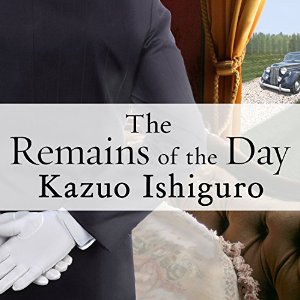
Book Review: The Remains of the Day

remains-of-the-dayThe Remains of the Day by Kazuo Ishiguro opens with a butler, Mr. Stevens, getting used to a new employer. Stevens had long and faithfully served Lord Darlington, who has now passed away, and an American, Mr. Farraday, has bought Darlington Hall. Not only does Mr. Farraday do and think differently from an English lord, but times have changed as well. The staff has been greatly reduced, leading to a series of small mistakes. When Mr. Farraday plans to be away for a few weeks, he encourages Stevens to take the car and see the country, something Stevens has never done. Stevens has recently had a letter from a former housekeeper, Miss Kenton, now Mrs. Benn, whose marriage seems to be failing, and he thinks perhaps she might be amenable to retaking her old position, which he feels will solve the staff problems. So he decides to take his employer up on his offer to take a “motoring tour” to see Mrs. Benn. The fact that he has a professional reason to go makes the trip more fitting to him than if he had just gone for pleasure.

The story is told in a series of journal-like entries during Stevens’ trip in which he combines the events of the day with recollections from the past and musings about life and his profession. He has given a great deal of thought and effort into determining how to be the best in his profession and what it means to have dignity. When other servants accompany their masters to Darlington Hall, the dominant topic of conversation seems to concern their profession rather than world events, books, music, etc. He comments that “Continentals are unable to be butlers because they are as a breed incapable of the emotional restraint which only the English race are capable of.”

Stevens is so emotionally restrained, though, that he stumbles over the concept of bantering. His new employer tends to make jokes in the course of everyday conversation, so Stevens feels it is expected that he should respond in kind. He studies the concept, and his attempts fall flat. When his own father is dying upstairs during a major conference at the house, Stevens takes pride in the fact that he maintained his dignity and performed his duties in such a way that his father would be proud (that and the strain in the scenes between him and his Father suggest that his father, also a butler, suffered from the same restraint). The only way we know that Stevens is at all affected by his father’s condition is the reaction of some of those he is serving who keep asking if he is all right.

Probably the most damage his restraint causes is in his relationship with Miss Kenton. At first they clash, but eventually they develop a warm working relationship. Ishiguro is a master of “showing, not telling,” especially in this relationship. Through a series of Stevens’ recollections, we deduce that Miss Kenton has feelings for Stevens, but either he is clueless or he is so restrained that he can’t accept them. In those days, members of the household staff could not marry without losing their jobs, so that probably played a big part in his lack of even thinking about the possibility.

Lord Darlington had a dear German friend who, after WWI, lost everything and ended up taking his own life. Darlington feels that the consequences meted out to Germany were too harsh and tries to set up conferences and meetings with leaders around the world to bring about what he thinks is justice. But in the climate of WWII, his affiliations cause him to be seen as a Nazi sympathizer, and he loses his good name and eventually his health. Though Stevens loyally defends the lord, he doesn’t admit to the people he meets on his trip that he worked for him, because he says it is just simpler that way. But part of his discussion about being a great butler included serving a great house and helping enabling great men to do their work well, and near the end he admits to himself he has lost even this.

It’s not until near the end of the book that we see some cracks in his armor. My favorite parts of the book are his last meeting with Miss Kenton/Mrs. Benn and a conversation with a perfect stranger on a bench at a pier where he rehashes his life and loyalties like he has done with no one else. Some say the book is a tragedy, but I think it ends on a hopeful note, with the stranger encouraging him to make the best of the time he has left. “The evening’s the best part of the day. You’ve done your day’s work. Now you can put your feet up and enjoy it.” The evening, not just of the day, but of one’s life.

I saw the wonderful film of this with Anthony Hopkins and Emma Thompson some years ago and enjoyed it, but it left me wondering what the author’s main point was. Was it a political commentary, or an unveiling of the problems in the old system where servants were expected to be nearly invisible and totally loyal, or an negative example of being so buttoned up and emotionally stifled that one can’t even have meaningful relationships? I’m glad to have read the book, which was much more fleshed out, of course, than the film, and I think that all of those subjects are a part of it, but primarily the last. There’s nothing wrong with thoughtfulness, loyalty, dignity, service, even sacrifice, or taking joy and pleasure in not being the big fish but rather aiding someone else in that position. But Stevens took it so far that he lost something of himself in the process.

I loved Ishiguro’s subtlety and style of writing. This isn’t a razzle-dazzle book full of action scenes; rather, it’s quite thought-provoking and emotionally compelling, especially near the end.

Here’s a trailer for the film. It’s been years since I have seen it, and I’d love to see it again now.

I also enjoyed reading Kazuo Ishiguro’s article How I Wrote The Remains of the Day in Four Weeks and listening to some of his comments here. I listened to the audiobook nicely narrated by Simon Prebble with occasional rereadings in a library copy of the book.

Genre: Modern fiction
My rating: 9 out of 10
Potential objectionable elements: The only thing I can recall is Mr Farraday’s coarse joke about Stevens’ taking a lady for “a roll in the hay,” which seems to go over Stevens’ head.
Recommendation: Yes.

(Sharing at Semicolon‘s Saturday Review of Books, and Literary Musing Monday, and Carol‘s Books You Loved)

literacy-musing-mondays-300x300

Books you loved 4


Save

Save

Save

Save

Book Review: Home to Chicory Lane

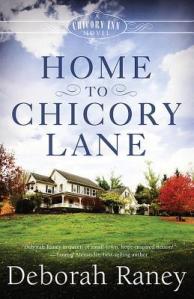
chicory-innIn Home to Chicory Lane by Deborah Raney, Audrey and Grant Whitman decide to turn their empty nest into a bed and breakfast in Missouri. They’ve sunk a good bit of their resources into it, hoping to make some back, and Grant has retired from his stressful job to help operate the inn. After decorating and getting everything ready, friends and family come in for the grand opening. But someone totally unexpected shows up right in the midst of the big day: their daughter Landyn, a newlywed living in NY with her husband, unannounced, alone, and with a UHaul.

Trying to get to the bottom of what’s going on with Landyn, trying to figure out how best to help, while still staying on top of things for the inn makes for a stressful time.

Landyn made me want to shake her by the shoulders at first. But I enjoyed seeing how she and her husband, Chase, finally came together and tried to work out their issues through very plot twists and turns.

I identified most with the parents: it’s hard to know sometimes with adult children when to advise, when to help, and when to step back and let them figure it out and grow on their own.

Overall it was a very enjoyable book. The one spot I didn’t like was when the young couple came together after a long separation. It’s not as graphic as Song of Solomon or Proverbs 5:19, but I would rather the scene had stopped a few paragraphs earlier.

It did convince me definitely that one thing I never want to do is open a bed and breakfast. 🙂

This is the first of three in a series called Chicory Inn novels, and I’m looking forward to getting to know more of the Whitman’s large family.

Genre: Christian fiction
My rating: 9 out of 10
Potential objectionable elements: The scene mentioned.
Recommendation: Yes.

(Sharing at Semicolon‘s Saturday Review of Books, Literary Musing Monday, and Carol‘s Books You Loved)

Books you loved 4

literacy-musing-mondays-300x300

Save

Save

Save

Wiersbe “BE” Commentaries

I’ve mentioned before that I like reading the Bible through, for a number of reasons, but I don’t do it in a year’s time any more. I like to be able to stop when I want to spend more time digging in.

I like to really slow down in the NT epistles especially. Many of them are so short, they could easily be read in one sitting. But they’re so densely packed with truth you wouldn’t want to do that. Previously when I’ve come with them I’ve read the same one over several days in a row until I felt I had gotten a grasp on it.

For the past year or so a couple of friends have been posting when one of Warren Wiersbe’s “BE” Commentaries has come up on a sale for the Kindle app. I really enjoyed his 50 People Every Christian Should Know and With the Word: The Chapter by Chapter Bible Handbook , so I thought I’d look into these. He has written one for every book of the Bible. For larger books, like Genesis, he has taken 2-3 books to cover them. He has combined smaller ones together in one volume. I don’t have them all, but I’ve collected several.

Unfortunately I forgot I had them in my current trek through the epistles until I had already read a number of them.

I wish I had reviewed each one, but at the time, I thought, “How do you review a commentary?” But these are the ones I have read with some stand-out quotes from each:

be-readyBe Ready (1 & 2 Thessalonians): Living in Light of Christ’s Return

The Christian who is feeding others must be careful not to feed on the wrong things himself.

Paul also comforted them. This word carries the same idea of “encouragement,” with the emphasis on activity. Paul not only made them feel better, but he made them want to do better. A father must not pamper a child; rather, he must encourage the child to go right back and try over again. Christian encouragement must not become an anesthesia that puts us to sleep. It must be a stimulant that awakens us to do better.

How does God cause our love to “increase more and more”? By putting us into circumstances that force us to practice Christian love. Love is the “circulatory system” of the body of Christ, but if our spiritual muscles are not exercised, the circulation is impaired. The difficulties that we believers have with one another are opportunities for us to grow in our love.

The purpose of Bible prophecy is not for us to make a calendar but to build character.

Any teaching that encourages us to disobey another divine teaching is not Bible teaching.
be-faithfulBe Faithful (1 & 2 Timothy, Titus, Philemon): It’s Always Too Soon to Quit!

But many prefer the “vain jangling” (1 Tim. 1:6) of those who teach novelties rather than the pure Word of God that produces holiness in lives.

It is not enough for a local church to teach sound doctrine and to proclaim the gospel. The church must also defend the faith by exposing lies and opposing the doctrines of demons (1 Tim. 4:1).

The purpose of prayer is not to get man’s will done in heaven, but to get God’s will done on earth.

Not all unity is good, and not all division is bad. There are times when a servant of God should take a stand against false doctrine and godless practices, and separate himself from them. He must be sure, however, that he acts on the basis of biblical conviction and not because of a personal prejudice or a carnal party spirit.

“That they may lay hold on eternal life” (1 Tim. 6:19) does not suggest that these people are not saved. “That they may lay hold on the life that is real” would express it perfectly. Riches can lure a person into a make-believe world of shallow pleasure.

What germs are to a physical body, false teaching is to a spiritual body, the church.

Note his emphasis on the person of Christ: “I know whom I have believed.” Salvation is not the result of believing certain doctrines, though doctrines are important. A sinner is saved because he believes in a Person—Jesus Christ the Savior. Paul had deposited his soul in the care and keeping of the Savior, and Paul was sure that Jesus Christ would faithfully guard that deposit.

be-matureBe Mature (James): Growing Up in Christ

The epistle of James was written to help us understand and attain spiritual maturity: “… that ye may be perfect and entire, wanting nothing” (James 1: 4). I like the way J. B. Phillips puts it: “… and you will find you have become men of mature character, men of integrity with no weak spots.”

In the Bible, patience is not a passive acceptance of circumstances. It is a courageous perseverance in the face of suffering and difficulty.

“A temptation is an opportunity to accomplish a good thing in a bad way, out of the will of God.

Christian love does not mean that I must like a person and agree with him on everything. I may not like his vocabulary or his habits, and I may not want him for an intimate friend. Christian love means treating others the way God has treated me. It is an act of the will, not an emotion that I try to manufacture. The motive is to glorify God. The means is the power of the Spirit within (“ for the fruit of the Spirit is love”). As I act in love toward another, I may find myself drawn more and more to him, and I may see in him (through Christ) qualities that before were hidden to me.

be-hopefulBe Hopeful (1 Peter): How to Make the Best Times Out of Your Worst Times

Hope is not a sedative; it is a shot of adrenaline, a blood transfusion. Like an anchor, our hope in Christ stabilizes us in the storms of life (Heb. 6: 18–19), but unlike an anchor, our hope moves us forward, it does not hold us back.

The Word reveals God’s mind, so we should learn it; God’s heart, so we should love it; God’s will, so we should live it.

We do not study the Bible just to get to know the Bible. We study the Bible that we might get to know God better. Too many earnest Bible students are content with outlines and explanations, and do not really get to know God. It is good to know the Word of God, but this should help us better know the God of the Word.

It is necessary to understand that God is not going to replace suffering with glory; rather He will transform suffering into glory. Jesus used the illustration of a woman giving birth (John 16: 20–22). The same baby that gave her pain also gave her joy. The pain was transformed into joy by the birth of the baby. The thorn in the flesh that gave Paul difficulty also gave him power and glory (2 Cor. 12: 7–10). The cross that gave Jesus shame and pain also brought power and glory.

I’m currently working through Be Real (I John): Turning From Hypocrisy to Truth.

I’ve been going through a study Bible this year, so I’ll read one chapter of the epistle with the study Bible notes. Then the next day I’ll read the corresponding chapter in Wierbe’s book. If it takes him more than one chapter in his book to cover a chapter in the epistle, I’ll read one a day (sometimes half of one a day) until I finish with with however many chapters in his book it takes to cover that chapter in the epistle.

So, for example, on Monday I’d read the introductory material on 1 John from the study Bible, and on Tuesday I’d read the first chapter of 1 John with the notes from it. Wiersbe takes two chapter to cover 1 John 1, so I’d read those on Wednesday and Thursday – or I’d take longer if I need to. The important thing isn’t that I finish a chapter in a day, but rather that I take the time to read carefully and understand what I am reading.

So I feel this has worked well to slow me down in those short epistles and really take time to soak in them and put them together as a whole rather than reading isolated chapters.

I appreciate that Wiersbe’s tone is, as one preface says, “theologically sound but not overly academic.” He tends to take the passages in sections, explains what they’re about, relates them to the rest of the book, sometimes provides cross references and illustrations or examples.

My only criticisms are that some chapters do get a bit long and might have benefited from being broken down even further, and I wish that, as he discusses the chapter in smaller sections of a few verses at a time, he’d put those verses at the beginning of that section. It would just make it easier than having to go back and forth between the Bible and the commentary.

I haven’t yet used one of his commentaries on a longer book, but I am especially looking forward to the one on Ecclesiastes after reading Hope’s review of it. That book is a little different from the rest, so I’d appreciate his expertise in studying it. Incidentally, she has a Facebook page where she lists free or sale books for the Kindle at Worthwhile Books.

I think when I finish 1 John I might try to review it: if not I may just share pertinent quotes then.

At any rate, I wanted to make you aware of these resources. I’ve found them very helpful.

(Sharing at Semicolon‘s Saturday Review of Books and Literary Musing Monday)

literacy-musing-mondays-300x300

Save

Save

Laudable Linkage

I’ve discovered some great reads around the Web recently. Here are the latest:

Treat Yourself to the Voice of God. “We’re prone to take one of the single greatest gifts available to us and treat it as a life-sucking obligation rather than a life-giving opportunity.”

After my post about Principles For Interpreting the Bible, I was pleased to see “Contending For Old School Hermeneutics” said some of the same things but also said some things I didn’t.

The Whole Sentence Matters. An illustration of the above, how one “popular” verse changes meaning a bit when read with the verse above it.

Kindness Changes Everything, and it’s different from just being “nice.”

Waiting to Die, HT to Challies. Working through the dark thoughts and emotions that come with a terminal diagnosis.

On Empty Nests, Christian Mommy Guilt, and Misplaced Identity by Jen Wilkin. “It’s as if our love is a cosmic batch of heart-shaped cookies we must divvy up. Give anyone more cookies than Jesus and your identity is misplaced. But shouldn’t there be a way to give Jesus all the cookies without depriving our families as well?”

A Prayer For Kindred Spirits. “The nurturing of just one kindred spirit can be enough to keep the voices at bay. It’s as if this secret I’ve been carrying around, afraid to share, has been loosed into the world, and it’s okay. There’s nothing like the deep, soul hug which takes place when realizing you’re amongst those who know the kind of person you really are. And it’s okay.”

3 Reasons Your Small Group Is Not the Church.

4 Practical Guidelines For Reading Old Testament Stories.

Do’s and Don’ts For Visiting Someone With Alzheimer’s.

Everyone Can Do Something.

9 Things You Should Know About Mother Teresa.

[Food and the Bible] When Eating Is Sinful.

Spelling Out Unconditional Love.

The High Calling of Bringing Order From Chaos. Sometimes I feel frustrated that this is such a constant battle, but this helps give it perspective.

Old Books, Disagreements, Loving People, HT to Worthwhile Books. Reasons to read books that contain things you disagree with.

Permission Not To Change a Thing. With all the nice photos on Pinterest and plethora of decorating and house-flipping shows, sometimes we feel a constant urge to do something to our homes. It’s certainly not wrong to redecorate or freshen things up or even do a grand remodeling. But it’s also ok not to.

With the 15th anniversary of 9/11 tomorrow, there are a lot of articles about it. I’ve only read a couple in depth so far: “We’re the only plane in the sky” about the president and those with him the first 8 or so hours (warning: a bit of bad language) and The Story Behind the Haunting 9/11 Photo of a Man Falling From the Twin Towers.

That’s it for today – hope you have a good Saturday.

Book Review: The Promise of Jesse Woods

jesse-woodsThe Promise of Jesse Woods by Chris Fabry opens with Matt Plumley in Chicago receiving a phone call from a voice from his past in West Virginia, sending him straight back there.

Matt had arrived in Dogwood, West Virginia from Pittsburgh when he was near 14 in the 1970s. His dad had grown up in Dogwood and was coming back to pastor the church there. Matt was not only the new kid, the new preacher’s kid at that, but he was also overweight, all of which worked against his making friends. But he did become friends with a couple of fellow outcasts, a boy of mixed race, Dickie Darrel Lee Hancock, and a girl named Jesse Woods from the wrong side of the tracks who took care of her sister because her father had left and her mother was ill.

As the three traipse around the countryside on their bikes, they get into various adventures and misadventures, revealing and keeping each other’s secrets. Matt’s eyes are opened to prejudice and mistreatment, to disappointment in his father, who goes along with Basil Blackwood, who runs everything in town, including the church, and to his first crush in Jesse.

The narration goes back and forth between the events of Matt’s childhood in 1972 and the events of 1984, when he returned. There is indication of something major that happened that caused a fallout between himself and Jesse, and though tidbits are uncovered along the way, the whole truth doesn’t come out until a big climax near the end. Even then it takes Matt a while longer to piece together the ramifications of that event to the present and to learn what he needs to learn, not only about the one promise Jesse didn’t keep, but also about himself.

Chris is a natural storyteller and weaves everything together nicely, though there was a bit too much detail about baseball for my tastes. There were also several mentions about what someone’s breath smelled like, which I thought odd in all but one instance. I would have been just a year or so older than Matt, so the parts about growing up in a small Southern town brought back many memories. There are moments of aching for children in Jesse’s situation. In one sense it’s a coming of age story – at least the 1972 scenes are. But in a larger sense it’s about Matt finally coming to terms with issues in his own life. A few times it’s pointed out to him that he’s concerned about rescuing others when maybe he’s the one who needs rescuing.

I thought the book was a smidgen too long and dragged in a couple of places, but overall it was an enjoyable read.

Genre: Christian fiction
My rating: 8 out of 10
Potential objectionable elements: There are a few “adolescent boy noticing a girl’s body” moments, though not explicit, and an attempted assault.
Recommendation: Yes.

(Sharing at Semicolon‘s Saturday Review of Books, Literary Musing Mondays, and Carol‘s Books You Loved)

Books you loved 4

Save

Save

Save

Save

Save

Book Review: I’m No Angel

im-no-angelI’m No Angel: From Victoria’s Secret Model to Role Model by Kylie Bisutti tells the story of her successful rise through the modeling world only to abandon it at the height of her success.

As a young girl Kylie was thin and pretty with “freakishy long legs,” and constantly people would tell her she looked just like a model or should be a model some day. Kylie makes an important point when she says:

Adults don’t always realize the profound effect their words can have on young kids—girls in particular. These people mean well, of course. What harm could possibly come from telling a little girl she’s pretty? Technically, none—unless that’s the only affirmation she ever hears…

It wasn’t as though I didn’t have anything else going for me…but whenever anyone looked at me, all they seemed to see was model.

As my identity became wrapped up in being pretty, it also became the primary attribute I used to define my value. If people weren’t praising me for my looks, I started feeling like I was lacking somehow, and I would go out of my way to make them like me. This would turn into a cycle that would haunt me for years to come.

In her junior high years, she felt a growing disconnect with her father, who had taken a new job and was working all the time so that she could “have what [he] didn’t have growing up.” She “missed their old life…when we had less money but more time together.” Then her height and thinness started getting her teased at school, with girls saying she was anorexic and boys calling her a giraffe.

So when opportunities for modeling did come her way, the positive attention and affirmation soothed. her. She hoped to “prove something to all the people who had teased me at school” and even to “regain [her] dad’s attention.”

From the very start, at just 14, she was made up and dressed to look older than she was and to appear sultry and sexy and pose provocatively. Being expected to change clothes in a room with models of both sexes made her uncomfortable, but she figured it was part of the job and she needed to get used to it. In addition:

That’s one of the harsh realities I learned early on about the modeling industry: ultimately, your body doesn’t really belong to you.  It belongs to the client.  Since they’re paying, they figure they can do pretty much whatever they want to you.  They can curl your hair, straighten it, dye it, cut it –even shave it.  I’ve seen hair extensions being pulled out by the roots and smoke billowing out of flat irons while the hair inside gets singed and fried.  I’ve watched models squeeze their feet into shoes so small their feet literally bled, and I’ve seen false eyelashes torn off so quickly that the natural lashes came off with them.  Modeling may look glamorous on the outside, but believe me, beauty can be an ugly business.

Some girls even had surgery to remove ribs to look thinner, Kylie herself, at a size 2 and 115 lbs., was referred to as “the big model,” and her agent called her a “fat pig” and a “cow” and told her she needed to lose weight.

After a devastating heartbreak in high school, Kylie was open when a friend invited her to her church’s youth group. She began going to her church and learning about God, Jesus, and salvation for the first time. At a youth camp some time later, she finally put her faith in the Lord Jesus as her Savior. After she came home, her mom saw such a difference that she was open to what Kylie shared about what she was learning.

It still took years, though, for Kylie to come to a realization that there might be a problem with her modeling, especially modeling lingerie. We are saved in a moment, but growth and sanctification are processes that come with time in God’s Word and in His church. Kylie tells how her modeling career continued until she reached what she considered the pinnacle: winning a Victoria’s Secret Runway Angel competition. Aspects of modeling continued to bother her, but at first she just thought it was part of the job, then didn’t want to displease her agent or company or jeopardize her job or risk rejection. Finally she was convicted, but continued to compromise. She “wasn’t mature enough to understand this at the time, but it wasn’t simply a question of what you can or can’t see in those types of photos. My sinful choice was rooted in something deeper: what the photos represented. I can only imagine how sad it made God to see my complete lack of honor and purity and respect, not only for myself, but also for my parents, for my future spouse, and most of all, for Him.”

Had I been further along in my Christian walk and more focused on serving God rather than myself, I might have seen that. But I still had a long way to go in my faith. In my mind, being a Christian meant that God loved me and that He wanted me to be happy, healthy, and successful. I’d been listening to CDs that taught me how to transform my mind, when I should have been immersing myself in the Bible so God could transform my heart through His Word. Up to that point, I’d been treating God like a genie in a lamp, making childish wishes and then waiting for Him to deliver.

But God didn’t send His Son to die on the cross so that one day I could become a famous fashion model. He doesn’t exist to serve me; I exist to serve Him.

When she married, her husband at first didn’t realize all that was involved in her modeling, and once he did, instead of “making” her quit, he just quietly prayed for God to convict her. And He did. “God was opening my eyes to the fact that I couldn’t glorify Him in my life while at the same time taking modeling jobs that compromised His values. The disconnect was too great, and if I kept trying to do both, I would end up despising one. I had to choose. Would I serve the world, or would I serve God?”

When she repented and chose to serve God, at first she thought she would continue t model but avoid jobs that were immodest.

But as I continued to grow in my relationship with the Lord, I started to lose the desire to model at all. Regardless of the type of clothing, I knew that modeling promotes the world’s sense of beauty. This wasn’t the type of beauty I wanted to endorse for girls and women. Not only that, but the temptation would always be there to be thinner, prettier, and more in demand. I’d seen how addictive those desires can become, and I didn’t want any part of it anymore.

Unfortunately a sad consequence of modeling is that the photos that were taken of her will forever be available on the Internet, even some by a unscrupulous photographer who sold some to a porn site. There’s no way to get them back or have them erased. “I could make godly decisions related to my future, but I couldn’t control how others chose to exploit my past.” She chooses to think of them as “a powerful reminder of the consequences of sin and the depths of God’s redemptive grace.”

Now she is married with two children and a ministry encouraging women in their walk with the Lord. She blogs at I’m No Angel.

A few years ago during Victoria’s Secret show on TV, Kylie was watching Twitter and finding mostly negative comments about it, some from women who felt that it was a negative not only because of the immodesty, but because of making “everyday” women feel inadequate. One man tweeted, “I’d rather have a Proverbs 31 woman than a VS model.” Kylie responded, “I quit being a VS model to become a Proverbs 31 wife.” Within minutes she was contacted and asked to do a guest blog post which went viral and led to interviews on a number of news sites. There were some verbal attacks as a result, but there were also words of encouragement in unlikely places in the industry.

At the end of the book is a 30-day devotional section titled “The Master’s Makeover,” with Scripture and words of wisdom about beauty from God’s point of view.

I found this quite an eye-opening book and was blessed by Kylie’s growth. As far as I can tell no one sat her down and had “a talk” about modesty with her, but God dealt with her heart and brought her to conviction Himself. In the few pictures shared in the book, she looks so much healthier and happier, in addition to being more modest, in her more recent photos.

Genre: Autobiography
My rating: 9 out of 10
Objectionable elements: I think Kylie does a good job showing the seamy side of the industry without getting unnecessarily explicit, but there are scenes that might bother some. In addition, a lady preacher is mentioned with whose teaching I would disagree, but I think that was who Kylie was talking about when she referenced listening to CDs teaching that God wanted her to be positive, happy, and successful rather than teaching the whole counsel of God.
Recommendation: Yes.

(Sharing at Semicolon‘s Saturday Review of Books, Literary Musing Mondays, and Carol‘s Books You Loved)

Books you loved 4

Save

Save

Save

Save

What’s On Your Nightstand: August 2016

What's On Your NightstandThe folks at 5 Minutes For Books host What’s On Your Nightstand? the last Tuesday of each month in which we can share about the books we have been reading and/or plan to read.

Between the Olympics, two birthdays, and a ten-day “stay-cation,” it’s been a different kind of month for us. I’ve been wondering how my reading record will go for this month. Let’s see:

Since last time I have completed:

Leaving Oxford by Janet W. Ferguson, reviewed here. Christian fiction about an ad exec who can’t leave her small town due to anxiety issues but falls in love with a coach who has a chance to go to the big leagues in another town. Good story.

More Things in Heaven and Earth by Jeff High, audiobook, reviewed here. A new doctor from Atlanta reluctantly starts his first practice in a small TN town only because of a program that will pay off his school bills and gradually finds good in the town and its people. Some bad language, and it took me a while to warm up to the characters, but ultimately good.

Be Mature (James): Growing Up in Christ and Be Hopeful (1 Peter): How to Make the Best Times Out of Your Worst Times by Warren Wiersbe. Not reviewed but very good.

Tuck Everlasting, reviewed here. Children’s story about a girl who stumbles across a family who are stuck forever at their current ages. Thought-provoking, nice writing.

The Green Ember, reviewed here. Children’s fantasy about rabbits who are preparing for a better world while fighting against wolves and birds of prey who are trying to extinguish them. Fairly good, though there are some odd things about the writing in spots.

Rescuing Finley by Dan Walsh, reviewed here. Heartwarming story about how various lives with various sets of problems intersect with that of a dog in need.

Ten Fingers For God: The Life and Work of Dr. Paul Brand by Paul Brand, reviewed here. A reread from 20 or so years ago, it’s a wonderful biography of a man raised in a small village in India who goes on to become a pioneer surgeon for lepers.

Well, I’m surprised! I read less due to the Olympics but more during our stay-cation, so I guess it averaged out. Plus last month’s last Tuesday for the Nightstand post left us with several days to be counted for this month.

I’m currently reading:

The Promise of Jesse Woods by Chris Fabry, audiobook.

Give Them Grace: Dazzling Your Kids with the Love of Jesus by Elyse M. Fitzpatrick and Jessica Thompson. This one keeps getting pushed behind others – I need to finish it.

Home to Chicory Lane by Deborah Raney

I’m No Angel: From Victoria’s Secret Model to Role Model by Kylie Bisutti

Up Next:

These were all listed as “next up” on last month’s nightstand post – but I didn’t get to them yet:

I’m Still Here: A New Philosophy of Alzheimer’s Care by John Zeisel, HT to Lisa’s review.

June Bug by Chris Fabry

Waiting For Peter by Elizabeth Musser

After that, I’ll choose from my TBR pile (to which I’ve added half a dozen or more books from my birthday) or the multitudes loaded on my Kindle app.

IMG_1820

I also did a post about my bookcases. I’d love to see yours!

Save

Book Review: Rescuing Finley

Rescuing FinleyI don’t read many dog stories, but I have enjoyed past books by Dan Walsh, so when Rescuing Finley came up for sale for the Kindle app, I got it.

Many dog stories are designed to be heartwarming, and Walsh is known for his heartwarming stories. My heart needs warming as much or more than everyone else’s, but when I know a story is aiming for that, I can find myself kind of resistant. But, they got me. I was touched and even in tears for part of the story.

The book tells the story of a few different people. One is Amy Wallace, a young woman who has been in trouble with drug addiction and stealing. Her family has cut ties with her, and when she’s caught shoplifting, the value of the item she stole lands her in prison.

Chris Segar is a minesweeper while in the Marines in Afghanistan, who steps on a silent mine, losing a leg and coming home with PTSD.

Then there’s Alicia Perez, whose son is killed in Afghanistan. She had been taking care of his dog, Finley, but she can’t handle him any more and takes him to the pound.

Kim Harper is an “Animal Behavior Manger and dog trainer” for the place where Finley is taken.

And then there is Finley himself, depressed by the loss of his owner and confused by his circumstances.

Walsh weaves their stories all together into a very satisfying book. You may even be able to guess where the story goes, but it’s worth the journey.

The sections from Finley’s point of view could have come across as cheesy, but I thought Walsh did a good job suggesting what Finley might be thinking without going that far.

I enjoyed the Author’s Note at the end, where he explains that, after his wife finished homeschooling all of their children, he encouraged her to do something she enjoyed. She wanted to train and be certified as a dog trainer. He explains that the book isn’t directly based on her or the organization she works with, but they greatly informed his story, along with the other research he did.

There are a few odd mistakes in the book (accept for except, bare for bear, our for are, etc.) that I was really surprised at. I don’t remember seeing anything like this in any of the author’s previous books: I’m wondering if something weird happened when formatting it for the Kindle. But I know it’s possible for little things to be missed in the process between writing and publishing.

This was a really nice read. It would make a great Hallmark movie.

Genre: Christian fiction
My rating: 10 out of 10
Objectionable elements: None.
Recommendation: Yes, I gladly recommend it.

(Sharing at Semicolon‘s Saturday Review of Books)

Save

Save

Save

Book Review: Ten Fingers For God

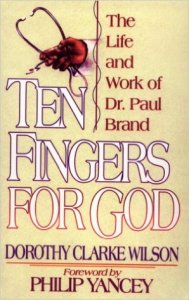
Ten Fingers For GodI first read Ten Fingers For God about Dr. Paul Brand by Dorothy Clarke Wilson some 25-30 years ago when we attended a church with a solid lending library of mostly biographies. After reading this book I read the same author’s book about Paul’s mother, Granny Brand, and I believe I also read her Take My Hands: The Remarkable Story of Dr. Mary Verghese, after seeing her story mentioned in this book. I reread Granny Brand a few years ago, and that caused me to want to reread Ten Fingers, so I found an inexpensive used copy online.

Originally my primary interest in Ten Fingers For God was stirred when I was told it mentioned Dr. John Dreisbach, who attended our church whenever he was in the country. But I was soon caught up in Paul’s story on it’s own merits.

He was the son of unconventional pioneer missionaries to India, Jesse and Evelyn Brand. He and his sister were allowed to roam pretty freely, his mother even letting him do his school work up in a tree and drop finished assignments down to her. “If [his work] was wrong, he had to climb down and get [it], reascend, and start over again” (p. 14). So it was a pretty strong shock to his system when, at the age of 9, I believe, he was taken to live with two maiden aunts in England for his schooling. Some of my favorite parts of the book are his and his sister’s antics there, like hanging upside down on the crosspiece of a streetlight in front of the aunt’s house, smiling at passers-by, or pretending the floor was lava and trying to make it around the room on the furniture without touching the floor. The aunties handled it as well as they could.

Paul’s father died when he was 15, and his mother returned to England for a time, devastated, but eventually she went back to India. It was understood that Paul would follow. Initially his main interest was in carpentry, so he apprenticed to a man his mother knew. When he applied to be a missionary, however, he was turned down. His father had had to build structures, which is one reason why Paul was interested in building, but it wasn’t accepted as a main missionary occupation. Medicine had originally been repulsive to him, with memories of his father treating gross and disgusting conditions. But once Paul decided to go that way and got into it, he marveled at the way God created the body and its systems and saw it as a wonderful way to help people.

He married and went to India and was thrust into more than full time medical ministry. Leprosy was still a mystery with a huge stigma attached. Sadly, most lepers were not actively contagious, but once the disease began they were ostracized. It was thought that their flesh wasted away, so much so that they couldn’t even be operated on, but Paul discovered that the cause for their ulcers and even lost digits was lack of pain sensation. He pioneered a surgery to transform their hands from their clawed version to workable, usable hands.

But that actually created more problems. People would not hire them because of the stigma of leprosy, but they couldn’t successfully beg any more because they no longer could garner the sympathy their clawed hands had elicited. Paul found employment for some at the hospital, but of course he could not do that for all of them. Eventually a training center was built where patients could not only learn a trade, but learn how to handle their tools in safe ways that wouldn’t damage hands that couldn’t feel, and in turn, as Paul and his crew became aware of problem areas, they could adapt tools or processes to the patients’ needs. Paul’s carpentry experience was valuable many times over in these endeavors.

Not many doctors were treating leprosy patients, so when possible, Paul traveled to other parts of the world to gain more insight (which led him to Dr. Dreisbach in Africa).

Eventually treatment expanded to include operations on feet, noses, and restoration of eyebrows. Paul’s wife, Margaret, became an expert in her own right on how leprosy affects the eyes.

I had forgotten that Paul worked in the ministry founded by Dr. Isa Scudder, someone else whose biography I enjoyed.

The last third or so of the book was not quite as interesting to me, as it got further away from Paul himself and more into how his procedures and methods gained worldwide attention, what organizations he became affiliated with, which organizations sent people or set up additional centers in Vellore, etc. There’s a nice epilogue in this edition which I don’t believe was in the one I first read, telling what happened in the lives of Paul, his wife, and each of his children.

He was so incredibly busy, I don’t know how he found time to even have a family. Yet he was known for being unflappable in just about any circumstance.

A lot of his insights into pain are in this book, but perhaps his best known book was originally titled Pain: The Gift Nobody Wants, which I’ve not read. It’s been republished and retitled The Gift of Pain with Philip Yancey, but I don’t know if the text has been altered or what Yancey’s contribution to the book was. They did collaborate on other books, Fearfully and Wonderfully Made and In His Image (I’ve not read these, either.)

Overall this was a fascinating look into a unique and remarkable man, perfectly fitted to what God called him to. I’m glad I read it again.

Genre: Biography
My rating: 10 out of 10
Objectionable elements: None
Recommendation: Yes, I highly recommend it.

(Sharing at Semicolon‘s Saturday Review of Books)

Save

Save

Save

Save