Book Review: What Follows After

What Follows AfterIn What Follows After by Dan Walsh, Scott and Gina Harrison are separated, but no one knows it. They attend functions together and ask their boys, Colt, age 11, and Timmy, age 6, to pretend as if everything is all right. But everyone is miserable, and Colt has finally had enough. He decides to take the money he has saved and buy bus tickets for himself and Timmy to go to their favorite aunt and uncle’s house. They feel sure their aunt and uncle will take them in, listen to their side of the situation, and talk some sense into their parents.

Everything goes as planned until the bus stops for a short break. Colt and Timmy get something to eat at a nearby diner. When all sorts of Army vehicles begin to pass by, Timmy is enthralled and won’t come when Colt needs to use the restroom. Colt decides it won’t hurt to leave Timmy there for a few minutes. But when he comes back, Timmy is gone. The waitress said he went out with a man she thought was their dad. They had gotten on a different bus heading the opposite direction from their aunt and uncle’s house.

The story is set in 1962 Florida on the eve of the Cuban missile crisis, which, though it doesn’t affect the story directly (except in taking attention and manpower away from the kidnapping case), does add a layer of tension. I was born in the 50s and thought Walsh did a good job recreating that era.

There are a lot of threads to the story: Scott and Gina’s relationship, what led to its current standing, the kidnapping, the motive and the man who did it, race relations in the South at the time, and people’s reactions to the current crisis with Cuba. I thought the overall story was good, and Walsh brought out a lot of good points about the Harrison’s marriage and what needed to be done to mend it.

Walsh is known for writing that tugs at the heartstrings, for books that could easily be made in Hallmark movies. But though all the elements were there to make this another winner, somehow it just fell flat to me. The characters did not seem fully developed and some of the conversation seemed cliche. Whatever it is that draws me in and really makes me feel for the characters just seemed to be missing this time. But, skimming through reviews on Amazon and Goodreads, none of them seemed to have any objections except just a very few people who didn’t like the religious element. So maybe it was just me.

But even though I didn’t feel it was up to Walsh’s usual standards, it’s still a fine book and I’d still recommend it. Maybe you’ll like it better than I did. I especially like the paragraph from which the title comes, that “what follows after” a crisis or terrible situation can be good, that God can bring beauty and blessing out of misery and work all things together for good for those who love Him.

(Sharing at Semicolon‘s Saturday Review of Books)

Book Review: True Woman 201: Interior Design

True Woman 201I’m not sure how I first came across True Woman 201: Interior Design: Ten Elements of Biblical Womanhood by Mary Kassian and Nancy Leigh DeMoss (now Wolgemuth). But I saw that it was a study of Titus 2:1, 3-5, a passage I’m very much interested in, and I’ve enjoyed what I’ve read of Nancy’s writings. In fact, I’ve been asking myself why I haven’t read more of her. My “interior design” can always use some work, so this seemed like a good book to work through.

It is set up as a ten week study for either an individual or a group. Each week contains five daily 15-minute or so readings around one particular “design element.” There are leader resources as well as videos which run about 20 minutes that cover the highlights of the lessons on TrueWoman201. So a group studying together would work through the lessons for the week, meet together and watch that week’s video, and then discuss the lessons. I only watched 3 or so of the videos. Though they did provide a good recap, I just didn’t feel inclined to listen to the same things I had just read.

Normally when you hear Titus 2:1-5 preached or taught, people hone in on a woman’s responsibility to love her husband and children, be submissive to her husband, and be a “keeper at home,” with much debate over exactly what that last one involves. Off the top of my head I can only think of one time where I have heard the whole passage dealt with, and that was at a lady’s conference where there were sessions on each section. So I very much appreciated that the authors here dealt with every part of the passage, beginning with verse 1. Titus is told to “teach what accords with sound doctrine,” and the authors explain that one’s doctrine is a set of beliefs and that “sound” doctrine is healthy, without contamination. They discuss the use of a “plumb line” in decorating or building to help one’s work to stay straight and show how we need to use the “plumb line” of Scripture to make sure we’re “in accord with sound doctrine,” “That we henceforth be no more children, tossed to and fro, and carried about with every wind of doctrine, by the sleight of men, and cunning craftiness, whereby they lie in wait to deceive” (Ephesians 4:14).

There is so much in here that it would be hard to encapsulate it all, but here’s a little bit about each “design element” after discernment:

Honor: “A True Woman makes much of Christ…She is ‘reverent in behavior.'”

“The basic meaning of the ‘fear of God’ is ‘reverential awe.’ It’s a personal, jaw-dropping awareness of God’s majestic greatness and holiness, reflected in a commitment to honor Him by turning from sin and faithfully obeying His Word” (p. 41).

Slander and being “slaves to much wine” (Titus 2:3) are seen as a lack of reverent behavior toward God and our fellow man, a self-promotion and self-indulgence that dishonors His sacrifice for us.

Affection: “A True Woman values the family…She “loves her husband and children.”

The authors make some interesting observations in this section, one noting what’s not on this list. If we were going to come up with a curriculum for discipling young women, we’d likely list Bible study, prayer, etc. – which are essential for all believers. But the specific things mentioned in this passage emphasize God’s priorities for women, which in our day is countercultural. This passage also emphasizes that these things must be learned. And they observe that this passage is for all women, even for those who are single or without children (Nancy was single with no expectation of marriage at the time of this writing), because marriage and childbirth is part of God’s plan of redemption, the marriage relationship picturing that between Christ and the church.

“As God designed it to function, ‘family’ helps us to understand what it means to have a heavenly Father and be part of a household of faith….God gave us these images so we’d have human thoughts, feelings, experiences, and language adequate and powerful enough to understand and express deep spiritual truths” (p. 68).

Discipline: “A True Woman makes wise, intentional choices…She is ‘self-controlled.'”

“Sometimes we focus too much on trying to change or stop the behavior, when what we need to do is go back and find out what kind of thinking produced that kind of behavior in the first place. It’s easier to fix the ‘what’ if we understand the ‘why.’…Here are some examples of the type of false beliefs that may have accounted for your behavior:

I have a right to return tit for tat.
Life should be easy.
He’s the problem, not me.
I deserve to be happy.
I just can’t handle it!
Indulging is better than holding out.

What if you paused to recalibrate your mind with truth?” (p. 101).

Virtue: “A True Woman cultivates goodness…She is ‘pure.'”

“Virtue and purity are two sides of the same coin: the presence of goodness and the absence of defilement” (p. 111).

The authors discuss the difference between “positional purity” that Christ wrought for us when He died on the cross for our sin, and “personal, practical purity (sanctification)” in which our everyday lives grow bit by bit to match our “position.”

“Two of the three times when diabolos refers to slander, it’s speaking specifically to women. God created women as relators and gave us an amazing capacity for verbal communication. Unfortunately, Satan likes to turn this strength into a weakness. He likes to turn virtue into vice” (p. 121).

“The Bible’s definition is broader…Slander means to speak critically of another person with the intent to harm…even if the information is correct. That’s why diabolos has been translated ‘malicious gossip’ as well as ‘false accuser'” (p. 122).

“Getting rid of vice and growing in virtue isn’t easy. It takes work. That’s why the Bible says, ‘Make every effort to add to your faith virtue’ (2 Peter 1:5). That’s right: love-motivated, Spirit-enabled, Christ-glorifying effort” (p. 131).

“In ancient Greek, the word pure originally meant ‘that which awakens awe’ or ‘that which excites reverence.’ Purity is ravishingly beautiful. It makes the gospel attractive and believable. When you make every effort to cultivate virtue in your life, the great ‘Refiner and Purifier of silver’ will reveal His beauty in you, and others will be drawn to love and worship Him!” (p. 131).

Responsibility: “A True Woman maintains the right work priorities…She values ‘working at home.'”

“In our minds, the question isn’t ‘Should women work?’ but rather ‘What is God’s view of work?’ ‘How do I choose which work receives the most time and attention at this stage of my life?’ ‘Am I giving my home the focus and priority God wants it to have?’ And ‘am I determining the value of my work based on earthly or heavenly economics?'” (p. 135).

“Work…exists because we’ve been made in the image of the great worker, God. We work because He works. Work is a God-ordained activity. Honest, diligent, attentive, productive, innovative, creative, faithful, fruitful, conscientious, hard work bears witness to God’s nature and character” (p. 142).

“Work does not primarily exist for the purpose of financial gain (though we may get paid). It’s primary purpose is to glorify God” (p. 142).

“No legitimate work, undertaken for the glory of God, is menial or meaningless. Hard physical labor wasn’t beneath the dignity of the Son of God. Jesus worked as a carpenter for about seventeen years and only about three years doing itinerant ministry. Carpentry was a lowly, ill-paying profession. Yet Jesus was doing God’s work when pounding a nail just as much as He was doing it when preaching on a hillside–because He was doing what God wanted Him to do when God wanted Him to do it” (p. 143).

“[The Proverbs 31 woman] could be a bit intimidating for the most energetic, gifted woman. But the thing that stands out in this passage is not so much all this woman’s abilities or all the things she does. What makes her extraordinary is the fact that she is so utterly un-self-centered and that she consistently demonstrates a heart to serve her family and others–all grounded in her reverence for God” (p. 149).

“To be idle is to ‘not be working or active,’ to habitually avoid one’s responsibilities, or to fill one’s time with things of no real worth or significance. Idleness is not the opposite of busyness. Idle people are often extremely busy. Take the woman of Proverbs 7 for example: “She is loud and wayward; her feet do not stay at home; now in the street, now in the market,  and at every corner she lies in wait” (Prov. 7:11-12). Though this woman was busy, she was actually being idle; for she wasn’t doing the ‘good work’ she was supposed to do” (p. 151).

“The reason we give priority to managing household responsibilities is not that vacuuming, dusting, or cooking are intrinsically valuable or satisfying tasks. It’s that we want to create a peaceful, orderly, welcoming environment conducive to nurturing and growing disciples for the kingdom of God” (p. 154).

Benevolence: “A True Woman is charitable…She is ‘kind.'”

“In the type of ‘random acts of kindness and senseless acts of beauty’ that society commends, the benefactor and the beneficiary generally have little if any awareness of each other’s deepest motivations and needs” (p. 159).

“For a believer, kindness is a fruit of the Spirit that is empowered, enabled, and directed by God. When our kindness extends beyond those who deserve or reciprocate our benevolence, when it reaches out to those whose shortcomings and failures we know full well, that is when we reflect the heart of Him who is ‘kind to the ungrateful and the evil'” (Luke 6:35) (p. 159).

Disposition: “A True Woman cultivates a soft, amenable spirit…She is ‘submissive.'”

“Jesus Christ is the epitome of submission. His ‘not-My-will-but-Yours-be-done’ attitude is at the heart of the gospel story” (p. 182).

Legacy: “A True Woman is a spiritual mother…She ‘teaches what is good.'”

“Deborah had a God-given nurturing instinct that gave her courage and compassion. She wasn’t driven by the things that drive many modern women–power, control, position, or recognition–but by a mother’s heart. She saw herself as ‘a mother in Israel'” (p. 211).

Paul’s use of the Greek word neos in Titus 2:4 “indicates that his categories of older and younger had more to do with experience, life stage, and spiritual maturity than chronological age. A neos is a newbie, a ‘greenhorn’–a fresh, inexperienced novice. It’s a woman new to the circumstance in which she is placed. The point is, if you want to be the kind of woman who brings glory to God, you should actively learn from the lives of women who have walked the path before you, and actively teach those who are coming after. Regardless of your age, the Lord wants you to be both a learner and a teacher” (p. 219).

“The older we get, the bigger the catalog of failures Satan can throw in our faces. You may think, ‘I don’t have anything to offer.’ But you can teach out of your failures as well as your successes” (p. 223).

Beauty: “A True Woman displays the attractiveness of the gospel…’So that the word of God may not be reviled.'”

“A Christian woman whose life doesn’t bear witness to the transformative power of the gospel causes the gospel to be blasphemed, defamed, and dishonored–it’s as though she invites vandals to deface it with foul graffiti. If, on the other hand, she cooperates with God and allows Him to change her, she ‘adorns’ the gospel. To adorn means to beautify it and make it attractive. Outsiders will look at her life and say, ‘Wow! Her life makes me think the Bible is true!’ We can’t just tell them it’s true. They need to see and feel and experience that it really is true through our lives” (p. 235).

They stress that God’s design for genders is not fluid according to whatever the world’s thoughts are: they’re a part of “sound doctrine.” On the other hand, they agree that God’s design doesn’t turn out cookie cutter Christians who all look the same, that how this works out in a life might differ from woman to woman. I appreciated that while they held fast to those areas where Scripture is specific, they dealt evenhandedly with controversial issues like a woman working outside the home, sharing a list of Biblical women who had other kinds of jobs, but stressing the primary ministry of home and family. They mention also that though many of these characteristics should be true of men as well, there are reasons that the Holy Spirit inspired Paul to list some characteristics for men and some for women.

If there is a “201,” there must have been a “101,” and there was: True Woman 101: Divine Design, which focuses on God’s plan and design for womanhood. I have not read it yet but probably will some day. It looks like it’s laid out the same as this was with 5 daily readings for each chapter, covering eight weeks rather than ten.

Back to True Woman 201: I thought the layout was a bit distracting at first. The spiritual “interior design” theme was couched in a similarities to the design of a home, and there are lots of photos relating to that kind of thing scattered throughout the pages. Verses and quotes are in sidebars. I got used to it after a while, and it’s a minor complaint. Overall I thoroughly enjoyed this study. I appreciated the authors’ thorough and gracious treatment of the topic and I can enthusiastically recommend it to you.

(Sharing at Semicolon‘s Saturday Review of Books)

Book Review: The Moonstone

MoonstoneThe Moonstone by Wilkie Collins opens with a copy of a family paper from an unnamed source. The writer and his cousin, John Herncastle, were soldiers in the English battle for Seringapatam, India, in 1799.  The night before, stories were told by the men in the camp about various treasures to be found there, especially one called the moonstone, a large yellow diamond in the forehead of a statue of a moon god. The narrative tells of the history and legend of the stone, including three Brahmins who were supposed to keep it under constant watch and “certain disaster to the presumptuous mortal who laid hands on the sacred gem, and to all of his house and name who received it after him.” After the battle, the narrator and his cousin were charged with keeping the men from looting, but the narrator came across his cousin in a room with the diamond in his hand and two dead and one dying Indian at his feet. Though the narrator knew his cousin had stolen the diamond and killed the men, he could not prove it since he had not actually seen it done, so he didn’t bring it to the authorities. He did, however, turn his back on his cousin and has written this narrative to explain to the family why he has done so. The family in turn turned their back on John. The narrator concludes, “Although I attach no sort of credit to the fantastic Indian legend of the gem, I must acknowledge, before I conclude, that I am influenced by a certain superstition of my own in this matter. It is my conviction, or my delusion, no matter which, that crime brings its own fatality with it. I am not only persuaded of Herncastle’s guilt; I am even fanciful enough to believe that he will live to regret it, if he keeps the Diamond; and that others will live to regret taking it from him, if he gives the Diamond away.  ”

Fast forward 50 years or so, and John Herncastle tries to visit his sister and her daughter. His sister refuses to see him. He retreats, but leaves the diamond to his sister’s daughter, Rachel, in his will. Rachel’s birthday is coming up, and her cousin Franklin Blake has been assigned to bring the diamond to her for the occasion. Knowing the diamond’s history, he is unsure whether giving it to Rachel is the best thing to do, but after consulting with longtime friend and family butler, Gabriel Betteredge, they conclude that giving it to her is the only thing that can be done.

So Franklin gives her the diamond and fastens a little setting so she can wear it on her blouse. And who should crash the party but three traveling Indian jugglers, who can’t escape seeing the diamond.

The next morning, it’s discovered that the diamond is missing, stolen out of Rachel’s room. The Indians are the first suspected, but they have an alibi. Rachel is strangely uncommunicative about the incident.

The story continues from there with various people being suspected and cleared, various family secrets coming forth, and finally the mystery revealed.

The Moonstone is considered by many to be the first detective novel written (Poe wrote mysteries, but they were short stories) and contains many elements that soon became standards of the genre: bumbling local police, a famous detective with eccentricities, false leads, , the “least likely” suspect being the perpetrator, a plot twist, and the detective summing everything up and filling in the missing pieces at the end. The detective is oddly missing in the middle of the novel, but Franklin Blake pursues the mystery, and even Gabriel Betteredge confesses to getting “detective fever.”

The story is written as a series of accounts requested by Blake from various people of what they saw and experienced, so in a sense the reader gets to consider the evidence and play detective along the way.

I thought the story dragged a bit in the middle, when the accounts there seemed to have little to do with the diamond theft: later, however, the reason for those seemingly unrelated details comes to the forefront. Like Dickens, with whom Collins was friends and for whose magazine he wrote, there are no extraneous details or characters: everything fits into the plot, though it doesn’t always make sense until the end. The latter third of the book really picked up the action and I found it hard to put down at that point. The story was originally published monthly in Dickens’ magazine, and at the end of many chapters I thought Collins showed great skill in ending the chapter on a note that would makes readers breathless until the next installment. I was glad I didn’t have to wait a month between chapters! I also thought Collins shone in having characters reveal details about themselves unawares and seemingly contradicting what they meant to reveal about themselves..

The Moonstone and The Woman in White are considered the best of Collins’ novels. I had read the latter a couple of years ago and consequently wanted to read more of Collins, but shied away from this one because I wasn’t sure how much superstition about the stone would play a part in it. But that turned out to be a very minor part of the story, mainly contained in the first section about its history. As the first narrator said, ” crime brings its own fatality,” and the book mainly deals with the crimes along the way of the moonstone’s history.

Though I normally enjoy reading analysis in Sparknotes, I thought they were a little off in a couple of places concerning this book. Here they say the story is “a novel in which women don’t speak often and therefore do not have a distinctive presence.” But the women spoke quite often – one of the major narrators is a woman. And they assert that the moonstone is symbolic of Rachel’s femininity and virginity and the theft of it from her room symbolic of her “deflowering.” But I saw no reason to associate it as such, especially as she is not “deflowered” in the incident.

I enjoyed listening to the audiobook narrated by several and the perusing parts of the text at Project Gutenberg.

(Sharing at Semicolon‘s Saturday Review of Books)

Winner of The Tenth Plague giveaway

The-Tenth-Plague

The winner of the giveaway of the paperback version of The Tenth Plague by Adam Blumer is Faith. Congratulations, Faith!

For those who didn’t win, check out Adam Blumer’s Facebook page, where he’ll be posting about various other giveaways over the next few months.

Thanks for entering, and thanks to Adam for sponsoring the giveaway and writing such great books!

Book Review: The Reunion

The ReunionI’ve had The Reunion by Dan Walsh in my Kindle app for months now (or years…yikes!), but Lou Ann’s review caused me to move it up to my next Kindle read.

Aaron Miller is a Viet Nam vet who works as a maintenance man in a trailer park. Serious injuries sustained in the war sent him home and caused him to become addicted to painkillers. He lost his family, his job, his home, and lived on the streets for a time. But he found the Lord and began the slow road to recovery.

Even though his job might not look prestigious to most, he does it well. And in the course of it, he seems often to be put in the way of people who need help. A teen-age girl with an abusive boyfriend. A legless veteran who is on the verge of ending it all. An elderly woman whose home is crushed by a tree.

Unbeknownst to Aaron, three men he knew back in Nam are looking for him. And when one of them hires journalist Dave Russo, who is writing a book about Viet Nam vets in honor of his later veteran father, they just might find him.

All of Dan’s books that I have read are heartwarming, but this one is probably the most so. I kept thinking it would make a great Hallmark Movie. 🙂 I loved the Amazon introduction to this book: “There are people in this world we pass right by without giving a second thought. They are almost invisible. Yet some of them have amazing stories to tell, if we’d only take the time to listen…” I loved Aaron’s character and could just picture him as one of those kinds of people most would tend to overlook but who faithfully does his work well and who has a great story behind him. I enjoyed Dave’s story as well. Dan did a wonderful job weaving all the different elements of the story together and pulling at the heartstrings.

Here are just a couple of quotes that stood out to me:

Of course, it was clear the thing Billy needed most was a friend. It didn’t help that Billy talked so much once he got going. One thing after another, like he’d been sitting on a mountain of words and Aaron had come in and set off a volcano.

Most of the people who blame God for everything never even try things his way, so how can they blame Him when it all goes wrong? But they do. I did. For years, til eating that meal. That day, the lights came on. And I saw that all I ever did was do things my way, my whole life. And all it ever did was get me in trouble and more trouble.

I also enjoyed the Author’s Note at the end where Dan says two stories about two different WWII Congressional Medal of Honor winners (Bobbie E. Brown and Bill Crawford) who came home, eventually became janitors, and had very different endings inspired him and caused him to think about people we overlook who might have amazing life stories or might have accomplished great things no one would ever guess. Plus he was inspired by Jesus’ example of speaking to out-of-the-way, overlooked people. And I join him in expressing gratitude for “the unsung warriors whose actions have made it possible for the rest of us to live free.”

(Sharing at Semicolon‘s Saturday Review of Books)

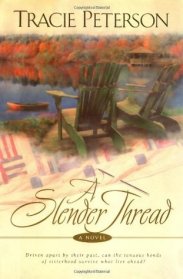
Book Review: A Slender Thread

Slender ThreadIn A Slender Thread by Tracie Peterson, five sisters return home to Council Grove, Kansas, for the funeral of the mother who had abandoned them to pursue an acting career. They gather at the farmhouse of their grandmother, Mattie, who raised them and tried to instill in them a hope and faith in God. But each of the women has been affected in different ways by their mother’s desertion which causes conflict between them.

Ashley is married to a doctor, has two young boys, and is vying for Supermom status, trying to be everything her mother was not to her. Brook is a model who can’t let herself open her heart to the possibility of love. Connie feels alone because her two older and two younger sisters are close, and she has a different father, so she feels the odd woman out on many fronts. But she makes it worse by putting up walls that none of them can break through and making choices that she knows Mattie would be heartbroken over if she knew. Deirdre was the only planned child of her mother, conceived to try to heal her marriage. She’s the peacemaker but hides a secret obsession. Erica was the youngest, born barely 9 months after Deirdre, a gifted musician who puts her potential career above her love interest.

As the girls gather for the first time in years, tensions rise to the surface and harsh words break out on all sides. Mattie tries to point them to the love the have for each other, the “slender thread” that ties them together, and to God’s help and grace, but each one is too immersed in her own issues.

There’s a lot of bickering in this book. A lot. It’s meant to show that their issues go beyond the usual sibling rivalry, but they seem extraordinarily touchy and too willing to get offended by innocent remarks. Some of the same issues keep coming up over and over – which does happen when people are fixated on their past hurts without attempts to come to peace with them. But it did get old. The story seemed very slow in the first section when the girls were all together but the action picked up quite a bit when they all went back to their own lives and we saw them in their own setting. Their characters were developed quite a bit more then.

But I did appreciate the emphasis that we don’t have to be bound by a bad past or a parent who has failed us. We’ll forever be affected by them, but with grace and forgiveness and God’s help, we can put the past in perspective and forge new trails for ourselves and our families.

(Sharing at Semicolon‘s Saturday Review of Books)

Giveaway of Adam Blumer’s Book, The Tenth Plague

Tenth Plague

A few years ago I posted this review of Adam Blumer‘s The Tenth Plague along with an interview with him. At the time the book was only available in an e-book format, and it still is. But now — in fact, today — his publisher has released a paperback version. If you’d like to enter for a drawing to hold a real live copy of this book in your hands, leave a comment below (US addresses only, due to the expense of shipping). A week from today, April 12, I’ll draw from the names entered with random.org, and we’ll send one happy winner a copy!

Here’s a recap of the review and interview:

The-Tenth-PlagueIn The Tenth Plague by Adam Blumer, Marc and Jillian Thayer have just adopted a new baby boy, and a friend has invited them to  a Christian-themed resort for some rest and time together as a new family.

When they arrive, however, the retreat is in upheaval. A company planning a new Bible translation is having meetings at the resort, and a throng has arrived to protest. Someone rigged the water system to dispense what appears to be blood from the faucets. What seems an odd prank is soon discovered to be the first in a series of events based on the Biblical ten plagues of Egypt, some of them resulting in fatalities. Marc calls on a friend, a retired homicide detective, to help with the investigation as the plagues escalate.

Gillian, meanwhile, runs into someone who has hurt her deeply in the past. She thought she had put it all behind her, but the old anger and hurt rush back in like a flood,  and she wrestles with the need to extend forgiveness.

The Tenth Plague is a sequel to Fatal Illusions, Adam’s first book (which I reviewed here), but you don’t have to have read the first book to understand and enjoy the second. Both books are tremendously suspenseful and feature realistic, everyday Christian people trying to discern and apply God’s will in their circumstances. I enjoyed them both very much!

Here is an interview with Adam:

blumer_adam_portrait

What was your inspiration behind The Tenth Plague?

One day I was reading the book of Revelation and came across 22:18–19. “I warn everyone who hears the words of the prophecy of this book: if anyone adds to them, God will add to him the plagues described in this book, and if anyone takes away from the words of the book of this prophecy, God will take away his share in the tree of life and in the holy city, which are described in this book” (ESV). My mind began playing the “what if” game. Would God really bring a biblical plague on someone who tampered with His Word? I chatted with a few theologian friends, and the plot emerged from there.

How does this novel compare with your first novel, Fatal Illusions?

Though the plot, of course, is different, the two novels share a number of similarities. Both are set in Michigan’s Upper Peninsula, where I live. I like to write about average folks like Marc and Gillian Thayer, a pastor and his wife who face unexpected, even threatening, events. Of course, there’s another really bad killer who wants to do them harm, and their retired homicide detective friend, Chuck Riley, once again comes out of retirement to help them. I also like to weave in a historical event that somehow relates to the present day. In Fatal Illusions, it was the killer’s obsession with Houdini; in The Tenth Plague, an old mine disaster plays an important role. The past always plays an important role in the present—a running theme in my novels. Overall, I like to write about redemption: how biblical truth offers the answers to the complicated issues of life. Stories, like parables, present some of the best ways to illustrate biblical truths.

What was one of the most important lessons you learned during the writing of this novel?

The power of the collaborative process. I had a fairly strong first draft, but I was stuck. A novel editor provided a creative springboard and helped me see where my true story lay. Without her help, I doubt this story would have seen the light of day.

What part of writing this novel took the most work?

This novel required a ton of research. From an old mining tragedy to autism, from adoption law to anthrax, from pheromones to the Oklahoma City bombing, the research for this one required much more than I ever expected. I’m so thankful for technology and ease of access, thanks to the Internet. Without Google and so many resources at my fingertips, I’d probably still be researching this story.

So far, what has been your favorite work experience in life?

During one summer between years in high school, I worked at a library, a book lover’s paradise. Granted, a lot of the work involved stocking shelves, but being surrounded by so many fascinating books and interesting authors was pure heaven. I was born a die-hard book lover, and I’ll probably die one too.

Consider the qualities that make you unique. How do these qualities come out in your writing?

I love suspense fiction and history, so a blending of the two always seems to come out in my writing. In high school, I won awards in calligraphy; Gillian Thayer, my female lead, is into calligraphy in a big way (it’s her job). I’ve always been intrigued with how one’s past impacts his or her present and future. This is a recurring theme in my novels because it’s part of who I am. Now that I think about it, what I write is inseparable to some degree from who I am.

Introduce your plot summary and main characters. What is your favorite part of the story?

Water turns to blood. Flies and gnats attack the innocent. Marc and Gillian Thayer’s vacation resort becomes a grisly murder scene, with a killer using the ten plagues of Egypt as his playbook for revenge.

When their friend turns up dead, Marc and Gillian put their vacation on hold, enlist the help of a retired homicide detective, and take a closer look at the bizarre plagues as they escalate in intensity. Meanwhile, a stranger is after the Thayers’ newly adopted baby. Will they uncover the truth behind the bitter agenda before the tenth plague, the death of the firstborn son?

My favorite part is when the firstborn son is revealed and the novel culminates in the tenth plague. This is the most suspenseful and action-packed part of the story, with several key characters in jeopardy. I had a blast writing it.

One of the main themes of The Tenth Plague is confronting and dealing with your past. What can readers take away from this theme, especially in a novel that deals with religion and death?

Both the villain and my heroine, Gillian Thayer, grapple with heartbreaking real-life issues from their past. But how they respond shows two very different paths. My hope is that readers will see the stark contrast in the context of biblical truth presented in the story. The bottom line is that God is enough, and He offers the solution to every problem of life. This is another repeated theme in my stories. Thank you for the opportunity to talk about my latest project.

Some content used by permission of Kirkdale Press

Tenth Plague Forgiveness

(Sharing at Semicolon‘s Saturday Review of Books)

(Update: The giveaway is now closed. The winner is Faith! Congratulations!)

Mount TBR Checkpoint

Mount TBR 2016

The Mount TBR Reading Challenge (to read books one already owned) has checkpoints every quarter where we can report how we’re doing. So far for this challenge I have read (each title links back to my review of it):

  1. What Are You Afraid Of? Facing Down Your Fears With Faith by David Jeremiah (Finished 2/22/16)
  2. The Bronte Plot by Katherine Reay (Finished 2/2/16)
  3. Searching for Eternity by Elizabeth Musser (Finished 1/16/16)
  4. Our Mutual Friend by Charles Dickens (Finished 2/22/16)
  5. A Connecticut Yankee in King Arthur’s Court by Mark Twain (Finished 3/8/16)
  6. Big Love: The Practice of Loving Beyond Your Limits by Kara Tippetts (Finished 2/14/16)
  7. Gilead by Marilynne Robinson (Finished 1/13/16)
  8. SEAL of God by Chad Williams and David Thomas (Finished 1/24/16)
  9. Not In the Heart by Chris Fabry (Finished 3/26/16)

The levels, or “peaks,” for this challenge are met with every 12 books read, so I am well on my way to the first one. I had only committed to the first one, but it looks like I may reach the second one by year’s end as well.

Only five of these were on my original list, but I don’t think that matters. I do still plan to read the rest of them plus others if I can. In fact, I am nearly done with one of them and partway into another one.

Bev (our hostess) also suggested some other things we could share about the books we’ve read, like a favorite book cover or character. I think for me the favorite book cover would go to Searching for Eternity by Elizabeth Musser.

Searching for Eternity

I like elements of the story that are there – Emile, the scene from the Varsity in Atlanta, and the passport from France. I tend to like drawn/painted rather than photographed covers for fiction.

Favorite characters….that’s a hard one. But I think it would be Truman Wiley from Not In the Heart by Chris Fabry, even though he’s not a good guy for most of the novel. I like his journey and how he is written.

Another question was whether any of the books surprised us. That would again go to Not In the Heart by Chris Fabry. The initial description of the story intrigued me, but there were so many more layers to it than I expected. It was my first of Fabry’s books, but I immediately bought another one after finishing this one.

One that surprised me negatively was Gilead by Marilynne Robinson. Perhaps that was due to having heard such wonderful things about the writing, so my expectations were built up overly high. I did come to agree about the writing by the time I finished, but it was awfully hard to get into.

Bev didn’t ask this question, but probably the most beneficial of these books would be What Are You Afraid Of? Facing Down Your Fears With Faith by David Jeremiah.

So that wraps up this checkpoint – looking forward to the next one!

Book Review: Every Waking Moment

every-waking-momentIn Every Waking Moment by Chris Fabry, Devin Hillis is a filmmaker with vision but no cash. He wants to make a documentary of the stories of people in the Desert Gardens assisted-living facility. He tries to support himself in the meantime by making shorter memorials for funerals, but that’s not paying the bills, and both his partner and his landlord are on his case.

His time in Desert Gardens brings to his attention an employee there named Treha Langsam. At first she looks like perhaps she is developmentally delayed somehow, but she is very intelligent. She has nystagmus, a condition which causes her eyes to be almost constantly moving, and when she’s agitated she makes a typing motion with her hands, but otherwise she seems emotionless. She grew up in various foster homes and has little to no memory of her history. But she seems to have a gift: she is able to bring out residents who have been closed off and uncommunicative to where they are speaking clearly. She was hired for janitorial services, but when the facility supervisor, Miriam Howard, saw her work with the residents, she let her have free reign to interact with them. Devin thinks Treha may be the story he’s looking for.

But Miriam is about to retire, and the new supervisor is more concerned about her own rules and regulations than care of the residents. She has her eye on Treha, threatening to fire her if she does anything other than clean.

What will happen to Treha and the residents if she loses her job, and will Devin and Miriam be able to solve the mystery of Treha’s background, not just for the documentary, but for her future?

I got this book right on the heels of finishing Not in the Heart by Chris Fabry because I loved his writing so much and wanted to read more. I was looking at that book on Amazon when a link to this book with these words from Chris intrigued me:

What if this is as good as life gets? Are you okay with that?

This question has haunted me over the past few years. Several years ago we moved to the desert for health reasons. Looking for recovery in a dry and thirsty land. And I realized my soul was more thirsty than anything.

Every Waking Moment is my effort to take some of the pain and loss of life and sift it through the life of a young woman who’s been marginalized in society, working among people who are marginalized (the elderly). This character, Treha, has an extraordinary gift that few observe because she’s “different.”

Like most of my tales, it’s a love story, a mystery, part thriller–but mostly a character sketch of lonely people looking for hope. And it’s my intent that you find hope and meaning for your own life through Treha’s journey.

That theme of “What if this is as good as it gets” comes up for several characters throughout the book. Poking around Chris’s web site, I saw that this novel arose in part because of his family’s experience with toxic mold and the detrimental effects it has had on his family’s health. That is not what caused Treha’s problems, but he draws parallels from the experience.

Not in the Heart was fast-paced and suspenseful. Every Waking Moment is a different kind of book. It has moments of suspense, and of course there is the mystery of Treha’s history and what made her the way she is. But overall the book has a different pace and feel to it. But it is still quite good.

Some of the lines about or by the facility residents were especially poignant to me with the decline of my mother-in-law’s health and abilities over the last several years:

The daughter didn’t realize that this was part of the problem. The same tasks that wore her mother down were the tasks that gave her structure and stability. Worth. When she could no longer do them and others were paid to accomplish things she had done as long as she could remember, life became a calendar of guilt–every day lived as a spectator, watching others do what she couldn’t.

Deciding what Mother would like or wouldn’t like was a seesaw between two relatives who were guessing. Love looked like this and worse and was accompanied by a mute, white-haired shell.

“I want that person you knew to return. But the truth is, this may be the best we achieve. Today, having her here and comfortable and not agitated…that may be as good as we get. Are you okay with that?”

“Your love for your mother is not conditional on her response. You love her for who she is. You don’t love her because of the things she can do for you.”

“The medical community views individuals as patients to be cured. But when people age, they’re not looking for a cure as much as they are for encouragement to continue. Our work here is not about curing. It’s about the dignity of each person…”

“Value people not just for the income they provide us. Value them because of the lives they’ve lived. Value each person who pushes a broom or cleans a bedpan. And value the girl whose life is marred, yes, but who gives these people more than a doctor ever will.”

“Growing older is not much fun. It’s the slowing down that gets to you. Elsie calls it ‘vigor mortis.’ You just can’t do what you used to.”

“Old age teaches you in a very unkind way that things won’t necessarily get better. Not in this life. In fact, you can pretty much count on things degenerating. Being content is not a lack of ambition. It’s being able to rest and relax and know that your worth doesn’t come from what others think of you or even what you think of you.”

And one I loved just for the writing: “Retirement was bearing down on Miriam like a semitruck trying to make it through a yellow light.”

For those of you who like book trailers:

I enjoyed this book quite a lot and can heartily recommend it to you.

(Sharing at Semicolon‘s Saturday Review of Books)

What’s On Your Nightstand: March 2016

What's On Your NightstandThe folks at 5 Minutes For Books host What’s On Your Nightstand? the last Tuesday of each month in which we can share about the books we have been reading and/or plan to read.

It’s been another busy month, but I’m thankful for the mini-breaks that reading provides.

Since last time I have completed:

Our Mutual Friend by Charles Dickens, audiobook, reviewed here.

Sweet Grace: How I Lost 250 Pounds And Stopped Trying To Earn God’s Favor by Teresa Shields Parker, recommended by Melanie, reviewed here.

Not In the Heart by Chris Fabry, reviewed here. Excellent!

Narrative of the Life of Frederick Douglass, reviewed here.

The Sword in the Stone by T. H. White, audiobook, reviewed here.

A Connecticut Yankee in King Arthur’s Court by Mark Twain, audiobook, reviewed here.

Around the World in 80 Days by Jules Verne, audiobook, reviewed here.

The Old Man and the Sea by Ernest Hemingway, audiobook, reviewed here.

What Are You Afraid Of: Facing Down Your Fears With Faith by David Jeremiah was finished and mentioned at the last Nightstand, but I had not reviewed it yet. That review is here. I think this will be a favorite of the year.

Every Waking Moment by Chris Fabry. Just finished it this weekend – review coming soon, hopefully.

Though that looks like a lot, a couple of them were mostly read in Feb. and just finished up this month, the last Nightstand was almost a week before Feb. ended  (giving us an extra week in this Nightstand’s reading), and five of these were fairly short audiobooks.

I’m currently reading:

True Woman 201: Interior Design by Mary Kassian and Nancy Leigh DeMoss.. Enjoying very much.

Beyond Stateliest Marble: The Passionate Femininity of Anne Bradstreet by Douglas Wilson

The Moonstone by Wilkie Collins, audiobook.

Pioneer Girl: The Annotated Autobiography by Laura Ingalls Wilder and Pamela Smith Hill. I probably should not include this because I don’t know if I have actually looked at it this month. :-/ As I’ve said before, it’s a big book that doesn’t really fit in the places where I keep books I am reading, so I keep forgetting to pick it up. I started it in Feb. and need to make a determined effort to finish it.

Up Next:

Pride, Prejudice, and Cheese Grits by Mary Jane Hathaway

The Renewing of the Mind Project by Barb Raveling, recommended by Kim.

After these, I still have some Christmas presents and my reading lists for the year to choose from.

What are you reading now?