Book Review: Little Dorrit

Little DorritLike many Dickens’ novels, Little Dorrit starts off kind of slow with different scenes, characters, and conversations that don’t seem connected. But if you’ve read much Dickens, you know everything is connected in his books and trust it will all make sense in time, and it does.

One of the early scenes involves a group of people in quarantine after a trip from China to England. One of them, Arthur Clennam, has been living and working with his father for several years. His father has died, and Arthur is returning home. He goes to visit his mother and to tell her he does not want to continue in the family business. He also says he has reason to suspect that his father has perhaps wronged someone without having a chance to make it right, and asks if she would know whom, so that Arthur can do this kindness for his father. His mother and her butler-turned-business-partner Mr. Flintwich takes great offense at the suggestion.

Arthur is in his 40s and his home has never been a happy one. His parents have never gotten along, and his mother is rigidly and unmercifully religious, seeing everything that happens in terms of God’s punishment.

Arthur notices what he thinks is a young girl doing needlework at his mother’s house, but when he looks at her more closely, he sees that, though she is small, she is actually a young woman. He notices that his mother treats her with a modicum of kindness, unlike how she treats everyone else, and wonders if perhaps this girl or her family are ones that his family or their business has wronged. He follows her as she leaves to try to find out more about her.

He discovers that her father has been in Marshalsea debtor’s prison for some 23 or so years. The girl, known to everyone as Little Dorrit, was born there. Evidently prison at this time, at least this prison, allowed inmates’ families to live with them and come and go. Little Dorrit’s (her given name is Amy) mother died years ago. She has an older sister who has learned how to dance and works in that way, and an older ne’er-do-well brother. Her father has the distinction of having lived in the prison the longest of anyone there and is regarded as “the Father of the Marshalsea.” What is odd about all the family except Amy is that they put on airs (later Amy’s sister remonstrates with her about embarrassing the family and their position by walking home with an old pauper).

Arthur tries to discover the details of Mr. Dorrit’s case to see if there is anything he can do to help the family. He goes to the Circumlocution Office – Dickens’ satirical treatment of the epitome of bureaucracy and red tape – and gets nowhere.

Book I of the novel is called Poverty; Book II is Riches, which tells you that the Dorrit family’s fortune changes, but not their character.

Amy has fallen in love with Arthur, but Arthur, although he comes to care for her deeply, calls her “my child” and seems to see himself as a father figure. Meanwhile, he is in love with a girl named Pet, whom he met on the trip from China, along with her family, the Meagles. He has become friends with her family and visits them often. But she loves someone else.

Along with these threads, there are a few more: two prisoners seen in the opening chapter show up in different perspectives later in the book; a Miss Wade who was also on that first ship from China is a bitter woman whose path crosses that of the Meagles, Arthur, and one of the prisoner’s many times; there are several businessmen who play key roles, some good and some bad; there are a couple of Society women who do the same; there is a convoluted mystery involving Arthur’s mother, her butler, one of the prisoners, and Little Dorrit.

At 800+ pages, there is a lot to this novel. It was originally published in monthly installments over two years in the 1850s. Dickens’ own father had been a Marshalsea prisoner. Most of his novels deal with some sort of social injustice, and this one touches on the plight of the poor, governmental inefficiency, and the falseness of high society. He says in the preface that the major investment failure in the book that affects many is based on an actual bank failure.

It’s a little hard to sum up in one sentence what the book is about, but, going by the title character, I’d say it probably has to do with a character who stays good and kind whether her circumstances are good or bad, whether people treat her well or poorly. When her father’s fortune changes, she “lay her face against his, encircled him in the hour of his prosperity with her arms, as she had in the long years of his adversity encircled him with her love and toil and truth; and poured out her full heart in gratitude, hope, joy, blissful ecstasy, and all for him.” She reminds me a lot of Nell in The Old Curiosity Shop, caring for a fairly foolish parent (or grandparent in Nell’s case), except she is older and wiser and comes to a better end. That is one gratifying thing about this novel: the good characters win out in the end, even though some of them go through some low spots and trials, and most of the bad ones get their just desserts.

Even though Dickens deals with serious issues, he sprinkles quite a bit of humor throughout the book. In one of the sections dealing with a high society dinner, and having commented often on the highly powdered wigs of the footmen, he says that at the dinner “There was so much Powder…that it flavoured the dinner. Pulverous particles got into the dishes, and Society’s meats had a seasoning of first-rate footmen.” In telling about a Mr. Pancks, who is sort of the man who gets things done behind the respected figurehead of his business, he describes him as a tugboat who pulls the big ship where it needs to go, and uses phrases harkening back to that metaphor almost every time he mentions him, like, “Pancks opened the door for him, towed him in, and retired to his own moorings in the corner” and “On taking his leave, Pancks, when he had shaken hands with Clennam, worked completely round him before he steamed out the door.” The family in charge of the Circumlocution Office are slyly named Barnacle.

There are also some very tender, poignant moments, as when Arthur, after accepting that Pet loves someone else, tells Amy that he’s too old now to think about love, and Amy doesn’t want to show her feelings toward him but is dying inside. Arthur had decided early on that it would be best not to fall in love with Pet, and there are several statements along the lines that, “It’s a good thing he made that pact not to fall in love with her,” but he actually had. Later, after Pet tells him she’s going to marry another and he’s alone again, he takes the flowers she had picked and given him and gently tosses them in the river, where his hopes and dreams float away with them. And another young man, coming to grips with a great disappointment, “the heart that was under the waistcoat…swelled to the size of a gentleman, and the poor common little fellow, having no room to hold it, burst into tears.”

A favorite moment late in the book is a confrontation between Arthur’s mother and Little Dorrit, in which the latter tries to convince Mrs. Clennam that she doesn’t have to punish herself for her wrongdoing:

“Even if my own wrong had prevailed with me, and my own vengeance had moved me, could I have found no justification? None in the old days when the innocent perished with the guilty, a thousand to one? When the wrath of the hater of the unrighteous was not slaked even in blood, and yet found favour?”

“O, Mrs Clennam, Mrs Clennam,” said Little Dorrit, “angry feelings and unforgiving deeds are no comfort and no guide to you and me. My life has been passed in this poor prison, and my teaching has been very defective; but let me implore you to remember later and better days. Be guided only by the healer of the sick, the raiser of the dead, the friend of all who were afflicted and forlorn, the patient Master who shed tears of compassion for our infirmities. We cannot but be right if we put all the rest away, and do everything in remembrance of Him. There is no vengeance and no infliction of suffering in His life, I am sure. There can be no confusion in following Him, and seeking for no other footsteps, I am certain.”

I mostly listened to the audio version wonderfully read by Simon Vance, but near the end I switched back and forth with the Kindle version, both because I was getting eager and impatient to see how everything came out, and I could read at times that I couldn’t listen. I’ve been trying to read some Dickens work that I was not familiar with, so I’m glad to have completed Little Dorrit in that vein. Though I can’t say this is one of my favorites of his, I did enjoy it, and Amy and Arthur are among my favorites of his characters. There was a BBC miniseries made of it in 2009 (starring Matthew McFadyen, who played Mr. Darcy in the Kiera Knightly version of Pride and Prejudice, as Arthur) that I would love to see some time, but as it is several hours long, I’d probably have to break it up into segments as it originally aired. Here’s a trailer for that series:

Have you read Little Dorrit? What did you think?

(This review will also be linked to Semicolon‘s Saturday Review of Books.)

Book Review: Walking With God in the Season of Motherhood

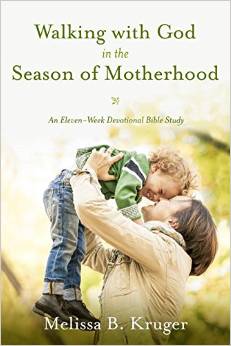
Walking With GodI first saw Walking With God in the Season of Motherhood by Melissa B. Kruger when someone linked to her blog, and I saw this story of how the book came to be written. I thought it might be a good book to pass along to young moms, but I found much for my own heart, though my children are all grown.

This study grew out of Melissa’s desire for “a Bible study that intersected who I was as a believer with the role I had been given as a mother.” It’s not necessarily a “how to be a better parent” study. It’s more of a “how to walk with God and then let that relationship impact your ministry to your children” study.

She begins with our purpose – to glorify God and enjoy Him forever – then reminds us of our responsibility to teach the same to our children and our inability to do so for ourselves or for them on our own. Succeeding chapters discuss walking in faith, wisdom, prayer, carefulness, and then each facet of the fruit of the Spirit, ending with a discussion of the Perfect Mom Syndrome.

The study is laid out over eleven weeks, with four days of study per week and a fifth wrap-up summary of the truths covered in that week. I really like that the Bible verses are included within the study, so a busy mom trying to feed a baby or grab a few minutes of study while waiting for piano lessons or ball practice to end has everything needed right there within the book. There is an additional study guide at the back that would be great for a group study but is also helpful for personal use.

I have several quotes marked but will try to pull out just a few:

It is important to assess regularly whether my family is suffering from an overly busy calendar. However, rather than simply removing activities, my greatest need is to add one particular meeting to my schedule. Every day I need time with Jesus. While it seems counterintuitive, the addition of this one meeting promises to positively affect every other part of my day (pp. 30-31).

When impatience, anger, or discontent well up in our hearts, these are signs that we are mothering in our own strength. Rather than dealing only with our outward behavior, we need the Lord to renew and recharge our hearts…our souls find renewed energy only by abiding in Jesus. Without this time we will find ourselves depleted, discouraged, and unable to bear fruit (p. 33).

[Re the Proverbs 31 woman], We can view her as an older woman to learn from rather than a standard against which to measure ourselves (p. 73).

An additional benefit of a home at peace is that it overflows into loving care and service for our community. The goal is not to create a place to escape or avoid the world but to carefully build our home so that it is a light to the world, shining the grace of Christ to those who are without hope. A peaceful home offers a place of respite and care in the midst of a weary world (p. 76).

When we receive the abundant love of Christ, we are free to pursue others with love, not to gain their affection but to give back what we have already received (p. 93).

True joy does not discount real suffering; it shines all the greater in the midst of it (p. 115).

The ability to extend kindness requires an other-awareness. We are apt to miss the needs of those around us if we remain self-focused. Helping children to see the needs of others will bless them with perspective on their own lives, as well as propel them toward good works that display the kindness of God (p. 157).

God uses these moments to grow our hearts in grace. We can only bear the fruit of patience when we have something to be patient about (p. 164).

In Jesus the performance pendulum stops — both the pride of success and the despair of failure are absorbed by grace (p. 208).

I cannot protect my children from my weaknesses. As hard as I may try, at some point my sin will affect their lives. However, the way I deal with my failure can provide an example for them to follow. I am a sinner raising sinners. Each of my children will face the weight and sorrow of his or her own sins. Just as we teach daily hygiene habits like brushing teeth, our children need instruction on how to find cleansing for their souls. By teaching our children about confession and repentance as well as grace and forgiveness, we bless their lives for years to come (p. 213).

At some points the study seemed a bit long, both in number of weeks and in how long it took to complete the day’s reading and answer the questions. But it’s not, really – eleven weeks is a good length of time for a study. I went through the book in less time than that because I used it six days a week and went on to the next chapter after finishing one rather than reading one chapter per week, but I think the latter would be the better course, to really soak in the truths for that week before going on. And each day’s lesson only took about fifteen minutes. One could spend longer – I tend to answer the basic questions in writing but answer some of the more thoughtful ones in my head. If one did more with the writing sections, one could spend more time with each lesson. And if a day’s reading and questions take more time than one has, there is no reason you can’t take a couple of days or whatever time is needed to complete it. It’s better to go at one’s own pace and really dig into it than barrel through just to get it done. Melissa’s summaries at the end of each week’s lessons really help to review the material and help tie it all together.

I really enjoyed going through this study, found it very beneficial, and am happy to recommend it to you in whatever season you are in.

(This review will also be linked to Semicolon‘s Saturday Review of Books.)
Book Review: The Captive Maiden

Captive MaidenThe Captive Maiden by Melanie Dickerson is a retelling of Cinderella set in Germany of the 1400s. Gisela’s father has died and her step-mother has taken over and treats Gisela like a servant. While Gisela submits when she has to, she is spirited and uncowed When a big tournament is held in town, Gisela sneaks away to see the games and unexpectedly runs into Valten, the duke’s son. They had met years ago when she was seven and he and his father had bought one of her father’s horses, and she has thought about him ever since.

Valten is the older brother of Gabe from The Fairest Beauty but quite different in personality. Where Gabe is glib-tongued, especially with the ladies, Valten never knows quite what to say and seems aloof. Valten excels at winning tournaments, particularly in jousting, but is beginning to think there has to be something else in life.

Valten also has an enemy in Ruexner, his main challenger in the tournaments. When Ruexner observes that Valten has an interest in Gisela, Ruexner sees her as a means of getting back at Valten. And of course Gisela’s step-mother hinders her attempts to pursue a relationship with Valten, so, to paraphrase Shakespeare, the course of their true love is not going to run smoothly. But I won’t spoil the details.

Along the way, Valten has to realize that he needs to rely on God’s strength rather that his own, and they both have to wrestle with the vengeance belonging to the Lord rather than being theirs to exact.

I didn’t think the writing in this story flowed quite as smoothly as in some of Melanie’s other books, and, although it is normal for couples to have some misunderstandings at first as they are getting to know each other and learning to read each other, the misunderstandings and misreadings here seemed excessive. But overall I did enjoy the story. I think anyone who likes fairy tale retellings and/or clean Christian romances would like this book.

(This review will also be linked to Semicolon‘s Saturday Review of Books.)

Book Review: The Little Prince

the-little-prince.jpegThe Little Prince by Antoine de Saint-Exupéry was chosen by Amy for Carrie‘s Reading to Know Classics Book Club for June, and, at 85 pages, also happened to fit the novella or short classic category for my Back to the Classics Challenge. I read the 70th anniversary edition, which, thankfully, my library had, and which also includes a CD of the story read by Viggo Mortenson (Aragorn in the LOTR films). I listened a bit to one CD just to see what it was like, but this is a book you definitely want to read rather than listen to because of the illustrations.

On the surface, the story opens with the narrator reminiscing that as a child, when he drew a picture of a boa constrictor digesting an elephant, grown-ups could only see it as a hat and advised him to stop drawing and concentrate on school subjects. “That is why I abandoned, at the age of six, a magnificent career as an artist. I had been discouraged by the failure of my drawing…Grown-ups never understand anything by themselves, and it is exhausting for children to have to provide explanations over and over again” (p. 2). As an adult he still showed people his drawing, but if they said they only saw a hat, he “would put myself on his level and talk about bridge and golf and politics and neckties” (p. 3).

So he felt pretty lonely and misunderstood until he crash-landed his plane in the Sahara Desert and met, in the middle of the isolation, a little prince. He had a hard time at first learning anything about the prince because he didn’t answer direct questions. The narrator had to pick up clues from things he said in passing, and in that way he learned that the prince was from an extremely small planet (the size of a house). But best of all, the prince understood his drawings.

Over the next eight days – the length of time the narrator’s water supply lasted while he tried to fix his plane – he learned more about the prince’s planet, travels to different planets and the odd people he met there, and his first excursions on Earth.

One gets the definite sense while reading that this story means more than the adventures of a little prince on his travels, yet the meaning isn’t entirely plain. I didn’t feel too bad about not being to make it out when I saw on SparkNotes and Wikipedia that there are differences of opinion among those who have read and studied the book since it was published 70 years ago. Some see in it elements of WWII, since it was written during that time, the dangerous baobob trees of the prince’s planet, which can “overgrow the whole planet. It’s roots pierce right through. And if the planet is too small, and if there are too many baobobs, they make it burst into pieces” (p. 15) representing Naziism. But some dispute that. There is more agreement that the vain rose that the prince cared for on his planet represents Saint-Exupéry’s wife. Some see it as “an allegory of Saint-Exupéry’s own life—his search for childhood certainties and interior peace, his mysticism, his belief in human courage and brotherhood…. but also an allusion to the tortured nature of their relationship” (Wikipedia). Some see it as “metaphor of the process of introspection itself, wherein two halves of the same person meet and learn from each other,” the narrator and the prince both representing aspects of Saint-Exupéry (SparkNotes). It adds to the mystique of the story that Saint-Exupéry was a pilot and did indeed crash-land in the desert once, and went missing while on a mission in his plane.

Whatever it means or represents, there are a few themes that come to the forefront. One is that “One sees clearly only with the heart. Anything essential is invisible to the eyes,” as a fox tells the prince. Another major theme is the problem of limited viewpoints. First there are the adults not understanding the narrator’s drawings, then one planet the prince visits is inhabited only by a king who only sees others as subjects to be ruled and acts toward them accordingly, and on another planet there is only a vain man who only sees others as admirers of himself, and so on. When the prince comes to Earth and lands in the desert and sees no other people, he asks a flower where they are. In her life she had only seen a few pass by, so she thought that’s all there were and that “The wind blows them away. They have no roots, which hampers them a good deal” (p. 52).

But to me the crux of the book is in the concept of “taming.” When the fox tells the prince he isn’t tamed, and the prince asks what “tamed” means, the fox replies:

“It is an act too often neglected,” said the fox. “It means to establish ties.”

“To establish ties?”

“Just that,” said the fox. “To me, you are still nothing more than a little boy who is just like a hundred thousand other little boys. And I have no need of you. And you, on your part, have no need of me. To you I am nothing more than a fox like a hundred thousand other foxes. But if you tame me, then we shall need each other. To me, you will be unique in all the world. To you, I shall be unique in all the world….”(p. 59).

He goes on to say that, “If you tame me, my life will be filled with sunshine. I’ll know the sound of footsteps that will be different from all the rest…If you come at four in the afternoon, I’ll begin to be happy by three” (pp. 60-61), and that from now on a wheat field, which means nothing to a fox since he doesn’t eat wheat, will remind him of the prince since his hair is the same color, “And I’ll love the sound of the wind in the wheat…” (p. 60). The fox also says, “It’s the time that you spent on your rose that makes your rose so important. . . . People have forgotten this truth, but you mustn’t forget it. You become responsible for what you’ve tamed. You’re responsible for your rose” (p. 64). The prince had thought his only rose was special until he comes across thousands of them on Earth. But the time and care he spent on it was what made it unique and special. So I think probably the biggest takeaway is that relationships (“creating ties”) are worth both the investment of time and care and then the pain when those with ties are apart, as the narrator himself discovers at the end. When the prince has to leave the fox, and the fox is sad, the prince tells him it’s his own fault for wanting to be tamed. When the fox admits he will weep when the prince goes, the prince asserts the fox got nothing out of being tamed. The fox replies, “I get something because of the color of the wheat” (p. 61). That statement in context is so poignant it almost makes me teary.

What I first thought of as an odd little tale that I couldn’t quite make sense of, now, after a couple of days of pondering, seems a very sweet and touching story about love and relationships. I love books that do that – make you think and unfold themselves long after the last page is turned.

(This review will also be linked to Semicolon‘s Saturday Review of Books.)

What’s On Your Nightstand: June 2015

 What's On Your NightstandThe folks at 5 Minutes For Books host What’s On Your Nightstand? the fourth Tuesday of each month in which we can share about the books we have been reading and/or plan to read.

This being the fourth Tuesday of June, it’s time for another Nightstand post:

Since last time I have completed:

Christy by Catherine Marshall for Carrie‘s Reading to Know Classics Book Club for May, reviewed here. Nice reread.

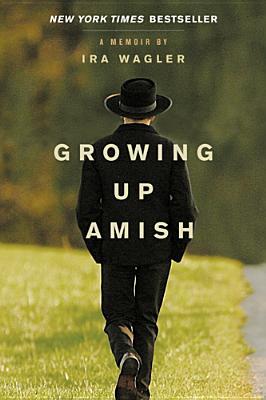
Growing Up Amish: A Memoir by Ira Wagler, nonfiction, reviewed here. Very enlightening.

Strait of Hormuz by Davis Bunn, reviewed here. Very exciting!

The Little Prince by Antoine de Saint-Exupéry for Carrie‘s Reading to Know Classics Book Club for June. Just finished Monday, hope to have a review up in a day or two. Somewhat strange – I am still processing it.

The Incorrigible Children of Ashton Place, Book 5: The Unmapped Sea by Maryrose Wood, audiobook, reviewed here. Funny and clever as usual for this series, but a bit sad as well (which is, hopefully, a set-up for everything to come right again in the next book).

The Fairest Beauty by Melanie Dickerson, reviewed here. Nice retelling of Snow White.

I’m currently reading:

Walking With God in the Season of Motherhood by Melissa B. Kruger

Little Dorrit by Charles Dickens

Pioneer Girl: The Annotated Autobiography by Laura Ingalls Wilder, edited by Pamela Smith Hill.

The Captive Maiden by Melanie Dickerson, a retelling of Cinderella

Next Up:

The Narnian by Alan Jacobs for both the Reading to Know Classics Book Club for July and the Chronicles of Narnia Reading Challenge, both hosted by Carrie. Maybe Live Like a Narnian by Joe Rigney for these as well. Either one will finish up my TBR Challenge list.

After Little Dorrit, I have five more classics to chose from for my Back to the Classics Challenge. Thinking about One Day in the Life of Ivan Denisovich by Aleksandr Solzhenitsyn next.

Then I have some new books acquired since Christmas that I’d like to get to:

A Captain’s Duty: Somali Pirates, Navy Seals, and Dangerous Days at Sea by Richard Phillips

The River and Child of Mine by Beverly Lewis

Unlimited by David Bunn

Running Scared: Fear, Worry, and the God of Rest by Edward T. Welch

I think that will keep me busy for a while. 🙂 Sherry ay Semicolon wrote last weekend of a 48-hour reading challenge she was participating in. That made me think how nice it would be to have a reading vacation, whether at home, on the beach, or in a cabin somewhere. I don’t think anyone else in my family would go for it, though.

Happy reading!

Book Review: The Fairest Beauty

FairestBeautyMelanie Dickerson writes Christian fiction retellings of fairy tales and sets them in medieval Germany. She says on her web site that she has “always loved fairy tales and been fascinated by the prospect of fleshing out traditional fairy tales and turning them into an in-depth romance. I was fascinated by the idea of taking a well-known fairy tale and making it real, with realistic characters and realistic reactions to their circumstances.” There are no magic wands or fairy godmothers in her stories, so the issues have to be worked out a bit more realistically. Having previously enjoyed The Merchant’s Daughter (based on Beauty and the Beast) and The Healer’s Apprentice (based on Sleeping Beauty), I snapped up The Fairest Beauty (based on Snow White and the Seven Dwarves) when it came up on sale for the Kindle app.

Sophie is a scullery maid for the wicked Duchess Ermengard, who throws her into the dungeon for things like rescuing the puppies that the duchess had ordered to be drowned. Sophie doesn’t see any way out of her situation, so she tries to make the best of it. Believing herself to be an orphan, the cook, Petra, is the closest person Sophie has to a mother, and another servant. Roslind, is her best friend. Somehow, despite her miserable upbringing, she is good and kind, and many love her (this is a fairy tale, after all. 🙂 )

What she doesn’t know is that she is the daughter of the presumed-dead husband of the duchess, and the duchess is actually her step-mother, who treats her as she does because she is insanely jealous of her. Only two servants in the entire castle know who Sophie really is, and one of them has just escaped and traveled several days’ journey to Hagenheim Castle, the home of the man Sophie was betrothed to years ago, Valten. Unfortunately Valten is laid up with a broken leg and can’t leave immediately to investigate this claim that the girl he thought had died years ago is alive. His younger brother, Gabe, decides on his own to go and rescue Sophie. Though he sincerely feels that God would have him do so and that Sophie might be in danger, his motives are primarily to best his brother this one time and to be the hero.

Once he finds Sophie, he has to ascertain whether she really is the daughter of a duke and then try to convince her of that. Then they face several days’ journey back to Hagenheim, facing dangers from the henchmen the duchess has sent after them and wolves. Along the way they begin to fall for each other, each fighting it at first because they are both betrothed to others.

Since this is based on Snow White, we know how the story will end, but it was fun to see how Melanie worked out the details of the issues the couple faced as well as the classic fairy tale elements, like the poisoned apple and the seven dwarves (I’ll let you discover that for yourself. 🙂 )

One thing I especially enjoyed in this book were the spiritual journeys. Sophie had to learn to trust and to let God heal her from the lies the duchess had been telling her all her life. Gabe had to realize that he had acted with wrong motives and that his impetuosity could put Sophie in danger physically and possibly hurt her reputation.

One little part I didn’t like was that, as they were becoming more aware of their interest in each other, there were mentions of Sophie noticing his muscles and being disconcerted when his shirt was off due to tending a wound. I don’t doubt that those things would happen in those situations, but I just don’t like to go there in books that I read. Thankfully, that was just a small part of the book.

I did also enjoy an unexpected tie-in with a couple of characters from A Healer’s Apprentice.

Overall I enjoyed this book quite a lot and look forward to a couple of others Melanie has written in this same vein.

(This review will also be linked to Semicolon‘s Saturday Review of Books.)

Book Review: Strait of Hormuz

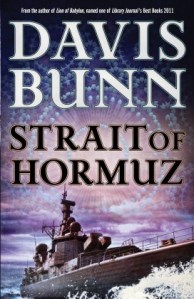
Strait of HormuzStrait of Hormuz by Davis Bunn starts off with a bang and keeps up a steady pace through most of the story. Marc Royce was formerly an intelligence operative for the State Department, but was fired by his boss. Since then, however, his former boss has called him for a couple of missions in which he needs someone off the grid. In this case, there is possible evidence that Iran is up to something involving nuclear bombs. The money trail leads to an art gallery in Geneva, which explodes just after Marc enters it.

Marc is unexpectedly reunited with Kitra Korban, whom he had met and fallen in love with in Israel in Rare Earth. He’s had to break off the relationship: she wanted him to stay and help lead the kibbutz her family led, but his calling was elsewhere. She had been notified by a stranger that she needed to warn Marc that he was in danger, and thus she became embroiled in his latest mission. While they both long to see each other, they also feel awkward and helpless, knowing nothing can change between them.

The Strait of Hormuz is an actual location, a narrow passage from the Persian Gulf to the ocean. In the story, American and other officials want to stop a ship they think contains components of an Iranian bomb before it gets to the Strait, but doing so will be interpreted as an act of war. In Marc’s investigation he finds unanticipated allies and enemies and follows trails that lead nowhere until he finally realizes what the actual Iranian operation and target is. But will he be in time to prevent it? And what casualties might occur in the process?

Action, adventure, espionage, an international flavor, and Christian faith elements woven in a natural and realistic way are hallmarks of this book. The pace is tense, fast most times, but Bunn handles even the stillness or times of uncertainty well. It’s a hard book to lay aside.

Strait of Hormuz is the third in the Marc Royer series, Lion of Babylon being the first and Rare Earth the second. I don’t think you have to have read those books to understand this one – enough information is given to comprehend the connections here – but you would probably enjoy this more fully for having read those.

(This review will also be linked to Semicolon‘s Saturday Review of Books.)

Book Review: The Incorrigible Children of Ashton Place, Book 5: The Unmapped Sea

Unmapped SeaThe Incorrigible Children of Ashton Place, Book 5: The Unmapped Sea by Maryrose Wood is the newest book in the series. It opens not on the best note, with Lady Ashton complaining, but picks up quickly from there. She’s expecting her first baby, and the doctor prescribes sea air for her. But instead of going to Italy, as she would like, Lord Ashton decides to go to Brighton – in the off-season, when it’s cold.

Penelope Lumley, governess to the three Incorrigibles (who are wards of Lord Ashton, having formerly been raised by wolves), jumps at the chance to go to Brighton. Her friend Simon’s Uncle Pudge, who was the cabin boy for Lord Ashton’s great-grandfather, lives there, and she and Lord Ashton hope she can find out more about the wolfish curse that was put on him and reverse it before his baby is born.

While in Brighton, the Ashtons, Incorrigibles, and Penelope meet a quirky Russian family, the Babushkinovs, with whose destiny they become more entwined by the end. And Penelope and the children have another dangerous run-in with the evil Edward Ashton. This time, it seems he has gained the upper hand.

In fact, this book ended on a very sad, but hopeful note. Yet it has a lot of good fun and very clever writing in it, as all the Incorrigible books do. A lot of the threads of previous plot lines come together in this one, yet there are a few more problems to be worked out – a major one, by the end of the book – and a few more questions still unanswered.

A couple of issues parents might want to be aware of, so you can be prepared for discussing them: the Ashton family curse has come up before. If you’ve read the series up til now you’ve probably had discussions about this aspect with your children, whatever your feelings about it. The second issue is a discussion about how babies are born (apparently Lady Constance does not know, content to leave that to the doctor). Nothing explicit is said, but the discussion will probably prompt questions about it, so you might want to be ready for that. 🙂

I listened to the audiobook, once again read wonderfully by Katherine Kellgren.

(This review will also be linked to Semicolon‘s Saturday Review of Books.)
Book Revew: Growing Up Amish

Growing Up AmishI had seen Growing Up Amish: A Memoir by Ira Wagler recommended by a number of people, so when it came through on sale for the Kindle app, I snagged it.

I’ve been somewhat dismayed at the rosy fascination in Christian circles for the Amish, resulting in a multitude of Amish fiction. I suppose there is an air of mystery about them that always piques curiosity. I understand admiration for their work ethic. I know some long for simpler times with less technology and wonder if the Amish might be on to something. I would have no qualms about someone living without electricity and modern conveniences because they felt it would benefit their family time or the ecology. But I do have a problem with deeming anything modern as “worldly” and condemning people to hell over such arbitrary practices as wearing a mustache, having rubber tires on a buggy, varying any degree on dress or hair styles, etc. “Legalism” is such an overused buzzword in Christendom today, but the extreme legalism of the Amish is seemingly overlooked.

Ira Wagler’s memoir strips away the romanticism and gives us a clearer view. He grew up in a prominent Amish family and community in Canada, the ninth of eleven children of a man well-known in Amish circles for his writing. As he grew into his teen years, he felt more and more constricted and constrained, “stuck in a stifling, hostile culture consisting of myriad complex rules and restrictions…arcane laws based on tradition…not to mention the drama, dictatorial decrees, the strife among so-called brothers, and the seemingly endless turmoil that resulted.” At age seventeen he left in the middle of the night and traveled by bus to work for a man who had once visited his father’s farm.

He enjoyed the freedom, but he missed his family and the stability of life at home, plus, after long days of hard work, he wasn’t really getting ahead financially. So he decided to move back home. His family and church accepted him, but the old conflicts rose to the surface again:

And therein lies the paradox that would haunt me for almost ten years: the tug-of-war between two worlds. A world of freedom versus a world of stability and family. A world of dreams versus a world of tradition. And wherever I resided at any given moment, trudging through the tough slog of daily life, the world I had left called me back from the one I inhabited. It was a brutal thing in so many ways, and I seemed helpless to combat it. Torn emotionally, moving back and forth, always following the siren’s call to lush and distant fields of peace that seemed so real but, like shimmering mirages in the desert, always faded away when I approached them.

He ended up leaving home five times altogether, always returning again until the last time, at age 26. People encouraged him to “decide to do what’s right, and then do it,” and assured him that once he just settled down, everything would be ok. He tried hard to make it work, even being baptized and joining the church. But “A mental choice, absent a real heart change, is no choice at all. We couldn’t force ourselves to be something we were not. That just couldn’t happen. And it didn’t.”

Believing that “The Amish way provided my only chance of salvation,” and that if he permanently left the fold, he would end up in hell, still couldn’t provide motive enough to stay, though it grieved him.

Personally, he “probably always believed there was a God, a sort of dark and frowning force. I just didn’t believe in him, to the extent that I thought he could or would make an actual difference in my life. I tried to believe, in my heart. But I couldn’t, in my head. I’d heard about him all my life. But if he was everything the preachers claimed he was, he sure had a strange way of hiding himself from people like me.”

Depressed and desperate, in a “mental trench of darkness from which I could see no way out,” he felt he had no choice but to finally leave the Amish for good. But then ” a sliver of light” came to him. Most of the praying he had ever seen in the Amish community was scripted, but he “decided he could simply talk to God. Ask for his help. Not by reading from a little black book, but by talking to him, man to man. Or man to God.” So he did, merely asking for the desire to do what was right.

Less than a month later, he met and almost instantly meshed with an English man who had joined the Amish, yet was a true believer.

He explained that there was no human penance for my sins. No way I could ever atone for all the things I had done. But…there was someone else who could atone. Who could wipe the past away and give new life. Heal all the wounds — my own and those I had inflicted on so many others through the years…

By quietly showing me Christ’s love, my friend had led me to the Source of that love. For the first time, I truly grasped that Christ had died for me — suffered, bled, and died–and that I could be his through faith. I was amazed at how simple it was. Why had it all seemed so hard, so impossible before?

The book ends with his final departure from the Amish at the age of 26. There’s a short epilogue at the end, but I would have liked to have learned more how about he finally adjusted to the outside world in the twenty years since he left, how his relationships with his family were since the final break, what kind of career he finally chose, etc.

I enjoyed this book quite a lot, not only for the view into what it was like to grow up Amish, but also to marvel again at how God draws people to Himself.

(This review will also be linked to Semicolon‘s Saturday Review of Books.)

Book Review: Christy

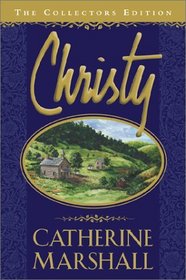
ChristyChristy by Catherine Marshall was the May selection for Carrie‘s Reading to Know Classics Book Club. I had read it decades ago and looked forward to this opportunity to revisit it.

Christy is historical fiction based on the experiences of the author’s mother, who went as a single lady to teach school in an impoverished Appalachian town.

Christy responds to the appeal of the founder of a mission to Cutter Gap, TN. She’s 19 and has not finished college, but she believes she can be a help to the mission. When she gets there, she’s overwhelmed by the poverty, ignorance, and superstition. In her youthful zeal, she’s all fired up to do something and gets frustrated that others haven’t yet. She oversteps her bounds a couple of times, and Miss Alice, a Quaker lady who works at the mission (she seems to be the head under the founder) has to gently remind her that she needs to find out first how the founder wants things done, and she has to learn she can’t come barging in as an outsider telling people how they need to change. Christy clashes at first with Dr. MacNeil, who was actually raised in the area: she feels he needs to correct people’s superstitions, particularly those that are unsafe from a health and medical standpoint. But because he is from the area, he knows that would only alienate people: he feels he has to work within their system, showing better ways and giving advice gently, carefully, and only a bit at a time.

In one sense this is something of a coming-of-age novel as Christy develops from a zealous but immature teenager into a more mature young woman. One part of that coming of age is her faith journey. I don’t think this book was marketed as Christian fiction – I don’t think that was a genre at the time, at least not like it is now – but I believe it’s a natural part of the story that her beliefs would be challenged, matured, and solidified. When she first leaves home, she knows surprisingly little. These days candidates for any mission are examined about their beliefs: maybe that wasn’t done then. But she experiences a few crises of faith. One comes in the face of hardship and evil. the other comes about partly through Dr. MacNeil, an agnostic who looks at God as only something of a “starter-force,” and David Grantland, the minister, who is something of a liberal. One of the saddest scenes is when David and Christy visit a woman who is dying, and she asks him to read portions of the Bible about heaven, which he does, but when she tries to talk about it, it comes out that he doesn’t really believe it, at least not like it says.

In one of the best passages in the book, in which Christy has had a fairly wrenching experience and is wrestling with the evil she has seen, Miss Alice says:

You’re sensitive, Christy. So am I. You want to know why seeing stark evil hasn’t made me rough or bitter?…Remember, I said is was God who was prying the little girl’s hands off her eyes. As if He were saying, ‘I can’t use ivory tower followers. They’re plaster of Paris, they crumble and fall apart in life’s press. So you’ve got to see life the way it really is before you can do anything about evil. You cannot vanquish it. I can. But in My world the battle against evil has to be a joint endeavor. You and Me. I, God, in you, can have the victory every time.’ After that, He was always right there beside me, looking at the dreadful sights with compassion and love and heartbreak. His caring and His love were too real for bitterness to grow in me…

Perceptive people like you wound more easily than others. But if we’re going to work on God’s side, we have to decide to open our hearts to the griefs and pain all around us. It’s not an easy decision. A dangerous one too. And a tiny narrow door to enter into a whole new world.

But in that world a great experience waits for us: meeting the One who’s entered there before us. He suffers more than any of us could because His is the deepest emotion and the highest perception…He doesn’t just leave us and Himself in the anguish. At the point where His ultimate in love meets His total capacity to absorb and feel all our agony, there the miracle happens and the exterior situation changes. I’ve seen that miracle….

Love has mending power. All of us have watched it work in small situations. Well, what I am talking about is a vast multiplication of that power (pp. 94-96)

Later it is revealed that Miss Alice has very personal reasons for these conclusions, having wrestled with the hand of evil leveled against herself.

Besides these issues, feuding between families, battling the moonshine business, handling 67 students from all  different grades and a shortage of supplies, and, later, a typhoid epidemic are all factors. Christy discovers that despite the ignorance and hardships in the mountains, there is also great beauty and dear people.

Quietly, Miss Alice was demonstrating this God of love and beauty too — in small ways and in large. For a few, the concept that life did not have to be all starkness and misery was slowly taking root. Tentatively, timidly – -constantly encouraged by Miss Alice — some of the women were at last reaching out for light and beauty and joy (p. 109).

For a few decades, the plot of a teacher coming from a more civilized area leaving home and going to work in a less civilized one got overworked (usually with a teacher from back East going to the untamed West), to the point that I got pretty tired of it and couldn’t read it any more. But this was one of the first, and the struggles are real.

What do you do when strength is called for and you have no strength? You evoke a power beyond your own and use stamina you did not know you had. You open your eyes in the morning grateful that you can see the sunlight of yet another day. You draw yourself to the edge of the bed and then put one foot in front of the other and keep going. You weep with those who gently close the eyes of the dead, and somehow, from the salt of your tears, comes endurance for them and for you. You pour out that resurgence to minister to the living (p. 471).

Somehow I did not see the TV show from the 90s based on the book, but I am tempted to look it up some time. Kellie Martin does seem well-cast as Christie.

While I would not agree with all the theology in the book (most of it coming from a Quaker perspective), it does contain a good deal of truth. I enjoyed visiting this book once again and retracing Christy’s journey.

(This review will also be linked to Semicolon‘s Saturday Review of Books.)