Book Review: The Old Curiosity Shop

Old Curiosity ShopThe Old Curiosity Shop by Charles Dickens was his fourth novel, originally published as a serial in his weekly periodical, Master Humphrey’s Clock. It was said to have been so popular that people clamored to the boats when the last shipment arrived, asking the sailors, who may have read it on the way, what happened to little Nell.

The story involves a girl of thirteen named Nell and her grandfather, who is never named. They live in her grandfather’s shop, which is kind of an odds and ends store. Her parents died long before, and she is content to live with and help her grandfather, even though it is something of a lonely existence for her. She rarely sees anyone her own age except Kit, who works for her grandfather and can make her laugh. Unbeknownst to her, Kit watches for her when she goes out on errands for her grandfather at night until she is safely home in bed.

The grandfather goes out at night as well, but no one knows where for several chapters. Later it is revealed that he has been gambling in order to try to give Nell what she deserves, but he has lost what money they had.

A dwarf named Daniel Quilp has loaned Nell’s grandfather money, and when he can’t repay, he takes over the curiosity shop and makes overtures to Nell about becoming his wife when she is older. He is already married but apparently doesn’t think his wife will live that long. Nell’s grandfather has something of a nervous breakdown, and when he recp0vers sufficiently, Nell convinces him that they should run away, that even if they have to beg for a living, they’ll be freer than they are now. Her grandfather agrees, and since he is weak and still not entirely in his right mind, Nell leads them and makes all the major decisions, at least for a time.

A great deal of the book deals with the different characters and situations they run in to. With Dickens’ penchant for unique characterizations, both good and villainous, you can imagine some of the ups and downs their path might take.

Quilp still seems to think they have a hidden fortune somewhere, so he tries to find them, and then sets his sights on Kit, whom he thinks is hindering him. He sets rather an elaborate scheme in motion to frame Kit for theft and have him imprisoned. The storyline spends a lot of time with Kit for much of the book before tying his situation back to Nell’s.

Meanwhile, someone else who is only called, at first, the Single Gentleman, comes to look for Nell and her grandfather, and it is not until later in the book that we discover what his purposes are.

Some of the quotes that stood out to me in the book:

For your popular rumour, unlike the rolling stone of the proverb, is one which gathers a deal of moss in its wanderings up and down.

There are chords in the human heart–strange, varying strings–which are only struck by accident; which will remain mute and senseless to appeals the most passionate and earnest, and respond at last to the slightest casual touch.

In the majority of cases, conscience is an elastic and very flexible article, which will bear a great deal of stretching and adapt itself to a great variety of circumstances.

From the death of each day’s hope another hope sprung up to live to-morrow.

The day was made for laziness, and lying on one’s back in green places, and staring at the sky till its brightness forced one to shut one’s eyes and go to sleep.

“Ahem!” coughed Miss Brass interrogatively.

“Places lie beyond these,” said the child, firmly, “where we may live in peace, and be tempted to do no harm. We will take the road that promises to have that end, and we would not turn out of it, if it were a hundred times worse than our fears lead us to expect. We would not, dear, would we?”

“The invading army of bricks and mortar whose station lay for the present nearly at his feet…” [I was amused at characterizing buildings as brick and mortar — I had thought that was a modern appellation!]

There is much I like about the book. Dickens characterizations are always rich, and there is a running note of sly irony connected with some of them that is quite amusing. Some sections are very touching. There is a lot of suspense both in what happens to Kit and and in the Single Gentleman’s pursuit. I especially liked how Richard Swiveller grew though the book : he started out as a friend of Nell’s brother, who was a ne’er-do-well who also thought the old man had money and was holding out on him, but the brother, Frederick, only has a small part. Richard, however, reminds me of the “simple” person in Proverbs – naive, easily swayed, in danger of going down the wrong path, but due to the circumstances he goes through, his eyes are opened to a great deal and he becomes a force for good. I could not stand him at first, but he grew to be one of my favorite characters.

But I am mad at Dickens for how the story ended. πŸ™‚ And though Quilp is thoroughly villainous, it was hard for me to take him seriously. Maybe he was a little too villainous. No offense to little people, but I couldn’t comprehend how Quilp could intimidate all these people when any one of them could have taken him down.

But despite those complaints, I enjoyed the book and am glad to have read/listened to it. I had not known anything about it before except that I had heard about it being serialized and people were clamoring to know what happened at the end – understandable, especially when the end didn’t come for 73 weeks.

(This will also be linked toΒ Semicolonβ€˜s Saturday Review of Books.)

31 Days of Inspirational Biography: The Last CIM Missionaries in Communist China

In 1950, Arthur and Wilda Mathews and their 13 month old baby, Lilah, traveled to Hwangyuan, China. China had fallen to Communism, and other missionaries were leaving, yet the Chinese church had invited them to come, with the approval of the Communist government. They felt this was a miraculously opened door God would have them go through. Yet, when they arrived, they could sense that all was not well. The Christians pastors who met them were strained, and they discerned that between the time of their invitation and arrival, the Chinese learned that association with the white people would be a liability under Communism, not a asset. The Mathews then thought perhaps, if they could not be a help to the church, they could endeavor to evangelize the unreached Mongols in the area and nearby. They had a few weeks in which to minister, but soon found that they were restricted in ways they could help. They endeavored to set up an inn with which to reach the Mongols, but Chinese troops took it over the day before it was to open. Arthur protested, but soon found it would have been wiser to have said nothing. In two days a policeman came to the mission compound to announce that no one there could do village work without permission, and the white people were forbidden everything: they could not have meetings outside the compound, they could not give out tracts or dispense medicine. They were restricted to the mission compound.

They finally decided that since they were more of a hindrance than a help, they would apply for exit visas. They thought, since the government did not want them, they would be allowed to leave quickly, and so gave away or sold dishes, curtains, etc., keeping just the bare minimum to function until they could leave. Arthur was summoned to the police station and asked to sign a statement that he was for world peace. He had heard of another missionary having to sign some document before leaving, so he signed without thinking much of it. The government official then asked what contribution Arthur was then willing to make toward world peace, outlining a plan in which Arthur would go to India and essentially be a Communist spy. Arthur realized that the Communist definition of world peace was a world dominated by communism, and of course could not consent.

A government official called Arthur in and promised his exit visas if he would do something for them, like write a report of five other missionaries. At first Arthur did write glowing reports of the missionaries in question, but someone told him he dare not turn that in: the Communists would change what he had written but keep his signature. So Arthur threw his report in the fire and told the official he could not be a Judas. The official then told him that he could have given him a pass, if he had cooperated, but now a charge had been laid against him which must be investigated, and β€œinvestigations take a long time.”

Thus began a two and a half year ordeal. Their provisions from their mission were frozen by the government, which made Arthur submit a report of what he would need, and then they doled out to him much less than what the report said he needed. Every victory they mentioned in a letter seemed to be immediately challenged by the enemy of their souls: once when they wrote what a blessing Lilah was, she then came down with scarlet fever, and they almost lost her. All of them had turns being ill. Eventually they were told that no one could speak to them, and they could only leave home to draw water from the creek and get food.

They wrestled with the β€œwhat-ifs” and the frustration of what they called β€œsecond causes,” finally coming to the conclusion that they had to trust that the Lord was in control and had them there for a reason, though it was hard to discern that reason when they were so restricted. Yet the Lord did use them even when they could not speak to the people. The few weeks they had had to minister before restrictions set in, people knew their hearts and saw their love. When the Mathews could no longer speak openly, the people saw them in tattered clothes, persecuted, attacked by illness without much medical aid, laughed at, jeered, humiliated, doing menial, degrading work just to survive, tantalized by the government offering release and then not giving it or doling out money that was theirs in the first place. They saw the Lord provide miraculously for them in many ways. Yet more than that, they saw them endure graciously and joyfully until, finally, the Mathews became the last CIM missionaries to leave China.

Green-Leaf-in-DroughtHow the Lord provided for them and ministered through them in unexpected ways are some of the most exciting parts of the book Isobel Kuhn wrote of their story titled Green Leaf in Drought. She says,

But most amazing of all was their spiritual vigour. Whence came it? Not from themselves: no human being could go through such sufferings and come out so sweet and cheerful. As I was in a small prayer meeting… one prayed thus: β€˜O Lord, keep their leaf green in times of drought!’ I knew in a moment that this was the answer. Jeremiah 17:8: β€œHe shall be as a tree planted by the waters, and that spreadeth out her roots by the river, and shall not see when heat cometh, but her leaf shall be green; and shall not be careful in the year of drought, neither shall cease from yielding fruit.” That was it! There was an unseen Source of secret nourishment, which the Communists could not find and from which they could not cut them off…That is needed by all of us. Your drought may not be caused by Communism, but the cause of the drying up of life’s joys is incidental. When they dry up β€” is there, can we find, a secret Source of nourishment that the deadly drought cannot reach?…Is it possible for a Christian to put forth green leaves when all he enjoys in this life is drying up around him?

The answer, by God’s grace, is yes!

(Reposted from the archives.)

photo 3(2)

For the 31 Days writing challenge, I am sharing 31 Days of Inspirational Biography. You can find others in the series here.

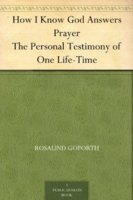
Book Review: How I Know God Answers Prayer

How I Know God Answers PrayerI think I first readΒ Rosalind Goforth’s first book, How I Know God Answers Prayer, maybe in my twenties, so about 30 years ago. I don’t remember how many times I have read it since. It is a testimony of how God has answered prayers both small and great in her life through the years, spurred by people’s occasional response that perhaps what seemed an answer to prayer was just a coincidence that would have happened anyway. She wanted to demonstrate through a lifetime of her walk with God that prayer is just a child of God asking her Father for what she needs, and seeing Him answer – not always just the way she originally wanted, but with love and wisdom nonetheless. Of her three books, including Goforth of China (a biography of her husband) andΒ Climbing (a book she was asked to write concerning some of her own experiences and perspectives),Β Climbing is my favorite, but this book is very good as well.

Since I was reading it this time for Carrie’sΒ  Reading to Know Classics Book Club, I tried to view it as others might who have not read it before.Β  For the first time I thought perhaps a little of the effect of what she relates might have been lost by the description of events taken out of context. For instance, when she writes near the end about finding “that the Lord could guide me even in trimming my hat to his glory,” some people might think, “What?” In Climbing, one of the difficulties she underwent was criticism of her dress when she would come home on furlough. There was no Internet, Facebook, or even Wal-Mart in those days to keep up with what was going on in the fashion world back home, and she had no idea what would be stylish or out of style or different from the last time she had been there. It is really ridiculous that people would criticize under such circumstances, but they do. Once when a lady offered to get new outfits for her when she was home, she was relieved, until the lady brought her garments entirely in black, which she evidently thought was appropriate for missionary ladies. Jonathan told her she looked like she was in mourning, but she felt she couldn’t refuse the gifts without causing offense. She didn’t necessarily want to be up-to-the minute in the latest styles (in fact, when Merry Widow hats were in style at one point, she thought they were ridiculous and tried to find a way not to wear them), but she didn’t want to be a distraction, either, as they visited churches and conferences. In that book she relates some of God’s leading and answers to prayer regarding that whole issue, represented here just by the sentences, “I found the Lord could guide me even in trimming my hat to his glory! That is, so that I could stand before an audience and not bring discredit to my Master.”

She mentions the anti-foreigner sentiments and some of the dangers involved, but I don’t know if readers will understand just how pervasive and dangerous it was. China was a very closed-off country then, and anything “foreign” was suspicious (one reason why Hudson Taylor advocated dressing like Chinese rather than British). She does mention here that one of the ways she and her husband tried to combat this was to hold “Open House” where they’d let their neighbors come in and tour the house so they could see there wasn’t anything dangerous about them. In one of her other books she writes that one of these times, someone saw her daughter’s dolls in her bed and spread the word that the Goforths kidnapped children and shrunk them. It seems ridiculous now that anyone would think that, but it was a very superstitious and suspicious time. Rumors like that could at the very least cause people to avoid them, and at the worst set off a powder keg of anger. Sudden mob violence was not uncommon, especially leading up to the time of the Boxer rebellion. I remember reading in another book (I forget whose) about a missionary having in her school a skeleton for educational purposes, and then trying to decide how best to dispose of it so people wouldn’t think they had killed someone. Trying to preach a gospel that the people were probably going to react negatively against at first in such a setting indeed required a lot of prayer and faith.

But even with some events taken somewhat out of context, she presents a testimony full of grace in how the Lord dealt with her. Some of the answers she relates were major –Β  a sudden breakthrough in her husband’s grasp of the language when he was discouraged and near giving up, found later to have happened right at the time that a group in his old college had met to pray for him, response in meetings found to have happened when others were praying (incidents that should remind and encourage us to pray for others), healing when all other help had been exhausted, protection from danger, especially in their escape during the Boxer rebellion. Of the last, she was asked why God spared them so miraculously but not others. She responded:

Truly a vital question, which could not lightly be set aside! Humbly and prayerfully we pondered this β€œWhy” in the light of Scripture. In the twelfth chapter of Acts, we read of Herod’s succeeding in putting James to death by the sword, and directly after comes the story of how Herod was hindered in carrying out his intention to kill Peter who was delivered by a miracle. Then who could read that marvelous eleventh chapter of Hebrews with its record of glorious martyrdom and miraculous deliverances without being thrilled? In face of these and many other passages, while still unable to answer the β€œwhy,” we saw our Almighty God used His own prerogative to glorify His name whether in the glorious martyrdom of some or in the miraculous deliverance of other.

I referenced this a few months ago in a post on our pastor’s cancer, how God heals some but not others, for reasons only He knows.

Such big and dramatic answers to prayer can be thrilling, but what touched my heart even more were the smaller, “everyday” answers: a lost key found, provision for clothes, a gift of fresh fruit, the need for a telephone and a coat and help during a speaking engagement when she felt ill.

Some of the incidents were deeply personal, such as the time her husband wanted to go touring out among the people, and she said no at first, for the safety of the children (smallpox was rampant and the Chinese then had no thought of keeping sick people home). She had to learn that “‘the safest place’ for myself and the children ‘was the path of duty.'” Though several of her children died from other causes, none died during this time in their ministry once she yielded to the Lord about it. Another personal situation was finally understanding what it was to rest in the Lord and trust Him for salvation from the power of sin and not just the penalty of it, after feeling like she had been on something of a roller coaster spiritually for 40 years.

Something else I thought some people might have a problem with in reading her book were the times she mentioned prayer being hindered by a wrong attitude or bitterness on her part, or, in one instance, the fact that she felt God allowed something to bless her for responding in a right way. These days what we often hear is that God deals with us on the basis of His grace, not our “performance.” That is true. Yet there are instances in Scripture, even in the New Testament, of disobedience hindering. We’re told that some people are sick and some have died because of partaking of the Lord’s Supper in a wrong manner, that we should reconcile with our brother before offering a gift to God, that confession of sin is a part of praying for healing, that we can’t expect forgiveness if we don’t forgive. We’ll never be perfect, but we can’t expect the Lord’s blessing if we are hanging on to known sin. As to the other, does God ever do a special little something for us when we obey in some area or do the right thing? I don’t know – I can’t think of a Scripture reference that deals with that exactly in the New Testament. We tend to think, especially when reading the Old Testament, “Be good and God will bless me, mess up and He will come after me hard.” But even there Job experienced great calamity even though he was doing everything right, and the wicked seem to prosper even when they are not obedient. Ultimately everything that God allows comes from His wisdom, love, and grace. But I have felt at times, especially in my very early days as a Christian, that some blessing or answer to prayer came just after taking an important step in the right direction, not as a reward or as God patting me on the head for doing right, but just as a little encouragement from a Father to His child. Don’t we do the same for our children? When we see them struggle in an area and do the right thing, don’t we give them some kind of encouragement, even if it is just a smile or a nod or a thumbs up or a “Well done”? Of course, we need to do right even if no one seems to notice or care or no “blessing” comes in response. I don’t think this nullifies the fact that it all comes from God’s grace because we can only obey and make right decisions with His grace. (I’ve written earlier that grace does not nullify the need for obedience but rather enables it. See Of grace, law, commandments, rules, and effort and What grace does not mean). God blesses us far beyond our ability to obey as it is, and obedience should be an outgrowth of love and reverence for Him rather than a “work” to “earn” blessing. This is too involved a topic for this post, but I feel sure she isn’t advocating that prayer and obedience are like vending machines where we put in out part and then expect God to do His – not at all.

Since this is a testimony of answered prayer, naturally most of the anecdotes involve those answers. Yet she also shares some times when God didn’t answer, at least not in the way she prayed for. In one instance, years later she could see and was thankful for the fact that He hadn’t granted a particular request, one that would have changed the path of her life away from China. In other instances, like healing that did not come and the deaths of several of her children, she continued to trust even though she couldn’t understand.

I don’t think Rosalind shared any of these answers to prayer with the attitude, “Look at me and my wonderful answers to prayer. Aren’t I special?”Β  I think she would have been horrified that anyone would think that. I think rather, she just wanted to show forth His provision and willingness to take care of His dear children’s needs, like the psalmists, whose testimony was, “Hear what great things the Lord has done and how He delivered me.” Every Christian walking and talking with God would have a record like this whether written or not, though admittedly probably not with situations like being delivered from an angry mob on the list. But like the Ebenezers I mentioned a few weeks ago, we should all be able to look back on those times where God met with us, provided for us, and answered prayer for us in a way that only He could. It’s good to share things like this with our families, so they know God didn’t just meet people’s needs back in Bible times, but He still does today. Such things redound to His praise and encourage us in the Lord when “when I remember you upon my bed,Β and meditate on you in the watches of the night;Β  for you have been my help,Β and in the shadow of your wings I will sing for joy.Β  My soul clings to you;Β your right hand upholds me” (Psalm 63:5-8).

photo 3(2)

For the 31 Days writing challenge, I am sharing 31 Days of Inspirational Biography. You can find others in the series here.

Reading to Know - Book Club

(This will also be linked toΒ Semicolonβ€˜s Saturday Review of Books.)

Book Review: In Perfect Time

Perfect TimeIn Perfect Time by Sarah Sundin is the third in her Wings of the Nightingale series about three friends who were flight nurses during WWII (The first was With Every Letter, the second was On Distant Shores, both linked to my reviews).

They didn’t start out as friends: they had their differences. Kay Jobson was probably the hardest to get to know for the other girls. They were Christians and she was not. She liked to flirt, to have half a dozen boyfriends at a time, was decidedly unchristian, and liked to run around with other girls who felt the same way she did. But circumstances in the previous two books have led to something of a friendship between Kay, Mellie, and Georgie.

Someone in the book called Kay a floozy, and honestly, that’s what I thought of her in the other books. But I was convicted of being judgmental. She doesn’t get physical with her boyfriends – in fact, that’s one reason she keeps so many, so that none will get too serious. When he does, she drops him. Finding out her back story and mindset was eye-opening. Girls who are flirtatious and even promiscuous are souls Jesus died for with stories and heartaches of their own.

I won’t unfold her story here except to say that part of it involved a father who only preached condemnation and who condemned her about things that weren’t her fault and were beyond her ability to change. Her life now is all about control. Her view of Christians has been shaped by her father.

Guys seem to melt like around her, except for pilot Roger Cooper. He keeps his distance and is known not to date. He has his reasons, noble to him, as we soon discover. He is a Christian anyway, which Kay doesn’t like. But one encounter opens both of their eyes a bit to the other, with a glimpse that there may be more to the other than each had thought.

Roger is a great pilot, courageous, daring, thinking outside the box, but he is not good with details like filling out forms and being on time, and he loves to pull pranks on the other guys. His father told him he would never amount to anything, which becomes kind of a self-fulfilling prophecy.

Both Roger and Kay have to learn that other people’s expectations and misjudgments and even past failures don’t define us. When Kay learns that she is, in fact, redeemable, for the first time she begins to want to be redeemed. They also have to learn that though it is okay to dream, ultimately we have to give our dreams and desires over to God. If He fulfills them, it will be better than anything we could have done. If He redirects them, it will be better than going our own way would have been.

I loved Kay and Roger’s story on several levels. I will forewarn some that this book is perhaps a little more physical than Sarah’s others, but nothing is explicit. One of the characters wrestles with sexual temptation, but that is a common temptation, and I thought Sarah handled it well.

Though characters from the other two books are in this one, I think this one can be enjoyed alone (though I’d encourage you to read the others as well. πŸ™‚ )

(This will also be linked toΒ Semicolonβ€˜s Saturday Review of Books.)

31 Days of Inspirational Biography: Mrs. C. H. Spurgeon

Some years ago a friend mentioned that she had never read anything by C. H. Spurgeon because she thought his writings would be over her head. Her husband, a student in Bible college at the time, assured her that would not be the case, so she began to read some of his books. She was happily surprised to find that he was very readable and down to earth. Her remarks intrigued me because I had felt the same way about Spurgeon. I began to read some of his books and made the same happy discovery myself.*

spurgeonmrsSome years after that I came across a biography of his wife titled Mrs. C. H. Spurgeon by Charles Ray. It is out of print, but used copies are available online, and it looks like the text is online here. Originally published in 1905, the language is very old-fashioned to modern ears, but it is easily readable and gives a sweet picture of a godly lady well suited to her husband as well as glimpses of their home life.

Susannah wasn’t impressed by Spurgeon at first, though. She had believed on the Lord Jesus Christ but was in a state of coldness and indifference when she first heard him speak as a guest at her church. She had heard good things about him, but she was shocked at his youth and “countrified” manner. She wrote later:

β€œAh! how little I then thought that my eyes looked on him who was to be my life’s beloved; how little I dreamed of the honor God was preparing for me in the near future! It is a mercy that our lives are not left for us to plan, but that our Father chooses for us; else might we sometimes turn away from our best blessings, and put from us the choicest and loveliest gifts of His providence. For, if the whole truth be told, I was not at all fascinated by the young orator’s eloquence, while his countrified manner and speech excited more regret than reverence. Alas, for my vain and foolish heart! I was not spiritually-minded enough to understand his earnest presentation of the Gospel and his powerful pleading with sinners; – but the huge, black satin stock, the long badly-trimmed hair, and the blue pocket handkerchief with white spots which he himself has so graphically described, – these attracted most of my attention and I fear awakened some feelings of amusement.”

He was called to be her pastor, and she kept going to hear him. Eventually she changed her mind not only about him, but about the spiritual state of her own heart.

Not many months later they were with a large group of friends watching the opening of the Crystal Palace, he pointed out a passage in a book he was reading and asked her what she thought. The title of the passage was “On Marriage,” and the quote:

β€œβ€˜Seek a good wife of thy God, for she is the best gift of His providence; Yet ask not in bold confidence that which He hath not promised: Thou knowest not His good will; be thy prayer then submissive thereunto; And leave thy petition to His mercy assured that He will deal well with thee. If thou art to have a wife of thy youth, she is now living on the earth; Therefore think of her and pray for her well!’

β€œβ€˜Do you pray for him who is to be your husband?’ said a soft, low voice in my ear, – so soft that no one else heard the whisper. I do not remember that the question received any vocal answer; but my fast-beating heart, which sent a tell-tale flush to my cheeks, and my downcast eyes, which feared to reveal the light which at once dawned in them, may have spoken a language which love understood. From that moment a very quiet and subdued little maiden sat by the young Pastor’s side, and while the brilliant procession passed round the Palace, I do not think she took so much note of the glittering pageant defiling before her, as of the crowd of newly-awakened emotions which were palpitating within her heart.”

She did have to learn how to share her husband with an adoring public and how to encourage him when public sentiment turned against him, how to respond well when he was sometimes distracted or busy with sermon preparations and other duties.

They had twin sons, Charles and Thomas. Susannah never regained her strength and at times was pretty much an invalid, unable to go with Spurgeon to his speaking engagements. In one sweet testimony of one of her sons, he said,

“I trace my early conversion directly to her earnest pleading and bright example. She … taught me to sing, but to mean it first, – β€˜I do believe, I will believe, That Jesus died for me; That, on the cross, He shed His blood From sin to set me free.’ My dear brother was brought to Christ through the pointed word of a missionary; but he, too, gladly owns that mother’s influence and teaching had their part in the matter. By these, the soil was made ready for a later sowing.”

One of her major ministries was a book fund for preachers. It came about this way:

Incredible as it may seem, the state of things revealed when the Book Fund was started was so bad that many ministers had been unable to buy a new book for ten years. β€œDoes anybody wonder if preachers are sometimes dull?” was C. H. Spurgeon’s comment on this fact. Like most other important works, the Book Fund grew from a very simple beginning, and there was no idea at the first of the wonderful way in which the movement would develop. In the summer of 1875 Mr. Spurgeon completed the first volume of his β€œLectures to my Students,” and, having given a proof copy to his wife, asked her what she thought of the book. β€œI wish I could place it in the hands of every minister in England,” was the reply, and the preacher at once rejoined, β€œThen why not do so: how much will you give?” This was driving the nail home with a vengeance. Mrs. Spurgeon was not prepared for such a challenge, but she began to wonder if she could not spare the money from her housekeeping or personal account. It would necessitate pressure somewhere, she knew, for money was not plentiful just then. Suddenly a flash of memory made the whole way clear. β€œUpstairs in a little drawer were some carefully hoarded crown pieces, which, owing to some foolish fancy, I had been gathering for years whenever chance threw one in my way; these I now counted out and found they made a sum exactly sufficient to pay for one hundred copies of the work. If a twinge of regret at parting from my cherished but unwieldy favorites passed over me, it was gone in an instant, and then they were given freely and thankfully to the Lord, and in that moment, though I knew it not, the Book Fund was inaugurated.

In the next edition of his publication of The Sword and the Trowel, Spurgeon mentioned the need, and people began to send in both donations and used books (the latter not always of use to preachers, though, like French Grammar and Exercises).

She was also a skilled writer and wrote a variety of things in her later years, including a biography of her husband.

One delight in this book are the many excerpts of letters between the Spurgeons. Here are a few:

β€œGod bless you,” wrote the husband on one occasion [when he had to travel for rest}, β€œand help you to bear my absence. Better that I should be away well, than at home suffering – better to your loving heart, I know. Do not fancy, even for a moment, that absence could make our hearts colder to each other; our attachment is now a perfect union, indissoluble for ever. My sense of your value and experience of your goodness are now united to the deep passion of love which was there at the first alone. Every year casts out another anchor to hold me even more firmly to you, though none was needed even from the first. May my own Lord, whose chastening hand has necessitated this absence, give you a secret inward recompense in soul and also another recompense in the healing of the body! All my heart remains; in your keeping.”

β€œI had two such precious letters from you this morning, worth to me far more than all the gems of ancient or modern art. The material of which they, are composed is their main value, though there is also no mean skill revealed in its manipulation. They are pure as alabaster, far more precious than porphyry or verd antique; no mention shall be made of malachite or onyx, for love, surpasses them all.”

Charles Haddon Spurgeon looked upon the writing of these letters as more than a loving duty to, his wife. Knowing how pressed he was with other correspondence that had to be attended to, and with literary work, she often used to urge him to write less often to her, so as to get more rest for himself, but this he would not hear of, and except when taking a long railway journey, he used to write a letter to his wife every day that he was absent from her. β€œEvery word I write,” he says in one note, β€œis a pleasure to me, as much as ever it can be to you; it is only a lot of odds and ends I send you, but I put them down as they come, so that you may see it costs me no labor, but is just a happy scribble. Don’t fret because I write you so many letters; it is such a pleasure to tell out my joy.”

At another time, when sending some pen and ink sketches which he had made of the women’s head-dresses in Italy, he writes, β€œNow, sweetheart, may these trifles amuse you; I count it a holy work to draw them, if they cause you but one happy smile.”

This note seems to sum up his estimation of her value to him.

“None know how grateful I am to God for you. In all I have ever done for Him you have a large share, for in making me so happy you have fitted me for service. Not an ounce of power has ever been lost to the good cause through you. I have served the Lord far more and never less for your sweet companionship”

photo 3(2)

For the 31 Days writing challenge, I am sharing 31 Days of Inspirational Biography. You can find others in the series here.

* Though I have benefited very much from reading Spurgeon, I am not a Calvinist, so would differ from him on some of those points.

(This will also be linked toΒ Semicolonβ€˜s Saturday Review of Books.)

Book Review: Somewhere Safe With Somebody Good

SomewhereSafeJan Karon had thought that she had finished up the Mitford books, but her fans desire for more encouraged her to write another book about Father Tim in Mitford (according to this article, which also includes an excerpt from the first chapter.) Thankfully she indulged her fans, and her newest book is Somewhere Safe With Somebody Good, just released last month.

The last two novels are called Father Tim novels rather than Mitford books because in one he took an interim pulpit for a time somewhere else, and in the other he and his wife were in Ireland. A few of the Mitford folks were here and there, and the books were good – just not the same as the Mitford-based ones. This book is set squarely inΒ  Mitford, however. And though visiting in Mitford is cozy, that doesn’t mean everything goes smoothly and perfectly. Different characters have serious situations to wrestle with.

Father Tim and Cynthia are just back from Ireland, and he feels a restlessness. He’s not sure what to do with himself in retirement. He has little odds and ends things to keep busy, even things that useful to others, but it is just not the same as having an overall purpose and focus that comes with a regular job, or in his case, church. Then, due to tragic circumstances, he is offered what at one time would have seemed like the ideal job. But should he take it? He had to retire due to health reasons. Could he manage the full time load again for a time as an interim, or would it be wiser to step aside?

As he contemplates this dilemma, he is also waylaid by another. Sammie, Dooley’s younger brother, was found in an earlier book and moved into Mitford, and though he could pass for Dooley in looks, his attitude and demeanor are quite different. He is out of control, out of temper, destructive, and about to be kicked out by his landlady. Nothing anyone does seems to get through to him. Of all of Dooley’s dysfunctional birth family, Sammie in some ways had the worst situation in living with his alcoholic father. Father Tim knows he can’t deal with him like he didΒ  Dooley, but it’s hard to know just how to deal with him.

Meanwhile Hope Murphy, manager of the Happy Endings bookstore, is in danger of losing her unborn baby and even her business due to the need to be on bedrest. Father Tim and a couple of others offer to keep her shop open for a couple of days a week.

There are other subplots – aging Esther Cunningham, former mayor, thinks about throwing her hat in the ring again, a new eatery opens in town, an Internet romance blooms, someone discovers and unknown relative, and Coot Hendricks, who has always been a background character before, has a particularly sad and sweet storyline.

I think one challenge an author like Karon might have would be how to keep the Mitford books similar enough so they have that same familiarity to them, yet different enough so that they’re not just remixes of the same thing. I think she does that skilfully. This book was like a visit back home with a stop to see all the loved ones and neighbors, but there were enough differences to add more interest. For instance, Fancy Skinner, the motormouth hairdresser in hot pink, (never one of my favorite characters) in several of the books subjected Father Tim to an inevitable long harangue while she cut his hair and he couldn’t get a word in edgewise. In later books Karon has managed to include her and show her personality without having the same scene repeated every time.Β  Similarly, Mule Skinner never knows what he wants to order at restaurants, and the scenes with him are familiar enough to think, “Yep, that’s ol’ Mule,” but different enough that they don’t get boring.

Then, too, there are signs that everything is not quite the same, just like in real life. Different characters feel the effects of aging, one passes on, some have serious changes to deal with. I loved how Karon showed, without stating it, that Esther is really not up to running for mayor again and demonstrates how that “take charge” personality can manifest itself when one gets older.

As always in Karon’s books, there is an underpinning of faith naturally and seamlessly woven in.

Some of my favorite moments from this book:

When a young, bookish boy in the book store asks Father Tim about a book by Wordsworth (Father Tim’s favorite author), “He turned away for a moment, smacked by the beauty of complete surprise” (p. 197).

“Since retiring, he hadn’t been able to find the groove worn by all those years of priesting. Getting up at five had remained routine, as had Morning Prayer, but from there, routine staggered off the cliff around 7:30 a.m. and perished on the rocks below. He had missed being in a groove” (p. 217).

“Books! Man’s best friend. Next to the dog, of course” (p. 217).

“‘You love him. I can see it’
‘More than anything.’
That alone should be enough, he thought, but of course it never is. Courage has to come in there somewhere, and perseverance and forbearance and patience and all the rest. A job of work, as Uncle Billy would say, but worth it and then some” (p. 337).

And a quote from Samuel Taylor Coleridge: “The happiness of life is made up of minute fractions – the little soon forgotten charities of a kiss or smile, a kind look, a heartfelt compliment, and the countless infinitesimals of pleasurable and genial feelings” (p. 440).

I loved catching up with the folks back in Mitford. I don’t know if Jan Karon is planning any more books. There was a distinct “wrapped up” (except for one storyline that I felt was left hanging, but I guess enough was said to give us an indication that everything would be all right) and refocused feeling at the end. But who knows? Maybe if her fans keep clamoring for more, she’ll keep indulging us.

(This will also be linked toΒ Semicolonβ€˜s Saturday Review of Books.)

31 Days of Inspirational Biography: Ann Judson, Brave and Faithful

Every missionary has to have dedication and has to be willing to make sacrifices, even in our day. But the amount of dedication and sacrifice and willingness to step into the unknown displayed by Adoniram and his wife and the small group who stepped out with them just amazes me. His wife, Ann Hassletine (also called Nancy) is one of the bravest women I have ever read of, going into the great unknown as she did and facing all that she did in later years. The letter Adoniram wrote to ask her father for her hand in marriage in July of 1810 is an atypical proposal, but frank:

I have not to ask, whether you can consent to part with your daughter early next Spring, to see her no more in this world; whether you can consent to her departure, and her subjection to the hardships and sufferings of missionary life; whether you can consent to her exposure to the dangers of the ocean; to the fatal influence of the climate of India; to every kind of want and distress; to degradation, insult, persecution, and perhaps a violent death. Can you consent to all this, for the sake of Him who left His heavenly home and died for her and for you; for the sake of perishing immortal souls, for the sake of Zion, and the glory of God?

He was not being melodramatic: he was being realistic. It says a lot about Nancy that she accepted such a proposal, especially as it was written only a month after they had met. It took her two months to respond.

Adoniram and Ann were among the first missionaries that we know of that America sent out. I wrote about Adoniram’s biography, To the Golden Shore, last year, but this time I want to focus on Ann.

Ann had come to saving faith in Christ as a teenager, and since that time had developed a strong sense of reverence and dedication to God and a desire to be useful in His service. She would not have taken such an offer as Adoniram’s lightly. She consented and married him more than a year later.

Theirs is one of the most fascinating and, in many ways, heartbreaking stories in Christendom. They sailed for India with a few others. They left as Congregationalists, but during their months at sea their study of baptism in Scripture led them to become Baptists. This step of what they felt was obedience was also a step of faith, as it meant they would no longer be supported by the Congregationalists. Whatever your feelings about modes of baptism and denominations, it says a lot about their character that they would follow through with what they believed to be right as a matter of conscience even though it would cost them in many ways.

Through a variety of circumstances too long to tell here, they ended up in Burma (now known as Myanmar) rather than India. During they voyage Ann had delivered a baby which died and was buried at sea. They labored for six years without a convert and worked on translating the Bible into the native language. Within a year after that first convert, they had baptized 18 Christians. Ann opened a school for women and children. Another son was born and died.

Adoniram was imprisoned for a year and a half due to circumstances too long and detailed to go into here, but involved the Burmese misunderstanding of Adoniram’s banking situation, and they thought they money he was receiving for support from the British, with whom they were at war, meant he was a spy. Ann faithfully visited, bribed the guard so she could see Adoniram, brought him food and encouragement, smuggled his Bible translation work to him a hard pillow, repeatedly appealed for his release, and did what she could to relieve the suffering of the other prisoners as well. When Adoniram and other prisoners were forced to walk barefoot 8 miles to another prison, Ann took her baby daughter and followed. She wrote to her brother around this time, “But the consolation of religion, in these trying circumstances, were neither ‘ few nor small!’ It taught me to look beyond this world, to that rest, . . . where Jesus reigns and oppression never enters.” She fell severely ill with smallpox and spotted fever, and Adoniram was able to nurse her back to health when he got out, though she remained weak. Some time later she contracted another fever she could not fight off. She died at the age of 36, and her baby daughter died soon after.

She had wanted to beΒ  “useful,” and God certainly did use her throughout her life and since. After her death God worked through a book she had written about the early mission work in Burma to inspire interest in missions. He works through her biographies today to encourage us to a closer walk with God and closer dedication to Him.Β To the Golden Shore naturally has much about her as well as Adoniram, and My Heart In His Hands: Ann Judson of Burma by Sharon James tells Ann’s life story primarily through her journals and letters. Unfortunately it is not in print, but used copies can be found for just a few dollars (somebody needs to work on getting some of these books on Kindle!) Some years ago I read The Three Mrs. Judsons by Cecil Hartley, but I don’t remember much about it. It is available online here. In looking for that one I came across Lives of the Three Mrs. Judsons by Arabella Stuart that is free for the Kindle: I haven’t read it but just ordered it. It is also available online here.

The title from Sharon’s book comes from a journal entry of Ann’s after she accepted Mr. Judson’s proposal:

If nothing in providence appears to prevent, I must spend my days in a heathen land. I am a creature of God, and he has an undoubted right to do with me, as seems good in his sight… He has my heart in his hands, and when I am called to face danger, to pass through scenes of terror and distress, he can inspire me with fortitude, and enable me to trust in him. Jesus is faithful; his promises are precious. Were it not for these considerations, I should sink down with despair…But whether I send my days in India or America, I desire to spend them in the service of God, and be prepared to spend an eternity in his presence. O Jesus, make me to live to thee, and I desire no more.

photo 3(2)

For the 31 Days writing challenge, I am sharing 31 Days of Inspirational Biography. You can find others in the series here.


31 Days of Inspirational Biography: Louis Zamperini, Olympian, POW, Christian

The preface of Unbroken by Laura Hillenbrand tells of three men in a raft in the Pacific Ocean. Their plane had crashed, the rest of the crew was dead, they’d been on the raft for 27 days. Finally they rejoiced to hear a plane. They shot flares into the sky and put dye in the water to make their raft more visible. But then the plane started shooting at them: it was Japanese, not American. One of the men jumped into the water, but the sharks came toward him…

And then the author cuts away to the childhood of Louis Zamperini, one of the men in the boat. He had been on the fast track to becoming a juvenile delinquent until his brother intervened for him with the high school principal who had banned Louis from participating in sports as a punishment. The principal relented and allowed Louis to run track, where Louis found focus and purpose.

Louis did so well, in fact, that he ran in the 1936 Olympics in Berlin and was expected to be the first man to break the four-minute mile. His dream of the 1940 Olympics was shattered when they were cancelled due to WWII.

Louis joined the Army Air Force and became a second lieutenant and a bombardier. On one harrowing mission, his plane was ravaged by over 500 bullet holes, yet made it safely back to base.

But on one May day in 1943, their plane crashed into the Pacific, killing the other eight crewman. Louis and the other two survivors stayed afloat for 27 days until the event described in the preface occurred.

I had thought that would be the climax of the story, but it was just the beginning of Louis’s troubles. The crew was eventually captured by the Japanese and taken to a place off the grid from the other POW camps. It was not registered with the Red Cross, no one knew about it, the men were given up for dead, and ultimately the Japanese could do what they wanted with the prisoners with no fear of consequences.

When we think of WWII we often think of the atrocities of the Nazis, but the Japanese were uncommonly cruel. Hillenbrand explains that their concept of β€œsaving face” makes surrender the ultimate humiliation, and the soldiers’ surrender to them gave them license, they felt, to degrade them in any way that came to mind.

At several points in Louis’s story, I thought, β€œHow much more can one man endure?” He must have wondered the same thing at times.

Even after he returned home, his troubles did not end as he was afflicted with post-traumatic stress syndrome, severe nightmares, and succumbed to alcoholism.

But the subtitle to Unbroken is β€œA World War II Story of Survival, Resilience, and Redemption.” Louis’s survival, resilience, and redemption make for an exceptionally touching and inspiring book.

The story is told primarily through narrative, with very little dialogue, but it is captivating. I listened to it via audiobook, and Edward Herrman did an excellent job narrating.

There are those who would want to be forewarned that there is a smattering of bad language in it, understandable in the context, including one particularity vulgar word that could have been left out. But other than that, this is an excellent book.

A movie is being made of Louis’s life, and I hope they won’t leave out the faith element. After Louis got back to the USA, his troubles weren’t over, but God used them to lead him to Himself.

(Reposted from the archives)

photo 3(2)

For the 31 Days writing challenge, I am sharing 31 Days of Inspirational Biography. You can find others in the series here.


31 Days of Inspirational Biography: Corrie Ten Boom Repurposes a Concentration Camp

I saw this on the Corrie Ten Boom Facebook page.

Corrie Ten Boom

I have not read the book mentioned, but I have read The Hiding Place by Corrie and have an audiobook copy to listen to sometimes. It is amazing and convicting the grace God gave Corrie and her sister for all that He had them go through.

photo 3(2)

For the 31 Days writing challenge, I am sharing 31 Days of Inspirational Biography. You can find others in the series here.


31 Days of Inspirational Biography: Darlene Deibler Rose learns “faith stripped of feelings, faith without trappings”

Evidence Not SeenLast year I wrote about Darlene Deibler Rose’s testimony in the book Evidence Not Seen of being a missionary in the Philippines and then imprisoned as a POW during WWII. This is one of my all-time favorite biographies. This year I wanted to share just this one excerpt. The following takes place after Darlene has been incarcerated by the Japanese for some time:

Β I knew that without God, without that consciousness of His Presence in every troubled hour, I could never have made it…Quite suddenly and unexpectedly, I felt enveloped in a spiritual vacuum. β€œLord, where have You gone? What have I said or done to grieve You? Why have You withdrawn Your Presence from me? Oh Father—” In a panic I jumped to my feet, my heart frantically searching for a hidden sin, for a careless thought, for any reason why my Lord should have withdrawn His Presence from me. My prayers, my expressions of worship, seemed to go no higher than the ceiling; there seemed to be no sounding board. I prayed for forgiveness, for the Holy Spirit to search my heart. To none of my petitions was there any apparent response.

Β I sank to the floor and quietly and purposefully began to search the Scriptures hidden in my heart…

Β “Lord, I believe all that the Bible says. I do walk by faith and not by sight. I do not need to feel You near, because Your Word says You will never leave me nor forsake me. Lord, I confirm my faith; I believe.” The words of Hebrews 11:1 welled up, unbeckoned, to fill my mind: β€œNow faith is the substance of things hoped for, the evidence of things not seen.” The evidence of things not seen. Evidence not seen β€” that was what I put my trust in β€” not in feelings or moments of ecstasy, but in the unchanging Person of Jesus Christ. Suddenly I realized that I was singing:

When darkness veils His lovely face,
I rest on His unchanging grace.
In every high and stormy gale,
My anchor holds within the veil.

On Christ the solid Rock I stand;
All other ground is sinking sand.

Β I was assured that my faith rested not on feelings, not on moments of ecstasy, but on the Person of my matchless, changeless Savior, in Whom is no shadow caused by turning. In a measure I felt I understood what Job meant when he declared, β€œThough He slay me, yet will I trust in Him” (13:35). Job knew that he could trust God, because Job knew the character of the One in Whom he had put his trust. It was faith stripped of feelings, faith without trappings. More than ever before, I knew that I could ever and always put my trust, my faith, in my glorious Lord. I encouraged myself in the Lord and His Word.


photo 3(2)

For the 31 Days writing challenge, I am sharing 31 Days of Inspirational Biography. You can find others in the series here.