
31 Days of Inspirational Biography: Rosaria Butterfield

I don’t know when 148 pages of someone’s life story has impacted me more. There are sections where I have sticky tabs and markings on several pages in a row.

Unlikely ConvertThe Secret Thoughts of an Unlikely Convert: An English Professor’s Journey Into Christian Faith is Rosaria Champagne Butterfield’s story of how she, as an atheist, leftist, feminist, lesbian professor specializing Critical Theory, or postmodernism, and whose specialty was Queer Theory, who hated Christians, encountered and embraced the truths of Christianity in what she calls a “train wreck” of a conversion.

After a few pages detailing how she came to her professorship and worldview, she describes a kind and inquiring letter from a pastor in response to an article she had written.

The Bible makes it clear that reason is not the front door of faith. It takes spiritual eyes to discern spiritual matters. But how do we develop spiritual eyes unless Christians engage the culture with those questions and paradigms of mindfulness out of which spiritual logic flows? That’s exactly what Ken’s letter did for me – invited me to think in ways I hadn’t before (pp. 8-9).

The letter had invited her to call him, and after a week, she did. He invited her to have dinner with him and his wife at their home, and she accepted. She was also at this time doing research for a book on the Religious Right and figured he could answer some of her questions. “Even though obviously these Christians and I were very different, they seemed to know that I wasn’t just a blank slate, that I had values and opinions too, and they talked with me in a way that didn’t make me feel erased” (p. 10). Thus began two years of regular meetings and studying Scripture before she ever set foot in a church, which Ken and his wife knew would probably be “too threatening, too weird, too much” (p. 11) for her. “Good teachers make it possible for people to change their positions without shame. Even as Ken prayed for my soul, he did it in a way that welcomed me into the church rather than made me a scapegoat of Christian fear or an example of what not to become,” (p. 14.)

Gradually she came to believe, but she knew it would cost her. “I clung to Matthew 16:24, remembering that every believer had to at some point in life take the step I was taking: giving up the right to myself, taking up his Cross (i.e., the historicity of the resurrection, not masochism endured to please others), and following Jesus.” “I learned that we must obey in faith before we feel better or different. At this time, though, obeying in faith, to me, felt like throwing myself off a cliff” (p. 22). “One doesn’t repent for a sin of identity in one session. Sins of identity have multiple dimensions, and throughout this journey, I have come to my pastor and his wife, friends in the Lord, and always the Lord himself with different facets of my sin” (p. 23).

She tells of a woman she knew and counseled who was in a Bible-believing church but was in a secret lesbian relationship. Her secret denied her the help and prayers of other believers and only resulted in shame and pretense. When Rosaria asked why she didn’t share her struggle with anyone in her church, she replied, “If people in my church really believed that gay people could be transformed by Christ, they wouldn’t talk about us or pray about us in the hateful way they do” (p. 25). Rosaria then asks readers, “Do your prayers rise no higher than your prejudice? I think that churches would be places of greater intimacy and growth in Christ if people stopped lying about what we need, what we fear, where we fail, and how we sin” (p. 25).

Rosaria was a tenured professor in subjects that would now radically change because of her conversion. When she let it be known that she was now a Christian, both she and her gay friends felt she had betrayed them and turned traitor. “I…was alert to the reality that God had ministry waiting for me. I prayed that I would be strong for the task at hand. Yes, I was still a laughing stock in the gay community. Yes, I was still a traitor and an example of what not to be. But so too was Paul the Apostle shamed among Pharisees, and I trusted that God would take my life and make a place for me” (p. 50).

The rest of the book tells how God did just that, both in her career and ministry to others, leading her to marry a pastor, to eventually adopt four biracial children, and to become a homeschooling mom.

Along the way, she shares an eye-opening perspective of what Christianity looks like to others. For instance, when she moved to a community where there were Bible verses on bumper stickers and placards, instead of it looking like people were sharing a bit of light, it looked to her like the community was for “insiders” only. Christians seemed like “bad thinkers” or even anti-intellectual to her before this journey, using Scripture to shut down conversations rather than to shed light. Unfortunately, that is too often true: instead of truly discussing what the Bible has to say and being “ready always to give an answer to every man that asketh you a reason of the hope that is in you with meekness and fear” (I Peter 3:15b), some Christians take offense at being asked and use Scripture to bludgeon. I’ve known some who have been turned off, not so much to all Christian truth, but to Christian community because of this experience.

One theme that comes out throughout the book is the willingness to engage people who are different from us in any way. Thank God the pastor and wife who first shared Christ with her looked past her butch haircut and gay and pro-choice bumper stickers to the need of her heart. But even after she became a Christian, she ran into this phenomenon in various churches. When her husband was the guest speaker at a church and she was getting out of the car holding one of her adopted children while the other was asleep in the car seat, a man said to her, “So, is it chic for white women to adopt black kids these days?” After asking him if he was a Christian, she said, “So, did God save you because it was chic?” When her husband started pastoring a small church plant made up mostly of college students, families would come for a month or so and then leave because of a “lack of fellowship” with people just like themselves. I could step on a small soapbox here: I get so discouraged when people within the same church only want to fellowship with people just like themselves — same age bracket, same marital or parental status, same way of educating or disciplining children, etc., etc.

If I shared everything else I marked, I’d be nearly rewriting the book here, so I can’t do that. But here are just a few more things that grabbed me:

“Since all major U. S. universities had Christian roots, too many Christians thought that they could rest in Christian tradition, not Christian relevance” (p. 7).

“When we read in the book of Romans, “And we know that God causes all things to work together for good to those who love God, to those who are the called according to His purpose” (8:28), we are not to be Pollyanna about this. Many of the ‘things’ we will face come with the razor edges of a fallen and broken world. You can’t play poker with God’s mercy – if you want the sweet mercy then you must also swallow the bitter mercy. And what is the difference between sweet and bitter? Only this: your critical perspective, your worldview. One of God’s greatest gifts is the ability to see and appreciate the world from points of view foreign to your own, points of view that exceed your personal experience”  (p. 125).

“Many people in our community protect themselves from inconvenience as though inconvenience is deadly. We have decided that we are not inconvenienced by inconvenience. The needs of children come up unexpectedly. We are sure that the Good Samaritan had other plans that fateful day. Our plans are not sacred” (p. 126).

When a teenage girl in foster care with mental illness heard a pastor speaking about God’s call, afterward she “approached Pastor Steve and said, ‘Steve, I hear voices all the time. How do I know the difference between hearing the voice of God and hearing the voices of my own sick mind?’ Pastor Steve said, ‘Dear one, we all have the check the voices of our own sick mind with the Bible. Daily. You are no different’” (p. 128).

One thought that came to mind while reading the book was, “Why don’t we see this happening more often?” If the gospel is the power of God unto salvation, and it is, then why don’t we see such transformative conversions more often, and why are those raised in Christian culture often so anemic? Sometimes I long with the Psalmist “To see thy power and thy glory, so as I have seen thee in the sanctuary” (Psalm 63:2). Is it because we don’t share the gospel in a kind and loving way enough? Or is it because not many people are truly willing to examine the claims of the Bible and bring themselves under its authority? Maybe both. I’ve seen online encounters where non-Christians have as much of a “smackdown” way of encountering Christians as Christians do encountering them. I know I would have been scared to death to engage someone like Rosaria before she was saved: I’d have been afraid that I wouldn’t be able to answer her questions and she’d be able to run rings around me with her reasoning ability. But I have to remind myself that those whom God brought across her path with just the right thing to say at the right time were operating under the leadership of the Holy Spirit, not their own wisdom and insight. Sometimes we look for a formula: we see articles or pamphlets about “How to witness to atheists” or whomever else, and those can have some helpful points, but we can’t memorize a script and then present it to people. We need to share a Person and show His love to others and trust Him for the right words to say and pray for His working in hearts.

Rosaria writes now from a Reformed Presbyterian perspective, and since I am not from that perspective, I’d disagree with a few minor points here and there, but I am not going to nitpick about them. I do believe Christians can agree on the big issues and agree to disagree about smaller ones.

There is a condensed version of her testimony here, but I do encourage you to read the book as well. I was one of my top ten books read in 2013, and it is one of my top ten of all time.

And if you think of it, you might pray for her ministry now. I’ve caught a few news items since reading this book where she has gone to speak at a university and faced student protests from those who are close-minded about her message. She understands where they are coming from because she used to think the same way. May the light of God’s truth open many more hearts.

(Reposted from the archives. I was just going to post a quick summary – but I couldn’t. 🙂 )

photo 3(2)

For the 31 Days writing challenge, I am sharing 31 Days of Inspirational Biography. You can find others in the series here.

31 Days of Inspirational Biography: Sarah Edwards As a Mother

Yesterday I wrote about the marriage of Jonathan and Sarah Edwards from the book Marriage to a Difficult Man by Elisabeth M. Dodds. As I mentioned then, the writer doesn’t mean that Mr. Edwards was “difficult” in the sense of being hard to get along with: she classifies him as a genius (which she feels made him misunderstood by some) but also lacking somewhat in social skills and willing to strongly preach unvarnished truth, which some would have trouble accepting. It is written from a historical viewpoint, so there are all sorts of neat little tidbits about life in that time. In fact, I am fairly sure that the writer is not saved and is writing from a historical interest rather than a Christian one, yet she still conveys the truth of Edward’s beliefs.

Today I want to just focus on a few passages about Sarah as a mother. She had 11 children, which was not unusual for the 1700’s: but what was unusual for the times was that they all lived past childhood. “Every account of the Edwards house has the same ring. All visitors seem to have been impressed that eleven children managed to be lively and individual as personalities, yet could act courteously with one another and function as a coordinated unit…[Sarah’s] way was not at all permissive. The requirements were completely clear. But she at the same time allowed the children areas of flexibility that were unusual for that day.” “A curious feature about the Edwards children is that this firmness did not squash individuality.”

The following four paragraphs are observations of Samuel Hopkins, one of many houseguests of the Edwards’, who lived with them for several months:

She had an excellent way of governing her children; she knew how to make them regard and obey her cheerfully, without loud angry words, much less heavy blows. She seldom punished them; and in speaking to them, used gentle and pleasant words. If any correction was necessary, she did not administer it in a passion; and when she had occasion to reprove and rebuke she would do it in a few words, without warmth and noise…In her directions in matters of importance, she would address herself to the reason of her children, that they might not only know her…will, but at the same time be convinced of the reasonableness of it. She had need to speak but once; she was cheerfully obeyed; murmuring and answering again was not know among them.

In their manners they were uncommonly respectful to their parents. When their parents came into the room they all rose instinctively from their seats and never resumed them until their parents were seated; and when either parent was speaking…they were all immediately silent and attentive. The kind and gentle treatment they received from their mother, while she strictly and punctiliously maintained her parental authority, seemed naturally to…promote a filial respect and affection, and to lead them to a mild tender treatment of each other. Quarreling and contention…were in her family unknown.

She carefully observed the first appearance of resentment and ill will in her young children, towards any person whatever, and did not connive at it…but was careful to show her displeasure and suppress it to the utmost; yet not by angry, wrathful words, which often provoke children to wrath…Her system of discipline was begun at a very early age and it was her rule to resist the first, as a well as every subsequent exhibition of temper or disobedience in the child…wisely reflecting that until a child will obey his parents he can never be brought to obey God.

For [her children] she constantly and earnestly prayed and bore them on her heart before God…and that even before they were born.

“The management of a large busy household took leadership and efficiency. Mothers then had to be administrators, because the food and clothing depended on the mother’s ability to produce it. Sarah had to learn to assign chores…Children then had the advantage of knowing that their chores were indispensable.”

“The Edwardses saw that the children learned to be orderly about money…[Sarah] herself took care to save anything of trifling value, or directed her children…to do so, or when she saw them waste any thing, she would repeat the words of our Savior — ‘THAT NOTHING BE LOST.'” (emphasis the author’s.) Edwards himself wrote sermons on the backs of shopping lists. Paper was precious in those days.

“The Edwardses made it a point to single out individual children from the humming family hive, to get to know each one in turn by himself.”

“Sarah’s way with their children did more than shield [him] from the hullabaloo while he studied…[He] poured his feelings about this in sermons which eventually appeared as a book, Christian Love as Manifested in the Heart and Life,which I have not yet read.

I am sure the Edwards weren’t perfect and wouldn’t claim to be. Modern biographies tend to show “warts and all” to provide a more real picture of the subject, whereas older biographies did not want to appear unkind or gossipy. In addition, most of the author’s material came through others, as Sarah was not much of a letter-writer and was too busy to keep a journal, and those sources probably did not know or were too kind to spread their faults. Mrs. Dodds does not present them as perfect: she claims they were both very complex individuals. So I think we can assume that all was not idyllic and there was an occasional misunderstanding or cross word, but we can still take inspiration from their walk with God knowing that though they were sinners just like we are, God gave them grace and wisdom in their marriage and the raising of their family.

I mentioned yesterday that the book was out of print, but used copies were available online. I did just find what appears to be a free audio version of the book here. The audio quality is not great – but it’s free. 🙂

photo 3(2)

For the 31 Days writing challenge, I am sharing 31 Days of Inspirational Biography. You can find others in the series here.


31 Days of Inspirational Biography: The “Uncommon Union” of Jonathan and Sarah Edwards

Marriage to a Difficult Man by Elisabeth D. Dodds is a story of what Jonathan Edwards called on his deathbed his “uncommon union” with his wife, Sarah. The author does not mean Edwards was “difficult” in a negative sense, but rather that his lack of social skills combined with what she calls his “genius” made him perhaps a little hard to adapt to.

In fact, when Edwards “first showed an interest in Sarah, he scared her.” “Already it was clear that this glowering young man was touched by the fatal ingredient of greatness.” He had “entered college at the age of thirteen,” had been the “valedictory orator, and was “collecting a reputation as a formidable intellect.” “Often people who turn out to be the most interesting adults are the ones least acceptable to their adolescent peers.” “But it is remarkable that these two survived their courtship. Moody, socially bumbling, barricaded behind the stateliness of the very shy, Edwards was totally unlike the girl who fatefully caught his eye. She was a vibrant brunette, with erect posture and burnished manners. She was skillful at small talk — he had no talent for it at all. She was blithe — he was given to black patches of introspection.” Over four years, as Edwards had opportunity to participate in various ministries, he learned and grew. He and Sarah discovered mutual interests in books and nature (she was educated beyond the norm for the times). They married when she was seventeen and he was twenty-four (it was customary in those days for girls to be married before they were sixteen).

This book is full of details of everyday life in this period of history. This was the age of the Puritans, and modern-day conceptions of them are often wrong. What would have been involved for Sarah in housekeeping and the hospitality she was known for exercising are detailed as are also the customs of church life.

Jonathan and Sarah had eleven children, and their lineage is outlined (for example, a study made in 1900 revealed 13 college presidents, 66 physicians, 100 lawyers, 65 professors, 30 judges, and 80 holders of public office from the Edwards line). With just a handful of exceptions, their descendents were productive citizens.

Some of the most enjoyable passages in the book provide glimpses into Jonathan and Sarah’s relationship. The author writes, “The town saw Edwards’ composed dignity. Only his wife and closest friends knew what storms slammed about in the controlled exterior of him. What was driving him? [His sermons] were models of reason and rhetorical power, but they were more. Though the people in Northampton did not realize it, they were witnessing a great mind pushing out the frontiers of thought almost as drastically as other men in that day were pushing back forests.” A longtime houseguest and family friend, Samuel Hopkins, writes,

It was a happy circumstance that he could trust everything…to the care of Mrs. Edwards with entire safety and with undoubting confidence. She was a most judicious and faithful mistress of a family, habitually industrious, a sound economist, managing her household affairs with diligence and discretion. While she uniformly paid a becoming deference to her husband and treated him with entire respect, she spared no pains in conforming to his inclination and rendering everything in the family agreeable and pleasant; accounting it her greatest glory and there wherein she could best serve God and her generation, to be the means in this way of promoting his usefulness and happiness.

Jonathan “treated her as a fully mature being — as a person whose conversation entertained him, whose spirit nourished his own religious life, whose presence gave him repose.” Many days at about 4:00 in the afternoon, Jonathan would come out of his study and Sarah would “join him for a horseback ride… She often visited him in his study, and at night they had prayers together after everyone else…had gone to bed. As their days began with thanks to God for the return of the miracle of morning, so they ended with the consecration of their sleeping selves to the Lord of both their lives.”

After they began having children, Jonathan saved an hour of each day to focus just on his family, “entering freely into the concerns of his children and relaxing into cheerful and animate conversation accompanied frequently with sprightly remarks and sallies of wit and humor…then he went back to his study for more work before dinner.” Edwards also believed in educating his girls, which was unusual for the times, so he tutored them at home while the boys went to school in town. He took turns taking one child at a time with him on his travels.

Edwards pastored in Northampton, Massachusetts for about 24 years until an increasing difference of many opinions caused him to sadly resign. (Interestingly, his famous sermon, “Sinners in the Hands of an Angry God” did not yield much response in his own church: it was when he preached it elsewhere that it caused such a stir.) He then ministered in Stockbridge for about six years to a small English congregation and a great number of Indian families. This at first may have seemed a strange assignment, but it offered a time of recuperation for the family from the stresses of Northampton and afforded Edwards opportunity to write some of his greatest works.

Edwards had just accepted the presidency of Princeton when he received a smallpox inoculation, which was new and controversial and proved deadly for him. Sarah died a few months later at he age of 49.

I’m not sure of the author’s spiritual state due to some of her comments and conclusions, but still the truth of what Edwards preached and what he and Sarah lived comes though clearly and reveals two hearts dependent on God and cherishing one another.

Unfortunately the book is out of print, but used copies are available from $1.78 and up through Amazon and other booksellers online.

For more about Sarah Edwards as a mother, see this post.


photo 3(2)

For the 31 Days writing challenge, I am sharing 31 Days of Inspirational Biography. You can find others in the series here.

(This will also be linked to Semicolon‘s Saturday Review of Books.)

31 Days of Inspirational Biography: Georgi and Natasha Vins, Christianity Behind the Iron Curtain

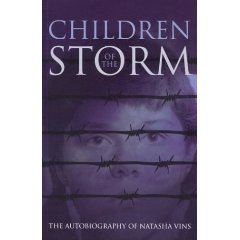
Some of you may remember the name of Georgi Vins. He was a Ukrainian pastor in prison for his “religious activities” in the Soviet Union several years ago. I was a student praying for him in the campus Slavic Mission Prayer Band in the late 70s, and it was with great joy I heard years later that he had been exiled to the USA in exchange for Soviet spies.  Children of the Storm, written by his daughter, Natasha, tells of her perspective during those years of persecution.

Natasha was about nine years old when persecution began in her school (though ridicule of Christianity had begun years before), and it seemed to increase as the years went by. Teachers would hold her up for ridicule in front of her classmates and blame her for her class’s not making it into certain competitions. She was assigned to write a report on a boy held up as a Soviet hero who turned his father in to the KGB for keeping back a little of his grain for his starving family. The other children began to taunt and threaten her or just avoid her. She was threatened with being removed from her home and “re-educated.” These things struck a chord with me when I first read this book because my youngest was at the age Natasha was when some of this was happening, and I just could not imagine him going through these things. Yet as it all struck me as so sad, the Lord reminded me that He marvelously kept her through that time. And she was not even saved yet!

In later years she had a teacher who had similar interests, befriended her, was kind to her, and then began to undermine her Christian beliefs. This time Natasha listened, thought some of what her teacher said made sense, and began to question. When her father came home from a prison camp and she had an opportunity, she talked with him. Imagine coming home from being in prison for your faith to have your own daughter question your faith. Yet he did not express anger or disappointment: he just answered her questions as best he could. Not long afterward Natasha was saved.

At this time and place one truly had to count the cost of following Christ. Natasha was denied finishing her studies in her field of choice because of her Christianity. Her father had had to go “underground” by this time and sent word that he would like her to join him in the printing ministry. She helped for many years in vital ways, and even got to see her father here and there. Once they were to meet with someone who at the last minute had to postpone meeting with them for a couple of hours. Natasha and her father used the time to walk around the city and talk. He thought it highly likely that he would be arrested again, and his talks with her that day helped her to make it through the time when he was indeed arrested. Imagine having to prepare your child not for the remote possibility but for the very real likelihood of your imprisonment…and to do so in a way that does not leave her bitter or feeling sorry for you or herself, but leaves her strengthened and resting in the Lord.

Natasha’s grandmother was also arrested when she was in her sixties and thought she would die in prison, yet the Lord delivered her.

The book tells also of Natasha’s mother and siblings, of visits to her father and grandmother in prison, of the persecuted church, of struggling to maintain a Christian attitude toward persecutors, of their reaction when her father was suddenly and unexpectedly exiled, of the family’s preparing to join him, of their impressions of America: one of the younger siblings was astounded that everyone carried Bibles to church. Natasha wept upon seeing a Christian bookstore. They left Russia with sorrow because it was their homeland, but before long they began to see how the Lord could use them in the USA.

The epilogue of the book tells of the Lord’s help through their adjustments to the US, and then opportunities for ministry by publishing newsletters and several books and establishing a mission. After 11 years of exile, in 1990, Pastor Vins was able to make several return trips to the former Soviet Union, visiting and preaching openly, discussing with church leaders how the mission in America could best help them. He passed away Jan. 11, 1998, leaving not only a continuing ministry, but a legacy of godly man and his family.

Reposted from the archives.

photo 3(2)

For the 31 Days writing challenge, I am sharing 31 Days of Inspirational Biography. You can find others in the series here.
31 Days of Inspirational Biography: Walter Wilson

Walter WilsonWalter Wilson had the ability to turn nearly any conversation into a witnessing opportunity, yet with graciousness and kindness rather than belligerent buttonholing. A friend commented about him that he certainly had the gift of evangelism. True. But he also had an obedient and willing heart. He would have been the last person to have wanted people to think he was unique or that no one could do what he did. We can learn much from his spirit as well as the particular ways he had of turning conversations to the things of the Lord.

Harry Ironside urged him to write some of his experiences, which led to five books of anecdotes about various opportunities he had to lead people to the Lord. Some of the stories have been compiled into a fascinating book titled Just What the Doctor Ordered.

He was able to lead a German shop owner to the Lord when he told him the blank book he was buying was to be used for recording his prayer requests and answers. The man asked, “Can you get to Gott?” explaining that he had wanted to “find Gott” for many years.

One of my favorite chapters, “The Wrong Address But the Right Persons,” tells of a visit he tried to make while out of town to the son of a friend. After looking up the name and address, he arrived to find the man’s wife and two friends. As they began to talk, he realized that this young man, though he had the same name, was not the son of his friend. As he apologized and began to get ready to leave, he noticed a well-worn Bible on a table. He asked if they read it and loved it, which they said they did. He asked if they had learned from its pages how to be saved. Stirred, the three looked at each other, and then explained that when he had rung the doorbell, they had been on their knees praying that God would send someone who would show them how to be saved.

Another chapter tells about an atheist doctor known for his antagonism. Dr. Wilson visited him and discovered the one issue that kept the doctor from believing. He invited the doctor to church, and the Lord gave him just the right illustration that removed the obstacle in this doctor’s thinking. Another chapter tells how, as he was holding special meetings in a certain city, the pastor invited him to visit a church member who had been seriously ill in the hospital. They did so and had a good visit. Dr. Wilson took notice of a nurse in the room and went over to her to ask her if any of this man’s visitors had brought any message of comfort to her as well. She said no, she was not a Christian as these folks were. As he told her about the Lord, she began to weep. “All unknown to those who had visited the sick man, this nurse had been listening, the hunger had been increasing, and the desire to have what they were talking about became more and more acute in her soul…Although the visiting Christians had overlooked this splendid prospect, nevertheless God used their words to prepare her heart…The hungry heart may be quite close to us but may be all unobserved because we are not looking for the troubled soul.”

Other chapters are “The Case of the Japanese Barber,” “The Ticket Did Not Arrive on Time,” “God visited the Circus,” “Mrs. Fox Did Not Like It,” “A Hopeless Cripple Could Sing,” “Lost on Mount Wilson,” “The Candlestick Was Not in the Ark,” “”Lillian Was Miserable on the Stage,” “’Will I See My Little Girl Again?’” “The Intern Was Surprised,” “The Cursing Barber,” as well as others. At the end is a chapter entitled, “Hints and Helps For Personal Soulwinners.”

Dr. Wilson was not a trained or ordained preacher. He was a “medical doctor, natural scientist, salesman, businessman, author, preacher, school administrator, and more.” But he viewed sharing the gospel as his “principal business in life.” David Woehr, in his biographical sketch at the beginning of the book, says:

He translated that concern into action by taking advantage of every available opportunity to present the gospel. On the other hand, he placed great emphasis on the leading of the Holy Spirit. Each morning he would earnestly pray for the Holy Spirit to guide him to the particular person whom He had prepared to receive the gospel. During the day, expecting God to answer his prayer, he would take advantage of each favorable occasion to speak a word for Christ. He was not one to wait for some strange, inner urging of the Spirit to move him, for the opening up of an opportunity was leading enough for him.

Always a gentleman and never intrusive or abrasive, it was evident that the love of God motivated him. He was not a salesman with a product to huckster onto some unsuspecting potential client…Each one with whom he came in contact was a person who perhaps needed the water of life. He was a man under orders, ready at every moment to follow the Spirit’s leading and be the instrument by which God would bring a new-born babe into His kingdom.

photo 3(2)

For the 31 Days writing challenge, I am sharing 31 Days of Inspirational Biography. You can find others in the series here.

(This will also be linked to Semicolon‘s Saturday Review of Books.)

31 Days of Inspirational Biography: Margaret Paton, Missionary to Cannibals in the South Sea Islands

Margaret PatonI wrote last year about John Paton, a missionary to the New Hebrides in the 1800s and a great man of God, who is the source of one of my all time favorite missionary quotes. Before he went to the field, some regarded him as foolish for going to minister where there were cannibals. To one man’s warning about his potential fate, he replied, “Mr. Dixon, you are advanced in years and your own prospect is soon to be laid in the grave, there to be eaten by worms. I confess to you that if I can but live and die serving and honoring the Lord Jesus, it will make no difference to me whether my body is eaten by cannibals or by worms.”

Some time ago I happened upon a book titled Margaret Paton: Letters From the South Seas, which, as its name implies, is a collection of letters that John Paton’s wife sent out over the years. The letters were written primarily to family back home, though there are a few to other individuals. They are quite long, but that is because they did not have the opportunity to send and receive mail very often. Since they were written to family, they contain more personal glimpses and anecdotes than a prayer letter to supporters would, and Margaret (or Maggie, as she signs herself) often had an amusing way of telling them. But there were also times of tragedy and perplexity that they experienced, and Maggie’s letters convey the situations and the wrestlings of heart they had in trying to discern the Lord’s will and His grace through every trial.
Rather than trying to summarize the whole book, I just want to give you a few excerpts here and there.

Maggie was John’s second wife: his first wife and son had died of malaria on the island of Tanna. When Maggie first came to the island with John, he pointed out “that Sacred Spot [the grave of his wife and child], so indelibly photographed on his memory. Oh, how I longed to spend a quiet hour by the grave of her whose footsteps I feel so unfit to follow, and who met her trials so unshrinkingly and alone — alone, so far as regards female companionship and sympathy!”

They were going to another island to labor and dropping off fellow missionaries at their respective islands on the way. On one island, “Great crowds of people came to look at us, as I believe we are the first white women who eve landed on Fotuna. The ladies were, in consequence, very curious to have us examined properly; and they went about it in a business-like way, as I can testify from the pokes and thumps received. They always felt themselves at the same time, to see how far we were alike. Poor things, they had yet to learn that we were sisters, resting under the same penalty and equally in need of and entitled to the same Saviour.” Then she mentioned having to “escape” when “their examinations” became “rather too minute.”

One thing that some missionaries struggle with, especially in primitive areas, is whether their living arrangements should be just like the natives or closer to what they are used to. There is no one right answer: it depends on the place, the people, health issues, and the leading of the Lord in each circumstance. The Paton’s home would have been nothing really like European homes, but Maggie writes, “I am trying my best to make it the prettiest and most inviting home I know — as refined, as civilized, and as nearly what we have been accustomed to, as our limited resources will permit. We must not let ourselves ‘down’ because we are among Savages, but try rather to lift them up to our Christian level in all things. One’s home has so much influence on one’s work, and on life and character; and it is due to our two wee boys to make it a bright one…it is no part of my creed to believe that…everything pleasant in sinful.” She then writes that, before she left for the field, one lady told her, “that missionaries’ wives were expected to live and dress in the most primitive way, and to set an example of great gravity and solemnity, else they would get to be talked about.” After wrestling with the “old Adam” in her, Maggie “controlled myself to retort, that in my Bible there was no separate code of rules for missionaries’ wives, any more than for other Christian gentlewomen.” She then wonders “that any one can be blind to the fact that our kind Creator has given us such wealth of beauty in Nature.” He could have made everything just useful, yet He chose to scatter beauty and charm throughout creation. This could probably be a separate post, but it all comes back to balance: I’ve read other stories of missionaries trying to find the right balance. I’m thinking of Isobel Kuhn in particular, who had some nice things from her wedding in her new home in a primitive area of China only to have them ruined by such practices the people then had of blowing their nose in their hands and then wiping them on the (new!) furniture, or letting babies use the bathroom on the beloved rug. She had to learn that though it isn’t wrong to “nest” or have nice things, it’s wrong to let them have priority over people’s souls or the work they were called to. I don’t think Maggie went too far the other way, but I’m just offering the other side of the balance for perspective.

In struggling to learn the language, she writes, “How the Apostles must have appreciated the gift of tongues on the Day of Pentecost! I wonder if it was accorded to their wives as well!” She writes how “provoking” it s to think you’ve mastered enough to converse a little, only to see them “looking at each other wonderingly.” “I got Mr. Paton’s help in any great difficulty — though he did not at all times enjoy the interruption, especially if the point in question turned out to be only about a needle and a thread, while he had been called away” from his work.

To some children who had given toward the Dayspring, the mission ship that transported people and supplies to the islands, she wrote, ”Now, if I tell you how really grateful all the missionaries are to the children who give their money so willingly to keep the Dayspring in nice order, and how the little vessel actually helps to keep the missionaries alive, as well as those so dear to them, by bringing them food and medicine and all they require, I am sure you will not grudge having denied yourselves many little gratifications to help in so important a work.”

There is a section I wish I had space to include answering some who criticize a missionary having a family. “The life of the Christian home is the best treatise on Christianity — a daily object lesson, which all can…’read, mark, learn, and inwardly digest.’” She also has a good section answering the comments some make that “ seem to grudge a man of burning enthusiasm and magnetic eloquence going to the foreign field, as if it were so much power and genius being wasted.” She argues convincingly for sending our best to the field.

I’ll forewarn you that there is a bit of perspective that’s not what we would think of as politically correct by today’s standards but I think is probably common for the times.

All of this comes just from the first third of the book! There’s so much more I wish I could include. I hope I’ve inspired you to read it for yourself.

photo 3(2)

For the 31 Days writing challenge, I am sharing 31 Days of Inspirational Biography. You can find others in the series here.

(This will also be linked to Semicolon‘s Saturday Review of Books.)

31 Days of Inspirational Biography: Dr. Sa’eed of Iran

Some years back I wrote about Dr. John Dreisbach, a modern-day missionary who had recently gone Home to heaven. I was listening to his memorial service online when I heard the following poem read:

Christ is my Life, and Christ is my light;
Christ is my guide in the darkness of night;
Priest and strong Advocate Christ is for me;
Christ is my Master, to truth he’s the key.

Christ is my Leader, he peace to me brought;
Christ is my Savior, Christ righteousness wrought;
Christ is my Prophet, my Priest, and my King;
My Way, and the Truth to which I firmly cling.

Christ is my Glory, and Christ is my Crown;
Christ shares my troubles when woe strikes me down;
Christ is my treasure in heaven above:
In every deep sorrow he soothes me with love.

Christ is my Savior, my Portion, my Lord;
All honor and homage to Him I accord.
Christ is my Peace, and Christ my Repast;
Christ is my Rapture forever to last.

In joy and in sorrow Christ satisfies me;
‘Tis Christ who from bondage of sin set me free.
In all times of sickness Christ is my Health;
In want and in poverty Christ is my Wealth.

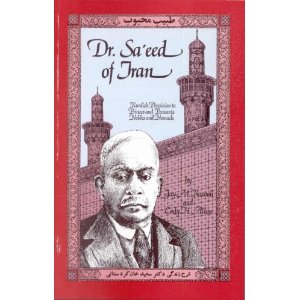
Afterward I searched online to find out who wrote this poem and discovered it was titled “Dr. Sa’eed’s Hymn” and was contained in the book  Dr. Sa’eed of Iran: Kurdish Physician to Princes and Peasants Nobles and Nomads by Jay M. Rasooli and Cady Hews Allen. It is no longer in print, but Amazon.com has inexpensive used copies, so I ordered one. (If you don’t mind reading books on the computer, the text is online through Google books.)

Dr. Sa’eed’s is a fascinating story. He was born into a Kurdish mullah’s (an Islamic teacher) family in June of 1863 in what was then Persia, now known as Iran. He was uncommonly bright and well-taught, so much so that he was given the title of mullah at the age of thirteen when his father died.

As a child he once saw a foreigner wearing a hat with a brim, uncommon because Persians then wore brimless hats. When he asked his mother why the man wore that “funny hat.”

“He is an unbeliever,” she replied, “and they do not wish him to see the sky, which is the abode of God.” By such an answer was aversion to non-Moslems instilled in the receptive mind (p. 23).

Sometimes he might be in a Christian home and “accidentally” knock something fragile off a shelf so that it broke or sit on a rug and cut holes in it with his knife. “Such misdeeds, while inspired by bigotry, were done especially to earn merit with God by causing damage to an unbeliever or even to one of a rival Moslem sect” (p 24).

But he also had a thirst for holiness that led him to fervent study and extreme rituals. After years he was still “dissatisfied and restive” (p. 29.) His first encounters with professing Christians were with Catholics who disgusted him, as they drank alcohol (forbidden in the Koran).

When he was seventeen, some Protestant missionaries came to town and engaged Sa’eed as a tutor in the Persian language. He had heard even worse things about Protestants, but he acquiesced.

He was surprised by many things: they knew something of the Koran, they prayed for their enemies, they did not drink, lie, or gossip. Their behavior matched their teaching. They used the Bible for language study, and Sa’eed heard many discussions about Christian teachings. Over time he began to speak with Kasha Yohanan about religion and read the Bible for himself. He began to see his own failings and to doubt what he had always been taught. This was agony to him, causing him to burn himself with hot coals as a vow never to speak with Christians about religion again and to tell the missionary that he was no longer available. But the words he had heard continued to burn in his heart until he finally prayed to be led in the true way. He decided to study both the Bible and the Koran. “In Mohammed’s teachings and personal life I found nothing which would satisfy the longing soul — not a drop of water to quench the thirsty spirit” (p. 38). Finally he yielded to faith in God.

His heart was now at peace, but his persecutions began in earnest. Even his own brother planned to kill him. The rest of the book details his growth, his training as a physician, and his life as a testimony to the One who saved him. Though often in danger, he never failed to treat anyone who called on him, even his enemies. His faith and godly character were a witness and a reflection of the One in Whom he believed.

(Reposted from the archives)

photo 3(2)

For the 31 Days writing challenge, I am sharing 31 Days of Inspirational Biography. You can find others in the series here.

31 Days of Inspirational Biography: Mimosa

783046_the_sensitive_flower

Sometimes people who work in children’s ministries can get discouraged due to the seeming lack of fruit or the fact that they have some children just a few times and then never see them again. Mimosa by Amy Carmichael tells the story of a little girl who was marvelously changed by just a short encounter with the gospel.

When Amy Carmichael was a missionary in India she learned that some little girls were sold to the temples for immoral purposes. Whenever she could, she tried to rescue these girls, to talk their parents into letting them stay with her instead. One such little girl was named Star. She had been with Amy for a while when her father came, bringing her sister, Mimosa, with him, to try to take Star back. He met and talked with Amy and Mr. Walker, the director, and at one point even stretched out his arm to take Star — yet he felt he could not move, that some strange power was preventing him.

Mimosa saw this. Some of the workers had a short time to talk with her, not even time enough to present the gospel completely. Mimosa asked her father to let her stay: he would not hear of it.

Those who had met with Mimosa longed for her: she seemed intelligent and interested. They lamented that they had not had time to tell her more. “How could she possibly remember what we had told her? It was impossible to expect her to remember……Impossible? Is there such a word where the things of the Lord are concerned?”

Something of what she heard about a God who loved her stayed with her. She knew instinctively she could no longer rub the ashes of her family’s god on her forehead, as was their custom. The women in the house thought her naughty or “bewitched” and beat her with a stick. She was bewildered, but she knew God loved her, in spite of all she could not understand of her circumstances.

After she was married at age seventeen, she found she had been deceived by her husband’s family: He was “landless [and] neck-deep in debt.” It was no shame to be in debt: in that culture: “”If you have no debt, does it not follow that no one trusts you enough to lend you anything, and from that is it not obvious that you are a person of small consequence?” But Mimosa’s character could not endure it, though she had never been taught against it. She encouraged him to sell the land in her name, the only piece of land he had that he had given as a dowry, to pay off the debt, and then suggested they would work. He was amazed at such a thing, but agreed. His unscrupulous elder brother suggested they start a salt market and that Mimosa sell her jewels to get them set up: he would take care of it. He instead somehow misused the money. She gave some money to her mother to keep for her, but then her mother would not give it to her when she asked for it: her mother was angry with her over the loss of the jewels that had been passed to her. “Let thy God help thee!” she told her daughter.

Mimosa went out to pray: “O God, my husband has deceived me, his brother has deceived me, even my mother has deceived me, but You will not deceive me…Yes, they have all deceived me, but I am not offended with you. Whatever You do is good. What should I do without you? You are the Giver of health and strength and will to work. Are not these things better than riches or people’s help?….I am an emptiness for You to fill.”

Thus her life went. She was a derision because she would not worship the false gods or engage in idolatrous practices. She worked hard because her husband would not. There were times when she was weak and could not work that God worked in unusual ways to provide for her. She had three sons; then a snake bite left her husband blind and crazy. In a couple of instances she received a bit more information about the God she loved, and she clung to it and to Him.

Meanwhile, Star was concerned for her sister. She felt led to write to her and prayed someone would read the letter to Mimosa. A cousin did read it to her, as often as Mimosa asked him, but neither of them thought to write back to Star, so she and the ladies of Dohnavur were left to wonder and pray.

A mysterious illness which took the life of one of her sons caused the neighbors to torment her further with their words. They felt it was all her fault since she would do nothing to appease the gods. Mimosa replied, “ My child God gave; my child has God taken. It is well.” Though weak, ill, grieving, and alone, she still told God, “I am not offended with you.”

The years followed in much the same way. She had two more sons. The oldest one was taken by the father (who had regained something of his right mind) to another town to work but, to Mimosa’s grief, required him to rub the god’s ashes on his forehead.

She began to long that her children should have “what she had never had, the chance to learn fully of the true and living and holy God and themselves choose His worship.” It would take too much space here to tell how God wondrously worked out the all the details to go to Dohnavur, even, miraculously, her husband’s approval. Her sister, Star, was strongly burdened to pray for Mimosa and discovered later that was just the time when all of this was coming to pass. Twenty-two years after she first visited Dohnavur, she returned. It can only be imagined what she felt as she soaked up Christian fellowship, learned to read, studied the Bible, was baptized. After a time she went back to her husband, determined to win him. He was in a less tolerant caste, yet amazingly he did not put her away. Her life was not easy. “But then, she has not asked for ease; she has asked for the shield of patience that she may overcome.”

“Is not the courage of the love of God amazing?” Amy Carmichael wrote. “Could human love have asked it of a soul? Fortitude based on knowledge so slender; deathless, dauntless faith — who could have dared to ask it but the Lord God Himself? And what could have held her but Love Omnipotent?”

photo 3(2)

For the 31 Days writing challenge, I am sharing 31 Days of Inspirational Biography. You can find others in the series here.

31 Days of Inspirational Biography: Bill Maher, “Missionary to the Handicapped”

photo 3(2)

Beyond My DreamsWhen Bill Maher was born in 1928, the midwife assisting his mother thought he was dead. He was laid in the crib while the midwife and doctor turned their attentions to his mother, who was having severe complications. Bill was not dead, however, he was diagnosed with severe cerebral palsy. His parents were advised to put him away in an institution and forget they had him. The shocked mother refused. His parents sought any help and advice they could find to help their son while trying to treat him as normally as possible. His neck muscles were too weak to hold up his head, his arm and leg and tongue muscles were contracted and had to be stretched out daily. The therapy had both mother and son in tears, but it worked.

When Bill was two, he developed mumps and measles at the same time and lost his hearing. Yet he somehow learned to lip read. By the age of five he still could not talk.

Other children and even adults would taunt and tease Bill if his family was not around. Sadly, some of those people were even Christians — who would then ask Bill if he wanted to become a Christian! Neither he nor his parents did. Bill writes later in his autobiography, Beyond My Dreams, “Apparently these people had never read Leviticus 19:14: ‘Thou shalt not curse the deaf, not put a stumblingblock before the blind, but shalt fear thy God: I am the Lord.’ In other words, Christians should realize that God made the afflicted the way they are for a purpose and no one should take advantage of them because of their afflictions.”

One Christian lady knocked him down into the mud to get him out of her way and then told his mother he should not be allowed to walk where other civilized people did; he should instead be taken into the woods where the other animals were. Bill did not want to walk outside any more after that, but his mother told him, “Giving up is not in our vocabulary.”

Bill’s parents made him do chores and work hard. One time when he got out of a job his grandfather paid him to do by paying another child a lesser amount to do it, his mother was angry, but his grandfather realized he had to use his brains to figure that out. Bill had a wonderful sense of humor, manifested throughout his book.

Bill attended a regular school until fifth grade, when he failed because he could not keep up. The school felt they had taken him as far as they could, but the principal recommended a school for the deaf 30 miles away. His family made the daily commute, and Bill began to learn more.

When Bill was about 12, one family that was kind to him invited him to their church. There he saw many of the kids who picked on him, as well as the lady who had pushed him down. Yet he enjoyed the service and came back that evening. He misunderstood something the pastor said, and asked to speak to him afterward. Bill was ignorant of what the Bible said, and the pastor patiently explained Bill’s need for a Savior. Thankfully he did not let the failures of some of God’s people keep him from the one and only Savior who could meet his deepest needs. He accepted Christ and experienced immediate changes. He writes, “When I had walked into church that night, I had seen people I hated. When I left, I couldn’t hate them any more.”

When Bill completed the tenth grade at the school for the deaf, he was told he needed to face the “real world” and go to the public high school. He did passing work, got involved in extracurricular activities, held down part time jobs, got his driver’s license. But on graduation night, as he walked across the stage to receive his diploma, the man handing them out said, “It is amazing that you’ve graduated. You work hard, but you will still not amount to anything. If you can get a job, all you’ll ever be is maybe a janitor.” Bill was stunned, his mother was in tears, his dad was angry. Yet Bill was more determined that ever to prove this kind of thinking wrong.

Bill got a good job, but began getting into some of the activities of the unsaved coworkers and backslid. One day at work he had a heart attack, at the age of 22, and was told he only had a month to live. He asked his parents if he could stay with the pastor who had led him to the Lord at the camp where the pastor now ministered. They agreed, and over time Bill confessed his sins to the Lord and surrendered to do anything the Lord wanted him to do. The pastor felt Bill was called to preach. Bill didn’t think so because of his impediments. As he studied his Bible, he came across II Cor. 1:3-4 about comforting others with the comfort wherewith God comforted us, II Cor. 12 about God’s grace being sufficient, Phil. 4:13, and God’s answers to Moses’ objections. He surrendered to preach. His parents were upset and his dad told him not to come home.

Eventually his father did overcome his objections, Bill became a preacher, married, had two children, traveled all over the United States and then the world, preaching, ministering to the handicapped and afflicted, helped to start Christian schools for them, became a police chaplain, and received a honorary doctorate. He went home to be with the Lord in 2002.

In Dr. John Vaughn’s forward to Dr. Bill Maher’s book, he writes, “God is to be praised for the wonderful way he has worked in and through this man’s life. Bill Maher is to be commended for the wonderful way he has served the Lord under circumstances that would have discouraged most others from the start. As you read, you will probably ask yourself the question that comes to me so often when I am with this man who is like a father to me, ‘If he has done this with the Lord’s help, what could I do if I would really trust Him myself?’”

Luke 14: 13-14: But when thou makest a feast, call the poor, the maimed, the lame, the blind: And thou shalt be blessed; for they cannot recompense thee: for thou shalt be recompensed at the resurrection of the just.

For the 31 Days writing challenge, I am sharing 31 Days of Inspirational Biography. You can find others in the series here.

(This will also be linked to Semicolon‘s Saturday Review of Books.)

31 Days of Inspirational Biography: One Woman Against the Reich

photo 3(2)

Sometimes, when we hear of the possibility of future hard times or even persecution, our greatest concerns are for our loved ones. We know from Scripture that God is in control, that He won’t allow anything that He won’t give us the grace to handle, that the “trial of our faith” works patience and endurance in us and glorifies the Lord. From time to time we also hear testimonies of God’s keeping grace during trial.

One WomanOne such book I discovered some years ago is titled One Woman Against the Reich: The True Story of a Mother’s Struggle to Keep Her Family Faithful to God in a World Gone Mad by Helmut Ziefle. Mr. Ziefle’s parents lived in Germany during WW II; in fact, he was born in April 1939. In the previous years, the Nazi regime had grown, and trials and persecutions had grown for anyone not in agreement with them. There were two older brothers and a sister already in the family before Helmut made his appearance. His brother Kurt, 11, rushed home excited one day to tell his parents he had joined the Hitler Youth Organization. His mother reminded him that he belonged first to Jesus. But he was carried away with excitement. Of course, the youth organization happened to meet at the same time the rest of the family went to church. Hitler is quoted as saying, “In my Teutonic order, a youth will grow up which will frighten the world. I want a fierce, masterful, fearless and ferocious youth. It can’t show any weakness or tenderness. The free and magnificent beast of prey must finally glow again from their eyes.” Can you imagine such a man after the young people of our homes and churches?

Maria, Helmut’s mother, had many concerns to deal with in those days: her children being carried away with Nazism; the possibility of persecution from neighbors when she did not return their “Heil Hitler;” threats against her husband; safety for herself and her family during air raids and bombings; severe scarcity of food; having a baby during all of this; the safety of her two older sons when they became old enough to go into military service, one fighting for Nazism, one against it but having to go nonetheless (the latter son ended up in a Russian POW camp for 5 years, sadly, ironically, for a cause he did not believe in); being turned out of their home so that soldiers could use it; her own poor health with phlebitis; the uncertainty of being separated from the rest of her family for a time. Yet in each situation her heart instinctively turned to her Lord. And in each situation she found Him faithful.

For the 31 Days writing challenge, I am sharing 31 Days of Inspirational Biography. You can find others in the series here.

(This will also be linked to Semicolon‘s Saturday Review of Books.)