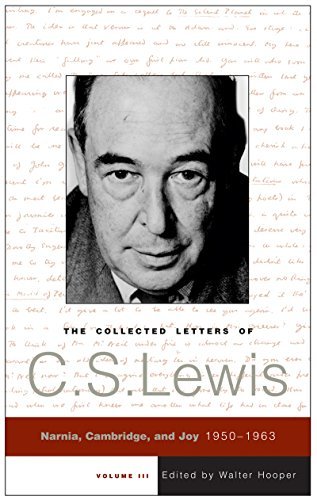
The Collected Letters of C. S. Lewis, Volume 3

Walter Hooper was an American who became something of a secretary to C. S. Lewis, or Jack, as he was known, in the latter’s final years. After Jack’s death, Hooper helped care for Warnie, Jack’s older brother, and tried to preserve some of Jack’s memorabilia. Many of Jack’s letters had been quoted by Warnie in an earlier book titled Letters of C. S. Lewis, but none is quoted in its entirety. Hooper scoured the various libraries where Jack’s papers were kept to present a comprehensive volume of his letters.

That volume ultimately became three. Volume 1 is titled Family Letters and covers 1905-1931. Volume 2 is titled Books, Broadcasts, and the War, from 1931-1949. The final volume is titled Narnia, Cambridge, and Joy, covering 1950-1963.

I chose to read the last volume first. I had read of Jack’s earlier life in Surprised by Joy and other books, but knew the least about his last several years. This book was a whopping 6,328 pages, so it has taken me a while to read it.

Lewis was a prolific letter-writer, corresponding by hand. Warnie helped him when he was home, then Hooper later. It’s obvious Jack enjoyed a great many of the letters he wrote, but answering correspondence also put pressure on him. He even asked some of his friends not to write in December, because he received so much extra mail then.

One question I had was where these letters came from. Lewis says in this volume that he did not keep copies of the letters he answered once he was done with them. He didn’t appear to use carbon copies. It’s understandable the letters to family members were kept by the recipients. But Hooper doesn’t explain how he obtained the letters written to so many people. I don’t know if he, or Warnie, or someone else put out a request to Jack’s correspondents asking for any of his letters, which were then included in various collections.

Some of the letters are lengthy and thoughtful. Some are short notes. I think some of the short notes about where to meet someone for dinner or when they were coming to visit could have been left out. But even some of these have funny or interesting spots. He writes to lifelong friend Arthur Greeves of their travel plans that since Arthur was a light sleeper and Jack “an unreasonably early riser,” they should ask at the places where they were staying to “be put in rooms not adjacent. (This is not meant as a joke!)”

Some letters were news between friends. Others were answers to questions about his writings or philosophical or spiritual queries. Some gave requested writing advice like that “wh. old Macan gave me long ago ‘Don’t put off writing until you know everything or you’ll be too old to write decently.'”

Some of his letters provided critiques requested by his correspondent of their writing. He didn’t pull any punches! But he was not unkind.

By this time, he refused most of the requests for forewords or prefaces to other people’s books. He just didn’t have time. We forget that, with all his writing, he had a full-time job teaching. He writes to one friend, “I am so busy marking examination papers that I can hardly breath! The very good ones and the very bad ones are no trouble, but the in-between ones takes ages.” Plus, he said to most of these authors that his reputation was such that he didn’t think his name in their books would be a help to them.

I thought it a little odd that no letters to Joy were here. Of course, their main correspondence would have occurred before she moved to England. Perhaps she didn’t bring those letters over, or maybe she or Jack destroyed them. They may have been too personal, concerning her own soul-searching plus problems with her first husband.

It was funny to read how he described her when she visited, though. Evidently she liked to talk a lot. He wrote one friend: “I am completely circumvented by a guest, asked for one week but staying three, who talks from morning till night.” To another he said, “Perpetual conversation is a most exhausting thing.” (I agree!)

Jack said he never appreciated parents before–her two boys were good kids, he said, but whirlwinds that left the “two old bachelors” exhausted by the end of the day.

But he tells through various letters of his developing relationship with Joy, their marriage of convenience so she could remain in England, her illness, a “real” marriage ceremony (the first was legal, but when they began to care for each other, they found a minister who would marry them in her hospital room), her miraculous recovery, and a few good years they had until she began to decline again. He writes near the end of her life, “May it please the Lord that, whatever is His will for the body, the minds of both of us may remain unharmed; that faith unimpaired may strengthen us, contrition soften us and peace make us joyful.”

Jack’s letters are filled with literary references. Hooper painstakingly annotated these, sharing the source, the location within the source, and the full quote Lewis cited.

It’s fun to see humor laced through many of the notes. He asked one friend, “What is a ‘rumpus room’? Rumpus with us means a loud noise, or row, or ‘shindy’. Do you have a special room for shouting in? (I’ve known houses where it wd. be convenient!) To another: “There’s no news at all about Cambridge cats. I never see one. No news and no mews.”

One of the great sorrows of his life was his brother Warnie’s alcoholism. Warnie would go off on benders and then go to a place to dry out, then come home, only to repeat the process later. Jack would let close friends know what was going on, but would tell others that Warnie was sick or in the hospital.

It was sad to read of Jack’s final days, knowing when he was going to die. He was to have one last trip with his friend, Arthur. But they had to cancel due to illness on both their parts. Lewis writes that he is comfortable, “But, oh, Arthur, never to see you again! . . .”

As you can imagine, I have multitudes of quotes highlighted. Here are some that stood out to me:

Of course we differ in temperament. Some (like you–and me) find it more natural to approach God in solitude: but we must go to church as well. Others find it easier to approach Him thro’ the services: but they must practice private prayer & reading as well. For the Church is not a human society of people united by their natural affinities but the Body of Christ in which all members however different (and He rejoices in their differences & by no means wishes to iron them out) must share the common life, complementing and helping and receiving one another precisely by their differences.

God loves us: not because we are lovable but because He is love, not because He needs to receive but because He delights to give.

I am going to be (if I live long enough) one of those men who was a famous writer in his forties and dies unknown–

I don’t wonder that you got fogged in Pilgrim’s Regress. It was my first religious book and I didn’t then know how to make things easy.

[On Queen Elisabeth’s coronation] Over here people did not get that fairy-tale feeling about the coronation. What impressed most who saw it was the fact that the Queen herself appeared to be quite overwhelmed by the sacramental side of it. Hence, in the spectators, a feeling of (one hardly knows how to describe it)–awe–pity–pathos–mystery. The pressing of that huge, heavy crown on that small, young head becomes a sort of symbol of the situation of humanity itself: humanity called by God to be His vice-regent and high priest on earth, yet feeling so inadequate. As if He said ‘In my inexorable love I shall lay upon the dust that you are glories and dangers and responsibilities beyond your understanding.’

How little they know of Christianity who think that the story ends with conversion: novelties we never dreamed of may await us at every turn of the road.

As long as we have the itch of self-regard we shall want the pleasure of self-approval: but the happiest moments are those when we forget our precious selves and have neither, but have everything else (God, our fellow-humans, animals, the garden & the sky) instead.

If only people (including myself: I also have fears) were still brought up with the idea that life is a battle where death and wounds await us at every moment, so that courage is the first and most necessary of virtues, things wd. be easier. As it is, fears are all the harder to combat because they disappoint expectations bred on modern poppycock in which unbroken security is regarded as somehow ‘normal’ and the touch of reality as anomalous.

We should mind humiliation less if [we] were humbler.

I’m so pleased about the Abolition of Man, for it is almost my favourite among my books but in general has been almost totally ignored by the public.

At the end of this volume, Hooper included a series of letters between Lewis and his friend, Owen Barfield, called “the Great War” in which Lewis tries to “dissuade Barfield from his belief in anthroposophy,” a “system of theosophy . . . based on the premise that the human soul can, of its own power, contact the spiritual world.” The timing of these belonged to one of the earlier volumes, but Hooper didn’t receive them until he was working on this one. I didn’t read these, because they were quite long and I couldn’t follow the reasoning. I scanned some of them.

Hooper also includes extensive biographies in the back of Jack’s regular correspondents as well as interesting details about them or their interactions with Jack (which, along with the index, makes up some of the lengthy page count). I did not read all of these, either.

I very much enjoyed reading these letters and getting to know Lewis a little better. Someday I’ll get back to the other two volumes.

(Sharing with Bookish Bliss)

Laudable Linkage

Laudable LInkage

Here are some good reads for the first weekend in March.

The Great Danger is to Assume We Are All Headed for Heaven, HT to Challies. “For every American who believes they’re going to Hell, there are 120 who believe they’re going to Heaven. This optimism stands in stark contrast to Christ’s words in Matthew 7:13-14: ‘…wide is the gate and broad is the road that leads to destruction, and many enter through it. But small is the gate and narrow the road that leads to life, and only a few find it.’”

The Sacred Mundane, HT to Challies. “What about the ordinary and mundane tasks of the homemaker? Can they possibly be more than they are? the making of breakfasts, of lunches and dinners, the folding of laundry, wiping of counters, changing of diapers, the picking up, and the dropping off. Can these have meaning beyond the day after day ‘sameness?’”

All My Heroes Are Broken. “Disappointment. Once again, a Christian leader has fallen off the pedestal. Of course, I should never have placed them on it. But in my mind, they are not what they once were. Maybe they never were. I need good examples–role models who live out what it means to walk by faith and reflect God’s glory. My heart cries out for inspiration to live for God day by day. Can I really do what God made me and saved me to do? How have others done this before me?”

A Congregation Is a Voting Body. I share this because it never occurred to me anyone would think otherwise until a few years ago, when I heard someone say that they didn’t have the church vote on things because there was no instance of it in Scripture. But there is.

You Probably Won’t Get a Book Deal. But We Still Need You to Write, HT to Challies. “It’s difficult to be published. Unless you have a large following, or catch a break, you may face an uphill battle in getting your book published. And yet, I would argue, it’s still important for you to write for at least a couple of reasons.”

The Three Lost Pieces of a Good Romance, HT to Challies. “Today, I’ll be discussing the three essential elements of a good romance novel that have gradually been vanishing from mainstream romance tales, and why these three elements are necessary for a good story.”

C. S. Lewis quote

“But tho’ there is much to be puzzled about, there is nothing to be worried about.”
–C. S. Lewis

Review: Lenten Lands: My Childhood with Joy Davidman and C. S. Lewis

Douglas Gresham was the son of Joy Davidman Gresham, who married C. S. Lewis when Douglas was eleven years old. In 1973, ten years after Lewis’s death, Gresham wrote Lenten Lands: My Childhood with Joy Davidman and C. S. Lewis, partly because he was asked to, partly to correct some misconceptions concerning C. S. Lewis. Yet Lenten Lands is his own biography, not Lewis’s.

The title of the book comes from a poem that Lewis had originally written for a friend, but then adapted to be put on Joy’s tombstone:

Here the whole world (stars, water, air,
And field, and forest, as they were
Reflected in a single mind)
Like cast off clothes was left behind
In ashes, yet with hopes that she,
Re-born from holy poverty,
In lenten lands, hereafter may
Resume them on her Easter Day.

Joy married fellow writer William Gresham in 1942. They had two sons, David and Douglas. But their marriage was troubled. They had been atheists, but searched other religions. Joy was drawn to the writings of C. S. Lewis as he told of his own journey from atheism to Christianity. She began writing to Lewis and eventually visited him in England.

When she returned home, she found that her husband was having an affair with the cousin she had left to keep house for her husband and sons while she was away. She tried to reconcile the marriage, but it was too late. Joy took her two sons and moved to England.

Joy and Lewis and Lewis’s brother, Warnie (Warren) enjoyed a strong, intellectual friendship. Joy and Lewis influenced each other’s writing. When Joy’s visa was not renewed in 1956, Lewis married her in a civil ceremony.

But before long, the couple grew to love each other as more than friends and sought a Christian marriage, difficult since the church of England did not condone Joy’s divorce. But they found someone who would perform the ceremony.

Joy developed bone cancer but went into remission. The cancer came back a few years later, and Joy died in 1960. C. S. Lewis wrote A Grief Observed under a pseudonym. He had not been well himself, and died three years after Joy.

Douglas experienced all these things as a child: he was just eighteen when Lewis passed. He kept in touch with Warnie for some years, but Warnie’s grief and alcoholism were too much for Douglas to bear. He later regretted that he was not more attuned to Warnie’s grief and more of a help to him.

Douglas then tells of his various jobs, marriage, and children.

In his afterword, written in 2003, thirty years after the original publication of the book, he tells how he “committed [his] life to Christ and His service.” He had “always believed in God and in Jesus Christ; my problem was not one of belief, but one of arrogance and pride. I did not want to submit my life to any authority other than my own and it took me a long time to realize that I am simply not qualified to run it myself.” At that time he “was working more and more for the C. S. Lewis Literary Estate.” His Wikipedia page says he “hosted Focus on the Family Radio Theatre’s adaptations of his stepfather’s most famous works, and he was named co-producer for the series of theatrical films adaptations of The Chronicles of Narnia” and is now a “stage and voice-over actor, biographer, film producer, and executive record producer.”

Not much is said of his brother, David, in the book. Douglas’s Wikipedia page says David returned to Judaism and was later diagnosed as a paranoid schizophrenic.

My heart went out to Douglas, having experienced so much loss at heartache at such a young age. His young adult years were somewhat tumultuous. A good talking to by the woman who would become his wife helped set him on the right course.

One of my favorite moments in the book was when Douglas actually met Jack. He had regarded him as “a cross between Sir Galahad and Merlin the Wise (p. 27), “on speaking terms with King Peter, with the Great Lion, Aslan himself” (p. 55). But Jack was “a slightly stooped, round-shouldered, balding gentleman whose full smiling mouth revealed long, prominent teeth, yellowed like those of some large rodent, by tobacco staining” (p. 55). “Well, so much for imagery,” Douglas concluded. But he also noticed “His florid and rather large face was lit as if from within with the warmth of his interest and his welcome. I never knew a man whose face was more expressive of the vitality of his person” (p. 55).

Another favorite part was when Douglas said “When I was home from school, the dinner table of The Kilns was the scene of my real education. Jack and Warnie were both brilliant at sustaining a conversation at any one of a dozen different levels and on almost any topic, and I learnt more sitting and conversing over meals than I ever learnt at school (p. 81). I imagine so!

I appreciated what was said about the interaction between Joy and a friend named Jean: “Though they did not always agree upon matters of religion, politics, or taste, they could argue for hours and finally simply agree to disagree, without the dissent having the slightest adverse effect on their friendship” (p. 92).

I became interested in this book after reading a fictional account of the relationship between Joy and Lewis, Becoming Mrs. Lewis by Patti Callahan (linked to my review). Since much of what the author wrote (like letters between the two) was made up, I wanted to read the account from one who was actually there at the time. It’s taken me a few years to get to it, but I am glad I finally did.

Surprised by Joy

I’ve read a few biographies of C. S. Lewis and recently watched The Most Reluctant Convert, based on his journey from atheism to theism to Christianity. It occurred to me while watching the latter that I had never read Lewis’ testimony in his own words, Surprised by Joy. So I got the audiobook version of his book.

I thought that, since these other sources all quoted heavily from this book, I’d be familiar with most of it. Much was familiar, but there was a lot I didn’t know. There were also some incidents missing that I thought came from this book.

Lewis writes that this book is not an autobiography of his whole life til that point. He focuses mainly on everything that led to his conversion. That story encompasses much of his early life and what went into his becoming the personality and type of thinker he was. As he goes on, the focus narrows to just his spiritual movement.

One fact that I don’t remember reading before was that both Lewis and his brother had only one workable joint in their thumbs. Trying to make models of things or cut cardboard with scissors ended in frustration and tears. Games at school were the bane of his existence because he could never play them well. He could write and draw, though, and he liked solitude, which factors led to his creating stories about “dressed animals” in what he called “Animal Land.” His brother drew and wrote stories about India and trains and ships. Eventually they combined their imaginary worlds into what they called Boxen.

It was quite interesting to follow all that made Lewis into the man he became, from being unable to reason with his father, to (mostly negative) experiences at school, to his time with a private tutor (the “Great Knock”) who demanded that he be able to defend every opinion he expressed. Then the books he read and people he came across and conversations he had with them at various junctions all led step-by-step to his becoming a Christian. His journey was driven by philosophy more than emotion.

Surprised by Joy was written after the majority of Lewis’ other books were published. He said he wrote the book partly to answer questions he regularly received and partly to correct some misconceptions. Some of his detractors assumed he came from a Puritanical background, but Lewis assures them that the family he grew up in was not religious at all. Then when he came to make his own choice about religion, he turned against it though he did not tell his father. It was only many years and much reading later, after he began his career, that he came to believe. He likened it to a chess game where God knocked down his objections and false beliefs one by one by one.

The joy in Lewis’ title was what he described as a feeling of longing. It first came upon him when his brother brought in a toy garden he had made in the lid of a tin. It was something beautiful but ineffable, a small glimpse into something greater. “Joy is distinct not only from pleasure in general but even from aesthetic pleasure. It must have the stab, the pang, the inconsolable longing” (p. 86, Kindle version). At times through his life, he sought to recreate that feeling. After he became a Christian, he realized that what he thought of as joy was not an end in itself, but a signpost to point him to God.

A few quotes from the book that stood out to me:

The greatest service we can do to education today is to teach fewer subjects. No one has time to do more than a very few things well before he is twenty, and when we force a boy to be a mediocrity in a dozen subjects we destroy his standards, perhaps for life” (p. 137).

[Of his tutor, Kirk] Here was talk that was really about something. Here was a man who thought not about you but about what you said. No doubt I snorted and bridled a little at some of my tossings; but, taking it all in all, I loved the treatment. After being knocked down sufficiently often I began to know a few guards and blows, and to put on intellectual muscle. In the end, unless I flatter myself, I became a not contemptible sparring partner (p. 167).

I knew very well by now that there was hardly any position in the world save that of a don in which I was fitted to earn a living, and that I was staking everything on a game in which few won and hundreds lost. As Kirk had said of me in a letter to my father (I did not, of course, see it till many years later), ‘You may make a writer or a scholar of him, but you’ll not make anything else. You may make up your mind to that.’ And I knew this myself; sometimes it terrified me (p. 224).

I was by now too experienced in literary criticism to regard the Gospels as myths. They had not the mythical taste. (p. 288).

There’s a verse of “Just As I Am” by Charlotte Elliott that is not as well known as the rest of the hymn, but seems to sum up Lewis’ journey of faith:

Just as I am, Thy love unknownHas broken every barrier downNow to be Thine, yea, Thine alone,O Lamb of God, I come, I come.

I’m grateful God pursued Lewis and “broke every barrier down,” both for Lewis’ sake and our own. What a gift Lewis has been to us, even so many years after he lived. But his example gives me hope that God will do the same for dear ones I pray for.

Laudable Linkage

Though still not caught up with the blogs I usually read, I got to a lot of them this week—as you can tell by my long list of links to share. Perhaps one or two will be as thought-provoking to you as they were to me.

January’s for Reflecting, not Resolving, HT to Challies. “Maybe part of the reason why so many resolutions fail by February is that they were early. Maybe the resolutions weren’t wrong; they were just underdeveloped. Maybe, they needed an extra month or two in the oven.”

Holy Prayers from Rocking Chairs, HT to the Story Warren. A lovely poem about mothers’ middle of the night sessions.

A Legacy of Love: Passing Down the Gift of Spiritual Discipline to Your Children. “Because of the legacy my mom passed to me, I have a vision that goes beyond serenity and candles. I want my children to see a mother desperate for Jesus, willing to do whatever it takes to be at His feet.”

Make Christianity Hard Again, HT to Challies. “The way of Jesus is the way of the cross. So don’t talk about it like we just need to be nice people. Here are three commands that have challenged me, with practical trails we can follow.”

I Must Decrease” . . . But How? HT to Challies. “It’s pretty clear: the world’s loud, incessant voice tells me that in order to be happy, I need to spend more of my time, money, and attention on myself. You’ve probably heard the same message about your need for this, as well.”

Wasn’t My Body, but It Was My Baby, HT to Challies. “Abortion isn’t just about a mother’s choice. It’s also about a father’s responsibility. Perpetuating the lie that men need to stay out of the abortion debate isn’t just untrue—it’s catastrophic for the generations to come.”

Don’t Women Need Access to Abortion for Rape? “‘You don’t have the right to tell my fourteen-year-old daughter she has to carry her rapist’s baby.’ That’s what Joe Rogan, the most popular podcaster in the world, recently argued when he interviewed Seth Dillon, owner and CEO of the satire website The Babylon Bee. How would you respond to that argument? Here are three arguments to consider.”

The Murderer Who Crushed a Worm. “We get hard through the steps of an unperceived process.” This is a different kind of hardness from the article above.

C. S. Lewis an Mrs. Moore: Relationship of Sin or Sanctification? HT to Challies. “Every biographer of C. S. Lewis must face ‘the Mrs. Moore question’ and decide what to make of the relationship the beloved writer had with a woman more than 25 years his senior who remained a major part of his life from the time he returned from the trenches of the Great War until her death in 1951.” I especially like the concluding paragraphs of how God uses difficult people in our lives.

God Plans Your Stops, HT to Challies. “If God plans our steps, it means He plans our stops as well. And if you sit with it for a minute, there’s comfort in that.”

Unraveling the Riddle of Rejoicing Always, HT to Challies. “Several years ago, while meditating on Philippians 4:4, the Lord helped me glimpse why it makes sense to always rejoice—even in hard times—and how it is possible to give thanks in everything.”

A Family Vacation, a Broken Transmission, and a God Who Is With Us, HT to Challies. A neat story about God’s provision in a crisis.

Caregiving As a Calling and Ministry, HT to Challies. “At the time I didn’t see it as a ministry, and I didn’t understand that I had been called. I saw caregiving as a giant disruption to everything in my life and a burden that was forcing me to ‘step out of ministry’ to do this caregiving thing that I hadn’t signed up for. Over time, God has shown me  that caregiving wasn’t a disruption; it was God’s plan for me all along.”

How Should I Dispose of an Old Bible, HT to Challies. Though the sacredness of the Bible comes from what it says and Who gave it to us, not the pages and ink, we still want to treat it with respect. This has a good suggestion.

The Pilgrim’s Regress

The Pilgrim’s Regress was the first fiction book written by C. S. Lewis after his conversion to Christianity. Lewis’ book is not a retelling of Bunyan’s Pilgrim’s Progress: Lewis just borrows the allegorical format.

The book’s protagonist is John, a young man from a land called Puritania. The country is ruled over by a Landlord who is reportedly very good and kind but who will throw anyone who disobeys him into a black hole.

One day John catches a glimpse of a beautiful island through a window. The sight, sounds, and smells raise an ineffable longing to see the island again and even visit it.

John journeys towards the island, but instead finds different philosophers and detractors. He meets a “brown girl,” who assures him she’s what he really wanted. But she represents lust, and John eventually finds he’s dissatisfied with her. (This article makes a good case that Lewis was neither racist or misogynistic by designating lust as a brown girl).

John continues on and meets Mr. Enlightenment, the Spirit of the Age, Mother Kirk, Mr. Sensible, Mr. Neo-Angluar, Mr. Humanist, History, Reason, and others. Some say his island is an illusion. Others offers various suggestions for how to get there. Some argue for or against the against the existence of the Landlord. History tells John the landlord sent truths about himself in the form of various pictures. But many interpreted the pictures the wrong way.

Finally John understands the way to the island. Wikipedia says, “The Regress portion of the title now comes into play as John journeys back home and now sees everything in a new light and sees how the road he took is a knife’s edge between Heaven and Hell.”

In a preface to the third edition of the book, written ten years after it was originally published, Lewis apologized for the book. Although he hadn’t intended the book to be strictly autobiographical, he hadn’t realized that not everyone’s journey was quite like his.

On the intellectual side my own progress had been from ‘popular realism’ to Philosophical Idealism; from Idealism to Pantheism; from Pantheism to Theism; and from Theism to Christianity. I still think this a very natural road, but I now know that it is a road very rarely trodden. In the early thirties I did not know this. If I had had any notion of my own isolation, I should either have kept silent about my journey or else endeavoured to describe it with more consideration for the reader’s difficulties.

He says that in the new edition (online here), he added headlines before the different sections. He apologizes for doing so, but the headlines would have been a great help if I had read rather than listened to the book.

I think I would have gotten more out of the book of I had read an annotated edition, which explained more about the different references and philosophies (one GoodReads reviewer recommended C. S. Lewis and Narnia for Dummies as an aide). But I got the gist of the story and understood most of the discussions between characters. To me, this book illustrates what Lewis said in Mere Christianity:

If I find in myself a desire which no experience in this world can satisfy, the most probable explanation is that I was made for another world. If none of my earthly pleasures satisfy it, that does not prove that the universe is a fraud. Probably earthly pleasures were never meant to satisfy it, but only to arouse it, to suggest the real thing.

Once Upon a Wardrobe

In Once Upon a Wardrobe by Patti Callahan, Megs Devonshire is a college student at Oxford in the 1950s. Her 8-year-old brother, George, has a heart condition and is not expected to live long.

George has become enamored with The Lion, the Witch, and the Wardrobe by C. S. Lewis. George wonders often if Narnia is a real place. If not, where did it come from? When he learns that the author of the book is a professor at Megs’ school, George begs her to ask Lewis about Narnia for him.

Megs demurs. First, she explains to George, Oxford is made up of different colleges, and Lewis doesn’t teach at the one she attends. Plus, Megs studies math and physics and is not much for stories. She prefers logic and black and white answers. Of course Narnia is just a figment of the author’s imagination, she insists.

But George keeps asking, and Megs loves him. So she finds a way to meet Mr. Lewis.

Lewis is very hospitable. But he doesn’t answer Megs’ question directly. Instead, he tells her a series of stories about his life over several visits.

George enjoys the stories. But Megs is frustrated that she can’t get a straight answer. And their mother wonders if George is spending too much time thinking about an imaginary world.

There are three levels, or threads, to this story. One is Megs and George and their family. One is Lewis’ biography. And another is Megs’ learning the value of stories. Having read On Stories by Lewis, I recognized a lot of his points in this novel. He’s not saying that the world doesn’t need logic and math and facts. Rather, “Reason is how we get to the truth, but imagination is how we find meaning” (p. 52).

The middle section of the book seemed a little formulaic. Megs’ point of view is written in the first person. She’d visit Lewis and come back with a story for George. As she begins to tell it, the point of view switches to George’s, but in the third person. Then, as if the scene is unfolding in George’s imagination, a section of Lewis’ story is told in the third person.

In the final third or so of the book, the action picked up and there were no more switches, so it was easier to get caught up in the story.

The scenes with C. S. and his brother, Warnie, made me feel like I was there in their room with the fireplace going, listening in. Callahan had studied Lewis’ life for her first book, Becoming Mrs. Lewis, and I am not surprised another book about him grew from all that research. The details shared showed a familiarity with Lewis’ home and school without overpowering the story.

Callahan writes in her note after the story that she wasn’t interested in “ascribing logic, facts, and theory to the world of Narnia,” as that has been done by so many others. But she wanted to explore how Narnia changes readers and how, as Lewis said, “Sometimes fairy stories may say best what needs to be said.”

I’ve read many biographies of Lewis, so most of his story was familiar to me. There were parts that surprised me, though. For instance, I knew he took some children from London into his home during the Blitz, but I had never heard anything about them until this book. It also occurred to me that, though I had read much about Lewis, I had never read his book about himself: Surprised by Joy. I’d seen that book quoted in anything else I’d read about him, so I thought I knew it. But I should read it some time.

There were a couple of places the theology was a little wonky. I wasn’t sure whether these were from the author’s beliefs or a character’s.

But overall, this was a sweet and touching story.

I listened to most of the book via audiobook, read nicely by Fiona Hardingham. But I had also gotten the Kindle version on sale and looked up many sections there.

The Four Loves

In The Four Loves by C. S. Lewis, he says that when he contemplated writing about love, he thought there were two types: Need-Love and Gift-Love. Need-love is that of a child for its parents, who meet its needs and comfort when frightened. Gift-love is that of a man who works hard for the well-being of his family. Lewis was going to propose that the latter is more like God because He gives and needs nothing. Need-love, however, seemed totally selfish and not deserving of the name “love.”

But, he reasoned, no one thinks a child is selfish for looking to its parents for comfort or an adult selfish for wanting the companionship of friends. And man’s love to God is almost totally Need-love.

It would be a bold and silly creature that came before its Creator with the boast ‘I’m no beggar. I love you disinterestedly.’ Those who come nearest to a Gift-love for God will next moment, even at the very same moment, be beating their breasts with the publican and laying their indigence before the only real Giver. And God will have it so. He addresses our Need-love: ‘Come unto me all ye that travail and are heavy-laden,’ or, in the Old Testament, ‘Open your mouth wide and I will fill it’ (pp. 3-4).

Lewis also differentiates between Need-pleasures and Appreciation-pleasures. One quote stood out to me here because I see this in online discussions all the time.

We must be careful never to adopt prematurely a moral or evaluating attitude. The human mind is generally far more eager to praise and dispraise than to describe and define. It wants to make every distinction a distinction of value; hence those fatal critics who can never point out the differing quality of two poets without putting them in an order of preference as if they were candidates for a prize (pp. 14-15).

Next he writes a chapter titled “Likings and Loves for the Sub-Human”—about love of nature, home, family, country. There’s much to contemplate here, but I’ll just share this one quote from this chapter: “All natural affections, including this, can become rivals to spiritual love: but they can also be preparatory imitations of it, training (so to speak) of the spiritual muscles which Grace may later put to a higher service” (p. 30).

Then Lewis determined that there were four loves and dedicated a chapter each to each one.

First is Affection, or storge in the Greek (“two syllables and the g is ‘hard,'” p. 41). He describes Affection as “a warm comfortableness . . . satisfaction in being together . . . the least discriminating of loves” (p. 41). Affection is “the humblest love. It gives itself no airs” (p. 43). Affection can be in combination with the other loves or not.

Next comes friendship. You’d think that would be part of Affection. But Affection can be felt for pets and even people we don’t like very much. If I understand it rightly, it’s not as deep as friendship.

This chapter contains Lewis’ famous quote, “The typical expression of opening Friendship would be something like, ‘What? You too? I thought I was the only one'” (p. 82).

“To the Ancients, Friendship seemed the happiest and most fully human of all loves; the crown of life and the school of virtue. The modern world, in comparison, ignores it” (pp. 72-73). This book was published in 1960 and its elements were first shared in a series of radio talks. I don’t know if Lewis would say the same today. However, I am sure he would emphasize even more in our day that “It has actually become necessary in our time to rebut the theory that every firm and serious friendship is really homosexual” (p. 76).

Those who cannot conceive Friendship as a substantive love but only as a disguise or elaboration of Eros betray the fact that they have never had a Friend. The rest of us know that though we can have erotic love and friendship for the same person yet in some ways nothing is less like a Friendship than a love-affair. Lovers are always talking to one another about their love; Friends hardly ever about their Friendship. Lovers are normally face to face, absorbed in each other; Friends, side by side, absorbed in some common interest (p. 77).

Friendship is also not just between two people, though it can be. A group of friends enhances the friendship of each with the other. “In each of my friends there is something that only some other friend can fully bring out. By myself I am not large enough to call the whole man into activity; I want other lights than my own to show all his facets” (p. 77).

Friendship also has its good and bad sides. There is a certain exclusiveness to friendship–we can’t be as close to everyone as we are with our closest friends. But that can turn to snobbishness or cliqueishness. It can also form an “us against the world” attitude where we close off criticisms or efforts to point out problems or disagreements. Friendship must “invoke the divine protection if it is to remain sweet” (p. 111).

The third love, Eros, is what Lewis calls romantic love. I’ve always heard the Greek word eros meant sexual, physical love, but Lewis call that Venus. People can experience Eros and Venus together or just one or the other.

Sexual desire, without Eros, wants it, the thing in itself; Eros wants the Beloved. The thing is a sensory pleasure; that is, an event occurring within one’s own body. . .

Now Eros makes a man really want, not a woman, but one particular woman. In some mysterious but quite indisputable fashion the lover desires the Beloved herself, not the pleasure she can give (p. 120).

Eros, like Friendship, can have good and bad sides. Our fallen nature can corrupt any good thing.

The last of the four loves, according to Lewis, is Charity or agape in Biblical Greek. Lewis warns many times that our natural loves can act as rivals to the love of God. But he also warns that love of God does not erase or demean our naturals loves. Rather, His love infuses them to be what He created them to be.

Lewis gives an example from Augustine (which, in the providence of God, I just finished reading). Augustine had a dear friend, Nebridius, whose death plunged him into despair and desolation. “This is what comes, [Augustine] says, of giving one’s heart to anything but God” (p. 153). Therefore, he concludes we shouldn’t love other people so much. “If love is to be a blessing, not a misery, it must be for the only Beloved who will never pass away” (p. 153). Lewis responds:

Of course, this is excellent sense. . . I am a safety-first creature. Of all arguments against love none makes so strong an appeal to my nature as ‘Careful! This might lead you to suffering.’ To my nature, my temperament, yes. Not to my conscience. When I respond to that appeal I seem to myself to be a thousand miles away from Christ. If I am sure of anything I am sure that His teaching was never meant to confirm my congenital preference for safe investments and limited liabilities. I doubt whether there is anything in me that pleases Him less (p. 153-154).

To love at all is to be vulnerable. Love anything, and your heart will certainly be wrung and possibly be broken (p. 155).

The only place outside Heaven where you can be perfectly safe from all the dangers and perturbations of love is Hell. I believe that the most lawless and inordinate loves are less contrary to God’s will than a self-invited and self-protective lovelessness. It is like hiding the talent in a napkin and for much the same reason. . . Christ did not teach and suffer that we might become, even in the natural loves, more careful of our own happiness (p. 155).

We shall draw nearer to God, not by trying to avoid the sufferings inherent in all loves, but by accepting them and offering them to Him; throwing away all defensive armour. If our hearts need to be broken, and if He chooses this as the way in which they should break, so be it (pp. 155-156).

Lewis then goes on to a good discussion of what it means when God says He loved Jacob but hated Esau, or what God meant when He tells us we can’t be His disciples without hating mother, father, etc., which He tells us in other places to love. One helpful quote from this section:

To hate is to reject, to set one’s face against, to make no concession to, the Beloved when the Beloved utters, however sweetly and however pitiably, the suggestions of the Devil. A man, said Jesus, who tries to serve two masters, will ‘hate’ the one and ‘love’ the other. It is not, surely, mere feelings of aversion and liking that are here in question. He will adhere to, consent to, work for, the one and not for the other (p. 157).

But then we’re called to show this agape kind of love to others. And when we try, we quickly see it’s not in us naturally.

The invitation to turn our natural loves into Charity is never lacking. It is provided by those frictions and frustrations that meet us in all of them; unmistakable evidence that (natural) love is not going to be ‘enough’— . . . But in everyone, and of course in ourselves, there is that which requires forbearance, tolerance, forgiveness. The necessity of practising these virtues first sets us, forces us, upon the attempt to turn—more strictly, to let God turn—our love into Charity. These frets and rubs are beneficial (p. 173).

These can be raised with Him only if they have, in some degree and fashion, shared His death; if the natural element in them has submitted—year after year, or in some sudden agony—to transmutation (p. 174).

Even though this is an overly long review, I still feel I’ve only scratched the surface of the book. And even though I gleaned much from the book, I can already tell I’ll need to read it again some time.

I like to read whole chapters of this kind of fiction at a time so I can follow and hopefully retain the author’s thoughts all the way through. But with only six chapters in a 192-page book, the chapters are long. It wasn’t until the last chapter that I hit on the idea of taking it in much shorter bits and chewing on that for a while before moving on. I’ll have to try that through the whole book next time.

As always, Lewis has a way of stating and illustrating some things in a way to make them startlingly clear and convicting.

I’ll close with one last quote sharing the need for surrendering to God:

This pretence that we have anything of our own or could for one hour retain by our own strength any goodness that God may pour into us, has kept us from being happy. We have been like bathers who want to keep their feet—or one foot—or one toe—on the bottom, when to lose that foothold would be to surrender themselves to a glorious tumble in the surf. The consequences of parting with our last claim to intrinsic freedom, power, or worth, are real freedom, power, and worth, really ours just because God gives them and because we know them to be (in another sense) not ‘ours’ (pp. 167-168).

I’m counting this book for the Nonfiction Classic in the Back to the Classics Challenge.

C. S. Lewis: Christian Reflections

Reading C. S. Lewis’ nonfiction is always a stretch for the brain muscles. Even Elisabeth Elliot, a deep thinker herself, said that she could follow his line of reasoning but couldn’t always reproduce or explain it.

Lewis’ writings for the general population, like Mere Christianity, are accessible–I would not want to scare anyone away from them.

However, I checked out Lewis’ Christian Reflections several month ago–and laid them aside several times. I was about to give up on them completely when I decided to try once more, praying for understanding and discernment. And then I was able to follow the gist of what he was saying.

This book is a collection of Lewis’ essays on various topics pertaining to Christianity or from a Christian point of view. They were assembled and published by Walter Hooper, Lewis’ longtime secretary, after Lewis’ death. In Hooper’s preface, he shares which of the essays had been previously published or never before published. Many were written for Lewis’ peers, which explains the elevated level of philosophic thought (and the plethora of unfamiliar Latin phrases. I wished I had read this in my Kindle app, where at a touch I could get the translations).

There are fourteen essays in all, touching on topics like Christianity and Literature, Christianity and Culture, ethics, church music, and the psalms. Others delve into things like subjectivism and historicism and de futilitate. I’ll try to give a sentence or two about each:

“Christianity and Literature.” These first two were the ones I was most looking forward to, but they were also the most difficult. I can’t really sum them up in a short sentence or two. I think I need to come back and read them again some time in the future to get more out of them. This blogger has created a helpful outline of the essay.

“Christianity and Culture.”

“Religion: Reality or Substitute?” This essay discusses faith vs. reason and whether religion is a substitute for reality.

“On Ethics.” Lewis discusses whether “the world must return to Christian ethics in order to preserve civilization, or even in order to save the human species from destruction” p. 44).

De Futilitate.” Lewis debunks the idea that we can’t really know anything so therefore everything is futile. Doesn’t that sound depressing?

“The Poison of Subjectivism.” This sounds a lot like the postmodernism of our era: maybe the seeds of it began here. “There are modern scientists, I am told, who have dropped the words truth and reality out of their vocabulary and who hold that the end of their work is not to know what is there but simply to get practical results” (p. 72). Indignation against another person’s or country’s morality . . .

is perfectly groundless if we ourselves regard morality as a subjective sentiment to be altered at will. Unless there is some objective standard of good, over-arching Germans, Japanese and ourselves alike whether any of us obey it or no, then of course the Germans are as competent to create their ideology as we are to create ours. If ‘good’ and ‘better’ are terms deriving their sole meaning from the ideology of each people, then of course ideologies themselves cannot be better or worse than one another. Unless the measuring rod is independent of the things measured, we can do no measuring (p. 73).

“The Funeral of a Great Myth” takes a look at evolution not in the scientific sense but in the sense of society. Lewis says the thought of humanity continually getting better has been around longer than Darwin but at no point has been witnessed or proven true. Rather, just the opposite seems to be the case. Nor does the complex arise from the simple, but the complex often offers the seed of the simple.

“On Church Music.” In Lewis’ day, church music “glorifies God by being excellent in its own kind; almost as the birds and flowers and the heavens themselves glorify Him. In the composition and highly-trained execution of sacred music we offer our natural gifts at their highest to God, as we do also in ecclesiastical architecture, in vestments, in glass and gold and silver, in well-kept parish accounts, or the careful organization of a Social” (p. 95). “But in most discussions about Church Music the alternative to learned music is popular music” (p. 95) which he says can be shouted and “bellowed” as well as sung. Either one can be done to the glory of God—or simply because it’s what people like. Each one could be done with pride and condescension. Or, the musician “of trained and delicate taste” can “humbly and charitably sacrifice his own . . . desires and give people the humbler and coarser fare than he would wish” (p. 96), and the the less musically learned could “humbly and patiently, and above all silently, listen to music which he . . . cannot fully appreciate, in the belief that it somehow glorifies God (p. 96). To both, “Church Music will have been a means of grace; not the music they have liked, but the music they have disliked. They have both offered, sacrificed, their taste in the fullest sense” (p. 97) for love of others, the glory of God, and the good of the church.

“Historicism.” ““What I mean by a Historicist is a man who asks me to accept his account of the inner meaning of history on the grounds of his learning and genius” (p. 101). He doesn’t have a problem with those who find “causal connections between historical events” (p. 100), a work belongs to historians. “The mark of the Historicist, on the other hand, is that he tries to get from historical premises conclusions which are more than historical; conclusions metaphysical or theological or (to coin a word) atheo-logical” (pp. 100-101).

“The Psalms.” I’ve always appreciated the psalms for their humanness, their depth of emotion. So I was a little surprised Lewis called them “shockingly alien,” until he described his religious experience of “Anglican choirs, well laundered surplices, soapy boys’ faces, hassocks, and organ, prayer books” (p. 114). He has an interesting discussion on the call for justice in the psalms, “not something that the conscience-stricken believer fears but something the downtrodden believer hopes for” (p. 123), “the continual hope of the Hebrews for ‘judgement’, the hope that some day, somehow, wrongs will be righted” (p. 124). I would disagree with his view of imprecatory psalms, but I admit I don’t always know how to interpret them.

“The Language of Religion.” Lewis begins by discussing different kinds of language: ordinary (his example: “It was very cold.”), scientific (“There were 13 degrees of frost.”), and poetic, with several lines from Keats. He discusses how each type conveys some level of accuracy and elicits some degree of emotion, yet each has its failings. Then he applies this to apologetics, which he compares to trying to convey a certain shade of color to a blind man who has never seen color.

“Petitionary Prayer: A Problem Without an Answer.” Lewis struggles here with the difference between biblical promises that we receive whatever we ask for in faith vs. Jesus’ prayer in Gethsemane that the cup be removed, yet “not my will but Yours be done.” He doesn’t have a problem with a loving providence saying no. But he seems to have a problem with so many promises of answers to prayers of faith for what one asks, even of mountains being moved (acknowledging the metaphorical aspect), that it would seem that Jesus did not pray with that kind of faith. But I think Jesus did pray with that kind of faith–faith that the Father’s will would ultimately be done. To me, the mystery is that Jesus prayed that the cup would be removed when that cup was the very reason He came, as He said earlier. I’ve only been able to conclude that this shows the human side of our Lord. And it shows that deep dread of a coming crisis in the will of God is not necessarily sin. Jesus had planed and prepared for this before creation–it was His own will (I lay down my life, no on can take it from me) as well as the Father’s. Yet His human side shrank from it. That gives me great comfort.

“Modern Theology and Biblical Criticism.” This essay was not only fairly easy to follow, it was delightful. Lewis takes on the problem of modern theologians who “ask me to believe they can read between the lines of the old texts; the evidence is their obvious inability to read (in any sense worth discussing) the lines themselves” (p. 157). These Biblical critics “seem to me to lack literary judgement, to be imperceptive about the very quality of the texts they are reading” (p. 154). “I have been reading poems, romances, vision-literature, legends, myths all my life. I know what they are like. I know that not one of them is like this [the Biblical text]” (p. 155).

Lewis speaks not as a theologian, but as a “sheep telling shepherds what only a sheep can tell them” (p. 152). He claims some authority on the basis of how people have wrongly evaluated his writings and that of his friends, assuming things about the background and meaning which weren’t true. A longer quote:

A theology which denies the historicity of nearly everything in the Gospels to which Christian life and affections and thought have been fastened for nearly two millennia—which either denies the miraculous altogether or, more strangely, after swallowing the camel of the Resurrection strains at such gnats as the feeding of the multitudes–if offered to the uneducated man can produce only one or other of two effects (p. 153).

Those effects, Lewis goes on to say, would be to look elsewhere for spiritual truth or to become an atheist.

“The Seeing Eye.” Lewis here refers to the Russian astronauts who said they had not found God in space. He replies, ‘It is not in the least disquieting that no astronauts have discovered a god of that sort. The really disquieting thing would be if they had” (p. 167).

Space-travel really has nothing to do with the matter. To some, God is discoverable everywhere; to others, nowhere. Those who do not find Him on earth are unlikely to find Him in space. (Hang it all, we’re in space already; every year we go a huge circular tour in space.) (p. 171).

He then discusses various scenarios of what kinds of other creatures we might find on other worlds and how we’d likely respond to them. He explored this to a degree in his science fiction series.

In the end, I was glad I persevered. I did enjoy and benefit from several of the essays, though it would take multiple readings to really grasp everything Lewis was saying in some of them. But it’s good to give one’s brain a workout.

I’m counting this book for the essay category for the Nonfiction Reading Challenge.

Laudable Linkage

IMG_0195

Here are some of the noteworthy reads discovered recently.

What Changed After C. S. Lewis Came to Christ? We think mostly of Lewis’ intellect, but other areas of his life changed as well. “Lewis was always submitting his life to Christ to be changed. He was always renewing his mind. He understood the New Testament concept of the atonement as involving dying with Christ. He continually submitted habits and attitudes to be killed . . . “

Why I Stopped Calling Parts of the Bible Boring. The theologian she quotes is not my favorite, but otherwise I like this. “Scripture is history, drama, and art. And more importantly, it is the surprisingly simple story of God redeeming his creation. But if in our simplifying or systematizing we end up relegating entire portions of Scripture to boring irrelevancy, we have lost the plot of a God who chose to reveal himself to us in the form of a breathtaking story.”

Helping Our Kids Put On the Armor of God, HT to The Story Warren “Every parent yearns for their child to stand in the face of peer pressure, evil enticements, false claims, and even amidst their own disappointments and losses. Fitting them in these six pieces of spiritual armor will help equip and enable them to stand.”

Cinderella, Strong Women, and the Courage to Be Kind, HT to The Story Warren. “Most of us are strong in ways that go unlauded, and maybe we don’t see our daily routine as strength because of it, or we think we have to be fighting for something—whatever that might look like. But we are strong women when we practice virtues like kindness, when we are patient, when we show compassion and turn away wrath.”

Biblical Submission Does Not Justify Abuse (Or Even Permit It). “Her submission is not your responsibility. Loving her like Christ loved the Church is your responsibility, and abusing her in action or word is a gross violation of the direct command that God has given you. Demanding submission as a cover for acting abusively is a loathsome sin and God notices.”

Midlife, Christ Is. “In midlife, Christ is a consolation for all the things I wish I’d done differently. He doesn’t change my past, but he can redeem it. . . . In midlife, Christ is a companion through all the worries and stresses.”

God Loves Your Perimenopausal Body. “To tell you the truth, the shock as this reality began to dawn in my life left me feeling as though my body might have heard the gospel for the first time even though my heart, mind, and soul had been committed to Jesus since I was a teen. All that time, I’d gotten the message at church that my body was a problem, not a gift.”

Awesome June Activities for Kids, HT to The Story Warren. When school is out and boredom creeps in, here are lots of great things to do.

Just in time for Father’s Day, HT to The Story Warren: a “Try not to Laugh” challenge involving dad jokes:

Happy Saturday!