Review: North! Or Be Eaten

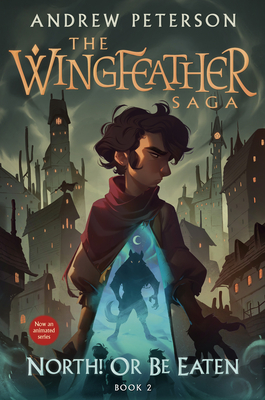
North! Or Be Eaten

North! Or Be Eaten is the second of Andrew Peterson’s Wingfeather Saga for children.

In the first book, On the Edge of the Dark Sea of Darkness (linked to my review), we met the Igiby family: grandfather Podo, mother Nia, sons Janner and Tink, and daughter Leeli. They lived in Skree, which is under the domination of the Fangs of Dang, headed by Gnag the Nameless.

At the end of the first book (spoiler alert if you haven’t read it), the children are stunned to learn that they are the lost Jewels of fabled Anniera. Their father was the High King.

Unfortunately, the Fangs figure this out as well. They raze the town, burn the Igiby’s home, and pursue them. Podo’s plan is to make it to the Ice Prairies, which the lizard-like Fangs can’t tolerate. Once there, they can decide what to do next.

Thus the family sets out on an epic quest “through many dangers, toils, and snares.”

They are accosted by the Stranders, rough, fierce people who live in Glipwood Forest and have no conscience about stealing and kidnapping. Yet they find a couple of people of character even there.

They get separated at Dugtown, which, oddly, lacks children–and soon find out why.

While searching for the lost Tink, Janner gets whisked away to the deceptively named Fork Factory, where there is no escape.

They are betrayed by those they thought were friends. But they find aid in unexpected sources.

Along the way, they battle not only the enemies pursuing them, but themselves. When the journey is quiet, the children are told more about the kingdom and their established roles in it. Leeli is fine with hers and seems to have been fulfilling it already. But the boys take longer to absorb the news and aren’t so sure they want the responsibility.

However, their trials and hardships bring home to their hearts what is most important. And when things seem at their lowest, “darkness is seldom complete, and even when it is, the pinprick of light is not long in coming–and finer for the great shroud that surrounds it” (p. 312).

One whose hidden past caught up with him “moved through the days in peace and wonder, for his whole story had been told for the first time, and he found that he was still loved” (p. 323).

The first book took a while to set up the characters and situation. This book dove right into the action. There’s a lot less humor in this book than the first, but I felt the first went a little overboard in that department. There aren’t many occasions for full-blown humor in this book, but it’s tucked in here and there.

Besides trusting “the Maker,” family, bravery, and overcoming, it seemed to me that identity was a key theme. Though Janner struggled with his role in the kingdom, remembering who he really was helped him in the Fork Factory, where all the workers were only called “Tools” and treated as such.

The book is wonderfully illustrated by Joe Sutphin. I think the boy on the front cover is supposed to be Tink, who looks a lot like former Monkee Michael Nesmith. 🙂 I don’t think that’s purposeful, as neither author nor illustrator are old enough to have been Monkee’s fans. But it was a fun connection.

I enjoyed the book a lot, especially the latter third of it. There are two more books in the series. I look forward to what happens to the Igiby family next.

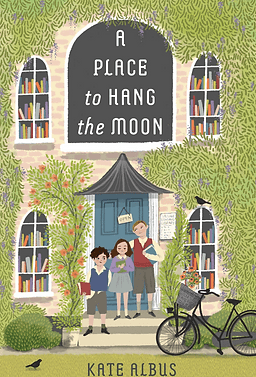
A Place to Hang the Moon

In A Place to Hang the Moon by Kate Albus, William, 12, Edmund, 11, and Anna, 9, live in 1940 England. Their parents died when William was 5. “The grandmother” had charge of them since, but she sent them off to boarding school and was cold and aloof when they were home.

Now the grandmother has died as well. The family solicitor, Mr. Engersoll, explains that the children have been left a lot of money, but no one has been named as their guardian. Apparently there is no one to ask. The children plead to stay with the family’s housekeeper, Mrs. Collins, but she’s too old to take them in.

Mr. Engersoll suggests that the children join evacuees being sent to the country. Perhaps the foster parents they find might take them in permanently. The children are advised not to tell anyone that they are alone in the world or that their family has money, so they don’t get taken advantage of.

The children agree with what Mrs. Collins calls “the preposterous plan,” as there seems to be no other option.

The children are billeted together first with one family, then another. I don’t want to spoil the story by telling what went on in those places, but neither is suitable.

The children spend many afternoons in the town library. Books have always been their friends, and the warmth and quietness of the library provide a refuge. The kind interest of the librarian, Mrs. Muller, makes the place even more welcome.

It’s not long, however, before they discern Mrs. Muller is something of an outcast. She’s married to a German man who has disappeared.

The children wish they could stay with Mrs. Muller, despite her husband’s possible Nazi leanings.

This story starts out like a classic fairy tale, with children alone in the world having to overcome various difficulties. I had thought it was a young adult book, but Amazon recommends it for grades 4-7.

I don’t often read secular books for this age group, but the Story Warren and Hope both spoke well of this story, piquing my interest. I agree with C. S. Lewis that a good children’s book can be enjoyed by adults as well. When the title came up temporarily free from Audible. I gave it a try.

I’m so glad I did. I loved this book. The story is well-told and the characters are beautifully drawn. Descriptions of both warm and cozy and difficult scenes make you feel you are experiencing them along with the children. References to beloved classic children’s books are scattered throughout. Polly Lee’s British accent enhanced the audiobook. I didn’t want the book to end.

Some of my favorite quotes:

The first words of a new book are so delicious—like the first taste of a cookie fresh from the oven and not yet properly cooled.

The librarian took this all in, standing by the fire and observing the children for a while, letting the silence be. Somehow, it didn’t feel awkward, the way silences often do. Perhaps librarians are more used to quiet than most.

William, Edmund, and Anna knew, somewhere deep in the place where we know things that we cannot say aloud, that they had never lived in the sort of home one reads about in stories – one of warmth and affection and certainty in the knowledge that someone believes you hung the moon.

Edmund took in the boy’s mended jacket, the eyes underlined in shadows, the skin above his upper lip chapped raw from a dripping nose gone unattended, and saw the sort of hunger whose endlessness digs a pit in a person. Being eleven, Edmund wouldn’t have put it quite in those words, but he recognized it nonetheless.

While she wasn’t sure of the precise definition of the word “bibliophile,” Anna was certain it meant something that she wanted to be.

The stealing of sweets, after all, is an act committed only by those with unspeakably black souls.

The smell of the cookies filled the children with a warmth that can only come from the magnificent alchemy of butter and sugar.

Truth be told, Anna was rather giving away the ending, but sometimes one cannot help oneself.

Anna thought of offering up a hearty platter of I told you so, but she didn’t. Why foul perfection with such a sharp thing as bitterness?

This is a lovely book. Not fluffy bunny and serene landscape lovely, but a wonderful tale beautifully told.

Book Review: Eight Cousins

Eight Cousins by Louisa May Alcott was published in 1875.

Rose Campbell is 13 and newly-orphaned. Her mother had died when Rose was young, but her father just recently passed. She’s sent to live with several aunts (their house is known as the “Aunt Hill”) until her appointed guardian, her father’s single brother, comes home from sea.

Rose had never met her father’s family. The aunts embody the truism of too many cooks spoiling the stew, with their different and sometimes opposite views on how she should be raised. One, something of a hypochondriac herself, has Rose almost convinced she has “no constitution.”

When Dr. Alec finally arrives, he puts his foot down with the aunts that Rose is to be raised his way for a year without their interference. Then they can evaluate how she’s doing and whether they need to make a change. The aunts can’t help but share their opinions occasionally, but they abide by Alec’s wish.

Alec starts slow with Rose, changing her diet and activities to healthier ones, not by decree but by persuasion. Rose regards her newfound uncle kindly because he is so like her father and seems to care greatly for her, so she acquiesces for the most part. She struggles to give up her little vanities, like wearing her belt so tight she can’t take a full breath so her waist looks smaller.

Much of the book involves Rose’s interactions with her seven boy cousins. She didn’t think she would like boys: she had never been around any. But she soon grows to love them. They all inadvertently teach each other lessons.

Alcott gets in a lot of opinions about what’s good and bad for young people. Some of the fashion sense Alec prescribes, we would consider common sense today (like doing away with corsets and having clothes loose enough to move comfortably in). Some of the vices her characters try to steer each other away from might sound funny to modern ears (like slang. Or maybe it’s that slang in that day is acceptable now.)

Wikipedia says Rose’s instruction and training for the wealth she will one day come into was “revolutionary” for the times, because women didn’t have much control over their own “money, property, or destinies” then.

Alcott uses the adjectives “good, old-fashioned” often, and this is a good, old-fashioned tale. Through “frolics” and “scrapes,” gentle admonition and learning by experience, the young people grow and develop good character.

A  couple of quotes I especially liked:

When Uncle Alec tells Rose he wants her to take up something special, housekeeping, she says, “Is that an accomplishment?” He replies: “Yes; it is one of the most beautiful as well as useful of all the arts a woman can learn. Not so romantic, perhaps, as singing, painting, writing, or teaching, even; but one that makes many happy and comfortable, and home the sweetest place in the world. Yes, you may open your big eyes; but it is a fact that I had rather see you a good housekeeper than the greatest belle in the city. It need not interfere with any talent you may possess, but it is a necessary part of your training, and I hope that you will set about it at once, now that you are well and strong.”

When one of the cousins takes Rose on her first pony ride, he chooses a gentle one named Barkis. Then the book says Barkis was “willin’,” an allusion to David Copperfield in which a man named Barkis lets Peggotty, David’s nurse,  know that he’s interested in marrying her by sending the message, “Barkis is willin.'” Hearing that phrase made me smile.

I listened to the audiobook at Libravox, a site for free audiobooks. The last time I used them, there was some disruption in the loading of individual chapters. That process went smoothly this time, but they’ve added some annoying ads every few chapters. The narrators at Libravox just read the books: they don’t put inflection in them like those at Audible. But sometimes a book is short enough that I don’t want to use a full Audible credit on it, and I am thankful for the option of Libravox. They also have some books that Audible doesn’t have.

Rose in Bloom is the sequel to this book, and that’s next on my reading list for Tarissa’s Louisa May Alcott Reading Challenge this month. I had read both books years ago and enjoyed revisiting them.

(Sharing with Carole’s Books You Loved, Booknificent Thursday)

Book Review: The Incorrigible Children of Ashton Place: Book VI: The Long-Lost Home

Incorrigible The Incorrigible Children of Ashton Place: Book VI: the Long-Lost Home is the long-awaited finale to the Incorrigible Children series by Maryrose Wood.

If you’re not familiar with the series, it’s about three children raised by wolves whom Lord Frederick Ashton brings home after he discovered them on a hunting trip. Needing someone to teach and “tame” the children, Lord Ashton advertised for a governess. He was sent the plucky Miss Penelope Lumley, graduate of Agatha Swanburne’s Academy for Poor Bright Females.

A number of intriguing mysteries and connections have been traced through the first five books: the fact that Penelope’s hair is the exact same color as the Incorrigibles, that Frederick Ashton gets “wolfy” during full moons, that Frederick’s presumed-dead father is not really dead but has not revealed himself. Book V ended with Penelope separated from the Incorrigibles,  having been tricked into switching places with a tutor to the  Horrible Babushkinovs in Plinkst, Russia.

In this final book, the looming due date of Lady Constance Ashton’s baby means the family curse will come to a head, and one side or the other will be destroyed.  How can Penelope help them while so far away? How can she possibly get home with no resources?

All of the various threads are satisfactorily resolved in this final book. I’ve mentioned before that I don’t normally go for books about “curses” or ones that have soothsayers as recurring characters. Those weren’t elements in the first book that got me hooked on the series. The most objectionable element to me was a seance, I think in Book III. If you read this with your children, you’ll have to discuss these issues in concert with your beliefs.

I also don’t read all that many children’s books, and I am not sure what age level this book is intended for.

But what I love most about the series is the clever writing and the humor. Every book is sprinkled with Agatha Swanburne’s pithy sayings and includes explanations and references to a couple of classics (Hamlet and The Count of Monte Cristo, in this case). Values such as hard work, resourcefulness, basic decency, and loving family are emphasized in each book.

I loved the distinction between “Optoomuchism” – an overly optimistic and ultimately untenable outlook – and “pessimax” – pessimism to the extreme.

I happened to listen to the first book due to a free audio version, and I fell in love with Katherine Kellgren’s fantastic narration, character voices, and inflections. I chose to listen to all of the books via audio because she added so much to them. Sadly, she passed away before the final book was published. There is a very touching afterword in this book honoring Katherine and telling of the friendship that had arisen between the author and narrator. Audiobooks don’t always include forwards and afterwards, so I am glad this one did. This audiobook was ably narrated by Fiona Hardingham.

These are my reviews of the previous books:

The Incorrigible Children of Ashton Place, Book 1: The Mysterious Howling 

The Incorrigible Children of Ashton Place, Book II: The Hidden Gallery

The Incorrigible Children of Ashton Place, Book III: The Unseen Guest (for some reason did not review this one)

The Incorrigible Children of Ashton Place: Book IV: The Interrupted Tale

The Incorrigible Children of Ashton Place, Book V: The Unmapped Sea

(Sharing with Carole’s Books You Loved)

Book Review: Where the Red Fern Grows

Red FernI had seen the 1974 film version of Where the Red Fern Grows when my two older boys were elementary-school age, some 25 or so years ago. I enjoyed the film, but I don’t remember if I knew then it was based on a book. I wish we had read it back then! But I was glad to finally listen to it via audiobook this month.

The book begins with an adult Billy Coleman leaving work and coming upon a dogfight. When he sees the dog being attacked is a hound like one he used to have, he rescues it, takes it home, feeds it, and lets it rest, then releases it. That stirs up memories of the dogs he used to have.

Billy had grown up in a poor family in the Ozarks. There was nothing he wanted more than a dog to go coon hunting with – but not just any dog. He wanted hounds. His parents could have gotten him a mongrel dog, but they could not afford a special breed, no matter how much Billy pleaded.

I suppose there’s a time in practically every young boy’s life when he’s affected by that wonderful disease of puppy love. I don’t mean the kind a boy has for the pretty little girl that lives down the road. I mean the real kind, the kind that has four small feet and a wiggly tail, and sharp little teeth that can gnaw on a boy’s finger; the kind a boy can romp and play with, even eat and sleep with.

One day Billy found a magazine some hunters had left behind at their campground and found an ad for two Redbone Coonhounds for $50. Without telling anyone, he performed odd jobs, dug up and sold worms for bait, picked and sold blackberries, and did anything he could think of to earn money. It took him two years, and when he finally showed his savings to his grandfather and told him what they were for, his grandpa helped him order the dogs. But the dogs would be shipped to a town more than a day’s journey away. Billy took off on foot alone to pick up his dogs and bring them back, helped by a kindly station master.

The dogs were a brother and sister. Billy named the brother, who was strong and quick to react, Old Dan. The thoughtful, intelligent girl dog was named Little Ann.

Billy went to work training his dogs to hunt coons, selling coon hides and giving the money to his father, and having many adventures with his dogs. Tragedy struck a couple of times, the second occurrence shaking Billy’s faith.

This is a wonderful “boy and his dogs” and coming of age story, even if readers are not all that interested in hunting. Strong themes of loyalty, perseverance, family, and faith undergird the novel. There are a couple of gruesome parts (one boy has a hunting accident with an ax, a dog in a fight with a mountain lion is severely injured), and the author tells them realistically but not gratuitously. The ending is sad but ultimately hopeful.

People have been trying to understand dogs ever since the beginning of time. One never knows what they’ll do. You can read every day where a dog saved the life of a drowning child, or lay down his life for his master. Some people call this loyalty. I don’t. I may be wrong, but I call it love-the deepest kind of love.

Wikipedia shares the interesting background story of how Wilson Rawls wrote the story, destroyed his manuscript, then wrote it again at his wife’s urging. I also enjoyed reading 12 Things You Might Not Know About Where the Red Fern Grows. Though Rawls wrote for children, his first publisher oddly marketed the book to adults. Sales were slow until Rawls spoke at a conference for teachers and librarians who took the samples of his book back to their schools and libraries, where children loved it.

I listened to the audiobook wonderfully read by Anthony Heald. I didn’t know until just now that there was a 2003 remake of the movie. Some day I would like to see it.

(Sharing with Semicolon‘s Saturday Review of Books, Literary Musing Monday, Carole’s Books You Loved)

Book Review: The Secret Garden and a Discussion of Magic in Children’s Books

Secret Garden I have mixed emotions about The Secret Garden by Frances Hodgson Burnett. I’ll explain why in a moment.

The story opens with nine-year-old Mary Lennox in India with her family. Her father “had held a position under the English government and had always been busy and ill himself, and her mother had been a great beauty who cared only to go to parties and amuse herself with gay people. She had not wanted a little girl at all,” so Mary was left to the care of her Ayah. So as not to bother Mary’s mother and get in trouble, the Ayah and other servants gave Mary her way in everything, leading to her becoming “as tyrannical and selfish a little pig as ever lived.”

A cholera outbreak took her Ayah, both parents, and several others, and everyone else fled the compound, leaving Mary alone and forgotten until some officers discovered her. She was sent to Yorkshire, England, to stay with her mother’s brother, her only relative, Archibald Craven at Misselthwaite Manor. Mr. Craven had a crooked back and had been in deep mourning for the ten years since his wife died. Mary did not meet him for a long time, as he traveled frequently, so she was taken care of primarily by a housemaid named Martha.

No one had thought to provide Mary with books or anything to do. She was strongly instructed not to poke around in the house, rumored to have 100 rooms. Martha encouraged her to go outside, pointing the way to the gardens and mentioning that there was one that had been locked up for ten years. It had been Mrs. Craven’s personal garden, but her husband had it locked up after she died.

That piqued Mary’s curiosity, and, as the title indicates, she does eventually find the garden. And what’s more, she discovers an unexpected person living in another part of the house.

My thoughts:

The story itself is a sweet, cozy, Victorian English tale. It’s not hard to see the symbolism between Mary and the friends she discovers bringing this garden back to life, weeding it, and tending it, and Mary and another orphan’s need for weeding and tending themselves. The story unfolds in a nice way and some of the characters are treasures: Ben Weatherstaff, the gruff gardener who helps Mary make friends with a robin; kindly Dickon, Martha’s brother, who has a way with animals; Mrs. Sowerby, Dickon’s warm and practical mother. I loved Mary’s transformation. The ending is perfect, just the way you’d want a book like this to end.

My mixed emotions are due to the book’s use of magic. Now, magic can mean different things in different books. I wrote some years ago about wrestling with this and concluding that fairy tale magic is not the same thing as the occult (real witches are not warty little old ladies who turn people into frogs). C. S. Lewis uses “magic” as a symbol for God’s ways. When my kids were little, one library haul yielded two books about magic carpets. In one, the “magic carpet” was a rug that the mom and child sat on to read books together – harmless and sweet. The other was a dreadful New Age tale complete with a message from a spirit guide in the back! So when magic comes up in a book, first I have to discern what the author meant by it and how the concept is portrayed.

The gust of wind that revealed the garden door was “a Magic moment.” I didn’t think much about that at first, but more and more as the story went on, Magic was given the credit for many things, until at last the children actually perform an incantation asking Magic (always capitalized) to come and do what they want. Mention is make of tales of Magic Mary heard about in India and the work of fakirs there. As the children themselves ponder what Magic is, one suggests it’s the dead mother of one of them, “lookin’ after Mester Colin, same as all mothers do when they’re took out o’ th’ world.” Other conversations attribute it to some kind of life force, the same thing that makes the flowers grow.

 I am sure there is Magic in everything, only we have not sense enough to get hold of it and make it do things for us—like electricity and horses and steam. When Mary found this garden it looked quite dead…Then something began pushing things up out of the soil, and making things out of nothing. One day things weren’t there and another they were. I had never watched things before and it made me feel very curious. Scientific people are always curious and I am going to be scientific. I keep saying to myself, ‘What is it? What is it?’ It’s something. It can’t be nothing! I don’t know its name so I call it Magic…Sometimes since I’ve been in the garden I’ve looked up through the trees at the sky and I have had a strange feeling of being happy as if something were pushing and drawing in my chest and making me breathe fast. Magic is always pushing and drawing and making things out of nothing. Everything is made out of Magic, leaves and trees, flowers and birds, badgers and foxes and squirrels and people. So it must be all around us. In this garden–in all the places. The Magic in this garden has made me stand up and know I am going to live to be a man. I am going to make the scientific experiment of trying to get some and put it in myself and make it push and draw me and make me strong. I don’t know how to do it but I think that if you keep thinking about it and calling it perhaps it will come. Perhaps that is the first baby way to get it. When I was going to try to stand that first time Mary kept saying to herself as fast as she could, ‘You can do it! You can do it!’ and I did. I had to try myself at the same time, of course, but her Magic helped me—and so did Dickon’s. Every morning and evening and as often in the daytime as I can remember I am going to say, ‘Magic is in me! Magic is making me well! I am going to be as strong as Dickon, as strong as Dickon!’ And you must all do it, too.

When Ben Weatherstaff suggests they sing the Doxology, one of them says, “’It is a very nice song…I like it. Perhaps it means just what I mean when I want to shout out that I am thankful to the Magic.’ He stopped and thought in a puzzled way. ‘Perhaps they are both the same thing. How can we know the exact names of everything?’”

Then when Dickon’s mother is asked whether she believes in Magic, she says:

I never knowed it by that name but what does th’ name matter? I warrant they call it a different name i’ France an’ a different one i’ Germany. Th’ same things as set th’ seeds swellin’ an’ th’ sun shinin’ made a well lad an’ it’s th’ Good Thing. It isn’t like us poor fools as think it matters if us is called out of our names. Th’ Big Good Thing doesn’t stop to worry, bless thee. It goes on makin’ worlds by th’ million–worlds like us. Never thee stop believin’ in th’ Big Good Thing an’ knowin’ th’ world’s full of it–an’ call it what tha’ likes. Tha’ wert singin’ to it when I come into th’ garden…Th’ Magic listened when tha’ sung th’ Doxology. It would ha’ listened to anything tha’d sung. It was th’ joy that mattered. Eh! Lad, lad, what’s names to th’ Joy Maker.

As I read and was trying to discern how to take the Magic in this book, I figured it would be best first to see if I could find out what the author meant by Magic. Wikipedia says, “In the early 1880s [Burnett] became interested in Christian Science as well as Spiritualism and Theosophy.” Sparknotes says “throughout the novel, the idea of magic is heavily inflected by the tenets of both Christian Science and New Thought.” Part of the latter is the idea of “mind over matter,” the thought that repeating something over and over, as the children do in their chanting, can make it become real. Also, near the end of the book, the author writes:

One of the new things people began to find out in the last century was that thoughts—just mere thoughts—are as powerful as electric batteries—as good for one as sunlight is, or as bad for one as poison. To let a sad thought or a bad one get into your mind is as dangerous as letting a scarlet fever germ get into your body. If you let it stay there after it has got in you may never get over it as long as you live.

So long as Mistress Mary’s mind was full of disagreeable thoughts about her dislikes and sour opinions of people and her determination not to be pleased by or interested in anything, she was a yellow-faced, sickly, bored and wretched child. Circumstances, however, were very kind to her, though she was not at all aware of it. They began to push her about for her own good. When her mind gradually filled itself with robins, and moorland cottages crowded with children, with queer crabbed old gardeners and common little Yorkshire housemaids, with springtime and with secret gardens coming alive day by day, and also with a moor boy and his “creatures,” there was no room left for the disagreeable thoughts which affected her liver and her digestion and made her yellow and tired.

There’s a sense in which it’s true that both positive and negative thoughts can affect one’s outlook and even one’s health. But it’s possible to take that philosophy too far. SparkNotes goes on to say:

One of the book’s underlying themes is the way in which happiness begets happiness, and misery begets only more of itself….The source of this notion can again be found in Burnett’s fascination with the New Thought and Christian Science movements, which held that one must think only positive thoughts if one wants good things to happen. The fact that this idea is patently false miraculously did nothing to deter its adherents. Dickon’s remark that “the springtime would be better [for Colin] than doctor’s stuff” provides another instance of Christian Scientist tenets in the novel. Christian Science, as a philosophy, disapproves of medical intervention: no disease is truly corporeal (caused by the body), but is in fact the result of morbid and negative thinking. Colin must have contact with the life of the world if he is to go on living, because this contact will dispel his thoughts of death: Dickon (guided by Burnett’s Christian Scientist beliefs) says that Colin “oughtn’t to lie there thinking [of death and illness]… No lad could get well as thought them sorts of things.” The fact that Colin’s fury at Ben Weatherstaff provides him with sufficient strength to stand reinforces the notion that his previous inability to do so was entirely a product of his negative thinking. It also underlines the idea that if one only wishes to overcome one’s illness, one can. Negative thoughts are the human error to be found at the root of all disease; one must therefore force out ugly thoughts with agreeable ones, for “two things cannot be in one place.” This notion is responsible for both Colin and Mary’s wondrous metamorphoses. Once they are thinking of the garden and nature, of Dickon and of their own blossoming friendship, they can no longer concern themselves with their own contrariness or with the fear of becoming a hunchback and dying an early death. Instead, they become normal, healthy children, full of dreams of the future. This questionable (and inarguably syrupy) goal is given inane epigraphic expression in the phrase “Where you tend a rose, my lad, a thistle cannot grow.”

So there is a sense in which you could think of the Magic in the book as “positive thinking” or the same force that makes the plants grow. Or, as this writer did, you could see it as pluralism, wanting to lump all of these philosophies in with Christianity as if they are the same thing, when they’re not. Knowing more of Burnett’s background and philosophy makes me wary. I don’t know if I would read this to my children, if they were still young enough to read to: we’d at least have to discuss some of these issues as we read.

There is also a bit of colonialism, I guess you’d call it, in the book, with Mary being disdainful of the Indian servants and seeing them always as only servants, and Martha’s ignorance in calling them “blacks.”

A brief biography of the author, unusual in audiobooks, mentions that “Later in life, reporters criticized her lifestyle, and turned public sentiment against her.” But it doesn’t say what exactly they criticized, so I don’t know if it was her philosophies or the fact that she was divorced or something else.

I listened to the audiobook wonderfully read by Josephine Bailey and also looked up some passages in a library copy and on Project Gutenberg.

(Sharing with Semicolon‘s Saturday Review of Books, Carol’s Books You Loved, Literary Musing Monday)

Book Review: Old Yeller

I loved the movie version of Old Yeller when my kids were little. I don’t know if I knew then that it came from a book, but I’ve been wanting to read the book by Fred Gipson for years. When I was searching for a classic about an animal for the Back to the Classics Reading Challenge, plus a shorter classic after finishing a very long one, this fit the bill on both counts.

Old YellerThe story is told from the point of view of Travis, the fourteen-year-old oldest son of a family in Texas in the 1860s. Though the family lived off the land easily, they didn’t have much in the way of “cash money.” Some of the settlers were joining a cattle drive to a town some 600 miles away, and Travis’s dad decided to go. He left Travis as the “man of the house,” with the responsibility of a man: shooting game for food, keeping critters out of the corn, protecting the family from Indians and wildlife, milking the cows, looking after his Mama and little brother, Arliss, marking the new pigs, and not waiting for his mom to tell him to do things.

Travis felt “pretty near a grown man” and welcomed the opportunity to prove himself. With the exception of being able to reign in Little Arliss, he put in full days of work and did a good job. He was especially gratified when his mother waited supper for him, just like she did for his dad when his work ran late.

But then one day a scruffy, yellow ugly dog showed up on the property and stole some of the family’s meat. Little Arliss claimed the dog immediately, and their mom was willing for him to have him. But Travis hated him especially because of his thieving but also because he was ugly and seemed worthless.

But it wasn’t long before the dog proved it could learn and be a big help to the family, herding hogs, chasing off bears and wolves, etc. And it wasn’t long before Travis loved the dog even more than Little Arliss.

That made it all the harder when tragedy struck, which the author speaks of on the first page.

I love “coming of age” stories, especially the character has to stretch him- or herself farther than they think they can go (Keep the Lights Burning, Abbie, is another favorite along these lines.) I also enjoyed the peek into this era. It used to be a regular thing for a teenager to be trained to do an adult’s work, though they weren’t often left with it all on their shoulders like Travis was. Sometimes I wonder if that would be a better thing than not expecting young people to take on adult responsibilities until they’re out of college or later. Then again, it was a hard life, and I enjoy the fact that young people now have avenues to explore in their teens that young people didn’t have then. I also can’t imagine being nearly alone on the edges of a settlement while a husband is away for months with no means of communication for all that time, and having to patch up serious injuries of both boys and animals and take on the extra work that they can’t do while injured.

Probably my favorite part of the book is the advice Travis’s dad gave him when he returned and heard all that had gone on in his absence:

That was as rough a thing as I ever heard tell of happening to a boy. And I’m mighty proud to learn how my boy stood up to it. You couldn’t ask any more of a grown man… It’s not a thing you can forget. I don’t guess it’s a thing you ought to forget. What I mean is, things like that happen. They may seem mighty cruel and unfair, but that’s how life is part of the time. But that isn’t the only way life is. A part of the time, it’s mighty good. And a man can’t afford to waste all the good part, worrying about the bad parts. That makes it all bad.

I listens to the audiobook very nicely read by Peter Francis James. he did a good job with the expression as well as the accents. It’s been a long while since I’ve seen the movie version, but it seems to have followed closely to the book except for drawing out the climax more.

(Sharing with Semicolon‘s Saturday Review of Books and Carole’s Books You Loved)

Save

Save

Book Review: These Happy Golden Years

happy-golden-yearsThese Happy Golden Years by Laura Ingalls Wilder covers the time when Laura, at age 15, starts teaching school, to the time of her marriage at age 18.

It’s incredible to us today to think of someone teaching at age 15, before they have even finished high school. I don’t think that was the usual course even then, but a need arose, and Laura had passed the teaching examination and was willing to go.

This term was one of the most difficult of her life. The school was twelve miles from her home, and she boarded with the superintendent. His wife was sullen, mostly silent, and seemed to resent Laura’s being there. Later Laura heard her complaining about everything, not just Laura, so she knew it was just that she was unhappy in general rather than just resenting Laura. The woman was probably clinically depressed from what I can ascertain. At one point in the middle of the night she threatened her husband with a knife, but he talked her down. The conditions of both the house and the school were fairly primitive. The walls and floor of the school had cracked through which the cold seeped in. Sometimes Laura let the students do their lessons around the stove. Laura never really liked teaching, but it was a way she could earn money to help keep Mary in the college for the blind.

She was concerned that her youth and small stature would be a problem in trying to teach and discipline students who were bigger and older than she was. And indeed it was, but her parents’ good advice and her own ingenuity helped her over those hurdles.

The only thing that made this time bearable was the fact that it was only for that one term, plus Almanzo Wilder came and picked her up every Friday afternoon, took her home, and brought her back every Sunday. When her students referred to him as her beau, she didn’t want him to get the wrong idea, and told him she was just riding with him to get home, not because she had any interest in him. She expected he wouldn’t keep coming after that, but he did.

Finally the term was over and she was back at home, attending her own classes, which she had been able to keep up with by studying on her own. On weekends a lot of the young people paired up to go sleighing around town. Laura was feeling lonely and out of it when Almanzo came and asked if she’d like to go with him. Thus started a habit that continued on, riding the sleigh in the winter and the buggy in the spring and summer. Laura was not afraid even when Almanzo was breaking new horses in with the buggy, and she had to jump in as Almanzo could only pause for a few seconds before the horses took off again.

She taught two more terms of school in different places, continued with her own schooling, helped at home. Mary came home for a couple of visits. I enjoyed seeing Carrie mature and the relationship between her and Laura grow, as well as the rejoicing in the family when any one of them received something or had a good opportunity. Pa would have liked to move the family on again where the land was less settled, but he didn’t. Her descriptions of a couple of dresses Ma made, with all the detail, layers, lining, and bustle, made me very glad that fashions have changed since that time!

Almanzo was a quiet, not pushy, but persistent suitor. Laura didn’t give him much encouragement, as he was ten years older. At one point when someone called Laura a young lady, “she was startled” and had not thought of herself in that way and “was not sure she liked” it. But when Nellie Oleson tried to horn her way in to his attentions, I think perhaps Laura understood then just how much she actually did care for Almanzo. In Pioneer Girl, she wrote that after he had been away for a few months, “I hadn’t known that I missed him, but it was good to see him again, gave me a homelike feeling.” The way they got engaged was both sweet and funny.

One of my favorite scenes in the book is when she’s admiring their new home, particularly the spaciousness and organization of the kitchen and pantry that he had crafted for her.

I very much enjoyed this reread of this book.

(Sharing with Semicolon‘s Saturday Review of Books and Carole’s Books You Loved)

Books you loved 4


Save

Book Review: The Story Girl

story-girlI read The Story Girl by L. M. Montgomery for Carrie’s  L. M. Montgomery Reading Challenge.

It opens with two brothers, Beverly and Felix King, going to stay with their father’s extended family while he travels to Rio de Janeiro on business. The King family lives on the old family homestead, and Bev and Felix look forward to exploring all the old haunts their father has told them of. The branch of the family they are staying with includes a brother and two sisters, Dan, Felicity, and Cecily King. Another cousin, Sara Stanley, lives with a nearby aunt and uncle. Neighbor Sara Ray and hired boy Peter Craig round out the group.

Sara Stanley is called the Story Girl partly because there is another Sara in the group, but mainly because she has a unique voice and ability to enthrall children and adults alike with the way she tells stories. The book tells of the children’s interactions, adventures, and misadventures, and along the way Sara entertains them with stories. Some are family tales, some are local lore, others are fairy tales or classical stories.

The children range in age from 11 to 14, yet seem younger than children of the same age by today’s standards.

I wondered if one reason Montgomery told stories about children was because she could explore issues through a child’s innocence, lack of experience, and questioning that she might not feel quite the freedom to with adults. For instance, in one chapter the cat is unwell, and some of the children think one of the women in the village put a spell on him when he yelped because she accidentally stepped on his tail. Some don’t think so, but they agree that they need to make an appeal for her to remove the spell and explain that he didn’t mean any harm. They also get some medicine down him, and pray. When he gets well, they argue about whether it was the spell removal, the medicine, or the prayers that cured him. “Thus faith, superstition, and incredulity strove together amongst us, as in all history.” In another, one of them finds an article in the newspaper reporting that someone in the USA predicted the date for Judgment Day. They argue over whether it’s true and what to do about it and respond in a variety of ways.

One story that disturbed me a bit was a legend about how the Milky Way came to be (in the chapter “A Daughter of Eve”). As the story has it, two archangels fell in love, which God did not allow among angels, so He separated them to far sides of the universe. But they loved each other so much, they each began building a bridge of light toward the other, not realizing the other was doing the same. When they met, some of the other angels reported it to God and asked him to punish them. He said, “‘Nay, whatsoever in my universe true love hath builded not even the Almighty can destroy. The bridge must stand forever.” It’s not the fanciful story that bothers me so much as the thought planted in reader’s heads that there is something God is powerless against. In another part of the book, the children wonder what God looks like until finally one of them finds someone who says he has a picture of God in a book at home, and they buy the picture from him for 50 cents. When they see it, they’re sad and dismayed that He looks old and “cross” and intimidating rather than friendly and inviting. They all process this in different ways until they finally ask the minister, who assures them that, though no one really knows what God looks like, He assuredly does not look like this. He tells them to bury the picture. They’re relieved, yet,

We had lost something of infinitely more value than fifty cents, although we did not realize it just then. The minister’s words had removed from our minds the bitter belief that God was like that picture; but on something deeper and more enduring than mind an impression had been made that was never to be removed. The mischief was done. From that day to this the thought or the mention of God brings up before us involuntarily the vision of a stern, angry, old man. Such was the price we were to pay for the indulgence of a curiosity which each of us, deep in our hearts, had, like Sara Ray, felt ought not to be gratified.

To me, planting that thought from the other story that God is powerless against true love does the same thing. Even though we know that’s not true, that thought keeps coming to mind.

But most of the stories and happenings are much lighter. There is a lot of charm in the stories, and I particularly like LMM’s characterizations and how the children play off each other. But there is a bit of a sharp edge, too, when the children are mean to each other, like the constant references to Felix being fat or Dan’s larger than usual mouth. Some of LMM’s writing is lovely; some seems to me to overstep into purple prose. But one of the main points of the story that I love is:

There is such a place as fairyland – but only children can find the way to it. And they do not know that it is fairyland until they have grown so old that they forget the way. One bitter day, when they seek it and cannot find it, they realize what they have lost; and that is the tragedy of life. On that day the gates of Eden are shut behind them and the age of gold is over. Henceforth they must dwell in the common light of the common day. Only a few, who remain children at heart, can ever find that fair, lost path again; and blessed are they above mortals. They, and only they, can bring us tidings from that dear country where we once sojourned and from which we must evermore be exiles. The world calls them its singers and poets and artists and story-tellers; but they are just people who have never forgotten the way to fairyland.

And I could identify with this, said of the Story Girl:

She loved expressive words, and treasured them as some girls might have treasured jewels. To her, they were as lustrous pearls, threaded on the crimson cord of a vivid fancy. When she met with a new one she uttered it over and over to herself in solitude, weighing it, caressing it, infusing it with the radiance of her voice, making it her own in all its possibilities for ever.

If I still had children of an age to read to, I am not entirely sure I would read this to them: if I did, it would be with some editing and discussions along the way.

One of the reasons I wanted to read this book was that the series “The Road to Avonlea” is based on it and its sequel, The Golden Road. I don’t remember seeing any of the series when it was originally on except for possibly a part of one episode at someone’s house. I had planned to see one before writing this review, but it’s not on Hulu or Netflix. There are excerpts on YouTube, but only 4 or 5 minutes each, with links back to Sullivan Entertainment, where they offer to sell them to you. DVDs are still available, but I didn’t want to buy them – I just wanted to see the first episode. Unfortunately our library system only has one Christmas episode from the series. The part I saw on YouTube had the same feel and look as Sullivan’s production of “Anne of Green Gables” with Megan Follows, but apparently they left out some of the characters and changed various details.

I listened to a free audiobook version on Librivox, which was read by volunteers across the country. Unfortunately, it sounds like it was read by volunteers. The sound quality wasn’t good on all of them: some had static or other noises. Some of the readers did better than others. But…it was free, Audible didn’t have it, and I had more room in my listening time than I did in my reading time, so I pressed on with it. I did get a copy of the book from the library to go over certain parts, and I just discovered a short while ago that the text is online here. I do want to read The Golden Road some time to see what happens with the children.

So – mixed emotions. A lot of good, a handful of qualities I in particular didn’t like. For more enthusiastic reviews, see Hope‘s or Carrie‘s.

(Sharing with Semicolon‘s Saturday Review of Books)

Save

Save

Book Review: The Green Ember

Green EmberThe Green Ember by S. D. Smith is a children’s story about rabbits. Brother and sister Heather and Picket live a normal (for storybook rabbits), almost idyllic life with their parents and baby brother until one day when a mysterious stranger comes to talk with their parents. Heather and Picket are shooed out to pick berries, but while they are gone, their home is attacked by wolves and burned. Not knowing where their parents are and being spotted by wolves, they try for a harrowing escape, being rescued at the last minute by an uncle they didn’t know they had and his adopted son, Smalls.

Their uncle, Wilfred, and Smalls take them to a community of rabbits hidden away. They see and hear evidences of other wolf attacks. While rabbit forces are training to fight the wolves, rabbit artisans and workmen are keeping their skills honed for a time when the heir of their fallen king will rise up and claim his place and lead them to a season of peace. When injustices or suffering occur, they comfort themselves with the saying, “It shall not be so in the Mended Wood.” Meanwhile discord threatens the community, and Heather and Picket struggle to find their place, especially when they learn their family’s history with the king.

My thoughts:

I don’t read children’s stories other than classics often, though I agree with C. S. Lewis that a good children’s story should appeal to adults, too.

I was expecting to be wowed, and maybe that’s the biggest problem with why I wasn’t. I think when expectations are so high, that can actually set one up for disappointment. I’ve seen it compared to Narnia, and though there are similarities, I think such a comparison helps set up those lofty expectations and the resulting letdown.

It’s not a bad story at all. It has a lot of great elements. I tend to enjoy “coming of age during adversity” type stories generally. I bought and looked back through the Kindle version after listening to the audio, and the things that bothered me while listening didn’t stand out so much while reading. I am not sure if that’s because it lends itself better to being read than listened to or if I was already familiar with it, so certain things did not then stand out.

I don’t mean to sound nitpicky and critical. I really don’t read or listen to books with an editing pen handy, ready to pounce on any little infraction. But there were a few things that were like speed bumps, pulling me out of the story to wonder why some things were phrased the way they were.

I think the arc of the story, the characters, the conflict, and most everything else is fine: it’s just these little things that could be tightened up to make it stronger, or at least provide fewer distractions.

To be fair, let me share some of the great quotes that stood out to me:

“If you aren’t angry about the wicked things happening in the world all around, then you don’t have a soul.”

“Why not just apologize to Smalls, to everyone, and move on? But he couldn’t do it. It would feel too much like surrendering ground he felt entitled to.” Thought that was quite insightful – that’s exactly how one feels when not wanting to apologize.

“All of life is a battle against fear. We fight it on one front, and it sneaks around to our flank.”

My place beside you,
My life for yours,
‘Til the Green Ember rises
Or the end of the world!

I like the way the community is not just surviving, but also focusing on and preparing for the time to come: “Here we anticipate the Mended Wood, the Great Wood healed. Those painters are seeing what is not yet but we hope will be. They are really seeing, but it’s a different kind of sight. They anticipate the Mended Wood. So do all in this community in our various ways. We sing about it. We paint it. We make crutches and soups and have gardens and weddings and babies. This is a place out of time. A window into the past and the future world. We are heralds, you see, my dear, saying what will surely come. And we prepare with all our might, to be ready when once again we are free.”

The story ends rather abruptly, obviously setting up for a sequel, which is due out in September: Ember Falls. Between these two a prequel was published, The Black Star of Kingston.

It’s not an overtly Christian book, but there are spiritual parallels, mainly of a fractured, hurting world longing for its king to come, and many spiritual truths along the way. A good discussion of this aspect is in this review.

The illustrations by Zach Franzen are gorgeous. I was glad the Kindle included them.

If you’d like to read a much more enthusiastic review, the great majority on Amazon or Goodreads are positive.

(Sharing at Semicolon‘s Saturday Review of Books)

Save

Save

Save

Save