Book Review: Tuck Everlasting

TuckI hadn’t planned to read Tuck Everlasting by Natalie Babbitt until I saw Carrie’s review of it, and even then, it wasn’t high on the TBR list. But a couple of weeks ago I was looking for a quote about August and came across this one:

“The first week of August hangs at the very top of the summer, the top of the live-long year, like the highest seat of a Ferris wheel when it pauses in its turning. The weeks that come before are only a climb from balmy spring, and those that follow a drop to the chill of autumn, but the first week of August is motionless, and hot.”

It’s the opening sentence from Tuck Everlasting, and it so arrested me that I had to read the book. Thankfully it was available for the Kindle for a good price.

Ten year old Winnie Foster is contemplating running away. As an only child of a fairly strict and controlling family, she’s restless to get out from under the constant watchfulness and longs to do “something interesting–something that’s all mine. Something that would make some kind of difference in the world.” She can’t quite muster the courage to run away, but she does venture out into the woods near her family’s home, something she has never done before. She is startled to come upon a teenage boy drinking from a stream, and they converse easily. But when she wants a drink from the stream, he tries to keep her from doing so, which raises her ire. When the boy’s mother and brother happen along, they whisk Winnie away to their home.

After Winnie simmers down from being kidnapped, the Tuck family explains that they had to do what they did, and after they explain, they’ll be very glad to take her back home the next day. They share that 87 years ago, they came across this same woods and spring and drank from it, as did their horse. They didn’t know at first that anything was different. But when different ones of them had serious accidents but didn’t die, and after a while they realized that none of them was aging (not even the horse), they tried to trace back the cause. When they came back to the spring years later, the tree near where they stopped had not grown at all, and the “T” the father had carved there looked freshly done. So they covered up the spring with rocks. They could not stay in one place for long because when people noticed they didn’t age, they accused them of witchcraft.

Winnie isn’t sure she believes the story, but she likes the Tucks. The father, Angus, explains why it is so important for her to keep their secret. But what neither of them realize is that the secret is already out: a nameless man in a yellow suit has been following, questioning, and has overheard. But he’s not inclined to keep any secrets: in fact, he wants to profit by them.

I’ll leave the story there so as not to spoil it for those who haven’t read it. As I read, I kept wondering what the author was trying to say about life and death. But according to one interview, she said:

People are always looking for a lesson in it, but I don’t think it has one. It presents dilemmas, and I think that’s what life does! I dealt with a lot of dilemmas before I even started school. I think a lot of adults would like to think that things are simple for kids, but that’s not so. I get a lot of letters from students and teachers saying they spend a lot of time debating the things that happen in Tuck.… I think the book doesn’t present any lessons about what’s right and what’s wrong, but it does point out how difficult these decisions are.

(Warning: The interview does contain vital plot points, so it might be best read after reading the book.)

Each of the Tucks has a different viewpoint about their situation. The mother, Mae, feels that there is nothing they can do about it so they may as well make the best of it. The father, Tuck, mourns the fact that in the normal course of things, they’re “stuck,” that everything and everyone else is “moving and growing and changing” except for them.

Your time’s not now. But dying’s part of the wheel, right there next to being born. You can’t pick out the pieces you like and leave the rest. Being part of the whole thing, that’s the blessing. But it’s passing us by, us Tucks. Living’s heavy work, but off to one side, the way we are, it’s useless, too. It don’t make sense. If I knowed how to climb back on the wheel, I’d do it in a minute. You can’t have living without dying. So you can’t call it living, what we got. We just are, we just be, like rocks beside the road.

Miles, the oldest son, has lost the most. He was married with two children when his wife noticed he wasn’t aging, and she took the children and left, fearing witchcraft. This was before they figured out what caused it, so he had no explanation. He tells Winnie, “It’s no good hiding yourself away, like Pa and lots of other people. And it’s no good just thinking of your own pleasure, either. People got to do something useful if they’re going to take up space in the world.”

And Jesse, forever seventeen, thinks life to be enjoyed to the hilt.

I’ve thought that if I had the option to stay forever at one certain age, which would I choose? I don’t know – they all have their advantages and disadvantages. But being stuck at one age, you would lose that anticipation of what’s around the next bend. Thankfully eternal life in heaven will be a different situation.

I thought the story was certainly interesting and thought-provoking, and the characters were well-drawn and likeable. But what stood out to me was Babbitt’s writing. Beside the quote at the beginning, these sentences or phrases stood out to me:

…A stationery cloud of hysterical gnats suspended in the heat above the road.

The toad…gave a heave of muscles and plopped its heavy mudball of a body a few inches farther away from her.

…An enormous tree thrust up, its thick roots rumpling the ground ten feet around in every direction.

The sun was dropping fast now, a soft red sliding egg yolk…

I have not seen the recent film, but I’d like to some day.

(Sharing at Semicolon‘s Saturday Review of Books)

Save

Save

Save

Book Review: The Wind in the Willows

I never read The Wind in the Willows by Kenneth Grahame as I was growing up: I don’t think I had even heard of it. I didn’t read it to my children, but we did watch a video of it which I thoroughly could not stand. It mainly focused on Toad’s misadventures with his car, and Toad just irritated me to no end.

But reading some of C. S. Lewis’s books over the last couple of years, particularly On Stories, I saw that he mentioned it quite a lot, and some of his comments spurred me to give it a try.

It begins with Mole getting exasperated by his spring cleaning and escaping out into the forest, running about to his heart’s content, until he comes to a river, which he has never seen before. Delighted by the sight, he notices the Water Rat, who invites him into his boat for a ride. Mole has never been in a boat and is thrilled. He ends up not only having a picnic with Rat, but going to stay at his house for a time and meeting Otter, Badger, and eventually Toad.

Otter is more of a secondary character, but Mole, Rat, Badger and Toad become fast friends. Badger is introverted and doesn’t come into society much, but is friendly when he does. He was an old friend of Toad’s father and is very wise. Rat loves his boat, believes “there is nothing – absolutely nothing – half so much worth doing as simply messing about in boats,” and likes to write poetry and songs. Mole is an all-around good fellow but gets into trouble by extending himself past his experience and ability a couple of times, until near the end, when his doing so saves the day. Toad is rich, pompous, conceited, undisciplined, and goes full-bore into whatever his current interests are (and I still don’t like him very much. 🙂 ) When he discovers motor cars, he’s almost a lost cause.

There are almost two stories intertwined in the book: the raucous Toad’s pursuit of cars, wrecks, theft of one, imprisonment, disguise, escape, wild journey back home, and defense of his home from the weasels and stoats who overtook it while he was away, and then the quieter, gentler, homier experiences of the other animals. I like the second much better, but I understand that a book especially for children needs some action.

If I had to try to sum up what the book was about overall, the theme that comes to me is friendship. Each of the friends extends himself for the others at various points (except Toad, unless you want to count his final trying to rein himself in after several false repentances as an effort for his friends’ sake). They often inconvenience themselves greatly for each other, are kind to his others’ foibles, encourage and look out for each other.

There is one odd little section where Mole and Rat are helping to search for Otter’s lost little one and come upon the god Pan playing his pipes and watching over the little Otter. There reaction personifies reverence:

Then suddenly the Mole felt a great Awe fall upon him, an awe that turned his muscles to water, bowed his head, and rooted his feet to the ground. It was no panic terror—indeed he felt wonderfully at peace and happy—but it was an awe that smote and held him and, without seeing, he knew it could only mean that some august Presence was very, very near. With difficulty he turned to look for his friend and saw him at his side cowed, stricken, and trembling violently…

Perhaps he would never have dared to raise his eyes, but that, though the piping was now hushed, the call and the summons seemed still dominant and imperious. He might not refuse, were Death himself waiting to strike him instantly, once he had looked with mortal eye on things rightly kept hidden. Trembling he obeyed, and raised his humble head; and then, in that utter clearness of the imminent dawn, while Nature, flushed with fullness of incredible colour, seemed to hold her breath for the event, he looked in the very eyes of the Friend and Helper; saw the backward sweep of the curved horns, gleaming in the growing daylight; saw the stern, hooked nose between the kindly eyes that were looking down on them humourously…

‘Rat!’ he found breath to whisper, shaking. ‘Are you afraid?’

‘Afraid?’ murmured the Rat, his eyes shining with unutterable love. ‘Afraid! Of HIM? O, never, never! And yet—and yet—O, Mole, I am afraid!’

Then the two animals, crouching to the earth, bowed their heads and did worship.

I was curious to know what Grahame might have meant by it, especially since one of his previous books is titled Pagan Papers. I found a variety of opinions about it: one professing pagan fully embraced it as pagan worship and called Pan his favorite god; one thought it was a representation of Christ, as Aslan was in the Narnia books (and was taken to task in the comments); one thought it was a personification of nature. I still don’t know Grahame’s intention, though. I know C. S. Lewis used the mythic gods as something almost like superheroes, maybe just above or below the angels but definitely above man, yet in service to the one true God. I did read that some newer editions leave out this section, and I wasn’t the only reader that thought it was anomalous. But one of the posts I read – I forget which one – pointed out that though Pan made an appearance in person, his influence was all throughout the book. And when I went back and reread the first few pages, I thought that might be true: the way nature is spoken of is the same there as it is in the section with Pan. So I am a little wary: if I was reading this to my children, we’d have to have a discussion about it.

I went back and skimmed through the couple of books by C. S. Lewis looking for one quote in particular that most influenced me to read the book, and, frustratingly, I could not find it. If my memory is correct, I thought it had to do with dealing with ridiculous people (Toad in this case), and it helped me in regarding a ridiculous person or two in my acquaintance. But here are a few other quotes from Lewis about Wind in the Willows:

Does anyone believe that Kenneth Grahame made an arbitrary choice when he gave his principal character the form of a toad, or that a stag, a pigeon, a lion would have done as well? The choice is based on the fact that the real toad’s face has a grotesque resemblance to a certain kind of human face–a rather apoplectic face with a fatuous grin on it. This is, no doubt, an accident in the sense that all the lines which suggest the resemblance are really there for quite different biological reasons. The ludicrous quasi-human expression is therefore changeless: the toad cannot stop grinning because its ‘grin’ is not really a grin at all. Looking at the creature we thus see, isolated and fixed, an aspect of human vanity in its funniest and most pardonable form; following that hint Grahame creates Mr. Toad–an ultra-Jonsonian ‘humour’ (On Stories, p. 13).

It might be expected that such a book would unfit us for the harshness of reality and send us back to our daily lives unsettled and discontented. I do not find that it does so. The happiness which it presents to us is in fact full of the simplest and most attainable things–food, sleep, exercise, friendship, the face of nature, even (in a sense) religion. That ‘simple but sustaining meal’ of ‘bacon and broad beans and a macaroni pudding’ which Rat gave to his friends has, I doubt not, helped down many a real nursery dinner. And in the same way the whole story, paradoxically enough, strengthens our relish for real life. This excursion into the preposterous sends us back with renewed pleasure to the actual (On Stories, p. 14. Incidentally, the paragraph just after this one contains the quote, “No book is really worth reading at the age of ten which is not equally (and often far more) worth reading at the age of fifty–except, of course, books of information.”)

The Hobbit escapes the danger of degenerating into mere plot and excitement by a very curious shift of tone. As the humour and homeliness of the early chapters, the sheer ‘Hobbitry’, dies away we pass insensibly into the world of epic. It is as if the battle of Toad Hall had become a serious heimsókn and Badger had begun to talk like Njal (On Stories, p. 18).

I never met The Wind in the Willows or the Bastable books till I was in my late twenties, and I do not think I have enjoyed them any the less on that account. I am almost inclined to set it up as a canon that a children’s story which is enjoyed only by children is a bad children’s story. The good ones last (On Stories, essay “On Three Ways of Writing For Children,” p. 33).

Consider Mr Badger… that extraordinary amalgam of high rank, coarse manners, gruffness, shyness and goodness. The child who has once met Mr Badger has ever afterwards, in its bones, a knowledge of humanity and of English social history which it could not get in any other way (On Stories, “On Three Ways of Writing For Children,” (p. 37).

If you subtract any one member, you have not simply reduced the family in number; you have inflicted an injury on its structure. Its unity is a unity of unlikes, almost of incommensurables…A dim perception of the richness inherent in this kind of unity is one reason why we enjoy a book like The Wind in the Willows; a trio such as Rat, Mole, and Badger symbolises the extreme differentiation of persons in harmonious union, which we know intuitively to be our true refuge both from solitude and from the collective (The Weight of Glory, essay “Membership,” p. 165).

That last one may have been the one I was searching for initially, because I remembered it had to do with unity among different kinds of people. But I had thought the quote I had in mind mentioned Toad specifically and had the word “ridiculous” in it, so maybe not.

I’ve been giving Toad a hard time, but some people do find him lovable and funny despite his foibles.

Now, for a few favorite quotes from the book itself:

He thought his happiness was complete when, as he meandered aimlessly along, suddenly he stood by the edge of a full-fed river. Never in his life had he seen a river before—this sleek, sinuous, full-bodied animal, chasing and chuckling, gripping things with a gurgle and leaving them with a laugh, to fling itself on fresh playmates that shook themselves free, and were caught and held again. All was a-shake and a-shiver—glints and gleams and sparkles, rustle and swirl, chatter and bubble.

They braced themselves for the last long stretch, the home stretch, the stretch that we know is bound to end, some time, in the rattle of the door-latch, the sudden firelight, and the sight of familiar things greeting us as long-absent travellers from far over-sea…

We others, who have long lost the more subtle of the physical senses, have not even proper terms to express an animal’s inter-communications with his surroundings, living or otherwise, and have only the word ‘smell,’ for instance, to include the whole range of delicate thrills which murmur in the nose of the animal night and day, summoning, warning, inciting, repelling. It was one of these mysterious fairy calls from out the void that suddenly reached Mole in the darkness, making him tingle through and through with its very familiar appeal, even while yet he could not clearly remember what it was. He stopped dead in his tracks, his nose searching hither and thither in its efforts to recapture the fine filament, the telegraphic current, that had so strongly moved him. A moment, and he had caught it again; and with it this time came recollection in fullest flood.

Home! That was what they meant, those caressing appeals, those soft touches wafted through the air, those invisible little hands pulling and tugging, all one way! Why, it must be quite close by him at that moment, his old home that he had hurriedly forsaken and never sought again, that day when he first found the river! And now it was sending out its scouts and its messengers to capture him and bring him in. Since his escape on that bright morning he had hardly given it a thought, so absorbed had he been in his new life, in all its pleasures, its surprises, its fresh and captivating experiences. Now, with a rush of old memories, how clearly it stood up before him, in the darkness! Shabby indeed, and small and poorly furnished, and yet his, the home he had made for himself, the home he had been so happy to get back to after his day’s work. And the home had been happy with him, too, evidently, and was missing him, and wanted him back, and was telling him so, through his nose, sorrowfully, reproachfully, but with no bitterness or anger; only with plaintive reminder that it was there, and wanted him.

The smell of that buttered toast simply spoke to Toad, and with no uncertain voice; talked of warm kitchens, of breakfasts on bright frosty mornings, of cozy parlour firesides on winter evenings, when one’s ramble was over and slippered feet were propped on the fender; of the purring of contented cats, and the twitter of sleepy canaries.

Take the Adventure, heed the call, now ere the irrevocable moment passes!’ ‘Tis but a banging of the door behind you, a blithesome step forward, and you are out of the old life and into the new! Then some day, some day long hence, jog home here if you will, when the cup has been drained and the play has been played, and sit down by your quiet river with a store of goodly memories for company.

Another theme in the book seems to be the contrast between going on adventures – usually fun and enlightening – and coming home, even more delightful.

I did not find a lot of biographical information about Grahame online or in the sketches in the books I looked at, but they all said this book grew out of stories he used to tell to his only son, Alastair. The son seemed to have a number of problems, and Toad was based on his personality. Sadly, Alastair took his own life as a young adult.

I listened to an audiobook version, and sampled several narrations before choosing the one I initially did. Unfortunately I had not listened far enough to catch the character voices, and that narrator’s voice for Mole was like fingernails on a chalkboard. Thankfully Audible allows returns, so I exchanged that one for this one narrated by Michael Hordern, and found it much more cozy and not at all grating.

WillowsAnd though I very much enjoyed the audiobook, I felt this book might best be enjoyed in a full-color illustrated version. I tried this Kindle one, but the pictures were very small. The only copy I could find in our nearby branch library just had line drawings by Ernest Shepard rather than color illustrations, but after I got over their not being in color, the drawings did enhance the story a lot. I had not thought of Toad as comical (though he is supposed to be) until seeing Shepherd’s illustrations, especially of Toad’s disguise as a washerwoman. Shepard includes a nice introduction about showing his drawings to Grahame.

IMG_1714

I hope you’ll forgive the length of this review. It’s more than a review, really: I like to try to note my thoughts and reactions for my own benefit and memory rather than just writing a shorter and more focused review like you’d find on Amazon or Goodreads, but that means some of it might be extraneous to my readers.

Except for the odd bit about Pan, I thoroughly enjoyed the book and understand why it is a classic. I am glad I finally read it and imagine I will turn to it again some time.

(Sharing at Semicolon‘s Saturday Review of Books)

Save

Laudable Linkage

I’m back with my periodic round-up of note-worthy reads discovered online in the last couple of weeks:

Called Out to Gather. Good discussion of the Biblical teaching about the church.

Spiritual Drafting and the Dangers of Christian Complacency. “We all benefit from observing other Christians and seeing how they live the Christian life. This is God’s grace to us, giving us men and women who are worthy of imitation, putting people in our lives who are stronger than we are spiritually. But having such strong believers in our lives is meant to drive us to imitate them, not to simply take advantage of their efforts. Their example is meant to spur us on to greater earnestness in our spiritual lives, greater discipline in our pursuit of holiness.”

When NOT Helping Hurts. A missionary wrestles with the dilemma of when help is actually needed and when it fosters dependency.

Three Things You Should Not Say to a Newlywed.

Lessons From Little People: Life at Child Speed. Some go forward at full-tilt, some like to stop and explore and ponder.

Evolution and a Universe as Young as Humanity.

Hermeneutical Fidelity – Key Bible Passages in the Same Sex Marriage Debate. Answers to revisionist interpretations concerning homosexuality.

Why N. D. Wilson Writes Scary Stories for Children. I’ve not read one of his books, but his philosophy here reminds me of C. S. Lewis’s quote that to withhold “the knowledge that he is born into a world of death, violence, wounds, adventure, heroism and cowardice, good and evil…would be to give children a false impression and feed them on escapism in the bad sense. There is something ludicrous in the idea of so educating a generation which is born to the Ogpu and the atomic bomb. Since it is so likely they will meet cruel enemies, let them at least have heard of brave knights and heroic courage.”

And I thought this was cute, especially how much the dog’s tail was wagging all the way through!

Happy Saturday!

Book Review: The Little Prince

the-little-prince.jpegThe Little Prince by Antoine de Saint-Exupéry was chosen by Amy for Carrie‘s Reading to Know Classics Book Club for June, and, at 85 pages, also happened to fit the novella or short classic category for my Back to the Classics Challenge. I read the 70th anniversary edition, which, thankfully, my library had, and which also includes a CD of the story read by Viggo Mortenson (Aragorn in the LOTR films). I listened a bit to one CD just to see what it was like, but this is a book you definitely want to read rather than listen to because of the illustrations.

On the surface, the story opens with the narrator reminiscing that as a child, when he drew a picture of a boa constrictor digesting an elephant, grown-ups could only see it as a hat and advised him to stop drawing and concentrate on school subjects. “That is why I abandoned, at the age of six, a magnificent career as an artist. I had been discouraged by the failure of my drawing…Grown-ups never understand anything by themselves, and it is exhausting for children to have to provide explanations over and over again” (p. 2). As an adult he still showed people his drawing, but if they said they only saw a hat, he “would put myself on his level and talk about bridge and golf and politics and neckties” (p. 3).

So he felt pretty lonely and misunderstood until he crash-landed his plane in the Sahara Desert and met, in the middle of the isolation, a little prince. He had a hard time at first learning anything about the prince because he didn’t answer direct questions. The narrator had to pick up clues from things he said in passing, and in that way he learned that the prince was from an extremely small planet (the size of a house). But best of all, the prince understood his drawings.

Over the next eight days – the length of time the narrator’s water supply lasted while he tried to fix his plane – he learned more about the prince’s planet, travels to different planets and the odd people he met there, and his first excursions on Earth.

One gets the definite sense while reading that this story means more than the adventures of a little prince on his travels, yet the meaning isn’t entirely plain. I didn’t feel too bad about not being to make it out when I saw on SparkNotes and Wikipedia that there are differences of opinion among those who have read and studied the book since it was published 70 years ago. Some see in it elements of WWII, since it was written during that time, the dangerous baobob trees of the prince’s planet, which can “overgrow the whole planet. It’s roots pierce right through. And if the planet is too small, and if there are too many baobobs, they make it burst into pieces” (p. 15) representing Naziism. But some dispute that. There is more agreement that the vain rose that the prince cared for on his planet represents Saint-Exupéry’s wife. Some see it as “an allegory of Saint-Exupéry’s own life—his search for childhood certainties and interior peace, his mysticism, his belief in human courage and brotherhood…. but also an allusion to the tortured nature of their relationship” (Wikipedia). Some see it as “metaphor of the process of introspection itself, wherein two halves of the same person meet and learn from each other,” the narrator and the prince both representing aspects of Saint-Exupéry (SparkNotes). It adds to the mystique of the story that Saint-Exupéry was a pilot and did indeed crash-land in the desert once, and went missing while on a mission in his plane.

Whatever it means or represents, there are a few themes that come to the forefront. One is that “One sees clearly only with the heart. Anything essential is invisible to the eyes,” as a fox tells the prince. Another major theme is the problem of limited viewpoints. First there are the adults not understanding the narrator’s drawings, then one planet the prince visits is inhabited only by a king who only sees others as subjects to be ruled and acts toward them accordingly, and on another planet there is only a vain man who only sees others as admirers of himself, and so on. When the prince comes to Earth and lands in the desert and sees no other people, he asks a flower where they are. In her life she had only seen a few pass by, so she thought that’s all there were and that “The wind blows them away. They have no roots, which hampers them a good deal” (p. 52).

But to me the crux of the book is in the concept of “taming.” When the fox tells the prince he isn’t tamed, and the prince asks what “tamed” means, the fox replies:

“It is an act too often neglected,” said the fox. “It means to establish ties.”

“To establish ties?”

“Just that,” said the fox. “To me, you are still nothing more than a little boy who is just like a hundred thousand other little boys. And I have no need of you. And you, on your part, have no need of me. To you I am nothing more than a fox like a hundred thousand other foxes. But if you tame me, then we shall need each other. To me, you will be unique in all the world. To you, I shall be unique in all the world….”(p. 59).

He goes on to say that, “If you tame me, my life will be filled with sunshine. I’ll know the sound of footsteps that will be different from all the rest…If you come at four in the afternoon, I’ll begin to be happy by three” (pp. 60-61), and that from now on a wheat field, which means nothing to a fox since he doesn’t eat wheat, will remind him of the prince since his hair is the same color, “And I’ll love the sound of the wind in the wheat…” (p. 60). The fox also says, “It’s the time that you spent on your rose that makes your rose so important. . . . People have forgotten this truth, but you mustn’t forget it. You become responsible for what you’ve tamed. You’re responsible for your rose” (p. 64). The prince had thought his only rose was special until he comes across thousands of them on Earth. But the time and care he spent on it was what made it unique and special. So I think probably the biggest takeaway is that relationships (“creating ties”) are worth both the investment of time and care and then the pain when those with ties are apart, as the narrator himself discovers at the end. When the prince has to leave the fox, and the fox is sad, the prince tells him it’s his own fault for wanting to be tamed. When the fox admits he will weep when the prince goes, the prince asserts the fox got nothing out of being tamed. The fox replies, “I get something because of the color of the wheat” (p. 61). That statement in context is so poignant it almost makes me teary.

What I first thought of as an odd little tale that I couldn’t quite make sense of, now, after a couple of days of pondering, seems a very sweet and touching story about love and relationships. I love books that do that – make you think and unfold themselves long after the last page is turned.

(This review will also be linked to Semicolon‘s Saturday Review of Books.)

Book Review: The Incorrigible Children of Ashton Place, Book 5: The Unmapped Sea

Unmapped SeaThe Incorrigible Children of Ashton Place, Book 5: The Unmapped Sea by Maryrose Wood is the newest book in the series. It opens not on the best note, with Lady Ashton complaining, but picks up quickly from there. She’s expecting her first baby, and the doctor prescribes sea air for her. But instead of going to Italy, as she would like, Lord Ashton decides to go to Brighton – in the off-season, when it’s cold.

Penelope Lumley, governess to the three Incorrigibles (who are wards of Lord Ashton, having formerly been raised by wolves), jumps at the chance to go to Brighton. Her friend Simon’s Uncle Pudge, who was the cabin boy for Lord Ashton’s great-grandfather, lives there, and she and Lord Ashton hope she can find out more about the wolfish curse that was put on him and reverse it before his baby is born.

While in Brighton, the Ashtons, Incorrigibles, and Penelope meet a quirky Russian family, the Babushkinovs, with whose destiny they become more entwined by the end. And Penelope and the children have another dangerous run-in with the evil Edward Ashton. This time, it seems he has gained the upper hand.

In fact, this book ended on a very sad, but hopeful note. Yet it has a lot of good fun and very clever writing in it, as all the Incorrigible books do. A lot of the threads of previous plot lines come together in this one, yet there are a few more problems to be worked out – a major one, by the end of the book – and a few more questions still unanswered.

A couple of issues parents might want to be aware of, so you can be prepared for discussing them: the Ashton family curse has come up before. If you’ve read the series up til now you’ve probably had discussions about this aspect with your children, whatever your feelings about it. The second issue is a discussion about how babies are born (apparently Lady Constance does not know, content to leave that to the doctor). Nothing explicit is said, but the discussion will probably prompt questions about it, so you might want to be ready for that. 🙂

I listened to the audiobook, once again read wonderfully by Katherine Kellgren.

(This review will also be linked to Semicolon‘s Saturday Review of Books.)

Book Review: The Long Winter

The Long WinterThe Long Winter by Laura Ingalls Wilder starts out in the summer. The Ingalls family has lived in their little claim shanty through the spring, and Pa is cutting down hay. When Pa comes across a big muskrat house made bigger and thicker than he has ever seen, he takes that as a sign that this coming winter will be a particularly hard one. An early blizzard in October and an Indian’s prediction convinces Pa and other homesteaders that they need to move into town for the winter. Pa had built a building in town in the last book and rented it out. The claim shanty was too flimsy to stand up against a blizzard, and being in town would keep them close to supplies.

But then blizzards start coming one right after another with only a day or so in-between, some times only half a day. Supplies run out and the trains can’t get through. Almanzo comes up with a plan, but it is a dangerous long shot.

This book isn’t a fun read, but it is a good one mainly to see the ingenuity and character of the family in this crisis. But there are a few lighter moments. When the family moves to town, Laura and Carrie have to go to school: they’re frightened at first (though Laura tries not to show it), but eventually they make friends and enjoy their studies. There is still a lot of singing in the evenings, along with other ways of entertaining themselves.

There are also glimpses of the times and culture. When Laura wants to help hard-working Pa to get the hay in, Ma was reluctant. “She did not like to see women working in the fields. Only foreigners did that. Ma and her girls were Americans, above doing men’s work.” But Pa could use the help, so she agreed. I was amused that Ma thought girls “above doing men’s work,” when usually we see “women’s work” demeaned. (And there is a bit of that as well – Almanzo considers cooking women’s work, but since he and his brother are bachelors and have to eat, he pitches in. Maybe each gender thought they had the best of it, though they all were industrious and hard-working). I was interested to read Almanzo’s justification for lying about his age in order to stake a claim. The land agent evidently got that he was underage, yet winked at him and gave him the necessary papers. I did have to smile when he commented once that “Three o’clock winter mornings was the only time that he was not glad to be free and independent” when he had to rouse himself up to do something, when at home his father would do that. Ma’s sending ginger water out when Pa and Laura are working in the hot sun on the hay makes me wonder if the recipe is in the Little House cookbook – it sure sounds refreshing. I’ve mentioned before Ma’s not politically incorrect feelings towards Indians, one of her few flaws grown primarily from fear. It is mentioned in passing again here. Laura has an interesting conversation with Pa when she asks how the muskrats know about the coming  winter, and Pa replies that God tells them. Laura asks why God didn’t tell people, and that leads into free will, independence, the differences in the way God deals with animals and people (he could have said, but didn’t, that one way God did give clues to people was through observation of things like muskrat houses).

I like that Laura is honest about her feelings and faults. “Sewing made Laura feel like flying to pieces. She wanted to scream. The back of her neck ached and the thread twisted and knotted. She had to pick out almost as many stitches as she put in.” She and Mary quarrel some times and she flies off the handle sometimes, but family discipline is such that she does this less often than one might expect.

There are interesting comments about how progress can actually make us less able to cope than our forebears:

“We didn’t lack for light when I was a girl, before this newfangled kerosene was ever heard of.”

“That’s so,” said Pa. “These times are too progressive. Everything has changed too fast. Railroads and telegraph and kerosene and coal stoves — they’re good things to have but the trouble is, folks get to depend on ’em.”

When the train can’t get through, they reason, “We survived without trains before.” Thankfully both Pa and Ma come up with some old tricks to help along the way. But as dependent as I am on electricity modern appliances, and creature comforts, I agree that I would have a hard time surviving in that setting.

A lot of this book is about endurance, and that might not be fun reading for some, but it is important. I think for most of us, our endurance would have run out long before theirs did, and we see some cracks in their armor due to the strain of constant storms, being trapped inside, dwindling food, and monotonous tasks just to keep alive. One of the first times I read this book, it made me quite ashamed that I feel tired of winter and gloomy about the lack of warmth, sunlight, and color – and I have always lived in the southeast, where, though we do have freezing temperatures and bad winter weather, it’s not nearly as bad as what others have to face. As it happened, the several days that I was reading this story this time, we had some of our severest winter weather, and while reading this story reminded me that I have nothing to complain about, in some ways it oddly did add to that feeling of winter weariness. But there is always hope that spring will indeed come again.

(This review will also be linked to Semicolon‘s Saturday Review of Books.)

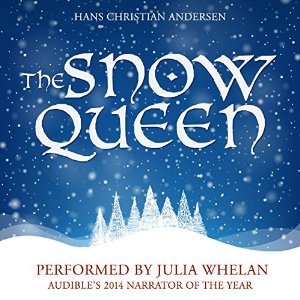
Book Review: The Snow Queen

Audible.com offers an end-of-year gift to its members in the way of a free short classic audiobook. Past offerings have been  A Christmas Carol,  The Wizard of Oz, and The Cricket on the Hearth: this past year it was The Snow Queen by Hans Christian Andersen (as of right now it is still free for members – don’t know how long it will be).

Snow QueenYou probably know that Frozen, Disney’s blockbuster movie last year, was supposedly based on The Snow Queen, but there is little resemblance besides a woman who “was beautiful but all made of ice: cold, blindingly glittering ice; and yet she was alive, for her eyes stared at Kai like two stars, but neither rest nor peace was to be found in her gaze,” an ice palace, and a talking reindeer (among other talking animals and even flowers) and some of the themes. All of the main characters’ names are different. But it is a pleasant story nonetheless, though maybe a little weird in places.

The tale is told in seven shorter stories. It begins with a troll (or sprite or hobgoblin or demon – different translations tell it a little differently) who made a mirror which causes those who look into it to see to see only the bad and nothing good or beautiful. In fact, the bad was magnified and the real distorted. After terrorizing everyone they could with the mirror, the fellow creatures of this being decided to take this mirror to heaven to “mock the angels,”  but in the process it fell and broke into millions of small pieces and splinters.

The next story tells of two childhood friend, Gerda and Kai (or Kay, depending again on which book you read), and their innocent play and love for each other, until one day Kai gets one of these splinters in his eye and heart, which changes him and makes him quite disagreeable. Then one day he sees the Snow Queen, mentioned already, whom Kai’s grandmother had told them of. He is frightened of her and draws back. But another day when all the boys are hooking their sledges up to carts and carriages to pull them, Kai ends up unknowingly fastening his to the Snow Queen’s vehicle. Too late he realizes who she is: she won’t stop, and she takes him to her palace far away. Her kiss numbs him and makes his heart grow colder.

Everyone in the village thinks he has died, but Gerda is convinced he has not, so she goes to look for him. Several more of the intervening stories tell of the people and creatures she meets along the way, some who help and some who hinder her.

There are vivid contrasts – light vs. darkness, warmth vs. coldness, innocence and purity vs. evil. In one segment it is said,

“I can give her no greater power than she has already”, said the woman; “Don’t you see how strong that is? How men and animals are obliged to serve her, and how well she has got through the world, barefooted as she is. She cannot receive any power from me greater than she now has, which consists in her own purity and innocence of heart. If she cannot herself obtain access to the Snow Queen, and remove the glass fragments from little Kai, we can do nothing to help her.”

I’ve wondered if the Snow Queen was inspiration for C. S. Lewis’s White Witch in Narnia. There are similarities, but the White Witch’s personality is much more developed – maybe because she spans several books whereas the Snow Queen is just in this one story – and she is more overtly evil. But the scene in which Edmund is taken into the White Witch’s sleigh and folded into her robes is very reminiscent of the Snow Queen doing the same with Kai.

There is also something of a religious element. I realized after reading this that I know very little about Andersen’s background, so I don’t know what he believed, but the children quote a fragment of a hymn which says, “Roses bloom and cease to be, But we shall the Christ-child see,” and later when Gerda is in trouble she prays the Lord’s Prayer, and angels come to help her. Near the end, “The grandmother sat in God’s bright sunshine, and she read aloud from the Bible, ‘Except ye become as little children, ye shall in no wise enter into the kingdom of God.’ And Kay and Gerda looked into each other’s eyes, and all at once understood the words of the old song, ‘Roses bloom and cease to be, But we shall the Christ-child see.'”

I found some of the intervening chapters, particularly one where Gerda is talking to flowers to see if they know anything about Kai, and they tell their stories, not only a little strange but also not really contributing much to the plot. But overall it is a sweet story of good triumphing over evil, of loyalty, of loving someone despite their flaws, of resilience when facing hardship and adversity. You can find the whole story online in various places with minor variations in the text (like the spelling of Kai/Kay’s name). Some day I’d like to read a nicely illustrated book version of the story.

(This will also be linked to Semicolon‘s Saturday Review of Books.)

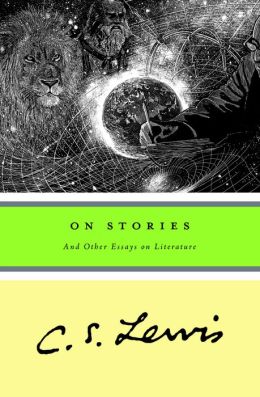
Book Review: On Stories and Other Essays on Literature

On StoriesSomeone recommended On Stories and Other Essays on Literature by C. S. Lewis some time last year. I asked for and received it for Christmas, but then set it aside when I entered a number of reading challenges for this year. But something in How to Read Slowly touched off a train of thought that reminded me of Lewis’s book, so I was happy to pick it up recently. Then realizing it could qualify for Carrie’s Narnia Reading Challenge for July made me push a little harder to try to get through it by the end of the month.

Nineteen of Lewis’s essays were compiled for this book by Walter Hooper, one of his biographers, his private secretary for a time, and eventually the literary executor of his estate. The last selection in the book is a transcript of a discussion recorded with Lewis and two colleagues. Many of the essays were previously published in magazines or in Lewis’s books: others had been unpublished until this book. Some are Lewis’s thoughts on fiction, science fiction, writing for children, etc., while others are critiques of other writers’ work (Dorothy L. Sayers, Rider Haggard, George Orwell, Tolkien, and others).

There is no way to really review a book like this, so I am just going to share some observations.

I hadn’t known and was fascinated to learn in Hooper’s mini-biography which introduces the book that in Lewis’s time “the most vocal of the literary critics were encouraging readers to find in literature almost everything, life’s monotony, social injustice, sympathy with the downtrodden poor, drudgery, cynicism, and distaste: everything except enjoyment. Step out of line and you were branded an ‘escapist'” (p ix). I’m glad Lewis not only stepped out of the box but succeeded and made it okay to enjoy stories as stories.

Lewis states many times in various essays that he did not write the Narnia series or his science fiction trilogy with morals or symbolism in view, as many people in his time and since have thought. They started with certain pictures in his mind (a faun carrying an umbrella) and developed from there. “Never…did he begin with a message or moral, but…these things pushed their own way in during the process of writing” (p. xv). He says in the transcript at the end, “The story itself should force its moral on you. You find out what the moral is by writing the story” (p. 145).

Reepicheep and Puddleglum the Marshwiggle were his favorite characters (p. xi).

He decried the kind of fiction where “the author has no expedient for keeping the story on the move except that of putting his hero into violent danger. In the hurry and scurry of his escapes the poetry of the basic idea is lost” (p. 10). Of course he had no problem with putting the hero in danger, as you know if you’ve read Narnia or the Space Trilogy: sometimes that’s a necessary part of the plot. But if that’s all the story is, it might be enjoyable to some, but there’s no deeper meaning.

He also believed that the “marvels in a good Story” should not be “mere arbitrary fictions stuck on to make the narrative more sensational” (p. 12). In other words, the story itself should be intrinsic to the “world” in the story. A story about pirates should  have a different feel and problems than a story about giants and dragons. The plot shouldn’t be such that it could be stuck into any setting.

He quotes Dorothy L. Sayers as saying, about the assumption that she wrote to “do good”: “My object was to tell that story to the best of my ability, within the medium at my disposal — in short, to make as good a work of art as I could. For a work of art that is not good and true in art is not good and true in any other respect” (p. 93).

When asked what he thought of a certain book, he replied, “I thought it was pretty good. I only read it once; mind you, a book’s no good to me until I’ve read it two or three times” (p. 146).

I found his thoughts on critiques and book reviews quite interesting in “On Criticism” and in his answering of some criticisms of his work in “On Science Fiction.” Then to see/read him “in action” critiquing other books was enlightening. He didn’t pull any punches, but he wasn’t mean or belittling, and he complimented and praised the good while sharing honestly what he thought was bad. He made a strong case for truly evaluating what was good and bad and not deeming a book bad just because one doesn’t like a particular genre.

He thought The Lord of the Rings would “soon take its place among the indispensables” (p. 90). He was right. 🙂

I didn’t look up every word I didn’t know in this book, but I should have, especially with a dictionary app at hand on my phone. I eventually started doing so partway through the book.

Though Lewis has such a wealth of knowledge, I found him very readable and not hard to follow for the most part. I’d love to have sat in on one of his classes.

And here are some of my favorite quotes:

“It might be expected that such a book would unfit us for the harshness of reality and send us back into our daily lives unsettled and discontent. I do not find that it does so….Story, paradoxically enough, strengthens our relish for real life. This excursion into the preposterous [speaking here of The Wind in the Willows] sends us back with renewed pleasure to the actual” (p. 14).

“No book is really worth reading at the age of ten which is not equally (and often far more) worth reading at the age of fifty – except, of course, books of information” (p. 14).

On the topic of frightening elements in children’s literature, he agreed that “we must not do anything likely to give the child those haunting, disabling, pathological fears against which ordinary courage is helpless,” but to withhold “the knowledge that he is born into a world of death, violence, wounds, adventure, heroism and cowardice, good and evil…would be to give children a false impression and feed them on escapism in the bad sense. There is something ludicrous in the idea of so educating a generation which is born to the Ogpu and the atomic bomb. Since it is so likely they will meet cruel enemies, let them at least have heard of brave knights and heroic courage. Otherwise you are making destiny not brighter but darker. Nor do most of us find that violence and bloodshed, in a story, produce haunting dread in the minds of children…Let there be wicked kings and beheadings, battles and dungeons, giants and dragons, and let villains be soundly killed at the end of the book…I think it possible that by confining your child to blameless stories of child life in which nothing at all alarming ever happens, you would fail to banish the terrors, and would succeed in banishing all that can ennoble them or make them endurable” (pp. 39-40) (emphasis mine).

On The Lord of the Rings: “Here are beauties which pierce like swords or burn like cold iron; this is a book that will break your heart” (p. 84).

“‘But why,’ some ask, ‘why, if you have a serious comment to make on the real life of men, must you do it by talking about a phantasmagoric never-never land of your own?’ Because, I take it, one of the main things the author wants to say is that the real life of men is that of mythical and heroic quality” (p. 89).

“The value of myth is that it takes all the things we know and restores to them the rich significance which has been hidden by the ‘veil of familiarity.’ The child enjoys his cold meat (otherwise dull to him) by pretending it is buffalo, just killed with his own bow and arrow. And the child is wise. The real meat comes back to him more savory for having been dipped in a story…If you are tired of the real landscape, look at it in a mirror. By putting bread, gold, horse,apple, or the very roads into a myth, we do not retreat from reality: we rediscover it. As long as the story lingers in our mind, the real things are more themselves. This book [LOTR] applies the treatment not only to bread and apple but to good and evil, to our endless perils, our anguish, and our joys. By dipping them in myth we see them more clearly” (p. 90).

I love that – that by seeing truth in stories we sometimes see it more clearly than we otherwise would have.

If you like Lewis or like literature, I highly recommend this book to you.

Chronicles of Narnia Reading Challenge

(This will also be linked to Semicolon‘s Saturday Review of Books.)

Book Review: The Last Battle

Last BattleThe Last Battle is the last book in the Narnia series by C. S. Lewis. It opens with a false Aslan: a confused donkey coerced to wear a lion skin by a conniving ape, who in turn is being controlled by others. In Aslan’s name, talking beasts are turned into slaves, dryads are dying because their trees are being cut down, Calormenes are overseers. Strange things are afoot, everything seems not quite right to everyone, but Aslan is not a tame lion, after all, so his ways will of course be a little different, and they think they must obey.

King Tirian sees at once that something is wrong, but he sets off rashly without thinking and winds up in trouble, He calls out for help, and Eustace and Jill show up. Together with the few Narnians who don’t believe in the false Aslan, they wage a last battle to save Narnia.

Even though the Narnia series is not an allegory per se, it’s still not hard to see the Biblical allusions to the end times and the antichrist. In Narnia as on Earth, things will get much, much worse before the end comes. And “Aslan’s country” has always typified heaven. All the beasts and creatures and people going “further up and further in” to Aslan’s country, the joyful reunions with those who have gone before, the sense that “this is what I have been seeking and waiting for my whole life” are the best parts of the books to me.

I think this time through the series, that is most what I have carried away with me: that longing, as in the song “Beulah Land”: “I’m kind of homesick for a country where I’ve never been before.” I have to admit that too often I am caught up with the joys and cares of this life. I look forward to having no more sin, sorrow, suffering, and tears some day, but I don’t always carry that personal longing just to be with Christ there, and this series as a whole stirs up that longing for Narnia and Aslan that all who visit experience while they’re away. It calls to mind Biblical texts like Hebrews 11:16: “But now they desire a better country, that is, an heavenly: wherefore God is not ashamed to be called their God: for he hath prepared for them a city,” and Colossians 3:1-2: “If ye then be risen with Christ, seek those things which are above, where Christ sitteth on the right hand of God. Set your affection on things above, not on things on the earth,” as well as Lewis’s own words from Mere Christianity: , “If I find in myself a desire which no experience in this world can satisfy, the most probable explanation is that I was made for another world…I must [therefore] keep alive in myself the desire for my true country, which I shall not find til after death.”

There is sadness for those who choose not to believe, such as the dwarves who are only for the dwarves and refuse to be “taken in.” As Aslan says, “They will not let us help them. They have chosen cunning instead of belief. Their prison is only in their own minds, yet they are in that prison, and so afraid of being taken in that they cannot be taken out.” Unfortunately there will be people like that as well.

There is a point of confusion with the Calormene Emeth, who served the Calormene god Tash, yet is admitted to Aslan’s country, not because Tash and Aslan are one, as some tried to proclaim (Aslan shook the earth with his growl at the very thought), but because Aslan took to himself everything Emeth had done for Tash. For, he says, “he and I are of such different kinds that no service which is vile can be done to me, and none which is not vile can be done to him. Therefore if any man swear by Tash and keep his oath for the oath’s sake, it is by me that he has truly sworn, though he knew it not, and it is I who reward him. And if any man do a cruelty in my name, then, though he says the name Aslan, it is Tash whom he serves and by Tash his deed is accepted…unless thy desire had been for me thou wouldst not have sought so long and so truly. For all find what they truly seek.” I don’t know how much of this reflects Lewis’s personal belief system, but I can’t endorse the idea that someone sincerely serving and seeking a false God is really serving the one true God unaware.

A couple of my favorite quotes:

“I have come home at last! This is my real country! I belong here. This is the land I have been looking for all my life, though I never knew it til now. The reason why we loved the old Narnia is that it sometimes looked a little like this.”

“Your father and mother and all of you are – as you used to call it in the Shadowlands – dead. The term is over: the holidays have begin. The dream is ended: this is the morning.”

It was only the beginning of the real story. All their life in this world and all their adventures in Narnia had only been the cover and title page: now, at last they were beginning Chapter One of the Great Story which no one on earth has read, which goes on forever.”

I have to thank Carrie for sponsoring the Chronicles of Narnia Reading Challenge, which spurred me on to revisit the series. I’ve so enjoyed being in Narnia again! I also marvel at how someone with an intellect as large and complex as Lewis’s can write something simple enough for children to understand yet engaging to adults, too, with such nobility and depth and beauty.

Here are my posts from the whole series:

The Lion, the Witch, and the Wardrobe
Prince Caspian
Voyage of the Dawn-Treader
The Silver Chair
The Horse and His Boy
The Magician’s Nephew
The Lion, the Witch, and the Wardrobe Graphic Novel.
The Way Into Narnia
Narnian Magic.

Chronicles of Narnia Reading Challenge

(This will also be linked to Semicolon‘s Saturday Review of Books.)

Book Review: The Incorrigible Children of Ashton Place, Book 2: The Hidden Gallery

Hidden GalleryAfter I listened to Book 1 in The Incorrigible Children series, The Mysterious Howling (linked to my thoughts), I had to get the audiobook for Book 2: The Hidden Gallery. The children are not called incorrigible because they are disobedient, but their benefactor, Lord Ashton, has given them that name after he found them in the woods, deduced they had been raised by wolves, and brought them home. His wife was less than pleased, but hired a star graduate from Swanburne Academy for Poor Bright Females, Penelope Lumley, age fifteen, to be their governess in the first book. Miss Lumley genuinely cares about the children and has brought them a long way, though they still have some howling inclinations and the tendency to drool at the sight of small birds.

The Hidden Gallery opens with workmen repairing the damage caused by the mayhem in Book 1. The noise and bother causes Lady Ashton to take the whole family to London while the work is being done. Penelope enjoys taking the children to see the sites, but they do have some mishaps, such as when the children mistake the furry hat of a stoic guard at Buckingham Palace for a bear.

The also have an odd encounter with a gypsy soothsayer with a mysterious prognostication and meet a new friend in young Mr. Simon Harley-Dickinson (he of the “perfectly nice young face, waves of brown hair, finely formed features, gleam of genius,” p. 154), and Penelope receives some strange warnings and instructions from her former teacher and mentor, Miss Mortimer.

Some mysteries just hinted at in the first book are expanded upon a bit here, such as the similarity in color between Penelope’s hair and the children’s, Lord Ashton’s somewhat wolfish behavior and absences during full moons, and the mural in the attic whose likeness appears in an art gallery, but we don’t seem to be close to finding answers for them nor the questions of what happened to the children’s parents nor Miss Lumley’s. I don’t know what the long term plans are for this series – I know Book 3 is out and Book 4 is due in December – but I’d rather have a short, really good series than have some of these questions dragged on for 8 or 10 books. But if the rest of the books are as fun as the first two, I don’t suppose people will complain too much, and it will be an enjoyable ride.

There are more pithy sayings from Swanburne Academy for Poor Bright Females’ founder, Agatha Swanburne, sprinkled throughout the book (such as “She who waits for the perfect moment to act will never make a turn at a busy intersection”) and apt descriptions (“If you have ever ridden on a tire swing after turning the rope ’round and ’round until it was twisted from top to bottom, you will have some idea of the wild, spinning, escalating whirl of Lady Contstance’s distress,” p. 5). Author Maryrose Wood also offers some amusing asides of instructions to her younger readers, such as the difference between high dudgeon and dungeon, or the meaning of some French phrases, and then refers back to these throughout the book.

Katherine Kellgren did another wonderful job narrating, and I enjoyed the book so much more by hearing her intonations. I did check the book out of the library as well to refer back to passages I heard in the audiobook.

The only real objectionable element was the soothsayer. She’s not a major character, but she appears three times in the book and speaks of a curse on the children. If I were reading this to children I’d feel the need to expound against soothsaying and fortune-telling.

With that caveat, I can recommend this as another fun, clever, witty, enjoyable book from Maryrose Wood.

(This will also be linked to Semicolon‘s Saturday Review of Books.)