Review: Yesterday’s Tides

Yesterday's Tides novel by Roseanna M. White

Roseanna M. White’s novel, Yesterday’s Tides, has two related story lines taking place in 1914 and 1942 on Ocracoke Island in North Carolina’s Outer Banks.

In 1914, Louisa Adair helps her mother and “Grann” run an inn. She’d like to go to teacher’s college, but there isn’t enough money. Plus, she’s needed at home.

Though Louisa has blue eyes, her skin coloring is darker than most people’s. Her mother will not tell her anything about her deceased father except that he was a good man. A few people are prejudiced against her, thinking she must be of mixed race.

When two college-age cousins, one from Maryland and one from England, come to the inn for the summer, Louisa has no idea how her life will change as a result. Louisa has no plans to fall in love: she keeps a polite reserve with the inn’s male guests. But she and Remington Culbreth, from England, find themselves in each other’s company often. Just after they do fall in love, WWI breaks out and Remington is called to service at home. Will their relationship survive not only the war, but the differences in their families and lifestyles?

In 1942, Evie Farrow now runs the inn with her grandmother. One day while taking some baked goods to the neighbors, a loud explosion is heard in the distant waters. While Evie’s Coast Guard friends prepare to investigate and help, Evie heads home to pray. When a badly burned Englishman washes up near the inn, somehow Evie knows not to report him. He says he is military, but he’s not in uniform. What mutterings she hears as he goes in and out of consciousness alert her to the fact that he is an intelligence officer. But what would an English spy be doing in Ocracoke?

When he wakes up, she learns his name is Sterling Bertrand and he is tracking a German operative. But it will take weeks for his wounds to heal. Meanwhile, he wonders just how far he can trust Evie, who seems to have secrets of her own.

I’ve read many dual timeline novels, and usually there are enough differences between the two timelines to keep from getting confused. I had a little harder time with this one, since both stories took place at an inn in Ocracoke and involved a visiting Englishman. I think I would have had an easier time with reading rather than listening. I didn’t catch some of the names that were the same in both timelines, so I kept getting surprised at the connections. I don’t think that would have happened if I were reading instead of listening.

As it happened, partway through the audiobook I discovered that I did have a Kindle copy! So I went back and forth between reading and listening.

One delight with this book was running into some characters from Roseanna’s previous books. I won’t say which ones, as that might give away parts of the plot. You don’t have to have read those books to understand this one, but it was a fun surprise to see those characters again. Evidently Remington was in an earlier book as well, but, though I remember the story and situation, I don’t remember him.

I’m sorry to say I was not thrilled with the audiobook narrator. Some of her accents seemed a little off to me. Plus she had an odd cadence, her inflection going up when it didn’t need to.

There are so many layers to this novel, and so much more to it than there appears to be at first. I loved the stories, and after finishing the book, I just wanted to sit with the characters a bit more before saying goodbye to them and starting another story.

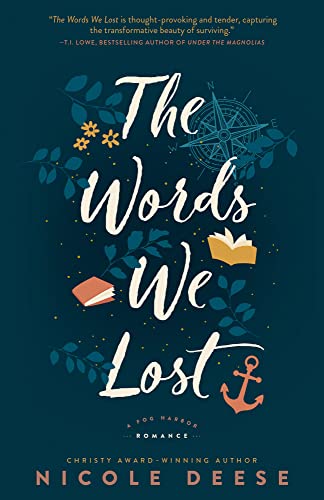
Review: The Words We Lost

The Word We Lost novel

In The Words We Lost by Nicole Deese, Ingrid Erikson moved to western Washington state with her father and became friends with cousins Cece and Joel Campbell when they were all teenagers.

Cece grew up to write a novel, which Ingrid, as an intern at a publishing house, sneaked to her editor. The editor loved the manuscript, bought it, and Cece’s series became runaway best-sellers.

But then Cece tragically died on the operating table during surgery to remove a brain tumor.

Besides losing Cece, Ingrid’s father died several years before. Ingrid blamed Joel and broke contact with him. So she lost all the people and the place she loved most and moved hundreds of miles away.

Ingrid is now a senior acquisitions editor, but she has a hard time functioning due to her grief. She relies heavily on her own intern, Chip. But her new boss can see she’s faltering.

Then Joel suddenly shows up unannounced. The family lawyer discovered a sealed letter addressed to him and Ingrid from Cece. She wanted them to come back home together to retrieve a package.

Ingrid’s boss gives her an ultimatum: find the rumored missing fourth manuscript to Cece’s series, or lose her job.

Ingrid isn’t sure she can go back to the area that she loves, but that brought her so much pain—and do so with Joel. But she doesn’t have a choice if she wants to keep her job.

I bought this book because I loved two of Nicole’s other books I had read. I got the audiobook at first, but the narrator just hit me wrong somehow. So I returned the book and got the Kindle version.

Then the first few pages held one of my pet peeves in writing. 🙂

But once we got past all that and I settled into the story, I loved it just as much as the others.

Some of the quotes I liked:

Success is a slow, long process of repetition (p. 90, Kindle version).

No heartache has ever gone unseen, and no darkness is ever too solid for light to overcome (p. 156).

God is often made visible by the hands and feet of the people He places in our lives (p. 177).

We can’t change the time we’ve spent, just how we choose to spend the time we have left (p. 228).

Even though there are still things to talk and sing and laugh about in this life, there are also things to miss and lament and grieve, too. Both are welcome and both are necessary (p. 367).

I enjoyed the depth of the characters and was pulled into their heartaches. The last few chapters unravel a bit of mystery. After the first few pages, I loved how the story developed and then concluded. I also loved the double meaning in the title. I’m happy to recommend this book to you.


Review: Dreams of Savannah

In Dreams of Savannah by Roseanna M. White, Cordelia Owens is a pampered Southern belle who loves to dream and write stories. She also loves Phineas Dunn, a lifelong friend newly recruited to the Confederate Navy, and promises to wait for him forever.

When she learns Phineas has been lost at sea, she weaves heroic tales for his mother and sister to help them keep up hope.

When Phineas was shot and fell overboard, he thought he was done for. But somehow he washes up on an island near Cuba. He’s rescued by a person he never imagined existed: an educated free black man from England. He has no way to let his family or his commanding officer know what has happened to him. All he can do is try to get well as fast as possible and get home. But his injuries are severe.

As the weeks drag by, a distant cousin of Cordelia’s comes to Savannah, assigned to the Confederate regiment there. Her parents are impressed by his manners, standing, and wealth. They like Phineas well enough, but his family’s credentials just don’t compare. They put pressure on Cordelia to turn her attention to her cousin. But even if she had not promised Phin she would wait forever, she would not have her cousin. There’s a predatory gleam in his eyes when her parents aren’t around.

When Phineas finally returns, he is still suffering from his injury. Worse, he has fallen in his own estimation. He wanted to be the hero of Cordelia’s stories. He doesn’t feel worthy of her, but he still vies for her hand. Her parents keep pushing her toward her cousin.

Both Cordelia and Phineas are from good families who are known to be kind to their slaves. Phineas’ father was, in fact, planning to free his slaves until doing so became illegal in Georgia.

But different experiences and people begin to change their perspectives. The question now is what to do. Is it enough just to be good to one’s slaves? Could they be mocked, scorned, or even arrested if their views on slavery changed? And how could their views change without changing their actions as well?

At the beginning of this book, Cordelia came across to me as young and somewhat silly (one of her fears for Phineas was that he might be attacked by a giant squid. . . ). I’m not sure how old she was, something hard to go back and find in an audiobook. Also, the Southern belle vibe came across a little too thick, replete with “fiddale-faddle” and “fiddel-dee-dee” (making me wonder for the first time why “fiddle’ was in so many expressions then).

But after I settled into the story, I began to enjoy it more. Cordelia is immature at the beginning. But the circumstances of the story cause her to grow. Even her story-telling matures over time.

It would be hard to write a book of changing viewpoints towards slavery and black people set in the 1861 South without attributing to the characters twenty-first century sensibilities. But Roseanna avoided that and had beliefs change and grow in the context of what was going on at the time.

A couple of my favorite quotes:

She certainly shouldn’t be refused happiness because of your convoluted ideas about your precious blood making her better than her mother . . . Because let me just tell you . . . your blood doesn’t have that power. There’s only one Man’s blood in all of history that can make us better than we are—and your are not Him.

She didn’t need to be a heroine in some fantastic tale of derring-do. That wasn’t what the Lord had given her. No, He’d given her words. Words to live by. Words to create with. Words that maybe, just maybe, could change the world beyond her house as surely as they had changed the one within.

I listened to the audiobook nicely narrated by Sarah Zimmerman.

So far, I have loved every book of Roseanna’s that I have read, including this one.

Review: In This Moment

In This Moment is the sequel to When the Day Comes by Gabrielle Meyer. Maggie is the youngest daughter of Libby from the first book. Like Libby, Maggie is a time crosser. But because both Maggie’s parents were time crossers, she has three paths instead of two.

One of her timelines is in Washington D.C. in 1861, where she goes by Margaret and is the daughter of a senator. The Civil War has begin, and after hearing of Confederate spies in the area, she keeps alert. She helps Clara Barton nurse wounded soldiers, but incognito, because such work would be frowned upon in society. Maggie wouldn’t care what people thought, but she has to think of her father’s reputation.

When Maggie goes to sleep in 1861, she wakes up in 1941. Her time crossing parents reside in Williamsburg, VA. Maggie is a nurse who joins the Navy along with her sister, Anna. But when they are asked to join a team on a hospital ship in Pearl Harbor, Maggie wrestles with what she knows will happen.

When Maggie goes to sleep in 1941, she wakes up in 2001 in D. C., where she is in medical school training to become a surgeon.

Though it takes Maggie 30 years to get through 10 normal years, no time is lost between her timelines. When she wakes up in one timeline, it’s the next day after the last time she was there.

Like her mother, Maggie will have to choose which timeline she wants to stay in by her twenty-first birthday. Then her body will die in the other two time periods.

Her mother knew all her life which timeline she wanted, though she had to wrestle with the fact that her preference might not be what God wanted. However, Maggie has no clear preference. She loves all of her timelines and her families. She has important work to do in each one. She’s frustrated that God seems silent on the matter.

Maggie has determined not to become romantically involved in any timeline before her twenty-first birthday because she doesn’t want the complication for her decision-making. But an attractive man becomes part of each of her lives.

Since Maggie is involved in medicine in all three lives, it’s hard not to let her twenty-first century medical knowledge impact her work in 1861 and 1941. If she knowingly tries to change history in any timeline, she’ll forfeit her life in that timeline early. She also struggles with the knowledge of what will happen in 1861 and 1941 and the desire to warn people. But no one in any of her timelines knows that disaster is looming in September 2001.

i loved this book just as much as the first one. I wondered how Gabrielle could write another book about time crossers without repeating some of the same scenarios in the first book. But though Maggie and her parents wrestled with some of the same things, their circumstances and challenges were very different.

I liked the fact that the 1861 and 2001 timelines both occurred in Washington, D. C., but with vast differences.

Happily, the audiobook this time included the author’s notes about what circumstances and people were real and which were made up. I always enjoy that information after finishing a historical fiction book.

There were just a couple of small things I disagreed with here—one character saying he had to learn to love himself before others could love him, and another who determines to “follow her heart.”

But overall, I loved this book. I kept looking for ways to sneak in a few minutes listening more than my usual times. There is at least one more book coming in this series, and I am looking forward to it.

Review: When the Day Comes

When the Day Comes by Gabrielle Meyer has an intriguing and unique premise for a novel.

Libby Conant is a time crosser. She lives in 1774 Williamsburg with her widowed mother and two sisters. She and her mother took over the printing of the Virginia Gazette after her father died, but they are barely making ends meet. Creditors threaten prison. Then the Conants are awarded the public printing contract from the House of Burgesses. They print Thomas Jefferson’s pamphlets as well as public notices. The Revolutionary War is about to break out, and tensions run high between rebels and loyalists.

Libby has loved Henry Montgomery since they were both children. She thinks he has feelings for her as well, but they move in different social circles. Plus he has secrets of his own. Whose side is he really on?

When Libby goes to sleep in Williamsburg, she wakes up as Anna Elisabeth Wells, only daughter to a prominent, wealthy family in 1914 New York. Her father’s fortune was self-made, which is not enough for her mother’s ambition for rank which values “old money.” Her mother has paraded Libby around for two seasons in New York, and now they are going to London to see what the titled male population is like there.

Libby does not want to marry, at least not before her twenty-first birthday. She enjoys working with the suffragette movement, which her mother disdains. Mother Wells is one of the most manipulative women ever and overrides Libby’s wishes and protests in her pursuit of the right suitor.

War is looming on this timeline as well, though no one knows it yet. Libby only knows because her mother in 1774 was a time crosser as well who lived in the twenty-first century.

When Libby goes to sleep in New York, she wakes up in Williamsburg again, with no loss of time in either place. Thus has it been since she was born and thus it will be until she turns twenty-one. Then she will have to choose which path she wants to live in permanently. Her body will die in the path she does not choose, but she will retain her memories of that time. If she tries to knowingly alter history in either path, she’ll forfeit her life in that path.

Libby is sure which path she will choose. She likes the conveniences of the Gilded Age in 1914, but she’s not interested in status and wealth. She’s needed in 1774 to help her family and the cause of freedom. And even if her love for Henry can never come to fruition, she wants to be where he is.

But unexpected circumstances may force her into a different choice.

This book came out last year, and I kept seeing it favorably mentioned among bloggers I follow. I still wasn’t quite sure I’d be interested, but I decided to give the audiobook a try. And . . . wow. This book was fascinating. The characters are well-drawn. It was fun seeing a few historical figures in the story. The plot kept a good pace, even with the intricacies of two timelines. I loved the eventual emphasis on the need to trust God rather than strive after our own way. I didn’t see the ending coming at all, but it was supremely satisfying.

As usual, the audiobook did not contain the author’s notes. I was curious about how she got and developed the idea for this book and found an interview with her about it here.

I enjoyed this book so much, I immediately started the sequel, In this Moment. Highly recommended.

Every Ocean Has a Shore

Every Ocean Has a Shore, a novel by Jamie Langston Turner, opens with a few people in a small diner in Chicago. Suddenly a young man with a gun comes in, locks the door, and starts barking orders.

Tragedy is averted, but everyone is shaken. The three adults in the main dining room don’t know it yet, but they are bonded together even after they go their separate ways.

The only customers in the diner at the time were an older woman, Alice, and a young boy. Alice had been estranged from her daughter for years before her daughter died. Alice just found out that her daughter left behind a young son, Ian, who had been cared or by his father. But now the father is dying, and someone finds Alice’s contact information. Alice flew from South Carolina to Chicago to pick up five-year-old Ian, who doesn’t speak. They’ve just stopped at the diner for lunch when the incident occurred.

Gary is the owner of the diner. He was always a quiet man, but became quieter still after his wife died. He’s intelligent, but it takes him a while to think through things. His loneliness and the crime in the city cause him to consider moving, but he doesn’t know where or what he would do with himself. He has a sister in Vermont who needs help fixing up her home. Maybe he’ll start there.

Fawna is the waitress, a college dropout with a birthmark on her cheek in the shape of Borneo and a penchant for saying weird things. She rents a room from a crotchety old woman named Mrs. Welborn and helps her out. Her parents died, leaving her with money to live on. She’s drifted around for the past eight or nine years, but thinks she might like to settle down somewhere. The problem is, she doesn’t know where to go or what she wants to do.

The point of view switches between these three as they go on with their lives but keep in touch. We learn some of their background and issues. Fawna discovers C. S. Lewis and begins to wonder if, as Lewis suggests, someone has been orchestrating all the events of their lives.

Fans of Jamie Langston Turner will welcome this, her first new book in nine years. A few characters from her earlier books make an appearance, particularly Eldeen, the larger-than-life older woman from Jamie’s first book, Suncatchers. But this is a stand-alone novel that can be enjoyed even if you haven’t read the previous books.

Jamie’s books are character-driven, not plot-driven. This isn’t an edge-of-your-seat kind of story. In fact, the story seems pretty slow in places. But as we learn more about each character and see how everything is woven together, we find great depth. I’ve seen many people who don’t normally like Christian fiction say that they like Jamie’s books.

The Shenandoah Road

In The Shenandoah Road: A Novel of the Great Awakening by Lynne Basham Tagawa, John Russell is a widower in need of a wife to mother his four-year-old daughter. Leaving his daughter in his sister’s care, John travels back to Boston, where his father lives, to do some trading and hopefully find a wife as well.

Abigail Williams is the daughter of a Boston merchant. Her father approaches her with a proposition. His bookkeeper’s son is looking for a woman to marry and accompany back to a settlement in Shenandoah. The two men are coming to dinner tonight. Would she think about the possibility?

The settlement in Shenandoah is smaller and much rougher than what Abigail is used to. But John Russell seems to be a kind man. She decides to marry him and go.

Abigail has dutifully kept the commandments all her life. But when John shares with her part of a sermon by George Whitfield, her heart is troubled. Is keeping the commandments not enough? How can she be sure she’s right with God?

As the Russells travel the long road back to the settlement by the Shenandoah River, they face dangers in roving buffalo, Indians, and a dangerous ruffian. Abigail wonders how she will adjust to life when she gets to John’s home. She feels her lack of knowledge about everyday housewifery. She wonders if John’s daughter will accept her. But most of all, she struggles to understand the words from Whitfield and the Bible that her husband shares with her.

I don’t know that I have ever read a novel from this time period, though I was familiar with Whitfield and Jonathan Edwards and such. It seems like every believer would have been thankful for the “Great Awakening.” But just like in our times, people had different opinions about the various proponents and points of doctrine. It was interesting to see some of that discussed.

I enjoyed the historical aspects of daily life, as well. Abigail loved botany, especially the medicine use of plants. It’s unfortunate that we’ve gotten away from such knowledge today.

I enjoyed getting to know John and Abigail as hey got to know and appreciate each other.

Still, I wasn’t swept into the story and characters as often happens with fiction. I can’t quite put my finger on why. But even though I wasn’t spellbound, the book is still a good one.

All That It Takes

All That It Takes is a sequel to All That Really Matters by Nicole Deese. Val Locklier had been Molly McKenzie’s virtual assistant in the first book. As Molly’s business expanded, she invited Val to move from Alaska to Spokane for a full-time job.

Moving was a big leap for Val. Not only was she extremely cautious by nature, but she had her ten-year-old son, Tucker, to think about. Leaving the support system of her parents was hard. But she felt it was time to spread her wings.

Molly settled Val in the upstairs apartment her brother rents out. He’s out of the country and left Molly in charge. He usually rents to single guys, but Molly doesn’t think he’ll mind renting to Val. They had met a few months before.

As Val settles in, an opportunity for an elite film mentorship unexpectedly opens up. Val wants to expand in that area, but all her insecurities arise to talk her out of taking a chance.

Molly’s brother, Miles, is unhappily on his way home from Mexico. He is the outreach pastor, but the new senior pastor has cut down on outreach and travel–while setting up things like a gourmet coffee bar. Miles grew up with Pastor Curtis, but never felt Curtis adequately filled his pastor-father’s shoes. People seemed so much more earnest in Mexico, focused on the right things. Disillusioned, he thinks maybe he’ll resign his position and seek an opportunity there. He calls his missionary father to keep an eye out for a position.

When Miles arrives home, he finds two surprises. Val and Tucker now live above him. And Pastor Curtis reassigned Miles to the family resource center, a side ministry that is on its last legs.

Miles feels like he is set up to fail, just marking time until Pastor Curtis closes this ministry as well. But he begins to clean things up, gets to know the one or two people still on staff, and learns about what the facility does. Val agrees to take pictures and help him spiff up the web site, but is unexpectedly pulled into the needs of a young woman who visits the center.

As Val and Miles become more attracted, Val is not sure whether her reservations are her old insecurities or a warning sign not to get involved. “Pastor Miles McKenzie was an adventurer by nature, a traveler of exotic places and an extroverted humanitarian who never seemed to sit still for longer than a minute. And while he’d been nothing but kind to Tucker and me during our brief encounters at the fundraising event we attended last fall and again during Molly and Silas’s wedding this March, I was certain that other than his sister, the two of us had little in common” (p. 12). Val is a single mom certainly not looking for adventure.

As Miles seeks his own will for his future, he finds that God might be leading a different way, and he just might have been wrong about a couple of things.

Some of the quotes that stood out to me:

Give me an essay to write anytime. Or a ten-page paper, for that matter, on any number of subjects that I could research and put into my own words. But don’t ask me to think on the spot. Don’t ask me to provide meaningful answers that determine my future without adequate time to prepare (p. 67, Kindle version).

Every story is original not because of the plot . . . but because each storyteller behind the pen or camera or canvas has an original perspective (p. 107).

You might not be able to make sense of God’s plan or timing, but I can promise you that He isn’t confused (p. 126).

In the midst of trials, it’s tempting to confuse release with relief. But make no mistake, they are not interchangeable. One is long-lasting, the other fleeting (p. 126).

Sometimes all that it takes is one person being willing to step out in love for the betterment of another to change the trajectory of an entire life (p. 270).

I’d much rather my life be defined by a thousand little moments of faithfulness than by one big moment of fame (p. 389).

When I started this book, at first I missed the “sparkle” of Molly’s personality from the previous book. She’s in this story, but as a side character. Val and Miles are quieter people. But as I got to know them, I really enjoyed their story.

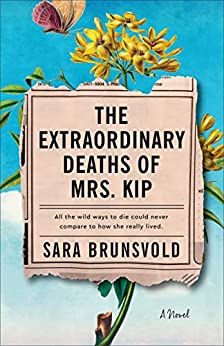
The Extraordinary Deaths of Mrs. Kip

In The Extraordinary Deaths of Mrs. Kip by Sara Brunsvold, Aidyn Kelley has been a cub reporter for the Kansas City Star for a year. But she feels more than ready for a real assignment, not the research she’s done for other reporters and the few light pieces she’s written. She was an award-winning student journalist at the University of Missouri, after all. So she sends a note to the managing editor, bypassing her supervising editor, laying out the reasons she is qualified and eager for meatier assignments.

Aidyn learns there is a reason not to bypass one’s supervisor. The managing editor wants to fire Aidyn, but her supervisor, Woods, advocates giving her a stern-talking to and low-level assignments until she learns humility and respect for the rules.

The first assignment is to interview and write an obituary for a dying septuagenarian, Mrs. Clara Kip. Aidyn dreads visiting the hospice center and talking to a dying woman. But if she wants to keep her job, she has no choice.

Aidyn finds more than she bargained for in Mrs. Kip. But Mrs. Kip isn’t going to unfold her story all at once. She wants Aidyn to make up some extraordinary deaths for her, and for every one, she’ll be allowed to ask Mrs. Kip three questions.

I don’t want to say too much more about the plot, because discovering Mrs. Kip’s personality and background along with Aidyn is half the pleasure of reading this book. I had thought, at first glance, that the story line would be pretty predictable. But the author throws in lots of surprises.

Alongside Aidyn’s journey, Mrs. Kip is dealing with the fact that she is dying, having to accept the weakening of her body and her confinement to the hospice center. Even so, she feels God has a couple more things He wants her to do before she runs out of steam.

Some of the quotes that stood out to me:

She could only trust that the Lord was up to something. Because he usually was (p. 2).

Clara gazed at the sliding glass doors of Sacred Promise. Such an odd feeling to know that once she walked in, she would not walk out. She clung to the belief the Lord had something for her here, so she shuffled forward. (p. 12.).

“I did nothing amazing, Miss Kelley,” she insisted. “Despite what you’ve been told. I simply tried to love people as best I could for as long as I was privileged to be with them. We don’t stay long in each other’s lives—that’s the crux of our humanness. You have to be the friend people need while they are there with you, because it’s the only chance you’ll get.” (p. 198).

The Lord will give you all the words you need. It’s not about whether they sound pretty. It’s about what he will do with them (p. 200).

This was a touching and encouraging story in many ways.I enjoyed both Aidyn’s and Mrs. Kip’s journeys.

Circle of Spies

Circle of Spies is the third of Roseanna M. White’s Culper Spy Ring, a real life spy ring active during the Revolutionary War (Ring of Secrets was the first and Whispers from the Shadows was second). Although we don’t know that the ring continued, Roseanna said in the last book that someone in the CIA said it was possible. So Roseanna imagined how the spy ring could have worked during the War of 1812 in the second book, and now in the Civil War.

Marietta Hughes is an unlikely heroine at first. She has lived mostly for her own will and pleasure, not walking with the God of her parents. She married Lucien Hughes, wealthy president of a railroad company. But Lucien had been killed. Marietta had an understanding with his brother, Devereaux, that they would marry as soon as was proper after her period of mourning.

But then Marietta’s grandfather, Thaddeus Lane, informs her that the Hughes family is not staunchly Unionist, as they proclaim. Not only are they Confederate, but Devereaux is the head of a secret fifth column bent on killing Lincoln and seizing power.

As if that wasn’t enough to turn Marietta’s world upside down, Lane tells her that their family has been involved as a ring of spies since the Revolutionary War. Then he tells her that a Pinkerton man, Slade Osborne, is on his way to infiltrate the secret society to try to find proof that will lead to their arrests. Marietta’s job is to distract Devereaux as much as possible to facilitate Osborne’s investigation.

Thus begins a game of cat-and-mouse. Osborne is not altogether certain he can trust Marietta at first. Marietta is revolted at what she has learned about the Hughes family, but must keep pretending she is in love with Devereaux.

I ached with Marietta as she came to face what she had become and wondered if God could forgive her. Sometimes the realization of the magnitude of one’s sin breaks open to them more fully after they believe. Osborne, too, has a broken background, as well as complications from a twin brother whose values were the opposite of his.

By the end of this book, I wanted to put everything else aside to keep reading what happened. There were some quite exciting twists and turns!

I did disagree with one point, though, when a character says that God doesn’t speak for or against slavery. He does: I wrote once about the Bible and Slavery. But I did like what the character had to say about trying to reconcile the views of different Christians on the issue: “At last we realized we didn’t have to, because God so very rarely tells us what society should do—rather, He tells us how we, as believers, should behave in whatever society to which we belong” (p. 226).

In-between this book and the previous one was a little novella titled A Hero’s Promise. Julienne Lane has been helping a friend, Freeda, hide runaway slaves and get them to safety. Julienne is unsure whether to let her fiance, Jack Arnaud, in on the situation.

Meanwhile, Jack has postponed their wedding twice already but might have to do so again. A mentally unbalanced man is being set up by enemies to assassinate President Jackson, and the Culpers must intervene.

The assassination attempt was based on a true event.

I enjoyed these forays in early American history and spycraft. But even more, I enjoyed the journeys of faith Roseanna takes her characters through.