Review: The Wings of Poppy Pendleton

In The Wings of Poppy Pendleton, a novel by Melanie Dobson, the newly rich Pendleton family is trying to find a place among the top Gilded Age society families. Mr. Pendleton had built a stunning castle on Koster Island among New York’s Thousand Islands, and the family is hosting a fete for elite guests. Their almost five-year-old daughter, Poppy, is sleeping in the castle’s tower, supposedly under the care of one of the maids, while the guests party.

But in the morning, Poppy is missing and Mr. Pendleton is dead.

Police, detectives, and curious seekers investigate for years, trying to determine what happened. But Poppy’s disappearance remains a mystery.

In 1992, Chloe Ridell is the only resident on Koster Island. Her grandfather, Cade, had been the caretaker of the castle and island in the Pendleton’s time and decades afterward. Mrs. Pendleton willed the property to Cade, who then passed it along to Chloe.

Chloe is uninterested in the castle and has never been in it. She runs a candy store started by her grandparents, and she just wants to maintain their legacy. But her funds are running low.

Then one stormy night, a young girl shows up on Chloe’s porch. Her name is Emma, but she refuses to say much else about who she is or why she is there. She’s frightened, though, especially of a man named Mitch. Chloe feels led to let Emma stay while her situation is investigated by the police. Eventually, Emma lets Chloe see her scrapbook, which is filled with drawings, magazine cutouts, and descriptions of birds. On the last page is a picture from a news article about the magnificent aviary Mrs. Pendelton’s husband had constructed at her request and filled with dozens of birds and their native trees. The aviary burned down decades ago. But Chloe wonders at the oddity of Emma’s connection to the Pendletons.

Then another visitor shows up out of the blue. A reporter, Logan, arrives in Chloe’s candy shop. Poppy Pendleton’s ninetieth birthday is coming soon. Logan thought it would be a good time to look into her case again. Chloe has no interest. But Logan convinces her that solving the mystery will not only bring justice for Poppy, but it will stop the curious from tramping around her island and asking her questions.

The point of view switches between characters and timelines to uncover what happened to Poppy, her mother, and Emma.

So far I have loved all of Melanie’s novels, and this is no exception. She explores some darker themes than usual. But, sadly, the issues in the story are all too real.

I felt the faith element was woven in naturally and not at all preachy or stilted.

I listened to the audiobook nicely read by Nancy Peterson. Many audiobooks don’t include the author’s afterword or notes, but this one did. Plus Melanie tells a little bit about her research for the novel, with pictures from a trip to the Thousand Islands and its castles, here.

Review: As Dawn Breaks

As Dawn Breaks

In Kate Breslin’s novel, As Dawn Breaks, Rosalind Graham works in a Chilwell munitions factory in England in 1918. Her parents had passed away long ago, and her uncle took Rosalind and her two brothers in. But the arrangement was far from cozy. Rosalind’s uncle is forcing her to marry a ruthless man she doesn’t love.

Shortly before the wedding, Rose’s best friend from the factory, Tilly, sends her to her apartment to get ready for a bridal shower. But while Rose is away, the factory blows up, killing hundreds, including Tilly.

Stunned and devastated, Rose eventually realizes the explosion offers her a way out of her dilemma. She can take on Tilly’s identity and leave, and everyone will think Rose died in the explosion. Though she hates to make her brothers think she’s dead, it’s the only way she can see to help herself and them. She plans to find a job in another town and then retrieve her brothers when she has saved enough money.

Rose/Tilly ends up in another munitions factory in Gretna, Scotland. She’s put in charge of a group, and one of the young women says her family will let her rent a room. She revels in a warm, caring, normal family life.

RAF Captain Alex Baird heads for home in Gretna on an undercover mission. Sources indicate the Gretna factory might be next for the saboteur. Alex is charged with working in the factory to find clues as to what might happen and who might be involved.

Alex is stunned to find a woman, Rose, who he knows as Tilly, renting his bedroom. He didn’t know his father was unable to work and needed to make money by renting out his room. Rose and Alex don’t get on well at first, but eventually they form a bond over their love for his family.

Then Alex receives word to surveil Tilly, who is suspected of having some connection in the Chilwell bombing. Rose knows nothing of Tilly’s involvement and wonders at Alex’s sudden interest in everything she does.

Meanwhile, Alex has secrets of his own that not even his parents know.

I didn’t know, when I read Kate Breslin’s Far Side of the Sea a couple of months ago, that it was the third of a five-part series. As Dawn Breaks is the fourth and has been in my Kindle app for a couple of years now. Each of the books is understandable alone, but it’s fun to follow some of the characters through the series.

I enjoyed the characters, and there was plenty of suspense in wondering what Tilly had been involved in, whether Rose would be blamed, whether the saboteur would be found in time, and other plot lines. I thought one of the threads was wrapped up a little too easily, but overall I enjoyed the book very much.

Review and Giveaway: Chasing Shadows

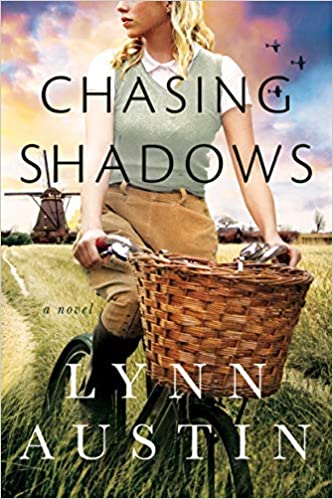
Chasing Shadows by Lynn Austin

In Chasing Shadows, a novel by Lynn Austin, people of the Netherlands thought they would be safe during WW2 because their country was neutral. But the Nazis invaded and took over anyway.

Lena de Vries is a farmer’s wife with a son and two daughters. She loves her life, though she has frequent arguments with her daughter, Ans.

Ans doesn’t care for farm life and doesn’t embrace her family’s faith. When she has an opportunity to move to Leiden, she takes it. She’s offered a job as a companion to a woman named Eloise with “melancholia”–her symptoms sound like what we would call bipolar disorder today. Eloise is depressed by her losses during WW1. When the Nazis invade, she’s in danger of sinking further. Ans starts helping in small, but ever-increasing ways with the Resistance. When Eloise finds ways she can help, too, she’s energized.

Ans had begun dating a Dutch policeman, Erik. The Nazis took over the police force, but Erik thought the best way to cope was just to get along with them. But they increasingly require more and more, and he and Ans differ about where they should draw the line.

Jewess Miriam Jacobs fled Germany with her father, who procured a teaching position in Leiden. They planned to send for Miriam’s mother later. But when the Nazis came, there was nowhere to escape. The coastline and borders were monitored. Some Jews who had escaped to other countries were turned away. One by one, the Nazis followed the same procedures as they had in Germany: limiting Jewish activity, requiring yellow stars on their clothing, eliminating their positions. When word came that Jews were being deported to settlement camps, Miriam and her father know they have to hide.

Meanwhile, Lena has to learn to let go—first of Ans when she leaves, then her husband Pieter when he trains for fighting, then her teenage son when the Nazis scoop up young men to build trenches and such. She and her husband hide both Jews and Dutch police who went underground rather than work for the Nazis. Though their food supply continues to dwindle, Lena can’t turn away the hungry that come to her farm.

I loved that this book didn’t cover just one thread–the Jewish persecution or the dangers of being in the Resistance or strains on the homefront—but dealt with facets of all of them. It was fully orbed, covering how the war affected and caused suffering for everyone. For instance, when the queen, in exile, orders railroad workers to strike, deportations of the Jews cease and Nazi supplies are stopped–but so are everyone else’s. There was widespread starving, especially in cities. People who had homes chopped up furniture to burn to keep warm, and animals of any kind (including cats and horses) weren’t safe from being caught and eaten.

Plus the three main characters are at different stages in life and at different levels in their faith. And each has to make nearly impossible choices.

I was so attached to these characters that I was sad to let them go when the story was over.

As it happens, I somehow ended up with two copies of this book. I think I bought it on sale but maybe forgot I had already received it for my birthday. Then the audiobook (nicely read by Stina Nielsen) came up free in the Audible “Plus” catalog, and I figured I’d get to it sooner via audio. But I still liked having the print books to refer to certain passages and read the book’s back material.

So I’d like to offer these two paperback books to a couple of my readers. I’m sorry I’ll have to restrict the giveaway to continental US addresses due to postage prices. If you’d like to enter a drawing for a copy of this book, leave a comment on this post. I’ll count all the comments on this post as entries unless you tell me you’d rather not be in the drawing. I’ll draw two names one week from today and contact the winners via email. If I can’t reach you or don’t hear back from you within a couple of days after that, I’ll draw another name.

I wish I could give you all a copy!

The giveaway is closed. Congratulations to Kitty and Sarah!

Review: Aftermath

Aftermath, a suspense novel by Terri Blackstock

Terri Blackstock’s novel, Aftermath, opens with three young women at their favorite band’s concert. As the Libertarian political candidate the band was opening for came to the podium, an explosion rocked the stage area. Only one of the girls, Taylor, makes it out alive.

Just minutes after the explosion, policemen pull aside Dustin Webb’s car. They ask to search his trunk, and, having nothing to hide, he agrees. He’s shocked to see plastics for explosives in his trunk. He insists he doesn’t know how they got there and he didn’t put them there. The officers don’t believe him. They got an anonymous tip that he was the bomber, he worked with bombs in the Army, and his security company had a client which had explosives stolen from them. Everything adds up to Dustin being involved in the bombing.

Desperate, Dustin calls a friend from his past, Jamie Powell. She was the only person who believed in him when she lived next door. Perhaps she’ll believe in him now. They haven’t spoken since he went into the Army, but she’s a lawyer now, and he needs a good one.

Jamie drops everything to help Dustin. She has to fight for the right to represent him with the partners of her firm, who fear the repercussions of defending a suspected terrorist.

Meanwhile, Taylor’s fragile recovery from OCD is threatened by the tragedy she underwent. Despite seeing her psychiatrist, starting a new medicine, and being watched over by her sister, Taylor’s grief and guilt over not staying behind to help her friends escalates her symptoms. She feels the only way she can set things right is to find who did this.

I don’t often read suspense novels, but Terri is a master of them. This one had me on the edge of my seat, yet every character drew my sympathy. The faith element is clear and natural and not heavy-handed. If you like suspense—and even if you don’t—I think you would enjoy this book.

Review: What She Left for Me

In Tracie Peterson’s novel, What She Left for Me, Jana McGuire is a pastor’s wife who just returned home to Spokane from a three-week missions trip to Africa. Puzzled that no one was at the airport to meet her, she hails a cab and arrives at home to a note on the table. Her husband wrote that he left her for his church secretary and wanted a divorce. Jana saw that he also took anything of value in the house, including her jewelry. At the bank the next day, Jana discovers her savings and checking accounts have been cleaned out, leaving her only $10.

Jana’s husband, Rob, told the deacon board at church two weeks previously that he was resigning because Jana wanted out of the marriage. The church searched for an interim pastor and found one, who was moving into the parsonage that weekend. Therefore Jana needed to move out of her home immediately. When Jana explained her circumstances, the men were more sympathetic. But by that time, the interim pastor was still coming, and Jana still needed to leave.

With no home or money, and finding out she is pregnant, Jana has only one choice. She has to call her mother, with whom she was not close: the mother who kept her at arm’s length all her life, wished she was a boy, sent her to boarding schools, and said she wished she had aborted Jana.

Jana’s mother, Eleanor, had moved to Montana to stay with her octogenarian Aunt Taffy. Eleanor doesn’t want Jana to come, but Taffy is thrilled.

As expected, arguments erupt between Jana and her mother frequently while Taffy tries to be a peacemaker. Jana questions her mother about her upbringing in an effort to understand her better, but her mother shuts down any discussion of her past.

Yet Jana’s presence cause Eleanor’s painful memories to resurface, told to the reader in flashbacks. Eleanor had coped by shutting down all past memories and refusing to be vulnerable or close to anyone.

And Jana, in her pain and bitterness, is beginning to follow in her mother’s footsteps.

Tracie includes a note at the beginning of her book forewarning readers that the book will deal with adultery and child abuse. Tracie avoids graphic details, but she wanted to write the book because, at that time (2005), one in four girls were molested before the age of eighteen. She wanted to help readers understand what people in these circumstances go through and encourage reaching out and offering love and help.

I felt Tracie achieved her goal. But I felt she could have done so a little more efficiently. There’s a lot of repetition of certain points in the book. It’s understandable that in real life, people will bring up the same points while arguing, or people processing situations will cover the same ground repeatedly. But fiction is usually a little more streamlined and progresses more logically from point to point.

Plus, a plot device of someone walking in unheard at a vital point in a conversation was used more than once, when once was enough.

But overall, I felt the book did a good job showing what people in Eleanor’s and Jana’s circumstances go through and answering common questions and feelings, like “What did I do wrong to deserve this?” and “Why didn’t God stop this from happening?” Though the subject matter is difficult, it’s also far too common. I applaud Tracy for writing about it.

Review: Far Side of the Sea

In Far Side of the Sea by Kate Breslin, Lieutenant Colin Mabry had been on the front in WWI. After recovering from a serious accident and the loss of his hand, he’s assigned to MI8, decoding messages sent by carrier pigeon. He’s troubled by the sounds of battle he hears across the channel as well as any loud, sudden noises.

One day he finds a carrier message to himself from a woman he thought dead, Jewel Reyer. She had taken him in, at great risk and cost to herself, when he was injured in France. He had promised to return for her. But then he had his accident and recovery, and afterward heard her entire village had been attacked with no survivors.

He obtains permission to travel to France. He is stunned to find that the message was sent not by Jewel, but by her half-sister Johanna, who works with doves for the French Army Intelligence. Johanna found Jewel’s diary, where she mentioned Colin. Johanna has reason to think her sister is alive and in the custody of a German agent who had been in charge of her village. Johanna wants Colin to help her find Jewel.

Colin is angry at the deception and wary of Johanna. But if there is a chance Jewel is alive and needs his help, he must look for her. He owes her that. Plus, the two were just beginning to develop feelings for each other, and he must know if she still feels the same way.

So he sets aside his anger at Johanna, and they travel to Jewel’s last known location with more questions than answers.

But they find themselves in danger, not knowing whom to trust.

This is the first book I’ve ever read by Kate Breslin, and it definitely reeled me in after the first few chapters. Johanna has several secrets she has not shared with Colin, and bits of her story and background are revealed through the book, as well as her reasons for not sharing all. It takes a while to decide whether she is trustworthy and someone we should be pulling for.

Then they meet an array of iffy characters and situations and face multiple twists and turns.

The story also deals with Colin and Johanna’s inner issues as well. Colin not only suffers from what we now know as PTSD, but he’s lost confidence in himself. Johanna had a checkered upbringing and struggled to find a place to belong or believe that there was a God who was interested in her.

I didn’t know at first that this book was a sequel to another, Not By Sight. Far Side of the Sea read well on its own, but I might like to go back and read the first book some time if I catch it on sale.

I enjoyed the author’s notes at the end, where she tells more about carrier pigeons used in war and what details and people were real or made up.

I’d had the Kindle version of this book for a while, but recently saw the audiobook was among Audible’s free titles. It was nice to switch back and forth between reading or listening, depending on my circumstances.

As I said, this was the first of Kare Breslin’s books I’ve read, but it won’t be the last.

Laudable Linkage

Laudable Linkage

I found a lot of good reading this week:

A Comforting Resource for People Who Have Lost Parents. My friend, Lois, lost both parents within five weeks of each other a few year ago. Some of her blog posts since then have been about processing their loss and working through grief. She found a lot of resources for losing a child or a spouse, but not much on losing parents. That seemed to be treated as just a normal part of life. Though the death of one’s parents is inevitable, grief still runs deep. Lois has just pulled these posts together in one resource page. She tells about it and links to the Help for Parent Loss page there.

How Can I Cultivate a Listening Life in a Noisy World? “Do we demonstrate through our choices that we truly believe that we NEED God’s Word? Are we still ‘the people of the Book?'”

Can a Christian Have Mental Illness? HT to Challies. “Some Christians believe that Christians cannot have mental illness. If a professing Christian is depressed, anxious, or bipolar, they think it’s because they are not a real Christian, or that there is some terrible sin they haven’t repented of, or that they need to repent of the depression or whatever the problem is. Nearly half (48 percent) of evangelicals believe that serious mental illness can be overcome with prayer and Bible study alone. The result of this condemnation of mental illness as sin is that many Christians do not admit they have a mental illness, they don’t talk about it, and they don’t reach out for help.”

We Need Every Word, HT to Challies. “I want to feast on the Bible passages I love, the ones that make me feel some note of pleasure or comfort. I want the reminders that I’m loved, the encouragements to hold fast, and the songs of praise that remind me of God’s faithfulness. I don’t always want the lists or the history or the stories that don’t seem to affect me.”

Why We Are Tempted not to Pray, HT to Challies. “Prayer should stupefy us. ‘You mean, this all-powerful God who keeps galaxies spinning is interested in you telling him about your day and might alter the course of the entire cosmos because you asked him if you could have a parking space?’”

Being Involved in Church as a Teen, HT to Challies. “But being born into a church as a baby, and then growing up through Sunday school and youth group, can often make it hard to be taken seriously. Even older Christians with the best intentions can miss the mark. It can feel a bit awkward when they ask you the same questions every time they see you in church. It takes time and effort from both sides to help and encourage one another, and ultimately, have more meaningful relationships.”

Is the Lord’s Day the Christian Sabbath? HT to Challies. “At the outset, I need to say that this issue is one that I think Christians should not divide over. The view I present below is not the one I grew up with, but I have no particular ambition to convert people to my view — except that, with regard to those who have the duty to teach God’s word, it is important to do so properly, ‘rightly handling the word of truth’, preaching the full counsel of God with all His authority, but never giving human ideas that same authority.”

The Ritual of Rearranging Books, HT to Linda. “Taking all the books down was a chance to organize and cull, but primarily, it was an experience in simply remembering what was there, how it got there, and why. You can look at shelved books until the cows come home, but it’s not the same as actually taking them off the shelves.”

Seeing the Light on Religious Fiction, HT to Linda. “As I complete my 40th year working with books, I’ve changed my mind about an entire publishing genre that I once held at arm’s length at best, and treated with something akin to critical dismissal at worst. I feel like the proverbial old dog who has suddenly learned a new trick. The genre? Religious fiction.” I especially loved this one!

Routine leads to devotion, especially in Bible study.

The quote here is from “Just Not Feeling It”: How Routine Awakens Devotion.

Review: Bleak Landing

Bleak Landing

In Terrie Todd’s novel, Bleak Landing, Bridget O’Sulliovan’s family had come to the small town of Bleak Landing in Canada from Ireland when she was seven. But her mother and brother died on the voyage. Her father took to drinking, gambling, and beating Bridget, making sure she knew he wished she had been the one to die.

Bridget didn’t fare much better at school. Her fiery red hair, Irish accent, rundown home, and drunken father all made her a target for bullying. Her two worst enemies were Victor Harrison and Bruce Nilsen, who locked her in the school outhouse one day. She vowed then that she’d leave Bleak Landing the first chance she got.

Her resolve was strengthened when she learned that one of her father’s gambling debts involved her.

Leave she did when she was fifteen, finding a job in a textile mill, then in a mansion as a cook’s helper, rising up the ranks to lady’s maid.

She becomes best friends with Maxine, a chatty girl she met at the mill. Maxine and her family are Christians. Bridget thinks they are nice and appreciates their hospitality, but doesn’t feel God has done her any favors.

Several years later, Bridget learns in a roundabout way that her father died and there’s some dispute about his property. At first she doesn’t care. She doesn’t want to see Bleak Landing again, and the property wasn’t much to speak of anyway. But when she loses her job and apartment during the Depression, her father’s property is the only thing in the world she owns besides the clothes she wore.

When she gets back to Bleak Landing, though, no one recognizes her except Victor. She looks much different and doesn’t have any identification.

Victor, during all these years, fought during WWI, was injured, came home, and trained to be a pastor. He regretted the way he treated Bridget when they were kids, but had no way to make amends to her. But will she forgive him and let him help her?

Bridget’s story was heart-breaking at first. She rises above her circumstances, but she doesn’t let anyone in and doesn’t share anything about her past with anyone. It’s a wonder, humanly speaking, that Maxine put up with her negativity, especially not knowing what caused it.. But eventually Bridget’s heart softens as she realizes she might need more than spunk to get through life.

I wouldn’t agree with every little theological point made, and I am not a fan of ecumenism between gospel-preaching and works-based churches.

But otherwise, I loved the characters and story.

Review: A Beautiful Disguise

A Beautiful Disguise by Roseanna M. White

In A Beautiful Disguise, a novel by Roseanna M. White, siblings Yates and Marigold Fairfax had an idyllic childhood in Edwardian England. Their father loved entertainment and spent lavish money on it, even buying a circus. They grew up playing with the animals, learning the trapeze, loving the performers like family.

The Fairfaxes didn’t know, until their father’s death when they were young adults, that all the entertainment came at a steep price. They weren’t in debt, but there was no money. They needed not only to take care of themselves and the family estate, but the circus performers who depended on them.

They decided to use their skills to start an investigations company: The Imposters, LTD. They’d maintain their positions as Lord and Lady Fairfax in 1908 British society, not so much because they cared about position, but because that’s the world they knew and moved in and where their clientele would come from. Marigold remade many of her mother’s beautiful old gowns into outlandish costumes with ostrich plumes and wide hat brims so that people would notice her persona, not her. Her friend, Gemma, alias newspaper columnist G. M. Parker, played up Marigold’s “Lady M” by reporting on her lavish clothing. It worked so well that Gemma could sometimes pose as Marigold because people usually looked at her outfits, not her face.

Sir Merritt Livingstone was a faithful soldier for ten years. But a severe bout of pneumonia took ages to recover from. He’s still not at full steam, so he’s been given a desk job in the War Office Intelligence Division. One of his agents has not been heard from in an unusual amount of time. His most recent coded telegram simply contained the name of Merritt’s boss, Lord Henning. Merritt doesn’t want to believe anything ill of Henning, but he has to discreetly find out what’s going on.

Sounds like a job for the Imposters.

When Merritt meets the intriguing Lady M. at a ball, he has no idea she’s half the team looking into his request.

At first it might sound odd for a titled family to own a circus. The Fairfaxes family home was in Northumberland while they spent “the season” in London, so much of society didn’t know they had a lion in their back yard and a high wire set-up in their gym. But the circus situation worked into the story believably and smoothly. In fact, it was fun and different. Yates’ and Marigold’s acrobatic training came in handy climbing window ledges to eavesdrop, and their stage makeup allowed them to disguise themselves.

The characters and plot are well-drawn and compelling. The faith element is woven in naturally.

I listened to the audiobook wonderfully read by Susan Lyons. I missed the author’s notes at the end, which I wished audiobooks included. But I did see this blog post where Roseanna introduced the series and this interview, in which she shares some of her inspiration.

I thoroughly enjoyed this book and can’t wait for the sequel.

Review: A Fool and His Monet

A Fool and His Monet

In the novel A Fool and His Monet by Sandra Orchard, Serena Jones is a new member of the FBI Art Crime Team. She was motivated by the death of her grandfather during an art theft and hopes her new position will help her find his killer.

Serena’s friend, Zoe, the temporary head of security at the local art museum, brings Serena in to report the theft of two paintings in storage, a Monet and a Rijckaert. Since the paintings were in storage, the theft had not been noticed immediately. So the case was already somewhat cold. But Serena immediately begins interviewing museum employees. Her trainer, Tanner, joins her on the case. Oddly, her supervisor makes her stop investigating her lead suspect.

Serena’s mother pesters her to get a nice, safe, normal job and give her grandchildren. Her aunt fancies herself an amateur sleuth and offers Serena advice. The aunt even inserts herself into some of Serena’s investigation.

Though the book has some serious and touching moments, it’s somewhat a comedy of errors. But the case eventually gets solved with many twists and detours along the way.

I enjoyed several art-related details sprinkled throughout the book, especially one quote from Stella Adler: “Life beats down and crushes the soul and art reminds you that you have one.”

There’s a light faith element: a few mentions of God and prayer.

This isn’t my usual genre of book. But that’s one nice thing about Kindle sales: trying something you might not have otherwise.

I admit I got a little lost on some of the details. And I wasn’t fond of Serena’s aunt’s involvement. But overall this was a fun book. If you like figuring out mysteries with comedic undertones, you might like this one.