Book Review: Hidden Among the Stars

In Austria in 1938, Annika Knopf is the daughter of the caretaker of the Dornbach family’s castle in Hallstatt. She and the Dornbach’s only son, Max, have been friends since childhood. But now they are grown, and she has quietly loved him for a long time.

When Annika discovers Max is hiding treasures of their Jewish friends on the estate grounds, she wants to help. Max wants to protect her as much as possible, but the time comes when he must accept her offer.

Max has never seen Annika as anything but a good friend. He’s in love with Luzia Weiss, a beautiful and brilliant violinist with the local orchestra. The Dornbach and Weiss families have been friends for years. But as Hitler’s forces advance, it’s not healthy to associate with Jews like the Weiss family. Max loves Luzia still and looks for ways to avoid fighting for the Reich and to get Luzia and her family out of Austria before it’s too late. In the meantime, he brings Luzia to the family’s lake castle to hide and asks Annika to watch over Luzia.

In modern times, Callie Randall runs a book store with her sister. Her tumultuous early life, with rejection from both parents and and betrayal by her fiance, has turned her naturally introverted character into someone who enjoys hiding out and is afraid of . . . almost everything except her job and shop.

Callie’s sister gifts her an early edition copy of Bambi, and Callie finds within its pages a list of items in the same script as the book’s font. The name written in the front is Annika Knopf. Callie begins an Internet search, hoping to reunite the book with Annika or someone in her family. But Callie discovers Annika’s story may intersect with Charlotte, the woman who took Callie and her sister in and whom she loves like a mother. Callie yearns to find Annika and restore to Charlotte something of her lost history. But first she must find the courage to step outside her safe haven.

I had read several WWII-era books this year, and was determined to read something from a different time. I love stories from that era, but I was starting to get a little tired of it. However, when I read the description of Hidden Among the Stars by Melanie Dobson, I had to read it next. A main character with a personalty similar to mine, a bookstore owner, mention of several classic children’s books, a castle on a lake—all these drew me in. And I am glad. I think this might be my favorite of Melanie’s books so far—and that’s saying something, because I’ve enjoyed all I’ve read from her.

I listened to the audiobook, wonderfully read by Nancy Peterson. Unfortunately, the audio version didn’t include any back matter that books sometimes have about the author’s inspiration for writing, historical research, etc. However, I did find that information on Melanie’s site here. There really is an abandoned castle in Hallstatt! I enjoyed hearing about Melanie’s trip there.

I’m pretty sure this will be one of my top ten books of the year. Highly recommended.

Memories of Glass

Memories of Glass by Melanie Dobson is a time-slip novel. One time line is modern day, and one begins in 1933 but quickly progresses to WWII.

In the older timeline, three childhood friends in Amsterdam are joined by a fourth when Anneliese Linden moves into their neighborhood. Just a few years later, the war has begun. Eliese’s father’s bank was closed because he was Jewish. Samuel works in another bank and sends his sister, Josie, on missions to deliver hidden correspondence in baskets of flowers and jam when she’s not taking classes at the teacher’s college. Klaas—well, no one knows quite where he stands, so they don’t trust him.

Eliese had moved to London for a time. Her friends don’t know that she’s back in Amsterdam with a young son. Her father has a position helping the Nazis, which he thinks will protect him and Eliese. Eliese feels conflicted registering the families that the Nazis round up, but she doesn’t know what she, as one young woman, can do. When she finds that Josie is working at a creche nearby, they form a plan to rescue some of the children.

In the modern timeline, Ava Drake helps her grandmother, Marcella Kingston, with her charitable foundation though the rest of the family disapproves. Ava’s mom had left the family years ago, but when she and Ava’s brother died in a fire, a case worker found Ava’s connections to the Kingstons. The Kingstons all view Ava as an outsider except Marcella, and since Marcella is the matriarch and holds the purse strings, they all go along—at least in public.

Part of Ava’s job is to vet the charities that apply to the Kingston Foundation for grants. In that capacity, she travels to Uganda to visit a man, Paul, who runs a coffee plantation as a means to help Ugandans. Later, Ava travels to the coffee company’s headquarters in Portland and meets Paul’s sister and grandmother, where she finds a surprising connection.

Ava determines that her family won’t heal until its past is brought to light. As she digs into her family history, she finds connections with the young friends from Amsterdam—connections that some of the Kingstons don’t want known.

The part about rescuing children away by deleting their names on the registration forms was a true one, and Melanie tells that story in her afterword. It’s a reminder that even thought it looks like someone is collaborating with the enemy, he or she might have another purpose in mind.

I felt for Eliese here—there were probably many who were in similar positions, stuck “helping” the Reich. If she resisted, she and possibly her father would have been killed. I was glad she found a way to help after all.

I found myself reading parts of this while also reading Women Heroes of World War II, mentioned yesterday. It was interesting seeing some of the activities there fleshed out in the novel.

There were a lot of details to keep up with, and I am not sure I caught all the threads in the end. But I enjoyed the stories of hope and redemption.

Catching the Wind

Melanie Dobson’s Catching the Wind made me want to lay everything else aside to read it. But I also wanted to slow down and savor it and hated to see it end

The story opens with two children playing in 1940 Germany. Brigette Berthold is ten and wants to play nothing but princesses and knights. Dietmar Roth is a few years older and tolerates the game because Brigette is his favorite playmate. Plus he promised her father that he would help take care of her.

When the children’s parents are attacked by the Nazis, Dietmar and Brigette run. If they can make it to the English Channel and get across, Hopefully Dietmar can find his aunt.

After a harrowing journey, they finally do make it to English soil. But then they are separated.

Over 70 years later, Dietmar is a wealthy old man who goes by the name Daniel Knight. He has hired several private investigators to try to find Brigette, with no luck. Now his hopes rest in a reporter, Quenby Vaughn. He has read her stories about refugee children and knows she searches with her heart.

Quenby is working on her own story about a wealthy English woman, Lady Ricker, rumored to have helped and secretly supported the Nazis in the 1940s. Understandably, the woman’s descendants don’t want the story to run and aren’t cooperating.

When Mr. Knight’s arrogant solicitor approaches Quenby with Mr. Knight’s proposal, he’s not forthcoming enough to interest her. But she agrees to meet with Mr. Knight. When she learns that Brigette’s story ties in with the Rickers, she’s hooked.

There are several layers to this story—what happened to Brigette and Daniel, what was going on with Lady Ricker, and Quenby’s family history of a mother who abandoned her, which has crippled her ability to trust.

As one character says, “I believe God uses our pasts, even our regrets to help us and other people find Him.”

I listened to the audiobook (winner of a 2018 Audie award) nicely read by Nancy Peterson. This is one of my favorites of Melanie Dobson’s.

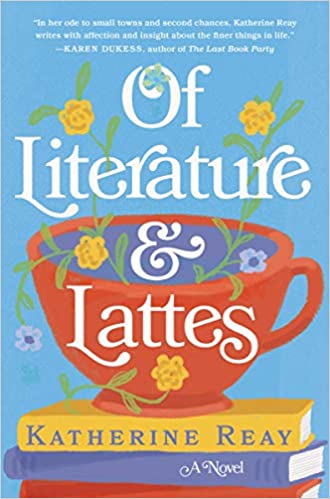
Of Literature and Lattes

Alyssa Harrison got along with her father, but clashed with her mother at every turn. Then her mother committed an unpardonable offense. So Alyssa moved out as fast as she could with no plans to return.

But then the company she worked for in CA was closed down by the FBI over rumored wrongdoing. The FBI interviewed all the employees—except Alyssa. While she waits for their call, she has no job and no way to pay for her apartment. The only place she can go is back home to Winsome, IL.

Her parents were divorced, and she wants to move in with her dad. But he doesn’t have the space and sends her to her mom. Sparks fly from the outset. Her mom doesn’t fight back any more, which somehow makes Alyssa madder. Alyssa can see changes in her mom’s life, but she doesn’t take time to try to understand them. She looks for a job and waits nervously for the call from the FBI.

Jeremy Mitchell moved from Seattle to Winsome to be near his young daughter. His wife had walked out of the marriage while still pregnant, and Jeremy’s visits with his daughter, Becca, have been sparse. But he wants to rectify that. He’s put everything he has into a Seattle-style coffee shop. But Winsome residents resent the changes from the homey coffee shop that Jeremy replaced. And he can’t seem to figure out where all his money is going.

Alyssa’s best friend, Lexi, sets her up to help Jeremy with his business. Alyssa speaks numbers like a second language. Alyssa and Jeremy are drawn to each other. But each has so many issues in their personal lives, and neither is sure they are staying in Winsome.

Of Literature and Lattes by Katherine Reay is the sequel to The Printed Letter Bookshop. It took me a while to remember some of the situations of the characters from the first book. I think the background of the first book would shed light on this one, especially Alyssa’s mother’s situation. But I do think this could be read as a stand-alone book.

The back of the book says, “With the help of Winsome’s small town charm and quirky residents, Alyssa and Jeremy discover the beauty and romance of second chances.”

The second chances theme comes through not only for Jeremy and Alyssa, but for many characters. And Winsome is a lovable small town.

Katherine’s books are always sprinkled with literary quotes and references. I wasn’t familiar with some of the books mentioned this time. The main one was Of Mice and Men, which I’ve never read—but now I am tempted to.

Overall, I really enjoyed the story, the bookshop, the small town atmosphere. It was a little hard to take all the arguing between Alyssa and her mother and Jeremy and his ex-wife. I know stories need conflict, but I am not used to people talking to each other so harshly. The tension in some scenes left me tense after putting the book down. This isn’t a criticism—I’m sure some families duke it out verbally as much as these do, or worse. And their verbal jabs point up the severity of their issues. It was just hard for me to take in personally.

My biggest problem with the book would be hard to explain without going into a lot of detail, which I don’t want to do in a book review. Let’s just say I am not ecumenical. There are times to put differences aside and just love people in Jesus’ name. But there are some differences that should not be put aside—like the truth that a person is saved by grace through faith alone. When the main spiritual spokesperson in a book is from a faith background that adds church ritual and traditions, that seems to emphasize works and faith, that’s a problem for me. Yes, I know James says our faith should manifest itself in works—but the works come as an outgrowth of faith, not in addition to faith to merit favor in God’s eyes. I have some very dear friends in this faith background, but I wouldn’t hold a joint ministry together with them. There are all sorts of angles to this that could be discussed endlessly, thus the difficulty of getting into it in a short book review. So I’ll leave it there for now.

My other problem with this book was not the fault of the author. I listened to the audiobook, which was narrated by an English woman. It felt weird hearing the narration, including the character’s thoughts, in an English accent, but their speaking voices in an American accent. Then, the narrator’s English accent bled through the American voices sometimes. Most words ending in an “a” sound had instead an “r.” The word “idear” came up several times, as did “Grandmar,” “vanillar,” etc. Then there was “enything” for “anything” and “figger” for “figure.” Plus she didn’t do many of the male voices very well. So I’d recommend reading this over listening to it. Most of the comments on the audiobook page were similar. I love English accents in English audiobooks, but I didn’t think the mix worked well here.

If you like small towns with quirky neighbors, stories with a lot of book references, or families coming together over their differences, you’d probably like this book.

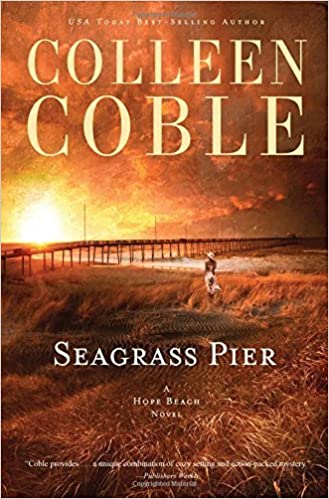
Book Review: Seagrass Pier

Elin Summerall has a lot on her plate. Her husband died a few years ago, leaving her with their baby daughter, now four years old. She took in her mother, who was diagnosed with Alzheimer’s. Then Elin developed a virus in her heart, which required a transplant.

Recovering from transplant surgery, Elin has been having frightening dreams—only they seem more like memories, memories of her donor being stalked and murdered. When she tells people, they think she’s just reacting to the trauma of the surgery and the strong anti-rejection drugs.

But then someone breaks into her home, leaving odd messages.

She takes her daughter and mother and flees to Hope Beach. There she finds an old acquaintance, an off-duty FBI agent, Marc Everton, who takes her story seriously and offers to help. They’ve never gotten along, except for one night in their past that they’ve both repented of.

Can they overcome their differences and work together before it’s too late—especially after Marc finds out Elin’s secret?

Seagrass Pier is the third in Colleen Coble’s Hope Beach series, and to me was the most intense. The first two were Tidewater Inn and Rosemary Cottage (linked to my reviews). Some characters from the first two books appear in the third as well. All of the books are set in a beach town on the Outer Banks, and all feature lovely historic homes I’d love to see in person.

The books have been reprinted with different covers, and one Kindle version bundles all three together.

I don’t know if the concept of “cell memory”—the idea that a transplant recipient can have memories of the donor or take on traits of the donor—goes as far in real life as is portrayed in this book. But as this is a work of fiction and not a medical treatise, I was able to set aside whether this could really happen and just go with the story.

If you like romantic suspense with a Christian undercurrent, you would probably like these books. Just don’t do what I did and start the last one in the evening without being able to put it down until way past bedtime.

Book Review: Rosemary Cottage

Amy Lange visits her family’s beach home, Rosemary Cottage, to mourn for her brother, Ben. They used to spend time at the cottage every summer together. But Ben died, in what some say was a surfing accident. A mysterious email suggests another possible explanation. However, the police think the email is just a prank.

Amy is a midwife. As she revisits Hope Island, she begins to think she could start a practice there.

Curtis Ireland is a member of the Coast Guard rescue team on the island. He’s raising his young niece, Raine, since his sister died after being struck in the water by a passing boat. His aunt, Edith, has come to help him with Raine.

Amy’s brother was idolized by her family as the golden boy, set for a successful life. Gina, Curtis’s sister, was the “black sheep” of the family, yet had made positive changes the last years of her life. But appearances can be deceiving.

Amy and Curtis join forces to investigate the siblings’ deaths, yet each holds back secrets. Each is defensive of his or her sibling. But they need to put aside their differences . . . especially as someone begins to threaten them both.

Rosemary Cottage is the second book in Colleen Coble’s Hope Beach series. Tidewater Inn was the first, and some of those characters appear in this book as well.

I not only liked the beachy setting, but I enjoyed the old houses mentioned in each book. There’s a budding romance for those who like that in a book, and there’s plenty of suspense for those who prefer action and intrigue. I thought the faith element was developed naturally.

All in all, a nice summer read.

Chris Fabry’s Dogwood

Dogwood by Christ Fabry is set in West Virginia and told from four different points of view.

Karin is a pastor’s wife with three children. But she feels far from God. She has trouble sleeping and spends most nights in her closet with a Bible and a book of poetry. She doesn’t seem to know what the basic problem is or how to feel close to God again. An aged woman in her church, Ruby, takes an interest in her and tries to help her.

Will Hatfield is from Dogwood, but has spent the last twelve years of his life in prison for his part in an accident that killed two children. He has loved Karin since he was a teenager and plans to go back to Dogwood and win her when he gets out.

Bobby Ray is Karen’s brother, a rookie police officer, and a soon-to-be dad of his first child with his wife.

Danny Boyd is a young boy who talks to a counselor about his feeling responsible for the death of his sisters.

At first, the four different points of view are confusing, especially as some of the names of side characters are similar. I listened to the audiobook, which makes it harder to backtrack to double check names or points. But after a while, I was able to distinguish who was whom and who belonged with which character.

I was able to piece various parts of the story together as the narratives went along. I had figured out one aspect, but the main twist, revealed in the last 30-45 minutes of the story, took me by completely by surprise.

I loved some of Fabry’s phrasing here:

My constant companions were fears, not God. I convinced myself he was simply on vacation, out carrying someone else on that beach with all the footprints. My heart had shriveled, and my soul was as wrinkled.

Ruthie was the first to tell me that God hadn’t abandoned me but was drawing me deeper, calling me out of the shallows, past the abyss, and into the current of his love and mercy. Yeah, right, I thought. God hadn’t asked me if I wanted to go deeper, and thank you very much, I liked the shallows. It’s easier to play when there’s no current. In the middle you lose your footing; you lose control.

Water that’s not moving becomes stagnant. And if there’s not someone pouring into you, the pitcher gets dusty. A person is most satisfied and most useful when she is both giving and receiving. In marriage. In life. In friendship. With God too.

There were a couple of statements that bothered me, like “I’m convinced God sometimes wants to communicate outside the usual box” and “Listen to your heart.”

And I didn’t like couple of scenes with a teen couple swimming in their underwear and mention of women displaying cleavages for Will to see.

But the overall story was very good. Chris tells some of his thoughts in writing the novel here. This is the first of a trilogy. I had already read June Bug, the sequel, a few years ago. I probably won’t read the last one, though, about an angel’s assignment in Dogwood.

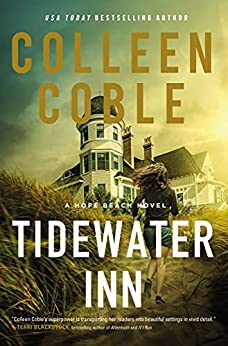
Tidewater Inn

In Tidewater Inn by Colleen Coble, Libby Hollander is an architectural historian. She and her business partner, Nicole, convince investors to let them restore old buildings.

While Libby checks out one house, Nicole visits a property on the Outer Banks. But what she discovers stuns both of them. Libby had been told her father died when she was five. However, he had been living on Hope Island all this time, remarried, had two more children, and left his Tidewater Inn to Libby when he passed away a year before.

Libby learns that her half-siblings knew about her. Even though they’ve received a sizeable cash inheritance, they’re not happy that she inherited the inn. Another investor is also interested in the Inn. Though Libby would dearly love to keep it, she doesn’t have the money to restore it. The investor wants to begin a ferry service to the island and build up some other properties, but long-time residents fear commercialization of the island.

Before Libby can even begin to delve into all this, however, Nicole is kidnapped right before her eyes—and the local sheriff thinks Libby is the prime suspect.

And a hurricane is heading toward the island.

There are different layers of mysteries tied up in the story, and a handsome Coast Guard lieutenant helps Libby untangle them.

Several years ago I had read a few of Colleen’s books about a woman named Bree and her rescue dog, Samson, and some of the rescues they were involved in. And, lo and behold, Bree and Samson turn up in this book for a bit.

I enjoyed the story, Libby’s journey, and the setting. I grew up on the Southern Texas coastline, near Padre Island, and stories set in a coastal town bring that back to me.

This is the first book in the Hope Island series, and I’ve already started the second.

Unconditional

Unconditional by Eva Marie Everson is based on a movie by the same name, which in turn was based on true events.

Samantha Crawford loves her life, living on a ranch with her beloved husband, Billy, riding her horses, and writing and sketching children’s books.

Then tragedy strikes. Billy is gunned down in an alley in a poor part of town.

Samantha loses her belief in God’s love and goodness. She doesn’t write any more.

At her lowest point, Samantha encounters a child hurt by a hit-and-run driver. Taking the child and the child’s brother to the hospital, Samantha runs into one of the children’s neighbors—her best from from school, Joe Bradford.

As Samantha reconnects with Joe, she learns he has kidney disease. But he spends his time ministering to the children in his neighborhood. He and his girlfriend, Denise, provide after-school snacks, attention, affirmation, and encouragement. But Joe’s time is running out unless he can get a kidney transplant.

Observing Joe’s simple faith and ministry, Samantha’s heart starts to warm again. But she’s also driven to find her husband’s murderer, convinced that the police have given up on the case. And she thinks she just may have found him—in Joe’s neighborhood.

I had not heard of the movie, but picked up this book on a Kindle sale because I had enjoyed some of Eva Marie Everson’s books. I didn’t know when I started reading it that it was based on a true story. “Papa Joe” Bradford started Elijah’s Heart to aid at-risk children.

Finding out the story was true made it even more heart-warming and inspirational than it already was. In an interview, Joe Bradford says about 97% of film is true to his life and the Samantha character is a composite of different friends.

The movie used to be on Netflix, but isn’t any more. However, it’s online here and on YouTube here. I enjoyed watching it last night. The book uses scenes and dialogue from the movie, but includes more information. Here’s a trailer for the film:

Have you seen or read Unconditional? If not, I hope you do.

A Southern Season: Stories from a Front Porch Swing

I picked up A Southern Season: Stories from a Front Porch Swing because I liked the title and concept. Plus, I had read several books by one of the authors, Eva Marie Everson, and heard her speak at a writer’s conference I attended virtually.

The book contains four novellas written by different authors. Each story takes place in the South in different seasons.

the first is Ice Melts in Spring by Linda W. Yezak. Since her husband’s drowning, Kerry Graham had avoided the coast. But now she has been requested by a reclusive author to come and catalog the items the author is donating to the museum Kerry works for. As the author lets down her guard and shares from her life, Kerry finds they have more in common than she knew.

In Lillie Beth by Eva Marie Everson, Lillie Beth was overjoyed not only to fall in love, but to escape her abusive home life. After she married David, Lillie Beth lives with David’s Granny while he goes to Viet Nam. But David doesn’t come home: he is killed in action.

Meanwhile, a Dr. Gillespie comes to town to help and then replace the town doctor. Dr. Gillespie’s wife had died, and he feels God has abandoned him. As the doctor helps Lillie when Granny is dying, he sees Lillie Beth’s simple faith and strength of character.

In Through an Autumn Window by Claire Fullerton, Cate returns to her Memphis hometown after her mother passes away. Her brother perpetuates their sibling rivalry until the two of them face a common enemy.

In A Magnolia Blooms in Winter by Ane Mulligan, Morgan James is living her dream as a Broadway actress. It was harder to break in than she thought. While waiting to hear whether she got her first leading part, her mother calls her home. The man leading the Christmas play has been injured. Since Morgan wrote the play, and her mother is responsible for the man’s accident, her mother asks Morgan to come help out. Morgan finds unexpected joy in directing the play and helping other young actors. When she reconnects with an old flame, she struggles with the thought of giving up what she thought was a God-given dream to act on Broadway. But could God have given her that dream for a specific purpose and season?

I enjoyed all these stories. Some were sad, some were funny. All were poignant and hopeful. The title fit well: this was a good book for summer evenings.

(Sharing with Carole’s Books You Loved)