Book Review: The Road Home

In Malissa Chapin’s debut novel, The Road Home, Cadence Audley has started a new life with a new name—for the second time. Her past has dogged her steps, but she’s determined to lead a quiet, peaceful life in Deercrest, Wisconsin. She’s found a good job as a barista with a great boss. Antique stores in the area fulfill her taste for vintage purchases.

On one such shopping trip, Cadence finds an old recipe box filled with hand-written recipes. Her coworker Googles the name written inside the box and found that the owner had lived in town. Thinking to return a valued heirloom, Cadence finds Fredonia, the middle-aged daughter of the recipe box owner. Fredonia had donated the recipe box in the first place and is not thrilled to see it again—or Cadence, for that matter. But, upon learning that Cadence likes antiques, Fredonia invites the younger woman to drive with her to Kentucky to help clean out her mother’s home.

Fredonia’s offer comes just in time, because Cadence’s past has caught up with her—again.

This is a split-time novel. The second timeline belongs to Ida Beale Evans, owner of the recipe box. She had been a banker’s daughter in Indiana when she married her sweetheart, Bud, and moved with him to his new pastorate in Kentucky. Though she enjoys life as a country preacher’s wife, she has one sorrow. Suddenly one night, her deepest desire is unexpectedly fulfilled—but to keep it will call for a lifetime of secrecy.

Though Ida is a Christian and Cadence is not, both women struggle with trusting that the truth will set them free. The truth seems like it will destroy them. But Cadence has come to the end of her road. Can she escape and start over yet again? Or must she face her past and its consequences, even though doing so means losing everything she holds dear? Can she trust the young preacher who tells her, “Your sin caused problems everywhere, but God is bigger than this. He’s big enough to help you live a new life” (Location 3415, Kindle version).

I enjoyed following the journey of both women and the truths they learned. I also enjoyed the sense of place in the book, especially the Kentucky sections. There was a nice mix of both funny and poignant moments in the story. Sprinkled throughout the book are recipes from Ida Beale’s box. It was fun to learn on Malissa’s blog what inspired the pink Cadillac road trip in the book and to peruse her Pinterest board for the people and items that inspired or contributed to the story.

As of this writing, the Kindle edition is $2.99, but a paperback version is also available.

Book Review: Half-Finished

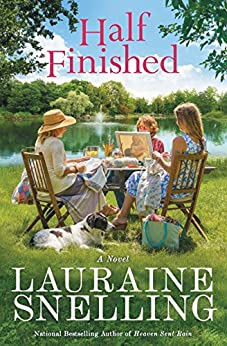
In Lauraine Snelling’s novel, Half Finished, two friends get fed up with all their half-done craft projects and decide to do something about it. One, Roxie, had heard about UFO clubs—not for discovering alien life, but for finishing UnFinished Objects, or projects in their case. They discuss the idea with a few other friends and decide on a time to meet together with each choosing one project to work on while they meet.

As word of the UFO club spreads, more people want in on it—because who doesn’t have unfinished projects of some kind. Soon there are morning and evening clubs at several different locations. Even some of the men get it on the meetings.

But the clubs grow beyond projects. Relationships form and people band together to help each other through the sorrows and joys they encounter.

Lauraine said in her afterword that the book was inspired by such a UFO club in her own town. And this story brought up fond memories of a group of women who did something similar in my early married days. We didn’t focus on unfinished projects—though that’s what they were. But it wasn’t a matter of projects that had been lying around for years. We were too young to have many like that. We just met to spend some time fellowshipping while working on our various projects. We’d rotate houses, and ladies would take turns bringing snacks. I always felt we were a little inspired by the sisters in the Little Women sequels, who would meet together and visit with each other while doing their mending. I was sorry to see our group disbanded after a while: I think some of the ladies felt guilty spending time working on crafts during the day.

The beginning of the book was hard to get into: it was very busy. There were so many characters, they and their families were hard to keep straight. Plus the pages seemed to be stuffed with unnecessary details. For instance, there was one paragraph all about one woman’s two credit cards and which she used for what and why she was using the one she did for a purchase that day. Unless something about the credit cards was going to come up later in the story, there was no need to know any of that, or even that she paid for the purchase with a credit card. I don’t remember seeing that kind of thing in any of Lauraine’s other books.

But once the narrative settled down into a few of the main characters’ stories, the book became more enjoyable. There’s Roxie, a widowed real estate agent and a founding member of the UFO club. She has a grown daughter, Loren, who lives with her. Fred and Ginny own a farm and share their bounty with others. Their son and his family live nearby, and they enjoy getting together often. Their granddaughter, Addy, is an expert cookie baker. Amalia is one of my favorite characters: she is widowed and sold her own farm to live in senior apartments. But, even though she couldn’t keep up with the farm alone, she’s still able-bodied and mentally sound. She spends her days helping out some of the other seniors with physical needs or her friends.

One of the themes of the book is that we’re all half-finished projects. We’re all in a state of growth. So we need to be patient with ourselves and each other, but we also need to keep growing and learning.

Three Christmas Reads

I thought I’d group together short reviews of three books I enjoyed this December.

Expecting Christmas is a 40-day devotional book by multiple authors. I didn’t know any of the author names except one (Jennifer Dukes Lee). It’s put out by New Hope Publishers.

The selections are short, which is appreciated in a month like December. Each began with a verse or two of Scripture, a page and a half to two pages (at least in the Kindle version) of text, then three questions for refection.

The readings cover a variety of Christmas topics, though several deal with light.

A couple of samples: Day 15 talks about how horses in past years were seen as “labor animals, forms of transportation, and even weapons of war” (p. 44). After describing war horses, the writer points out Zechariah 9:9-10: Jesus did not come as an overthrowing conqueror, at least as the kind of conqueror society expected. His second coming will be more like that. But this time, He came humbly on a donkey. The author concludes, “Take time now to thank the Lord for being both just and humble, for bringing salvation instead of condemnation, for riding peacefully on a colt rather than on a warhorse. Ask Him to help you trust Him, especially when you don’t understand His ways. When you find yourself confused by His methods, remember the salvation He brought and the joys of that great gift” (p. 46).

In mediating on Jesus being given “the tongue of the learned” (Isaiah 40:4-5), another writer says, “Jesus didn’t use His deep knowledge and gift for oratory to make a name for Himself or climb social ladders. Rather, as seen in the Gospel accounts of His ministry, Jesus used His words to unburden people, free minds from the lies they had learned from false religions, and draw weary hearts closer to the Living God” (p. 54).

Another points out that people responded differently in praise and worship of the Savior, and that’s okay. “Mary’s response was one of quiet introspection as she treasured the good news of the gospel in her heart. The shepherds, on the other hand, left young Jesus, glorifying God and praising Him with outward enthusiasm and passion. People celebrate the gospel in different ways” (p. 77).

I only wish this book was 25 or 31 days so it would fit within the month of December. I didn’t get started 40 days ahead, so I have a bit yet to finish up. But I wanted to mention it before the month was over. Overall, I enjoyed it.

The second book I mentioned in my top twelve post yesterday. I had never heard of Letters From Father Christmas by J. R. R. Tolkien. I discovered it while looking for a short Christmas audiobook to finish out the year. This fit the bill nicely.

Tolkien sent letters and drawings as if from Father Christmas to his children from 1920 to 1943. He wrote with a shaky script because he was so old, he said (probably also to disguise his handwriting). The letters would comment on happenings in the children’s lives as well as at the North Pole. The North Polar Bear was Father Christmas’s helper and companion, a cheerful but bumbling fellow who unwittingly caused a lot of accidents. Polar Bear adds his own commentaries with a thick script because of his paws. Later an elf named Ilbereth acts as Father Christmas’s secretary. The last few letters mention “this horrible war” (WWII) and the people displaced, the shortage of supplies even at the North Pole, etc.

I got the audiobook superbly narrated by Derek Jacobi as Father Christmas and a couple of others for the infrequent voices of the bear and elf. But when I realized the book had photos of the letters and drawings, I had to get the Kindle version, too.

I thought in passing of Tolkien’s penchant for languages but figured that wouldn’t have a place in this book. But he did come up with a made-up language called Arktic that is spoken at the North Pole, and Polar Bear shares a few lines of it.

He also included some battles with goblins, who at times liked to raid Father Christmas’s supplies.

These letters are wonderfully imaginative. I especially loved the banter between Father Christmas, Polar Bear, and Ilbereth.

My last Christmas book this year is The Ornament Keeper, a contemporary fiction novella by Eva Marie Everson.

It’s Felicia Morgan’s custom to begin decorating the Christmas tree with the special, customized ornaments her husband has given her, one each year except for the last year. Each represented something special about their year: their first Christmas together, their children, her job advancement, etc.

This year, though, Felicia is dragging her feet. She and Jackson have separated after twenty years of marriage. Her daughter convinces Felicia to put up decorations as usual, but the memories are painful.

As Felicia hangs each ornament, we see a flashback to the circumstances surrounding each of them. Felicia’s marriage began with a mistake which has haunted the couple’s twenty years. Though God has redeemed and worked together for good their indiscretion, seeds of resentment and unforgiveness threaten to destroy what they have. Can they find their way back to each other before it’s too late?

I enjoyed the story and the truths brought out. I appreciated that the book wasn’t superficial or treacly.

Have you read any of these? Did you read any Christmas books this year?

The Yuletide Angel

In The Yuletide Angel by Sandra Ardoin, someone mysteriously leaves gifts at the homes of the needy during Christmas season nights in the 1890s. The town dubs the mysterious visitor the Yuletide Angel.

No one knows that the Yuletide Angel is shy, timid Violet Madison.

No one except her neighbor, Hugh Barnes. Hugh had seen Violet on her mission one night, and ever since he has followed her at a discreet distance to protect her.

When Violet learns her brother is planning to marry soon, she begins to worry. Her brother inherited the family home and plans to bring his bride there. They plan for Violet to live with them, but she would feel like she’s intruding on their lives. Her father did not leave her much because he assumed she would marry. But she is plain and not well-spoken, and no one has shown an interest. What could she do to make her own way that would be socially acceptable? She has some ideas of things she could sell in the Hugh the grocer’s shop.

Hugh has been fond of Violet for a long time. He speaks cheerfully to her and tries to gently draw her out. He enthusiastically endorses her plan for selling her baked goods in his store.

Just when it seems their relationship is unfolding well, Hugh’s ne’er-do-well brother, Kit, shows up. When Hugh sees Violet and Kit together, he feels betrayed.

And on top of everything else, an unseen stalker is following Violet on her nightly rounds and stealing her gifts.

This was an enjoyable story. I appreciate that as a Christian author, Sandra is not afraid to deal with Christian issues outright rather than just hinting at them. Yet her style is not heavy or preachy.

As a novella, this was a quick read. But the characters and story arc were well-developed. All in all, a good quick read.

Christmas By the Sea

In A Christmas by the Sea by Melody Carlson, Wendy Harper and her son, Jackson, are in the midst of hard times. Wendy’s husband passed away, and she is left with a mountain of medical bills.

Then she learns that she has inherited her grandparents’ cottage by the sea. She had visited them several summers as she grew up. Though she loves the cottage, she knows she has to sell it to get back on her feet financially. So she and Jackson drive down to spend a few days fixing the cottage up.

Jackson, who has been having a hard time since his father died, is renewed by the town and the cottage. He thinks they are going to stay. Wendy doesn’t want to disappoint him, so she puts off telling him that they have to sell the place.

When Wendy goes shopping for supplies, she meets a helpful man, Caleb, who she takes to be store employee. Later she discovers he is a local craftsman who owns his own store, while his mother owns the tourist shop Wendy remembers from her childhood.

Wendy faces challenges in her renovations, her need to tell Jackson her plans for the house, her deciding what to do next in life, and her growing relationship with Caleb.

I loved the nontraditional setting for a Christmas story. As I’ve mentioned before, I grew up on the coast of southern Texas, so my early Christmases didn’t contain snow and sledding and such.

My one complaint is that the story wrapped up awfully quickly and a bit unrealistically. But otherwise, I thought it was a nice book.

Book Review: Chapel Springs Revival

In the Chapel Springs Revival novel by Ane Mulligan, best friends Claire Bennett and Patsy Kowalski meet with other friends weekly at Dees ‘n’ Doughs’ bakery in their small Georgia town. Most of the ladies are also entrepreneurs. As they discuss the diminishing tourist trade, the newest resident points out the shabby fronts of most of the main street businesses.

Claire, “with all the subtlety of a charging water buffalo,” makes it her mission to revitalize the town—or at least encourage all the business owners to spiff up their places and the town council to spring for repainting and flower baskets.

Patsy, for all the time she has known Claire, has helped helped rein her in and bail her out of trouble.

Both ladies are experiencing trouble in their marriages, which need revitalization more than the town does. They had married men who were also best friends, but now one is grouchy and the other is absent more often than not.

A series of “mishaps and miscommunication,” according to the Amazon description, gives the ladies sometimes comedic trouble. But the book isn’t all comedy. The characters learn and grow and have some touching moments.

This book wasn’t quite my cup of tea, so I don’t plan to read any more of the series. Claire never quite resonated with me. And one or more characters had a penchant for saying “Van Gogh’s ear!” when they were exasperated, which made no sense to me. But if you like I Love Lucy-type comedy with a Southern accent, you’d probably like this book.

Book Review: The Nature of a Lady

In The Nature of a Lady by Roseanna M. White, Lady Elizabeth Sinclair prefers microscopes to ballrooms. She never feels she fits in with her peers. Her best friend is her maid, Mabena. Libby’s brother wants to marry her off to Lord Sheridan so she’s “taken care of.” Sheridan would at least tolerate her eccentricities. But is that she can expect out of life—toleration?

Libby decides to take Mabena on a summer holiday to the Isles of Scilly, where Mabena is from. While she’s away, Libby hopes Sheridan will see that they can’t possibly get married. She rents a cottage and discovers the previous occupant had also been named Elisabeth and had left suddenly with no explanation.

Then Libby begins receiving packages and notes that must be for the other Elizabeth. But one contains a cannonball, of all things.

Then a young man shows up at her doorstep demanding to know where his sister is. And this young man somehow knows Mabena.

Oliver Tremayne is a vicar and a gentleman, but most of the family’s wealth was spent on his brother’s illness. He’s exasperated with his sister, Beth. She was supposed to write him twice a week, but he hasn’t heard from her in two weeks. He’s afraid Beth’s absence is aggravating his grandmother’s dementia. He’d told Beth he’d stay away and giver her her freedom while on Holiday, but he has to make sure she is all right. Imagination his surprise, then, when someone other than his sister opens her door at his knock—someone he has met before, someone with Mabena.

Besides the mysteries of what happened to Beth and how everyone knows Mabena, other unexplained happenings include strange noises on one of the islands, a white figure, odd notations in an old book, pirate treasure, and past princes.

Meanwhile, Libby feels more at home in the isles than she has ever felt in her life. But can she ever convince her brother to let her stay?

One mystery to me: why the cover portrays Libby as dark-haired, when she’s repeatedly described as blonde and fair in the book.

I had never heard of the Isles of Scilly before listening to this book, and I enjoyed learning about them. The puzzles and mysteries in the book were intriguing, though I think I lost a couple of the threads before it was all over–probably a result of listening to the audiobook rather than reading the book, which made it harder to go back and trace some things. I liked the threads about being who God created you to be and the fact that science and faith aren’t enemies (though Libby seemed to accept evolution as fact, which I would disagree with).

I can’t say I enjoyed this story quite as much as Roseanna’s other books I’ve read, but I still enjoyed it quite a bit. And I am looking forward to the next book in the series.

Book Review: Hidden Among the Stars

In Austria in 1938, Annika Knopf is the daughter of the caretaker of the Dornbach family’s castle in Hallstatt. She and the Dornbach’s only son, Max, have been friends since childhood. But now they are grown, and she has quietly loved him for a long time.

When Annika discovers Max is hiding treasures of their Jewish friends on the estate grounds, she wants to help. Max wants to protect her as much as possible, but the time comes when he must accept her offer.

Max has never seen Annika as anything but a good friend. He’s in love with Luzia Weiss, a beautiful and brilliant violinist with the local orchestra. The Dornbach and Weiss families have been friends for years. But as Hitler’s forces advance, it’s not healthy to associate with Jews like the Weiss family. Max loves Luzia still and looks for ways to avoid fighting for the Reich and to get Luzia and her family out of Austria before it’s too late. In the meantime, he brings Luzia to the family’s lake castle to hide and asks Annika to watch over Luzia.

In modern times, Callie Randall runs a book store with her sister. Her tumultuous early life, with rejection from both parents and and betrayal by her fiance, has turned her naturally introverted character into someone who enjoys hiding out and is afraid of . . . almost everything except her job and shop.

Callie’s sister gifts her an early edition copy of Bambi, and Callie finds within its pages a list of items in the same script as the book’s font. The name written in the front is Annika Knopf. Callie begins an Internet search, hoping to reunite the book with Annika or someone in her family. But Callie discovers Annika’s story may intersect with Charlotte, the woman who took Callie and her sister in and whom she loves like a mother. Callie yearns to find Annika and restore to Charlotte something of her lost history. But first she must find the courage to step outside her safe haven.

I had read several WWII-era books this year, and was determined to read something from a different time. I love stories from that era, but I was starting to get a little tired of it. However, when I read the description of Hidden Among the Stars by Melanie Dobson, I had to read it next. A main character with a personalty similar to mine, a bookstore owner, mention of several classic children’s books, a castle on a lake—all these drew me in. And I am glad. I think this might be my favorite of Melanie’s books so far—and that’s saying something, because I’ve enjoyed all I’ve read from her.

I listened to the audiobook, wonderfully read by Nancy Peterson. Unfortunately, the audio version didn’t include any back matter that books sometimes have about the author’s inspiration for writing, historical research, etc. However, I did find that information on Melanie’s site here. There really is an abandoned castle in Hallstatt! I enjoyed hearing about Melanie’s trip there.

I’m pretty sure this will be one of my top ten books of the year. Highly recommended.

Memories of Glass

Memories of Glass by Melanie Dobson is a time-slip novel. One time line is modern day, and one begins in 1933 but quickly progresses to WWII.

In the older timeline, three childhood friends in Amsterdam are joined by a fourth when Anneliese Linden moves into their neighborhood. Just a few years later, the war has begun. Eliese’s father’s bank was closed because he was Jewish. Samuel works in another bank and sends his sister, Josie, on missions to deliver hidden correspondence in baskets of flowers and jam when she’s not taking classes at the teacher’s college. Klaas—well, no one knows quite where he stands, so they don’t trust him.

Eliese had moved to London for a time. Her friends don’t know that she’s back in Amsterdam with a young son. Her father has a position helping the Nazis, which he thinks will protect him and Eliese. Eliese feels conflicted registering the families that the Nazis round up, but she doesn’t know what she, as one young woman, can do. When she finds that Josie is working at a creche nearby, they form a plan to rescue some of the children.

In the modern timeline, Ava Drake helps her grandmother, Marcella Kingston, with her charitable foundation though the rest of the family disapproves. Ava’s mom had left the family years ago, but when she and Ava’s brother died in a fire, a case worker found Ava’s connections to the Kingstons. The Kingstons all view Ava as an outsider except Marcella, and since Marcella is the matriarch and holds the purse strings, they all go along—at least in public.

Part of Ava’s job is to vet the charities that apply to the Kingston Foundation for grants. In that capacity, she travels to Uganda to visit a man, Paul, who runs a coffee plantation as a means to help Ugandans. Later, Ava travels to the coffee company’s headquarters in Portland and meets Paul’s sister and grandmother, where she finds a surprising connection.

Ava determines that her family won’t heal until its past is brought to light. As she digs into her family history, she finds connections with the young friends from Amsterdam—connections that some of the Kingstons don’t want known.

The part about rescuing children away by deleting their names on the registration forms was a true one, and Melanie tells that story in her afterword. It’s a reminder that even thought it looks like someone is collaborating with the enemy, he or she might have another purpose in mind.

I felt for Eliese here—there were probably many who were in similar positions, stuck “helping” the Reich. If she resisted, she and possibly her father would have been killed. I was glad she found a way to help after all.

I found myself reading parts of this while also reading Women Heroes of World War II, mentioned yesterday. It was interesting seeing some of the activities there fleshed out in the novel.

There were a lot of details to keep up with, and I am not sure I caught all the threads in the end. But I enjoyed the stories of hope and redemption.

Catching the Wind

Melanie Dobson’s Catching the Wind made me want to lay everything else aside to read it. But I also wanted to slow down and savor it and hated to see it end

The story opens with two children playing in 1940 Germany. Brigette Berthold is ten and wants to play nothing but princesses and knights. Dietmar Roth is a few years older and tolerates the game because Brigette is his favorite playmate. Plus he promised her father that he would help take care of her.

When the children’s parents are attacked by the Nazis, Dietmar and Brigette run. If they can make it to the English Channel and get across, Hopefully Dietmar can find his aunt.

After a harrowing journey, they finally do make it to English soil. But then they are separated.

Over 70 years later, Dietmar is a wealthy old man who goes by the name Daniel Knight. He has hired several private investigators to try to find Brigette, with no luck. Now his hopes rest in a reporter, Quenby Vaughn. He has read her stories about refugee children and knows she searches with her heart.

Quenby is working on her own story about a wealthy English woman, Lady Ricker, rumored to have helped and secretly supported the Nazis in the 1940s. Understandably, the woman’s descendants don’t want the story to run and aren’t cooperating.

When Mr. Knight’s arrogant solicitor approaches Quenby with Mr. Knight’s proposal, he’s not forthcoming enough to interest her. But she agrees to meet with Mr. Knight. When she learns that Brigette’s story ties in with the Rickers, she’s hooked.

There are several layers to this story—what happened to Brigette and Daniel, what was going on with Lady Ricker, and Quenby’s family history of a mother who abandoned her, which has crippled her ability to trust.

As one character says, “I believe God uses our pasts, even our regrets to help us and other people find Him.”

I listened to the audiobook (winner of a 2018 Audie award) nicely read by Nancy Peterson. This is one of my favorites of Melanie Dobson’s.