Nick was born into an elite Charleston family but was considered and outsider because his mother was. After his father’s death and his mother’s abandonment, he was raised in an uncle’s family, always aware he was not really a part of the family except by blood.
The first book had Nick coming back to Charleston after several years due to receiving a clue about his mother’s disappearance. He comes into an inheritance and the family home.
He’s not really a detective or investigator—he teaches astronomy. But a detective friend has been in a serious car accident, and Nick volunteers to help her.
It turns out that the hazing and apparent suicide of a Citadel cadet two decades ago is related to the disappearance of a debutante, both of which are also connected to a current case. As Nick asks questions, he’s repeatedly warned not to stir up this hornet’s nest. But as he continues unraveling surprising connections, he finds himself in danger.
Some favorite quotes:
Merely going through rites was a much easier task than following the spirit behind them (p. 40, Kindle app).
Without God, life was dust and had no meaning. With God, hope transformed life and its sorrows (p. 158).
“I understand,” I said. “I will tell this woman how you feel.”
Life burst into the old woman’s face. She pointed at me, still clutching the shawl. “You, young man, have no idea how I feel!”
It was a well-deserved rebuke. “No,” I said quietly. “I don’t” (p. 160).
Not so fast, my junior-grade sidekick (p. 201).
I don’t often read this kind of book, but it’s nice for a change. I like Brouwer’s breezy style of writing here. Though there are dark and scary turns, there’s a lot of underlying humor and banter as well as a few sweet moments.
In By Way of the Moonlight by Elizabeth Musser, Allie Massey’s grandmother, known as Nana Dale, has just died. Nana Dale was an accomplished horsewoman, placing first in several shows and even riding in the Olympics. Their plan had always been that Allie would inherit the grounds, house, and enough money to open an equine therapy business on her grandmother’s property.
But the family learns at the reading of the will that Nana Dale sold the property to a development firm, evidently taken advantage of in her beginning dementia by an unscrupulous contractor.
Now Allie has a limited time to clear the house and have an estate sale before the house is imploded.
Allie is beyond upset. She can’t cope. She even breaks up with her fiance. Nana Dale had left a letter with cryptic instructions to find a cherrywood chest which will have more information. But no one in the family has seen such a chest.
In intermittent flashbacks, we learn of Dale’s life. She had loved horses from her earliest memories. But her father’s business crashed along with the economy during the Depression, and the horses had to be sold. Dale prayed long years that she might find Essie, her beloved filly.
Before the Depression, when her family boarded horses, Dale met a boy named Tommy with a horse named Infinity. The two became friends, even competing as a couple in some events.
The rest of Dale’s story takes us through Tommy’s bout with polio, mounted patrols along the coast during WWII called Sand Pounders, and a daring rescue of a sailor whose ship was torpedoed, which resulted in a major surprise.
In one interview, Elizabeth said part of the story was inspired by her mother’s property in Atlanta. In a series of short videos, Elizabeth takes readers through various areas of the house and grounds that were inspiration for the novel, which was fun to see. She said that there is pressure now, just like in the book, for owners of such properties to sell to developers who want to raze the buildings and put up new cluster houses.
The WWII and Sand Pounders sections of the book are not Elizabeth’s mother’s history. But when she happened upon information about the coastal mounted patrol, she wanted to include them in her book.
Elizabeth says later in her interview that in this book she wanted to “examine the thin line between fighting for what you believe in and developing an unhealthy obsession. Both women learn important lessons about pursuing dreams at all costs, which may cause them to sacrifice something or someone they love.”
I listened to the audiobook read by Susan Bennett. I thought Susan did a great job with the character voices, but the narration seemed too slow. Maybe she thought that was fitting for a Southern accent (the next audiobook I started is also read by Susan, but at a much more normal pace). Also, she had an annoying habit of turning one-syllable words into two syllables, especially at the end of sentences (not to be nitpicky, but after 14+ hours of listening, some things grate). The audiobook didn’t provide any back matter, so I am thankful Elizabeth included information and links to interviews here.
The story itself also seemed a little slow, especially the modern-day part. There’s almost no movement in plot in Allie’s story until near the end.
Nevertheless, overall, this was a good book. One of my favorite quotes, and themes, in the book is “When life gets hard to stand, kneel.”
Another: “Bitterness will rot out your soul. . . You may never get the answer on this side of life to the why. So it’s much better to ask the question, ‘Now that I’m in this place, Lord, what do you want me to do?'”
And “Life ain’t fair. It’s brutal sometimes. . . faith don’t stop the horrible things. But faith helps you walk through those things, whipped and angry and screaming on the inside. Lord don’t mind our screaming and raging. He done shown us how to do it in those psalms of his that King David wrote.”
Elizabeth is one of my favorite authors. Even though I like some of her other books better than this one, I did enjoy this one and can highly recommend it as well.
In Beneath a Golden Veil by Melanie Dobson, Alden Payne is a Harvard law student whose father owns a tobacco plantation in 1853 Virginia. Alden’s father expects him to help with and take over the plantation after he finishes school. Alden approaches Christmas break planning to tell his father that he cannot acquiesce to his father’s plans. He braces himself to face his father’s wrath.
At Harvard, “Both students and professors liked to rant about freedom for all men—and pontificate about the evil Southern planters—but in Alden’s opinion, none of them were willing to sacrifice a thing—especially not their cigars—to help free the slaves” (pp. 13-14, Kindle version). Alden doesn’t know what else he can do against such a strong institution, but at least he doesn’t have to be a part of it.
Arriving at home, he finds his father is livid over a runaway slave, a young man with whom Alden played when they were boys. Witnessing his father’s cruelty toward the young man only reinforces Alden’s decision. But now he feels compelled to do more: to help the young man escape. His best bet is to get the young man to Sacramento, where he can then find a way for him to go to Vancouver.
In Sacramento City, Isabelle Labrie owns one of the nicer hotels. She and her aunt had bought part ownership with Ross Kirtland. But Isabelle’s aunt died, and Ross sold his share to go to the gold fields. They plan to marry and run the hotel together when Ross returns. Meanwhile, Isabelle keeps her past a guarded secret, even from Ross. If anyone found out now, she would be ruined, perhaps even in danger.
When a scared young slave runs into her establishment one day, Isabelle and her porter, a freedman, hide him and get him to safety. This starts Isabelle on a mission to look for other slaves she can help. California is a free state, but allows for travelers to bring their slaves to help in the gold fields. The laws concerning slaves are a little murky on finer points.
When Alden’s and Isabelle’s paths cross in Sacramento, they don’t trust each other at first. It’s dangerous even in free California to come out as an abolitionist. Alden has had the young man act as his slave during their travels so they wouldn’t be questioned. But Isabelle thinks he’s an actual slaveholder.
Soon they get on the same page. however. But accomplishing their goals is going to be more dangerous than they thought.
Thankfully, the Kindle version and audiobook came on sale at the same time for a couple of dollars each, so I could go back and forth between them. The narrator did an okay job except for using the same irritating annoyed tone for any bad person, male or female. I’d recommend the print or Kindle version of this one.
Though I’ve read historical fiction about slavery, I haven’t often come across stories from the gold rush era. Melanie’s notes at the end reveal Isabelle’s character is based on a real-life one.
Inhumanity is always hard to read about. But it’s inspiring to read about brave souls who help others at risk to themselves.
There were many layers to this story, especially in Isabelle’s situation. Overall, it was a very good read.
One of my most enjoyable posts to write is naming my favorite books read each year. It’s like revisiting old friends, almost like enjoying the books all over again.
Most of these weren’t published in 2023, but were read this year.
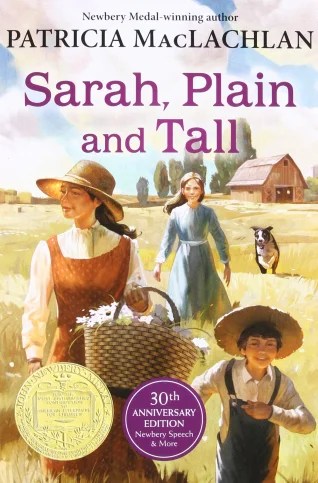
Sarah, Plain and Tall by Patricia MacLachan is a classic, but not one I had ever read. I did see the movie version with Glenn Close years ago and loved it. A widowed farmer with two children on the prairie places an ad for a new wife. He receives a reply from Sarah in Maine, who wants to come out and visit the family. There are some bumps along the way, but the blending of a new family is told with gentleness and tenderness.
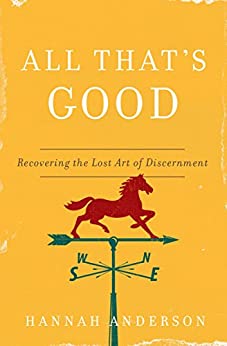
All That’s Good: Recovering the Lost Art of Discernmentby Hannah Anderson. I read Hannah’s Advent devotional, Heaven and Nature Sing, in 2022 and loved it. So I read three more of Hannah’s earlier books this year (as well as reading Heaven and Nature Sing again). I could honestly list each of them among my favorites this year. But I figured I’d just list one, and chose the first one I read. I love that Hannah approaches discernment not from the standpoint of avoiding the bad, though we need to do that. But she proposes discerning bad from good in order to pursue the good. That shift has many ramifications to our thinking.
Becoming Free Indeed: My Story of Disentangling Faith from Fearby Jinger Duggar Vuolo. Jinger was a member of the Duggar family featured on 19 Kids and Counting. As Jinger grew up and talked with other Christian young people, including her fiance and her sister’s husband, she began to realize some of the things she had been taught were wrong. Though writing about difficult subject matter, Jinger displays a gracious spirit. I especially appreciated that she didn’t “deconstruct” her faith and throw everything out. She studied and read and sought counsel to “disentangle” the good from the bad.
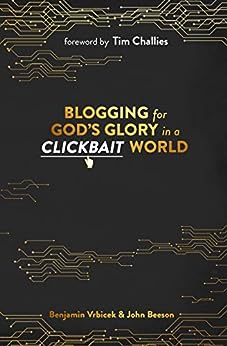
Blogging for God’s Glory in a Clickbait World by Benjamin Vrbicek and John Beeson helps not only with the mechanics of blogging but also with keeping our motives in the right place.
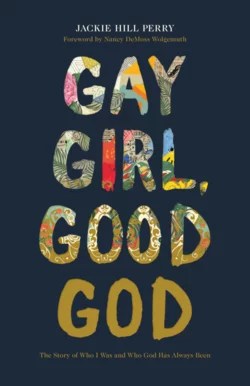
Gay Girl, Good God: The Story of Who I Was and Who God Has Always Been by Jackie Hill Perry is her testimony first of all of becoming a Christian, then how Christ changed her heart and her sexuality. She’s received a lot of flack, because the world cheers people who go from straight to gay, but not gay to straight. Jackie dispels a lot of glib Christian notions about what it means to become straight. This book opened my eyes to many things. Plus I appreciated Jackie’s poetic way of expressing herself.
I read so many good novels this year, they’re harder to narrow down to a few favorites.
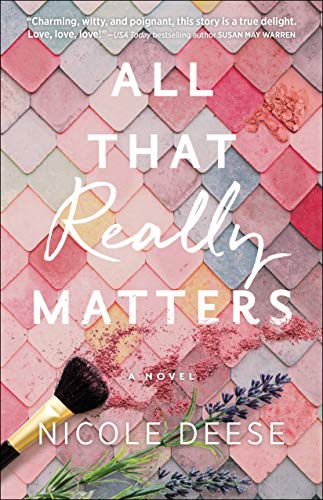
All That Really Matters by Nicole Deese is the first of Nicole’s books that I read, and so far it’s my favorite. It’s a novel of a perky social media influencer with half a million followers who needs to show a compassionate, involved side to potentially get a gig as a show host. Her brother recommends a a mentor program for kids transitioning out of the foster care program. The director, Silas, is not impressed and thinks Molly is shallow. But once they start working together, they are both changed. I loved that this book isn’t silly or frothy but goes deep.
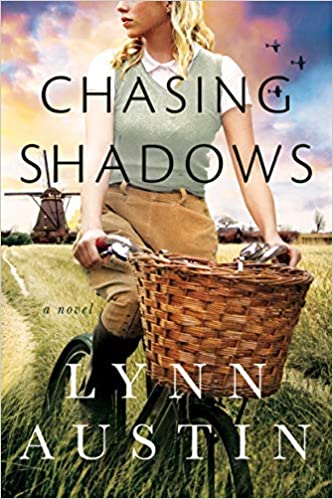
Chasing Shadowsby Lynn Austin is a novel that follows three women in the Netherlands through WWII. One is a farmer’s wife trying to keep things together at home with food shortages, a husband absent first as a soldier, then as a member of the Resistance, and helping others in desperate need. Another is a Jewish young woman trying to find a safe place for herself and her father. The third is a young woman in her first employment outside her home. She’s dating a policeman when the Nazis take over and commandeer the police force. She’s astonished by the changes she sees in her town and starts helping the Resistance.
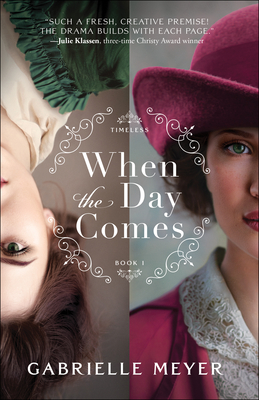
When the Day Comes by Gabrielle Meyer has a most unusual premise for a novel: Libby Conant is a time crosser, living on alternating days in 1774 Williamsburg and 1914 New York. On her twenty-first birthday, she’ll have to decide which time she wants to stay in the rest of her life. I loved everything about this book: the characters, the history, both timelines, and the ending.
In The Space Between Words by Michele Phoenix, a trip with friends to Paris is shattered when bombers attack a nightclub the friends were visiting. Jessica is shot, traumatized, and wants to go home as soon as possible. One friend does go home, but the other urges her to stay and go on to their flea market excursions. Jessica finds an antique sewing box with a secret compartment containing several sheets of handwritten paper and a few pages from an antique French Bible. Jessica feels compelled to learn more about the writer, who was from a family of seventeenth-century Huguenots. This story was captivating and touching and makes me want to find more of Michelle’s books.
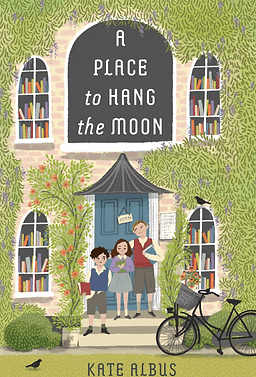
A Place to Hang the Moon by Kate Albus reads like a classic children’s book, but was just published in 2022. I agree with C. S. Lewis that children’s books can and should be enjoyed by adults, too. Three children in 1940s England were orphaned and taken in by their aloof grandmother. When the grandmother dies, the solicitor suggests the children join the evacuees being sent to the countryside: perhaps they might find a foster family that will take them in permanently. The children are billeted in a couple of problem homes and seek refuge often in the library. The kind librarian is something of an outcast herself, having a German husband who is away. I loved the well-told story, the beautifully drawn characters, the descriptions of both warm and cozy and difficult scenes, references to beloved classic children’s books, and Polly Lee’s British accent narrating the audiobook. I didn’t want the book to end.
Though part of me wants to keep listing good books. I think I’ll stop at an even ten.
Have you read any of these? What were your favorite books read last year?
I was able to finish some Christmas reading the last couple of weeks, but didn’t have time to review them. Many of them were short, so I’ll bunch them all together here.
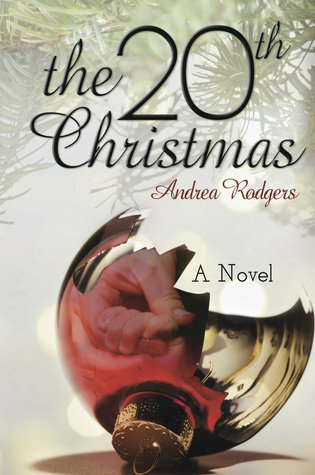
In The 20th Christmas by Andrea Rodgers, Arianna Tate faces a parent’s worst nightmare: her almost 2-year-old son is taken from her in a coffee shop just before Christmas.
Al the searching, detectives, and appeals come up with zero results. People remembered seeing a young woman in the coffee shop, but no one could remember much about her.
For the next 20 years, Andrea and her husband descend into the lowest depths of despair. They almost lose their marriage, but make determined efforts to make things work. They’re finally able to move on, though the pain never goes away.
Meanwhile. Lydia Feller’s estranged, drug-abusing sister shows up on her doorstep with a child. Lydia had heard her sister was pregnant a while back, but the timing doesn’t seem to match up with the age of this child. When her sister dies of an overdose, Lydia adopts her child to show him love and grant some stability to his life.
Twenty years later, the pathways of all involved meet.
I felt Arianna’s life before the kidnapping was almost too perfect. And there were a number of parenthetical statements in the writing I was surprised got past an editor.
But this was a good book overall.
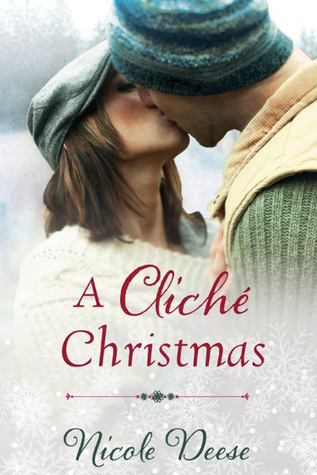
In A Cliche Christmasby Nicole Deese, Georgia Cole left heartache and humiliation in her home town of Lenox, Orgeon to become a Hollywood screenwriter famous for heartwarming but cliched Christmas movies. Since she works with Christmas themes all year, in December she usually takes her grandmother on an exotic vacation to get away from traditional Christmases.
But this year, her grandmother ropes her into putting on a Christmas play in her hometown to benefit a little girl with cancer.
Georgia runs smack into her old crush, Weston, who happens to be the uncle of the girl in question. She thought he lived elsewhere. They clash at every encounter until they finally start listening to each other.
Though in many ways this was a sweet story, I didn’t like all the manipulation going on with Georgia’s grandmother and Weston. Weston seems kind and caring in many respects, but he’s also a little pushy, pinning Georgia to a car at one point until she answers him. I don’t think the writer intended to make him seem as controlling as he came across sometimes, but in real life, I would’ve had reservations about him.
I read this because I loved a couple of Nicole’s other novels and I liked the unusual premise. Though I didn’t like this as well, I loved where the story ultimately ended up.
My friend Melanie mentioned rereading Shepherds Abiding at Christmas. The book comes in the middle of Jan Karon’s Mitford series. When I wanted something warm and Christmasy to finish out the year, I decided to listen to this again. I was afraid it might pull me into wanting to reread all the Mitford books. That’s a bit of a temptation, but this can be easily read as a Christmas book alone.
Various subplots are going on among Mitford’s residents, but the overarching story involves Father Tim trying to restore a mismatched Nativity set bought from local antiques dealer, Andrew Gregory. He wants to do it as a surprise for his wife, but keeping a secret is hard in Mitford.
This book showcases Karon’s trademark blend of warmth, humor and truth. The version I listened to also included short stories “Esther’s Gift” and “The Mitford Snowmen.”
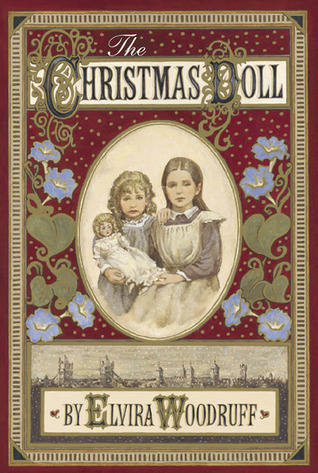
The Christmas Dollby Elvira Woodruff reads like an old-fashioned nineteenth-century classic, but it was published in 2000.
Two young sisters, Lucy and Glory, are orphaned and spend several years in a London workhouse with barely enough food. A deadly fever sweeps through the facility, claiming many of their friends. When Glory becomes ill, Lucy knows that if she’s taken to the infirmary, she’ll never come back. So she takes Glory and escapes.
But city streets are unfriendly to the poor, especially on winter nights. The girls suffer various mishaps. Finally someone tells them of “mudlarkers,” people who dig around in the muck by the river looking for things to sell. Lucy finds a dirty old doll with a quirky smile, setting off an unexpected series of events.
This book has some of the melodrama and fancifulness of a Dickens story. It was sweet and very well done. The audiobook was free for Audible subscribers at the time and wonderfully read by Bernadette Dunn.
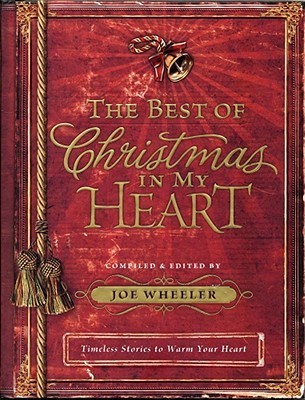
I had not heard of the Christmas in My Heart series by Joe Wheeler, but apparently he’s compiled several books of Christmas stories, his own as well as others’.
The Best of Christmas in My Heartis made of several heartwarming stories from the series gathered over the years. Many are old-fashioned, but some are new. Most are fiction, but some, like John Cain’s account of Christmas in a POW camp, are true. I had not heard of most of the authors, but a few familiar ones are represented, like O. Henry and McCain. One story about a tablecloth made the rounds of the Internet a few years back.
Wheeler begins the book with telling how he came to start writing and then start compiling this series.
There are eighteen stories, so it would be easy to spread this out over December with almost a story a night.
That wraps up my Christmas reading! Have you read any of these? Did you read anything Chrismasy in December?
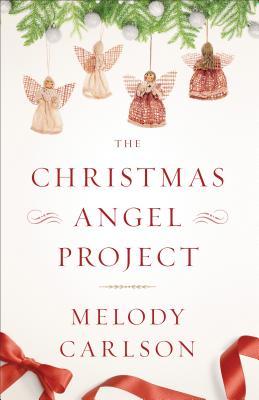
In The Christmas Angel Project by Melody Carson, five friends who are different ages and from different walks of life have been meeting together regularly for a book club. Just after Thanksgiving, one of the women, Abby, dies unexpectedly. She seems to have been the glue that kept them together and inspired them.
Some days after Abby’s memorial service, the other women meet together to decide what to do about the group–whether to keep meeting, invite more people, or disband. Abby’s husband gave the group a bag of Christmas gifts that Abby had prepared for them before she passed. They opened them together at their meeting. Abby had made an angel ornament for each of them with their individual characteristics.
Inspired by Abby’s example, the women decide to change their book club to a “Christmas angel” club. Each will choose a project involving their own unique gifts, talents, and resources and report back to each other once a week in lieu of reading books.
Belinda is Abby’s long-time personal friend, divorced with a college-age child. She started a thrift shop years ago that has become something of a boutique.
Cassidy is the youngest, a single veterinarian who struggles with self-confidence.
Grace is newest to the group. She and Belinda had an undercurrent of rivalry for Abby’s friendship. Grace and her husband argue over their twin’s lack of effort in college, among other things. Grace has her own home design business.
Louisa is the oldest of the group. Her husband passed away the year before. Now Abby’s passing has really affected her. She had been an artist, but hasn’t been inspired to create anything since her husband died. She wonders what she’s still doing here, why God didn’t take her instead of Abby.
As each woman struggles to decide what to do for her project, they each experience ups and downs, successes and failures, and learn more about themselves and others in the process.
It’s understandable that the book would start off sad. But it did seem a little depressing at first, especially for a Christmas story. The years when we were most grieving a loss, I don’t know if it would have been helpful to read a book like this or not.
But once they got going on their projects, the story picked up. I did enjoy the book overall. I was happy I discovered the audiobook free in Audible’s members’ Plus Catalog.
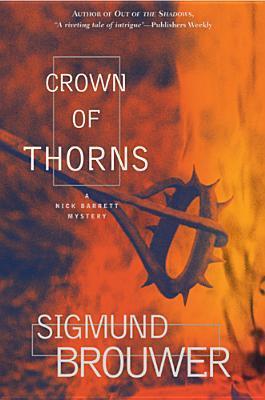
Crown of Thorns is the second in Sigmund Brouwer’s Nick Barrett Mystery Series, the first being Out of the Shadows (linked to my review).
Nick Barrett had grown up in Charleston high society as an outsider. His father was from an old, established family, but his mother was a waitress. In the first book, he had come back to Charleston after several years’ absence when he received an unsigned note promising information about his mother’s disappearance.
At the beginning of this book, Nick is still in Charleston, on a break from his teaching duties in New Mexico, embroiled with his half-brother in a court battle over the family inheritance.
While he waits, he visits frequently with a couple of old friends from his former years in Charleston, elderly twin sisters who own an antique shop. They ask him to help with a dilemma. A young girl from a crime-ridden side of town had come to them trying to sell a four-hundred-year old valuable painting that had been stolen from one of Charleston’s elite families fifty years earlier. They wanted to know, among other things, how this girl had come by the painting.
When Nick meets the eleven-year-old girl named Angel, he has no idea what he’s about to get into.
The plot weaves threads from a fifty-year-old murder, a young mother trying to escape from an abusive cult run by her father-in-law, and Angel’s voodoo-practicing grandmother.
If I had just started with this one and hadn’t read the first book or others of Brouwer’s, I probably would not have gotten past the prologue with its talk of voodoo spells. I just like to stay as far away as possible from that kind of thing. But I had read enough of the author’s work to trust he wouldn’t steer me wrong. He’s not promoting those practices and doesn’t go into gratuitous detail. And, as Nick’s journey has been spiritual as well as familial, the author clearly includes the offsetting truth of the gospel.
I look forward to reading the concluding book in the series.
In Secrets She Kept by Cathy Gohlke, Hannah Stirling’s mother has just passed away. More than mourning her mother, she mourns the loss of what could have been. Hannah’s mother had been distant from Hannah and her father for as long as she could remember.
Going through her parents’ home for some clue about her mother’s past turns out to be fruitless. When she sees the lawyer to finalize her mother’s affairs, Hannah is surprised to be given a key to a safe deposit box that Hannah had never known about. But all she finds there is her parents’ wedding certificate, her father’s military discharge papers, and a few empty envelopes with German addresses and stamps on them.
The paperwork, however, lets her know a shocking surprise: the man she called Daddy all her life could not have been her real father.
The point of view switches to thirty years earlier in Germany, when Hannah’s mother, Lieselotte Sommer, was a teenager just before Kristallnacht. Her mother lay dying, her brother was a whole-hearted member of the Hitler Youth, and her father was a rising member of the Nazi party. Lieselotte had loved her brother’s friend, Lukas Kirchmann, for as long as she could remember. She helps him and his family help Jews with food, false papers, and anything else they can. She longs for the day they can marry.
But Lieselotte’s father puts pressure on her to marry a Nazi officer and raise Aryan children for the Fuhrer. Her father has been distracted, but she never guessed the depths he would go to to further his own ends.
Switching back to Hannah again, her lawyer researches the German addresses on the envelopes in her mother’s safe deposit box. He discovers that she has a grandfather she never knew about. Her mother, Lieselotte, had said she was from Austria and her family all died in the war.
Hannah travels to Germany to meet her grandfather, to try to find out more about her mother, and to discover who her father was. At first she enjoys the connection with her grandfather. But her research uncovers horrifying family secrets.
This book was riveting. I listened to the audiobook, free at the time from Audible’s Plus Catalog, and eventually began looking for extra time to listen more. All the characters, including side characters, are well-developed and the plot. There’s so much more I’d love to say, but I don’t want to spoil anything for potential readers. So I’ll just say it’s a really good book and highly recommended.
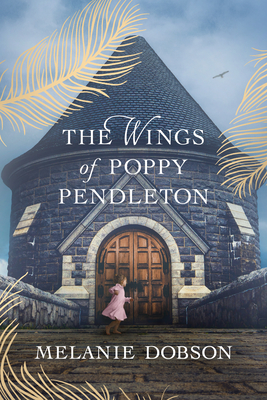
In The Wings of Poppy Pendleton, a novel by Melanie Dobson, the newly rich Pendleton family is trying to find a place among the top Gilded Age society families. Mr. Pendleton had built a stunning castle on Koster Island among New York’s Thousand Islands, and the family is hosting a fete for elite guests. Their almost five-year-old daughter, Poppy, is sleeping in the castle’s tower, supposedly under the care of one of the maids, while the guests party.
But in the morning, Poppy is missing and Mr. Pendleton is dead.
Police, detectives, and curious seekers investigate for years, trying to determine what happened. But Poppy’s disappearance remains a mystery.
In 1992, Chloe Ridell is the only resident on Koster Island. Her grandfather, Cade, had been the caretaker of the castle and island in the Pendleton’s time and decades afterward. Mrs. Pendleton willed the property to Cade, who then passed it along to Chloe.
Chloe is uninterested in the castle and has never been in it. She runs a candy store started by her grandparents, and she just wants to maintain their legacy. But her funds are running low.
Then one stormy night, a young girl shows up on Chloe’s porch. Her name is Emma, but she refuses to say much else about who she is or why she is there. She’s frightened, though, especially of a man named Mitch. Chloe feels led to let Emma stay while her situation is investigated by the police. Eventually, Emma lets Chloe see her scrapbook, which is filled with drawings, magazine cutouts, and descriptions of birds. On the last page is a picture from a news article about the magnificent aviary Mrs. Pendelton’s husband had constructed at her request and filled with dozens of birds and their native trees. The aviary burned down decades ago. But Chloe wonders at the oddity of Emma’s connection to the Pendletons.
Then another visitor shows up out of the blue. A reporter, Logan, arrives in Chloe’s candy shop. Poppy Pendleton’s ninetieth birthday is coming soon. Logan thought it would be a good time to look into her case again. Chloe has no interest. But Logan convinces her that solving the mystery will not only bring justice for Poppy, but it will stop the curious from tramping around her island and asking her questions.
The point of view switches between characters and timelines to uncover what happened to Poppy, her mother, and Emma.
So far I have loved all of Melanie’s novels, and this is no exception. She explores some darker themes than usual. But, sadly, the issues in the story are all too real.
I felt the faith element was woven in naturally and not at all preachy or stilted.
I listened to the audiobook nicely read by Nancy Peterson. Many audiobooks don’t include the author’s afterword or notes, but this one did. Plus Melanie tells a little bit about her research for the novel, with pictures from a trip to the Thousand Islands and its castles, here.
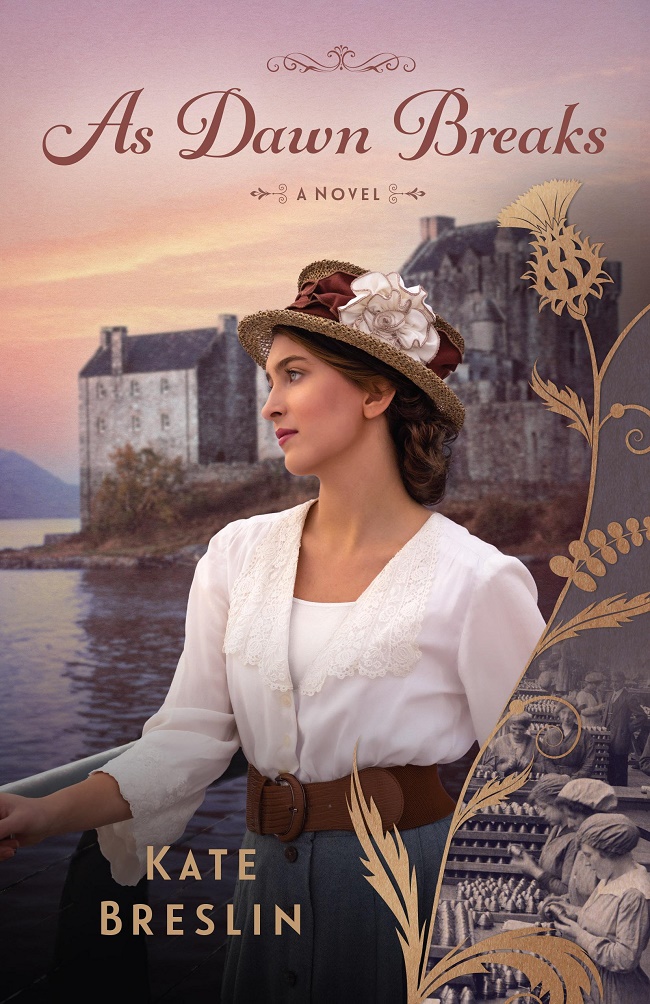
In Kate Breslin’s novel, As Dawn Breaks, Rosalind Graham works in a Chilwell munitions factory in England in 1918. Her parents had passed away long ago, and her uncle took Rosalind and her two brothers in. But the arrangement was far from cozy. Rosalind’s uncle is forcing her to marry a ruthless man she doesn’t love.
Shortly before the wedding, Rose’s best friend from the factory, Tilly, sends her to her apartment to get ready for a bridal shower. But while Rose is away, the factory blows up, killing hundreds, including Tilly.
Stunned and devastated, Rose eventually realizes the explosion offers her a way out of her dilemma. She can take on Tilly’s identity and leave, and everyone will think Rose died in the explosion. Though she hates to make her brothers think she’s dead, it’s the only way she can see to help herself and them. She plans to find a job in another town and then retrieve her brothers when she has saved enough money.
Rose/Tilly ends up in another munitions factory in Gretna, Scotland. She’s put in charge of a group, and one of the young women says her family will let her rent a room. She revels in a warm, caring, normal family life.
RAF Captain Alex Baird heads for home in Gretna on an undercover mission. Sources indicate the Gretna factory might be next for the saboteur. Alex is charged with working in the factory to find clues as to what might happen and who might be involved.
Alex is stunned to find a woman, Rose, who he knows as Tilly, renting his bedroom. He didn’t know his father was unable to work and needed to make money by renting out his room. Rose and Alex don’t get on well at first, but eventually they form a bond over their love for his family.
Then Alex receives word to surveil Tilly, who is suspected of having some connection in the Chilwell bombing. Rose knows nothing of Tilly’s involvement and wonders at Alex’s sudden interest in everything she does.
Meanwhile, Alex has secrets of his own that not even his parents know.
I didn’t know, when I read Kate Breslin’s Far Side of the Sea a couple of months ago, that it was the third of a five-part series. As Dawn Breaks is the fourth and has been in my Kindle app for a couple of years now. Each of the books is understandable alone, but it’s fun to follow some of the characters through the series.
I enjoyed the characters, and there was plenty of suspense in wondering what Tilly had been involved in, whether Rose would be blamed, whether the saboteur would be found in time, and other plot lines. I thought one of the threads was wrapped up a little too easily, but overall I enjoyed the book very much.






 Stray Thoughts