A revival of what?

Some days ago I turned on the radio to catch the news at noon, and caught the last few minutes of the prayer time my Christian radio station has right before 12:00. As I listened, I heard the announcer pray for “a revival of Biblical values” in our society. I stopped in my tracks and thought, “What?

50sI’m sure he meant well, and I am pretty sure I know what he meant, but that request struck me as a little off-base. I had the same reaction as I do when people speak of “reclaiming our culture for Christ.” I know they don’t mean this, but it brings to mind a 50s-style era where people were at least fairly decent in their lifestyles and even to some extent “God-fearing.” The problem is you can have a pleasant culture exactly like that with most of its members totally lost and on their way to hell.

I don’t think we’re called to reclaim cultures or promote Biblical values without the underlying base of trying to introduce people to the Lord. He has called us to make disciples. That kind of change comes from within and then influences a person’s actions which will then result in a change of values. Trying to promote Biblical values without a heart change is coming at things from the outside. It may make a person easier to live with, but it doesn’t change their destiny or character. But in this postmodern era, especially, Biblical values don’t make sense to someone without a Biblical heart.

I don’t mean that Christians should not be active in government. I’ve been listening to bits of Stephen Davey’s message “Stay on Task” (in other places it appears to be named “I Pledge Allegiance, Part II”) on the radio. I agree with the general thrust of his message that “The mission of the church is not moral reformation, but spiritual transformation” and “Our true battle is against the kingdom of darkness which has blinded the minds of the world to believe that God is not watching.” (It’s a great message – I encourage you to listen to or read it). On the other hand, just because Jesus or the apostles never tried to organize voters or push for campaign issues doesn’t mean it is wrong to do so. Unlike Bible times, we do have a government in these days where we can use our voice. We should first of all pray “For kings, and for all that are in authority; that we may lead a quiet and peaceable life in all godliness and honesty” (I Timothy 2:1-3). And personally I believe we should at least vote, as intelligently as possible. To be given such a gift at this time in history and not use it would be terribly negligent. Some might be called to do more, as described in the article “Is Voting Enough?” I think it is good for Christians to be involved in government as in every other segment of society, to be salt and light there. Since our government can be influenced by our voices, I am grateful for some who keep on top of issues, stand for the right, keep voters informed, and voice our concerns to our representatives. I don’t believe our ultimate hope is in government, but that doesn’t mean it isn’t a tool in God’s hands that can be used for good. Proverbs 21:31 says, “The horse is prepared against the day of battle: but safety is of the LORD.” God didn’t tell people to abandon their horses, but He told them rather to remember that ultimately safety is of Him. Our trust is in Him, not in any tools, even though He may use various tools to accomplish His objectives.

And in past history He has done so without a conservative culture or a representative form of government. I am extremely thankful for both of those and I hope we keep them. But the church can and should thrive with or without them. In Paul’s time, dictators were in power, yet the church grew in numbers and in character.

While we can and should use the tools at our disposal, those pursuits should never take priority over the basics of what God has called us to: being salt and light wherever we are, showing His love and grace to people, and telling them about the only God and Savior who alone can save them and meet their needs.

The Rupture of Self

From an old e-mail devotional from Elisabeth Elliot:

Sometimes our prayers are for deliverance from conditions which are morally indispensable–that is, conditions which are absolutely necessary to our redemption. God does not grant us those requests. He will not because He loves us with a pure and implacable purpose: that Christ be formed in us. If Christ is to live in my heart, if his life is to be lived in me, I will not be able to contain Him. The self, small and hard and resisting as a nut, will have to be ruptured. My own purposes and desires and hopes will have to at times be exploded. The rupture of the self is death, but out of death comes life. The acorn must rupture if an oak tree is to grow.

 It will help us to remember, when we do not receive the answer we hoped for, that it is morally necessary, morally indispensable, that some of our prayers be denied, “that the life of Jesus may be plainly seen in these bodies of ours” (2 Cor 4:11 JBP). Then think of this: the agonized prayer of Jesus in the garden went unanswered, too. Why? In order that life–our life–might spring forth from death–his death.

~ Elisabeth Elliot, A Lamp For My Feet

 Verily, verily, I say unto you, Except a corn of wheat fall into the ground and die, it abideth alone: but if it die, it bringeth forth much fruit.
John 12:24

Public domain image, royalty free stock photo from www.public-domain-image.com

(Photo courtesy of Public Domain Images.)

31 Days of Inspirational Biography: A Short List of Several

photo 3(2)

For the 31 Days writing challenge, I am sharing 31 Days of Inspirational Biography. You can find others in the series here.

As we near the end of the 31 Days writing challenge, I find I have many more inspirational biographies I’d like to share than days left in the month, so I’d like to share a short list of the ones I didn’t get to with a few comments on each.

Last year I wrote about 31 Days of Missionary Stories and ended with a list of the favorites I had read over some 37 or so years. In addition to those, plus the ones I have listed for 31 Days of Inspirational Biography this year, I can recommend these (those with links are ones I have reviewed and linked back to):

Kitty, My Rib by E. Jane Mall is story of the wife of Reformer Martin Luther. He was a former priest, she was a former nun. She was a well-suited complement to his personality.

Ida Scudder: Healing Bodies, Touching Hearts by Janet and Geoff Benge. The Benges actually have a series of biographies aimed primarily at younger people, but I have enjoyed the ones I have read. Ida was a daughter of a missionary doctor in India and had absolutely no plans of being a missionary herself until one night when three different women died whom her father could have helped but who were not allowed to be seen by a male doctor. She eventually became a doctor herself and went back to India.

Bruchko: The Astonishing True Story of a 19-Year-Old American, His Capture by the Motilone Indians and His Adventures in Christianizing the Stone Age Tribe by Bruce Olson. I really wanted to talk about this one this month, but it has been too many years since I read it and I did not have time to reread it this month. I do remember thinking he was perhaps a little headstrong, but overall it was a great book.

Dorie, The Girl Nobody Loved by Dorie N. Van Stone. It has been years since I’ve read this one, too, and I’d like to reread it some time, but the story of a grueling, abusive childhood overcome by God’s grace was very touching.

Gifted Hands by Ben Carson. I’m not sure if Dr. Carson is a Christian, but this is a great book about overcoming difficulties in childhood and changing direction in life. He grew up in poverty, did not do well in school, and had a horrible temper, but ended up being a pioneering neurosurgeon.

The Valley Is Bright by Nell Collins, the story of her salvation, her training as a nurse and plans to go to Africa, and the disruption (as it seemed) of her life by a serious cancer diagnosis. Part of her testimony is here.

Walking From East to West: God in the Shadows by Ravi Zacharias. You may have heard his radio broadcasts or benefited from his apologetics ministry. This is the story of how he came to the Lord and some of the difficulties in doing so for those from an Eastern mindset.

The God I Love by Joni Eareckson Tada. I’d also recommend When God Weeps by Steve Estes and Joni, not a biography but a book about why God allows suffering, and Joni and Ken: An Untold Love Story by Ken and Joni Eareckson Tada.

The Titanic’s Last Hero about John Harper, who told people about the Lord while clinging to debris from the ship. A testimony of him is here.

Same Kind of Different As Me by Ron Hall and Denver Moore. How one man’s reluctant service in a homeless shelter led to a lifelong friendship. This was riveting.

Heir to a Dream by Pete Maravich. I mentioned in an earlier post that I wasn’t really a sports fan, but I loved this autobiography of “Pistol Pete.” His dad groomed him to play basketball, even tucking a basketball into his bed instead of a teddy bear. He achieved great success and acclaim, but it was all empty until he found Christ. I first heard a bit of his testimony on some news show – 20/20, I think – and he seemed so genuine that I had to read the book. I could not find that interview online, but I did find this one:

The Autobiography of George Muller. Wonderful testimony of his rescue from a debauched lifestyle to an exercise of faith in supporting orphanages by depending on God alone.

Mistaken Identity by Don & Susie Van Ryn, and Newell Colleen & Whitney Cerak. Another riveting story of two girls in a horrific accident, and the surviving one was identified as the other.

In Trouble and In Joy by Sharon James, short biographies of Ann Judson, Margaret Baxter, Ann Steele, and Frances Ridly Havergal.

Faithful Women and Their Extraordinary God by Noel Piper, short biographies of Sarah Edwards, Gladys Aylward, Lilias Trotter, Esther Ahn Kim, and Helen Roseveare.

Thunder Dog: The True Story of a Blind Man, His Guide Dog, and the Triumph of Trust at Ground Zero by Michael Hingson

50 People Every Christian Should Know: Learning From Spiritual Giants of the Faith by Warren Wiersbe

Infinitely More by Alex Krutov, about an abandoned orphan in Russia whom God brought to Himself.

A Severe Mercy by Sheldon Vanauken, about his relationship with his wife, their conversion after originally having no interest in Christianity, her cancer, and his letters to C. S. Lewis.

The Reel Story by Larry D. Vaughn. Wonderful story about how someone outside the “bubble” of the conservative Christian world ended up a Christian. Larry was a film buyer, and his pastor and almost everyone else said he should continue in his job to be a witness to the film community, but Larry felt his conscience pricked and provoked enough that he finally had to leave the business.

The Hiding Place by Corrie ten Boom about her family’s involvement in helping to hide Jews during WWII and the consequences.

More Precious Than Gold, the Fiery Trial of a Family’s Faith by John and Brenda Vaughn. A garage fire had devastating consequences for Mrs. Vaughn and her young daughter. This book details the circumstances and how God helped the family through this trial.

As I have shared biographies that have inspired me this month, I tried to include some from people of various walks of life and some that were older as well as some modern ones. I hope you’ve found something to inspire you in some of these posts as well.

Tomorrow I want to write about “Why Read Biographies.” I know, a post like that should probably have come at the beginning of this series. I didn’t think about it then, beyond the remarks in my introductory post, but as I have been steeped in biographies this month, some thought came to mind I thought I’d share.

31 Days of Inspirational Biography: The Last CIM Missionaries in Communist China

In 1950, Arthur and Wilda Mathews and their 13 month old baby, Lilah, traveled to Hwangyuan, China. China had fallen to Communism, and other missionaries were leaving, yet the Chinese church had invited them to come, with the approval of the Communist government. They felt this was a miraculously opened door God would have them go through. Yet, when they arrived, they could sense that all was not well. The Christians pastors who met them were strained, and they discerned that between the time of their invitation and arrival, the Chinese learned that association with the white people would be a liability under Communism, not a asset. The Mathews then thought perhaps, if they could not be a help to the church, they could endeavor to evangelize the unreached Mongols in the area and nearby. They had a few weeks in which to minister, but soon found that they were restricted in ways they could help. They endeavored to set up an inn with which to reach the Mongols, but Chinese troops took it over the day before it was to open. Arthur protested, but soon found it would have been wiser to have said nothing. In two days a policeman came to the mission compound to announce that no one there could do village work without permission, and the white people were forbidden everything: they could not have meetings outside the compound, they could not give out tracts or dispense medicine. They were restricted to the mission compound.

They finally decided that since they were more of a hindrance than a help, they would apply for exit visas. They thought, since the government did not want them, they would be allowed to leave quickly, and so gave away or sold dishes, curtains, etc., keeping just the bare minimum to function until they could leave. Arthur was summoned to the police station and asked to sign a statement that he was for world peace. He had heard of another missionary having to sign some document before leaving, so he signed without thinking much of it. The government official then asked what contribution Arthur was then willing to make toward world peace, outlining a plan in which Arthur would go to India and essentially be a Communist spy. Arthur realized that the Communist definition of world peace was a world dominated by communism, and of course could not consent.

A government official called Arthur in and promised his exit visas if he would do something for them, like write a report of five other missionaries. At first Arthur did write glowing reports of the missionaries in question, but someone told him he dare not turn that in: the Communists would change what he had written but keep his signature. So Arthur threw his report in the fire and told the official he could not be a Judas. The official then told him that he could have given him a pass, if he had cooperated, but now a charge had been laid against him which must be investigated, and “investigations take a long time.”

Thus began a two and a half year ordeal. Their provisions from their mission were frozen by the government, which made Arthur submit a report of what he would need, and then they doled out to him much less than what the report said he needed. Every victory they mentioned in a letter seemed to be immediately challenged by the enemy of their souls: once when they wrote what a blessing Lilah was, she then came down with scarlet fever, and they almost lost her. All of them had turns being ill. Eventually they were told that no one could speak to them, and they could only leave home to draw water from the creek and get food.

They wrestled with the “what-ifs” and the frustration of what they called “second causes,” finally coming to the conclusion that they had to trust that the Lord was in control and had them there for a reason, though it was hard to discern that reason when they were so restricted. Yet the Lord did use them even when they could not speak to the people. The few weeks they had had to minister before restrictions set in, people knew their hearts and saw their love. When the Mathews could no longer speak openly, the people saw them in tattered clothes, persecuted, attacked by illness without much medical aid, laughed at, jeered, humiliated, doing menial, degrading work just to survive, tantalized by the government offering release and then not giving it or doling out money that was theirs in the first place. They saw the Lord provide miraculously for them in many ways. Yet more than that, they saw them endure graciously and joyfully until, finally, the Mathews became the last CIM missionaries to leave China.

Green-Leaf-in-DroughtHow the Lord provided for them and ministered through them in unexpected ways are some of the most exciting parts of the book Isobel Kuhn wrote of their story titled Green Leaf in Drought. She says,

But most amazing of all was their spiritual vigour. Whence came it? Not from themselves: no human being could go through such sufferings and come out so sweet and cheerful. As I was in a small prayer meeting… one prayed thus: ‘O Lord, keep their leaf green in times of drought!’ I knew in a moment that this was the answer. Jeremiah 17:8: “He shall be as a tree planted by the waters, and that spreadeth out her roots by the river, and shall not see when heat cometh, but her leaf shall be green; and shall not be careful in the year of drought, neither shall cease from yielding fruit.” That was it! There was an unseen Source of secret nourishment, which the Communists could not find and from which they could not cut them off…That is needed by all of us. Your drought may not be caused by Communism, but the cause of the drying up of life’s joys is incidental. When they dry up — is there, can we find, a secret Source of nourishment that the deadly drought cannot reach?…Is it possible for a Christian to put forth green leaves when all he enjoys in this life is drying up around him?

The answer, by God’s grace, is yes!

(Reposted from the archives.)

photo 3(2)

For the 31 Days writing challenge, I am sharing 31 Days of Inspirational Biography. You can find others in the series here.

Laudable Linkage

Here are some noteworthy reads online discovered in the last few weeks:

Voices That Haunt Us, ways to respond.

The Opposite of the Proverbs 31 Woman.

But Why Does She Get Babies?

Behold Your Mother. Quotes: “Care of parents, particularly in the latter years, is difficult, grueling, and offers little tangible reward. The elderly seem like speed bumps on the road to relevance. But if we really believe each human life was made in the image of God, if we really believe that every human has intrinsic worth, regardless of utility, we’d do better at embodying this ethic when it comes to equipping our people to care for their elderly parents.” “This is why care for the elderly is not simply “the right thing to do” but a vivid portrait of the gospel story. The Holy Spirit in us renews our self-centered motivations, reminding us that Christ cared for our spiritual disability while we were spiritually dead and “yet sinners.”

Ten Things To Do Differently *Before* You Lose Your Temper.

Bleep! Why Christians Shouldn’t Cuss.

5 Bad Substitutes For Discipline.

Dear Moms, Jesus Wants You to Chill Out.

Love Letters. HT to The Story Warren. Quote: “Today all around me I see a stark, utilitarian focus in writing in this age of technology: all must be said to purpose—briefly and efficiently; effortless interaction seems the primary goal as though thoughts are like footballs that simply need punting. Writing is regarded as a chore. Often, so is reading. Extra words, like Mozart’s famous “too many notes,” are regarded as distractions, time-consuming, even burdens on the reader. “Why does Melville ply us with his dense prose so packed with allusions? That is so boring,” I hear my students complain. “Why does Tolstoy carry on endlessly chasing one description after the other? Why can’t he just cut to the chase?” “Why does Tolkien play at length with interwoven plot lines in his wordy fantasies? Why can’t he get to the point?” Why? For one thing, I think it is because ‘the point’ is not the only thing that matters.”

And finally, something fellow book lovers will empathize with:

Waiting for sequel

Happy Saturday! 🙂

Book Review: How I Know God Answers Prayer

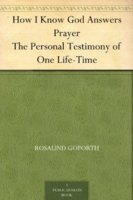
How I Know God Answers PrayerI think I first read Rosalind Goforth’s first book, How I Know God Answers Prayer, maybe in my twenties, so about 30 years ago. I don’t remember how many times I have read it since. It is a testimony of how God has answered prayers both small and great in her life through the years, spurred by people’s occasional response that perhaps what seemed an answer to prayer was just a coincidence that would have happened anyway. She wanted to demonstrate through a lifetime of her walk with God that prayer is just a child of God asking her Father for what she needs, and seeing Him answer – not always just the way she originally wanted, but with love and wisdom nonetheless. Of her three books, including Goforth of China (a biography of her husband) and Climbing (a book she was asked to write concerning some of her own experiences and perspectives), Climbing is my favorite, but this book is very good as well.

Since I was reading it this time for Carrie’s  Reading to Know Classics Book Club, I tried to view it as others might who have not read it before.  For the first time I thought perhaps a little of the effect of what she relates might have been lost by the description of events taken out of context. For instance, when she writes near the end about finding “that the Lord could guide me even in trimming my hat to his glory,” some people might think, “What?” In Climbing, one of the difficulties she underwent was criticism of her dress when she would come home on furlough. There was no Internet, Facebook, or even Wal-Mart in those days to keep up with what was going on in the fashion world back home, and she had no idea what would be stylish or out of style or different from the last time she had been there. It is really ridiculous that people would criticize under such circumstances, but they do. Once when a lady offered to get new outfits for her when she was home, she was relieved, until the lady brought her garments entirely in black, which she evidently thought was appropriate for missionary ladies. Jonathan told her she looked like she was in mourning, but she felt she couldn’t refuse the gifts without causing offense. She didn’t necessarily want to be up-to-the minute in the latest styles (in fact, when Merry Widow hats were in style at one point, she thought they were ridiculous and tried to find a way not to wear them), but she didn’t want to be a distraction, either, as they visited churches and conferences. In that book she relates some of God’s leading and answers to prayer regarding that whole issue, represented here just by the sentences, “I found the Lord could guide me even in trimming my hat to his glory! That is, so that I could stand before an audience and not bring discredit to my Master.”

She mentions the anti-foreigner sentiments and some of the dangers involved, but I don’t know if readers will understand just how pervasive and dangerous it was. China was a very closed-off country then, and anything “foreign” was suspicious (one reason why Hudson Taylor advocated dressing like Chinese rather than British). She does mention here that one of the ways she and her husband tried to combat this was to hold “Open House” where they’d let their neighbors come in and tour the house so they could see there wasn’t anything dangerous about them. In one of her other books she writes that one of these times, someone saw her daughter’s dolls in her bed and spread the word that the Goforths kidnapped children and shrunk them. It seems ridiculous now that anyone would think that, but it was a very superstitious and suspicious time. Rumors like that could at the very least cause people to avoid them, and at the worst set off a powder keg of anger. Sudden mob violence was not uncommon, especially leading up to the time of the Boxer rebellion. I remember reading in another book (I forget whose) about a missionary having in her school a skeleton for educational purposes, and then trying to decide how best to dispose of it so people wouldn’t think they had killed someone. Trying to preach a gospel that the people were probably going to react negatively against at first in such a setting indeed required a lot of prayer and faith.

But even with some events taken somewhat out of context, she presents a testimony full of grace in how the Lord dealt with her. Some of the answers she relates were major –  a sudden breakthrough in her husband’s grasp of the language when he was discouraged and near giving up, found later to have happened right at the time that a group in his old college had met to pray for him, response in meetings found to have happened when others were praying (incidents that should remind and encourage us to pray for others), healing when all other help had been exhausted, protection from danger, especially in their escape during the Boxer rebellion. Of the last, she was asked why God spared them so miraculously but not others. She responded:

Truly a vital question, which could not lightly be set aside! Humbly and prayerfully we pondered this “Why” in the light of Scripture. In the twelfth chapter of Acts, we read of Herod’s succeeding in putting James to death by the sword, and directly after comes the story of how Herod was hindered in carrying out his intention to kill Peter who was delivered by a miracle. Then who could read that marvelous eleventh chapter of Hebrews with its record of glorious martyrdom and miraculous deliverances without being thrilled? In face of these and many other passages, while still unable to answer the “why,” we saw our Almighty God used His own prerogative to glorify His name whether in the glorious martyrdom of some or in the miraculous deliverance of other.

I referenced this a few months ago in a post on our pastor’s cancer, how God heals some but not others, for reasons only He knows.

Such big and dramatic answers to prayer can be thrilling, but what touched my heart even more were the smaller, “everyday” answers: a lost key found, provision for clothes, a gift of fresh fruit, the need for a telephone and a coat and help during a speaking engagement when she felt ill.

Some of the incidents were deeply personal, such as the time her husband wanted to go touring out among the people, and she said no at first, for the safety of the children (smallpox was rampant and the Chinese then had no thought of keeping sick people home). She had to learn that “‘the safest place’ for myself and the children ‘was the path of duty.'” Though several of her children died from other causes, none died during this time in their ministry once she yielded to the Lord about it. Another personal situation was finally understanding what it was to rest in the Lord and trust Him for salvation from the power of sin and not just the penalty of it, after feeling like she had been on something of a roller coaster spiritually for 40 years.

Something else I thought some people might have a problem with in reading her book were the times she mentioned prayer being hindered by a wrong attitude or bitterness on her part, or, in one instance, the fact that she felt God allowed something to bless her for responding in a right way. These days what we often hear is that God deals with us on the basis of His grace, not our “performance.” That is true. Yet there are instances in Scripture, even in the New Testament, of disobedience hindering. We’re told that some people are sick and some have died because of partaking of the Lord’s Supper in a wrong manner, that we should reconcile with our brother before offering a gift to God, that confession of sin is a part of praying for healing, that we can’t expect forgiveness if we don’t forgive. We’ll never be perfect, but we can’t expect the Lord’s blessing if we are hanging on to known sin. As to the other, does God ever do a special little something for us when we obey in some area or do the right thing? I don’t know – I can’t think of a Scripture reference that deals with that exactly in the New Testament. We tend to think, especially when reading the Old Testament, “Be good and God will bless me, mess up and He will come after me hard.” But even there Job experienced great calamity even though he was doing everything right, and the wicked seem to prosper even when they are not obedient. Ultimately everything that God allows comes from His wisdom, love, and grace. But I have felt at times, especially in my very early days as a Christian, that some blessing or answer to prayer came just after taking an important step in the right direction, not as a reward or as God patting me on the head for doing right, but just as a little encouragement from a Father to His child. Don’t we do the same for our children? When we see them struggle in an area and do the right thing, don’t we give them some kind of encouragement, even if it is just a smile or a nod or a thumbs up or a “Well done”? Of course, we need to do right even if no one seems to notice or care or no “blessing” comes in response. I don’t think this nullifies the fact that it all comes from God’s grace because we can only obey and make right decisions with His grace. (I’ve written earlier that grace does not nullify the need for obedience but rather enables it. See Of grace, law, commandments, rules, and effort and What grace does not mean). God blesses us far beyond our ability to obey as it is, and obedience should be an outgrowth of love and reverence for Him rather than a “work” to “earn” blessing. This is too involved a topic for this post, but I feel sure she isn’t advocating that prayer and obedience are like vending machines where we put in out part and then expect God to do His – not at all.

Since this is a testimony of answered prayer, naturally most of the anecdotes involve those answers. Yet she also shares some times when God didn’t answer, at least not in the way she prayed for. In one instance, years later she could see and was thankful for the fact that He hadn’t granted a particular request, one that would have changed the path of her life away from China. In other instances, like healing that did not come and the deaths of several of her children, she continued to trust even though she couldn’t understand.

I don’t think Rosalind shared any of these answers to prayer with the attitude, “Look at me and my wonderful answers to prayer. Aren’t I special?”  I think she would have been horrified that anyone would think that. I think rather, she just wanted to show forth His provision and willingness to take care of His dear children’s needs, like the psalmists, whose testimony was, “Hear what great things the Lord has done and how He delivered me.” Every Christian walking and talking with God would have a record like this whether written or not, though admittedly probably not with situations like being delivered from an angry mob on the list. But like the Ebenezers I mentioned a few weeks ago, we should all be able to look back on those times where God met with us, provided for us, and answered prayer for us in a way that only He could. It’s good to share things like this with our families, so they know God didn’t just meet people’s needs back in Bible times, but He still does today. Such things redound to His praise and encourage us in the Lord when “when I remember you upon my bed, and meditate on you in the watches of the night;  for you have been my help, and in the shadow of your wings I will sing for joy.  My soul clings to you; your right hand upholds me” (Psalm 63:5-8).

photo 3(2)

For the 31 Days writing challenge, I am sharing 31 Days of Inspirational Biography. You can find others in the series here.

Reading to Know - Book Club

(This will also be linked to Semicolon‘s Saturday Review of Books.)

31 Days of Inspirational Biography: Margaret Baxter, Puritan Wife Of Like Passions As We Are

A few years ago I reviewed In Trouble and In Joy by Sharon James, which features four different women of God: Margaret Baxter, Sarah Edwards, Anne Steele, and Frances Ridley Havergal. Of Margaret Baxter I wrote:

Margaret Baxter was a rebellious, glamorous, well-to-do teen-ager who became a Christian under the preaching of her Puritan pastor, Richard Baxter. Though he was twice her age, Margaret fell in love with him, and in time her feelings were reciprocated, and they married. The union was a step down for Margaret socially and financially (Richard took care to arrange their finances in such a way that he did not have access to her money so it would not be thought he married her for her money), but  she had found her purpose in life and blossomed. This was a time when “Non-conformists” were persecuted, and when Richard was imprisoned for a while, Margaret voluntarily joined him. Both were, like all the rest of us, very human. Margaret was known for being generous, cheerful (Mrs. James notes, “It is simply not true that the Puritans went around looking miserable. Indeed, Richard Baxter wrote, “Keep company with the more cheerful sort of the godly; there is no mirth like the mirth of believers” [p. 49]), industrious, competent, capable, patient, supportive — and anxious, fearful, perfectionist, and over-zealous. Yet she was aware of and grieved by her faults, and it was her desire to live a holy life for God.

In the July/August 2002 issue of Frontline Magazine is an article by my former pastor, Dr. Mark Minnick, titled “’Dear Companion’ — A Husband’s Loving Tribute” about Richard Baxter’s now out-of-print book about his wife, A Breviate of the Life of Margaret, which appears to be online here. Richard Baxter was perhaps one of the better known Puritan preachers and writers. The Baxters lived in the 1600s. He was 47 and she was 26 when they married. One of their earliest marital adjustments was that he thought “so much ado about cleanliness and trifles” and keeping “stairs and rooms…as clean as dishes” was a “sinful eccentricity.” He did change his mind, however, and “left [such things] to her discretion.”

He writes of her “utter selflessness,” her charitable acts, her cheerfulness in hard times, her desire for the conversion of others, and many other aspects of her life. But the one thing I want to focus on in this short space is her fears. She was naturally “of too timorous and tender a nature,” and Baxter writes that her “diseased fearfulness” was “the great infirmity which tyrannized over her…against which she had little…free will or power.” “’Anything that had suddenness, noise, or fierceness in it’ upset her.” Dr. Minnick remarks that there may have been very good reason Margaret was this way: “Nearly her entire life was shot through with calamity. Her home had been stormed by soldiers when she was just a girl…plundered…and set on fire, [they] killed some of the household, and then stripped the very clothing from those they spared.“ She had nearly died from one illness; “there had been fires near her lodgings, the near collapse of the floor of an upper gallery…while Baxter was preaching” once; her mother’s death, her husband’s illnesses, dreams of “fires and murders.”

“For our encouragement and learning, this natural timidity displays that Margaret’s fearlessness before persecution was not simply the courage of a bold spirit. It was, Baxter wrote, ‘an evidence of the power of grace that so timorous a person…was more fearless of persecution, imprisonment, or losses and poverty thereby, than I or any that I remember to have known’” (emphases mine). She was a woman “of like passions” as we are, yet God’s grace strengthened her and caused her to triumph.

“Her husband’s troubles, care of the poor, and conscientious life all cost [her] dearly… Baxter reflected that perhaps her conscientious intensity contributed to her untimely death [after just nineteen years of marriage]. ‘She set her head and heart so intensely upon doing good that her head and heart would hardly bear it. Her knife was too keen,’ he observed, ‘and cut the sheath.’”

photo 3(2)

For the 31 Days writing challenge, I am sharing 31 Days of Inspirational Biography. You can find others in the series here.

31 Days of Inspirational Biography: Ann Judson, Brave and Faithful

Every missionary has to have dedication and has to be willing to make sacrifices, even in our day. But the amount of dedication and sacrifice and willingness to step into the unknown displayed by Adoniram and his wife and the small group who stepped out with them just amazes me. His wife, Ann Hassletine (also called Nancy) is one of the bravest women I have ever read of, going into the great unknown as she did and facing all that she did in later years. The letter Adoniram wrote to ask her father for her hand in marriage in July of 1810 is an atypical proposal, but frank:

I have not to ask, whether you can consent to part with your daughter early next Spring, to see her no more in this world; whether you can consent to her departure, and her subjection to the hardships and sufferings of missionary life; whether you can consent to her exposure to the dangers of the ocean; to the fatal influence of the climate of India; to every kind of want and distress; to degradation, insult, persecution, and perhaps a violent death. Can you consent to all this, for the sake of Him who left His heavenly home and died for her and for you; for the sake of perishing immortal souls, for the sake of Zion, and the glory of God?

He was not being melodramatic: he was being realistic. It says a lot about Nancy that she accepted such a proposal, especially as it was written only a month after they had met. It took her two months to respond.

Adoniram and Ann were among the first missionaries that we know of that America sent out. I wrote about Adoniram’s biography, To the Golden Shore, last year, but this time I want to focus on Ann.

Ann had come to saving faith in Christ as a teenager, and since that time had developed a strong sense of reverence and dedication to God and a desire to be useful in His service. She would not have taken such an offer as Adoniram’s lightly. She consented and married him more than a year later.

Theirs is one of the most fascinating and, in many ways, heartbreaking stories in Christendom. They sailed for India with a few others. They left as Congregationalists, but during their months at sea their study of baptism in Scripture led them to become Baptists. This step of what they felt was obedience was also a step of faith, as it meant they would no longer be supported by the Congregationalists. Whatever your feelings about modes of baptism and denominations, it says a lot about their character that they would follow through with what they believed to be right as a matter of conscience even though it would cost them in many ways.

Through a variety of circumstances too long to tell here, they ended up in Burma (now known as Myanmar) rather than India. During they voyage Ann had delivered a baby which died and was buried at sea. They labored for six years without a convert and worked on translating the Bible into the native language. Within a year after that first convert, they had baptized 18 Christians. Ann opened a school for women and children. Another son was born and died.

Adoniram was imprisoned for a year and a half due to circumstances too long and detailed to go into here, but involved the Burmese misunderstanding of Adoniram’s banking situation, and they thought they money he was receiving for support from the British, with whom they were at war, meant he was a spy. Ann faithfully visited, bribed the guard so she could see Adoniram, brought him food and encouragement, smuggled his Bible translation work to him a hard pillow, repeatedly appealed for his release, and did what she could to relieve the suffering of the other prisoners as well. When Adoniram and other prisoners were forced to walk barefoot 8 miles to another prison, Ann took her baby daughter and followed. She wrote to her brother around this time, “But the consolation of religion, in these trying circumstances, were neither ‘ few nor small!’ It taught me to look beyond this world, to that rest, . . . where Jesus reigns and oppression never enters.” She fell severely ill with smallpox and spotted fever, and Adoniram was able to nurse her back to health when he got out, though she remained weak. Some time later she contracted another fever she could not fight off. She died at the age of 36, and her baby daughter died soon after.

She had wanted to be  “useful,” and God certainly did use her throughout her life and since. After her death God worked through a book she had written about the early mission work in Burma to inspire interest in missions. He works through her biographies today to encourage us to a closer walk with God and closer dedication to Him. To the Golden Shore naturally has much about her as well as Adoniram, and My Heart In His Hands: Ann Judson of Burma by Sharon James tells Ann’s life story primarily through her journals and letters. Unfortunately it is not in print, but used copies can be found for just a few dollars (somebody needs to work on getting some of these books on Kindle!) Some years ago I read The Three Mrs. Judsons by Cecil Hartley, but I don’t remember much about it. It is available online here. In looking for that one I came across Lives of the Three Mrs. Judsons by Arabella Stuart that is free for the Kindle: I haven’t read it but just ordered it. It is also available online here.

The title from Sharon’s book comes from a journal entry of Ann’s after she accepted Mr. Judson’s proposal:

If nothing in providence appears to prevent, I must spend my days in a heathen land. I am a creature of God, and he has an undoubted right to do with me, as seems good in his sight… He has my heart in his hands, and when I am called to face danger, to pass through scenes of terror and distress, he can inspire me with fortitude, and enable me to trust in him. Jesus is faithful; his promises are precious. Were it not for these considerations, I should sink down with despair…But whether I send my days in India or America, I desire to spend them in the service of God, and be prepared to spend an eternity in his presence. O Jesus, make me to live to thee, and I desire no more.

photo 3(2)

For the 31 Days writing challenge, I am sharing 31 Days of Inspirational Biography. You can find others in the series here.


31 Days of Inspirational Biography: Louis Zamperini, Olympian, POW, Christian

The preface of Unbroken by Laura Hillenbrand tells of three men in a raft in the Pacific Ocean. Their plane had crashed, the rest of the crew was dead, they’d been on the raft for 27 days. Finally they rejoiced to hear a plane. They shot flares into the sky and put dye in the water to make their raft more visible. But then the plane started shooting at them: it was Japanese, not American. One of the men jumped into the water, but the sharks came toward him…

And then the author cuts away to the childhood of Louis Zamperini, one of the men in the boat. He had been on the fast track to becoming a juvenile delinquent until his brother intervened for him with the high school principal who had banned Louis from participating in sports as a punishment. The principal relented and allowed Louis to run track, where Louis found focus and purpose.

Louis did so well, in fact, that he ran in the 1936 Olympics in Berlin and was expected to be the first man to break the four-minute mile. His dream of the 1940 Olympics was shattered when they were cancelled due to WWII.

Louis joined the Army Air Force and became a second lieutenant and a bombardier. On one harrowing mission, his plane was ravaged by over 500 bullet holes, yet made it safely back to base.

But on one May day in 1943, their plane crashed into the Pacific, killing the other eight crewman. Louis and the other two survivors stayed afloat for 27 days until the event described in the preface occurred.

I had thought that would be the climax of the story, but it was just the beginning of Louis’s troubles. The crew was eventually captured by the Japanese and taken to a place off the grid from the other POW camps. It was not registered with the Red Cross, no one knew about it, the men were given up for dead, and ultimately the Japanese could do what they wanted with the prisoners with no fear of consequences.

When we think of WWII we often think of the atrocities of the Nazis, but the Japanese were uncommonly cruel. Hillenbrand explains that their concept of “saving face” makes surrender the ultimate humiliation, and the soldiers’ surrender to them gave them license, they felt, to degrade them in any way that came to mind.

At several points in Louis’s story, I thought, “How much more can one man endure?” He must have wondered the same thing at times.

Even after he returned home, his troubles did not end as he was afflicted with post-traumatic stress syndrome, severe nightmares, and succumbed to alcoholism.

But the subtitle to Unbroken is “A World War II Story of Survival, Resilience, and Redemption.” Louis’s survival, resilience, and redemption make for an exceptionally touching and inspiring book.

The story is told primarily through narrative, with very little dialogue, but it is captivating. I listened to it via audiobook, and Edward Herrman did an excellent job narrating.

There are those who would want to be forewarned that there is a smattering of bad language in it, understandable in the context, including one particularity vulgar word that could have been left out. But other than that, this is an excellent book.

A movie is being made of Louis’s life, and I hope they won’t leave out the faith element. After Louis got back to the USA, his troubles weren’t over, but God used them to lead him to Himself.

(Reposted from the archives)

photo 3(2)

For the 31 Days writing challenge, I am sharing 31 Days of Inspirational Biography. You can find others in the series here.


31 Days of Inspirational Biography: Corrie Ten Boom Repurposes a Concentration Camp

I saw this on the Corrie Ten Boom Facebook page.

Corrie Ten Boom

I have not read the book mentioned, but I have read The Hiding Place by Corrie and have an audiobook copy to listen to sometimes. It is amazing and convicting the grace God gave Corrie and her sister for all that He had them go through.

photo 3(2)

For the 31 Days writing challenge, I am sharing 31 Days of Inspirational Biography. You can find others in the series here.