
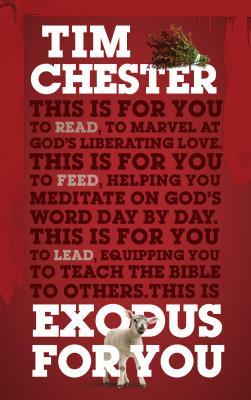
The book of Exodus has some of the most exciting and touching passages in the Bible, but also some chapters of details that aren’t quite so inspiring to read. Our ladies’ Bible study at church used Exodus for You: Thrilling You with the Liberating Love of God, where Tim Chester shares insights to better help us get the most from Exodus.
The narrative in Exodus begins some 400 years after Genesis ends. Jacob’s whole family had come to Egypt to escape famine, under the favor of son Joseph. But now a king had arisen who did not Joseph and didn’t regard his leadership and help during the famine crisis so many years ago. All this king knew was that there were enough Israelites to potentially rise up against Egypt. So he had them enslaved and commanded that male Israelite babies be killed.
During this time, Moses was born. You’re probably familiar with the story of his mother making a waterproof basket to put her baby in and setting it upon the Nile, where it was found by Pharaoh’s daughter, who took Moses to raise as her own.
The next several chapters detail Moses’ life, call of God to deliver Israel, and development as a leader.
Then we have the ten plagues in Egypt, the Israelites’ exodus, God’s deliverance through the Red Sea, the giving of the law, and the golden calf incident and its consequences. Some of the tenderest passages occur as Moses intercedes for God’s forgiveness for His people and then asks to see God’s glory. There are several chapters of details about the law and instructions for the tabernacle, it’s furnishings, and the priest’s garments. The book ends with the people obeying God by constructing the tabernacle and the glory of the Lord filling it.
God had promised to dwell with His people, and the tabernacle was a vivid picture of His fulfillment of that promise, which ultimately pointed to a fuller fulfillment to come in Christ.
Some of my favorite chapters in Chester’s book dealt with the symbolism of everything about the tabernacle. One of our Sunday School teachers from another church taught symbolism that the Bible doesn’t corroborate, like the four corners of the altar representing the four gospels, and the two cherubim over the mercy seat representing the Old and New Testaments. I don’t know if he got such ideas from a source or from his own musings. Chester does a much better job of showing from the rest of Scripture what each item symbolizes and points to.
Chester draws several parallels between the tabernacle and the garden of Eden, which was new thought for me. The cherubim guarding the entrance to Eden after Adam and Eve sinned and the cherubim oven into the curtain between the Holy and Most Holy place were pretty obvious parallels. I am still pondering some of the others (some are listed here).
I had never before heard of Chester’s description of God’s judgment and restoration through the Red Sea incident and others.as “uncreating” and “recreating.” I’m not quite sure I agree with that depiction–I have to think about it some more.
Some of my favorite quotes from Exodus for You:
God “remembered his covenant with Abraham”. What is going to drive this story is the promise to Abraham. “Remembering” is a covenantal term. It means deciding to act in order to fulfil a covenant. It’s not that the promise to Abraham had somehow slipped God’s mind. It’s not that he got distracted by other things. “Remembering” means 20
God is about to take the next step in the fulfilment of his promises (pp. 19-20).
One of the many ways in which God works good from suffering is that he uses it to make us cling to him in faith, to clarify our identity as his children and to increase our longing for the new creation (p. 21).
Moses will discover who God is through God’s saving acts. God is self-defining, and he is about to provide a definition of his name–and that definition is the exodus. In the exodus we will see the holiness of God in his judgment on Egypt. We will see the power of God in his triumph over Pharaoh and the gods of Egypt. We will see the grace of God in the redemption of Isarel. And we will see the rule of God in his words on Mt. Sinai (p. 41).
God intends not only to make himself known to Israel but also through Israel. The law is given to shape Israel’s life so that they display the character of God. It is missional in intent (p. 141).
“You shall not make for yourself an image” (v. 4). This is to reduce God to something of our own making–not to replace him, but to make him manageable, to understand him according to our notions rather than according to his revelation in his word. Have you ever judged God or reduced him? (p. 176).
For the most part, I greatly benefited from what Chester shared in this book.
If you’d like an overview of Exodus, the Bible Project shares it in two videos–Part 1 is here, part 2 is here.

 Stray Thoughts