
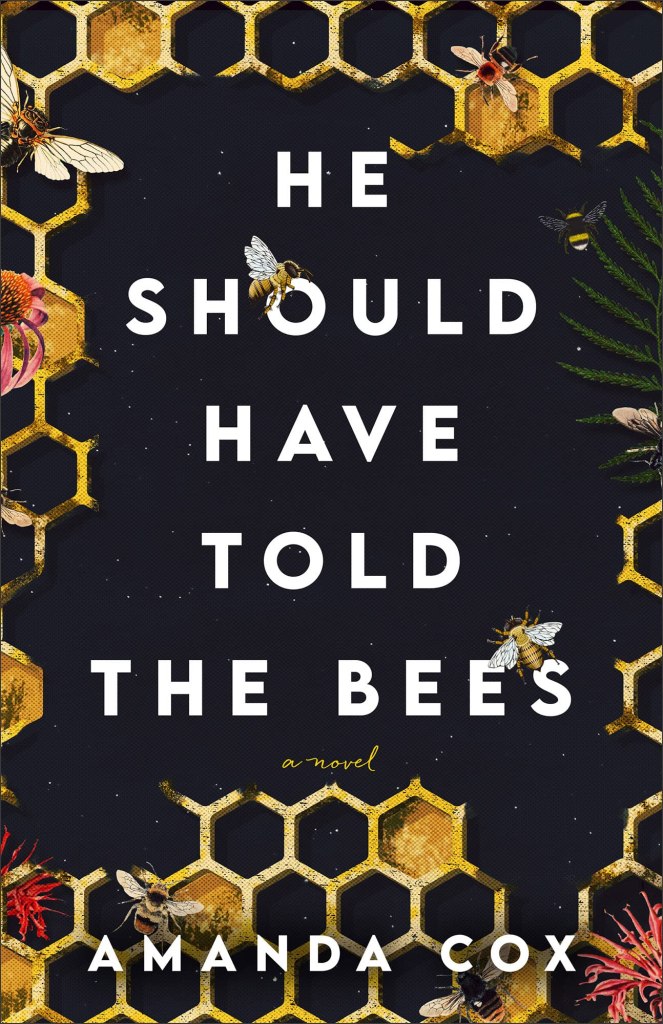
He Should Have Told the Bees by Amanda Cox tells the story of two young women whose lives intersect unexpectedly.
Beckett Walsh kept bees with her father until he died unexpectedly. Her mother had left them when Beckett was small. Though memories of her mother are hazy, her leaving sent Beckett into nightmares of monsters when she was a child and panic attacks as a young person and adult. Her father had left his job as a banker to homestead, start an apiary, and accommodate Beckett’s needs. But now he’s gone. Still, Beckett thinks she can do just fine, despite her aunt’s attempts to manage her life.
Callie Peterson grew up with an unstable alcoholic mother who went through a series of men. Now Callie has distanced herself and bought a building to start a new business making candles, lotions, etc. But the building is going to need more work than she thought. And then her mother shows up on her doorstep, claiming she’s ready to seek help. When Callie takes her to a rehab center, she’s unaware that her mother named her as the person responsible for the finances needed.
Both women get a summons about a hearing for a trust that Beckett’s father had set up, naming them both as co-owners of the farm. The two women never knew each other before. Beckett can’t fathom why her father would name this stranger a co-owner when he knows Beckett’s needs and problems. Callie doesn’t, either. But she wonders if selling the farm could help her financial problems. But doing so would oust Beckett from the only safe place she knows.
Both women try to understand why Beckett’s father named Callie in the trust. Their search leads them to secrets and connections they never knew about. Will both their lives be upended–or fulfilled?
I enjoyed this story quite a lot. It was easy to sympathize with each woman’s journey and pain.
The side characters are delightful. Beck is unexpectedly visited by a neighbor in the form of a young girl who says she is an alien. Callie’s booth neighbor in the markets where they sell their wares turns out to be a stabilizing factor in her life.
The book opens with an excerpt of a poem by John Greenleaf Whittier titled “Telling the Bees,” in which beehives are draped in black as the bees are told their keeper has died. Evidently, according to Wikipedia, this is a custom in many European countries. It was even done when Queen Elizabeth died in 2022.
At one point, Callie’s friend points out some sunbeams and says:
They’re called crepuscular rays. And they happen because of light hitting dust. It’s just ordinary, boring particulate floating all around us like it always does, and then bam, the light hits it and suddenly it’s something that makes people stop and take pictures. If that’s not a miracle, then I guess I don’t know what a miracle is (p. 54).
That becomes an underlying theme.
A few other quotes that stood out to me:
If she could stack up all the hurt in the world and sort the kind inflicted with malicious intent from the hurt inflicted by carelessness, how would the two compare? Was there really any difference when the result was the same? (p. 216).
It was a hard lesson to learn—that you couldn’t be the one to fill the holes in another person’s life. Working through dysfunctional patterns, finding healthy coping skills, and letting God heal the wounds the past left behind, those were things you couldn’t do for another person. No matter how much you wanted to (p. 251).
It’s possible for treasured things to come out of the brokenness. Even if it doesn’t happen the way any of us would have wanted. Even if it comes through loss (p. 299).
On a humorous note, it’s fun to notice a particular author’s unique repeated words. In this book and others, Amanda uses the word “scrubbed” a lot (eight times in this book)–she scrubbed her eyes, he scrubbed his hand over his face. And hearts tend to “stutter-step” when upset. And people “worry” their bottom lips.
Amanda doesn’t have end notes about the story, but there is an interview here where she discusses the book.
All in all, I’m happy to recommend this book.
(I often link up with some of these bloggers.)



 Stray Thoughts