
Be Careful of Your Strengths

Be careful of your strengths

I don’t consider myself to be good at public speaking. Even in a few interviews I’ve done, when I’m responding and not talking by myself, I don’t feel I do well. I don’t think quickly “on my feet.” It takes me a moment to process and respond (which is one reason I like writing better).

The nerves usually calm down exponentially once I get started. But for days afterward, I think of things I should have said or could have said better.

But I want to be faithful with opportunities the Lord gives me. So when they come, I spend time in prayer while I prepare. It comforts me that Paul told the Corinthians that he had been with them “in weakness and in fear and much trembling” (1 Corinthians 2:3), though it probably wasn’t public speaking itself that made him feel that way.

Hopefully, these skills will improve over time.

I told someone recently that these things would be so much easier if I could turn off the nervousness. But then I realized those nerves probably keep me dependent on the Lord, so ultimately they’re good.

When we’re asked to do something that we’re not sure we can do, that feels too big for us, that isn’t in an area where we feel gifted, it’s almost instinctive to run to the Lord.

When we attempt something that we failed at before, we plead for and depend on the Lord’s help.

When we know we might be facing a big temptation in an area where we’re weak, we fortify ourselves with prayer and Scripture.

But what about the areas where we feel strong, where we feel our best gifts are, where we feel we can function well? Those things that we do without even thinking to pray?

It’s not that we can’t approach some tasks with confidence or the assurance that comes from experience. But we often forget we need God’s help in those areas, too. Whatever gifts we have, He gave them to us. We don’t hold them in perfection yet: we’re still growing and learning. Jesus said, “I am the vine; you are the branches. Whoever abides in me and I in him, he it is that bears much fruit, for apart from me you can do nothing” (John 15:5).

One of the most chilling Scripture passages to me is the story of Uzziah in 2 Chronicles 26. He began to reign in Judah at the age of sixteen. “And he did what was right in the eyes of the Lord, according to all that his father Amaziah had done. He set himself to seek God in the days of Zechariah, who instructed him in the fear of God, and as long as he sought the Lord, God made him prosper” (verses 4 and 5).

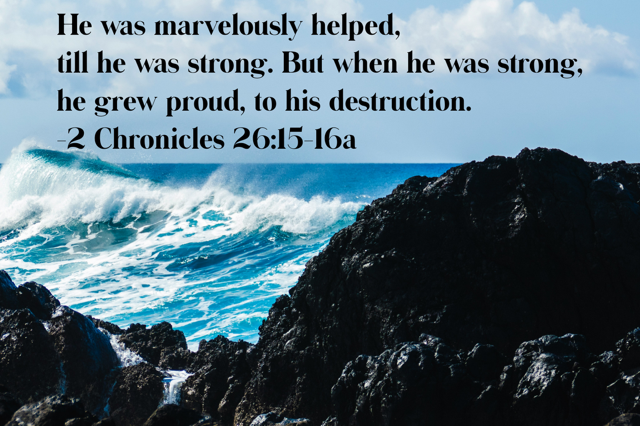
The next several verses tell about Uzziah’s victory in battle, his buildings, herds, crops, army, and machines. He was skilled in many areas. “And his fame spread far, for he was marvelously helped, till he was strong” (verse 15).

But when he was strong, he grew proud, to his destruction. For he was unfaithful to the Lord his God and entered the temple of the Lord to burn incense on the altar of incense” (verse 16).

It’s sadly possible to receive God’s grace and help for a task and then get puffed up as if we accomplished what He wanted us to do on our own.

He forgot where his strength, gifts, and skills came from. His pride led to presumption. Only the priests were consecrated to burn incense in the temple. They withstood him. He got angry.

Then leprosy broke out on his forehead. In that era, leprosy required quarantine. He lived the rest of his days in a separate house, and his son reigned in his stead.

His situation reminds me a bit of Samson, who took his gifts casually and flirted with the wrong kind of woman who tried to find the secret of his strength in order to tell his enemies. When she told him the Philistines were coming for him, “he awoke from his sleep and said, ‘I will go out as at other times and shake myself free.’ But he did not know that the Lord had left him” (Judges 16:20).

Jerry Bridges said in The Discipline of Grace, “Your worst days are never so bad that you are beyond the reach of God’s grace. And your best days are never so good that you are beyond the need of God’s grace.”

Jeremiah 9:23-24 tells us, “Thus says the Lord: ‘Let not the wise man boast in his wisdom, let not the mighty man boast in his might, let not the rich man boast in his riches, but let him who boasts boast in this, that he understands and knows me, that I am the Lord who practices steadfast love, justice, and righteousness in the earth. For in these things I delight,’ declares the Lord.”

I don’t want to go about my tasks without God’s power. I want to remember that I don’t have anything except what I have received from Him. I want to be just as dependent on Him when I feel sure of myself as when I feel overwhelmed. I want to remember that every good gift comes from Him and is to be used for Him.

The prayer in the song “O Great God” is what I want to express for myself. The last stanza talks about living a life dependent on His grace, for His glory:
2 Chronicles 26:15-16a

Some additional songs that help my thinking:

(I often link up with some of these bloggers.)

When It’s Good to Be Dependent

As parents, we ultimately work ourselves out of a job. As much as we love our children and miss them when they leave home, we want them to be able to stand on their own two feet as responsible adults. We’ll always listen, support, and help them when they need it, if we’re able. But there is every likelihood we’ll be gone before they are, so they need to function independently.

Spiritually, though, we never outgrow our dependence on God. In fact, we mature more spiritually the more we realize our need for dependence on God.

In Psalm 30, David said, “As for me, I said in my prosperity, “I shall never be moved.” By your favor, O Lord, you made my mountain stand strong; you hid your face; I was dismayed” (verses 6-7). Warren Wiersbe says “prosperity” here means “careless ease, a carefree self-assurance because things are going well” (Be Worshipful [Psalms 1-89]: Glorifying God for Who He Is, p. 116).

That happens all too easily, doesn’t it? When things are going well, we forget God is the One who made them go well. We get comfortable, and we forget our need for God . . . until a crisis comes up. The Bible is replete with examples of individuals and nations who went through that pattern.

My friend J. D. Wininger is a rancher who wrote recently about depending on God through unpredictable weather. His area faced eighteen months of drought last year. Now they’ve had so much rain, he can’t harvest some crops or plant others. I’ve often thought that the life of a farmer or rancher is one of felt dependence on God through all the things that can happen to influence the outcome of crops and herds.

But people in other occupations are just as dependent, even if they don’t know it. Employees think everything is going fine, until they receive notice that their particular job has been phased out, or their company is closing or has been bought by someone else. A new technology can put a whole industry out of business.

As the recent pandemic showed us, one part of society affects another. Suddenly we couldn’t count on finding basic supplies at the grocery store or even a bed in the hospital when needed.

And it’s not just in the area of physical provision that the rug can be pulled out from under us. We can be on top of the world socially. Then a poorly-worded tweet gets us “canceled.” Or a rumor or misunderstanding turns friends against us. David wrote, “All who hate me whisper together about me; they imagine the worst for me . . . Even my close friend in whom I trusted, who ate my bread, has lifted his heel against me” (Psalm 41:7, 9). Job lamented, “My relatives have failed me, my close friends have forgotten me. . . All my intimate friends abhor me, and those whom I loved have turned against me” (Job 19:14, 19).

Many of us have had the experience of being in perfect health one day only to be hit with a debilitating illness out of the blue. Or a loved one who seemed fine is found to have cancer that has been growing for months.

Does God shake things up for us sometimes as a thump on the head to remind us that we need Him? I don’t think so. He’s a loving father, not a capricious one.

We live in a fallen world and have an active enemy. God allows suffering for many reasons.

But I think He does teach us through His Word and through life experiences to remember to depend on Him for everything. He reminds us that He is our creator, provider, protector, friend. He promises to meet all our needs. He promises to be with us in any trial.

When we forget any of those things and become self-reliant, we usually get ourselves into trouble. I did a study once on what happens when we want our own way. It’s not pleasant.

Recently I was praying over a recurrent physical issue. As pondering and prayer intermingled, my thoughts ran something like this; “You know, most people don’t even think about this, much less pray about it. Am I going to have to pray about this every day? Can’t I just ask You to take care of it now and forever?”

The “Lord’s prayer” came to mind, where Jesus instructed His disciples to pray, “Give us this day our daily bread.” Our daily bread. Not enough for the week, or a lifetime. But just what we need for today.

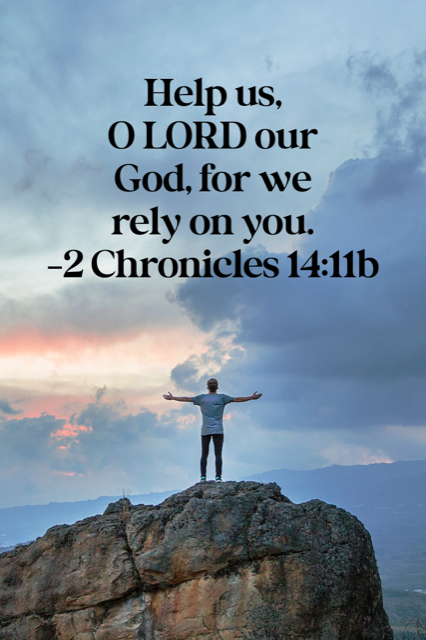
One day King Asa of Judah faced a much larger army from Ethiopia that had come against Judah (2 Chronicles 14). “And Asa cried to the Lord his God, ‘O Lord, there is none like you to help, between the mighty and the weak. Help us, O Lord our God, for we rely on you, and in your name we have come against this multitude. O Lord, you are our God; let not man prevail against you’” (verse 11).

I looked up the Hebrew word translated “rely” and read some of those occurrences here. The word can also be translated, lean, stay, and rest.

Rest.

Isn’t that what happens when we rely on God? We don’t have to worry about what’s going to happen. We can trust and obey.

Jean Sophia Pigott caught this idea of resting in the Lord in her marvelous hymn, “Jesus, I am Resting, Resting.”

Simply trusting thee, Lord Jesus,
I behold thee as thou art,
And thy love, so pure, so changeless,
Satisfies my heart;
Satisfies its deepest longings,
Meets, supplies its ev’ry need,
Compasseth me round with blessings:
Thine is love indeed.

As God’s child, I never outgrow my need for Him. I never become independent from Him. The farther I go in life, the more I realize I need Him for everything, great and small.

Abide in me, and I in you. As the branch cannot bear fruit by itself, unless it abides in the vine, neither can you, unless you abide in me. I am the vine; you are the branches. Whoever abides in me and I in him, he it is that bears much fruit, for apart from me you can do nothing. (John 15:4-5).

(I often link up with some of these bloggers.)
Laudable Linkage

Here’s my latest list of thought-provoking online reads:

Meditation. “We have an advantage over Joshua in that we have the completed Word of God. God’s inspired instruction to us goes far beyond the Law of Moses. Joshua had a record of the past works of God, His requirements of Israel, and His promises to them. As Warren Wiersbe once noted, ‘If Joshua was able to conquer Canaan having only the first five books of the Bible, how much more ought we to overcome now that we have a complete Bible!’”

Back to the Word, HT to Challies. “I’m just about ready to give up the rational conversational approach to social intercourse and to start quoting straight Bible to people. The further we go, the more reason isn’t working anymore. In these sputtering last gasps of the Enlightenment, language itself is deconstructing before our eyes.”

Sin Coddlers Are Not True Friends, HT to Challies. “The affirmation-only style of friendship looks good on the surface, and no wonder it’s become mainstream. But the result is a reduced understanding of friendship.”

Prayer for the Unconverted. I love this old prayer.

Social Media’s Anger Problem, HT to Challies. “Someone says something online that we find offensive, and we retaliate with a harsh word, a quick jab, or a joke at their expense. What we have done at that moment is allow them to steal our blessing of a quiet and gentle spirit to pay them back for their worthless words.”

I Can . . . Except I Can’t, HT to Proclaim and Defend. “If ‘I can’t’ paralyzes people, ‘I can do it all’ sends them off pursuing the wrong things and forever wondering if they missed their passion.”

How Does God Equip Us? “It’s said that God doesn’t call the equipped, but he equips the called, and, as we reflected earlier in this 31 Day series, everyone is called and everyone has a part to play. So, how does God equip us for what he is calling us to do? The New Testament highlights three main ways.”

An Unexpected Way to Teach Our Children to Pray, HT to The Story Warren. “After years of praying about whatever her eyes land on, she’s getting her first glimpse of the struggle to come to God in ‘the right way.’  And how do I teach her when it’s a lesson I’m still trying to learn myself? Teaching our kids to pray can seem so daunting when we don’t know what to say too. But the beauty of our gracious God is that he doesn’t need our perfectly crafted words. Growing in our own prayer lives has the ability to speak volumes to our kids.”

The Purpose of Christian Books. “Christian books have a distinct purpose in today’s world and throughout history. What some might call ‘preaching to the choir’ is really ‘reminding the disciples about who God is and what he has done.’ Certainly, the Bible is the greatest example of God reminding us. The choir is a forgetful group.”

This is pretty neat: a piano-like instrument made from Popsicle sticks.

(For some reason, the video won’t play here. But if you click where it says, “Watch on YouTube,” you can see it there.)

Happy Saturday!