Laudable Linkage

IMG_0195

Here are some of the good reads that caught my eye this week:

The Quiet Power of Ordinary Devotions, HT to Challies. “If we are reading our Bibles rightly, in fact, we should expect many mornings of ordinary devotions: devotions that do not sparkle with insight or direct-to-life application, but that nevertheless do us good. Just as most meals are ordinary, but still nourish, and just as most conversations with friends are ordinary, but still deepen affection, so most devotions are ordinary, but still grow us in the grace and knowledge of Jesus Christ.”

A Dangerous Trend. “Whether you’re a new believer or seasoned saint, don’t fall prey to the danger of replacing the Scriptures with other books. Let your love for God’s Word be rekindled as you come to the Word afresh to see, meditate, and delight in God’s glory. Don’t read the Bible merely to acquire knowledge or be challenged. Come to meet with God. ”

That Time I Went After an Older, Godlier Man. I’m thankful for this confession and the questions that arose from it.

People Need the Lord. How a pastor renews his compassion for people. Good not just for pastors.

Love What’s Near. “I now look askance at anyone who seems to speak primarily in the abstract: ‘fixing the economy,’ or ‘changing the culture,’ or ‘loving humankind.’ Why? Because it’s easy to succumb to self-righteousness when you pursue utopian visions in regard to great and massive things. It’s when you are faced with the smaller things and the people nearest you where you begin to spot your own flaws and diagnose your lovelessness.”

How to Explain to Your Kids Why Social Justice Warriors Hate Christians So Much. “Events like these that suddenly and explicitly pit Christianity against the cause of many Social Justice Warriors (“SJWs”) are the tip of an ideological iceberg that many Christians are (to a large degree) unaware of.”

Alone Against the Mob: Crowds, Cancel Culture, and Courage. “There really is nothing new under the sun. Today’s issues, as desperate as they can be, were first yesterday’s issues. This means one convenient and profound truth for the Christian: the solutions have not changed.”

How to Be Consistent in Memorizing Scripture. Great tips!

Are You Having Doubts? The doubts in question are whether/when/how this COVID thing is going to end. But I love the example of turning away from fears and frustrations and turning toward tangible ways to help others.

Finally, this almost made me cry: a baby sees her mother clearly for the first time:

Happy Saturday!

Laudable Linkage

A collection of good reading onlineHere’s my latest collection o good online reads:

The Song That Was Sharper Than Sting. This is a lovely piece of writing, referencing Tolkien and Lewis and the Bible about songs of Home that encourage us in the darkness.

Redemption May Be Closer Than You Think. “I have learned not to lose heart when everything around me crumbles. God is working. I can trust Him. It may be that what looks dead is about to spring to life.”

The Day I Scheduled God Out of My Life, HT to True Woman. “Your schedule will be different, and you’ll have a choice: to let your schedule dictate the depth of your relationship with Christ, or to let Christ dictate your schedule.”

Carrying a Knapsack, HT to Challies. Thoughts from Galatians 6 about what it means to bear burdens and carry our own load while relying on God’s grace to do so. “Problems arise when people act as if their ‘boulders’ are daily loads and refuse help, or as if their ‘daily loads’ are boulders they shouldn’t have to carry. The results of these two instances are either perpetual pain or irresponsibility.”

Be Quiet: Cultivating a Gentle Spirit in a World That Loves Noise. “Quiet, they claim, is weakness. Being still and speechless is no longer an acceptable option in a culture that values its own noise above all else.”

10 Awesome Art Appreciation Book Series for Your Homeschool (or to supplement whatever kind of schooling you do), HT to Story Warren. This is an area I wished we’d had more time for. These books would have helped.

Since we had two birthdays in our family this month, here’s Happy Birthday in 12 major keys and different styles:

Dwelling Richly

Letting God's Word dwell richlyHave you ever wondered what Colossians 3:16 meant when it said, “Let the word of Christ dwell in you richly”?

A couple of translations and one commentary connected “rich” to the “Word of Christ,” indicating that God’s Word is rich, and we should let it dwell in us. It is, and we should.

However, most translations phrase the verse so that “richly” modifies “dwell.” In fact, according to the definitions at the bottom of this page, the Greek word translated “richly” is an adverb meaning “Richly, abundantly, copiously.”

So how do we let God’s Word dwell “richly, abundantly, copiously” in us?

One former pastor put it this way. When a guest of honor comes to your home, what do you do? You “roll out the red carpet” for them. You give them the best bed, the best room. You bring out the guest towels and dishes that you save for company. You make your best recipes. You generally set aside your normal pursuits to some degree to spend time with that person.

In these days of more casual entertaining, you might not have special dishes or towels for guests, and you might have everyone work together on the meal and the clean-up. Still, you make some accommodations for a guest. You don’t generally put them in a drafty back room with a lumpy mattress where the Wifi doesn’t reach. You don’t invite someone over and then ignore them. You don’t go about your business and then bump into them in the hallway and act surprised: “Oh! I didn’t know you were here. Carry on.” Well, you might if one of your children’s friends came over unexpectedly.

What do most who come to your home value? Time, the hardest thing to give. As lovely as special table settings, wonderful food, and a well-appointed guest room are, they all fall a little flat if the hostess is constantly flitting about taking care of details. As Martha learned, Jesus cared more about her time, attention, and open heart than what was on the menu.

So how do we let the Word of God dwell richly with us? First of all, notice the word “dwell.” The Bible isn’t just a special guest who comes to visit once a year. It stays, lives in, abides in, inhabits us. Jesus spoke of His words abiding in us. God often tells people in the Bible to meditate, think over, chew on, His Word. You can’t think on what you don’t know. That meant they had to have read or heard it enough to mull over a piece of it at a time.

So we don’t treat God’s Word as a once- or twice-a-year visitor. We let it abide, dwell with us. That involves spending time with it. As we’ve discussed before, that doesn’t necessarily mean spending hours a day reading and studying it. Some days and seasons of life allow for more time than others, but we try to give it some time most days. We try to give it the best time of our day when we can get the most out of it rather than the leftovers of our day. One of my mottoes regarding the Bible is any time spent with it is better than nothing. So there may be busy, weary days when we fit it in whatever spare moments we can find. But as much as we can, we make room and time for the Bible.

And then, throughout the day, we think about it. That might involve listening to Christian music, sermons, Christian radio or podcasts. Or it might involve just thinking. John O’Malley suggests in Overcoming Your Devotional Obstacles that we jot down on a 3 x 5 card something that stood out to us during our Bible reading, and then set the card where we can see it through the day and think over it.Some people have memory verse cards they’ll go over when their hands are busy but their minds are free.

Many mental health experts recommend getting away from the constant barrage of information available through our phones and computers, especially when so many agitated opinions are flung about. Instead of automatically checking our phones, we could spend those minutes reading the Bible or thinking about what we read earlier.

Psalm 1:1 says “Blessed is the man who walks not in the counsel of the wicked, nor stands in the way of sinners, nor sits in the seat of scoffers; but his delight is in the law of the Lord, and on his law he meditates day and night.” Paul told Timothy in 2 Timothy 2:7: “Think over what I say, for the Lord will give you understanding in everything.”

What’s the result of this rich dwelling we give God’s Word? Colossians 3:16 continues: “ Let the word of Christ dwell in you richly, teaching and admonishing one another in all wisdom, singing psalms and hymns and spiritual songs, with thankfulness in your hearts to God.” When we fill up on God’s Word, we spill over into serving others and worshiping God. Psalm 1 goes on to say that the one who meditates on God’s Word day and night is “like a tree planted by streams of water that yields its fruit in its season, and its leaf does not wither.” When we’re filled with God’s Word, we have a continual source of nourishment.

If our service seems lifeless and forced, our worship barren, our inner spirit dry and withered, we probably need some time letting God’s Word dwell richly in us.

What are some ways you let God’s Word dwell richly with you?

(Sharing with Inspire Me Monday, Hearth and Home, Global Blogging,
Senior Salon, Purposeful Faith, InstaEncouragement,
Recharge Wednesday, W2W Share a Link Wednesdays,
Let’s Have Coffee, Heart Encouragement, Grace and Truth,
Blogger Voices Network)


My Journey with the Bible

My journey with the BibleI never heard Handel’s Messiah until I was in high school.

I had not grown up listening to either classical or religious music. (I grew up hearing “Your Cheatin’ Heart” and other such lovely little ditties). So while I was impressed with the beauty and grandeur of Handel’s oratorio, I can’t say I got much out of it. It was like drinking from the proverbial fire hydrant.

But my college performed selections from the Messiah frequently. And the church we attended the first fourteen years we were married did the same. I even got to be in the choir at church some of those years, so I learned the songs in more detail. Plus, I had become a Christian in later high school, so I could understand more of the spiritual significance and message of the piece.

When I learned that The Messiah had been composed during the Baroque era, with its “excessive ornamentation or complexity,” I understood why it was written the way it was.

As a result of hearing The Messiah over and over, becoming more familiar with it, learning more about it, and growing in the Lord, I came to love this piece of music. I anticipated each section just like I would rereading a favorite book or rewatching a favorite movie.

And then, just from growing familiarity with the music, I began to notice details. For instance, I had always thoughts of Isaiah 53:6 as somber and sad: “All we like sheep have gone astray; we have turned—every one—to his own way; and the Lord has laid on him   the iniquity of us all.” But the tune Handel put to this verse seemed almost jaunty to me at first. Then one day I noticed the notes on the word “astray” were going astray.

Further into that piece, on “We have turned,” the notes are turning over and over.

Isaiah 40:4 says, “Every valley shall be exalted, and every mountain and hill shall be made low: and the crooked shall be made straight, and the rough places plain.” In the song based on this passage, the notes on the word “crooked” go up and down—they would look crooked on the sheet music. And the melody on “straight” and “plain” is mostly straight. The notes on “exalted” go up.

The melodies illustrate the words! And I had listened to and sung this I don’t know how many times before that clicked. In fact, I just caught “exalted” going up watching this video.

In many ways, my journey with the Bible parallels my journey with this piece of music.

I had attended church occasionally growing up. I knew some basic Bible truths and narratives. But I didn’t start reading the Bible myself until high school. The church I started attending when I was sixteen strongly encouraged its people to read the Bible through in a year. So I did.

And it was like trying to drink from a fire hydrant.

But I am so thankful for that emphasis at the outset of my Christian life. That grounded me more than anything else and set me off with good habits.

I didn’t understand everything I read. Similarly, in church, I couldn’t have told you the main points of the sermon afterward. But I got enough to chew on and to nourish me. The Bible speaks of those young in the faith as taking in milk from the Word. So I took in and digested what I could, and my life was changed.

When I got to something I didn’t understand, I’d just keep going.For instance, Psalm 60:4-5 says:

Thou hast given a banner to them that fear thee, that it may be displayed because of the truth. Selah. That thy beloved may be delivered; save with thy right hand, and hear me.

And I would think, “Wow, that’s good!” Then the next few verses listed a bunch of names I didn’t know. And then I came to verse 8: “Moab is my washpot; over Edom will I cast out my shoe: Philistia, triumph thou because of me.”

And I thought, “Huh?”

And then I’d keep going to verses 11 and 12: “Give us help from trouble: for vain is the help of man. Through God we shall do valiantly: for he it is that shall tread down our enemies.” And I’d think, “Wow, so good!”

I don’t know if that’s the best way for a new Christian to go about Bible reading. But no one had told me what to do about the parts I didn’t understand. I had never heard of study Bibles in those days. Still, the Lord met me in those times with His Word.

And as I kept reading in the 40+ years since (though not through the whole Bible in a year any more), I understood more and more. I saw how individual verses and books fit within the whole. I know what Moab and Edom and Philistia are now. There are parts that are as familiar as any favorite, much-read book. There are parts holding dear memories of God giving me just the right words in an hour of need. I anticipate what’s coming next in a passage. But I am still learning new things even from old, familiar stories and chapters.

So, why am I telling you this today?

I want to encourage you to get into a habit of reading your Bible, if you’re not already doing so.

And I want to encourage you to read all of it. Maybe not in a year. There are two-year plans and five-year plans and almost any kind of plan you could think of. But if we just keep turning to our old favorite passages, we’ll miss so much.

And if you’re discouraged because there is so much you don’t understand, I want to encourage you to keep reading. You’ll “get” more and more of it the more you read it. Someone has said that the Bible is shallow enough for a child to wade in, but deep enough for an elephant to swim in. God can speak to you and minister to you even if you don’t understand every little thing in the passage. In fact, we’ll never exhaust the Bible in this lifetime.

The Bible says to “long for the pure spiritual milk, that by it you may grow up into salvation” (1 Peter 2:2-3), and then to go on to solid food (1 Corinthians 3:1-2) as we “ mature, for those who have their powers of discernment trained by constant practice to distinguish good from evil (Hebrew 5:11-13).

But even more than spiritual food, the Bible provides spiritual fellowship. We don’t read the Bible as an end in itself, but to get to know God better. The Bible is the primary way God speaks to us. From the time God’s words were first written all the way through until the end of time, God expected His people to read and follow it.

God’s thoughts are precious to us. The Bible bears witness about Christ, increases our faith, guides us, teaches, improves, corrects, trains us in righteousness, equips us, builds us up, gives us hope and comfort, helps us avoid sin, makes us stable and fruitful, gives us life, understanding, joy, hope, wisdom and discretion.

His divine power has granted to us all things that pertain to life and godliness, through the knowledge of him who called us to his own glory and excellence, by which he has granted to us his precious and very great promises, so that through them you may become partakers of the divine nature, having escaped from the corruption that is in the world because of sinful desire (2 Peter 1:3-4).

What a treasure trove we have in the Bible! May we partake of it every day.

Your words were found, and I ate them, and your words became to me a joy and the delight of my heart, for I am called by your name, O Lord, God of hosts (Jeremiah 15:16).

Taking in and rejoicing in God's WordSee also:

Finding Time to Read the Bible

Ways to Both Read and Study the Bible

Real Life Devotions

Studying the Parts to Understand the Whole

(Sharing with Inspire Me Monday, Hearth and Home, Global Blogging, Senior Salon,
Tell His Story, Purposeful Faith, InstaEncouragement, Recharge Wednesday,
Share a Link Wednesday, Let’s Have Coffee, Faith on Fire, Grace and Truth,
Blogger Voices Network. Links do not imply 100% agreement.)

Laudable Linkage

IMG_0195

Here are some of the thought-provoking reads I’ve found over the last couple of weeks:.

Choosing Our Battles Biblically. “This is a time for careful, clear thinking, and not for fed up emotional responses.”

Why You Should Never Take the Mass, HT to Challies.

How to Root Out Apathy with the Power of Habit, HT to Challies. “Practicing spiritual disciplines may feel like work at first. Establishing new habits always presses against our apathy in uncomfortable ways. But one day your heart will catch up to the regimen. One day you’ll look back and see growth.”

When Cancel Culture Comes to Newsrooms, HT to Challies. “We’re cowering under the sick mutation of Andy Warhol’s famed prediction—soon everyone will be canceled for 15 minutes. It’s one thing for cowardly corporations to choose the path of least resistance. But it’s a fresh horror when members of the only profession the Bill of Rights mentions shuck off their solemn responsibility to champion free speech and instead serve silence.”

Why Some Christian Leaders Don’t Post About Current Events on Social Media, HT to Challies. “Our culture appreciates ‘Hot Takes,’ but the Bible values takes that are truthful, thoughtful, helpful, and edifying, all of which cannot happen when you’re not slow to speak (James 1:19).”

Pastors on Social Media, HT to Challies. Though this is written to pastors, the advice is good for us all. Especially the guidelines suggested.

How to View Claims About Dreams and Visions, HT to Challies. “Some seek dreams, visions, and other mystical experiences constantly yet don’t even know their Bible. Others dismiss every supernatural claim and prefer rationalism at all costs; unwilling to even accept any possibility that supernatural experiences could either be demonic or that God could providentially use a very normal dream to move someone into realistic action once they wake up.”

Cheap Knockoffs, HT to Challies. When Christian ideals mix with a pagan worldview, they turn into counterfeits of truth.

Five Lessons I Learned From a COVID-19 Spike at Our Church, HT to Challies. “I’m convinced that one of the reasons the virus hasn’t spread faster and farther is that we have been following procedures designed to isolate sick people and keep everyone else socially distanced. At the same time, we had gotten comfortable, and on a few occasions we were a little lax in those policies. We can trace almost all of the infections back to one of those times.”

4 Reasons to Wear a Mask, Even If You Hate It, HT to Challies. I agree, the science is contradictory. I’ve seen people on both sides of the issue posting opposing data. But these are good reasons to wear one.

Learning From History and Sharing Hospitality. Loved this.

Happy Independence Day!

God's truth will set you free

Laudable Linkage

IMG_0195

Here are some thought-provoking reads discovered recently:

How Should Christians Respond to Racism? HT to Challies. “We have so confused Christianity with politics that people often assume Christian equals the stuff political conservatives identify with and non-Christian equals the stuff progressives talk about. And since racial justice often tends to be at the forefront of the discussion in politically progressive circles, we shy away from them because we think that to discuss the evil of racism is to identify with the liberal left. But here’s the thing. When we call out the evil of racism, we’re identifying with the word of Almighty God.” (Update: I removed the link to this one because evidently it was taken down from the Core Christianity site. The quote is included in the show notes of this podcast of the same title.  Perhaps what I originally saw was the transcript that was later taken down. That’s too bad—it was a good article. Probably a lot of people who would have read the article would not take the time to listen to a podcast.)

Three Thoughts on Current Events.

Three Tips on Teaching Your Children about Racism, HT to The Story Warren. “Parenting is hard, but learning how to parent as a white mom to black, white, and biracial children and discuss racial issues with them has been quite the journey. They are not naïve to the realities of living in a broken society.”

Canceled: How the Eastern Honor-Shame Mentality Traveled West, HT to Challies. “Today’s cancel culture is the 21st-century Western version of the Eastern honor-shame paradigm.”

How to Walk with Jesus When Your Kids Are Little. This is one of the hardest times to have any time with God. But it doesn’t have to be quiet, solitary, or lengthy.

How to Care for Your Pastor, Part 6: Rewarding. I’ve known people who didn’t believe pastors should be paid by the church, or at least supported full time by the church. But that’s not Biblical, as Dan Olinger shows in this sixth post in a series on caring for one’s pastor.

What It’s Like to Get Doxed for Taking a Bike Ride. This is scary. A man was misidentified as someone who was racist and assaulted someone. The Twitter mob turned on him, threatening him, with someone even publishing his address. “We must align in the fight for justice and equality — but not at the cost of due process and the right to privacy and safety.”

This is an engaging video explaining the concept of peace, or shalom in Hebrew. As often as I have heard this word, I don’t think I have heard it explained this way. HT to The Story Warren.

Laudable Linkage

A collection of good reading onlineHere are some great reads collected in the last couple of weeks.

How to Be Refreshed by Opening Your Bible.

It’s Time to Conquer that Midyear Bible Reading Slump. What a great idea to revisit the plans we made for Bible reading back in January. Michele suggests several great resources.

A Statement About Statements, HT to Challies. I appreciate the difficulty of being expected to come up with a statement on issues while still processing them.

We Need Rainy Times, HT to Challies. “We all love the sunshine, but the Arabs have a proverb that ‘all sunshine makes the desert.'”

I Know a Place, of justice, righteousness, mercy, grace, and more. HT to Challies.

Dear Worthless Cockroach, HT to Challies. “Is there anything about me (as myself, as the person I am apart from God’s saving grace) that is actually worthwhile or lovable? Am I just a worthless, sinful cockroach that God has chosen to love? And if so, am I wrong to feel bad or uneasy about this? To feel (as I sometimes do) that underneath everything, I really am pretty worthless and unlovable?”

The Exchange of Pleasures, HT to Challies. “Achieving a fitness goal and killing sin both happens through the exchange of pleasures.”

Pluckers. Proverbs 14:1 in the KJV says, “Every wise woman buildeth her house: but the foolish plucketh it down with her hands.” I enjoyed this post about ways we might unwittingly be “pluckers.”

A Cake on the Back Seat, HT to to Challies. “Dear sister, don’t underestimate your voice, especially when many others do. In speaking wisdom to us, reminding us of cakes being carried on back seats, you carry with you the spirit of Abigail as she rode out in 1 Samuel 25.”

Ten Questions Missionaries Love to Answer, HT to to Challies.

From Camping To Dining Out: Here’s How Experts Rate The Risks of 14 Summer Activities, HT to Lisa.

Giant List of Indoor Activities for Kids, HT to Story Warren. With playgrounds and restaurants closed and play dates off the calendar, this is good if you need some fresh ideas for the kids.

The Elisabeth Elliot.org site has gotten a complete overhaul in order to put the writings of Elisabeth, Jim Elliot, and their daughter, Valerie Elliot Shepard all under one “roof.” I miss “Ramblings from the Cove” that Elisabeth’s third husband, Lars, used to write, and I hope they include a word from him sometimes.

And finally, this was pretty clever. HT to Steve Laube.

Happy Saturday!

Real Life Prayer

IMG_2234 ?ver2A couple of weeks ago I wrote about #RealLifeDevotions, which often look different from Instagram-worthy ideals. That post focused on Bible reading, but the other half devotions, or quiet time, or “God and I” time, or whatever we want to call the time we meet with the Lord, is prayer. Just like Bible reading, we often neglect to pray until we can set aside a certain amount of time or set up prayer time the way we think is ideal.

Like Bible reading, my prayer time has varied through different seasons of life. For a while I had a regimented system of what to pray for on certain days. Another season, I used the acronym ACTS: Adoration, Confession, Thanksgiving, Supplication (requests). That seemed a little artificial (who else do we talk to in acronyms?), but it did help me to include other elements besides requests. When my children were young, I prayed while rocking or nursing or falling asleep.

I used to think I hadn’t officially prayed for something unless I brought it before God during devotional time. But then I reasoned that real life conversations aren’t crammed into one 10-15 minute segment of the day. We speak to those closest to us throughout the day as well as setting aside special times to talk.

The Bible is the best textbook on prayer. God gives us instruction about prayer, more than can be included in one blog post (avoid vain repetitions, empty phrases, praying for “show,” ask in faith, confessing known sin, etc.).

Not only does God give us specific instructions about prayer, but He also gives us examples of how and when people prayed and what they prayed for.

Prayer isn’t a ritual: it’s a conversation with God. Like any other relationship, we need one-on-one time, with everything else set aside. Daniel had set times to pray. Jesus’ life on earth was incredibly busy, but He got up early in the morning to be alone with His Father or prayed through the night. His prayer time was interrupted, just as ours sometimes is.

But Jesus and others Bible people also prayed “in the moment.” One of my favorite prayers in the Bible is Nehemiah’s quick appeal sent up to God right after the king asked him a question. So I began praying for a need as soon as I heard it, or thanking God for something just as it happened, or asking for wisdom, forgiveness, guidance, strength, etc., all through the day.

The psalms give us examples all over the spectrum, from the highest praise to the deepest lament. The epistles share some of the deepest prayer requests I’ve seen. For a long time, I had a sheet of Paul’s prayers typed out and tucked in my Bible, and I would pray through them for myself and loved ones. One of my favorites is Colossians 1:9-12:

And so, from the day we heard, we have not ceased to pray for you, asking that you may be filled with the knowledge of his will in all spiritual wisdom and understanding, so as to walk in a manner worthy of the Lord, fully pleasing to him: bearing fruit in every good work and increasing in the knowledge of God; being strengthened with all power, according to his glorious might, for all endurance and patience with joy; giving thanks to the Father, who has qualified you to share in the inheritance of the saints in light.

We’re not restricted to Biblical language, but Biblical prayers help us know we’re praying God’s will. But, really, we can turn almost any Scripture into prayer. We can ask God to help us heed the warning we’ve read, obey the command, trust in the promise, etc.

Usually I speak to God off the top of my head with whatever I’m thinking or concerned about at the moment. But sometimes I feel the need of structure to corral my wandering thoughts. The acronym mentioned above helps, but often I like to use what we call “the Lord’s prayer” in Matthew 6 as a basis. I first saw this idea in a book by Anne Ortland. It might go something like this.

Our Father

Thank you for being my Father. Thank you for drawing me to yourself and making me your child. Thank you for your tender love and care for me.

Which art in heaven

I’m grateful that You are not just my father, but my heavenly Father. You are all-wise, all-knowing, all-powerful.

Hallowed be thy name.

Help me to honor your name in everything I say and think and do. May the nations come to know you and consecrate your name.

Thy kingdom come

I look forward to the day when your kingdom comes, when sin is done away, when all wrongs will be made right.

Thy will be done in earth, as it is in heaven.

Help me to know and do your will. Help me to trust, when the world seems so far from you, when circumstances seems most antithetical to your will, that you are working all things together for good behind the scenes. I pray that you would turn people’s hearts toward you, open their eyes, that they might clearly understand who you are and believe on you.

Give us this day our daily bread.

Thank you that you have always supplied all that I needed and much that I wanted. I ask and trust you for today’s needs.

And forgive us our debts

Please search my heart and show me anything I need to confess to you, anything I need to turn from or make right.

As we forgive our debtors.

Help me to remember I have no right to ask your forgiveness if I am not willing to forgive others (Matthew 6:14-15). Help me not to hold grudges or resentment, but to forgive as freely and fully as you have forgiven me.

And lead us not into temptation

You know what’s ahead today. You know my weaknesses. Please strengthen me and help me to remember your truth to combat the devil’s lies.

But deliver us from evil

I’m trusting you for protection, spiritually, physically, emotionally, and mentally.

For thine is the kingdom, and the power, and the glory, for ever. Amen.

Then there are times in life we just don’t have the words. “Likewise the Spirit helps us in our weakness. For we do not know what to pray for as we ought, but the Spirit himself intercedes for us with groanings too deep for words. And he who searches hearts knows what is the mind of the Spirit, because the Spirit intercedes for the saints according to the will of God” (Romans 8:26-27). A favorite from the OT that I love is when Jehoshaphat says, “We do not know what to do, but our eyes are on you.” I’ve had to say something like that often.

The more we know what the Bible says about prayer, the more we can pray confidently, asking God to “do as you have spoken” (2 Samuel 7:25). “And this is the confidence that we have toward him, that if we ask anything according to his will he hears us” (1 John 5:14).

I saw a Twitter post once that spoke of “throwing the promises of God back in His face.” It’s good to base prayer on God’s promises, but not like this. Some have advocated storming heaven and demanding God answer a certain way. No, we approach Him in humility. That doesn’t mean we’re not honest or fervent. But we’re not belligerent or demanding. We don’t remind Him of His promises because He doesn’t remember them. He does. We plead them to be in accord with His will and to pray in faith.

You’ve heard the phrase “Prayer changes things.” Sometimes it does. More often, prayer changes us. Elisabeth Elliot once said, in answer to the question, “Does prayer work?”:

The answer to that depends on one’s definition of work. It is necessary to know what a thing is for in order to judge whether it works. It would be senseless, for example, to say that if a screwdriver fails to drive nails into a board it doesn’t “work.” A screwdriver works very well for driving screws. Often we expect to arrange things according to our whims by praying about them, and when the arrangement fails to materialize we conclude that prayer doesn’t work. God wants our willing cooperation in the bringing in of his kingdom. If “Thy kingdom come” is an honest prayer, we will seek to ask for whatever contributes to that end. What, after all is said and done, do you want above all? Is it “Thy will be done”? If so, leave it to Him.

Is it “My will be done”? Don’t waste your time and God’s by praying. Have it your way (A Lamp for My Feet).

Even knowing how beneficial prayer is, sometimes we just don’t feel like praying. A former pastor once said that one of his best times of prayer started out with confessing to the Lord that he didn’t want to pray. J. Sidlow Baxter has an almost amusing story of praying despite his emotions until they came along.

Elisabeth Elliot wrote of starting prayer time saying, “Lord, here I am again to talk to you. It’s cold. I’m not feeling terribly spiritual,” but then finding help in the psalms and hymns.

The point of praying isn’t to have an Exhibit A of ideal form. It isn’t about impressing God. It’s about getting to know Him, growing in our love for Him and likeness to Him. The more we read His Word, the more we talk to Him, the more natural and effectual prayer will be.

Has your prayer life changed through the years? Has prayer been a struggle? What has helped you learn to pray?

(Sharing with Inspire Me Monday, Global Blogging, Senior Salon, Hearth and Soul,
Purposeful Faith, Tell His Story, InstaEncouragement, Anchored Abode,
Recharge Wednesday, Worth Beyond Rubies, Share a Link Wednesday,
Let’s Have Coffee, Grace and Truth, Faith on Fire,
Blogger Voices Network. Links do not imply 100% agreement.)


Real Life Devotions

I’m sure you’ve seen Facebook or Instagram photos of ideal quiet times with the Lord. A beach at sunrise. A sunny deck and a glass of lemonade. A comfy chair, throw blanket, and steaming mug of coffee. A reading plan tidily checked off.

I admit I like having a plan and a routine. And there’s nothing wrong with those kinds of inspirational photos. It’s lovely when the setting comes together beautifully with devotional time. Maybe those pictures document the settings specifically  because they are so rare.

But I think sometimes we set ourselves up for failure because we don’t reach that ideal. When we struggle to stay awake, when we can’t find a quiet minute in the day, when the kids clamor for attention any time we sit down, when we hit the ground running with meetings all day and our attention span is shredded at night … what then? We often give up on our quiet time because it won’t look like we think it shoud.

But Bible reading isn’t just a nice thing to do when we can fit it in, when we can do all the things we think a quiet time requires. It’s vital to our walk with God. It’s our spiritual nourishment. We have our flesh and an enemy of our souls to fight against.

I’ve written before about finding time for Bible reading, so I won’t go into all that here. I just want to encourage you that real life devotions won’t always look ideal. God can speak to my heart in my comfy chair with a half hour set aside. But He can also speak through His Word (and has) when I am tired, rushed, ill, nursing a baby, traveling, or only have a few scattered minutes through the day.

With that in mind, I started a hashtag on Instragram and Twitter for #reallifedevotions. The idea was to show what real Bible reading time “in the trenches” was like.

Here’s my usual spot:

I used to be the comfy couch and throw blanket person, but then I too easily dozed off. So I moved here. My desk is cluttered, my inbox is stuffed, there’s a sprinkling of dust. My drawer is hanging open for easy access to pens, pencils, and sticky tabs. I do believe in dusting and straightening. 🙂 But if I waited to get everything else done before I read my Bible, well, I’d never get to it.

This is my second real life devotions photo:

I used to journal quite a bit, but then it seemed like I was spending more time writing my thoughts rather than reading God’s. For years I didn’t write anything. I guess some of my blog posts are processing what I have read. But lately I’ve started almost a bullet journal, just jotting down a summary, sometimes just a sentence. Sometimes I’ll write more if I need to process something. I look back at what I have written at the end of my quite time for that day, but rarely after that. (DL stands for Daily Light on the Daily Path, a devotional book I first discovered in missionary biographies and have read for years.)

With my mix of printing and cursive, I don’t know if others could even read my notes. (My handwriting has never been good, and trying to take notes in college lecture classes made it worse.) But they’re not meant for others to read. These aren’t the literary quality of The Journals of Jim Elliot or David Brainerd’s diary.

Nor are my journal entries decorative. I love to see what artistic people do with their devotional jottings, like Karla Dornacher. They can probably whip up beautiful art in journals or Bible margins in no time. I know for many, this is a way to meditate on God’s Word. But for me, trying to be artistic would be a distraction, a frustration, and one more thing to do. Their way works for them; my way works for me.

All of that to say, don’t feel like you have to have a beautiful, artistic, calligraphic journal with a pretty cover to jot down notes from your Bible reading time. You don’t even have to write anything down at all. If you do, great!  If it’s lovely, wonderful! But if it’s merely functional, a way to remember or think through what you’ve read, that’s fine, no matter what it looks like.

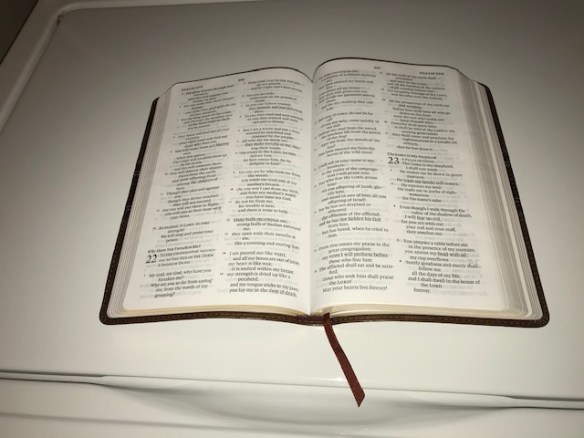
This third photo is staged because this has not been my practice. It’s in memory of a neighbor from decades ago who had three little stairstep children in a row, all under the age of five. Her washing machine was in her kitchen, and she left her Bible on top of it to get a few minutes reading in as she could.

As I wrote in Encouragement for Mothers of Small Children, the time when my children were little was the most challenging to try to carve out any quiet time, much less to read the Bible in a coherent manner. Yet I suffered spiritually when I didn’t read. It’s important to both read and study the Bible, but some seasons, it’s hard to do either. When I truly only had a few moments, God met with me and fed my soul in that time.

Moses met with God on a mountain. Daniel met with God in captivity. David met with God in pasture while shepherding, in a cave while hiding from enemies, and in a palace. Jonah met with God in the belly of a whale. We can meet with God any time, anywhere.

How about you? What does your real life devotional time look like? How has it changed through the different seasons of life? What was your most unusual devotional setting?

(Sharing with Purposeful Faith, Tell His Story, InstaEncouragement, Anchored Abode,
Recharge Wednesday, Worth Beyond Rubies, Let’s Have Coffee, Heart Encouragement,
Faith on Fire, Grace and Truth, Inspire Me Monday, Global Blogging, Senior Salon,
Hearth and Home)

Laudable Linkage

A collection of good reading onlineHere are some great reads collected in the last couple of weeks.

Women Wielding the Word.Such a good post by Sue on maintaining a habit of meeting with God in His Word. “I figure if I can’t give God five minutes anytime on any given day, I’m not taking Him and our relationship seriously.” ” We don’t worship the habit – that’s a rope on our necks instead of an anchor to our souls. God’s not interested in my checking off boxes in His name. I don’t worship the habit, but habits help me worship.

More and More, HT to Challies. I think many of us can identify with Glenna’s discouragement at not being more Christlike. “I’m beginning to think that when we’re most discouraged by our sin, God is working something good. The more we see it, the more He helps us to fight it.”

One Way to Build Your Trust Muscles, HT to Maree. “But if you’re looking for ways to strengthen your trust muscles for the days ahead, now might be a good time for you to start gathering up some stones from your past too.”

The Two Paths Out of Trials, HT to Challies.

The Right Response to the Old Testament Law. “Some struggle to understand how these laws reflect divine love and noble character. But this should not be surprising since we live at such a vast distance from that culture. If we want to see how the laws are just and fair and good, we need to study not only the laws, but also the context in which they were given”

Thankful for God’s Good Gift of Government. Our church has read through Ezekiel and Daniel in the past months, and one truth that comes through those books loud and clear is that God works behind, in, and through governments. That doesn’t mean they are always right. But he does call us to obey and honor them unless they contradict His commands.

5 common triggers for highly sensitive people, and 5 antidotes to help them survive social distancing by Anne Bogel, HT to Linda. This fits me to a “T” and was a good reminder. And a reassurance that I’m not the only one.

On Christians Spreading Corona Conspiracies: Gullibility is not a Spiritual Gift, HT to Linda. “God has not called us to be easily fooled. Gullibility is not a Christian virtue.” “Spreading unproven speculation is bearing false witness.”

How to Talk to Your Kids About the Tragedies of COVID-19, HT to the Story Warren.

The Worst Rebrand in the History of Orange Juice, HT to Challies. “Don’t let beautiful design distract from what’s important: Communicating the right information to your customer at the right time.” Yes! I hate when products undergo a major rebranding that’s artsy but doesn’t tell me what I need to know at first glance.

Of Stuck-ness and Sustaining Books. I loved this—partly because Pooh was a beloved character at our house, partly because of the scene Disney left out, and the comfort of “sustaining books” and kindness.

Mincaye Is Now With Jesus. Many of you are familiar with Jim Elliot, Nate Saint, and the other missionaries who were speared to death by the tribe they were trying to reach in Ecuador in 1956. Their story has been dear to me since I first read Through Gates of Splendor in college, and I have read much about the men and the families since that time. Mincaye was one of the killers of the men who later came to the Lord and became a grandfather figure to Steve Saint’s kids. Mincaye just passed away this week. Steve Saint’s tribute to him is here.

Finally, I loved this attempt at a professional video with a toddler “helping,” especially the end. The comments are fun, too. I am not sure if the video will show up in Feedly or emails: if not, you might need to click through to see it.

Happy Saturday!