
Review: The Prince of Spies

The Prince of Spies

The Prince of Spies is the third novel in Elizabeth Camden’s Hope and Glory series. Luke Delacroix is the younger brother of Gray, who heads the family’s spice business. But Luke doesn’t have a head for business. His one attempt was a drastic failure that continues to haunt him.

Instead, Luke has become a journalist. He’s just returned from a fifteen-month stint in a Cuban jail. He was thought to be supporting insurrectionists there, but he was actually on an undercover assignment that outed a traitor in the US military.

Now he has set his sights on five Congressmen whom he would like to see removed from office by research and articles showing their downside.

Enemy number one is Congressman Clyde Magruder, the head of Magruder Foods, the rival to the Delacroix company. But it’s not just the business rivalry. The Magruders cut costs by using additives and chemicals in their products. There were no laws about food labeling in the early 1900s. Luke knows personally of people who have been harmed by contents from Magruder’s.

In addition, Clyde is known to have had at least two children from affairs.

One day, Luke spies a young woman trying to rescue a dog who had fallen through ice in a pond. He jumps in to help her, depute Gray’s admonitions not to. Luke and the young woman, whose name he learned is Marianne, successfully rescue the dog, and Gray whisks Luke away to get him into dry clothes. Luke tracks down the fact that Marianne works as a photographer for the government and eventually finds her. But he’s stunned to learn she is Clyde Magruder’s daughter.

They decide not to see each other, but they keep crossing paths–sometimes on purpose.

Luke learns of an opportunity to join a group of volunteers for experiments testing the effects of additives in food. He applies and is accepted, planning to use the information in his articles. The volunteers nickname themselves the Poison Squad. The author says in her end notes that there really was such a group. The experiments eventually led to laws to protect food products.

There were several layers to this novel: Luke’s finding his place after not feeling he fit in for so long, the Romeo and Juliet-type romance, the food safety issues. Also, Marianne struggles with wanting a “normal” family. She loves her family, but their constant bickering and her father’s indiscretions are hard to deal with. Then, as she joins Luke in his research, she finds her family’s business has not always operated candidly. Trying to find the right perspective and balance with them is difficult. And Luke has to learn that, in the course of righting wrongs, it’s all too easy to forget that innocent people who could be hurt by his actions.

I enjoyed this book, and the series, a lot. I’ve missed visiting with the characters since I finished.
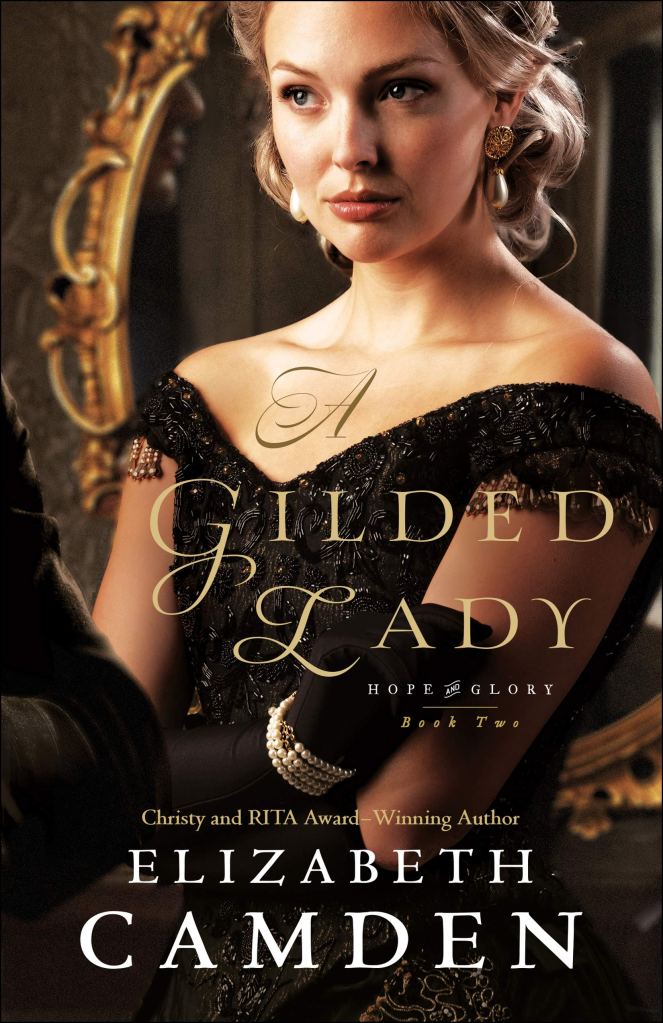
Review: A Gilded Lady

A Gilded Lady

A Gilded Lady by Elizabeth Camden is the second in the Hope and Glory series, a sequel to The Spice King.

Caroline Delacroix is the younger sister of Gray Delacroix, owner of the Delacroix Spice Company in the early 1900s. Caroline and her twin brother, Luke, had been frivolous and undisciplined growing up. Gray, twelve years older, was more like a father figure, especially after their father died.

But now Caroline is the secretary to the First Lady, Ida McKinley. Ida has epilepsy and other ailments and has been grieving the loss of her two children. She is excessively dependent on her husband. Plus she is notoriously difficult (the author says in her notes that the medication Ida was given to calm her nerves and help her epilepsy may have actually caused irritation).

Caroline has been blessed with common sense, political savvy, and a charming manner. She can usually talk Ida down, smooth over her moods, or intervene to avoid political embarrassment, such as when Ida wants to wear a hat with egret feathers to a function, when the papers had just carried news of a shortage of the egret population due to their feathers being used in women’s fashion.

Nathaniel Trask has been hired as the new head of the Secret Service, tasked with beefing up security at the White House. Nathaniel is by the book, no-nonsense–just the opposite of Caroline’s free spirit. So they clash repeatedly.

Furthermore, Caroline must keep her family secret under even tighter reigns. Her brother, Luke, has been arrested in Cuba, charged with helping insurgents there. Luke says he is guilty and has fired every lawyer Gray has hired. But Caroline knows her twin: she knows Luke is not guilty. She hopes that President McKinley will eventually grant Luke a pardon. But if Nathanial Trask ever finds out about Luke, Caroline will likely lose her job as well as Luke’s chance for a pardon.

I had known next to nothing about the McKinleys, so their history as well as behind-the-scenes looks at living in the White House in that era were interesting. The second half of the plot went in a little different direction, which I can’t reveal without spoiling the story. It was good to finally learn what was going on with Luke.

I didn’t like that this story overlapped with the previous book by about four months instead of picking up where the last one had left off. And I didn’t like that Caroline was given a vice in this book–smoking–that was not mentioned at all in the previous book. I think that took away from rather than added to the story.

But, overall, I liked the story and the characters. I listened to the audiobook, which had a much better narrator than the first book.

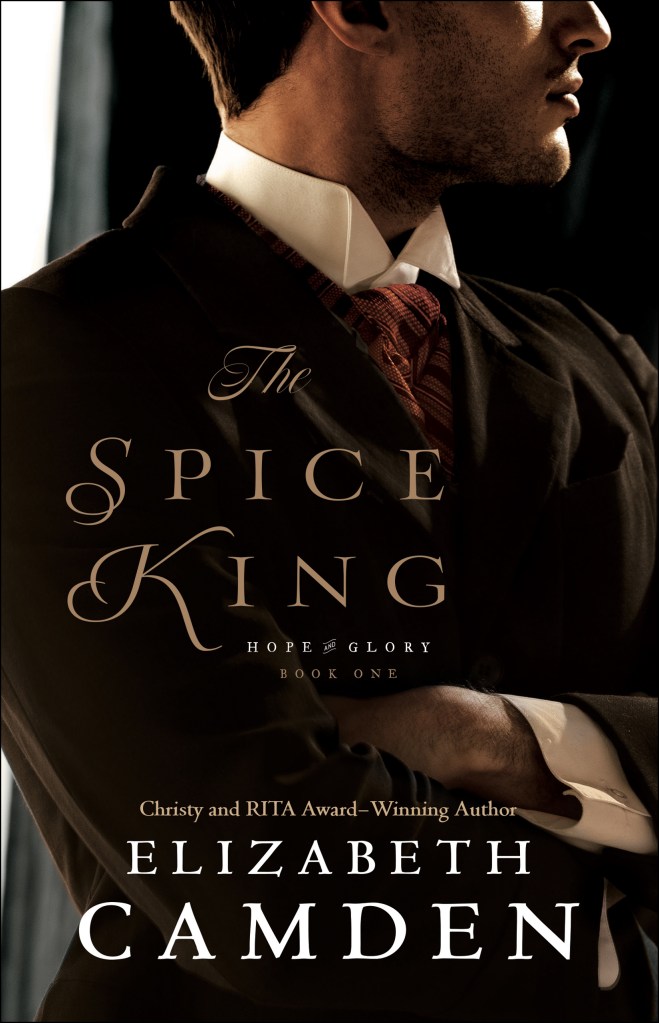
Review: The Spice King

The Spice King

The Spice King by Elizabeth Camden takes place during the Gilded Age in Washington, DC.

Annabelle Larkin had come to DC from Kansas when her blind sister, Elaine, received an opportunity to volunteer at the Library of Congress. Elaine had been depressed for a long time after her blindness, but now she was venturing out of her familiar safety. But she was still fearful and dependent on Annabelle.

Annabelle was given a temporary position as a junior botanist at the Smithsonian. Her boss promised her a permanent position if she could persuade Gray Delacroix, owner of Delacroix Global Spice Company, to donate his plant collection to the Smithsonian. Mr. Delacroix had traveled the world for his business, bringing back and cultivating plants he found along the way.

But the famously reclusive Mr. Delacroix has no interest in donating anything to the Smithsonian. He flatly refuses all of Annabelle’s requests.

Undaunted and determined, Annabelle shows up at his home with a gift. At first he refuses to see her. But his interest is piqued, so he allows his assistant to show her in. Their mutual love of plants draws them into conversation, but he still won’t give her any.

When Gray was young, the Union Army seized his father’s ships and burned their home to the ground. Gray and his father lived in a shed while they rebuilt their business. His father later remarried and had two more children: twins, Caroline and Luke. The twins had not known privation and hard work, so they tended to spend and act frivolously. But when Luke’s antics go too far, his life as well as the family’s reputation is in danger. And, unfortunately, Annabelle may have had a hand in his troubles.

Meanwhile, Gray’s business’s fiercest rivals are filling their food products with additives and fillers, making them cheaper than his wares and dangerous to people with sensitivities to them. But can he prove it? His distrust of the government makes him reluctant to appeal to them for regulation. He prefers the food industry to police itself, but what if it won’t?

I’ve read a few of Elizabeth’s books, but this one is my favorite by far. First, I enjoyed that the subject matter was different from other historical fiction books I’ve read. Most are situated in WW2, which is fine–I enjoy those stories. But I do get a little tired of them and wonder why authors don’t venture into the multitude of other eras available.

Then, the spice and food industry proved to be really interesting. Elizabeth shares enough detail to be informative but not academic. Good Housekeeping magazine even makes an appearance in the story long before its “seal of approval” days.

None of that would be helpful if the story and characters weren’t good–but they were!

Though this was Christian fiction, there were a couple of little oddities mentioned, like the luck of a horseshoe and the “stars coming into alignment.” Overall, however, faith in God and living by His Word were the main emphases.

I listened to the audiobook which was well done except that the narrator over-enunciated words, ran sentences together as if they didn’t have periods between them, and emphasized odd words in her inflections, like prepositions (“She disembarked FROM the streetcar,” “his empire IN Virginia,” “He stared at her hand BEFORE offering his own,” and so on). It took a concerted effort to concentrate on the story and not get distracted by the narration.

I thought one character’s fate was left hanging, but then I realized this book was the first in a series called Hope and Glory. I’m looking forward to reading the rest.

Review: Written on the Wind

Written on the Wind by Elizabeth Camden

In Written on the Wind by Elizabeth Camden, Natalia Blackstone has an unusual position for a woman in 1900. Her father owns a major bank in New York. Natalia rose through the ranks until she became one of his main analysts. Because her mother was Russian and Natalia speaks Russian fluently, she heads the analysis and funding for the Trans-Siberian Railway project.

She has communicated so often with the man in charge of the project, Count Dimitri Sokolov, that the two have become friends. Their correspondence veers into music, literature, and a number of other interests.

Lately, however, Natalia hasn’t heard from Dimitri. When she inquires about him, she is only told that he is no longer on the project.

Unknown to Natalia, Dimitri had been ordered to take part in an appalling crime. When he refused, he was arrested, stripped of his title and lands, and exiled to a Siberian penal colony. His only hope is to escape and tell the truth about what happened. But the incident will reflect poorly on the czar, so Dimitri must tread carefully. Without cash and contacts, he plans an impossible journey to get to Natalia, the only trustworthy person able to help him.

I very much enjoyed that the plot, setting, and characters were all much different than anything I have read before.

The only other book I have read from this author, The Rose of Winslow Street, had characters from Romania. With that and this book having Russian characters, I wondered if the author had a Russian heritage or a special interest in that region. The audiobook had an end note with details about the Trans-Siberian Railway, but nothing about the author personally.

Unfortunately, the narrator of the audiobook had an annoying way of over-enunciating. Plus she emphasized minor words in sentences, like propositions. (“He navigated THROUGH mirrored hallways”; “AFTER arriving IN New York . . .,” etc.). She made a faint attempt at the accent of an Irish character but none with any of the Russians. I am going to avoid this narrator in the future.

I didn’t realize, when I started the book, that it was the middle volume in a series. But it read well as a stand-alone. I looked through my Kindle library and saw I had the first book in the series on hand, so I’ll look into that one some time.