
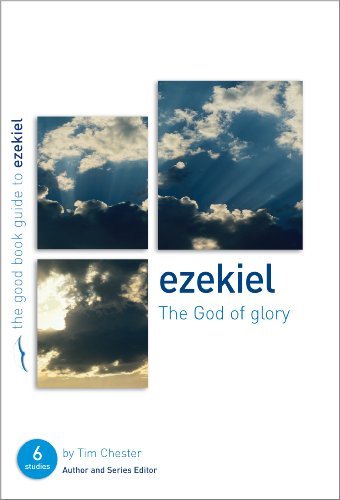
Ezekiel: The God of Glory

Ezekiel: The God of Glory

Ezekiel can seem like an intimating book of the Bible at first, with his many visions, odd heavenly creatures, acted-out sermons, and prophecies.

There’s much going on in Ezekiel’s 48 chapters. The basic idea of the book is that Israel has sinned, worshiping other gods and not living the way God told them to. They thought they were okay because they had the temple. After repeated warnings from various prophets, Israel is conquered and exiled by Babylon. Eventually Babylon destroys the temple in Jerusalem. Ezekiel was taken in the first wave of exiles and given the task of preaching to hard-hearted people who don’t listen to him. Some form of the phrase “You will know that I am the LORD” is used around seventy times in the book.

Eventually, God promises “I will give you a new heart, and a new spirit I will put within you. And I will remove the heart of stone from your flesh and give you a heart of flesh. And I will put my Spirit within you, and cause you to walk in my statutes and be careful to obey my rules. You shall dwell in the land that I gave to your fathers, and you shall be my people, and I will be your God. And I will deliver you from all your uncleannesses (Ezekiel 36:26-29). The famous vision in chapter 37 of the valley of dry bones that comes to life is a dramatic picture of what God is going to do in their hearts.

God also promises a coming shepherd-king, the Messiah, and a new temple (with much debate over the years whether this temple is literal or symbolic).

During my last reading of Ezekiel, I used Warren Wiersbe’s Be Reverent (Ezekiel): Bowing Before Our Awesome God as an aide while reading the book in my ESV Study Bible with its notes. Last year, I finished the last of Warren Wiersbe’s 50 “Be” commentaries on different books of the Bible. So I wanted to use a different source this time.

I had enjoyed our ladies’ Bible study’s use of the Good Book Company’s Isaiah for You by Tim Chester and 2 Corinthians for You by Gary Millar so I checked to see if there was a “For You” book for Ezekiel. There wasn’t, but while looking I found Ezekiel: The God of Glory by Tim Chester. It’s a six-week, 63-page study guide providing what the publisher called a “whistle-stop tour” through Ezekiel’s 48 chapters.

Unfortunately, I don’t think this format worked for Ezekiel. Perhaps it’s just too big a book to be covered in six chapters. I’m sure Chester had good reasons or highlighting the chapters he did, but they seemed random. There were several key passages I was surprised weren’t covered in the study.

In Isaiah for You, even though Chester only spent thirteen chapters on Isaiah’s 66 books, he summarized the chapters that came between the ones he covered. That helped orient the passages we did study into the book as a whole. Of course, in a smaller study like the one on Ezekiel, there was not space to do that, but it would have helped.

Each chapter’s study seemed fragmented to me. In fact, I was not getting much out of the study at all and thought perhaps I should get the leader’s guide it referred to, only to discover the guide was included in the back of the book. That helped some.

There were individual nuggets throughout the study that ministered to me and brought out truths from Ezekiel, but I was disappointed in the study as a whole. I don’t think the problem is with Chester’s writing since he did such a good job with Isaiah. I just don’t think this format worked well for Ezekiel. It might do better for some of the Bible’s smaller books.

On a side note, I’d heard about The Bible Project’s videos giving animated summaries of different books of the Bible, but had not seen one until it was used in our ladies’ Bible study as an introduction to Hebrews. I looked up their videos on Ezekiel and found them both fascinating and helpful. Part 1 is here and part 2 is here.

(Sharing with Bookish Bliss Quarterly Link-Up)

Book Review: Be Reverent

Warren Wiersbe has written a “Be” series commenting on almost every book of the Bible. The individual books cover more than a study Bible would, but they are not as in-depth as some commentaries. They are good study aides. Wiersbe gives background information, word meanings, different interpretations for passages as well as his reasons for the interpretation he chooses, and applications for modern-day believers. His style is easy to read.

The books are available in paperback, but I often see a few at a time on Kindle app sales for 99 cents to $1.99. I’ve collected most of them, but, I’m sorry to say, they stayed tucked away and forgotten in my app.

Our church has been reading trough Ezekiel for the last several weeks. Ezekiel is known for having some of the toughest passages in all of Scripture to understand and interpret, so I figured perhaps a bit more help than my study Bible might be needed.

Wiersbe sets the theme for Ezekiel right in the title: Be Reverent (Ezekiel): Bowing Before Our Awesome God. Judah had been taken over by the Babylonians, and most of the nation was sent to Babylon in three different deportations. God had called Jeremiah to warn the people before the kingdom fell to Babylon. He called Ezekiel to preach to the people in Babylon.

Many prophets would act out object lessons for the people. But Ezekiel seems to have been given not only the most of what the ESV Study Bible calls “street theater” messages, but also the most unusual. Wiersbe calls them “actions sermons.”

One of our former pastors taught that many of the prophets prophesied during the same era, and one reason was that different people responded to different personalities. Some may have thought Ezekiel a little weird or might have been uncomfortable watching him, but others would have been drawn especially because he was different.

Wiersbe points out several repeated phrases in the book:

  • God is called “Lord God” (“ Sovereign Lord” NIV) over four hundred times.
  • “I am the Lord” occurs fifty-nine times.
  • “You will know that I am the LORD” (6:7 NIV) . . . is found seventy times.
  • Ezekiel is called “son of man” ninety-three times.
  • “The phrase ‘the word of the Lord came’ is used fifty times in his prophecy and speaks of the authority of his message, and ‘the hand of the LORD’ is found also in Ezekiel 3: 14, 22; 8: 1; 33: 22; 37: 1; and 40: 1. The word of the Lord brings enlightenment and the hand of the Lord enablement (see Eph. 1: 15–23).”

Wiersbe notes that “The Jews were sinning against a flood of light” in that they had the books of Moses, “knew the terms of the covenant,” had heard the messages of several prophets, “yet persisted in disobeying God’s will.” “The attitude of the people wasn’t that of militant opposition but rather passive indifference.” “In their pride, they had cultivated a false confidence that the Lord would never allow His people to be exiled or His temple destroyed, but their sin had now ‘matured’ and both were now about to happen.”

We must correctly distinguish regret, remorse, and true repentance. Regret is an activity of the mind; whenever we remember what we’ve done, we ask ourselves, “Why did I do that?” Remorse includes both the heart and the mind, and we feel disgust and pain, but we don’t change our ways. But true repentance includes the mind, the heart, and the will. We change our minds about our sins and agree with what God says about them; we abhor ourselves because of what we have done; and we deliberately turn from our sin and turn to the Lord for His mercy.

Ezekiel assured the people that “Though His people were in exile and their nation was about to be destroyed, God was still on the throne and able to handle every situation. In His marvelous providence, He moves in the affairs of nations and works out His hidden plan.”

Ezekiel had to deal with the people about their sin and idolatry, but he also held out hope that one day God would set up a future shepherd (34:22-24), a covenant of peace (34:25-31), and His presence with them (34:30; 48:35).

One of the applications Wiersbe says Ezekiel brings out for us is “Too much so-called worship is only a demonstration of man-centered religious activity that fails to bring glory to the Lord.” He warns against falling into the trap Judah did in keeping outward forms of worship and religious activity without engaging the heart.

There is a lot of controversy in Ezekiel, too, especially over what the details of the new temple mean in the last few chapters.

There’s so much more, both to Ezekiel and Wiersbe’s comments. But perhaps this gives you taste of both. I’m looking forward to exploring more of the “Be series” in the future.

(Sharing with Carole’s Books You Loved, Booknificent)