
Some years ago I caught part of a TV program involving a group of people from several different denominations discussing tolerance. How the conversation progressed was quite interesting. In the part that I saw, they were at first discussing how intolerance can lead to persecution of those who believe differently. Then someone remarked that even the term “tolerance” smacked of arrogance — that one group is right but they are going to tolerate, or allow for other groups. Someone else remarked that in order to tolerate others you must have a seed of doubt that your beliefs are right, that there is a possibility that you could be wrong and other belief systems could be right. The last sentence I heard before turning the TV off was, “There is no room for certainty.”
I couldn’t disagree more.
I do believe in tolerance. The first Dictionary.com definition is “a fair, objective, and permissive attitude toward those whose opinions, practices, race, religion, nationality, etc., differ from one’s own; freedom from bigotry.” I don’t believe “a fair, objective, and permissive attitude” smacks of arrogance: just the opposite. Nor does it indicate doubt of one’s own beliefs.
And I do agree that intolerance has led to persecution and should not have. New Testament Christians, especially, are not told anywhere to persecute in any way those whose beliefs differ from ours.We believe that those of other beliefs have every right to exist and practice their beliefs. We’re to love, both our neighbors and our enemies. We’re instructed to share God’s truth, but if people don’t believe, we leave them to the Lord and hope and pray they have a change of heart. We don’t persecute them.
But what I disagreed with most was that last line about there being no room for certainty. I don’t believe that faith is a nebulous thing, that as long as you have faith in something you’re fine, that all religions are basically the same and lead to the same place. You don’t have to examine them very long to realize they don’t have all the same values and ends.
Our postmodern world wants to move away from absolute truth. “The questions are more important than the answers,” we’re told. Even people who call themselves Christians chip away at doctrinal truth.
It’s true there are mysteries to life and faith. We spend way too much time arguing over things that are unclear rather than living out what is clear.I often hear people say, “We’ll never understand until we get to heaven.” Surely we’ll understand much more than we do now, but I don’t see any guarantees in the Bible that even then we’ll understand everything. God’s mind and ways and thoughts will still be much greater than ours. But our trust will be perfect then.
Yet there is plenty in the Bible that is clear. God communicates specific truth to us. And sure, there are things we don’t understand, things we gain insight on from talking with and reading others, things we wrestle with, things that are hard to come to terms with. Most of us wrestle with a measure of doubt at times and carry around a list of unanswered questions. There are things we wish were more clear.
But reading and hearing the Bible taught shouldn’t lead us into more and more of a morass of uncertainty. There are plenty of bedrock truths to hold onto.
There is a God.
He made everything, including us.
He gave us His Word.
He is righteous, holy, and just, and we have sinned against Him.
He is merciful, kind, gracious, and loving and has provided salvation for those who will believe in His Son, the Lord Jesus Christ, who lived a sinless life, died on the cross for our sins, and rose bodily from the dead.
There is a literal heaven and a literal hell.
There are clear and definite sins.
Faith is too important an issue to leave up to uncertainty. God doesn’t leave us in a philosophical fog on the most important issues.
Now Jesus did many other signs in the presence of the disciples, which are not written in this book; but these are written so that you may believe that Jesus is the Christ, the Son of God, and that by believing you may have life in his name. John 20:30-31, ESV
I write these things to you who believe in the name of the Son of God, that you may know that you have eternal life. I John 5:13, ESV
For we have not followed cunningly devised fables, when we made known unto you the power and coming of our Lord Jesus Christ, but were eyewitnesses of his majesty. For he received from God the Father honour and glory, when there came such a voice to him from the excellent glory, This is my beloved Son, in whom I am well pleased. And this voice which came from heaven we heard, when we were with him in the holy mount. We have also a more sure word of prophecy; whereunto ye do well that ye take heed, as unto a light that shineth in a dark place, until the day dawn, and the day star arise in your hearts: Knowing this first, that no prophecy of the scripture is of any private interpretation. For the prophecy came not in old time by the will of man: but holy men of God spake as they were moved by the Holy Ghost. 2 Peter 1:16-21, KJV
So when God desired to show more convincingly to the heirs of the promise the unchangeable character of his purpose, he guaranteed it with an oath, so that by two unchangeable things, in which it is impossible for God to lie, we who have fled for refuge might have strong encouragement to hold fast to the hope set before us. We have this as a sure and steadfast anchor of the soul, a hope that enters into the inner place behind the curtain, where Jesus has gone as a forerunner on our behalf, having become a high priest forever after the order of Melchizedek.Hebrew 6:17-20, ESV
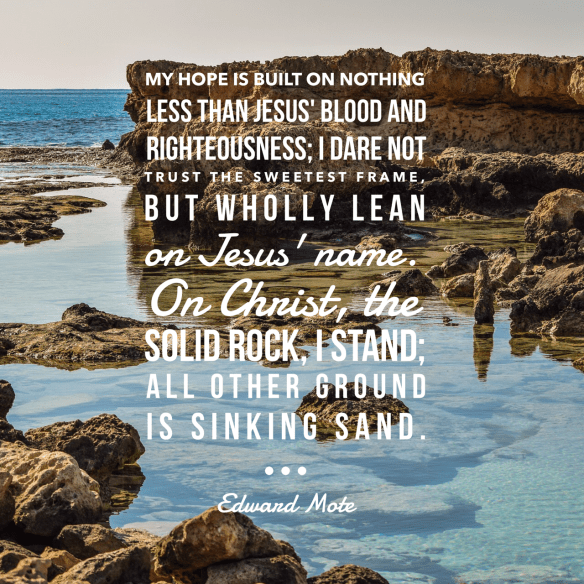
That doesn’t mean I feel I have all the answers to every little philosophical question or that I know how everything always works together. But I have a firm foundation, a “sure and steadfast anchor of the soul.”
See also:
Why Study Doctrine?
What Do You Know?
The Foundation of Our Faith.
(Sharing with Literary Musing Monday, Inspire Me Monday, Glimpses, Faith on Fire, Tell His Story, Woman to Woman Word-filled Wednesday, Coffee For Your Heart, Porch Stories, Wise Woman)





 Stray Thoughts