

31 Days of Missionary Stories: John Paton, Missionary to Cannibals

John Paton is the source of one of my all-time favorite missionary quotes. After a struggle, “dreadfully afraid of mistaking my own emotions for the will of God,” he offered himself and was accepted as a missionary to the New Hebrides (now Vanuatu). Most, including his pastor, were dead set against his “throwing his life away among the cannibals.” In a classic exchange, one “dear old Christian gentleman repeatedly exhorted me, ‘The cannibals! You will be eaten by cannibals!’ At last I replied, ‘Mr. Dickson, you are advanced in years now, and your own prospect is to soon be laid in the grave, there to be eaten by worms. I confess to you that if I can but live and die serving and honoring the Lord Jesus, it will make no difference to me whether I am eaten by cannibals or by worms. And in the great day my resurrection body will arise as fair as yours in the likeness of our risen Redeemer.’”

John and his wife, Mary Ann , arrived on the island of Tanna in 1858. The Tannese were curious about them and the Patons had to learn to communicate by gesture and trial and error until they learned the language. They found the people scantily clad, friendly but deceptive, thieving, glorying “in bloodshed, war, and cannibalism,” superstitious, and worshiping nearly everything. When the Patons began to teach them that God wanted them to ”throw away their idols and stop their wrongdoing,” persecution began.

Mrs. Paton and their baby boy died in the same month in 1859. “But for Jesus, and the fellowship He gave me there, I would certainly have gone mad and died beside that lonely grave.”

After a time some men came, like Nicodemus, at night to talk to John. A few believed, but persecution was the norm. John was in danger of his life many times. Sometimes he was led to hide somewhere, but other times, while men were facing him with spears, he kept on about his work as if he didn’t notice them, and God restrained their hands. Once he even directly challenged them to go through their rituals by which they curse people by making incantations over a piece of food from which that person has eaten, to prove that his God was greater than theirs, and God prevailed. He did have to leave the island eventually, escaping for his life. He went to Australia and Scotland to report to churches there. He came back with a wife and many new missionaries. The islanders were amazed that missionaries would return after the way they had been treated, and said, “If your God makes you do that, we may yet worship Him too.”

John and his new wife settled on the island of Aniwa. Though they faced some of the same problems as in Tanna, the Lord did bless them with a fruitful harvest there. Amazingly “the sinking of a well broke the back of dark religion on Aniwa.” The island did not receive much rain and much of the drinking water was not good. John decided to try to sink a well; the islanders thought he was mad. “Rain comes only from above. How could you expect our island to send us showers of rain from below?” The chief was afraid that Paton’s “wild talk” would cause the people to never listen to his word or believe him again. They were also concerned that he would die in the hole he was digging, and then the next English ship that came by would hold them accountable. He was able to persuade them to help him by offering fishing hooks for labor. They gladly labored, though they still thought he was going mad, until one side of the well caved in; then they were afraid and worried and would help no longer.

John was able to shore up the side of the well and take precautions against another cave-in. He had prayed about the location of the well and struggled with the fear that they might find salty water rather than fresh.

Finally the day came that he broke through and found good, fresh water. He filled a jug, climbed out of the well, and called the people over to taste it. They were amazed at the water he found and grateful that he would share the well with them. They offered to help him finish it in earnest. Later the islanders tried to sink several wells in various villages, but they either came to coral rock they could not penetrate or to salt water.

Chief Namakei asked if he could “preach” one Sunday. The book records one of the most beautiful sermons I have ever read. The essence of it was that, though they laughed and disbelieved when “Missi” (teacher) said he would find “rain coming up through the earth,” yet Jehovah God answered his prayers. “No God of Aniwa has ever answered prayers as the Missi’s God has done….The gods of Aniwa cannot hear, cannot help us like the God of Missi.” He felt that since what the Missi had said about the invisible water under the earth was true, then what he said about the invisible God was true, too, and he would worship Him. “He (Jehovah) will give us all we need for He sent His Son Jesus to die for us and bring us to heaven. This is what the Missi has been telling us every day since he landed on Aniwa. We laughed at him, but now we believe him.”

There followed a great burning of idols of many of the islanders and many were converted. They began to come to the church services and were baptized. John wrote, after a communion service, “At the moment when I put the bread and wine into those hands, once stained with the blood of cannibalism, now stretched out to Jesus, I had a foretaste of the joy of heaven that almost burst my heart in pieces. I will never taste a deeper bliss till I gaze on the glorified face of Jesus Himself.”
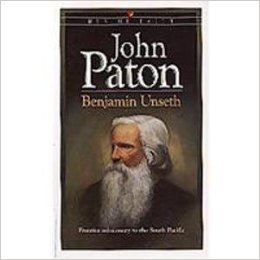
PatonJohn wrote his autobiography in three parts at three different times in his life. Benjamin Unseth used about one-fifth of the material in the three parts written by Mr. Paton to form a shorter biography simply titled John Paton, part of the Men of Faith Series published by Bethany House.

(You can see other posts in the 31 Days of Missionary Stories here.)

(This will also be linked to Semicolon‘s Saturday Review of Books.)

31 Days of Missionary Stories: Adoniram Judson’s Conversion

The salvation story of a five year old who is saved from a lifetime of heartache and bad memories is every bit a work of grace as the salvation of the most debauched sinner (though we have to remember, too, that what we think of as the “bad sins” are no worse than our pride, envy, and lack of love). A person doesn’t have to have a dramatic salvation story to have true faith and depth.

That said, one of the most dramatic salvation stories ever is that of Adoniram Judson. He is not quite as well-known a missionary as Hudson Taylor and Amy Carmichael, but he was among the first missionaries sent by America to another country.  I’ll say more about his life and ministry tomorrow, but for today I want to tell how he was saved. All quotes are from To the Golden Shore by Courtney Anderson.

The way the Lord brought this young man to Himself has me on the edge of my seat even though I know the story well. Plus, I have known people in much the same situation as Adoniram, and the obvious hand of God in his life gives hope and encouragement that He is at work drawing them as well, bringing them to the influences and people through whom He can work in their lives.

Adoniram had been raised in a strict Congregationalist pastor’s home in the late 1700s. There was never any indication that he didn’t believe: everything outwardly indicated his lifestyle was in line with what he had been taught all his life. When it was time for him to go to college, his father chose one where he was sure his son wouldn’t be led away from sound doctrine.

Adoniram had a brilliant mind which evidenced itself early in life and which God later used in translation work. He did excellently at college. He fell in with some friends who were Deists, who “rejected all revealed religion…. All the Deist admitted was the existence of a personal God.” They believed the Bible as well as other religions’ texts were only the work of men and that Jesus “was not the Son of God except in the sense that all men are” (pp. 33. 38). One of his best friends who had much influence on him was free-thinking Jacob Eames.

When Adoniram graduated and came home, he felt he could not just quietly go along with the family’s beliefs and practices any more. He broke the news to his parents that he had chosen a different way. His father tried to reason with him. “Very shortly he realized with dismay that every argument he advanced was being met by two better ones. Not for nothing had Adoniram been valedictorian of his class. Exposing the fallacies of his father’s syllogisms was child’s play. Point by point, with crushing finality, he demolished every thesis his father set out to prove…So far as logics and evidence went, Mr. Judson had to concede…He still knew he was right, but he could not prove it” (p. 38). His mother’s tears seemingly had little effect, either.

Adoniram had decided he wanted to go into the theater and perhaps become a playwright, so he left home and made his way to New York.

He happened to arrive during a very quiet time for the theater, He couldn’t find work, and then when he did find a theater troupe that hired him, the morals of the group appalled him.

He left to travel some more and ended up at an uncle’s home during the time a visiting young preacher was filling in for him. He and this young man of God “spent several hours in conversation. Adoniram was struck by the fact that, although his host was as pious as his father, there was a warmth, ‘a solemn but gentle earnestness,’ in his speech which kindled an answering warmth in the heart. To be a devoted minister it was not necessary, it seemed, to be austere and dictatorial like the Reverend Mr. Judson. Adoniram rode away in the morning deeply impressed. …The young minister…would [not] experience the pain of Adoniram’s inner conflict. He was at peace with himself” (p. 42).

Later in Adoniram’s travels, he came to a country inn, looking for a room for the night. The only available room, the innkeeper explained apologetically, was next to a young man who was dying. Adoniram assured the innkeeper that was all right, but through the night, he heard the sounds from the next room, and his thoughts were greatly disturbed considering what might happen after death.

The next morning as Adoniram checked out, he asked about the young man and learned that he had indeed passed away. For some reason he asked the young man’s name, and was startled to hear it was Jacob Eames.

Adoniram was stunned. Though shocked and saddened at the loss of a dear friend , especially one so young, even more disturbing were the thoughts that his beliefs could possibly be wrong. Was his friend even now experiencing “the unimaginable torments of the flames of hell — any chance of remedy, of going back, of correcting, lost, eternally lost?” “For already, this moment, Eames knew his error — too late for repentance” (p.44).

He wasn’t converted immediately, but he did realize that no one but God could have orchestrated all of the events since he left home, that they weren’t mere coincidence: the unexpected conversation with young preacher, the failure and disappointment of his plans in New York, and his ending up in a room in an inn next door to his dying friend. He felt he must learn more.

He went home where, soon afterward, two leading Congregationalist pastors came to visit his father to discuss a new theological seminary. They spent several hours talking with Adoniram. He “made an instant impression on [them]. His personality was ingratiating, yet without false humility. His mind was of the finest order. He already knew more theology than many theological students. He was open to conviction. He understood that he must undergo inner regeneration before he could look forward to faith and personal salvation. But clearly this was not to be accomplished in a few hours of argument. The very qualities that made the boy so worth saving made him hard to save. Yet the visitors felt almost at once that if he could find conviction he could become a minister such as had not been seen since the days of Whitefield and Jonathan Edwards” (pp. 47-48).

Eventually “they suggested that Adoniram enroll in the new seminary, where he would have the materials he needed to study to make up his own mind, and the counsel of some of the best theologians in the country” (p. 48). He was enrolled “as a special student — not as a candidate for the ministry” (p. 48). He began his studies: “under Dr. Pearson, he began to read the sacred literature in the original [languages]. At the same time he began to thrash out his theological doubts with Professor Woods, who turned out to be fully his match as a dialectician” (pp. 49-50).

He “felt no blinding flash of insight,” but by November he “began to entertain a hope of having received the regenerating influences of the Holy Spirit,” and December 2 “made a solemn dedication of himself to God” (p. 50).

31 Days of Missionary Stories

I’ve seen that several bloggers are participating in a 31 Days series hosted by Nesting Place. The basic idea is to choose a topic that you write about each day of October. I thought, “Hmm, that sounds interesting…but what in the world would I write about?” Then it hit me this morning: I love to read missionary biographies or stories: when I first started my blog I did a series for a few weeks on different missionary stories or anecdotes, and I have been doing the same in a church ladies’ newsletter for years. What a great opportunity to share some of those here! Some times it will be an overview of a person’s life: some times it will be just one incident or anecdote.

Why missionary stories? Because it increases my faith to see men and women “of like passions as we are” who learn, grow, overcome, and are used by God. I wrote more about reading missionary biographies before, and an excerpt from that is:

We learn history for a number of reasons, among them: to better understand our current times, to appreciate our heritage, to avoid repeating mistakes. There are heroes in our national history who inspire us to a love of country and duty and courage. There are heroes of our spiritual heritage who inspire us in love and dedication to God and to greater faith in remembering that the God they served and loved and Who provided for and used them is the very same God we love and serve today and Who will provide for us and use us. Though times and culture change, human nature at its core doesn’t change much, and God never changes.

This poem, which I first saw in Rosalind Goforth’s book, Climbing, embodies my own thoughts and feelings as well.

Call Back!

If you have gone a little way ahead of me, call back-
It will cheer my heart and help my feet along the stony track;
And if, perchance, Faith’s light is dim, because the oil is low,
Your call will guide my lagging course as wearily I go.

Call back, and tell me that He went with you into the storm;
Call back, and say He kept you when forest’s roots were torn;
That when the heavens thunder and the earthquake shook the hill.
He bore you up and held where the very air was still.

O friend, call back, and tell me for I cannot see your face;
They say it glows with triumph, and your feet bound in the race;
But there are mists between us and my spirit eyes are dim,
And I cannot see the glory, though I long for word of Him.

But if you’ll say He heard you when your prayer was but a cry,
And if you’ll say He saw you through the night’s sin-darkened sky-
If you have gone a little way ahead, O friend, call back-
It will cheer my heart and help my feet along the stony track.

I hope you’ll join me as we look to those who have gone on before us and learn from them.

I’ll be using this post as a directory to list the posts in the series.

Day 1: This post
Day 2: Rosalind Goforth; Answer to a Mother’s Prayer.
Day 3: Adoniram Judson’s Conversion.
Day 4: Adoniram Judson’s biography: To the Golden Shore.
Day 5: John Paton, Missionary to Cannibals.
Day 6: Darlene Deibler Rose: Missionary POW.
Day 7: Gracia Burnham and God’s Grace in Captivity.
Day 8: Isobel Kuhn Learns to Put God First.
Day 9: Isobel Kuhn’s Marriage: Whom God Hath Joined.
Day 10: Don Richardson: How to minister to a culture that values treachery?
Day 11: Amy Carmichael: With All Our Feebleness: Victory Through Pain and Illness.
Day 12: Amy Carmichael Learns to Die to Self.
Day 13: Amy Carmichael and Singleness.
Day 14: Gladys Aylward: The Small Woman With Big Faith.
Day 15: Mary Slessor and the Power of a Woman’s God.
Day 16: Spirit of the Rainforest: A Yanomamo Shaman’s Story
Day 17: Eric Liddell: Olympian and Missionary.
Day 18: Dr. John Dreisbach: Modern Missionary Statesman and Surgeon.
Day 19: The “Cambridge Seven
Day 20: William Carey: “Attempt great things for God. Expect great things from God.
Day 21: Rosalind Goforth, A Woman “Of Like Passions” As We Are.
Day 22: J. O. Fraser: Pianist and Engineer Turned Missionary.
Day 23: Dallas and Kay Washer, Candles in the Darkness.
Day 24: Margaret Stringer: Missionary to Cannibals With a Merry Heart and a Faithful Spirit.
Day 25: Clint and Rita Vernoy: On Ethnocide and Raising Children in the Jungle.
Day 26: Verda Peet: Sometimes I Prefer to Fuss.
Day 27: Jim Elliot’s Journals.
Day 28: Hudson Taylor, Pioneer Missionary.
Day 29: Not Only Preachers Are Called To Be Missionaries.
Day 30: Different ways to support and encourage missionaries.
Day 31: Thoughts on pedestals and missionary biographies with a list of my favorites.

You can see what other people are writing about for this 31 day challenge here: there are nine different categories.

(Photo courtesy of MorgueFile)

Laudable Linkage

Here are some noteworthy reads from the last couple of weeks:

Two pieces on the historicity of the first Adam, a current hot topic: Our Make-Believe Parents: When Adam Becomes More Fiction Than Fact and 19 Resources on the Historicity of Adam.

Grace Incognito. “I may like the idea of portraying the strong Christian woman weathering adversity with a brave face, but I don’t get to choose the scene of my martyrdom that will show off my good side. But what if the point isn’t sprinting across the finish line in record time, but knowing God in every halting, baby step along the way?”

One Step. “One step — one cross-shaped, trusting step of faith in a loving, good, and sovereign God — gives purpose to pain, turns mourning into dancing, and transforms everything (yes, everything) into a gift…And I have a visual of grace that I will never, ever forget.”

Savor “Every” Moment? This humorous piece reminds us that young moms in the trenches need more from us than the admonition to savor every moment because it all passes so quickly. They need to know we remember the trenches and survived them.

How to Criticize a Preacher.

Distinguishing Between Truth and the Bearer of Truth. This kind of goes along with the one above. I’ve had a possible blog post percolating in the back of my mind along these lines, but no time to write it out.

A Concerned Mother’s Letter to Teen-age Girls.

Thinking Evangelically About Tim Tebow. “I fear that the Tebow-mania is just another manifestation of the way evangelicals think cultural cache and celebrity influence is vital to the cause of Christ. When I read the Bible, I see the opposite, actually, how God uses the low, the weak, the despised, the cultural cast-offs to further his kingdom. I am not against Christians in the entertainment or athletic spotlights, of course, but I am against the idolization of these people, which I think much of our fandom becomes. To be clear: The cause of Christ is not dependent on Tim Tebow’s success in the NFL. And, by the way, neither is his witness!”

Can Oyster, the “Netflix For Books,” Be Successful?

Hope you have a great Saturday!

The Captain of My Fate

Some years ago during the brief four years we taught at home, our curriculum contrasted two poems. The first was “Invictus” by William Ernest Henley:

Out of the night that covers me,
Black as the Pit from pole to pole,
I thank whatever gods may be
For my unconquerable soul.

In the fell clutch of circumstance
I have not winced nor cried aloud.
Under the bludgeonings of chance
My head is bloody, but unbowed.

Beyond this place of wrath and tears
Looms but the Horror of the shade,
And yet the menace of the years
Finds, and shall find, me unafraid.

It matters not how strait the gate,
How charged with punishments the scroll.
I am the master of my fate:
I am the captain of my soul.

The second poem is obviously a response to the first: “Conquered By Christ” by Dorothea Day:

Out of the light that dazzles me,
Bright as the sun from pole to pole,
I thank the God I know to be,
For Christ – the Conqueror of my soul.

Since His the sway of circumstance,
I would not wince nor cry aloud.
Under the rule which men call chance,
My head, with joy, is humbly bowed.

Beyond this place of sin and tears,
That Life with Him and His the Aid,
That, spite the menace of the years,
Keeps, and will keep me unafraid.

I have no fear though straight the gate:
He cleared from punishment the scroll.
Christ is the Master of my fate!
Christ is the Captain of my soul!

My son at that time had a problem with wanting to yield the captaincy of his fate to Another. That’s understandable. We’re born with an intense self-will. We’re hesitant to trust someone else with our destiny. We want to make our own choices.

But once when I did a lengthy study on one’s “own” way in the Bible, I found that following our own way didn’t usually turn out well. Here are just a couple of examples:

“All we like sheep have gone astray; we have turned—every one—to his own way; and the Lord has laid on him the iniquity of us all.” Isaiah 53:6

“The backslider in heart will be filled with his own ways, But a good man will be satisfied from above.” Proverbs 14:14.

I didn’t realize until looking for these poems online that a handwritten copy of “Invictus” was the only statement Timothy McVeigh left behind when he was executed (see here). Invictus means “unconquerable.” How sad to remain unconquered only to come to such an end. “Therefore shall they eat of the fruit of their own way, and be filled with their own devices” Proverbs 1:31.

It’s one of those seeming paradoxes of Scripture that “Whosoever shall seek to save his life shall lose it; and whosoever shall lose his life shall preserve it” (Luke 17:33). Whatever we want to hold onto for ourselves we will eventually lose. What we yield to Christ He will keep for us and give back so much more.

There is good reason to trust Christ as our Captain. He knows what is ahead. He has the wisdom to guide us. He has the power to keep us. When the path passes through deep waters or dark shadows, He promises to be with us and uphold us. He loves us so much that He gave His own life for us and has promised to provide for everything we need, not only physically but spiritually. He is the only One Who can provide for us beyond the grave. He is more than worthy of our Captaincy and our trust.

The Conversion of Adoniram Judson

This is something I wrote for our ladies’ ministry booklet. I thought you might enjoy it, too.

I have been rereading To The Golden Shore by Courtney Anderson, a biography of Adoniram Judson, America’s first missionary. He has one of the most…I hate to use the word “thrilling” salvation stories, because every saved sinner’s story is thrilling, and a conversion isn’t more or less genuine based on the drama involved. However, the way the Lord brought this young man to Himself has me on the edge of my seat even though I know the story well. Plus, I have known people in much the same situation as Adoniram, and the obvious hand of God in his life gives hope and encouragement that He is at work drawing them as well, bringing them to the influences and people through whom He can work in their lives.

Adoniram had been raised in a strict Congregationalist pastor’s home in the late 1700s. There was never any indication that he didn’t believe: everything outwardly indicated his lifestyle was in line with what he had been taught all his life. When it was time for him to go to college, his father chose one where he was sure his son wouldn’t be led away from sound doctrine.

Adoniram had a brilliant mind which evidenced itself early in life and which God later used in translation work. He did excellently at college. He fell in with some friends who were Deists, who “rejected all revealed religion…. All the Deist admitted was the existence of a personal God.” They believed the Bible as well as other religions’ texts were only the work of men and that Jesus “was not the Son of God except in the sense that all men are” (p. 33. 38). One of his best friends who had much influence on him was free-thinking Jacob Eames.

When he graduated and came home, he felt he could not just quietly go along with the family’s beliefs and practices any more. He broke the news to his parents that he had chosen a different way. His father tried to reason with him. “Very shortly he realized with dismay that every argument he advanced was being met by two better ones. Not for nothing had Adoniram been valedictorian of his class. Exposing the fallacies of his father’s syllogisms was child’s play. Point by point, with crushing finality, he demolished every thesis his father set out to prove…So far as logics and evidence went, Mr. Judson had to concede…He still knew he was right, but he could not prove it” (p. 38). His mother’s tears seemingly had little effect, either.

Adoniram had decided he wanted to go into the theater and perhaps become a playwright, so he left home and made his way to New York.

He happened to arrive during a very quiet time for the theater, He couldn’t find work, and then when he did find a theater troupe that hired him, the morals of the group appalled him.

He left to travel some more and ended up at an uncle’s home during the time a visiting young preacher was filling in for him. He and this young man of God “spent several hours in conversation. Adoniram was struck by the fact that, although his host was as pious as his father, there was a warmth, ‘a solemn but gentle earnestness,’ in his speech which kindled an answering warmth in the heart. To be a devoted minister it was not necessary, it seemed, to be austere and dictatorial like the Reverend Mr. Judson. Adoniram rode away in the morning deeply impressed. …The young minister…would [not] experience the pain of Adoniram’s inner conflict. He was at peace with himself” (p. 42).

Later in Adoniram’s travels, he came to a country inn, looking for a room for the night. The only available room, the innkeeper explained apologetically, was next to a young man who was dying. Adoniram assured the innkeeper that was all right, but through the night, he heard the sounds from the next room, and his thoughts were greatly disturbed considering what might happen after death.

The next morning as Adoniram checked out, he asked about the young man and learned that he had indeed passed away. For some reason he asked the young man’s name, and was startled to hear it was Jacob Eames.

Adoniram was stunned. Though shocked and saddened at the loss of a dear friend , especially one so young, even more disturbing were the thoughts that his beliefs could possibly be wrong. Was his friend even now experiencing “the unimaginable torments of the flames of hell — any chance of remedy, of going back, of correcting, lost, eternally lost?” “For already, this moment, Eames knew his error — too late for repentance” (p.44).

He wasn’t converted immediately, but he did realize that no one but God could have orchestrated all of the events since he left home, that they weren’t mere coincidence: the unexpected conversation with young preacher, the failure and disappointment of his plans in New York, and his ending up in a room in an inn next door to his dying friend. He felt he must learn more.

He went home where, soon afterward, two leading Congregationalist pastors came to visit his father to discuss a new theological seminary. They spent several hours talking with Adoniram. He “made an instant impression on [them]. His personality was ingratiating, yet without false humility. His mind was of the finest order. He already knew more theology than many theological students. He was open to conviction. He understood that he must undergo inner regeneration before he could look forward to faith and personal salvation. But clearly this was not to be accomplished in a few hours of argument. The very qualities that made the boy so worth saving made him hard to save. Yet the visitors felt almost at once that if he could find conviction he could become a minister such as had not been seen since the days of Whitefield and Jonathan Edwards” (pp. 47-48).

Eventually “they suggested that Adoniram enroll in the new seminary, where he would have the materials he needed to study to make up his own mind, and the counsel of some of the best theologians in the country” (p. 48). He was enrolled “as a special student — not as a candidate for the ministry” (p. 48). He began his studies: “under Dr. Pearson, he began to read the sacred literature in the original [languages]. At the same time he began to thrash out his theological doubts with Professor Woods, who turned out to be fully his match as a dialectician” (pp. 49-50).

He “felt no blinding flash of insight,” but by November he “began to entertain a hope of having received the regenerating influences of the Holy Spirit,” and December 2 “made a solemn dedication of himself to God” (p. 50).