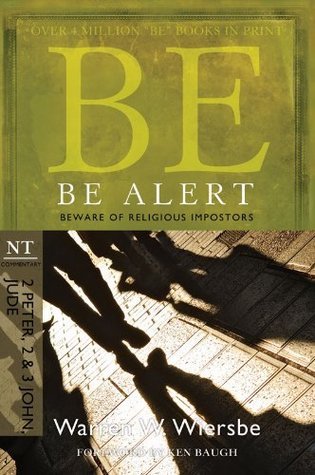
Review: Be Alert: (2 Peter, 2 & 3 John, Jude); Beware of Religious Imposters

Be Alert: Beware of Religious Imposters

At first glance, it might seem like Warren Wiersbe collected leftover short epistles to review in Be Alert: (2 Peter, 2 & 3 John, Jude); Beware of Religious Imposters. However, as his subtitle indicates, these four books near of the end of the New Testament have a common theme.

Often we go to the Bible for comfort, affirmation, assurance that God loves us and will take care of us. Those motives aren’t wrong: we find all those things in the Bible.

But the Bible’s purpose isn’t just to make us feel warm and cozy. God is truth, and anything that isn’t in line with His Word is falsehood. Satan, as God’s enemy, works seemingly tirelessly to question and pervert what God said. Indeed, his first recorded temptation was to question Eve in the garden of Eden about what God said and then to twist it. Often Satan includes enough truth to hook unsuspecting individuals.

That’s one reason to know God’s truth well (the first being that we learn to know God by learning His truth). Paul warned that “Men will rise up even from your own number and distort the truth to lure the disciples into following them” (Acts 20:30). Peter shared that false teachers will “twist” the Scriptures (“wrest” in the KJV). “The Greek word translated ‘wrest’ means ‘to torture on the rack, to distort and pervert’” (p. 113).

2 Peter, 2 and 3 John, and Jude all share what false teachers do, what motivates them, and what judgement is coming to them.

We’re not to support false teachers in any way, not even allowing them into our homes (2 John 10-11), but we’re to help those who have been influenced by them. “And on some have compassion, making a distinction; but others save with fear, pulling them out of the fire, hating even the garment defiled by the flesh” (Jude 22-23).

While the call to beware of false teachers is meant to help us to be alert and careful, we don’t need to panic or live in fear. 2 Peter opens with the reminder that “His divine power has granted to us all things that pertain to life and godliness, through the knowledge of him who called us to his own glory and excellence, by which he has granted to us his precious and very great promises, so that through them you may become partakers of the divine nature, having escaped from the corruption that is in the world because of sinful desire” (2 Peter 1:3-4) and closes with “You therefore, beloved, knowing this beforehand, take care that you are not carried away with the error of lawless people and lose your own stability. But grow in the grace and knowledge of our Lord and Savior Jesus Christ. To him be the glory both now and to the day of eternity. Amen” (2 Peter 3:17-18).

Likewise, Jude ends his warnings with “But you, beloved, building yourselves up on your most holy faith, praying in the Holy Spirit, keep yourselves in the love of God, looking for the mercy of our Lord Jesus Christ unto eternal life” (verses 20-21). Wiersbe comments, “He did not write, ‘Keep yourselves saved!’ because he had already assured them that they were ‘preserved in Jesus Christ’ (Jude 1). He wrote, ‘Keep yourselves in the love of God.’ Our Lord made a similar statement recounted in John 15: 9: ‘Continue ye in my love’” (p. 191). After several paragraphs on Christian love, he concludes, “We grow in our love for God as we listen to His Word, obey it, and delight in doing what pleases Him. That is how we keep ourselves in God’s love” (p. 192).

Finally, Jude concludes with this wonderful benediction: “Now to Him who is able to keep you from stumbling, And to present you faultless Before the presence of His glory with exceeding joy, To ]God our Savior, Who alone is wise, Be glory and majesty, Dominion and power, Both now and forever. Amen” (verses 24-25).

Here are a few more thoughts Wiersbe shared:

In his first epistle, Peter emphasized the grace of God (1 Peter 5: 12), but in this second letter, his emphasis is on the knowledge of God. The word know or knowledge is used at least thirteen times in this short epistle. The word does not mean a mere intellectual understanding of some truth, though that is included. It means a living participation in the truth in the sense that our Lord used it in John 17: 3: “This is life eternal, that they might know thee the only true God, and Jesus Christ, whom thou hast sent” (italics Wiersbe’s) (p. 19, Kindle version).

God has not only given us all that we need for life and godliness, but He has also given us His Word to enable us to develop this life and godliness. These promises are great because they come from a great God and they lead to a great life. They are precious because their value is beyond calculation. If we lost the Word of God, there would be no way to replace it. Peter must have liked the word precious, for he wrote about the “precious faith” (2 Peter 1: 1; cf. 1 Peter 1: 7), the “precious promises” (2 Peter 1: 4), the “precious blood” (1 Peter 1: 19), the precious stone (1 Peter 2: 4, 6), and the precious Savior (1 Peter 2: 7) (p. 22).

God gives His children all that they need to live godly lives, but His children must apply themselves and be diligent to use the “means of grace” He has provided. Spiritual growth is not automatic. It requires cooperation with God and the application of spiritual diligence and discipline. “Work out your own salvation.… For it is God which worketh in you” (Phil. 2: 12–13) (pp. 22-23).

It is a frightening fact that many people who are now zealous members of cults were at one time attending churches that at least professed to believe the Christian gospel (p. 79).

And with that, I have finished all 50 of Warren Wiersbe’s “Be” commentaries!

Believing What We Don’t See

Believing what we don't see

When you talk to people about God, some respond with, “I don’t believe in what I can’t see.”

Before we’re too hard on our skeptical friends, let’s ask ourselves what we’d say if someone told us they’d seen a fairy underneath a mushroom in a garden. We’d likely say something like, “Oh, really? Show me.” And when they couldn’t, we’d say inwardly, if not outwardly, “That’s what I thought.”

We tend toward belief in what we can see, hear, feel, taste, and touch. That’s the scientific method we grew up with, after all. We learn about the world around us by examining it and testing it.

We also try to fit our experiences into our current frame of reference. When we hear that a mild-mannered neighbor has been arrested for assault, we’re astonished. We never saw anything to indicate he was capable of raising a hand to someone. We try to make sense of his behavior by wondering if he was ill, drugged, drunk, or provoked in some way.

How many times have we heard someone say, “If I hadn’t seen it with my own eyes, I wouldn’t have believed it.”

When someone chooses not to believe in God because they can’t see Him, we usually point out that there are several things we believe in without seeing. Wind, for one. We see its effect. We can track its movement on weather maps. But we don’t see wind itself. We could say the same about gravity, electricity, love, and many other life experiences.

And we could point out that, just like wind and gravity and such, we see evidences and effects of God at work. We see His hand in creation. “The heavens declare the glory of God, and the sky above proclaims his handiwork” (Psalm 19:1). “For his invisible attributes, namely, his eternal power and divine nature, have been clearly perceived, ever since the creation of the world, in the things that have been made. So they are without excuse” (Romans 1:20).

We could also point out history. How do we know such persons as George Washington or Alexander the Great or others really existed? We might have some of their own writing or effects to examine. But more than that, we have historical evidence in documents and testimony about them.

We have the same with God. He has spoken through His Word over the course of thousands of years, with various people giving their testimonies of what He said to them, which all provides a coherent whole.

The field of apologetics, which comes from a Greek word meaning “speaking in defense,” according to Wikipedia, explores these kinds of things. Many books have been ably written by men such as Josh McDowell (Evidence That Demands a Verdict) and Lee Strobel (The Case for Christ, his own testimony of coming to Christ while in the process of trying to disprove Christianity), and others.

These have done a much better job explaining and defending the evidences for Christian faith than I could, especially in a small blog post.

Faith is not a blind leap in the dark. Faith is based on God’s Word and testimony about Himself and His gift of opening our eyes and hearts to His truth. Hebrews 11:1 says, “Now faith is the assurance of things hoped for, the conviction of things not seen.”

Recently, I began to ponder just how much of what we believe in is unseen.

Our Savior. “Though you have not seen him, you love him. Though you do not now see him, you believe in him and rejoice with joy that is inexpressible and filled with glory, obtaining the outcome of your faith, the salvation of your souls” (1 Peter 1:8).

Our protection. Once the king of Syria came after the prophet Elisha, because God had warned his people through Elisha how to avoid the king’s armies. Then, “When the servant of the man of God rose early in the morning and went out, behold, an army with horses and chariots was all around the city. And the servant said, ‘Alas, my master! What shall we do?’ He said, ‘Do not be afraid, for those who are with us are more than those who are with them.’ Then Elisha prayed and said, ‘O Lord, please open his eyes that he may see.’ So the Lord opened the eyes of the young man, and he saw, and behold, the mountain was full of horses and chariots of fire all around Elisha” (2 Kings 6:8-23).

Similarly, in the book of Esther, God is not mentioned once, but His fingerprints are all over that narrative.

I hope one thing we might do in heaven is hear more about those “behind the scenes” times God was protecting us.

The heavenly realm. I marvel at Ephesians 3:10, which says “that through the church the manifold wisdom of God might now be made known to the rulers and authorities in the heavenly places.” Imagine, beings in heaven learn more about God by seeing how He deals with us!

Not only are there unseen beings in heaven, but later in Ephesians 6, Paul tells us to put on the whole armor of God, “For we do not wrestle against flesh and blood, but against the rulers, against the authorities, against the cosmic powers over this present darkness, against the spiritual forces of evil in the heavenly places.”

Coming glory. “So we do not lose heart. Though our outer self is wasting away, our inner self is being renewed day by day. For this light momentary affliction is preparing for us an eternal weight of glory beyond all comparison, as we look not to the things that are seen but to the things that are unseen. For the things that are seen are transient, but the things that are unseen are eternal” (2 Corinthians 4:16-18).

All of God’s promises fulfilled. We’ve seen multitudes of God’s promises fulfilled in our own lives and through people in the Bible. But some of what has been prophesied has not happened yet. Hebrews 11 is often called the “hall of faith,” telling how God worked in and through the lives of many heroes of the faith. But, the passage says, “These all died in faith, not having received the things promised, but having seen them and greeted them from afar, and having acknowledged that they were strangers and exiles on the earth” (verse 13). Later in the chapter, the writer says, “And all these, though commended through their faith, did not receive what was promised, since God had provided something better for us, that apart from us they should not be made perfect” (verse 39). Some of the promises were fulfilled in biblical times, some in our time, and some are yet to come.

Our heavenly home. The writer of Hebrews says of those who “were strangers and exiles on the earth,” “For people who speak thus make it clear that they are seeking a homeland. If they had been thinking of that land from which they had gone out, they would have had opportunity to return. But as it is, they desire a better country, that is, a heavenly one. Therefore God is not ashamed to be called their God, for he has prepared for them a city” (Hebrews 11:14-16).

What do we do with these invisible realities?

We keep believing. “And blessed is she who believed that there would be a fulfillment of what was spoken to her from the Lord” (Luke 1:45).

We endure. “By faith [Moses] left Egypt, not being afraid of the anger of the king, for he endured as seeing him who is invisible” (Hebrews 11:27).

We lay up treasure in heaven. “Do not lay up for yourselves treasures on earth, where moth and rust destroy and where thieves break in and steal, but lay up for yourselves treasures in heaven, where neither moth nor rust destroys and where thieves do not break in and steal. For where your treasure is, there your heart will be also” (Matthew 6:19-21).

We live with eternity in view. “If then you have been raised with Christ, seek the things that are above, where Christ is, seated at the right hand of God. Set your minds on things that are above, not on things that are on earth” (Colossians 3:1-2).

We run the race, looking to Jesus. “Therefore, since we are surrounded by so great a cloud of witnesses, let us also lay aside every weight, and sin which clings so closely, and let us run with endurance the race that is set before us, looking to Jesus, the founder and perfecter of our faith, who for the joy that was set before him endured the cross, despising the shame, and is seated at the right hand of the throne of God” (Hebrews 12:1-2).

We do the work He left for us. 1 Corinthians 15 deals with the resurrection of Jesus from the dead and our resurrection after we die. At the end of the chapter, after talking about mortality putting on immortality, and death being swallowed in victory and losing its sting, Paul says, “Therefore, my beloved brothers, be steadfast, immovable, always abounding in the work of the Lord, knowing that in the Lord your labor is not in vain” (verse 58).

Ephesians 2:8-10 says we are saved by grave through faith, not works. But “we are his workmanship, created in Christ Jesus for good works, which God prepared beforehand, that we should walk in them.” We work, not to earn salvation, but as a result of our salvation.

We look forward to heaven. “For I consider that the sufferings of this present time are not worth comparing with the glory that is to be revealed to us” (Romans 8:18).

We’re encouraged. “For the Lord himself will descend from heaven with a cry of command, with the voice of an archangel, and with the sound of the trumpet of God. And the dead in Christ will rise first. Then we who are alive, who are left, will be caught up together with them in the clouds to meet the Lord in the air, and so we will always be with the Lord. Therefore encourage one another with these words” (1 Thessalonians 4:16-18).

We are blessed. After His resurrection, “Jesus said to [Thomas], ‘Have you believed because you have seen me? Blessed are those who have not seen and yet have believed'” (John 20:29).

In the second half of John Bunyan’s Pilgrim’s Progress, which tells the story of the Pilgrim’s wife, Christiana, one character only looks down, gathering up debris with a muck-rake. Someone stands above him, offering a celestial crown. But the man with the rake never looks up. The Interpreter tells Christiana, “Now whereas it was also shewed thee that the man could look no way but downwards, it is to let thee know that earthly things when they are with power upon men’s minds, quite carry their hearts away from God.”

Our senses are so filled here, we forget there are unseen realities. But those realities are more firm and lasting and important than what we see. “For the things that are seen are transient, but the things that are unseen are eternal” (2 Corinthians 4:18b). May God give us grace to look up, believe, and live for eternity.

Blessed are those who have not seen and yet have believed. John 20:29b

(I often link up with some of these bloggers.)

What Can We Know For Sure?

One philosophy popular in the last several years espouses that there is no absolute truth.

This works out conveniently for those who want to follow nontraditional courses. If there are no absolute, inarguable truths, then everyone can define their own truth.

But what happens when individual truths differ, or even clash with each other?

Just spend a little time on social media, and you’ll see. Instead of allowing everyone to have his or her own truth, society “cancels” anyone whose “truth” falls outside current societal values.

This philosophy has even crept into the church, sounding something like this: none of us is God, after all, and none of us knows everything perfectly. Therefore, we can’t be too dogmatic about anything.

It’s true, none of us is God. And it’s true none of us has perfect knowledge of all things. We’ll always be learning, growing, adjusting our philosophy to Bible truth as we understand it.

It’s wise to search out answers to questions. We might (and probably will) end up at the point that God is bigger than we are, and we can’t understand everything He does. But that shouldn’t be the smack-down, conversation-stopping answer to questions. There are many reasons young people have left the faith of their upbringing, but I think one factor is that the church has sometimes treated questions themselves as rebellion instead of invitations to help the person search out answers about the faith

But though all these caveats are true, it does not therefore follow that there’s nothing we can know for sure spiritually. There are some questions theologians will argue over til kingdom come, but there are core truths God has laid out in His Word.

Here are just a few:

There is a Creator.

“For what can be known about God is plain to them, because God has shown it to them. For his invisible attributes, namely, his eternal power and divine nature, have been clearly perceived, ever since the creation of the world, in the things that have been made” Romans 1:19-20). Psalm 19:1-3 tells us: “The heavens declare the glory of God, and the sky above proclaims his handiwork. Day to day pours out speech, and night to night reveals knowledge. There is no speech, nor are there words, whose voice is not heard.”

God is the Lord

Isaiah 45:6 says, “that people may know, from the rising of the sun and from the west, that there is none besides me; I am the LORD, and there is no other.” The phrase “that you may know that I am the Lord” appears about 70 times in Ezekiel and several times through the Bible in other places.

I used to sometimes see the saying, “Coincidences are God’s way of remaining anonymous.” And I’d smile and shake my head, because God is not in the business of remaining anonymous. He wants people to see and know Him.

Jesus forgives sin

Jesus said he healed a paralyzed man “that you may know that the Son of Man has authority on earth to forgive sins” (Matthew 9:1-8; Mark 2:1-12; Luke 5:17-26).

Jesus is God

When Jesus forgave the paralytic man’s sin, mentioned above, The Pharisees answered, “Who can forgive sins but God alone?” They got the point, even if they rejected it.

Jesus told men who were going to try to stone Him, “If I am not doing the works of my Father, then do not believe me; but if I do them, even though you do not believe me, believe the works, that you may know and understand that the Father is in me and I am in the Father” (John 10:37-38).

You can know you have eternal life

I’ve known of people who felt it was arrogant to claim salvation, or at least to claim assurance of going to heaven. But there is no arrogance involved, because it’s “by grace you have been saved through faith. And this is not your own doing; it is the gift of God, not a result of works, so that no one may boast” (Ephesians 2:8-9).

John wrote, “Whoever has the Son has life; whoever does not have the Son of God does not have life. I have written these things to you who believe in the name of the Son of God, so that you may know that you have eternal life” (1 John 5:12-13).

A few decades earlier, John wrote, “Jesus performed many other signs in the presence of His disciples, which are not written in this book. But these are written so that you may believe that Jesus is the Christ, the Son of God, and that by believing you may have life in His name” (John 20:30-31). See other claims Christ made about Himself here.)

Paul prayed that the “eyes of your hearts” would be “enlightened, that you may know what is the hope to which he has called you, what are the riches of his glorious inheritance in the saints” (Ephesians 1:8).

God’s Power

The rest of Paul’s prayer “that you may know” in Ephesians 1, mentioned above, is “what is the immeasurable greatness of his power toward us who believe, according to the working of his great might that he worked in Christ when he raised him from the dead and seated him at his right hand in the heavenly places” (Ephesians 1:19-20). God’s power raised Christ from the dead and set Him “far above all rule and authority and power and dominion, and above every name that is named, not only in this age but also in the one to come. And he put all things under his feet and gave him as head over all things to the church, which is his body, the fullness of him who fills all in all” (verses 21-23). Paul prays we might know the greatness of that power. A God who can do that can take care of us as well.

God loves us.

John wrote in 1 John 4:15-16, “If anyone confesses that Jesus is the Son of God, God abides in him, and he in God. And we have come to know and believe the love that God has for us. God is love; whoever abides in love abides in God, and God in him.” Paul prayed that we might “know the love of Christ that surpasses knowledge” (Ephesians 3:19) (I wrote more about knowing God’s love for us here.)

We can know God.

Jesus said, “And this is eternal life, that they know you, the only true God, and Jesus Christ whom you have sent” (John 17:3).

David told his son, “And you, Solomon my son, know the God of your father and serve him with a whole heart and with a willing mind, for the Lord searches all hearts and understands every plan and thought. If you seek him, he will be found by you, but if you forsake him, he will cast you off forever” (1 Chronicles 28:9).

Israel prayed, “Let us know; let us press on to know the Lord” (Hosea 6:3a).

How to live for God

Peter tells us, “His divine power has given us everything we need for life and godliness through the knowledge of Him who called us by His own glory and excellence. Through these He has given us His precious and magnificent promises, so that through them you may become partakers of the divine nature, now that you have escaped the corruption in the world caused by evil desires (2 Peter 1:3-4).

These are just a few of the things we can know with certainty. These are all verses which mention “know” or “knowledge” in some way. Yet the whole Bible is given that we may know God and know certain things about Him: His sovereignty, the truth and reliability of His Word, His anger against sin, His protection of His own, and so much more.

I’ve mentioned before that one former pastor said that the Bible is “divinely brief.” A God whose thoughts are more than we can number picked out these specific things He wanted us to know about Him and His world and will. It behooves us to apply our lives to His Word and then apply His Word to our lives.

(I often link up with some of these bloggers.)

Don’t Let Truth Become Cliche

People who write about writing tell us to avoid cliches. I read one article that advised tucking a few cliches into dialogue, if you’re writing fiction, so the conversations sound normal and familiar. Generally, though, cliches are considered trite and unoriginal. There’s nothing modern readers and publishers like so much as an original idea or a twist on an old one.

While I agree with all of the above, one day it dawned on me that the problem with cliches are not the phrases themselves. The problem is us. Most of the definitions and articles I looked up said that a phrase became a cliche through overuse. Why was the phrase overused? Because it aptly or creatively expressed something people identified with. But people heard it so much, they got tired of it. Then the phrase lost its luster, if not its meaning. The phrase still meant what it always did, but we don’t hear it the same any more. We gloss over it or even get irritated by it.

Most of us use cliches thoughtlessly out of habit—thus the admonition to watch for and eliminate them from our writing and speech. But some cliches are used to stop a conversation, according to Wikipedia. For instance, if you’re telling someone your troubles, and they respond, “That’s just the way the cookie crumbles” or “Into each life some rain must fall” (though the latter is from a poem), they’re not really interested in hearing you.

It’s possible to let truth become cliche spiritually as well, isn’t it?

In the church I attended in my teens and college years, we sang “Victory in Jesus” quite a lot. In another church my husband and I attended several years ago, a frequent congregational song was “Til the Storm Passes By.” In another place, it seemed like I heard “Be Thou My Vision” almost every week. For a while, I almost cringed when I heard these songs announced or heard their opening notes.

But was there anything wrong with the songs? No, they are all wonderful expressions of Biblical truth. The fact that they seemed overused was a problem in my own heart.

What about Romans 8:28: “And we know that for those who love God all things work together for good, for those who are called according to his purpose.” Granted, sometimes people use this verse like a band-aid on cancer. They mean well, but they want to “fix” the problem instead of weeping with those who weep, and then the verse becomes a conversation-stopper. But does the frequency with which we hear this verse null its meaning and effectiveness? It shouldn’t.

If someone quotes or refers to Psalm 23, should I glibly think, “Shepherd, sheep, got it,” and move on?

When Israel complained about eating manna, honestly, I can identify with them. But God faulted them for grumbling and murmuring. They forgot the miracle of God’s provision in the wilderness—a wilderness they were wandering in due to their own sin and failure.

In Malachi, Israel was offering to the Lord animals that wouldn’t even be fit for a governor (1:8), much less for a sacrifice for God. Then the people complained, “What a weariness this is” (1:13).

It’s good to be familiar with God’s Word. Throughout the Bible, God expects us to know Scripture enough to be able to think about it in our everyday lives. So if some parts of the Bible seem trite or overly familiar to us, the solution is not to scale back on our Bible reading.

What can we do then?

We can pray with the psalmist, “Open my eyes, that I may behold wondrous things out of your law” (Psalm 119:18). We can remember the incredible privilege it is that the Creator of the universe wants to speak to us. “How precious to me are your thoughts, O God! How vast is the sum of them!” (Psalm 139:17). If God’s Word isn’t feeling so precious and wondrous lately, we can ask God to help us see it that way.

We can pray for revival. “Will you not revive us again, that your people may rejoice in you?” (Psalm 85:6). “My soul clings to the dust; give me life according to your word!” (Psalm 119:25. Other translations say “quicken,” “revive, “preserve.”) Three times in Psalm 80, the writer asks God to “Turn us again, O God, and cause thy face to shine; and we shall be saved.”

We can ask God to search our hearts and lead us to repentance if need be. “For thus says the One who is high and lifted up, who inhabits eternity, whose name is Holy: ‘I dwell in the high and holy place, and also with him who is of a contrite and lowly spirit, to revive the spirit of the lowly, and to revive the heart of the contrite'” (Isaiah 57:15).

We can ask God to restore our delight in Him and His Word.

Delight yourself in the Lord, and he will give you the desires of your heart (Psalm 37:4).

I delight to do your will, O my God; your law is within my heart (Psalm 40:8).

Great are the works of the Lord, studied by all who delight in them (Psalm 111:2).

Blessed is the man who walks not in the counsel of the wicked, nor stands in the way of sinners, nor sits in the seat of scoffers; but his delight is in the law of the Lord, and on his law he meditates day and night.

We can return to our first love. “But I have this against you, that you have abandoned the love you had at first. Remember therefore from where you have fallen; repent, and do the works you did at first” (Revelation 2:4-5). Maybe thinking back through our testimony, God’s dealings with us when we first knew Him, revisiting our “Ebenezers,” those times we saw evidence of God’s working in our lives, will stir up that first love.

Practically, maybe interrupting our regular scheduled Bible reading plan to read through some psalms or passages that have held special meaning for us in the past might help. So might reading the Bible in a different translation than you’re used to. Slowing down to focus on the words, maybe reading them out loud, can keep us from racing through a passage. A college professor years ago advised looking up the definitions of all the words in a verse, especially if the verse was familiar.

There was a young man in my youth group years ago who, whenever he was asked to pray, asked that we’d learn something new from the Bible that day. We’ll continually be learning new things from the Bible; we’ll never exhaust it in this life. But sometimes we need reminders of what we’ve heard and learned before. “Therefore I intend always to remind you of these qualities, though you know them and are established in the truth that you have. I think it right, as long as I am in this body, to stir you up by way of reminder, since I know that the putting off of my body will be soon, as our Lord Jesus Christ made clear to me. And I will make every effort so that after my departure you may be able at any time to recall these things” (2 Peter 1:12-15).

John Newton wrote a lovely hymn called “Waiting for Spring.” First he talks about God’s promise that the seasons will continue, so we have the assurance that “Winter and spring have each their use” and winter will give way to spring. He says, “Believers have their winters too.” “Though like dead trees awhile they seem,” the spiritual life God placed in them will cause them to bloom again. He closes with this prayer:

Dear LORD, afford our souls a spring,
Thou know’st our winter has been long;
Shine forth, and warm our hearts to sing,
And thy rich grace shall be our song.

May God shine in and warm our hearts and renew our love for Him and His Word.

(I often link up with some of these bloggers.)

When Your World Is Shaken

Has your world ever been shaken? Has you ever experienced the rug being pulled from under you and everything going topsy-turvy? An unexpected serious diagnosis, a betrayal, a financial failure, a massive, destructive storm?

My own world was shaken once when I was 15. My parents divorced and we moved from a very small town to a humongous city. On one hand, my parent’s breakup was not a surprise: circumstances had been leading to that conclusion for a long time. But it was still a shock to the system when it happened. On top of family issues, I had to process the loss of friends, familiar neighborhoods, and school and face the culture shock of a totally different area, new school, etc.

Another shaking occurred in my thirties. One morning my left hand felt a little funny, like I had slept on it wrong. Within three hours, my left arm, both legs, and my lower torso were numb, I couldn’t walk on my own, and I was having trouble going to the bathroom. I thought I was having a stroke. After eight days and multitudes of tests, I was diagnosed with transverse myelitis. Would it get better . . . or worse? Would I walk again? How could I live in my split-level house when I couldn’t get up the stairs? How could I take care of my 2-year-old? No one could tell me.

I don’t remember when I first read C. H. Spurgeon’s Morning and Evening, but his meditation on the evening of June 22. was eye-opening for me. The verse for that evening was Hebrews 12:27: “This phrase, ‘Yet once more,’ indicates the removal of things that are shaken—that is, things that have been made—in order that the things that cannot be shaken may remain.” Even though that passage is talking about the ultimate “shaking” at the end of the age, we can apply some its truths to our comparatively smaller shakings.

Spurgeon says:

We have many things in our possession at the present moment which can be shaken, and it ill becomes a Christian man to set much store by them, for there is nothing stable beneath these rolling skies; change is written upon all things. Yet, we have certain “things which cannot be shaken,” and I invite you this evening to think of them, that if the things which can be shaken should all be taken away, you may derive real comfort from the things that cannot be shaken, which will remain.

What are some things that cannot be shaken? These truths are all through Scripture, but I’ll share a representative verse or two for each.

  • God’s sovereignty. Nothing that happens to us is a surprise to God. Well, then, why didn’t He prevent this calamity? That’s a question for another post. But He has a purpose in what He allows.

I am God, and there is no other; I am God, and there is none like me, declaring the end from the beginning, And from ancient times things which have not been done, Saying, ‘My purpose will be established, And I will accomplish all My good pleasure'” (Isaiah 46:9-10).

“The LORD is constantly watching everyone, and he gives strength to those who faithfully obey him” (2 Chronicles 16:9a, CEV).

“Are not two sparrows sold for a penny? Yet not one of them will fall to the ground outside your Father’s care” (Matthew 10:29, NIV).

God’s power, might, and knowledge are all still in force though circumstances are in an upheaval.

  • God’s presence. One of the first things people ask in a crisis is, “Where is God?” He’s there.

“Be strong and courageous. Do not fear or be in dread of them, for it is the LORD your God who goes with you. He will not leave you or forsake you” (Deuteronomy 31:6).

 Keep your life free from love of money, and be content with what you have, for he has said, “I will never leave you nor forsake you” (Hebrews 13:5).

  • God’s love. We might not understand how the turmoil we’re facing fits with God’s love, but we can rest in the fact that His love never leaves us.

 For I am sure that neither death nor life, nor angels nor rulers, nor things present nor things to come, nor powers, nor height nor depth, nor anything else in all creation, will be able to separate us from the love of God in Christ Jesus our Lord” (Romans 8:38-39).

  • Our salvation. Tumultuous circumstances do not indicate that my salvation is in question.

I give them eternal life, and they will never perish, and no one will snatch them out of my hand. My Father, who has given them to me, is greater than all, and no one is able to snatch them out of the Father’s hand” (John 10:28-29).

  • Our home in heaven. Spurgeon concludes his devotion on this topic this way: “Our country is Immanuel’s land, our hope is above the sky, and therefore, calm as the summer’s ocean; we will see the wreck of everything earthborn, and yet rejoice in the God of our salvation.” Sometimes trials remind us of this very thing: we seek “a better country, that is, a heavenly one.” This world is just a temporary dwelling, a tent.

If then you have been raised with Christ, seek the things that are above, where Christ is, seated at the right hand of God. Set your minds on things that are above, not on things that are on earth. For you have died, and your life is hidden with Christ in God. When Christ who is your life appears, then you also will appear with him in glory.” (Colossians 3:1-3).

This is one reason it’s so important that we mine the bedrock truth from the Bible. So often we seek affirmation or warm fuzzy spiritual feelings. But nice feelings will evaporate in hard times. We need to know God’s character and Word are true no matter how we feel and how circumstances seem.

If you’re familiar with Elisabeth Elliot, you know that her world was shaken in a major way a few times. Her first husband was killed by the Indians he was trying to reach with the gospel. Her specialty on the mission field was translation, and years of painstaking work was lost in an instant. Her second husband died of cancer. A recently published book, Suffering Is Never for Nothing, is transcribed from her sessions at a conference. In the third chapter she says:

We are not adrift in chaos. To me that is the most fortifying, the most stabilizing, the most peace-giving thing that I know about anything in the universe. Every time that things have seemingly fallen apart in my life, I have gone back to those things that do not change. Nothing in the universe can ever change those facts. He loves me. I am not at the mercy of chance (p. 43).

Sometimes it’s not the big things that shake us up. It’s the little accumulated everyday frustrations. I never read the book If God Loves Me, Why Can’t I Get My Locker Open, so I don’t know if it’s good. But I’ve had similar thoughts! I love God and I am trying to serve Him here, so why am I stuck in traffic/is my computer not working/is what I need unavailable. Elizabeth wrote in another book of the frustration of spending an inordinate amount of time in the jungle on a stove that wasn’t working. Couldn’t God “make” it function so she could get back to the more important translation work? He could, and sometimes He does. But we live in a fallen world, and He doesn’t take away all the effects of that yet. She wrote in A Lamp For My Feet:

Whatever the enemy of our souls can do to instill doubt about the real purpose of the Father of our souls, he will certainly try to do. “Hath God said?” was his question to Eve, and she trusted him, the enemy, and doubted God. Each time the suspicion arises that God is really “out to get us,” that He is bent on making us miserable or thwarting any good we might seek, we are calling Him a liar. His secret purpose has been revealed to us, and it is to bring us finally, not to ruin, but to glory. That is precisely what the Bible tells us: “His secret purpose framed from the very beginning [is] to bring us to our full glory” (1 Cor 2:7 NEB).

I know of no more steadying hope on which to focus my mind when circumstances tempt me to wonder why God doesn’t “do something.” He is always doing something–the very best thing, the thing we ourselves would certainly choose if we knew the end from the beginning. He is at work to bring us to our full glory.

Sufferings and trials have a way of clarifying for us what’s most important. As the things which can be shaken fall away, the things which cannot be shaken come more clearly into focus. Many of the psalmists go through this process: they come to God shaken by a problem: an enemy is after them, they’re troubled by the prospering of the wicked, etc. But as they pray and remind themselves of the truths they know, they’re brought back to a place of peace.

As Samuel Rutherford said, “Believe God’s word and power more than you believe your own feelings and experiences. Your Rock is Christ, and it is not the Rock which ebbs and flows, but your sea.”

God is our refuge and strength,
    a very present help in trouble.
Therefore we will not fear though the earth gives way,
    though the mountains be moved into the heart of the sea,
    though its waters roar and foam,
    though the mountains tremble at its swelling. Selah

There is a river whose streams make glad the city of God,
    the holy habitation of the Most High.
God is in the midst of her; she shall not be moved;
    God will help her when morning dawns.

“Be still, and know that I am God.
    I will be exalted among the nations,
    I will be exalted in the earth!”
The Lord of hosts is with us;
    the God of Jacob is our fortress.

Psalm 46:1-5, 10-11

(Sharing with Tell His Story, Purposeful Faith, Welcome Heart, Share a Link Wednesdays, Faith on Fire, Grace and Truth, Inspire Me Monday)