
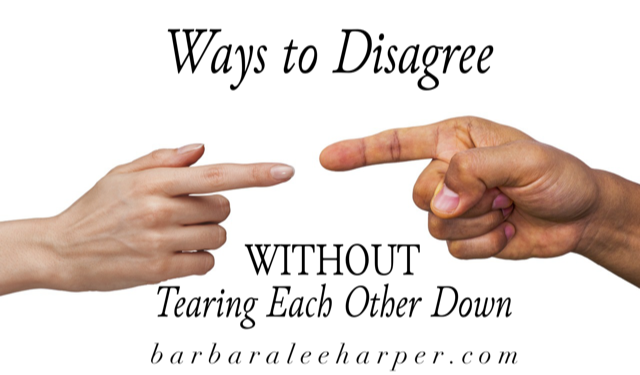
You never replace the toilet paper roll.
Why do you always do it the way I asked you not to?
How many times do I have to ask you not to do that?
You must be stupid to think that way.
When humans mix together for any length of time, friction develops. Even the brightest friendships and most dewy-eyed romances experience conflicts after a while. We each have our own history, preferences, ways of doing and thinking things. It’s inevitable that we’ll clash over something.
On top of all that, the Bible says we’re all sinners. We all want our own way. As someone once said, we’re all the stars of our own movies.
While disagreement is inevitable, some ways of disagreeing harm the relationship. All the statements at the beginning of this post are belittling. Disagreeing in ways that tear each other down will cause anger, resentment, and pain. If not dealt with, those jabs can harm and build walls between people. They may even destroy relationships. Even if the participants remain friends or married, they’ve injured each other so many times that the warmth is gone and they just go through the motions.
So how do we handle disagreements in ways that aren’t harmful?
I’m no expert, but after 47 or so years of being a Christian and reading God’s word, 40+ years of marriage, and more than that of living and interacting with people, I’ve learned a few things that I’d like to pass along. And though many of the illustrations I share pertain to marriage, most of these are true of any relationship.
No one is perfect. We know not to expect perfection, yet we get irritated at each other’s imperfections. I read that one man felt his wife wanted him to be a combination of Billy Graham, Dwayne Johnson, and Cary Grant*: a spiritual giant, a superb physical specimen, handsome, suave, and romantic all.the.time. The pressure was wearing on him. We have to manage our expectations and let each other just be human and imperfect. Elisabeth Elliot wrote:
My second husband once said that a wife, if she is very generous, may allow that her husband lives up to eighty percent of her expectations. There is always the other twenty percent that she would like to change, and she may chip away at it for the whole of their married life without reducing it very much. She may, on the other hand, simply decide to enjoy the eighty percent, and both of them will be happy ( From Love Has a Price Tag).
Understand each other’s personality and needs. Introvert/extrovert, indoor person/outdoor person, serious/fun people and other combinations are bound to clash. Even if personalities aren’t exact opposites, they also aren’t going to be exactly the same all the time. Each personality has its strengths and weaknesses. Honest discussions help, explaining how you feel or how things affect you, without accusation or assumptions. Perhaps offer a trade-off: “I’d love to go with you to that event if I can have some quiet time afterward to decompress.”
Take time to understand the other person’s perspective. Once when I was taking items to donate to the thrift store, my husband asked me to be sure to get a receipt for tax purposes. I balked at first: I felt that using donations to lessen taxes was like getting credit for what we gave, and weren’t we supposed to give without the left hand knowing what the right was doing (Matthew 6:1-4)? He explained that he wasn’t seeking credit, but he didn’t want to give the government any more in taxes than he had to. He saw it getting the receipt for a tax deduction as wise stewardship. Similarly, years ago I was on an email subscriber list for transverse myelitis patients and caregivers (before Facebook and even before message boards). A new technology was in the news that involved unused embryos leftover from in vitro fertilization treatments. Though the technology gave great hope to those who were paralyzed, those of us who believed life began at conception couldn’t condone it. You can imagine the blowup such a conversation could devolve into. To everyone’s credit we had a civil discussion with most of us understanding the others’ position even though we didn’t agree.
Don’t assume motives or accuse. Especially avoid always and never–they just make the other person defensive. Instead of, “You always leave your socks on the floor. What do you think I am, your maid?” perhaps say, “When you leave things lying around, it makes me feel like you expect me to pick up after you, like you think of me as a maid.” He’s probably not thinking at all of leaving things for her to pick up. He just forgot or overlooked some things. He would have picked them up eventually. But explaining rather than accusing will help him see things from her perspective. And yes, sometimes the situation is reversed and she’s the messy one.
Remember the relationship. Once I heard a speaker describe a wife having just cleaned her floors when her husband and children walked in with muddy shoes. The speaker admonished women to remember the relationship in such a case rather than lashing out. I thought to myself, “What about their remembering the relationship and respecting her ruined work that will now have to be redone?” While it’s true both sides should remember the relationship, the point was that we shouldn’t pounce on each other with angry words. The relationship is more important than the ruined floors. That doesn’t mean we have to be passive or never share when things bug us. But we don’t have to tear each other down in the process. The group discussion I mentioned a couple of paragraphs above probably went so well because the participants had forged relationships over years of sharing struggles and encouraging each other.
Does everything have to be our way? The classic little tiffs like how to squeeze the toothpaste tube or which way the toilet paper goes can grate against the nerves. But, really, is it that big a deal? Maybe you can compromise: do the toothpaste his way and the TP your way. I don’t know how many times I’ve heard men fuss about their wives pulling the seat up in the car and forgetting to set it back for their husband’s longer legs, or wives complaining about husband’s leaving the toilet seat up. Seriously, why can’t everyone adjust these things as they need them without fussing about them?
Don’t bring up a litany of past offenses. Some translations of 1 Corinthians 13:5 say love “keeps no record of wrongs.” When we wrong each other, we need to discuss it, confess it, forgive each other, and leave it in the past rather than bringing the same things up again later.
Don’t let offenses build up. Those of us who have a hard time speaking up when something bothers us need to avoid letting things build until we explode. Some of us don’t explode, but we seethe with resentment which comes out in coldness. None of those responses is healthy. It’s hard sometimes to know when to bring something to someone’s attention or when to overlook a fault. Proverbs 19:11 says, “Good sense makes one slow to anger, and it is his glory to overlook an offense.” But Jesus gave a detailed process for handling an offense in Matthew 18. Perhaps one aspect is whether the person committed an actual sin (robbing a bank, abusing someone) which needs to be reported and whether they just were inconsiderate or said something we took wrong. We can and should let some things go. We shouldn’t nag and nitpick about every little thing. But if we’re going to overlook something, we need to truly overlook it rather than just avoiding confrontation.
Don’t belittle or berate. I wince when I hear women talking to their husband as if they were talking to children–or even talking in ways they shouldn’t even use with children. Ephesians 5:33 tells wives to respect husbands—we can talk about things that bother us respectfully. “But what if he’s not acting in a manner worthy of respect?” I like to turn this around: that same passage tells husbands to love wives as they love themselves. Do we always act in a manner worthy of love? Would we want our husband to withhold love until we get our act together? This is a grace we can give each other: to treat each other with love and respect even when we don’t deserve it. Isn’t that how God loves us? All of us are to “Do nothing from selfish ambition or conceit, but in humility count others more significant than yourselves” (Philippians 2:3).
The Golden Rule says to treat others as we would like to be treated. How would we like to be treated if something is upset with us or angry about something we’ve done?
Be “quick to hear, slow to speak, slow to anger” (James 1:19). This is one of the most crucial things: listen first and wait to react. Many of us know and believe these other truths, but in the heat of the moment will say things we regret.
Attack the problem, not the person. Internet exchanges are notorious for devolving into name-calling, stereotyping, generalizing, and putting down. Yet we do that in everyday life as well. If in our thoughts or words we begin belittling or attacking the other person, we need to pull back and put our focus on the specific problem at hand.
Apologize when wrong. We’ve had relatives that could not seem to apologize after a blow-up. When they had cooled off, they might bring some little gift to try to smooth things over. We had to accept that was just their way and we weren’t likely to change them. But apologizing and asking for forgiveness are often the first steps in healing the breach. “Whoever conceals his transgressions will not prosper, but he who confesses and forsakes them will obtain mercy” (Proverbs 28:13).
Forbear and forgive easily. “Put on then, as God’s chosen ones, holy and beloved, compassionate hearts, kindness, humility, meekness, and patience, bearing with one another and, if one has a complaint against another, forgiving each other; as the Lord has forgiven you, so you also must forgive” (Colossians 3:12-13). Ephesians 4:1-3 and 31-32 echo the same. One former pastor used to say forbearance (as the KJV puts “bearing with”) was just good old fashioned putting up with each other. I used to get stuck on forgiveness when I felt the other person didn’t deserve it. But the parable of the unforgiving servant in Matthew 18:21-35 (told by Jesus in answer to Peter’s question about how many times he should forgive his brother) helped me have the right focus. The man was forgiven an insurmountable debt he owed, but then wouldn’t forgive another a much smaller amount. God has forgiven us an insurmountable debt of sin. Nothing that anyone else has done to us compares to our sin against Him. Can’t we, by His grace, forgive others their comparatively smaller sins against us?
Don’t grieve the Spirit. Ephesians 4 talks about the change that should be evident in our lives when we believe on Christ. Verse 29 says to “Let no corrupting talk come out of your mouths, but only such as is good for building up, as fits the occasion, that it may give grace to those who hear.” Verse 32, mentioned above, tells us to let bitterness, anger, and such be put away from us and to “Be kind to one another, tenderhearted, forgiving one another, as God in Christ forgave you.” Sandwiched between those two is verse 30: “And do not grieve the Holy Spirit of God, by whom you were sealed for the day of redemption.” We lift that verse out of context and generalize it. It does apply to many things. But originally it’s right here in the context of speech, anger, and bitterness. Have we realized that the way we disagree with each other can actually grieve the Spirit of God?
Look to Christ. “He committed no sin, neither was deceit found in his mouth. When he was reviled, he did not revile in return; when he suffered, he did not threaten, but continued entrusting himself to him who judges justly” (1 Peter 2:22-23).
Attempting these things shows us quickly that they are beyond us. We need help. Elisabeth Elliot said in A Lamp for My Feet:
How can this person who so annoys or offends me be God’s messenger? Is God so unkind as to send that sort across my path? Insofar as his treatment of me requires more kindness than I can find in my own heart, demands love of a quality I do not possess, asks of me patience which only the Spirit of God can produce in me, he is God’s messenger. God sends him in order that he may send me running to God for help.
What have you found that helps you deal with conflict in non-destructive ways?
_______
*I don’t remember if those were the exact names, other than Billy Graham’s.
**Abuse is something we should never overlook and put up with. If you are being abused by a spouse, boyfriend, friend, or bully, please seek out a trusted person that you can confide in.

(I often link up with some of these bloggers.)



 Stray Thoughts