Laudable Linkage

My round-up of exceptional online reads discovered this week:.

It’s OK to Choose Grace and Space. “There’s no Goals Police or Resolutions Monitor waiting to slap your hand if you don’t produce.”

Wherein an Anthropomorphic Tree Upends Me. HT to Story Warren. Beautiful.

What If Motherhood Was Meant to Be Hard? HT to Story Warren.

Letters to Taylor: On New Beginnings. HT to Story Warren.

Being Lazy Is Actually Good For You sometimes.

And, finally, I’ve always loved this quote:

Watching angels

When one of my sons was a baby and was intently staring at the ceiling, as babies are wont to do, my mother-in-law remarked that she thought when babies did that, they were looking at their guardian angels. We smiled – I think we even chuckled. I think she got a little embarrassed, but insisted, “No, really, I think they do see them!” We always kept that as a sweet memory of a sweet thought, and often when we saw a baby staring at the ceiling, we’d observe, “There they go looking at their guardian angels again” with a smile.

When we brought my mother-in-law home from the nursing home four years ago, we thought we were bring her home to die. She was down to 90 lbs., very fuzzy-minded, and not very responsive. But one-on-one care, especially in relation to feeding, and getting her off the narcotic drug we had not even known she was on until we brought her home, all improved her general condition dramatically. She’s 89, though, and one can’t stop the ravages of time. After maybe her first year or so at home, she began to decline more and more, moving less, sleeping more. Over the last year or so, she has become less interactive. She stopped speaking about a year ago, but we could tell by her eyes that she recognized us and followed what we were saying. She’d smile, nod, or shake her head. Though sometimes she still does, more and more lately there’s no light in her eyes when she looks at us, no response.

As we got her ready for bed last night, I noticed her staring intently at the ceiling, and that old sweet thought came back: maybe she’s watching her guardian angel.

Who knows what little babies and elderly people actually see when they fixedly stare at some point like that. I don’t know if each person is assigned a guardian angel, but the Bible does say that God sends angels to help us in various ways. Our pastor saw angels before he passed away, and I’ve heard similar things from others.

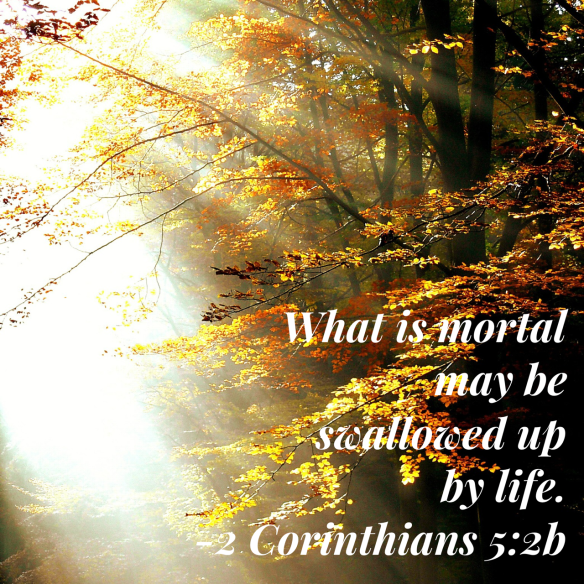
There is a sense in which all who know the Lord are getting closer to heaven every day, but the older and more frail one gets, the more imminent it seems. “For while we are still in this tent, we groan, being burdened—not that we would be unclothed, but that we would be further clothed, so that what is mortal may be swallowed up by life” (2 Corinthians 5:2, ESV). Some day she’ll cast off this silent, crumpled frame and see, not just angels, but the One she has loved and faithfully served for decades, the One who loved her, died for her, redeemed her, and made it possible that she and the family she so loved and prayed for could be with Him.

For this perishable body must put on the imperishable, and this mortal body must put on immortality. When the perishable puts on the imperishable, and the mortal puts on immortality, then shall come to pass the saying that is written:

“Death is swallowed up in victory.”
“O death, where is your victory?
    O death, where is your sting?”


The sting of death is sin, and the power of sin is the law.  But thanks be to God, who gives us the victory through our Lord Jesus Christ. 1 Corinthians 15:53-57, ESV

Blessed be the God and Father of our Lord Jesus Christ! According to his great mercy, he has caused us to be born again to a living hope through the resurrection of Jesus Christ from the dead, to an inheritance that is imperishable, undefiled, and unfading, kept in heaven for you, who by God’s power are being guarded through faith for a salvation ready to be revealed in the last time. 1 Peter 1:3-5, ESV

IMG_0497

(Sharing with Inspire Me Monday, Glimpses, Literary Musing Monday, Wise Woman, Tell His Story, Coffee for Your Heart, Porch Stories, Woman to Woman Word-filled Wednesday)

Eternal Glories Gleam

Our church was stunned and heartbroken yesterday to learn that our dear pastor has cancer of the liver and pancreas and is only expected to live 6 months to a year.

He had been losing weight over the past few months, had been really sick the past few weeks, went to the doctor – thankfully a member of our church and long time friend – last week for tests, where it discovered both his liver and pancreas are full of cancer. The pancreatic cancer is incurable and inoperable. He is having biopsies this week to confirm it, and there is a small chance that what they saw on the scans is not cancer, but everything else points to it. They are planning to start chemotherapy in hopes of slowing it down to some degree, but of course that carries its own set of problems.

He is in his early 50s with a wife and three daughters, two of whom are getting married this summer, and the youngest is schedule to go to college in the fall.

He has been preaching through the book of Romans, and providentially we were in the latter half of chapter 8 yesterday, which was so applicable to his situation. As he spoke to us yesterday, one of his concerns was that we think in a right way about his situation, that we not think God is mean or unfair or unkind. He had different men from the church read passages like Psalm 23 and II Corinthians 4:7-11:

.But we have this treasure in jars of clay, to show that the surpassing power belongs to God and not to us. We are afflicted in every way, but not crushed; perplexed, but not driven to despair; persecuted, but not forsaken; struck down, but not destroyed; always carrying in the body the death of Jesus, so that the life of Jesus may also be manifested in our bodies. For we who live are always being given over to death for Jesus’ sake, so that the life of Jesus also may be manifested in our mortal flesh.

And II Corinthians 4:16-18:

So we do not lose heart. Though our outer self is wasting away, our inner self is being renewed day by day. For this light momentary affliction is preparing for us an eternal weight of glory beyond all comparison, as we look not to the things that are seen but to the things that are unseen. For the things that are seen are transient, but the things that are unseen are eternal.

And II Corinthians 12:9-10:

But he said to me, “My grace is sufficient for you, for my power is made perfect in weakness.” Therefore I will boast all the more gladly of my weaknesses, so that the power of Christ may rest upon me. For the sake of Christ, then, I am content with weaknesses, insults, hardships, persecutions, and calamities. For when I am weak, then I am strong.

We know and love and take comfort in those truths but sometimes we tuck them away for “some day…”

Ecclesiastes 7:2 says, “It is better to go to the house of mourning than to go to the house of feasting, for this is the end of all mankind, and the living will lay it to heart.” Not that there is anything inherently wrong with feasting or celebrations: God created some for the Israelites to enjoy, and Jesus attended a wedding. But when someone faces death, certain truths crystallize into sharp focus. All of a sudden the petty irritation that was bothering me that morning wasn’t important. I was reminded that death comes to us all, sooner to some than expected, but God’s grace so wonderfully provided that we can be forgiven; that heaven is real; that this life really is but a vapor; that however good it is, heaven is better. I was reminded that we weren’t promised a life free from suffering on this earth; in fact, the Bible gives us plenty of warning about it and promises God’s help for it and assures us that He really, truly is our refuge and strength, a very present help in trouble (Psalm 46:1).

Last night a line from a hymn kept coming to mind, “Eternal glories gleam afar.” I couldn’t remember what hymn it was from, so I looked it up this morning and was surprised to find it was from “I’ve Found a Friend,” a song I haven’t heard in ages. The stanza containing that phrase says:

I’ve found a Friend, O such a friend! All pow’r to Him is given,
To guard me on my onward course, and bring me safe to heaven.
The eternal glories gleam afar, to nerve my faint endeavor;
So now to watch, to work, to war, and then to rest forever.

In situations like this, those eternal glories aren’t quite so far off: they are up close and personal.

This is going to be a heart-wrenching journey, especially for this man and his family, but also for our church as a whole. I know you all have your own churches and issues and prayer lists, but if you feel led, I’m sure all involved would appreciate your prayers.

Book Review: The Great Divorce

the-great-divorceI first picked up The Great Divorce by C. S. Lewis some years ago when I found it on sale in a bookstore. I wasn’t sure what kind of divorce the title was talking about, and the description on the front about a bus ride from hell to heaven seemed really weird, but it was Lewis and it was on sale, so I got it. But it sat around for all these years unopened. The TBR challenge of reading things that have been unread on our shelves spurred me to work this book in this year.

Lewis explains in the preface that the title and concept came in response to William Blake’s book The Marriage of Heaven and Hell. Lewis explains that there can be no such marriage.

“We are not living in a world where all roads are radii of a circle and where all, if followed long enough, will therefore draw gradually nearer and finally meet at the centre: rather in a world where every road, after a few miles, forks in two, and each of those into two again, and at each road you must make a decision. Even on a biological level life is not like a river but like a tree. It does not move towards unity but away from it and the creatures grow further apart as they increase in perfection. Good, as it ripens, becomes continually more different not only from evil but also from other good.”

“Evil can be undone, but it cannot ‘develop’ into good. Time does not heal it.”

To illustrate some of those fork-in-the-road choices as well as the opposite directions of heaven and hell, Lewis developed this fantasy of a group of people on a bus ride from hell to visit heaven. When they arrive, they are surprised to find that they are transparent and that contact with solid objects is painful (“It will hurt at first, until your feet are hardened. Reality is harsh to the feet of shadows.”) They are called ghosts, whereas the inhabitants who come to meet them are called Solid People or Spirits. Most of the people decide not to stay for various reasons, despite the Spirits encouraging them to put away whatever is holding them back and enter into joy.

The cleric who does not believe in absolutes refuses to believe in them still: “For me there is no such thing as a final answer. The free wind of inquiry must always continue to blow through the mind, must it not? ‘Prove all things’…to travel hopefully is better than to arrive.” The Spirit speaking with him, a friend he knew in life, responds, “If that were true…how could anyone travel hopefully? There would be nothing to hope for.” The artist prefers his painting to reality. “Every poet and musician and artist, but for Grace, is drawn away from the love of the thing he tells, to the love of the telling till, down in Deep Hell, they cannot be interested in God at all but only in what they say about Him.” The overbearing wife wants to continue “managing” her husband. The mother who has developed motherly love into idolatry would rather take her son from heaven back to hell with her than lessen her focus from him to love God. “Mother love…is the highest and holiest feeling in human nature,” she says, and is told, “No natural feelings are high or low, holy or unholy, in themselves. They are all holy when God’s hand is on the rein. They all go bad when they set up on their own and make themselves into false gods.” The man who lives for manipulating people with his self-pity is told, “Did you think joy was created to live always under that threat? Always defenseless against those who would rather be miserable than have their self-will crossed?”

But a few are willing to have their besetting sins taken and killed, and they grow more “solid.”

“There are only two kinds of people in the end: those who say to God, “Thy will be done,” and those to whom God says, in the end, “Thy will be done.” All that are in Hell, choose it. Without that self-choice there could be no Hell. No soul that seriously and constantly desires joy will ever miss it. Those who seek find. To those who knock it is opened. ”

“Good beats upon the damned incessantly as sound waves beat on the ears of the deaf, but they cannot receive it. Their fists are clenched, their teeth are clenched, their eyes fast shut. First they will not, in the end they cannot, open their hands for gifts, or their mouth for food, or their eyes to see.”

Lewis, or the narrator, finds George MacDonald, someone he has greatly looked up to and learned from, who then becomes a guide and teacher for him, similar to Dante and Virgil in The Divine Comedy.

Lewis assures in the preface that he is not writing to propose anything about what heaven might be like: he is simply using this scenario as a vehicle to discuss truths.

There are a few similar themes as are found in The Last Battle, the last book in the Narnia series written about 10-11 years later: the idea of moving “further up and further in” and the effusive joy of heaven.

I don’t know if Lewis believed in a purgatory or if he was just using the idea of the dead getting “second chances” to illustrate that many of them would not take it. The Bible says in Hebrews 9:27 that “it is appointed for man to die once, and after that comes judgment,” so I would have a problem with this book promoting the idea of purgatory, but I think the whole second chance scenario is just part of the plot device.

One character in the book says, “Hell is a state of mind – ye never said a truer word. And every state of mind, left to itself, every shutting up of the creature within the dungeon of its own mind – is, in the end, Hell. But Heaven is not a state of mind. Heaven is reality itself. All that is fully real is Heavenly. For all that can be shaken will be shaken and only the unshakeable remains.”  Again, I don’t know if the idea of hell being just a state of mind was part of Lewis’s own philosophy or if it was just the nature of it in this as a fantasy, but the Bible does speak of hell with literal terminology.

Overall this was quite a fascinating and thought-provoking read.

(This will also be linked to Semicolon‘s Saturday Review of Books.)

Book Review: The Last Battle

Last BattleThe Last Battle is the last book in the Narnia series by C. S. Lewis. It opens with a false Aslan: a confused donkey coerced to wear a lion skin by a conniving ape, who in turn is being controlled by others. In Aslan’s name, talking beasts are turned into slaves, dryads are dying because their trees are being cut down, Calormenes are overseers. Strange things are afoot, everything seems not quite right to everyone, but Aslan is not a tame lion, after all, so his ways will of course be a little different, and they think they must obey.

King Tirian sees at once that something is wrong, but he sets off rashly without thinking and winds up in trouble, He calls out for help, and Eustace and Jill show up. Together with the few Narnians who don’t believe in the false Aslan, they wage a last battle to save Narnia.

Even though the Narnia series is not an allegory per se, it’s still not hard to see the Biblical allusions to the end times and the antichrist. In Narnia as on Earth, things will get much, much worse before the end comes. And “Aslan’s country” has always typified heaven. All the beasts and creatures and people going “further up and further in” to Aslan’s country, the joyful reunions with those who have gone before, the sense that “this is what I have been seeking and waiting for my whole life” are the best parts of the books to me.

I think this time through the series, that is most what I have carried away with me: that longing, as in the song “Beulah Land”: “I’m kind of homesick for a country where I’ve never been before.” I have to admit that too often I am caught up with the joys and cares of this life. I look forward to having no more sin, sorrow, suffering, and tears some day, but I don’t always carry that personal longing just to be with Christ there, and this series as a whole stirs up that longing for Narnia and Aslan that all who visit experience while they’re away. It calls to mind Biblical texts like Hebrews 11:16: “But now they desire a better country, that is, an heavenly: wherefore God is not ashamed to be called their God: for he hath prepared for them a city,” and Colossians 3:1-2: “If ye then be risen with Christ, seek those things which are above, where Christ sitteth on the right hand of God. Set your affection on things above, not on things on the earth,” as well as Lewis’s own words from Mere Christianity: , “If I find in myself a desire which no experience in this world can satisfy, the most probable explanation is that I was made for another world…I must [therefore] keep alive in myself the desire for my true country, which I shall not find til after death.”

There is sadness for those who choose not to believe, such as the dwarves who are only for the dwarves and refuse to be “taken in.” As Aslan says, “They will not let us help them. They have chosen cunning instead of belief. Their prison is only in their own minds, yet they are in that prison, and so afraid of being taken in that they cannot be taken out.” Unfortunately there will be people like that as well.

There is a point of confusion with the Calormene Emeth, who served the Calormene god Tash, yet is admitted to Aslan’s country, not because Tash and Aslan are one, as some tried to proclaim (Aslan shook the earth with his growl at the very thought), but because Aslan took to himself everything Emeth had done for Tash. For, he says, “he and I are of such different kinds that no service which is vile can be done to me, and none which is not vile can be done to him. Therefore if any man swear by Tash and keep his oath for the oath’s sake, it is by me that he has truly sworn, though he knew it not, and it is I who reward him. And if any man do a cruelty in my name, then, though he says the name Aslan, it is Tash whom he serves and by Tash his deed is accepted…unless thy desire had been for me thou wouldst not have sought so long and so truly. For all find what they truly seek.” I don’t know how much of this reflects Lewis’s personal belief system, but I can’t endorse the idea that someone sincerely serving and seeking a false God is really serving the one true God unaware.

A couple of my favorite quotes:

“I have come home at last! This is my real country! I belong here. This is the land I have been looking for all my life, though I never knew it til now. The reason why we loved the old Narnia is that it sometimes looked a little like this.”

“Your father and mother and all of you are – as you used to call it in the Shadowlands – dead. The term is over: the holidays have begin. The dream is ended: this is the morning.”

It was only the beginning of the real story. All their life in this world and all their adventures in Narnia had only been the cover and title page: now, at last they were beginning Chapter One of the Great Story which no one on earth has read, which goes on forever.”

I have to thank Carrie for sponsoring the Chronicles of Narnia Reading Challenge, which spurred me on to revisit the series. I’ve so enjoyed being in Narnia again! I also marvel at how someone with an intellect as large and complex as Lewis’s can write something simple enough for children to understand yet engaging to adults, too, with such nobility and depth and beauty.

Here are my posts from the whole series:

The Lion, the Witch, and the Wardrobe
Prince Caspian
Voyage of the Dawn-Treader
The Silver Chair
The Horse and His Boy
The Magician’s Nephew
The Lion, the Witch, and the Wardrobe Graphic Novel.
The Way Into Narnia
Narnian Magic.

Chronicles of Narnia Reading Challenge

(This will also be linked to Semicolon‘s Saturday Review of Books.)