
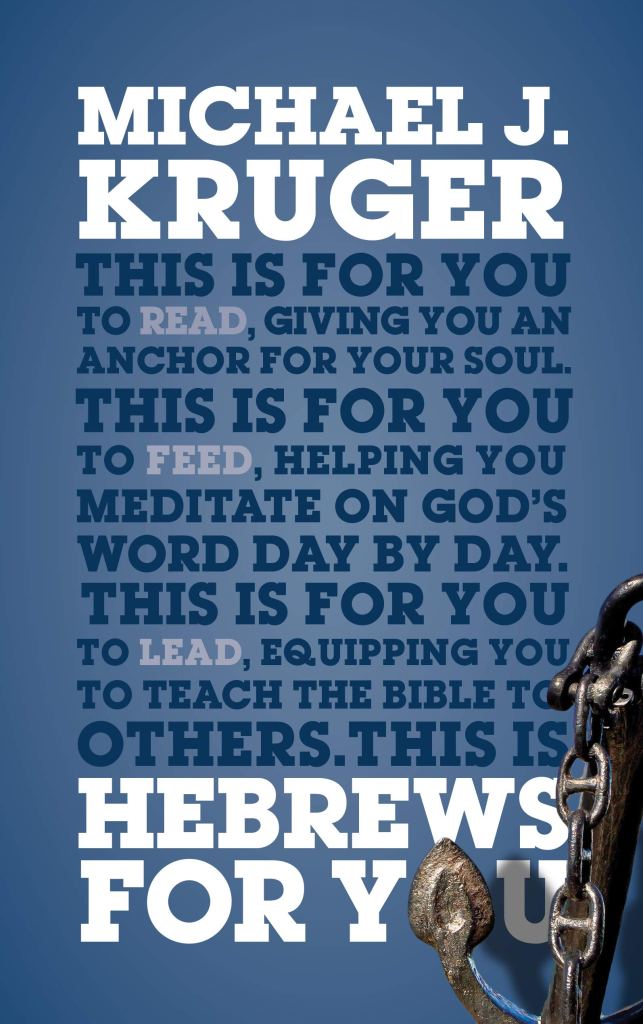
Hebrews for You

Hebrews for You

Most New Testament epistles begin with who wrote the letter and who the audience is. The author of Hebrews does neither. He appears to be someone familiar with the apostles’ teaching. He might even have been an apostle himself. He references the Old Testament. and seems to assume his audience would be familiar with it. Thus we believe he’s writing primarily to Jewish Christians. Many were undergoing persecution for their belief in Jesus and the prophesied Messiah. Some felt maybe they should go back to the Jewish traditions they had been taught.

The main theme of the book is that Jesus is better: better than angels, better than Moses, better than God’s previous revelations. His priesthood, according to the line of Melchizedek Psalm 110:4), is better because it’s eternal. His sacrifice is better because He only had to offer it once; He didn’t have to offer sacrifices for His own sin because He didn’t have any sin.

There are stern warnings at the end of each section–warnings against apostasy, against failing to enter God’s rest.

Probably most people who know anything about Hebrews are familiar with the “hall of faith” in Hebrews 11: the detailed list of people in the Bible who did follow Jesus in faith. They weren’t perfect; some on the list are a surprise. They are an encouragement to us to keep following.

This chapter also tells us, “And without faith it is impossible to please him, for whoever would draw near to God must believe that he exists and that he rewards those who seek him” (verse 6).

Chapter 12 urges readers to endure God’s discipline as a loving father and reminds us of the coming kingdom that cannot be shaken. Chapter 13 ends with practical instructions and applications.

One of my favorite verses in the book comes near the end in chapter 13, verses 20-21: “Now may the God of peace who brought again from the dead our Lord Jesus, the great shepherd of the sheep, by the blood of the eternal covenant, equip you with everything good that you may do his will, working in us that which is pleasing in his sight, through Jesus Christ, to whom be glory forever and ever. Amen.” What a magnificent prayer that we can pray today.

Even though the first audience was Jewish, we Gentiles benefit from reading the book today. The truth it contains is applicable to all. We’re spiritual children of Abraham by faith (Galatians 3:7-9) and we’ve been grafted in (Romans 11). We don’t replace Israel. But we’re part of God’s family. So all this truth pertains to us, too.

If you’ve read through the first five books of the Bible, especially if you’ve gotten lost in Leviticus, reading Hebrews will really help in understanding.

Our ladies’ Bible study has been reading Hebrews this semester using Michael Kruger’s book, Hebrews for You: Giving You an Anchor for Your Soul as an aid. I appreciated the author’s thoughtful insights as he went verse by verse through the book.

Some of the quotes I marked:

The old covenant was not false or wrong. But it was provisional and partial. “The law has but a shadow of the good things to come instead of the true form of these realities [Hebrews 10:1]” (p. 136).

Since God’s word is empowered by the Holy Spirit, when we encounter the word, we encounter God. It is through God’s word that we meet him, learn from him, and have fellowship with him (p. 61).

The word of God is not just a way to get to know God but also a way to get to know yourself. When you read the Bible and let it penetrate your heart, you will see things about yourself that you never saw before. You will see your real intentions, your real motives, and your real character. This is a good thing because there is rot and mildew built up in our hearts which need to be exposed (p. 65).

People in our world today sometimes embrace doubt and uncertainty as things worth striving for in themselves; Christians, by contrast, believe that there are certainties, even though we may find it difficult to hold on to them. So, when we have those struggles with doubt, we fight them. We look for reassurance from God (p. 164).

God does not promise that if we follow him we will have health and wealth—becoming successful or rich. There is a sad trend in evangelicalism today of teachers claiming that if you follow God it will make your life better in earthly ways. Of course, it is better to follow Jesus; but that does not mean bigger bank accounts or more popularity. This is not your best life now (p. 190).

Hebrews has some difficult passages, but Kruger’s commentary helped shed light on them.

I’m happy to recommend this book.

(I often link up with some of these bloggers.)

Be Confident: Live by Faith, Not by Sight

Our church’s Bible reading program alternates between Old and New Testament books. After we finished Leviticus, our next book was Hebrews.

That was fitting, because Hebrews explains how the OT sacrificial system pictured Christ.

My companions through this reading were my ESV Study Bible notes as well as Warren Wiersbe’s Be Confident (Hebrews): Living by Faith, Not by Sight.

Hebrews was written to Jewish believers in Christ in the first century. Mention is made of the temple as if it were still in operation, and it was destroyed in 70 AD. So we know Hebrews was written before that time.

Jewish believers were facing persecution for varying from what their community practiced. Some were tempted to go back. But the author of Hebrews urges them to keep persevering and reminds them that what they have in Christ is far superior to what they had before.

In fact, the word “better” occurs repeatedly in the book. Jesus is show to be better than angels, Moses, and the priesthood. His once-for-all sacrifice was better than the repeated ones the priests offered. His new covenant was better than the old.

It’s not that the old covenant and practices were wrong: God gave them to Israel. But they were always meant to be temporary, picturing and leading up to Christ’s revelation and ministry.

There are also five major warnings in Hebrews, a couple of which have created confusion. Wiersbe demonstrates that these warnings don’t indicate one can lose salvation, but they do emphasize the need to be sure we’re in the faith and growing in the Lord. “Without faith it is impossible to please him, for whoever would draw near to God must believe that he exists and that he rewards those who seek him” (Hebrews 11:6).

Hebrews 11 is the “Hall of Faith,” sharing examples of those who walked with God through the centuries. Just as they “desire a better country, that is, a heavenly” (Hebrews 11:16), so readers are reminded that “here we have no lasting city, but we seek the city that is to come” (Hebrews 13:14). And in the meantime, the God of peace will “equip you with everything good that you may do his will, working in us that which is pleasing in his sight, through Jesus Christ, to whom be glory forever and ever” (Hebrews 11:21).

As modern Gentiles, we might not be tempted to go back to Judaism. But we need this book as well to appreciate what we have in Christ and to heed its warnings and benefit from its encouragements.

Here are just a few of the quotes that stood out to me from this book:

More spiritual problems are caused by neglect than perhaps by any other failure on our part. We neglect God’s Word, prayer, worship with God’s people (see Heb. 10: 25), and other opportunities for spiritual growth, and as a result, we start to drift. The anchor does not move; we do (p. 35).

What does Canaan represent to us as Christians today? It represents our spiritual inheritance in Christ (Eph. 1: 3, 11, 15–23). It is unfortunate that some of our hymns and gospel songs use Canaan as a picture of heaven, and “crossing the Jordan” as a picture of death. Since Canaan was a place of battles, and even of defeats, it is not a good illustration of heaven! Israel had to cross the river by faith (a picture of the believer as he dies to self and the world, Rom. 6) and claim the inheritance by faith. They had to “step out by faith” (see Josh. 1:3) and claim the land for themselves, just as believers today must do (pp. 49-50).

The Canaan rest for Israel is a picture of the spiritual rest we find in Christ when we surrender to Him. When we come to Christ by faith, we find salvation rest (Matt. 11: 28). When we yield and learn of Him and obey Him by faith, we enjoy submission rest (Matt. 11: 29–30). The first is “peace with God” (Rom. 5: 1); the second is the “peace of God” (Phil. 4: 6–8). It is by believing that we enter into rest (Heb. 4: 3); it is by obeying God by faith and surrendering to His will that the rest enters into us (p. 54).

The second conclusion is this: There is no need to go back because we can come boldly into the presence of God and get the help we need (Heb. 4: 16). No trial is too great, no temptation is too strong, but that Jesus Christ can give us the mercy and grace that we need, when we need it (p. 61).

The believer who begins to drift from the Word (Heb. 2: 1–4) will soon start to doubt the Word (Heb. 3: 7—4: 13). Soon, he will become dull toward the Word (Heb. 5: 11—6: 20) and become “lazy” in his spiritual life. This will result in despising the Word, which is the theme of this exhortation (p. 136).

God wants our hearts to be “established with grace” (Heb. 13: 9). That word established is used, in one form or another, eight times in Hebrews. It means “to be solidly grounded, to stand firm on your feet.” It carries the idea of strength, reliability, confirmation, permanence. This, I think, is the key message of Hebrews: “You can be secure while everything around you is falling apart!” We have a “kingdom which cannot be moved” (Heb. 12: 28). God’s Word is steadfast (Heb. 2: 2) and so is the hope we have in Him (Heb. 6: 19) (p. 23).

Faith is only as good as its object, and the object of our faith is God. Faith is not some “feeling” that we manufacture. It is our total response to what God has revealed in His Word (p. 144).

I enjoyed delving into Hebrews again, especially with the faithful, helpful companions I found in these aids.

(Sharing with InstaEncouragements, Grace and Truth, Senior Salon, Carole’s Books You Loved, Booknificent)