
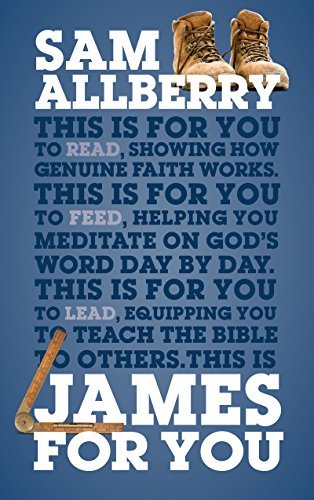
The New Testament epistle of James has been a controversial book over the years. Some have felt that his emphasis on showing faith by works contradicts Paul’s writings that salvation is by faith, not works. But Sam Allberry shows in James for You: Showing You How Real Faith Looks in Real Life that the two writers are really saying the same thing. They are just looking at faith and works from different angles.
One of the main things I appreciated in Allberry’s books is that he showed how the book flows together. We tend to–or at least, I have tended to–read the paragraphs as isolated topics. For instance, James 2-3 talks abut the sin of showing partiality, then faith without works, then taming the tongue, then wisdom from above, then worldliness. But each paragraph leads into the next.
Allberry describes James’ style as “practical, pithy, and very direct.” James was the half-brother of Jesus, and his book is “soaked in the words and wisdom of James’ older brother. He may not be named much in this letter, but his presence is felt throughout.” Like Jesus, James uses simple, everyday illustrations.
Some of the themes James deals with, in addition to faith and works, are wisdom, obedience, dealing with trials, needs of the poor, responsibility of the wealthy, the danger of double-mindedness, the dangers of the tongue.
A few quotes that stood out to me:
Faith needs the pushback of trials for us to grow spiritually. Trials and difficulties are an opportunity to cling on to the promises of God more tightly.
It is what God can accomplish through suffering that is good, not the suffering itself. It is an opportunity to gain the most valuable thing on earth: a faith that is complete and lacking nothing; maturity and depth in our relationship with God.
Good behaviour in one area does not cancel out law-breaking in another.
And so the battle is with the will. James is not saying that Christians will automatically be able to experience joy in suffering. We are called to “consider” trials in this way. We need to fight to think about them in the right way: consciously to force our perspective and vision above and beyond the present suffering, so that we look forward to the good that God will, over time, produce through them.
I have not read anything else by Sam Allberry–I had not even heard of him before. But I appreciate the insights he brought to the study of James.
 Stray Thoughts